Respect all members: no insults, harassment, or hate speech.
Be tolerant of different viewpoints, cultures, and beliefs. If you do not agree with others, just create separate note, article or collection.
Clearly distinguish between personal opinion and fact.
Verify facts before posting, especially when writing about history, science, or statistics.
Promotional content must be published on the “Related Services and Products” page—no more than one paragraph per service. You can also create subpages under the “Related Services and Products” page and publish longer promotional text there.
Do not post materials that infringe on copyright without permission.
Always credit sources when sharing information, quotes, or media.
Be respectful of the work of others when making changes.
Discuss major edits instead of removing others' contributions without reason.
If you notice rule-breaking, notify community about it in talks.
Do not share personal data of others without their consent.
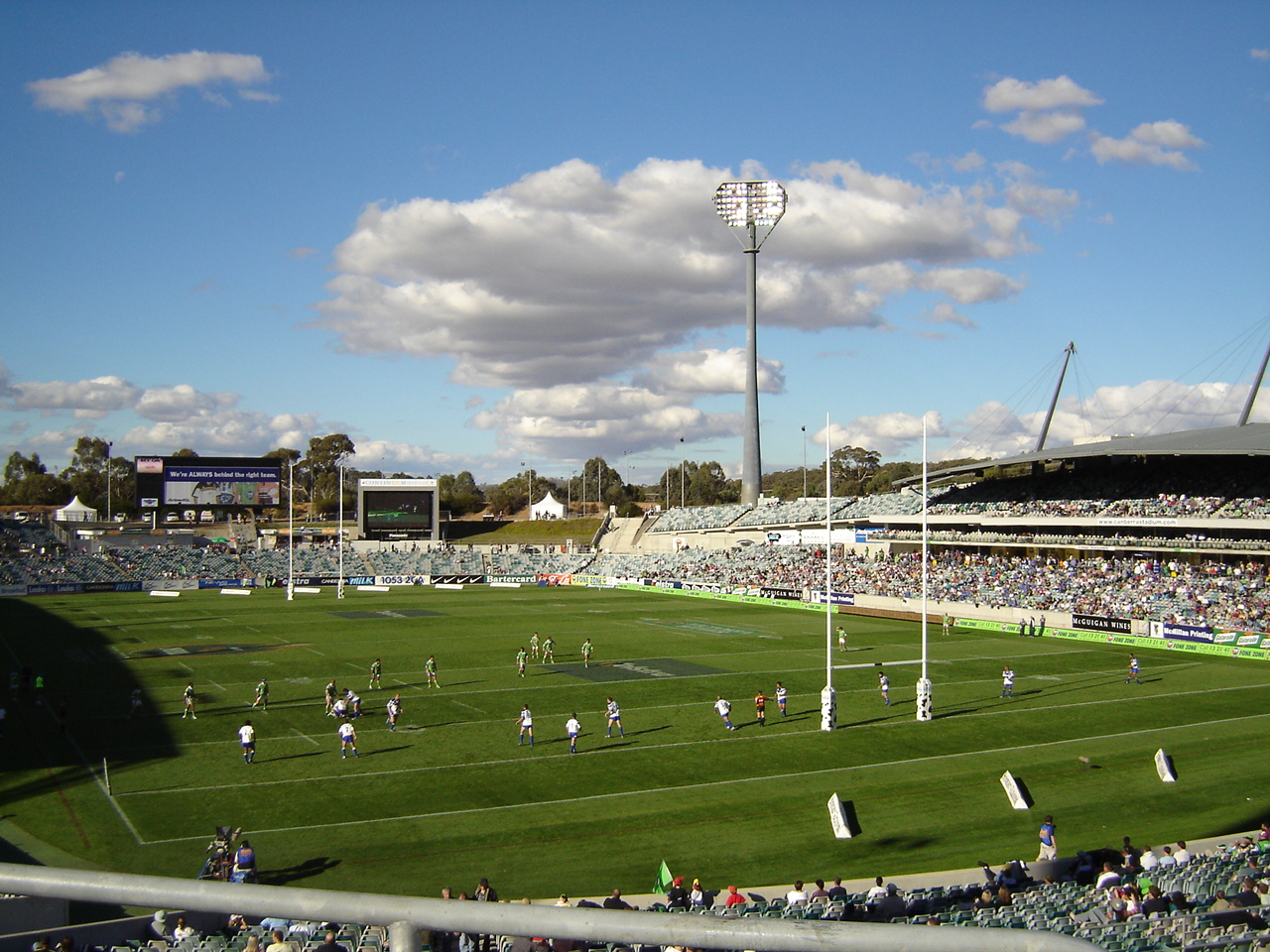
Canberra Stadium, commercially known as GIO Stadium Canberra, is a facility primarily used for rugby league and rugby union games, located adjacent to the Australian Institute of Sport in Canberra, the capital of Australia. It is the largest sports venue by capacity in Canberra. The Canberra Stadium was previously known as the Bruce Stadium and the National Athletics Stadium before its current name.
The removal of the athletics track meant that Australian rules football games, more specifically those of the Australian Football League (AFL), could be played at the ground, resulting in pre-season matches being scheduled as early as 1990.[5] In 1995, an AFL match for premiership points was contested between the West Coast Eagles and Fitzroy. There were also a number of pre-season AFL games played at the venue, mostly featuring the Sydney Swans.
Also around that time, a cricket pitch was placed in the centre of the ground as an experiment, and a day/night one-day cricket match was played between two local teams before a small crowd. Regular cricket matches on the ground did not eventuate.
Further renovations occurred in 1997, in preparation for staging soccer matches as part of the 2000 Summer Olympics in Sydney,[6] which shrank the size of the playing field, preventing any future Australian rules football games being played there. The final cost of the renovations was more than seven times what had been originally anticipated by the Territory government of the time, and the subsequent controversy ended the career of then Chief Minister Kate Carnell.[7][8][circular reference] During the lead-up, unseasonal snow fell on 28 May 2000, during a match between the Raiders and the Wests Tigers, the only such occasion in National Rugby League history, with the snow causing frost damage to the turf intended for the Olympic soccer tournament.
Olympic soccer in 2000 initiated a stadium facelift, converting the playing surface from oval to rectangular and bringing the crowd closer to the action.[9] It is now an all-seater rectangular stadium with two main grandstands on either side of the playing field. The major outcome of that revamp was that the stadium could no longer host AFL games. All top-class cricket and Australian rules football games in Canberra are now staged at the 15,000-capacity Manuka Oval.
In 2009, there was an A-League bid from Canberra that, if successful would have seen an A-League soccer team play at the stadium starting with the 2010–11 season. However, the League decided that the new teams would be Sydney Rovers FC (which dissolved due to financial problems) and Melbourne Heart FC.
To coincide with Canberra's 100th birthday celebrations, the stadium was chosen to host the 2013 Rugby League Anzac Test between Australia and New Zealand. On 19 April 2013 in what was the first game ever played by the Kangaroos in Australia's capital city, a crowd of 25,628 saw Australia defeat their Trans-Tasman rivals 32–12.
In January 2014, Canberra Stadium was rebranded GIO Stadium Canberra as part of a naming rights deal with GIO Insurance.[10]
A new video screen was installed at the southern end of the stadium in March 2020.[11]
Capacity is a nominal all-seated 25,011, the largest crowd being 28,753 for the 2004 Super 12 Final. The main grandstand is named after Canberra Raiders and Australian rugby league player Mal Meninga, and a statue of another Raiders and Australian league representative Laurie Daley adorns the main grandstand entrance.
Unveiling of the Gregan-Larkham stand at Canberra Stadium on 28 April 2007.
The eastern grandstand was named the Gregan/Larkham Grandstand on 28 April 2007, after Brumbies and Australia rugby union greats George Gregan and Stephen Larkham. Both ended their international careers after the 2007 Rugby World Cup as the two most-capped players in Wallabies history (at that time), with Gregan at a world-record 139 and Larkham at 102.
Whilst the stadium suits the needs of its two current primary tenants, as of 2017 it is the smallest Super Rugby stadium and only a medium-sized NRL venue. The stadium itself is approaching 35 years old, and despite modernisations over the years is lacking in certain amenities for fans – especially covered seating.
Additionally, Australia had bid for the 2022 FIFA World Cup and Canberra Stadium does not meet the necessary criteria to host matches. As such, the ACT Government launched a study examining the upgrade or replacement of Canberra Stadium, with options ranging from increasing capacity and enclosing the current facility, to completely re-configuring the current stadium to an oval for cricket and Australian rules football and building a state of the art rectangular facility next door.[12]
Citing costs of building multiple facilities as an issue, ACT Sports Minister Andrew Barr indicated his preference would be a 'super stadium' built with World Cup standard facilities and capacity, able to be reduced to approximately 30,000 seats after the event. Such a facility would have to incorporate movable seating in order to accommodate all of the major Australian sporting codes.[13]
The official bid for the 2022 World Cup indicated that the 'super stadium' plan was unlikely and the original plan of a new rectangular stadium built next door to the current stadium, with the existing facility re-configured for oval field sports, was considered to be the likely outcome.[14]
After the failed World Cup bid a new rectangular covered stadium was proposed for Canberra.[15] In 2013 the ACT government announced plans to build a 30,000 covered (with a roof similar to Forsyth Barr Stadium) rectangular stadium in the city on the shores of Lake Burley Griffin. It would be part of a 15-year significant redevelopment of the foreshore which extends the city to the Eastern Basin. Along with the stadium, as part of the redevelopment there would be apartments, a convention centre and an urban beach.[16] Plans to build a new stadium have, however, been put on hold indefinitely due to the need for funds to compensate local residents over an asbestos home insulation debacle.[17] Plans to construct the new stadium have since been pushed back by a decade.[17]
The previous logo of Canberra Stadium, prior to the naming rights deal with GIO Insurance.City vs Country rugby league match, 1981. City defeated Country 38–7 in front of 17,490 fans.
In 1995, the AFL's ailing Fitzroy Football Club played one home game against the West Coast Eagles at the venue. West Coast defeated Fitzroy 12.10 (82) to 8.6 (54) in front of 11,282 on 27 May.
On 19 April 2013 the Stadium hosted the 2013 Anzac Test, the first time the Kangaroos had played a test in Canberra. Canberra Stadium was awarded the test as part of Canberra's centenary celebrations.
^"AFL comes to Bruce Stadium". The Canberra Times. Vol. 64, no. 20, 023. Australian Capital Territory, Australia. 6 February 1990. p. 24. Retrieved 14 September 2022 – via National Library of Australia.
Canberra Stadium, commercially known as GIO Stadium Canberra, is a multi-purpose rectangular sports venue located in the Bruce suburb of Canberra, Australian Capital Territory, Australia, with a seating capacity of 25,011.[1][2] It primarily hosts rugby league and rugby union matches as the home ground for the National Rugby League's Canberra Raiders and Super Rugby's ACT Brumbies.[3][4]Originally constructed as Bruce Stadium for the 1977 Pacific Conference Games with an initial capacity of 8,000 seats in a single western grandstand, the facility underwent significant expansions, including an increase to 11,500 seats ahead of the 1985 World Cup Athletics event.[5] Further redevelopments in the early 2000s involved sinking the stands into the ground to improve sightlines and atmosphere, though these works exceeded budget estimates by a factor of seven, sparking public debate over costs.[6] The stadium has hosted notable international fixtures, such as Rugby League World Cup games and matches involving national teams from countries including Australia, Fiji, Samoa, and Tonga.[1]Despite its role in regional sports, Canberra Stadium faces criticism for aging infrastructure, including issues like concrete degradation, sewage leaks, and inadequate facilities, rendering it increasingly unfit for modern professional standards and prompting calls for replacement.[7] Ongoing disputes between the ACT government and federal authorities over funding have stalled upgrades, with the Canberra Raiders exploring relocation of home games to other venues due to these deficiencies as of 2025.[8][9] These challenges highlight causal factors such as deferred maintenance and jurisdictional funding conflicts, rather than isolated management failures, in the venue's decline from its mid-20th-century peak utility.[10]
Historical Development
Origins and Initial Construction
The origins of Canberra Stadium trace to Canberra's successful bid, announced in February 1974, to host the 1977 Pacific Conference Games, prompting the federal government to develop a dedicated athletics venue on federally owned land in the Bruce suburb.[11] The site's selection aligned with the National Capital Development Commission's 1974 plan, prioritizing a central location west of Black Mountain with access to future transit routes and freeway connections, facilitating integration into an emerging sports precinct.[11]Construction of the facility, initially named Bruce Stadium or National Athletics Stadium, commenced shortly thereafter and was completed in 18 months at a cost of $6.5 million, fully funded by the Commonwealth government as part of investments in national amateur sports infrastructure.[11] This emphasis on athletics reflected priorities for track-and-field development over professional team sports at the time, with the design featuring an open layout integrated into the local topography to optimize viewing for field events while shielding spectators from prevailing winds.[12]The stadium opened in December 1977 specifically for the Pacific Conference Games, with an initial permanent seating capacity of 8,000 in the western grandstand, augmented by 4,000 terraced seats and grass banking for up to 10,000 more, yielding a total ground capacity approaching 20,000 tailored to athletics requirements including a surrounding track.[11][5][1]
Conversion and Olympic Preparations
In 1997, Bruce Stadium (now Canberra Stadium) initiated a comprehensive redevelopment to host preliminary rounds of the football tournament for the 2000 Sydney Olympics, shifting the venue from its original oval athletics configuration to a rectangular layout optimized for soccer and rugby.[5] This transformation, driven by the Australian Capital Territory's allocation of Olympic matches and the need for infrastructure compatible with rectangular-field sports, addressed prior limitations in sightlines and field access imposed by the surrounding running track.[12] The project, managed by COX Architecture from 1997 to 1998, prioritized practical adaptations such as lowering the playing surface by up to 5 meters to improve proximity to spectators, removing the athletics track, and reinforcing structural elements to support the new field geometry without full demolition.[1][12]Key engineering modifications included the installation of a hybrid turf surface suitable for high-intensity international play, upgraded floodlighting for broadcast standards, and expanded corporate and media facilities to meet Olympic operational requirements.[1] These changes increased the stadium's permanent capacity to 25,000 seats through new inner-bowl seating and grandstand extensions, with temporary additions enabling higher attendances during the Games.[12][1] The rectangular field measured 100 meters in length by 70 meters in width, aligning with rugby union specifications while accommodating soccer's FIFA guidelines via adjustable markings, thus ensuring versatility for post-Olympic domestic use by teams like the ACT Brumbies and Canberra Raiders.[1]During the 2000 Olympics, the redeveloped stadium hosted multiple group-stage football matches, validating its international readiness despite challenges like turf wear from rapid preparation timelines. Notable fixtures included the men's tournament game between the United States and Czech Republic on September 13, which drew 24,000 spectators and ended in a 2–2 draw, alongside other contests such as Brazil versus South Africa on September 17.[13] These events underscored the venue's temporary viability for global competition, though post-Games audits highlighted cost overruns exceeding $50 million AUD due to accelerated construction and financing decisions, prioritizing short-term Olympic utility over long-term fiscal optimization.[14][15]
Subsequent Upgrades and Expansions
Following the preparations for the 2000 Olympics, incremental expansions addressed demands from local rugby teams, including the addition of corporate boxes and enhancements to existing grandstands, culminating in a seated capacity of 25,011 by 2011.[1] These improvements were supported through ACT Government leasing arrangements that allocated funds for venue maintenance and upgrades tied to tenancy agreements with the Canberra Raiders and ACT Brumbies.[16]In 2007, the eastern grandstand was officially named the Gregan-Larkham Stand, honoring rugby legends George Gregan and Stephen Larkham, with its unveiling marking a key enhancement to spectator facilities on that side of the venue.[17] This naming and associated works contributed to better sightlines and amenities without major structural overhauls, reflecting pragmatic responses to growing attendance at Super Rugby and NRL matches.The stadium's naming rights evolved commercially, shifting from Bruce Stadium to Canberra Stadium in the early 2000s before securing a sponsorship deal with GIO Insurance in 2013, rebranding it GIO Stadium Canberra effective January 2014.[18] The agreement, valued at approximately $300,000 to $350,000 annually for four years initially, underscored efforts to offset public operational costs through private partnerships, later extended through 2026.[19] Accompanying the GIO deal, a new video screen was installed to improve fan experience during events.[5]
Ownership and Operations
Federal Ownership Structure
Canberra Stadium is owned by the Australian Sports Commission (ASC), a statutory authority of the Australian federal government responsible for national sporting infrastructure.[20][21] The venue, originally constructed as Bruce Stadium in 1977 on federally designated crown land within the Australian Institute of Sport precinct, has remained under federal ownership to support national sports development objectives.[5] This structure stems from the territory's status as a federal enclave, where land use is zoned for Commonwealth purposes, limiting unilateral territorial alterations.[22]Since 2001, the ASC has leased the stadium to the ACT Government on a long-term basis for day-to-day operations and event hosting, with the most recent lease expiring at the end of 2024 amid ongoing renegotiations.[23][24] Under this arrangement, the federal government retains oversight on significant modifications, requiring ASC approval for major upgrades or redevelopments, as demonstrated by a 2023 memorandum of understanding between the ASC and ACT authorities to jointly assess options for stadium replacement within the precinct.[25] This bifurcated governance has contributed to operational frictions, including stalled upgrade proposals due to disagreements over cost-sharing and site control.[10]Federal ownership ensures baseline infrastructure stability through ASC-managed capital investments, but routine maintenance falls to the lessee, with event revenues primarily accruing to the ACT while exposing federal taxpayers to unrecouped holding costs absent proportional private-sector capitalization.[20] Annual federal budget allocations for ASC facilities, including Canberra Stadium, have prioritized targeted enhancements—such as planning funds for precinct masterplanning—over comprehensive privatization, perpetuating a model of public subsidization amid debates over efficiency.[26] This dynamic underscores causal tensions between national oversight and local operational demands, often delaying adaptations to contemporary standards without full revenue alignment to federal outlays.[27]
ACT Government Leasing and Management
The Australian Capital Territory (ACT) Government holds a rental lease on Canberra Stadium (commercially known as GIO Stadium) from the federal government's Australian Sports Commission, enabling territorial control over daily operations, event bookings, and minor upgrades while restricting major capital expenditures without federal involvement.[20][28] The annual lease payment stood at $350,000 as of a 2017 agreement following the expiration of prior long-term terms, with the arrangement set to conclude in 2024 amid ongoing negotiations for extension or transfer of ownership.[20][29] This structure allows the ACT to derive revenue from high-profile tenants, such as leasing the venue for Canberra Raiders (NRL) and ACT Brumbies (Super Rugby) home matches, which generate income through ticketing, hospitality, and ancillary services to offset operational costs.[30]Day-to-day management falls under Venues Canberra, an operational arm of the ACT Government's Chief Minister, Treasury and Economic Development Directorate, which oversees ticketing, corporate hospitality packages, food and beverage services, and event logistics at the stadium.[31][32] Venues Canberra coordinates with lessees for match-day preparations, including security and amenities, achieving average attendances of around 13,000–14,000 for Raiders games in a 25,000-seat capacity venue, with higher utilization during premium events like playoffs or internationals approaching 80–100% occupancy.[30][33]Critics, including sports administrators and opposition figures, have highlighted bureaucratic inefficiencies in this leasing model, arguing that the division of ownership between federal and territorial entities creates layered approvals that delay responses to infrastructure wear, such as weathering from exposure to Canberra's variable climate and high-traffic usage.[34][35] Lease terms incentivize only incremental fixes—evidenced by repeated minor tech upgrades like LED displays in 2024—while deferring comprehensive refurbishments, empirically correlating with the venue's characterization as outdated and unfit for modern standards without full ownership transfer.[36][37] This has fueled protracted debates on replacement, with ACT officials seeking federal co-funding amid rising construction costs, underscoring causal links between short-term leasing and maintenance stagnation.[38][39]
Venue Design and Capacity
Seating Configuration and Amenities
Canberra Stadium operates with a nominal all-seated capacity of 25,011, featuring a continuous oval bowl of tiered seating that encircles the playing field, including prominent east and west grandstands.[40] The configuration employs fixed individual plastic seats retrofitted over the original concrete structure, with rows designated from A (field-level in the inner bowl) outward in numbered sequence, and seat numbering progressing clockwise within each bay.[41][42] For rugby matches, select areas incorporate standing rails or designated standing zones to enhance viewing flexibility, though the primary setup remains reserved seating.[43] The venue provides no overhead cover, exposing all patrons to prevailing weather conditions, including wind and precipitation, which empirical attendee reports describe as creating a wind-tunnel effect during inclement events.[8]Amenities include corporate hospitality options such as private suites accommodating up to 12 guests each, equipped with dedicated service, premium sightlines, and private restrooms in select locations like the east suites.[44][45] Food and beverage outlets are distributed across concourses, alongside standard facilities like restrooms and medical stations compliant with event safety protocols.[46]Accessibility features encompass 157 wheelchair positions—equating to 0.62% of total capacity—plus companion seating, wheelchair-accessible parking, entrances, and toilets, with detailed evacuation and access plans available for patrons.[47][48]The stadium's compact design yields generally effective sightlines from most positions, facilitating clear views of the field, though lower-tier seats in sideline areas can present restricted perspectives for non-end-zone oriented play, as reflected in user reviews prioritizing direct observation over obstructed angles.[49][50] These elements underscore a functional but dated layout, where user experience hinges on event-specific configurations and external factors like weather exposure rather than advanced enclosure or tier optimization.[51]
Historical Attendance Records
The highest attendance at Canberra Stadium was 28,753, recorded during the Super 12 rugby union final on 22 May 2004, when the ACT Brumbies defeated the Canterbury Crusaders 47–38, exceeding the stadium's nominal seated capacity through temporary standing arrangements in designated areas.[33][52] This figure remains the venue's all-time peak, driven by the championship stakes and the Brumbies' strong local support base at the time, illustrating demand tied to decisive, high-profile domestic competitions rather than routine fixtures.In rugby league, the Canberra Raiders' home record stands at 26,567 for their NRL semi-final victory over the South Sydney Rabbitohs on 27 September 2019, again surpassing standard seating limits via safe standing provisions that allowed denser crowds without compromising safety protocols.[53][54] Earlier league highs include 26,476 for the Raiders' NRL elimination final against the Wests Tigers on 17 September 2010 and 25,628 for the international Test between Australia and New Zealand on 19 April 2013, both reflecting spikes from playoff intensity and national team appeal.[33]Rugby union regular-season attendances for the Brumbies have varied markedly, with derbies and marquee matches like the 27,040 crowd for the New South Wales Waratahs' win on 16 April 2005 exceeding 20,000, while major-event lows dipped to 5,283 against the Melbourne Rebels on 12 May 2018—the second-worst home turnout in club history.[33][55] These fluctuations correlate causally with factors such as opponent draw (e.g., interstate rivals boosting turnout), weather (colder Canberra evenings deterring casual attendees), and match timing, underscoring genuine variability in fan interest without indications of government or venue subsidies artificially inflating figures to meet projections.[56]
The Canberra Raiders have utilized Canberra Stadium (now GIO Stadium) as their primary home venue since relocating from Seiffert Oval in Queanbeyan in 1990, hosting the majority of their National Rugby League (NRL) home matches there.[57] This shift aligned with the club's growing presence in the national capital, where the stadium's facilities supported key milestones, including celebrations following the 1994 NRL Grand Final qualification after a preliminary victory.[54] The venue has hosted over 300 Raiders games as of 2022, contributing to home-ground advantages evident in dominant wins such as the 68–0 defeat of Parramatta in 1993 and the 66–4 thrashing of Eastern Suburbs in 1990. [54]Annually, the Raiders schedule 10–12 home games at the stadium, with historical average attendances ranging from 11,569 in the 2017–18 season to peaks near 18,700 in 2025, drawing crowds that sustain club operations in a small-market environment compared to Sydney-based teams.[58][59] These figures underscore economic viability through local revenue but highlight challenges, as lower turnouts relative to larger venues limit sponsorship and broadcasting leverage, prompting the club to relocate select games to New Zealand and Queensland for better facilities and returns.[60][7]While compliant with NRL standards, the stadium's infrastructure has drawn criticism for outdated elements impeding recruitment and performance, with CEO Don Furner stating in 2025 that it is "not fit for purpose anymore" due to issues like sewage leaks and dated amenities, forcing game relocations.[7] Coach Ricky Stuart echoed this in 2017, advocating upgrades to player facilities to enhance competitiveness, a view supported by NRL officials labeling the venue "below par."[61][62] Such constraints correlate with recruitment difficulties, as modern players compare it unfavorably to upgraded interstate facilities, though the club's three premierships demonstrate resilience tied to home support.[63]
Rugby Union: ACT Brumbies
The ACT Brumbies, a professional rugby union team in Super Rugby, have utilized Canberra Stadium as their primary home ground since the franchise's establishment in 1996.[64] The venue, adapted from its original athletics configuration through renovations to support rectangular-field sports, accommodates key rugby elements including scrums and lineouts within its 25,011-seat capacity.[1]Notable successes tied to the stadium include hosting the 2001 Super Rugby final, where the Brumbies defeated the Sharks 36-6 before 26,271 spectators, securing their first championship.[64] In 2004, they claimed a second title with a 47-38 victory over the Crusaders, drawing a record crowd of 28,753—the highest attendance for any event at the stadium.[65][33]Despite these peaks, the Brumbies have encountered attendance declines in the post-professionalization era, with average crowds falling from early highs and isolated games attracting as few as 5,283 fans amid broader challenges in Australian rugby popularity.[55][56] The open grass pitch, vulnerable to weather, has posed maintenance issues for consistent play, though specific Brumbies match cancellations due to conditions remain limited. Economically, each home game historically generated around $533,000 in local business expenditure as of 2013 assessments, underscoring the venue's role in sustaining regional activity despite fluctuating support.[66]
Other Sporting Events
The stadium has hosted association football (soccer) matches sporadically, including as the home venue for Canberra Cosmos FC in the National Soccer League from 1995 to 2000.[67] The club competed without reaching finals series contention and disbanded in 2001 following the NSL's dissolution.[67] It has also accommodated select A-League Men and A-League Women fixtures, often pre-season or neutral-site games for visiting clubs.[68]Prior to its 1997 redevelopment from oval to rectangular configuration, Canberra Stadium operated as the National Athletics Stadium and hosted international track and field competitions, notably the 1985 IAAF World Cup in Athletics.[5] The removal of the perimeter running track during upgrades eliminated ongoing suitability for athletics meets.[5] These pre-conversion events drew dedicated crowds but ceased as the venue shifted focus to rectangular-field sports.[6]Such secondary usages remain infrequent, with domestic soccer engagements yielding lower attendances than primary rugby code fixtures and highlighting the stadium's specialized infrastructure for oval-based rugby rather than broad diversification.[68]
Non-Sporting and Special Events
Concerts and Entertainment Productions
Canberra Stadium, commercially known as GIO Stadium Canberra, has hosted a limited number of major concerts, primarily leveraging its open-air configuration for large-scale rock and pop performances while prioritizing sports scheduling.[5] Notable events include the co-headlining show by Matchbox Twenty and Goo Goo Dolls on February 23, 2024, which drew attendees for a setlist featuring hits from both acts.[69][70] Earlier concerts, such as Keith Urban's performance, have also utilized the venue's capacity exceeding 25,000 seats, though stage installations typically restrict full utilization of the field and seating bowl.[71][40]Logistical adaptations for concerts involve temporary staging on the turf surface, which can necessitate post-event repairs to maintain playability for rugby codes, with hirers often bearing replacement costs under standard venue agreements.[72] Such events generate revenue through ticket sales and ancillary spending, but their frequency remains constrained by the stadium's primary sporting role and potential field wear.[73] Future bookings, like Ricky Martin's scheduled appearance on November 8, 2025, indicate ongoing interest in non-sporting entertainment.[74]
International Matches and Tournaments
Canberra Stadium hosted several matches during the 2000 Summer Olympics football tournaments, marking its debut as a venue for major international competition and prompting upgrades to the facility, including a switch to a rectangular pitch. On 13 September 2000, the women's tournament opened with Australia defeating Germany 3-0 in the Matildas' opener, followed by a men's Group C match where the United States drew 2-2 with the Czech Republic before a crowd of 24,000. Additional men's pool-stage games included USA vs Cameroon and others across five fixtures from 13 to 24 September, with semifinals also allocated to the venue, though primarily group play elevated its profile. These events drew over 17,000 spectators on average per match, showcasing the stadium's capacity to handle Olympic-scale logistics like security and broadcasting.[75][76][77]The stadium has hosted numerous rugby union Test matches for the Wallabies, primarily against tier-two nations and South American opponents in the 1990s and 2000s, often attracting crowds exceeding 20,000 and providing prestige through national team exposure. Key fixtures include a 74-0 World Cup qualifying win over Tonga on 22 September 1998; a 32-25 victory against Argentina on 24 June 2000; a 31-8 defeat of Italy on 13 June 2009, highlighted by James O'Connor's hat-trick; a 49-3 rout of Fiji on 5 June 2010; and a 45-20 triumph over Argentina on 16 September 2017 during The Rugby Championship. These Tests demonstrated the venue's suitability for international demands, including pitch standards and temporary seating expansions, though post-2017 rugby internationals have been limited, with a planned 2021 Wallabies-Argentina match relocated due to external factors.[78][79][80]Soccer internationals have persisted more recently, underscoring the stadium's versatility for global fixtures despite sparser rugby scheduling. In June 2025, the Matildas faced Argentina in a women's international, while on 5 September2025, the Socceroos hosted New Zealand for the Soccer Ashes first leg, fulfilling broadcast and security protocols effectively. Such events generate short-term tourism influxes tied to match weeks, enhancing local visibility without evidence of long-term economic multipliers beyond immediate hospitality gains. Hosting these underscores operational reliability for prestige bouts, though frequency has declined compared to domestic utilization.[81][82]
In 2009, the ACT Government announced plans for a comprehensive $350 million redevelopment of Canberra's major sporting venues, including significant upgrades to Canberra Stadium at Bruce to enhance its capacity and functionality for rugby league and union matches. These proposals encompassed adding extra seating to increase the stadium's capacity toward 25,000, installing a new roof over the west, south, and east stands to improve weather protection, and lowering the playing surface for better sightlines, with the rationale centered on attracting more international events and boosting local economic activity through improved facilities.[83][84] Concurrently, then-Treasurer Andrew Barr floated the concept of a new stadium in Civic as an alternative or complementary site, aiming to centralize major events and leverage urban accessibility, though this was positioned as a long-term vision tied to broader infrastructure priorities.[85]Throughout the 2010s, discussions evolved into federal-ACT collaborative talks for upgrading the existing Bruce site, with proposals emphasizing a phased expansion to around 30,000 seats to accommodate projected growth in National Rugby League (NRL) and Super Rugby attendance, predicated on optimistic forecasts of rising fan bases and event hosting opportunities. However, cost estimates quickly escalated beyond $500 million due to engineering complexities, site constraints, and requirements for multi-use adaptability, leading to repeated deferrals and shelving of firm commitments as fiscal scrutiny revealed mismatches between projected benefits and funding availability from both governments.[86][16]Empirical attendance data from the period underscored limitations in these rationales, with average crowds for Canberra Raiders NRL games hovering around 15,000 and peak figures rarely exceeding 17,000 despite the stadium's 25,000 capacity, indicating that studies advocating a 30,000-seat expansion overestimated demand growth unsubstantiated by actual trends in a market constrained by Canberra's population of approximately 450,000.[87][88] By 2023, amid intensified fiscal reviews exposing early over-optimism on revenue streams and sponsorships, the ACT Government scrapped the accumulated new-build plans, reverting to incremental maintenance rather than major capital outlay.[89]
Location and Design Controversies
The debate over the location of a potential replacement for Canberra Stadium has centered on retaining the existing Bruce site versus relocating to central areas such as Civic or the Acton Waterfront, with proponents of Bruce emphasizing its advantages in land availability and development costs while critics highlight transport limitations. The Bruce precinct, located in Canberra's northern suburbs, provides ample space for expansion within an established sports hub, avoiding the high expenses associated with acquiring premium city land, though its peripheral position has been faulted for exacerbating traffic congestion and reliance on car travel during events.[37] In contrast, city-center proposals, including the ACT Liberals' 2024 pledge for a 30,000-seat stadium at Acton Waterfront, argue for enhanced urban integration, pedestrian access to amenities, and economic revitalization of underutilized lakefront areas, but these have faced scrutiny for likely cost escalations exceeding $1 billion due to site preparation and infrastructure demands.[90][91]Design elements, particularly the inclusion of a roof, have sparked further contention, with advocates citing benefits for year-round usability amid Canberra's variable weather, potentially boosting event frequency and revenue through protection from rain and wind. However, ACT Sports Minister Yvette Berry stated in March 2024 that adding a roof would increase construction costs by hundreds of millions of dollars, representing a substantial fiscal premium—estimated in some analyses as 20-30% of total project expenses—without guaranteed returns sufficient to offset the burden on public budgets. Engineering and feasibility assessments have underscored these trade-offs, favoring partial renovations at Bruce over fully enclosed greenfield designs elsewhere to prioritize cost efficiency and minimize disruptions, though political endorsements for roofed city venues persist despite evidence of overruns in comparable Australian projects.[92][87]Public and expert input has leaned toward pragmatic upgrades at the current site, with surveys revealing widespread preference for Bruce retention to avoid the uncertainties of urban relocation, including heritage and environmental constraints at Acton. Analyses from government reviews have reinforced this by highlighting how suburban sites like Bruce enable scalable designs without the premium pricing of central parcels, though transport enhancements—such as improved bus links—remain essential to address accessibility critiques. Relocation advocates counter that central venues could foster broader precinct activation, yet independent costings have consistently projected overruns for city options, informing calls for evidence-based decisions over speculative urban visions.[91][93]
Fiscal and Political Challenges
Cost estimates for redeveloping or replacing Canberra Stadium have escalated markedly, rising from approximately $1 billion in early 2020s discussions to between $2.1 billion and $2.9 billion by August 2024 for a full new build in the city centre, with refurbishment of the existing site pegged at $1.163 billion to $1.194 billion including ancillary infrastructure like parking.[86] These figures underscore taxpayer exposure in a jurisdiction reliant on public funding for major infrastructure, where economic return-on-investment projections for sports venues have historically overstated benefits relative to maintenance costs and opportunity costs for alternative public spending.[86]Political proposals have been shaped by electoral cycles, with ACT Labor integrating stadium ambitions into the Bruce precinct's mixed-use renewal, including a push for Commonwealth co-funding beyond an initial $10 million planning commitment, yet without secured capital allocations or firm timelines as of mid-2024.[94] In opposition, the Canberra Liberals pledged a 30,000-seat venue at the Acton Waterfront in September 2024 ahead of territory elections, framing it as a central city asset but drawing scrutiny for advancing site-specific plans absent detailed fiscal modeling or federal buy-in.[90][93] Both approaches reflect partisan maneuvering, prioritizing precinct visions or urban prestige over resolved funding pacts, amid ACT's constrained budget where deficits exceed $1 billion annually.[95]Federal involvement remains a persistent hurdle, with Canberra's ACT government in ongoing deadlock over cost-sharing since at least 2022, as national budgets have withheld major allocations citing broader infrastructure demands and no dedicated line item for the project in 2023-2024 federal outlays.[10][34]Club executives, including Canberra Raiders CEO Don Furner, have warned of viability strains from prolonged delays, invoking potential home-game disruptions or leverage against government inaction as far back as 2018.[96] However, comparative data from the NRL indicates teams maintain competitive performance and attendance in aging facilities—such as Wests Tigers at Leichhardt Oval or regional venues for North Queensland Cowboys—without systemic relocation or collapse, suggesting upgrades enhance but do not determine franchise sustainability.[97][98]
Status as of 2025
As of October 2025, plans for replacing Canberra Stadium remain indefinitely delayed, with the ACT government prioritizing enhancements to the existing Bruce sporting precinct over a standalone new build due to insufficient economic justification for the latter amid escalating costs. The 2025-26 ACT budget allocates only $250,000 for minor upgrades to accessibility features and hospitality areas at the venue, reflecting a strategy of incremental maintenance rather than comprehensive redevelopment.[99][100]The stadium continues to serve as the primary home ground for the Canberra Raiders (National Rugby League) and ACT Brumbies (Super Rugby Pacific), though structural deterioration has prompted interim fixes such as turf resurfacing and facility patches to sustain usability. Raiders CEO Don Furner stated in February 2025 that the venue is "not fit for purpose," leading the club to relocate multiple home games to venues in New Zealand and Queensland for the 2025 season to accommodate modern broadcasting and fan experience standards.[7][101]No federal funding for stadium replacement appeared in the March 2025 Australian federal budget, marking the fourth consecutive Labor government budget without allocation despite ACT lobbying for contributions toward a precinct-wide project estimated to exceed $1 billion. Inflation-driven cost pressures, with construction expenses rising over 20% since initial proposals, have further eroded viability assessments, while public funding models have sidelined explorations of private sector partnerships that could distribute risk.[102][101][95]







 Tonga
Tonga
 Samoa
Samoa Argentina

 Canada


 France def.
  Scotland 36–18
 New Zealand 32–12
 Lebanon def.
  Media related to Canberra Stadium at Wikimedia Commons

.jpg)
