Hubbry Logo
BuswaysBuswaysMain
Open search
Busways
Community hub
Busways
logo
8 pages, 0 posts
0 subscribers
Be the first to start a discussion here.
Busways
Busways
from Wikipedia

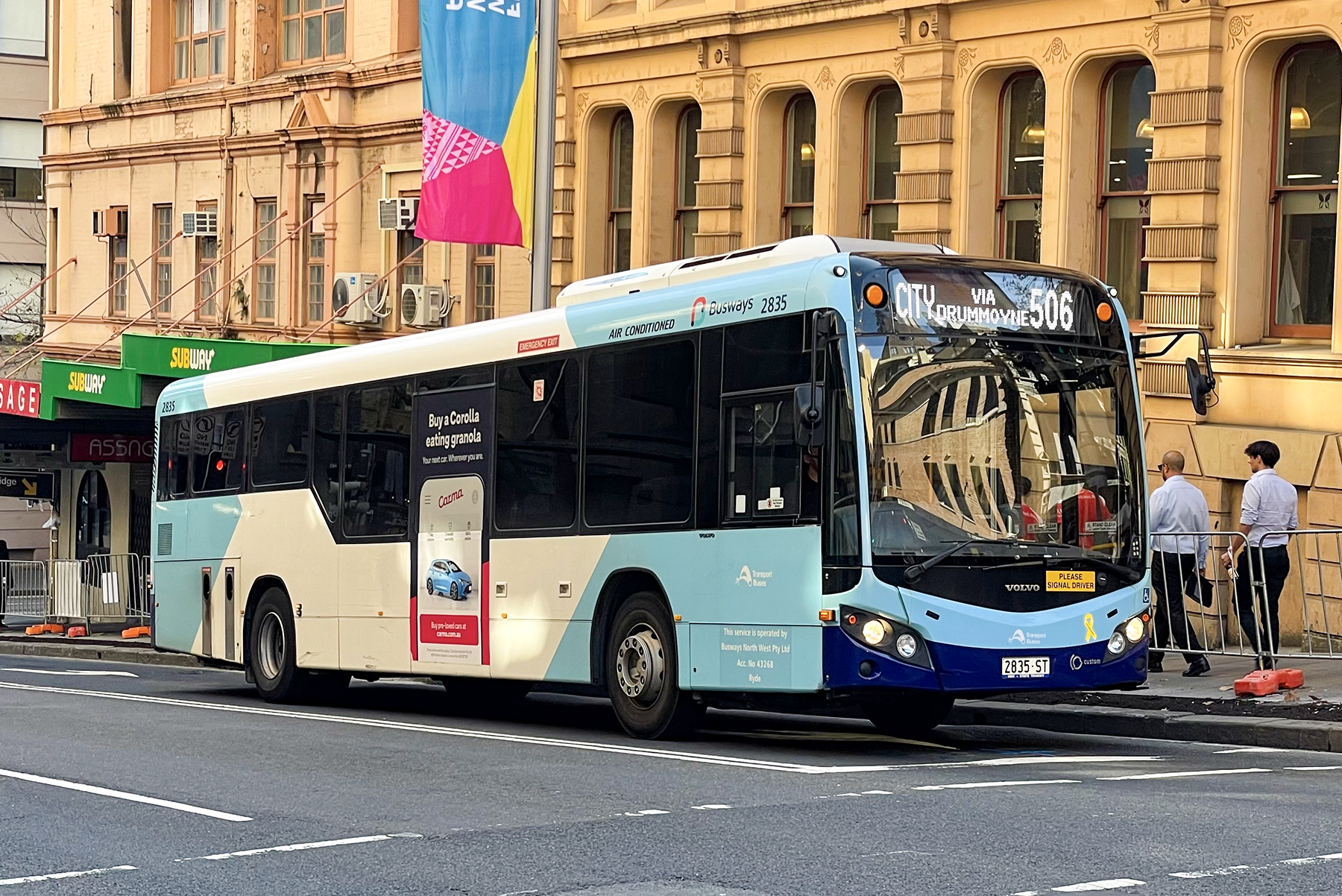
A Custom Coaches bodied Volvo B7RLE in July 2023
ParentRowe family
Commenced operation1942; 84 years ago (1942)
HeadquartersPymble
Service areaAdelaide
Sydney
Central Coast
Mid North Coast
Service typeBus services
Depots20
Fleet1335 (June 2025)
Managing DirectorByron Rowe[1]
Websitewww.busways.com.au
The Busways logo between 2008 and 2019

Busways is an Australian bus company operating services in Sydney, and in the Central Coast, Mid North Coast regions of New South Wales and Adelaide. It is the largest privately owned bus operator in Australia.[2]

History

[edit]
A Custom Coaches bodied Scania K230UB at Castle Hill in July 2013
A BusTech 'VST' bodied MAN 18-310 in old white livery

The origins of Busways can be traced to 1942 when Dick Rowe commenced a hire car service from Rooty Hill to Plumpton. In 1946 Rowe purchased his first bus and further expansion saw a depot established in Plumpton in 1958.[3][4]

In 1958, in partnership with Fred Bowman, Rowe purchased Parramatta-Villawood Bus Service followed by Campbelltown Transit on 13 May 1967 in partnership with Roger Graham and Jim Newport. In 1970, Rowe had taken full ownership of Campbelltown Transit and in January 1978 sold out of Parramatta-Villawood.[3][4][5][6]

In 1984, Riverstone Bus Service was purchased and merged with Rowe's Bus Service. In June 1986 Higlett's Motor Coach Services, Camden was purchased and rebranded Macarthur Coaches.[3][4][5][7]

In 1988, Campbelltown Transit, Macarthur Coaches and Rowe's Bus Service were all rebranded as Busways.[8] In February 1990 the Seargent's, Charmhaven business on the Central Coast was purchased[9] followed in July 1994 by the neighbouring Peninsula Bus Lines business in Kincumber, Ourimbah and Umina.[3][10]

In June 1991, the Campbelltown to Wollongong service of Farmborough Coaches was acquired.[4] In November 1992 Busways took over operation of the routes of Leslies, Arndell Park following its collapse before purchasing them in May 1993.[4][11]

In September 2003, Busways purchased the Great Lakes and Mid North Coast services of King Brothers from its administrator.[12][13] In January 2008 the school services of Yarramalong Bus Lines, Wyong were purchased[14] followed by those of Kulnura Bus Lines in July 2009.[15]

Between 2014 and 2015, Busways attempted to venture overseas by submitting a bid for the Bulim Bus Package in Singapore. It was among the 10 local and foreign bus operators who had submitted a bid for the tender. The bid was ultimately unsuccessful.[16][17]

In 2020, Busways was successful in expanding its bus operations outside of New South Wales, when it was awarded the contract to operate the Outer South bus network in Adelaide. Busways took over the operations from SouthLink in July that year.[2]

Current operations

[edit]

Western Sydney services

[edit]
Bustech CDi double decker, running route T75

Since 2005, Busways' services in the Blacktown area have formed part of Sydney Bus Region 1, held in partnership with Westbus and Hawkesbury Valley Buses. Operating from a depot in Glendenning, scheduled route and school services cover an area encompassed by Seven Hills and Castle Hill in the east; Rouse Hill and Riverstone in the north; Shalvey and St Marys in the west; Minchinbury and Prospect to the south.

The regional centres of Blacktown and Mount Druitt are a focus for all services, with trips also serving the employment centres of Eastern Creek, Huntingwood and Macquarie Park. Bus/train connections are provided at a variety of railway stations. Busways also operates services along the North-West T-way between Blacktown and Rouse Hill.

In March 2007, the Parramatta - Rouse Hill section of the North-West T-way opened. Bus routes 730 (renumbered T63) and 735 (renumbered 616, now 616X) were transferred from Busways to Hillsbus while bus route 718 was transferred from Hillsbus to Busways.[18] In November 2007, the Blacktown - Parklea of the North-West T-way opened. Existing Busways bus routes were amended and renumbered to become new T-way routes (T70, T71, T74 and T75) and ran mainly along the new section.

In October 2013, Busways after winning the tender for Sydney Bus Region 1, took over the operation of services in the St Marys, Penrith, Windsor and Richmond areas from Hawkesbury Valley Buses and Westbus.[19][20]

In May 2019, as part of the Sydney Metro opening, all Busways T-way services were renumbered from "T7x" to "73x", and the former Hawkesbury Valley Buses services (661–664) were renumbered to "67x" or "74x". Some services were also rerouted to stop at Tallawong station.[21]

Between 2022 and 2023, the contract for region 1 was put out to tender and was subsequently retained by Busways. The new contract commenced in December 2023 for a period of seven years.[22]

Sydney North Shore & West services

[edit]
An Ansair 'Orana' bodied Scania L113CRL at Huntleys Point ferry wharf in August 2024

In July 2021, Busways was announced as the new operator for Sydney Bus Region 7 in the North Shore, Northern and Western regions of Sydney. Busways commenced operating Region 7 on 9 January 2022 as part of an eight-year contract, taking over from State Transit.[23][24]

Central Coast services

[edit]

The Central Coast has services provided under the Outer Metropolitan Bus System Contract Region 6. This contract with the NSW Government covers a broad area that stretches from Patonga and Wagstaffe in the south through to Swansea and Morisset in the north; and Dooralong and Mangrove Mountain in the west to Terrigal and MacMasters Beach in the east.

With depots at Kincumber and Woongarrah, the key centres served by Busways routes include Gosford, Tuggerah, Wyong, Lake Haven, Erina Fair and Woy Woy. Occasional trips also serve Charlestown in the north and Spencer in the west.

Between 2021 and 2023, the contract for region 6 was put out to tender and was subsequently retained by Busways. The new contract will commence on 28 July 2024 for a period of seven years.[25]

North Coast services

[edit]

In September 2003, Busways purchased the services of King Brothers on the Mid North Coast from its administrator.[12][13] Busways provides services throughout Grafton, Kempsey, Wauchope, Laurieton, Coffs Harbour, Port Macquarie, Yamba, Bulahdelah, Heatherbrae, Macksville and Raleigh.

Adelaide Outer South services

[edit]
A Volgren bodied Scania L94UA and a Bustech bodied Scania K320UB Hybrid at Noarlunga Centre Interchange in September 2024

In July 2020, Busways took over Adelaide's Outer South network from SouthLink, including the Lonsdale and Seaford depots.

Former operations

[edit]

Macarthur services

[edit]

From 2005 Busways' services in the Macarthur Region formed Sydney Bus Region 15. Operating from depots at Campbelltown and Smeaton Grange, route and school services operated as far east as Kentlyn and Wedderburn; south to Appin and Wollongong; west to The Oaks and Warragamba; and north to Catherine Field and Raby.

Regional and district centres such as Campbelltown, Macarthur Square, Narellan and Camden were the focus of all routes. Busways operated the free Macarthur CBD shuttle which was terminated in August 2014. In June 2014 operation of the Sydney Bus Region 15 passed to Busabout.[5][26][27]

Coach services

[edit]

Rowe's Bus Service previously operated coach services with a fleet of six Dennings until the coach licences were sold to Westbus in 1986. Macarthur Coaches also operated some coaches that were sold in 1990.[28] Until October 2011 Busways operated a service from Forster to Sydney. Busways operate coach services from Newcastle to Taree under contract to NSW TrainLink.

Fleet

[edit]

Having traditionally purchased Leyland buses, in November 1978 the first of 30 Volvo B58s were delivered. Since then, Busways have purchased buses from MAN, Mercedes-Benz, Scania and Volvo. In the 1970s the Rowe fleet livery was white with a red stripe, with an orange stripe added in 1988. Since 2010, the blue and white Transport for NSW livery has been applied to the Sydney and Central Coast fleets.

As of June 2025, Busways operates 1,201 buses in NSW, including 36 electric buses,[29] and 134 buses in Adelaide. Busways operates a total of 1,335 buses across Australia.

[edit]

References

[edit]
Revisions and contributorsEdit on WikipediaRead on Wikipedia
from Grokipedia
Busways is an Australian bus operator company, founded in 1942 by Richard " as an on-demand passenger service in Plumpton, . It is the largest privately owned bus operator in and remains family-owned by the Rowe family in its third generation of leadership. Headquartered in Pymble, New South Wales, Busways employs over 2,600 people and operates more than 1,350 buses across 20 depots, serving approximately 53.7 million passengers annually as of 2023. The company provides public bus services under contract to in metropolitan , regional , and , along with school and charter services. In January 2025, Will O'Neill was appointed , marking the first non-family member in the role.

Overview

Company profile

Busways was founded in 1942 as a hire service and has since evolved into one of Australia's largest private bus operators, providing extensive solutions across multiple regions. The company currently operates from 20 depots in —covering the Sydney metropolitan area, Central Coast, and North Coast—and in 's Adelaide Outer South, supporting a broad network of urban and regional services. As of 2025, Busways manages a fleet of over 1,350 buses, primarily allocated to and operations; it employs over 2,800 staff and records annual travel exceeding 73 million kilometers. Busways serves as a key provider of government-contracted , collaborating with across designated regions and delivering essential services under contracts. As an Australian family-owned enterprise under third-generation leadership, it emphasizes reliable and innovative transport partnerships.

Ownership and leadership

Busways has remained a family-owned enterprise since its founding by Richard "Dick" Rowe in 1942, when he established a hire car service in . The company transitioned into bus operations in the 1950s and has since been passed down through generations, with Rowe's sons joining in the early 1980s to expand services. Today, it operates under third-generation leadership from the Rowe family, including grandchildren Byron Rowe and Asha Rowe, maintaining a structure that prioritizes family values alongside professional management. The current leadership team features Will O’Neill as , appointed effective January 1, 2025, succeeding Byron Rowe who served as Managing Director for seven years. Byron Rowe, grandson of , now holds the position of Executive Chair on the Busways Board, reflecting family business model that integrates generational stewardship with operational expertise. This board structure supports strategic decision-making while preserving family oversight, enabling to pursue expansions across multiple Australian states without external investor constraints. As a privately held family company, Busways benefits from the flexibility to make long-term investments in its fleet and efforts, free from the short-term pressures of public shareholders. Notable initiatives include the installation of solar panels at depots to generate and trials of zero-emission buses, aligning with broader environmental management goals certified under ISO 14001. These commitments underscore the founder's original emphasis on quality and local investment. Employee-focused policies form a core aspect of Busways' governance, with over 2,800 staff supported through comprehensive programs. Apprenticeships in areas like mechanics receive national recognition, such as the 2025 BIC Awards for a trainee, fostering skill growth within a collaborative environment. These initiatives promote safety, retention, and professional advancement across the workforce.

History

Founding and early development

Busways was founded in 1942 by Richard "Dick" Rowe as a passenger service in Plumpton, New South Wales. At the age of 18, Rowe launched the operation with a single 1931 Chrysler 70 five-seater car, providing passenger transport between Rooty Hill railway station and the nearby suburb of Plumpton to meet local demand in the growing western Sydney area. This modest beginning addressed the limited public transport options available in the rural-urban fringe during wartime constraints on vehicle availability and fuel. In the post-World War II era, the service transitioned from hire cars to dedicated bus operations, rebranding as Rowes Bus Service and focusing on local routes in Sydney's northwest, including areas like and Plumpton. This shift capitalized on the rapid population growth in suburbs, where migration and the drove urban expansion, increasing the need for accessible transport to connect new housing developments with employment centers and amenities. The government bolstered this development through policies and infrastructure investments aimed at expanding to support and economic recovery. Key early milestones included expansions in the and through joint ventures and strategic acquisitions that enhanced service coverage and reliability. In 1966, s Bus Service proactively installed bus stops in the emerging housing estate before its full completion, enabling immediate transport access for residents amid the ongoing population surge. A significant step came on 13 May 1967, when Rowe acquired a partial interest in Campbelltown Transit Company alongside partners Jim Newport and Roger L. Graham, extending operations into suburbs like Campbelltown and facilitating routes to Wedderburn and Kentlyn. By 1970, the Rowe family had gained full ownership of Campbelltown Transit, solidifying the company's foothold in these areas. These moves were underpinned by the era's demographic pressures and encouragement for private operators to fill gaps in public mobility.

Acquisitions, rebranding, and expansion

In 1988, Rowe's Bus Service, along with Campbelltown Transit and Macarthur Coaches, underwent a to Busways, unifying the operations under a single identity to better represent the company's expanding regional footprint in . Busways pursued significant growth through acquisitions in the early 2000s. In September 2003, it acquired the assets of the collapsed King Brothers bus operation for an undisclosed sum, gaining control of 11 depots and routes spanning the Central Coast, , and northern areas from Yamba to Heatherbrae, thereby extending its services beyond the metropolitan area. Further expansion occurred in 2013 when Busways successfully tendered for 's Region 1 bus , taking over all services previously operated by Westbus in the northwest, including areas around Penrith, St Marys, and Windsor, which doubled its metropolitan presence. Venturing internationally, Busways bid for Singapore's inaugural public bus contracts in late 2014 and early 2015 under the Authority's new contracting model, targeting packages like the Bulim depot routes amid competition from over a dozen global operators including and . However, the company failed to secure any awards due to the intense competitive pressures and established local dominance, leading to the abandonment of its Singapore expansion plans by mid-2015. By the mid-2010s, Busways had consolidated its domestic operations through integration into Transport for NSW's standardized metropolitan and outer metropolitan bus service contracts, standardizing liveries, performance metrics, and service delivery across its expanded network to enhance efficiency and compliance with state-wide reforms. This period marked a shift toward sustainable growth within , setting the stage for later interstate entries such as in .

Recent contracts and challenges

In 2020, Busways expanded its operations into for the first time, securing an eight-year contract (with a two-year extension option) to operate the Outer South bus network, commencing in July of that year. This move marked the company's entry into a third state, building on its established presence in , and involved maintaining existing routes and timetables while introducing operational efficiencies. Busways retained its core operations in through key contract renewals in the mid-2020s. In December 2023, the company was awarded a seven-year for Greater Sydney Bus Contract Region 1 (Western Sydney), effective from December 10, enabling continued service with over 350 buses and an emphasis on introducing 18 zero-emission vehicles. Subsequently, in July 2024, Busways secured a seven-year for Outer Metropolitan Bus Services Contract Region 6 (Central Coast), starting July 28, which ensured seamless continuity of services in the Wyong and areas without changes to routes or frequencies. The posed significant operational challenges for Busways from 2020 to 2022, with ridership in plummeting by approximately 80% during peak lockdowns, affecting bus services nationwide including those operated by the company. Recovery was gradual, with New South Wales bus patronage rebounding to about 70-80% of pre-pandemic levels by late 2022, though Busways adapted by implementing enhanced cleaning protocols, adjusted timetables, and special during restrictions. Additionally, the company faced pressures from evolving emission regulations, such as Australia's push toward zero-emission vehicles under the National Electric Vehicle Strategy and state-level incentives, prompting investments in sustainable fleet upgrades amid high upfront costs for and grid . Founder Richard "Dick" Rowe passed away on August 20, 2024, at the age of 100, leaving a lasting legacy as the pioneer behind Busways' growth from a local service to a major operator. In January 2025, the company appointed Will O'Neill as its new CEO, marking the first leadership change outside the Rowe family and signaling a strategic focus on expansion and innovation. In , Busways celebrated its 80th anniversary as a bus operator, reflecting on its evolution from a regional service founded in 1942 to a multi-state provider serving millions of passengers annually. The milestone highlighted the company's resilience through economic shifts and its commitment to innovation, coinciding with awards for environmental initiatives.

Current operations

Sydney metropolitan services

Busways operates bus services across 's metropolitan area under two key contract regions: Region 1 in the outer western suburbs and Region 7 in the north shore and northern districts. Region 1 covers areas including , , Penrith, Windsor, and Richmond, providing essential connectivity for local communities and links to adjacent hubs like . In Region 7, services extend to northern harbour and riverside suburbs, as well as north-western areas, facilitating travel to and from 's CBD. Operations in these regions are supported by multiple depots to ensure efficient service delivery. For Region 1, buses are maintained and dispatched from facilities in (Glendenning), Penrith, and Mulgrave, with the contract encompassing more than 350 vehicles dedicated to western routes. In Region 7, the and Willoughby depots handle services, incorporating a mix of standard and electric buses to meet demand in denser urban settings. The services emphasize reliability for peak-hour commuters through increased frequencies on key corridors, such as those connecting western suburbs to employment centers and northern areas to the city. Dedicated school services form a significant portion of operations, transporting students safely across both regions with tailored timetables and routes. All Busways services integrate with the system, enabling contactless payments and transfers across Sydney's network. Accessibility is prioritized, with most buses featuring low-floor designs, priority seating, and dedicated spaces to support passengers with disabilities. These features, combined with real-time tracking via the app, enhance the experience for diverse user groups, including families and elderly commuters.

Regional New South Wales services

Busways operates regional bus services in outside the Sydney metropolitan area, primarily focusing on the Central Coast and regions to provide essential connectivity for commuters, students, and tourists. These services support daily travel needs in less densely populated areas, linking key towns and facilitating access to , , and recreational sites along the coastal corridor. In the Central Coast region, Busways manages routes under the Outer Metropolitan Bus Services Contract 6 (OMBSC6), covering areas from Gosford and Wyong to the north at Ravensdale, west to Kulnura, south to Patonga, and east to Ourimbah, with connections extending toward the fringes of Newcastle. These routes include local town services, school buses, and inter-suburban links that integrate with rail services at stations like and Tuggerah, enabling seamless travel for residents commuting to regional hubs or beyond. The operations emphasize reliable timetables to accommodate peak school and work hours, serving over 4.5 million passengers annually through nearly 400,000 bus trips. On the , Busways provides coverage in key areas such as , , Kempsey, Wauchope, and Macksville, operating under the Rural and Regional Bus Service Contract M0821. Services here include school routes, inter-town connections like those between Port Macquarie and Coffs Harbour, and links to nearby communities such as Laurieton and Yamba, supporting both daily necessities and tourism by connecting coastal attractions, beaches, and national parks. These routes play a vital role in regional connectivity, offering options for travel along the Pacific Highway corridor and to local amenities, with a focus on accessible for non-urban populations. Overall, Busways' regional operations involve approximately 300 buses across these areas, with major depots in for the Central Coast and for the , alongside smaller facilities in locations like Wyong and Wauchope. This scale underscores the company's commitment to enhancing through scenic coastal routes and bolstering regional links that reduce reliance on private vehicles, while integrating briefly with networks for longer journeys. Following the retention of the OMBSC6 contract in 2023, effective from July 2024, Busways implemented minor timetable adjustments on the Central Coast in July 2024 to improve service reliability and coordination with other transport modes, including better alignment for school services and peak-hour efficiency. Similarly, the extension of the M0821 contract to July 2026 has supported ongoing enhancements in the , such as new school routes in to boost for students. These updates prioritize and passenger convenience in regional settings.

South Australia services

In July 2020, Busways commenced operations as the contracted provider for Metro's Outer South bus region under an eight-year agreement with a two-year extension option, marking the company's first expansion beyond . The services cover key southern suburbs, including routes connecting Noarlunga Centre Interchange to Aldinga Shopping Centre, Willunga, McLaren Vale, Seaford, and surrounding areas, with examples such as route 751 providing direct links from Aldinga to Noarlunga Hospital via Beach Road and Colonnades Shopping Centre. Busways operates a fleet of 134 buses from depots in Lonsdale and Seaford, fully integrated with Metro's system for seamless fare validation across buses, trains, and trams, alongside contactless Tap and Pay options introduced on all services in 2023. These operations emphasize suburban connectivity through strengthened corridors, scheduled service pulsing at interchanges for efficient transfers, and support for park-and-ride facilities at locations like Noarlunga Centre to encourage modal shifts in outer areas. Since inception, ridership has shown recovery amid post-pandemic trends, with timetable adjustments in 2024 enhancing frequency and coverage in the region.

Former operations

Macarthur services

Busways provided local bus services in the Macarthur region of southwest throughout the , operating under the Sydney Bus Region 15 contract from its establishment in 2005 until its end on 1 2014. These services connected key areas including Campbelltown, Camden, and parts of , such as routes linking residential suburbs to commercial hubs, railway stations, and employment centers in the growing southwestern corridor. The network supported daily commuting and community access in a region characterized by rapid urban expansion and reliance on integration with . The operations ceased following a competitive tender process for the Region 15 contract renewal, initiated by to optimize service efficiency and costs amid broader reforms. Busabout emerged as the successful bidder, taking over all routes effective 1 2014, in line with the agency's emphasis on performance-based contracting and route adjustments to better align with patterns. This process marked the end of Busways' direct involvement in Macarthur local routes, shifting focus to other regional operations.

Coach services

Busways operated long-distance coach services across regional during the 2000s and early 2010s, focusing on connections between the and major urban centers. These services provided essential intercity transport for passengers traveling between smaller coastal towns and , utilizing dedicated coaches for comfort on extended journeys. A prominent example was route 151, which linked Forster and Tuncurry to via key stops including , Newcastle, and the Central Coast. This daily service, introduced as part of Busways' expansion into regional express operations, catered to commuters, tourists, and locals seeking alternatives to rail travel. The route operated successfully for over a decade, integrating with connections at hubs like Broadmeadow station to facilitate broader regional mobility. By 2011, however, these coach operations faced challenges from declining patronage amid rising competition from more frequent and affordable rail options provided by NSW TrainLink's Xplorer services on the -Newcastle corridor. In October 2011, Busways discontinued the full extension of route 151, with the Sydney-Forster service taken over by Forster Coaches effective 23 October 2011; the route was cut back to a Newcastle-Forster-Taree loop due to insufficient ridership. This decision reflected a strategic shift toward securing and prioritizing government-contracted urban and short-haul bus services, which offered greater stability and volume. The discontinuation of the long-distance Sydney extensions around 2011 reduced Busways' involvement in certain intrastate regional coach operations, allowing reallocation of resources and vehicles to metropolitan contracts in areas like the Central Coast and Western . Ongoing regional coach services, such as Newcastle to , are covered under current operations.

Fleet

Conventional fleet composition

Busways' conventional fleet comprises approximately 1,299 diesel-powered buses as of June 2025, consisting of 1,165 vehicles in and 134 in . These buses form the backbone of the operator's daily services across metropolitan, regional, and outer suburban routes. The primary chassis models in the conventional fleet include the Volvo B7R for rigid single-deck configurations, the Scania K-series for low-floor urban operations, and the MAN A95 for double-deck applications in high-capacity corridors. Bodywork is predominantly supplied by Australian manufacturers Volgren, known for its Endura and Optimus designs, and Bustech, featuring VST and MD models adapted for local conditions. These combinations emphasize durability, passenger comfort, and integration with Australian infrastructure standards. Fleet configurations are optimized for diverse operational needs, with single-deck buses accounting for about 80% of the total to support standard route capacities, articulated buses making up 15% for peak-hour demand on busy arterials, and mini-buses comprising roughly 5% for accessibility in low-density regional areas. This mix ensures flexibility in addressing varying passenger volumes and terrain challenges in and . Maintenance for the conventional fleet is handled in-house across 20 dedicated depots, including major facilities in , the , and regions, facilitating routine servicing, repairs, and compliance checks. The average age of these buses ranges from 8 to 10 years, with the majority adhering to Euro 5 and Euro 6 emissions standards to meet regulatory requirements for reduced particulate and NOx outputs. As part of broader efforts, Busways maintains this conventional fleet while initiating a measured shift toward in select operations.

Electrification and sustainable fleet initiatives

Busways has been actively transitioning its fleet toward since , conducting extensive trials of zero-emission buses (ZEBs) across metropolitan, regional, and rural routes in and . As of October 2025, the company operates 20 electric buses in , primarily at the Penrith depot, including models such as BYD, , , and Custom Denning. In October 2025, Busways added two Volgren battery-electric buses to this fleet, enhancing service under Transport for NSW's New Bus Services for Western Sydney program. In , the company has tested ZEBs on Adelaide outer south routes. The state has procured 60 battery-electric buses as part of its broader transition to zero emissions. Central to these efforts is the "Road to Zero" initiative, which reached a key milestone in October 2025 with the deployment of BetterFleet software for real-time monitoring of charging and battery health across the ZEB fleet. This program supports Busways' alignment with ' Zero Emission Buses Transition Plan, which aims to transition the public bus fleet of over 8,000 vehicles to zero emissions by 2035 in Greater Sydney, 2040 in outer metropolitan regions, and 2047 in regional areas. The company integrates these buses with conventional operations to ensure seamless service delivery, drawing on six years of trial data to optimize range and performance. Infrastructure development includes dedicated charging facilities at key depots, such as the Penrith site equipped with nine pedestals capable of powering 18 buses simultaneously, alongside ongoing of overhead gantry chargers. depot features advanced integration software for grid-compatible charging, trialed since 2022 to support scalable electric operations, while depot incorporates to complement EV charging setups. These upgrades are funded through partnerships with the government under the Zero Emission Buses program, which has committed billions to depot conversions and vehicle procurement. To achieve net-zero emissions in line with Australian regulations targeting 2050, Busways provides specialized training for drivers on operations and for mechanics via and international manufacturer programs. A planned 165-bus electric depot in , set for completion by 2027, will further expand capacity for the Central Coast and northwest regions, supporting long-term sustainability goals.

References

Add your contribution
Related Hubs
User Avatar
No comments yet.