Hubbry Logo
Butler, TennesseeButler, TennesseeMain
Open search
Butler, Tennessee
Community hub
Butler, Tennessee
logo
8 pages, 0 posts
0 subscribers
Be the first to start a discussion here.
Butler, Tennessee
Butler, Tennessee
from Wikipedia

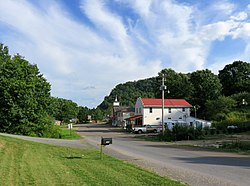
Butler is an unincorporated community in Johnson County in the northeastern corner of the U.S. state of Tennessee. It is located along the northern shore of Watauga Lake.[4] Butler is served by a post office, assigned ZIP Code 37640.

Key Information

Demographics

[edit]
Historical population
CensusPop.Note
1910499
192057815.8%
193070622.1%
1940608−13.9%
2020297
U.S. Decennial Census[5]

Butler first appeared in the 1910 U.S. census as a town of nearly 500 people. It would not appear in the 1950 census following the inundation of the town by the Watauga Lake in 1948.[6] The community would later be made a CDP in the 2020 census, with a recording of 297 people.

History

[edit]

The town was originally located on Roan Creek[7] at its confluence with the Watauga River.[8] Settlement began in 1768.[8] For many years the community was called Smith's Mill for the gristmill that Ezekial “Zeke” Smith built on the bank of Roan Creek in 1820.[9] After the Civil War, it was renamed in honor of Colonel Roderick R. Butler of Johnson County, who then represented the area in the state legislature and had been a commander in the 13th Tennessee Cavalry in the Union Army.[10]

Aenon Seminary, a secondary school, was established in Butler in 1871.[9] It later became Holly Spring College,[9] offering education up to a bachelor's degree, and enrolling as many as 200 students.[8] In 1906 it was purchased by the Watauga Baptist Association, which renamed it Watauga Academy. It operated under that name until 1948, when the town was inundated by the formation of Watauga Lake.[11]

Butler was the birthplace of U.S. Congressmen B. Carroll Reece of Tennessee and Robert R. Butler of Oregon (grandson of the town's namesake).

Inundation and relocation

[edit]
Main Street in "old" Butler, before inundation

The original town of Butler was subject to frequent flooding, experiencing major floods in 1867, 1886, 1901, 1902, 1916, 1924, and 1940.[12] The Tennessee Valley Authority (TVA) began the construction of the Watauga Dam in 1942 which created the Watauga Lake. The construction was delayed because of the ongoing World War II, but was finished in 1948 when the water steadily began rising and the town slowly became submerged under the lake. Butler was the only incorporated town inundated by a TVA reservoir.[13] In 1948, before the reservoir was filled, the town, which at the time had a population of about 600 and included more than 125 homes and 50 businesses, was relocated to higher ground.[7][9][10][13] The relocation project required construction of 54.9 miles (88.4 km) of roads and highways, three bridges, and 66 miles (106 km) of utility lines, as well as relocation of 1,281 graves.[14] The town's new site is located on Tennessee State Route 67 at 36°21′25″N 82°01′49″W / 36.35682°N 82.03015°W / 36.35682; -82.03015.

The original town is now known as "Old Butler."[15] Old Butler, called “the town that wouldn’t drown,” is commemorated in a museum in Butler and by "Old Butler Days" which is an annual festival held each year in August right in the heart of the town.[16] In 1983, a drawdown of the lake exposed the remains of Old Butler for a brief time, allowing former residents to visit the site.[13][17]

References

[edit]

Further reading

[edit]
[edit]
Revisions and contributorsEdit on WikipediaRead on Wikipedia
from Grokipedia
Butler is an unincorporated community in Johnson County, Tennessee, located along the northern shore of Watauga Lake in the northeastern portion of the state. As of recent census data, the population stands at approximately 150 residents. The community is defined by its unique history of relocation, stemming from the Tennessee Valley Authority's (TVA) construction of Watauga Dam in the 1940s, which flooded the original town site to form the reservoir. The inundation of Old Butler in 1948 marked the only instance in which the TVA deliberately submerged an incorporated , displacing around 600-800 families, several churches, and businesses to higher ground where the current community persists. This event transformed the local landscape, creating recreational opportunities around the lake while submerging historic structures that occasionally resurface during periods of low water levels, drawing interest from historians and visitors. Today, Butler maintains a and a preserving artifacts and narratives from the pre-flood era, underscoring its resilience and amid the Appalachian setting.

Geography

Location and physical features

Butler is situated in Johnson County in the northeastern corner of , , approximately 10 miles (16 km) northeast of Mountain City, the . The community's geographic coordinates are 36°21′13″N 82°1′55″W. It lies along the northern shore of , a in the region. The elevation of Butler is 1,995 feet (608 meters) above sea level, reflecting its position in the rugged terrain of the Southern . Surrounding physical features include steep forested ridges, narrow valleys, and proximity to the , which covers much of Johnson County and contributes to the area's biodiversity and recreational landscape. The , impounded to form the lake, shapes the local hydrology, with the reservoir's shoreline influencing settlement patterns and providing a mix of lacustrine and montane environments.

Climate and environmental conditions

Butler, Tennessee, lies in the Appalachian foothills at an of approximately 1,706 feet (520 meters), contributing to a (Köppen classification Cfa) moderated by mountainous terrain, with hot, humid summers and mild winters occasionally dipping into cooler conditions. Average annual temperatures range from lows of around 20°F (-7°C) in winter to highs exceeding 80°F (27°C) in summer, with July marking the warmest month at an average high of 82°F (28°C) and the coldest at 43°F (6°C). Precipitation averages 46 inches (117 cm) annually, distributed fairly evenly but with peaks in summer thunderstorms and winter , fostering lush typical of the region; snowfall totals about 12 inches (30 cm) per year, primarily from to . Wind speeds average 5-7 mph (8-11 km/h) year-round, with higher gusts during storms, and levels often exceed 70%, enhancing summer discomfort. The proximity to Watauga Reservoir, formed by the Authority's completed in 1948, influences local microclimates through evaporative cooling and increased fog, while the surrounding forested mountains promote higher rainfall interception and but also elevate risks during extreme events, as evidenced by record reservoir levels from Hurricane Helene in September 2024. indicates generally good air quality due to rural setting, though reservoir consumption advisories exist for contaminants like PCBs in sediments, reflecting legacy industrial influences in the watershed. The area's topography and riparian zones support diverse flora and , including black bears and species, but ongoing is necessary post-relocation to prevent in the .

History

Early settlement and development

The site of Butler, Tennessee, was initially settled in 1768 by John Honeycutt, who erected an arbor shelter and lean-to at the confluence of Roan Creek and the Watauga River, establishing one of the earliest communities in what would become northeastern Tennessee. By 1820, the settlement had grown to include about fifty families and was known as Smith's Mill, named for a large local mill that supported early economic activity centered on agriculture and processing. Johnson County, which includes Butler, was formally organized in 1836 and named for early settler Thomas Johnson, reflecting the region's pioneer heritage dating back to the mid-18th century. The community originally thrived as a hub for farming, milling, and small-scale mining, with settlers drawn to the fertile valley for its resources and strategic location. In 1868, the town was renamed Butler in honor of local figure Roderick R. Butler, a and , marking a period of post-Civil War stabilization and growth. It achieved formal incorporation shortly after the war, solidifying its status as a regional center. Into the early 20th century, Butler remained a quintessential locale focused on farming and lumber production, bolstered by the arrival of the and Western North Carolina Railroad in 1900, which enhanced connectivity and trade.

Chronic flooding and pre-TVA challenges

Butler, Tennessee, situated in the narrow valley in Johnson County, faced recurrent flooding due to the river's seasonal overflows and vulnerability to heavy rainfall events, exacerbated by the Appalachian terrain's steep watersheds that funneled rapid runoff into the low-lying settlement. Major floods struck in 1867, 1886, 1901, 1902, 1916, and 1924, repeatedly damaging homes, farms, and infrastructure while disrupting commerce in the agricultural and mercantile community. The most devastating event occurred in 1940, triggered by a tropical hurricane that dumped approximately 15 inches of rain over several days, causing the to swell catastrophically and claim six lives in while washing out sections of the Elizabethton-Butler highway and submerging much of the town. This inflicted widespread property destruction, including the loss of , crops, and buildings, and highlighted the valley's inadequate natural drainage and lack of engineered protections, rendering long-term habitation precarious. Pre-TVA efforts to mitigate these challenges were limited to measures like temporary levees and community cleanups, which proved insufficient against the river's power, as the floods eroded , contaminated water supplies, and fostered disease risks in the unsanitary aftermath. followed each inundation, with residents facing repeated rebuilding costs and reduced agricultural yields, fostering local for permanent flood control solutions by the early 1940s. These persistent hazards underscored the causal link between the town's location and its vulnerability, ultimately influencing federal intervention through the Authority's dam-building program.

TVA Watauga Dam project

The (TVA) launched the Watauga Dam project to mitigate chronic flooding from the , which had repeatedly devastated low-lying areas including , as part of its regional flood control and electrification mandate under the Tennessee Valley Authority Act of 1933. The initiative aligned with TVA's multipurpose dam-building strategy, emphasizing flood damage reduction alongside hydroelectric power generation in tributaries of the system. At completion, the dam—a rock and earth-fill embankment structure—measured 318 feet in height and 900 feet in length across the river, incorporating 1,484,700 cubic yards of compacted clay in a terraced design that made it the highest of its type upon finishing. Construction began in early 1942 but was suspended later that year when the U.S. redirected resources to higher-priority wartime efforts, deeming the project non-essential for defense. Efforts resumed in 1946 amid postwar recovery, culminating in the dam's operational readiness by late 1948; hydroelectric generation commenced on August 29, 1948, through a downstream powerhouse equipped with two units providing a net dependable capacity of 66 megawatts. The structure impounds waters from both the Watauga and Rivers, forming the Watauga Reservoir with a surface area of nearly 12,000 acres upon gate closure on December 1, 1948. Beyond storage, the project supports power production—yielding equivalent to average annual rainfall conditions—and sustains ecological functions such as maintenance and aquatic habitat enhancement, though primary causal intent centered on stabilizing riverine risks in the narrow . The dam's features a design at a crest of 1,975 feet, facilitating controlled releases to manage downstream flows. This addressed empirical data from prior decades, including severe events that submerged Butler's , without reliance on unsubstantiated projections.

Relocation process and resident experiences

The (TVA) initiated the relocation of following chronic flooding, particularly after the devastating 1940 flood that killed six residents and destroyed infrastructure, prompting dam approval in 1941. Construction of Watauga Dam began in 1942 but was halted by , resuming in 1946; by September 6, 1947, TVA had purchased all town real estate for $35,000. A non-profit acquired 200 acres on higher ground for the new site, where five contractors relocated 125 residences and 50 other structures, with some families moving overnight. Overall, the project displaced 761 families across nearly 12,000 acres, though approximately 650 resided in proper; power generation started on August 29, 1948, and dam gates closed on December 1, 1948, initiating inundation. Residents initially resisted full-town relocation proposals during planning, but acceptance grew as flooding persisted; one 1983 homecoming participant described the move as unavoidable, noting many subsequently improved their circumstances. However, former residents like Joe Lipford, born in 1921, expressed lasting anger over losing a tight-knit community, with many feeling TVA compensation was inadequate and forcing shifts from agriculture—such as one family's reduction from over 20 acres to a 5-acre lot. The process evoked down-hearted sentiments, exemplified by a resident's quip that "the next mayor of Butler will be a catfish," reflecting the town's submersion beneath Watauga Lake. Despite hardships, the relocation preserved Butler as an incorporated municipality—the only such town fully flooded by TVA—earning the new site the moniker "the town that wouldn't drown."

Inundation of Old Butler

On December 1, 1948, the gates of the newly constructed Watauga Dam were closed by the Tennessee Valley Authority (TVA), initiating the impoundment of the Watauga River and marking the start of the inundation of Old Butler. This action began the formation of the Watauga Reservoir, with water levels rising gradually to provide flood control, hydroelectric power, and water storage as authorized by Congress in 1941. By late 1948, the rising waters fully submerged the foundations and remaining structures of Old Butler, the only incorporated municipality ever intentionally flooded by the TVA. The town site, previously home to approximately 650 families before relocation, now lies beneath , which reaches depths exceeding 100 feet over much of the former valley floor and up to 265 feet near the dam. The inundation process was methodical, with the reservoir filling to its designed capacity by early 1949, permanently altering the landscape and eliminating the chronic flood risks that had plagued the area for over a century. The submerged remnants of Old Butler, including building foundations and streets, have occasionally resurfaced during severe droughts, such as in and 1983, allowing brief glimpses of the for former residents and visitors. These exposures highlight the engineered permanence of the , which spans 16 miles in length with 109 miles of shoreline, underscoring the trade-offs of the TVA's regional development strategy.

Post-1948 community evolution

Following the closure of Watauga Dam's gates on December 1, 1948, which inundated Old Butler, the relocated community—known as New Butler—was established on approximately 200 acres of higher-ground farmland overlooking the newly formed . The (TVA), in collaboration with the Tennessee State Planning Commission, designed the site's layout to include designated residential and business districts, facilitating a structured transition for the displaced population. Of the original 125 residences and 50 businesses, many structures were physically relocated by residents or TVA crews, with some families completing moves in a single day while preserving furnishings. The resettled population, comprising around 761 families from the broader acquisition area (including Butler's pre-flood estimate of 650 households or roughly 600 residents), adapted without significant organized resistance, viewing the move as a necessary escape from chronic flooding. By the early 1950s, the community had stabilized, though Butler transitioned from an to an unincorporated status, reflecting its reduced scale and integration into Johnson County. Residents reported general improvements in , including access to flood-free land and proximity to the lake's 109-mile shoreline, which spanned 16 miles and supported emerging recreational uses. Community cohesion persisted through periodic events, such as homecomings in 1954 and 1983, when lake drawdowns exposed Old Butler's foundations, allowing former residents to revisit and share memories, reinforcing cultural ties to the town's heritage. The establishment of the Museum of Butler in the new town further documented this evolution, preserving artifacts and narratives from the relocation era onward. Over subsequent decades, Butler's economy began orienting toward lake-based activities, diminishing its prior role as a regional trading hub while leveraging tourism potential, though specific business counts post-relocation remain limited in records. By the late , the population had contracted to a small community of about 150, indicative of broader rural depopulation trends in .

Demographics

As of the most recent estimates from the U.S. Census Bureau (2018-2022), has a population of 150 residents. This small size reflects the town's rural setting and historical relocation, which dispersed former residents and limited subsequent growth, with the community remaining under 500 inhabitants since the mid-20th century. Population estimates have shown fluctuations, including a reported year-over-year decline of approximately 40% in some recent analyses, though longer-term trends indicate stability at low levels amid broader regional depopulation in Appalachian counties. Demographically, Butler is overwhelmingly homogeneous, with 100% of residents identifying as in data, and negligible representation from other racial or ethnic groups such as , Asian, or origins. The gender distribution is balanced, at 48.7% and 51.3% . The population skews elderly, with a age of 62.1 years—59.4 for and 62.6 for —far above the national of around 38, signaling challenges like outmigration of younger residents and reliance on retirees or seasonal lake-related dwellers.

Socioeconomic characteristics

The median household in Butler, Tennessee, was estimated at $62,788 in 2023, based on 5-year estimates, though this figure includes a wide (±$23,984) due to the town's small of 150 residents, which limits statistical reliability. for the same period was $27,784, reflecting a modest consistent with rural Appalachian communities reliant on limited local opportunities. These levels lag behind the state median household of $67,631 but align with broader trends in small, aging towns where fixed incomes from and part-time work predominate. Poverty affects 11.33% of Butler's , a rate lower than the state average of 13.8%, potentially attributable to the influx of retirees with pensions or savings rather than active earners facing volatility. estimates are near 0% in recent local data, though this may reflect or seasonal work rather than full economic vibrancy, with county-level figures for Johnson County at 5% indicating sporadic job scarcity in non-tourism sectors. Educational attainment among adults aged 25 and older shows approximately 40% lacking a or equivalent, 37% holding a as their highest qualification, and lower rates of postsecondary completion, underscoring historical barriers to formal in isolated rural settings prior to modern infrastructure improvements. Alternative estimates suggest around 57.6% high school completion and 7.2% with a or higher, but small sample sizes yield inconsistent figures prone to over- or underestimation. The town's median age of 62.1 years further skews these metrics toward older cohorts educated in eras of limited access to advanced schooling.

Economy

Lake-based tourism and recreation

, a 6,430-acre reservoir created by the Tennessee Valley Authority's Watauga Dam in 1942, forms the cornerstone of tourism and recreation in Butler, Tennessee, drawing visitors to its clear, river-fed waters amid the . With approximately 105 miles of shoreline, the lake supports a range of water-based activities that leverage its scenic and relatively undeveloped setting. Primary pursuits include power boating, houseboating, , canoeing, , , jet skiing, , , and , facilitated by multiple public boat launches and marinas near Butler. stands out as a key attraction, with the lake stocked for species such as , , and ; guided charters operate from area access points, targeting trolling and bank opportunities. Highly developed recreation areas provide amenities for picnicking and , while the lake's tailwaters below the dam support additional and angling. These activities integrate with land-based , including along segments of the that intersect the shoreline, enhancing the lake's appeal for multi-day outings. Campgrounds and rental services in the vicinity accommodate seasonal visitors, particularly during summer months when water sports peak. Lake-focused bolsters Johnson County's economy through visitor expenditures on rentals, guides, and lodging, contributing to broader regional benefits from .

Other economic activities

Agriculture remains a foundational economic sector in the Butler area, integrated within Johnson County's broader rural economy. In 2021, direct agricultural output for the county totaled $124.2 million, encompassing crop and livestock production, food and fiber processing, farm inputs, and forestry-related products, with multiplier effects expanding the total economic impact to $150.5 million. This sector supported 631 direct jobs and 903 total jobs county-wide, reflecting an employment multiplier of 1.43, where each direct agricultural position generates additional employment in related industries. Manufacturing constitutes the largest employment sector in Johnson County, employing a significant portion of the 6,610 total workforce as of 2023. Key operations include production at Parkdale Mills, the county's largest manufacturer, which announced facility expansions in Mountain City to bolster yarn spinning capacity. Precision components , such as bearing parts at N&N Ball & Roller in Mountain City, further diversifies local output, contributing to industrial resilience in this Appalachian region. Forestry and logging activities, often linked to agriculture, add modestly to the local economy, with forest industries generating $2.52 million in annual value-added GDP for Johnson County in 2021, equivalent to 0.4% of total county economic activity. These efforts involve timber harvesting and processing, supporting small-scale sawmills and wood product firms amid the county's extensive woodland acreage.

Government and infrastructure

Local governance and services

Butler, an unincorporated community in , is governed as part of the county rather than through a separate municipal structure. operates under a framework established by the State Constitution, with executive authority vested in an elected county mayor—currently Larry Potter, who assumed office following the 2022 election—and legislative oversight provided by a of 15 commissioners elected from single-member districts. Law enforcement for Butler residents is delivered by the Johnson County Sheriff's Office, headquartered in Mountain City and led by Sheriff Clifton Worley Jr., which handles policing, detention, and emergency response across the county, including patrol and investigative services. and emergency medical first response are primarily provided by the Butler Volunteer Fire Department, a local volunteer organization equipped for fire suppression, vehicle extrication, and water rescue operations in the vicinity. Public utilities in Butler include water and sewer systems operated by independent local districts: Carderview Utility District, serving portions of the community with treatment and distribution compliant with state standards, and Dry Run Utility District, which manages similar for other areas. Road maintenance, , and other services are coordinated through Johnson County public works departments. Electricity is supplied by the , with distribution handled by local cooperatives.

Transportation and utilities

Butler is primarily accessed by U.S. Highway 321, which serves as the main north-south route through the town, connecting it to nearby , to the north and , to the south. State-maintained roads, including Tennessee State Route 75, provide secondary access and link to local areas around . The highway sustained significant damage from Hurricane Helene in September 2024, prompting repair contracts awarded in November 2024 for resurfacing and stabilization between Butler and the North Carolina state line. There is no passenger rail service or major public transit system; residents rely on personal vehicles, with the nearest commercial airport, , located approximately 40 miles southwest in Blountville. Electricity in Butler is distributed by the Butler Rural Electric Cooperative, which sources wholesale power from the (TVA) and manages local grid operations, including implementing rolling outages during to prevent broader blackouts. The cooperative's service area covers Johnson County, reflecting the post-1948 relocation's integration into TVA's regional power infrastructure, which was established alongside the Watauga Dam project to support flood control and . Water and sewer services are provided by local districts, including the Carderview Utility District, which operates from 209 Piercetown Road and handles treatment, distribution, and billing for residential and commercial users. The Dry Run Utility District similarly manages in adjacent areas, focusing on potable water delivery without sewer overlap in some zones. These systems were developed after the town's relocation to higher ground, replacing flood-prone pre-1948 infrastructure, though they remain vulnerable to regional events like heavy rainfall affecting lake levels and downstream flows managed by TVA. is not municipally piped; rural households typically use tanks or electric alternatives.

Cultural and historical significance

Butler Museum and preservation efforts

The Butler and Watauga Valley Heritage Museum, commonly known as the , opened in 2000 to preserve the history of the original Butler town and surrounding Watauga, Roan, and Elk Valleys, which were relocated due to the Authority's Watauga Dam construction. The museum, operated as a 501(c)(3) nonprofit, focuses on the narrative of "the town that wouldn't drown," showcasing artifacts salvaged by residents before the 1948 flooding, including items from early mountain life, Native American relics, Civil War artifacts, and pre-relocation home and business objects such as those from the and lumber mill. Exhibits feature personal stories from former residents, emphasizing community resilience during the displacement of approximately 700 people. Preservation efforts are sustained through visitor admissions of $5 per person, sales, and donations, with the facility located at 123 Selma Curtis Road in the relocated . Ongoing capital improvements include a $40,617 state grant awarded in October 2025 for maintenance enhancements, following a $25,000 federal grant in December 2023 for facility upgrades. Additional 2025 state museum funding supports broader capital projects amid Tennessee's $5 million annual appropriation for such institutions. Off-season initiatives in late 2025 encompass installing a new brick walkway to improve accessibility and protect collections, alongside special events like festivals that generate proceeds for operations. These activities ensure the museum's role in maintaining public access to 's submerged heritage, with seasonal operations typically from spring through October.

Commemorations and public memory

The annual Old Butler Days festival serves as the primary commemoration of the original 's history and relocation, drawing community members and visitors to celebrate the town's resilience following its inundation by in 1948. Held over two days in late August at Butler Park and Babe Curtis Park in the relocated townsite, the 36th edition occurred on August 22–23, 2025, featuring live music, local crafts vendors, food stalls, and historical displays focused on pre-flood life and the Authority's (TVA) project. The event underscores Butler's status as the only incorporated municipality ever fully flooded by the TVA, emphasizing themes of adaptation rather than loss. A Tennessee Historical Commission marker located near the original site, titled "Old Butler / Watauga Academy," commemorates the submerged community's founding before 1770 by settler John Honeycutt and its development into a with educational institutions like Watauga Academy, established in 1895. The marker highlights the town's relocation to higher ground prior to the Watauga Dam's completion, preserving public awareness of its underwater remnants three miles southeast of the new Butler. Public memory of Butler centers on its enduring nickname, "the town that wouldn't drown," which reflects the deliberate relocation of residents, businesses, and institutions to adjacent uplands, allowing cultural and social continuity amid the TVA's flood control efforts. This narrative, propagated through local storytelling, media coverage, and events like Old Butler Days, portrays the community as one that adapted to displacement without fully vanishing, distinguishing it from other TVA-inundated sites. Oral histories and artifacts further sustain this memory, often framing the relocation as a pragmatic response to federal infrastructure demands rather than outright erasure.

Controversies surrounding relocation and TVA role

The relocation of Butler, Tennessee, stemmed from the Tennessee Valley Authority's (TVA) construction of Watauga Dam to mitigate chronic flooding along the Watauga River, which had severely impacted the town, including a devastating 1940 flood that killed six people and damaged infrastructure. Dam construction began in 1942 but was paused during World War II, resuming in 1946, with land acquisition for the reservoir completed on September 6, 1947, when TVA purchased the entire town—including city hall and jail—for $35,000. Reservoir impoundment commenced on December 1, 1948, submerging Old Butler and displacing approximately 650 families, marking it as the only incorporated town fully inundated by a TVA project. TVA facilitated the move to higher ground on 200 acres, where 125 residences and 50 other structures were relocated, with some homes transported intact, including furnishings, in a single day. However, residents faced significant hardships, as TVA policies prohibited selling homes in the flood plain during dam construction, leaving many unable to afford new builds and forcing temporary residence in tents or trailers. Local accounts describe widespread resentment over the loss of generational farmlands—often reduced from over 20 acres to as little as five—leading some families to abandon entirely, with few reporting improved circumstances post-relocation. Criticisms centered on perceived inadequate compensation and the exercise of , with residents like Joe Lipford expressing enduring anger and sadness at being uprooted from their hometown without meaningful recourse against the federal agency's authority. While TVA emphasized the project's necessity for flood control—transforming a repeatedly inundated area into a stable community—opponents highlighted the disruption to tight-knit Appalachian social structures and the inadequacy of support for rebuilding lives in a region of limited economic prospects. No organized legal challenges specific to Butler emerged, unlike in other TVA projects, but the episode underscored broader debates over federal intervention balancing infrastructure gains against individual displacements.

Legacy and modern relevance

Environmental and recreational impacts of

The creation of through the impoundment of the by the Tennessee Valley Authority's Watauga Dam, completed in 1949, transformed the local ecology by flooding approximately 6,430 acres of valley land, including the original site of Butler, Tennessee, thereby altering riparian habitats and creating a deep, oligotrophic suited to cold-water . This shift supported diverse aquatic ecosystems, with the 's ecological health rated "good" by the TVA in 2021 assessments, reflecting stable levels, dynamics, and benthic macroinvertebrate communities, though ratings have historically fluctuated between "good" and "fair" due to factors like episodic from upstream development. populations, including and smallmouth bass, remain robust, indicative of healthy dissolved oxygen profiles maintained by the lake's high elevation (over 1,900 feet) and inflow from the cooler , though vulnerabilities to stressors like thermal stratification persist. is generally high, with management protocols emphasizing flood control and , but localized E. coli exceedances have been noted at certain access points, prompting monitoring by state agencies. Recreationally, sustains a high-volume sector, drawing over 1 million visitors annually for activities centered on its 104-mile shoreline within the . Boating, including powerboating and , is prominent due to consistent winds in the river gorge and multiple public launches, such as at Rat Branch Recreation Area, which also features handicapped-accessible piers. yields world-class opportunities, particularly for trout in tailwaters below the dam and reservoir species like , supported by TWRA stocking programs and habitat enhancements. , picnicking, , and — including segments of the —benefit from developed sites like Watauga Point and Fish Springs , fostering year-round use despite seasonal water level fluctuations managed by TVA for power generation. These pursuits generate economic value through marinas and rentals but impose pressures like boat traffic erosion on shorelines, addressed via forest service regulations.

Broader implications for TVA projects

The relocation of Butler exemplified the Tennessee Valley Authority's (TVA) expansive use of under the 1933 TVA Act, which empowered the agency to acquire land for dams providing flood control, , and hydroelectric power, often displacing entire communities without extensive . Between 1933 and 1945, TVA projects inundated over 1.3 million acres and displaced approximately 82,000 residents across the , with Butler's 1948 flooding—marking the only fully submerged—highlighting the scale of such operations even postwar. While TVA justified these actions as essential for , critics argued the process prioritized infrastructure benefits over individual property rights, as seen in legal challenges like United States ex rel. TVA v. Powelson (1943), where the upheld condemnation but limited speculative compensation, reinforcing federal authority amid landowner resistance. This pattern of displacement carried socioeconomic risks, including loss of community networks, , and for rural populations, disproportionately affecting poorer farmers through policies that favored relocating marginal operators rather than integrating them into new agricultural models. In Butler's case, TVA acquired properties for $35,000 in September 1947 and relocated 125 residences and 50 businesses by December 1948, with agency reports claiming improved living conditions post-flooding cessation, though independent accounts note persistent resident nostalgia and occasional homecomings during low water levels in 1954 and 1983. Broader TVA experiences informed later U.S. infrastructure debates, contributing to post-1960s reforms like the (1970), which mandated environmental impact statements and greater stakeholder input, curtailing similar wholesale inundations in favor of mitigation strategies. The Butler precedent underscored causal trade-offs in large-scale : empirical gains in flood reduction (e.g., averting 1940 disasters that killed six) and power generation versus uncompensable intangible losses like social cohesion, influencing skepticism toward unchecked in subsequent federal projects. TVA's official narratives emphasize net regional prosperity, yet analyses reveal uneven outcomes, with displaced groups facing higher risks of impoverishment and marginalization absent robust resettlement planning. These dynamics have echoed in modern controversies, such as 2021 disputes over TVA transmission lines in , where landowners contested valuations and routes, prompting renewed scrutiny of agency accountability.

References

Add your contribution
Related Hubs
User Avatar
No comments yet.