Hubbry Logo
CMB cold spotCMB cold spotMain
Open search
CMB cold spot
Community hub
CMB cold spot
logo
8 pages, 0 posts
0 subscribers
Be the first to start a discussion here.
CMB cold spot
CMB cold spot
from Wikipedia
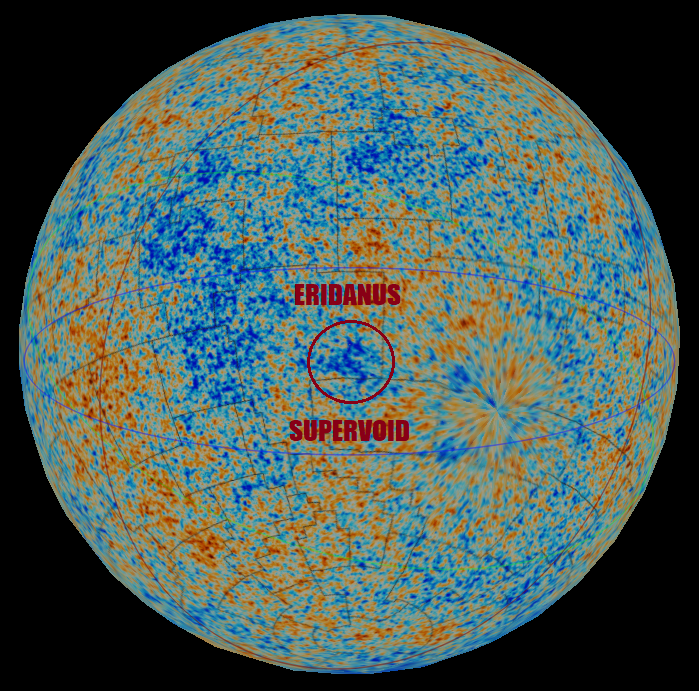
The circled area is the cold spot. Black lines in the Planck's CMB map indicates each constellation, cold spot is in Eridanus constellation. The blue circle is the equatorial line in the celestial sphere. Image generated with Celestia.
The circled area is the cold spot in the WMAP.

The CMB Cold Spot or WMAP Cold Spot is a region of the sky seen in microwaves that has been found to be unusually large and cold relative to the expected properties of the cosmic microwave background radiation (CMBR). The "Cold Spot" is approximately 70 μK (0.00007 K) colder than the average CMB temperature (approximately 2.7 K), whereas the root mean square of typical temperature variations is only 18 μK.[1][note 1] At some points, the "cold spot" is 140 μK colder than the average CMB temperature.[2]

The radius of the "cold spot" subtends about 5°; it is centered at the galactic coordinate lII = 207.8°, bII = −56.3° (equatorial: α = 03h 15m 05s, δ = −19° 35′ 02″). It is, therefore, in the Southern Celestial Hemisphere, in the direction of the constellation Eridanus.

Typically, the largest fluctuations of the primordial CMB temperature occur on angular scales of about 1°. Thus a cold region as large as the "cold spot" appears very unlikely, given generally accepted theoretical models. Various alternative explanations exist, including a so-called Eridanus Supervoid or Great Void that may exist between us and the primordial CMB (foreground voids can cause cold spots against the CMB). Such a void would affect the observed CMB via the integrated Sachs–Wolfe effect, and would be one of the largest structures in the observable universe. This would be an extremely large region of the universe, roughly 150 to 300 Mpc or 500 million to one billion light-years across and 6 to 10 billion light years away,[3] at redshift , containing a density of matter much smaller than the average density at that redshift.[citation needed]

Discovery and significance

[edit]
CMB Cold Spot was also observed by the Planck satellite at similar significance. Image generated with Celestia Program.

In the first year of data recorded by the Wilkinson Microwave Anisotropy Probe (WMAP), a region of sky in the constellation Eridanus was found to be colder than the surrounding area.[4] Subsequently, using the data gathered by WMAP over 3 years, the statistical significance of such a large, cold region was estimated. The probability of finding a deviation at least as high in Gaussian simulations was found to be 1.85%.[5] Thus it appears unlikely, but not impossible, that the cold spot was generated by the standard mechanism of quantum fluctuations during cosmological inflation, which in most inflationary models gives rise to Gaussian statistics. The cold spot may also, as suggested in the references above, be a signal of non-Gaussian primordial fluctuations.

Some authors called into question the statistical significance of this cold spot.[6]

In 2013, the CMB Cold Spot was also observed by the Planck satellite[7] at similar significance, discarding the possibility of being caused by a systematic error of the WMAP satellite.

Possible causes other than primordial temperature fluctuation

[edit]

The large 'cold spot' forms part of what has been called an 'axis of evil' (so-called because it was unexpected to see a structure like this).[8]

Supervoid

[edit]
The mean ISW imprint 50 supervoids have on the Cosmic Microwave Background:[9][clarification needed] color scale from -20 to +20 μK.

One possible explanation of the cold spot is a huge void between us and the primordial CMB. A region cooler than surrounding sightlines can be observed if a large void is present, as such a void would cause an increased cancellation between the "late-time" integrated Sachs–Wolfe effect and the "ordinary" Sachs–Wolfe effect.[10] This effect would be much smaller if dark energy were not stretching the void as photons went through it.[11]

Rudnick et al.[12] found a dip in NVSS galaxy number counts in the direction of the Cold Spot, suggesting the presence of a large void. Since then, some additional works have cast doubt on the "supervoid" explanation. The correlation between the NVSS dip and the Cold Spot was found to be marginal using a more conservative statistical analysis.[13] Also, a direct survey for galaxies in several one-degree-square fields within the Cold Spot found no evidence for a supervoid.[14] However, the supervoid explanation has not been ruled out entirely; it remains intriguing, since supervoids do seem capable of affecting the CMB measurably.[9][15][16]

A 2015 study shows the presence of a supervoid that has a diameter of 1.8 billion light years and is centered at 3 billion light-years from our galaxy in the direction of the Cold Spot, likely being associated with it.[11] This would make it the largest void detected, and one of the largest structures known.[17][note 2] Later measurements of the Sachs–Wolfe effect show too its likely existence.[18]

Although large voids are known in the universe, a void would have to be exceptionally vast to explain the cold spot, perhaps 1,000 times larger in volume than expected typical voids. It would be 6 billion–10 billion light-years away and nearly one billion light-years across, and would be perhaps even more improbable to occur in the large-scale structure than the WMAP cold spot would be in the primordial CMB.

A 2017 study[19] reported surveys showing no evidence that associated voids in the line of sight could have caused the CMB Cold Spot and concluded that it may instead have a primordial origin.

One important thing to confirm or rule out the late time integrated Sachs–Wolfe effect is the mass profile of galaxies in the area as ISW effect is affected by the galaxy bias which depends on the mass profiles and types of galaxies.[20][21]

In December 2021, the Dark Energy Survey (DES), analyzing their data, put forward more evidence for the correlation between the Eridanus supervoid and the CMB cold spot.[22][23]

Topological defects

[edit]

In late 2007, (Cruz et al.)[24] argued that the Cold Spot could be due to a cosmic texture, a remnant of a phase transition in the early Universe. Other explanations based on cosmic defects have been proposed, such as the thawing of a cosmic string loop[25].

Parallel universe

[edit]

A controversial claim by Laura Mersini-Houghton is that the cold spot could be the imprint of another universe beyond our own, caused by quantum entanglement between universes before they were separated by cosmic inflation.[3] Other researchers have modeled the cold spot as potentially the result of cosmological bubble collisions, again before inflation.[26][27][19]

A sophisticated computational analysis (using Kolmogorov complexity) has derived evidence for a north and a south cold spot in the satellite data:[28] "...among the high randomness regions is the southern non-Gaussian anomaly, the Cold Spot, with a stratification expected for the voids. Existence of its counterpart, a Northern Cold Spot with almost identical randomness properties among other low-temperature regions is revealed." However, apart from the Southern Cold Spot, the varied statistical methods in general fail to confirm each other regarding a Northern Cold Spot.[29] The 'K-map' used to detect the Northern Cold Spot was noted to have twice the measure of randomness measured in the standard model. The difference is speculated to be caused by the randomness introduced by voids (unaccounted-for voids were speculated to be the reason for the increased randomness above the standard model).[30]

Sensitivity to finding method

[edit]

The cold spot is mainly anomalous because it stands out compared to the relatively hot ring around it; it is not unusual if one only considers the size and coldness of the spot itself.[6] More technically, its detection and significance depends on using a compensated filter like a Mexican hat wavelet to find it.[citation needed]

See also

[edit]

Notes

[edit]

References

[edit]
[edit]
Revisions and contributorsEdit on WikipediaRead on Wikipedia
from Grokipedia
The CMB Cold Spot is an anomalous feature in the (CMB), the uniform microwave radiation filling the universe and remnant of the , manifesting as an unusually large and cold depression relative to the expected Gaussian distribution of fluctuations. Located in the southern celestial hemisphere within the constellation Eridanus at equatorial coordinates (RA 03h 15m 09.7s, Dec −20° 12′ 01″), it subtends an of approximately 5–10 degrees, corresponding to a physical scale exceeding 1 billion light-years at the distance of the CMB last scattering surface. The central region exhibits a contrast of about −70 μK below the mean CMB of 2.725 , with the deepest depressions reaching up to −140 μK, far exceeding the typical fluctuation amplitude of ±18 μK. This makes the Cold Spot a statistically significant , with a random occurrence probability of roughly 1 in 50 under standard inflationary cosmology. First identified through wavelet analysis of the first-year data from NASA's (WMAP) in 2004, the anomaly was highlighted for its non-Gaussian characteristics and exceptional in the . Subsequent WMAP releases and independent analyses confirmed its persistence, prompting detailed scrutiny of potential instrumental or foreground contaminants, though none fully accounted for it. The European Space Agency's Planck satellite, with superior and sensitivity, verified the Cold Spot in its 2013 and 2015 data releases, measuring consistent profiles and ruling out most systematic errors while noting its alignment with large-scale CMB asymmetries. High-resolution follow-up observations, including those from the Dark Energy Survey (DES), have mapped associated large-scale structure, revealing underdensities in galaxy distributions that intersect the . The origin of the CMB Cold Spot remains debated, challenging aspects of the standard ΛCDM model, though several hypotheses have been proposed. The leading explanation attributes it to the Integrated Sachs-Wolfe (ISW) effect from the Eridanus supervoid, a vast underdensity of matter (radius ~300 Mpc, redshift z < 0.2) that causes photons to lose energy as they traverse expanding space, imprinting a cold signature; DES observations confirm this void with signal-to-noise >5 and estimate it accounts for 10–50% of the temperature drop. Alternative interpretations include primordial non-Gaussianities from , cosmic textures or defects, or even exotic collisions, but these are disfavored by lensing and polarization data showing consistency with ΛCDM expectations. Recent studies suggest contributions from foregrounds, such as systematic CMB temperature decrements around nearby late-type galaxies in the Eridanus complex, potentially reproducing the Cold Spot's morphology and reducing its significance to <2σ after subtraction. Ongoing surveys aim to resolve whether the anomaly signals new physics or integrated local effects.

Background

Cosmic Microwave Background

The cosmic microwave background (CMB) is the thermal radiation left over from the Big Bang, consisting of uniform blackbody radiation that permeates the entire universe at a temperature of approximately 2.725 K. This radiation fills all observable space isotropically, providing a snapshot of the universe when it was about 380,000 years old, and its near-perfect blackbody spectrum serves as key evidence for the hot Big Bang model. The CMB was accidentally discovered in 1965 by Arno Penzias and Robert Wilson at Bell Laboratories, who detected excess antenna temperature at 4080 MHz corresponding to a nearly isotropic microwave signal of about 3.5 K. This finding was quickly interpreted as relic radiation from the early universe, earning Penzias and Wilson the 1978 Nobel Prize in Physics. Subsequent measurements, particularly by NASA's satellite launched in 1989, confirmed the CMB's spectrum as a precise blackbody with deviations less than 0.005% across frequencies from 2 to 20 cm⁻¹, solidifying its cosmological significance. Physically, the CMB originates from photons emitted during the epoch of recombination, when the universe cooled sufficiently (at a redshift z ≈ 1100) for electrons and protons to form neutral hydrogen atoms, allowing photons to decouple from matter and propagate freely. These photons have since been redshifted by the universe's expansion from the infrared regime to microwaves observable today. The CMB is remarkably isotropic, with the universe appearing uniform to within one part in 100,000, but it exhibits small temperature anisotropies of order ΔT/T ∼ 10^{-5} that served as the initial density perturbations seeding the formation of galaxies and large-scale cosmic structure. Measurements of the CMB have been conducted using space-based satellites such as COBE, the Wilkinson Microwave Anisotropy Probe (WMAP) launched in 2001, and the Planck satellite operational from 2009 to 2013, which provided the most precise full-sky maps to date. Ground-based telescopes, including the Atacama Cosmology Telescope and South Pole Telescope, complement these by targeting specific sky regions with high angular resolution to study finer details of the radiation.

Temperature Fluctuations in CMB

The cosmic microwave background (CMB) exhibits small temperature fluctuations, on the order of ΔT/T ≈ 10^{-5}, which arise from various physical processes during and after the epoch of recombination. These anisotropies are broadly classified into primary and secondary effects. Primary anisotropies originate at the time of recombination, approximately 380,000 years after the , when the universe became transparent to photons. They include the intrinsic temperature variations due to density perturbations in the photon-baryon plasma, the Doppler effect from the peculiar velocities of electrons scattering photons, and the Sachs-Wolfe effect arising from gravitational redshift in the primordial potential wells. The Sachs-Wolfe effect, dominant on large angular scales, is described by the relation ΔT/T=13Φ\Delta T / T = \frac{1}{3} \Phi, where Φ\Phi is the gravitational potential at the last scattering surface, reflecting the intrinsic coupling between matter overdensities and photon temperature. Secondary anisotropies, in contrast, are imprinted on the CMB after recombination as photons propagate through evolving large-scale structures. Key examples include the Sunyaev-Zel'dovich effect, where inverse Compton scattering of CMB photons by hot intracluster gas in galaxy clusters causes thermal distortions, and weak gravitational lensing, which remaps the primary CMB pattern due to the integrated deflection by matter along the line of sight. These secondary effects are generally smaller in amplitude but introduce non-Gaussian features that can be distinguished from the primarily Gaussian primary signal. The statistical properties of CMB temperature fluctuations are characterized by the angular power spectrum CC_\ell, which decomposes the anisotropies into multipoles \ell corresponding to angular scales θ180/\theta \approx 180^\circ / \ell. On small scales (high \ell), the spectrum features a series of acoustic peaks arising from baryon acoustic oscillations (BAO) in the early photon-baryon fluid, where sound waves prior to recombination left imprints frozen at last scattering; the first peak at 220\ell \approx 220 corresponds to the sound horizon scale. In the standard Λ\LambdaCDM model, these fluctuations are predicted to form a statistically isotropic Gaussian random field, with the overall variance set by the amplitude of primordial perturbations generated during cosmic inflation, typically parameterized by As2×109A_s \approx 2 \times 10^{-9} at pivot scale k=0.05k=0.05 Mpc1^{-1}. These temperature fluctuations play a central role in constraining cosmological parameters, as the power spectrum's shape and amplitude encode information about the universe's composition and evolution. For instance, the position of the acoustic peaks determines the baryon density Ωbh2\Omega_b h^2 and the total matter density Ωmh2\Omega_m h^2, while the low-\ell plateau constrains the Hubble constant H0H_0 through the angular scale of the sound horizon; analyses of CMB data yield Ωm0.31\Omega_m \approx 0.31 and H067.4H_0 \approx 67.4 km/s/Mpc, with the fluctuation amplitude providing a measure of the primordial power spectrum's normalization.

Discovery and Observations

Initial Detection with WMAP

The Wilkinson Microwave Anisotropy Probe (WMAP), launched by NASA on June 30, 2001, was designed to measure temperature and polarization anisotropies in the cosmic microwave background (CMB) across the full sky at five frequency bands ranging from 23 to 94 GHz. It operated until 2010, producing high-resolution maps with angular resolutions of 0.2° to 1.2° and sensitivity to temperature fluctuations at the microkelvin level, enabling detailed studies of CMB properties through multiple data releases starting in 2003. The initial detection of a prominent non-Gaussian feature, later identified as the CMB cold spot, emerged from analyses of WMAP's first-year data released in 2003. In 2004, Vielva et al. applied a spherical Mexican hat wavelet (SMHW) transform to probe for deviations from Gaussianity in the CMB temperature distribution, revealing an excess kurtosis in the wavelet coefficients at scales of approximately 10° in the southern galactic hemisphere. This anomaly was localized to a region centered at equatorial coordinates RA 03^h 15^m, Dec -20°, spanning a radius of about 5°. Subsequent investigation by Cruz et al. in 2005 confirmed that this feature corresponded to an unusually cold region in the CMB map, with a temperature deficit of approximately -70 μK relative to the mean CMB temperature, exceeding the typical expected fluctuations of ±50 μK for such scales under Gaussian assumptions. Statistical assessments, including wavelet-based kurtosis tests and comparisons to Gaussian simulations, yielded a low probability (p-value ≈ 0.001) of the feature arising from random Gaussian fluctuations, indicating a significant violation of statistical isotropy and Gaussianity. Further analysis using the three-year WMAP data in 2007 by Cruz et al. reinforced the anomaly's persistence, with the cold spot showing aligned excess kurtosis and a p-value of about 0.001 for non-Gaussianity, while also noting its alignment with the galactic equator in some estimators. These findings, published in key works such as Vielva et al. (2004, ApJ, 609, 22) and Cruz et al. (2005, MNRAS, 356, 29; 2007, ApJ, 655, 11), established the cold spot as a seminal anomaly in early WMAP observations, prompting extensive follow-up studies.

Confirmation with Planck

The Planck mission, launched by the European Space Agency in 2009, achieved higher angular resolution of 5–10 arcminutes and superior sensitivity to CMB temperature fluctuations compared to the WMAP satellite, enabling more precise mapping of the microwave sky. Its data releases from 2013 to 2018 facilitated refined analyses of large-scale CMB features, including independent verification of anomalies first noted in prior observations. In the 2013 data release, the Planck Collaboration identified the CMB cold spot at a position consistent with WMAP findings, centered near galactic coordinates (l, b) ≈ (209°, –57°), with a central temperature decrement of approximately –70 μK relative to the mean CMB temperature. Unlike some interpretations of WMAP data that suggested stronger non-Gaussianity, Planck measurements indicated a reduced non-Gaussian signal around the feature, with wavelet analyses showing a modified upper tail probability of about 0.01 at scales of ~300 arcminutes, corresponding to roughly 2.3σ significance. To mitigate contamination, the analysis employed Union (U73), Commander (CG70), and cut-sky (CG60) masks to exclude galactic foregrounds, alongside component-separation methods like SEVEM for subtracting dust, synchrotron emission, and point sources. These steps isolated the primordial CMB signal effectively, with tests using Wiener-filtered maps confirming minimal residual foreground leakage, as variations in the anomaly were stable across different masking and subtraction schemes. Statistical evaluations, including tail probabilities for skewness and kurtosis, along with χ² tests on multipole alignments, reassessed the feature's deviation from Gaussianity in the ΛCDM model, yielding 2–3σ tensions that persisted even after masking the coldest pixels or the gp10 galactic region. Overlay comparisons of WMAP and Planck temperature maps highlighted strong agreement in the cold spot's position, extent (~5–10° diameter), and depth, underscoring the anomaly's reproducibility across instruments. Overall, Planck's higher-fidelity observations ruled out instrumental artifacts as the cause, with the cold spot's high kurtosis emerging as a robust, potentially cosmological signature at ~2.5σ, though its origin remained unresolved within standard models.

Recent Surveys and Developments

Analyses from the Dark Energy Survey (DES) have probed the alignment between the CMB Cold Spot and the Eridanus supervoid, confirming a significant underdensity (signal-to-noise >5) along the line of sight at z < 0.2 but indicating that the integrated Sachs-Wolfe (ISW) effect from this void accounts for only 10–50% of the temperature anomaly, providing partial but insufficient evidence for a full causal connection. In April 2025, researchers at the Institute for Astronomy (IfA) reported the detection of a potential giant filamentary structure or cosmic wall, spanning hundreds of millions of light-years, based on cross-correlations with and near-infrared surveys; this structure's gravitational lensing or ISW effect may contribute to the Cold Spot's imprint on the CMB. A June 2023 multi-probe study integrating CMB maps, galaxy clustering statistics, and weak lensing convergence fields tested the supervoid hypothesis and ruled it out based on the lensing signal in Planck data, concluding that a large void cannot explain the Cold Spot. In April 2025, a study reported a highly significant (p < 0.0001) correlation between positions of nearby late-type galaxies in the Eridanus complex, including the Horologium supercluster, and CMB temperature decrements, suggesting that systematic foreground effects from these structures could mimic or enhance the Cold Spot signal, potentially reducing its cosmological significance after subtraction. As of November 2025, ongoing surveys continue to investigate these local effects versus new physics, with recent (ACT) DR6 power spectrum analyses (March 2025) providing general constraints on small-scale CMB fluctuations but no specific resolution on the Cold Spot's edges.

Physical Characteristics

Location and Extent

The CMB cold spot is centered at galactic coordinates (l, b) ≈ (209°, -57°), corresponding to equatorial coordinates RA 48.8°, Dec -20.4° in the constellation Eridanus. This feature manifests as an approximately 10° diameter patch on the sky, with a more pronounced core of radius 5°–10°. At the epoch of last scattering (z ≈ 1100), the angular extent translates to a comoving physical scale of roughly 1–2 Gpc, though interpretations involving local structures like supervoids suggest it could arise from volumes on the order of hundreds of Mpc. It contributes to observed hemispherical asymmetry in the large-scale CMB temperature field, predominantly in the southern galactic hemisphere. In full-sky CMB temperature maps from missions like WMAP and Planck, the cold spot appears as the most prominent dark region in the southern sky, contrasting sharply with surrounding fluctuations.

Temperature Anomaly and Statistical Significance

The CMB Cold Spot is characterized by a temperature decrement of approximately -70 μK relative to the surrounding cosmic microwave background in Planck satellite data, representing a deviation roughly 2–3 times deeper than the root-mean-square amplitude of typical fluctuations at angular scales of ~5–10 degrees. This anomaly, centered near galactic coordinates (l, b) ≈ (209°, -57°), was first quantified in detail using observations but confirmed and refined with Planck's higher-resolution, multi-frequency measurements, which better isolate the CMB signal from galactic foregrounds. Recent studies (as of 2024) suggest contributions from foregrounds, such as systematic CMB temperature decrements around nearby late-type galaxies in the Eridanus complex, potentially reproducing the Cold Spot's morphology and reducing its significance to <2σ after subtraction. The local statistical significance of the Cold Spot's temperature anomaly is estimated at ~3σ, indicating a low probability of arising from random Gaussian fluctuations in that specific sky region. However, when accounting for the look-elsewhere effect—arising from searching multiple sky positions and scales—the global significance drops to ~2σ, suggesting it is unusual but not overwhelmingly improbable across the full sky. Evidence for non-Gaussianity is further supported by analyses using Minkowski functionals, which measure the morphology of excursion sets in the temperature map and reveal deviations from Gaussian expectations, with the Cold Spot contributing significantly to the overall non-Gaussian signal in the southern galactic hemisphere. Comparisons with ΛCDM model simulations underscore the anomaly's rarity: in Monte Carlo runs of Gaussian CMB skies constrained by Planck power spectrum measurements, a feature as cold and extended as the Cold Spot appears in fewer than 2% of realizations, often less than 1% when incorporating its distinctive size and shape. The boundary of the anomaly exhibits steeper temperature gradients than predicted for isotropic Gaussian random fields, as evidenced by edge profile fits that highlight a sharp transition to a surrounding hot ring, enhancing its distinctiveness from standard primordial fluctuations. Initial assessments from WMAP data suggested a higher significance of up to 4σ for the Cold Spot, driven partly by less refined foreground subtraction. Planck analyses, benefiting from superior component separation and multi-frequency data, reduced this to ~2.5σ, attributing the adjustment to more accurate removal of astrophysical contaminants like synchrotron emission and dust, while preserving the core anomaly's presence.

Standard Cosmological Interpretations

Primordial Origin in ΛCDM Model

In the standard ΛCDM model, cosmic inflation in the early universe generates nearly Gaussian primordial curvature perturbations, which serve as the seeds for all large-scale structure, including cosmic microwave background (CMB) temperature fluctuations. These initial perturbations are evolved forward in time using linear transfer functions computed via Boltzmann codes such as CAMB or CLASS, accounting for the physics of photon-baryon interactions, gravitational redshifting, and diffusion damping up to the epoch of recombination. The resulting CMB temperature map thus reflects a statistical realization of these Gaussian fields projected onto the sky, with power on large angular scales dominated by the Sachs-Wolfe effect. The CMB cold spot, characterized by a temperature decrement of about 70 μK across an approximately 10° angular extent, can be viewed as an extreme manifestation of such primordial fluctuations—a rare underdensity in the initial conditions. Analyses of Gaussian CMB simulations under ΛCDM parameters from Planck data indicate that a feature as pronounced as the cold spot has an occurrence probability of roughly 1.9%, equivalent to a 1-in-50 rarity, which aligns with expectations at the 95% confidence level from the low-multipole power spectrum. This suggests the anomaly is statistically compatible with standard primordial Gaussianity, though it represents an outlier in the ensemble of possible universes. A key challenge arises from the cold spot's unusually large scale, which probes the far tail of the Gaussian distribution and exceeds the typical maximum size anticipated for cold spots in random fields generated by slow-roll inflation; this "tail issue" implies a low but non-zero probability, prompting scrutiny of whether vanilla inflationary models sufficiently accommodate such extremes without additional mechanisms. To quantify this, cosmological simulations integrating N-body evolution for matter clustering with Boltzmann solvers like CLASS or CAMB have been used to generate thousands of mock CMB skies; these yield an occurrence rate for cold spots matching the observed amplitude and morphology in approximately 0.1–1% of realizations, reinforcing that the feature is permissible within ΛCDM while underscoring its exceptional nature. If the cold spot originates primordially, it offers valuable constraints on inflationary scenarios by testing the Gaussianity and power spectrum tail at large scales, yet it requires no invocation of new physics beyond the established ΛCDM framework.

Integrated Sachs-Wolfe Effect from Local Structures

The integrated Sachs-Wolfe (ISW) effect arises from the interaction of cosmic microwave background (CMB) photons with time-varying gravitational potentials along their path from the last scattering surface to the observer. This secondary anisotropy is described by the temperature perturbation ΔTT=2Φ˙dl,\frac{\Delta T}{T} = -2 \int \dot{\Phi} \, dl, where Φ˙\dot{\Phi} is the time derivative of the Newtonian gravitational potential Φ\Phi, and the integral is taken along the photon path ll. In a Λ\LambdaCDM cosmology dominated by dark energy at low redshifts (z<1z < 1), the potentials decay due to the suppression of structure growth, leading to a net blueshift or redshift of photons depending on the local matter distribution. For large-scale underdense regions such as voids, the linear ISW effect produces a characteristic cooling of CMB photons. As photons enter a supervoid, they experience a gravitational redshift from the shallowing potential well (gaining energy relative to the expanding background), but upon exiting, they undergo a larger blueshift (losing more energy), resulting in a net temperature decrement. This mechanism is distinct from the primordial Sachs-Wolfe effect, which originates at recombination; the ISW is a late-time, secondary contribution that scales linearly with the growth rate factor fΩm0.55f \approx \Omega_m^{0.55}, where Ωm\Omega_m is the present-day matter density parameter. Theoretical models predict ISW temperature decrements of approximately 10–50 μK for supervoids with diameters of 1–3 Gpc at low redshifts (z<1z < 1), which is comparable in scale to the observed CMB cold spot depth of about 70 μK. For smaller voids around 200–300 Mpc, the expected central decrement is lower, around 20 μK. One prominent hypothesis links the CMB cold spot to the ISW effect from the Eridanus supervoid, a large underdensity of approximately 300 Mpc extent at z0.15z \approx 0.15 aligned with the cold spot direction. Studies from 2015–2017, using infrared galaxy catalogs like WISE-2MASS and Pan-STARRS1, detected this supervoid with a density contrast δ0.2\delta \approx -0.2 to 0.4-0.4 and proposed it as the primary cause of the cold spot via ISW, potentially accounting for up to half the observed anomaly under modified void profiles. However, more recent analyses using Dark Energy Survey (DES) Year-3 data from 2022 indicate that the Eridanus supervoid's depth is insufficient to fully explain the cold spot, producing only an ISW signal of about 20-20 μK—roughly 10–20% of the required amplitude—while confirming its existence as a significant underdensity with radius 200\approx 200 h1h^{-1} Mpc. Follow-up gravitational lensing measurements further suggest the void is shallower than expected in Λ\LambdaCDM simulations, with a convergence signal about 30% lower, reinforcing that local structures alone cannot fully resolve the anomaly. As of 2025, analyses of the broader "ISW puzzle"—where stacked ISW signals from supervoids show enhancements up to four times stronger than ΛCDM predictions—suggest the Eridanus supervoid may contribute more than previously estimated under standard cosmology, though it still falls short of fully accounting for the cold spot.

Alternative Explanations

Supervoids and Large-Scale Voids

One prominent alternative explanation for the CMB cold spot involves large-scale supervoids, which could induce a temperature decrement through the integrated Sachs-Wolfe (ISW) effect as photons traverse underdense regions. The Eridanus supervoid, located in the direction of the cold spot, has been proposed as a candidate, characterized by a density contrast of δ ≈ -0.2 extending over a physical radius of approximately 200 h^{-1} Mpc (corresponding to about 1.8 billion light-years across). Surveys have provided mixed evidence for these supervoids as the primary cause. The 2017 2dF-VST ATLAS Cold Spot galaxy redshift survey (2CSz), covering over 4,600 galaxies out to z ≈ 0.4, detected no significant large-scale underdensity aligned with the cold spot, with galaxy number counts consistent with the average cosmic density to within 1σ, thereby challenging simple supervoid interpretations. In contrast, the 2022 Dark Energy Survey (DES) Year-3 analysis confirmed a substantial underdensity in the Eridanus region at z < 0.2, using redMaGiC galaxy samples, with a signal-to-noise ratio exceeding 5 for the void's prominence in dark matter distributions derived from weak lensing. Recent multi-probe analyses further refine this picture. Cross-correlations between galaxy counts, weak lensing convergence κ (measuring mass distributions), and CMB temperature maps show modest alignment, typically at the 1-2σ level, with the Eridanus underdensity contributing partially to the observed ISW signal but falling short of fully accounting for the cold spot's depth. A 2023 analysis of Planck CMB lensing data ruled out the presence of a large supervoid capable of fully explaining the cold spot's temperature decrement through the ISW effect, as the observed lensing signal does not match predictions for such a structure. However, these supervoids face limitations within the ΛCDM model, where structures of such scale and depth (δ < -0.3 over >150 Mpc) are statistically rare, occurring with probability less than 1 in 1,000, and even the Eridanus void can explain only 10-20% of the cold spot's of -70 μK. This shortfall, combined with the observed lensing signal being about 30% weaker than ΛCDM predictions at the 2σ level, suggests that while supervoids contribute, they do not fully resolve the anomaly.

Topological Defects

Topological defects, including cosmic strings and textures, represent an exotic class of explanations for the CMB cold spot, originating from phase transitions in the early universe beyond the standard inflationary . These defects arise when global or symmetries are broken during rapid expansions shortly after the , leading to stable or unstable configurations of concentrated energy that can imprint distinct patterns on the (CMB). Unlike primordial Gaussian fluctuations in the ΛCDM model, defects produce non-random, correlated anisotropies that could account for the cold spot's unusual sharpness and alignment. The formation of such defects occurs via the Kibble mechanism during second-order phase transitions, where quantum fluctuations cause domains of differing vacuum states to form, resulting in line-like cosmic strings or knot-like textures with an associated energy scale of approximately 101610^{16} GeV, corresponding to (GUT) scales. Cosmic strings are one-dimensional filaments, while textures are higher-dimensional, unstable configurations from global , both scaling with the cosmic expansion to remain dynamically significant. In the cosmic texture model, collapsing texture knots—regions where the field configuration unwinds—release bursts of energy, injecting into the plasma and creating a central cold spot surrounded by a hot ring through compensatory cooling of the local distribution. This process mimics aspects of the Kaiser-Stebbins effect seen in cosmic strings, where relative motion between defects and induces discontinuities, but for textures, the effect stems primarily from the sudden energy dissipation during collapse. The resulting anomaly features a decrement of order 10510^{-5} K, with non-Gaussian profiles exhibiting sharp edges and preferential alignments that align with the observed cold spot's morphology. Theoretical predictions from defect models include enhanced non-Gaussianity, such as aligned bipolar , and suppressions in the angular power spectrum at low multipoles 1020\ell \sim 10-20, reflecting the causal horizon at recombination. Simulations of evolving defect networks in the , incorporating and full-sky maps, demonstrated that texture configurations produce cold spot-like features—cold regions exceeding 3σ3\sigma anomalies—in roughly 1% of realizations, consistent with the rarity of the observed feature under Gaussian statistics. Current observational constraints from Planck have significantly challenged these models, with tight limits on primordial non-Gaussianity (fNLlocal=0.9±5.1f_{\rm NL}^{\rm local} = -0.9 \pm 5.1 at 68% CL) ruling out defect scenarios predicting fNL10f_{\rm NL} \gtrsim 10, as such levels would overproduce the observed bispectrum. For cosmic strings, Planck data exclude tension parameters μ>3×10⁷\mu > 3 \times 10^{-7} at 95% confidence, while texture models are constrained to predict fewer than 6 detectable events across the full sky, rendering them viable only at low energy scales with minimal tension to data. A 2025 analysis of polarization lensing forecasts that collapsing cosmic textures could be detectable at up to 2.8σ with upcoming surveys like the Simons Observatory if at the edge of current limits, but current data show no anomalous lensing patterns supporting this for the cold spot.

Multiverse and Bubble Collision Theories

In the framework of , the CMB cold spot has been interpreted as a possible imprint from a collision between —envisioned as a bubble nucleated within an eternally inflating —and another such bubble. During , quantum fluctuations allow regions of space to tunnel into lower-energy states, forming distinct bubble universes that expand independently; a collision between adjacent bubbles can perturb the in our bubble, leading to a disk-shaped anomaly in the map as the photons from the last scattering surface pass through the affected region. This scenario provides a falsifiable prediction for theories, as the collision would produce azimuthally symmetric features with a sharp causal boundary and a characteristic profile deviating from primordial Gaussian fluctuations. Feeney et al. (2011) developed a phenomenological model for these bubble collision signatures, parameterizing the temperature modulation as δT/T=z0+(zcritz0)cosθ1cosθcrit\delta T / T = z_0 + (z_{\rm crit} - z_0) \frac{\cos \theta}{1 - \cos \theta_{\rm crit}} for θ<θcrit\theta < \theta_{\rm crit}, where z0z_0 represents the central amplitude (potentially negative for a cold spot), zcritz_{\rm crit} the edge discontinuity from energy injection, θcrit\theta_{\rm crit} the angular radius of the disk, and θ\theta the angular distance from the collision center. This profile, arising from the sudden change in expansion history at the collision boundary, was applied to WMAP 7-year data, identifying the cold spot as a candidate feature due to its circular shape and temperature dip of approximately 70μK-70 \, \mu{\rm K}, though the overall posterior favored zero collisions with an upper limit of Nˉs<1.6\bar{N}_s < 1.6 at 68% confidence. Early Bayesian analyses using WMAP data yielded evidence ratios suggesting moderate support for the bubble collision interpretation of the cold spot over standard Λ\LambdaCDM primordial fluctuations, with log evidence values indicating around 50:1 in favor for specific features like the cold spot. However, higher-resolution Planck observations, which confirmed the cold spot's but reduced its statistical status to about 2.5σ\sigma and revealed no corresponding hot spot on the antipodal sky (expected from asymmetric energy transfer in collisions), shifted the to near 1:1, disfavoring the model. Analyses incorporating CMB lensing and polarization data further constrain bubble collision scenarios by detecting no anomalous lensing convergence or E-mode polarization patterns around the cold spot, as predicted by collision models that would induce tangential polarization alignments and weak lensing signals from the perturbed geometry. These null results align with expectations from Gaussian rather than exotic early-universe interactions. Philosophically, the cold spot serves as a potential empirical test for hypotheses, offering a rare consequence of that could distinguish it from untestable variants; the absence of confirmatory signals underscores the challenge of verifying such grand theories while highlighting the CMB's role in probing fundamental cosmology.

Observational Biases and Artifacts

One potential explanation for the apparent anomaly of the CMB cold spot involves the , where multiple statistical tests across the sky inflate the reported significance of features like the cold spot. In initial analyses using methods, the cold spot's non-Gaussianity appeared at approximately 4σ confidence, but accounting for multiple testing and selections reduces this to around 2σ, rendering it consistent with random fluctuations in a Gaussian field. Foreground residuals from astrophysical sources can also mimic or contribute to the observed decrement in the cold spot region. Zodiacal emission, though primarily affecting wavelengths, leaves subtle residuals in bands after cleaning procedures, potentially enhancing apparent cooling on large scales. Similarly, the Sunyaev-Zeldovich (SZ) effect from unresolved galaxy clusters in the line of sight causes of CMB photons, producing a decrement of up to several μK in the cold spot direction, while unresolved point sources like radio galaxies add Poisson noise that may bias local estimates. These residuals are minimized in Planck's component-separation maps but persist at levels that could partially explain the anomaly's amplitude. Masking procedures to exclude the galactic plane introduce further sensitivity in the cold spot analysis, as the feature lies near the plane (at galactic coordinates l ≈ 32°, b ≈ -8°), where partial masking alters hemispherical power asymmetries and skewness statistics. In 2013 Planck tests using the U73 mask, excluding the seven coldest pixels near the plane raised the lower-tail probability for negative skewness from ~0.03 to ~0.30, indicating that mask choices can reduce the anomaly's apparent significance by up to a factor of 2 in standard deviation terms. Variations in mask aggressiveness, such as the gp10 cut, further demonstrate how galactic foreground avoidance impacts the detection of low-variance regions like the cold spot. Recent 2024 studies of foregrounds in the cold spot region highlight contributions from nearby large-scale structures, particularly emissions associated with the Horologium supergroup and Eridanus complex. Galaxy catalogs like 2MRS and 6dF reveal an overabundance of late-type spirals in this area, whose halo emissions produce a systematic CMB temperature decrement of approximately 20–30 μK over the cold spot's extent, about three times the sky average. These local extragalactic effects, modeled using Planck SMICA maps, account for a notable fraction of the observed ~150 μK anomaly without invoking exotic cosmology. While these observational biases and artifacts explain a portion of the cold spot's characteristics—reducing its tension with the —residual intrinsic anomalies persist after corrections, suggesting a combination of methodological and genuine cosmological signals.

References

Add your contribution
Related Hubs
User Avatar
No comments yet.