

Recent from talks
Quantum fluctuation
Knowledge base stats:
Talk channels stats:
Members stats:
Quantum fluctuation
In quantum physics, a quantum fluctuation (also known as a vacuum state fluctuation or vacuum fluctuation) is the temporary random change in the amount of energy in a point in space, as prescribed by Werner Heisenberg's uncertainty principle. They are minute random fluctuations in the values of the fields which represent elementary particles, such as electric and magnetic fields which represent the electromagnetic force carried by photons, W and Z fields which carry the weak force, and gluon fields which carry the strong force.
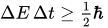
The uncertainty principle states the uncertainty in energy and time can be related by , where 1/2ħ ≈ 5.27286×10⁻³⁵ J⋅s. This means that pairs of virtual particles with energy and lifetime shorter than are continually created and annihilated in empty space. Although the particles are not directly detectable, the cumulative effects of these particles are measurable. For example, without quantum fluctuations, the "bare" mass and charge of elementary particles would be infinite; from renormalization theory the shielding effect of the cloud of virtual particles is responsible for the finite mass and charge of elementary particles.


Another consequence is the Casimir effect. One of the first observations which was evidence for vacuum fluctuations was the Lamb shift in hydrogen. In July 2020, scientists reported that quantum vacuum fluctuations can influence the motion of macroscopic, human-scale objects by measuring correlations below the standard quantum limit between the position/momentum uncertainty of the mirrors of LIGO and the photon number/phase uncertainty of light that they reflect.
In quantum field theory, fields undergo quantum fluctuations. A reasonably clear distinction can be made between quantum fluctuations and thermal fluctuations of a quantum field (at least for a free field; for interacting fields, renormalization substantially complicates matters). An illustration of this distinction can be seen by considering relativistic and non-relativistic Klein–Gordon fields: For the relativistic Klein–Gordon field in the vacuum state, we can calculate the propagator that we would observe a configuration at a time t in terms of its Fourier transform to be


In contrast, for the non-relativistic Klein–Gordon field at non-zero temperature, the Gibbs probability density that we would observe a configuration at a time is

These probability distributions illustrate that every possible configuration of the field is possible, with the amplitude of quantum fluctuations controlled by the Planck constant , just as the amplitude of thermal fluctuations is controlled by , where kB is the Boltzmann constant. Note that the following three points are closely related:


A classical continuous random field can be constructed that has the same probability density as the quantum vacuum state, so that the principal difference from quantum field theory is the measurement theory (measurement in quantum theory is different from measurement for a classical continuous random field, in that classical measurements are always mutually compatible – in quantum-mechanical terms they always commute).
Hub AI
Quantum fluctuation AI simulator
(@Quantum fluctuation_simulator)
Quantum fluctuation
In quantum physics, a quantum fluctuation (also known as a vacuum state fluctuation or vacuum fluctuation) is the temporary random change in the amount of energy in a point in space, as prescribed by Werner Heisenberg's uncertainty principle. They are minute random fluctuations in the values of the fields which represent elementary particles, such as electric and magnetic fields which represent the electromagnetic force carried by photons, W and Z fields which carry the weak force, and gluon fields which carry the strong force.
The uncertainty principle states the uncertainty in energy and time can be related by , where 1/2ħ ≈ 5.27286×10⁻³⁵ J⋅s. This means that pairs of virtual particles with energy and lifetime shorter than are continually created and annihilated in empty space. Although the particles are not directly detectable, the cumulative effects of these particles are measurable. For example, without quantum fluctuations, the "bare" mass and charge of elementary particles would be infinite; from renormalization theory the shielding effect of the cloud of virtual particles is responsible for the finite mass and charge of elementary particles.
Another consequence is the Casimir effect. One of the first observations which was evidence for vacuum fluctuations was the Lamb shift in hydrogen. In July 2020, scientists reported that quantum vacuum fluctuations can influence the motion of macroscopic, human-scale objects by measuring correlations below the standard quantum limit between the position/momentum uncertainty of the mirrors of LIGO and the photon number/phase uncertainty of light that they reflect.
In quantum field theory, fields undergo quantum fluctuations. A reasonably clear distinction can be made between quantum fluctuations and thermal fluctuations of a quantum field (at least for a free field; for interacting fields, renormalization substantially complicates matters). An illustration of this distinction can be seen by considering relativistic and non-relativistic Klein–Gordon fields: For the relativistic Klein–Gordon field in the vacuum state, we can calculate the propagator that we would observe a configuration at a time t in terms of its Fourier transform to be
In contrast, for the non-relativistic Klein–Gordon field at non-zero temperature, the Gibbs probability density that we would observe a configuration at a time is
These probability distributions illustrate that every possible configuration of the field is possible, with the amplitude of quantum fluctuations controlled by the Planck constant , just as the amplitude of thermal fluctuations is controlled by , where kB is the Boltzmann constant. Note that the following three points are closely related:
A classical continuous random field can be constructed that has the same probability density as the quantum vacuum state, so that the principal difference from quantum field theory is the measurement theory (measurement in quantum theory is different from measurement for a classical continuous random field, in that classical measurements are always mutually compatible – in quantum-mechanical terms they always commute).