Hubbry Logo
Canadian CorpsCanadian CorpsMain
Open search
Canadian Corps
Community hub
Canadian Corps
logo
8 pages, 0 posts
0 subscribers
Be the first to start a discussion here.
Canadian Corps
Canadian Corps
from Wikipedia
Canadian Corps
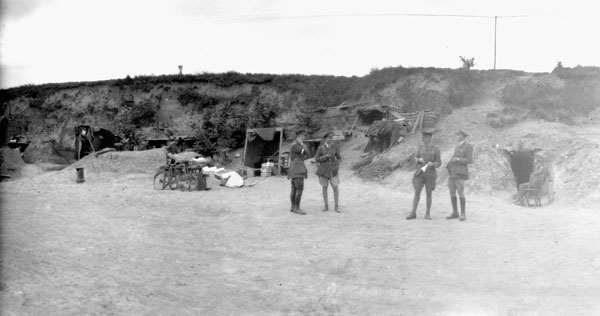
Canadian Corps Headquarters, Neuville-Vitasse, France, 1918
Active1915–1919
Country Canada
BranchCanadian Expeditionary Force
Size4 divisions
Part ofVarious British field armies
Commanders
1915–1916General Sir Edwin Alderson
1916–1917General Sir Julian Byng
1917–1919General Sir Arthur Currie

The Canadian Corps was a World War I corps formed from the Canadian Expeditionary Force in September 1915 after the arrival of the 2nd Canadian Division in France. The corps was expanded by the addition of the 3rd Canadian Division in December 1915 and the 4th Canadian Division in August 1916. The organization of a 5th Canadian Division began in February 1917 but it was still not fully formed when it was broken up in February 1918 and its men used to reinforce the other four divisions.

The majority of soldiers of the Canadian Corps were British-born Canadians until near the end of the war, when the number of those of Canadian birth who had enlisted rose to 51 percent.[1] They were mostly volunteers, as conscription was not implemented until the end of the war (see Conscription Crisis of 1917). Ultimately, only 24,132 conscripts made it to France before 11 November 1918. In the later stages of the war the Canadian Corps was regarded by friend and foe alike as one of the most effective Allied military formations on the Western Front.[2]

History

[edit]
A Canadian recruiting poster
Painting:"Ghosts of Vimy Ridge"

Although the corps was within and under the command of the British Expeditionary Force, understandably there was considerable political pressure in Canada, especially following the Battle of the Somme, in 1916, to have the corps fight as a single unit rather than have the divisions dissipated through the whole army.[3] The corps was commanded by Lieutenant General Sir E.A.H. Alderson, until 1916. Political considerations[4] caused command to be passed to Lieutenant-General Sir Julian Byng. When Byng was promoted to a higher command during the summer of 1917, he was succeeded by General Sir Arthur Currie, the commander of the 1st Division, giving the corps its first Canadian commander. Currie was able to reconcile the desire for national independence with the need for Allied integration. He resisted pressure to replace all British officers in high-ranking positions, retaining those who were successful until they could be replaced by trained and experienced Canadians.[3] British staff officers made up a considerable part of the Corps – although by 1917, 7 of 12 infantry brigades were commanded by Canadians trained during the war, British regulars were the staff officers of the divisions and British officers held two-thirds of senior appointments across the infantry, artillery and Corps headquarters with only four of the most senior appointments being Canadian. Among the British officers were Alan Brooke (at the time a major of the Royal Artillery who planned the artillery barrages for Vimy Ridge and later) and William Ironside. Both eventually became Field Marshals and held the position of Chief of the Imperial General Staff.[5]

The Canadian Corps captured Vimy Ridge in April, 1917, in a daring attack that was a turning point in the war, and as Currie called it, "the grandest day the Corps ever had".[6] During the German spring offensive of the spring and summer of 1918, the Canadian Corps supported British and French soldiers while they held the Germans back.[7] Between August 8 and 11, 1918, the corps spearheaded the offensive during the Battle of Amiens. Here a significant defeat was inflicted on the Germans, causing the German commander-in-chief, General Erich Ludendorff, to call August 8 "the black day of the German army." This battle marked the start of the period of the war the French later named "Canada's Hundred Days". After Amiens, the Canadian Corps continued to help lead the vanguard of an Allied push that ultimately ended on 11 November 1918 at Mons where the British Empire had first met in conflict with Imperial German forces in 1914.[8]

At the end of war the Canadian 1st and 2nd Divisions took part in the occupation of Germany and the corps was eventually demobilized in 1919.[9] Upon their return home the veterans were greeted by large and welcoming crowds all across the country.[8] Total fatal battle casualties during the war was 56,638, 13.5% of the 418,052 sent overseas and 9.26% of the 611,711 who enlisted.[10]

Canadian Corps divisions

[edit]
Canadian divisions[11]
Unit Formation patch Active Commanders Duration Major battles
1st Canadian Division
Established: August 1914
Disbanded: 1919
Edwin Alderson March 1915 – Sept 1915 Second Battle of Ypres
Arthur Currie
Sept 1915 – June 1917 Battle of Mont Sorrel
Battle of the Somme
Battle of Vimy Ridge
Archibald Cameron Macdonell
June 1917 – 1919 Battle of Hill 70
Battle of Passchendaele
2nd Canadian Division
Established: May 1915
Disbanded: 1919
Sam Steele
May 1915 – Aug 1915 None
Richard Turner
Sept 1915 – Dec 1916 Battle of the Somme
Henry Edward Burstall
Dec 1916 – 1919 Battle of Vimy Ridge
Battle of Passchendaele
3rd Canadian Division
Established: Jan 1916
Disbanded: 1919
Malcolm Mercer
Dec 1915 – Jun 1916
(died in combat)
Battle of Mont Sorrel
Louis Lipsett
Jun 1916 – Sep 1918 Battle of the Somme
Battle of Vimy Ridge
Battle of Passchendaele
Frederick Oscar Warren Loomis
Sep 1918 – 1919 None
4th Canadian Division
Established: Apr 1916
Disbanded: 1919
David Watson
Apr 1916 – 1919 Battle of Vimy Ridge
Battle of Passchendaele
Battle of Amiens
Battle of Arras
Battle of Cambrai
5th Canadian Division
Established: Feb 1917
Disbanded: Feb 1918
Garnet Hughes
Feb 1917 – Feb 1918 None

Battles

[edit]

Following its formation in late 1915, the Canadian Corps readied to fight major battles as a unified entity, beginning in 1916. Additional actions were fought by one or more units of the corps (see separate listings for the divisions, above). Major battles fought by the corps were the following:

1916

[edit]

1917

[edit]

1918

[edit]

Assessment

[edit]

The military effectiveness of the corps has been extensively analyzed. The corps evolved steadily following the 1915 summer campaign. As Godefroy (2006) notes, the Canadian Expeditionary Force "worked ceaselessly to convert all of its available political and physical resources into fighting power."[2] One striking feature of the corps' evolution was its unique commitment and ability to exploit all opportunities for learning. This was a corps-wide activity, involving all levels from the commander to the private soldier. This ability to learn from allied successes and mistakes made the corps increasingly successful. Doctrine was tested in limited engagements and, if proven effectual, developed for larger scale battles. Following each engagement, lessons were recorded, analyzed and disseminated to all units. Doctrine and tactics that were ineffective or cost too many lives were discarded and new methods developed. This learning process, combined with technical innovation and competent senior leadership in theatre created one of the most effective allied fighting forces on the Western Front.[2]

Ruthlessness and Prisoner Treatment

[edit]

This adaptive approach also shaped the Corps' reputation for ruthlessness, particularly in trench raids and the treatment of surrendering enemies, which enhanced its fearsome image among German forces.[12][13] German commanders reportedly reinforced sectors when facing Canadians, viewing them as "shock troops" prone to minimal quarter.[13][14] This reputation stemmed from aggressive tactics, the Corps' volunteer-heavy composition, and the brutalizing conditions of trench warfare, where similar acts occurred across all armies.[12][15]

Trench Raids and Deceptive Tactics

[edit]

The Corps pioneered large-scale trench raids for intelligence and morale disruption, often resulting in no-quarter combat due to the risks of escorting prisoners during withdrawals.[16] A notable incident near Ypres (1916–1917), recounted in A Canadian Who Went, involved tossing corned beef tins to lure starving Germans before attacking with grenades and rifles, described as "gifts from hell".[17] Similar deceptions, such as exploiting Christmas truces, reinforced this image, as in the 1915 incident where Canadians responded to German greetings with machine-gun fire.[15]

Killing of Surrendering Prisoners

[edit]

Executions of surrendering Germans were widespread, driven by revenge, safety concerns, and battlefield chaos.[12][18] Historian Tim Cook documented cases like Lieutenant R. C. Germain's bayoneting of prisoners ("a foot of cold steel thro them") and reprisals fueled by the debunked "Crucified Canadian" rumor of 1915.[12] While 42,000 Germans were captured overall, such killings were common in the fraught "politics of surrender".[12][15]

Context and Legacy

[edit]

Motivations included fear of prisoners alerting enemies and revenge for alleged atrocities; though not unique, these acts amplified the Corps' reputation.[18] Postwar, they contributed to veterans' trauma, with historians like Cook urging a re-examination of sanitized narratives.[15]

In literature

[edit]

Bartholomew Bandy, hero of The Bandy Papers series of humorous novels by Donald Jack, initially served as an infantry officer in the Canadian Corps before transferring to the Royal Flying Corps.

A large part of Robertson Davies' 1970 novel Fifth Business is devoted to the protagonist's experiences as a soldier in the Canadian Corps.

Lucy Maud Montgomery’s novel Rilla of Ingleside, (the 8th book in the “Anne of Green Gables” series), is one of the first successful commercial publications focusing on Canadian civilian and soldier World War I experiences. It is the only Canadian novel written of the First World War by a contemporary. It is also one of the first texts to mention the Gallipoli campaign as well as the ANZACs.

References

[edit]

Bibliography

[edit]

Further reading

[edit]
[edit]
Revisions and contributorsEdit on WikipediaRead on Wikipedia
from Grokipedia
The Canadian Corps was a field corps of the Canadian Expeditionary Force (CEF), formed in September 1915 in following the arrival of the , which enabled the consolidation of Canadian units into a unified command structure separate from British divisions. Initially comprising two divisions with approximately 35,000 troops, it expanded to four divisions—each with three brigades—and supporting corps-level , engineers, and logistics units, peaking at over 100,000 personnel by 1918. Commanded first by British Lieutenant-General Sir Julian Byng from May 1916, the Corps transitioned to full Canadian leadership under Lieutenant-General Sir in June 1917 after Byng's promotion, marking a in Canadian military autonomy within the British Expeditionary Force. The Corps distinguished itself through rigorous training, adaptive tactics—including innovative creeping barrages and infantry-artillery coordination—and a reputation for reliability amid high casualties, contributing decisively to Allied victories on the Western Front. Key achievements included the capture of Vimy Ridge in April 1917, a symbolically resonant success that unified Canadian while demonstrating superior preparation over prior British and French attempts; assaults at Hill 70 and Passchendaele later that year; and a pivotal role in the of 1918, where its divisions advanced rapidly, breaking German lines and hastening the war's end. These operations underscored the Corps' evolution from novice formations to an elite shock force, though at the cost of over 60,000 Canadian deaths and 170,000 wounded across the CEF. Under Currie's emphasis on , conservation of manpower, and deliberate pacing, the Corps avoided unnecessary risks, fostering a doctrine of calculated aggression that influenced post-war military thought.

Formation and Organization

Establishment and Initial Structure

The Canadian Corps was established on 13 September 1915, following the arrival of the in , which necessitated a unified operational and administrative structure for the expanding (CEF) overseas. Prior to this, the had operated independently under British higher command since its deployment in early 1915, but the influx of additional units from the CEF required centralized Canadian leadership to manage training, reinforcements, and front-line responsibilities. The Corps headquarters was opened at Bailleul, , on the same date, assuming control of approximately 4,400 yards of front line from Ploegsteert Wood to the Wulverghem-Messines road. Command was initially vested in Lieutenant-General Sir Edwin Alderson, a British officer appointed to lead Canadian forces due to his prior experience and the limited availability of qualified Canadian generals at the time. His staff included Brigadier-General C.H. Harington as Brigadier-General General Staff (BGGS), Brigadier-General T.B. Wood as Deputy Adjutant and Quartermaster-General (DA&QMG), and Brigadier-General H.E. Burstall as General Officer Commanding (GOC RA). The divisional commanders were Major-General A.W. for the 1st Division and Major-General S.B. Turner for the 2nd Division. Initially, the Corps comprised two infantry divisions, supported by corps-level troops including the Canadian Cavalry Brigade, field artillery brigades (1st, 2nd, and 3rd Canadian Field Artillery), Corps Heavy Artillery, Royal Canadian Horse Artillery Brigade, Canadian Engineers field companies, and various pioneer, medical, and railway units. By late September 1915, its strength totaled 1,354 officers and 36,522 other ranks, with reinforcements organized into twelve reserve battalions grouped into four reserve brigades affiliated with the field formations. This structure operated under the British Second Army's V Corps, reflecting the Corps' integration into the British Expeditionary Force while maintaining distinct Canadian administrative control.

Divisions and Manpower

The Canadian Corps was structured around four infantry divisions—the 1st Canadian Division, 2nd Canadian Division, 3rd Canadian Division, and 4th Canadian Division—which formed its primary combat elements on the Western Front. The 1st Division originated from the initial contingent of the Canadian Expeditionary Force (CEF), which departed Canada on October 3, 1914, comprising approximately 31,000 personnel organized into a single division. The arrival of the 2nd Division in September 1915 enabled the Corps' formal activation under British command, with the 3rd and 4th Divisions following in late 1915 and mid-1916, respectively, expanding the formation to its standard operational size. Each division followed a British Empire organizational model, including three infantry brigades (each with four battalions totaling about 12,000 riflemen), divisional artillery (typically 48 field guns and additional heavy batteries), engineers, cyclists, and support units, with an establishment strength of roughly 17,000–18,000 all ranks per division. Manpower for the Corps began modestly at around 35,000 troops across its first two divisions upon activation in , but grew to a peak of over 100,000 soldiers by mid-1918 during the , incorporating corps-level troops such as additional artillery, signals, and logistical elements beyond the divisions. This expansion drew from the broader CEF, which enlisted over 620,000 Canadians overall, with approximately 424,000 serving overseas, though the represented the CEF's core fighting force committed to sustained combat in and . A was raised in Britain in early amid political pressures for further expansion, but manpower constraints led to its dissolution by , with its personnel redistributed as reinforcements to maintain the four-division ' effectiveness amid high attrition rates. The ' ability to sustain this strength relied on a reinforcement system funneling drafts from , including voluntary enlistees and, after , conscripts under the Military Service Act, though reinforcement shortfalls increasingly strained by war's end.

Command and Administrative Framework

The Canadian Corps was formed on 13 September 1915 under the command of Lieutenant-General Sir Edwin Alderson, a British officer appointed to lead the newly consolidated 1st and 2nd Canadian Divisions along with supporting Corps Troops, totaling approximately 37,000 personnel by late September. Alderson's tenure, which began with the 1st Division in October 1914 and extended to the Corps' operational command in , emphasized integration into British Expeditionary Force (BEF) structures, but ended on 28 May 1916 amid criticism of handling the St. Eloi craters battle in April. He was succeeded by Lieutenant-General Sir Julian Byng, another British officer, who assumed command on 28 May 1916 and directed the Corps through key engagements including Vimy Ridge in April 1917, fostering tactical cohesion across its expanding four divisions. Byng relinquished command on 9 June 1917 to lead the British Third Army, marking the transition to Lieutenant-General Sir , the first Canadian to hold the position, who commanded until the on 11 November 1918 and prioritized national autonomy in operations. Administratively, the Corps headquarters, initially established at Bailleul, France, and later mobile during advances, comprised specialized branches: the General Staff (G) for and under a Brigadier-General (e.g., C.H. Harington until June ); the Adjutant-General's (A) for personnel and discipline; and the Quartermaster-General's (Q) for supply and transport, supported by dedicated artillery (under Brigadier-General H.E. Burstall), engineering, and medical units. Reinforcement and logistics flowed through Canadian base depots at and , reorganized into five specialized depots by May 1917, with a Corps Reinforcement Camp established in 1917 to maintain divisional strength amid heavy casualties. While operationally subordinate to commanders—such as General Sir Douglas Haig's BEF and sector armies like under Sir Herbert Plumer—the Corps gained administrative independence through the Ministry of Overseas Military Forces of Canada, created in October to oversee supply, reinforcements, and policy from , reducing direct interference and enabling to resist British proposals for Corps disbandment in 1918. This framework supported a peak strength of nearly 110,000 under Currie, with Canadian sections at British GHQ from July 1918 enhancing coordination without full integration.

Early Operations

Deployment to the Western Front (1915)

The , under the command of Major-General Edwin Alderson, embarked from in early February 1915, with key transports departing on 4 February, 9–10 February, and 10 February. The division arrived in between 10 and 16 February 1915, landing at ports including St. Nazaire, Boulogne, and , before concentrating in the Cassel and areas by mid-February after rail transport covering over 500 miles. Initially positioned as a reserve to the British III Corps east of , the division underwent indoctrination attached to the British 6th and 4th Divisions from 17 February to 2 March 1915. On 28 February to 3 March 1915, the 1st Division relieved the British 7th Division, taking over a 6,400-yard front near Fleurbaix in the Armentières sector, marking its entry into active duty under the British IV Corps. This deployment exposed Canadian troops to static warfare conditions, including rudimentary systems and exchanges, while preparing for larger engagements; the division supported the British demonstration at Neuve Chapelle from 10 to 12 March 1915 with and small-arms fire but did not commit . By early April 1915, elements shifted to the , relieving French troops on 4 April and assuming positions along a sector south of , where they faced their first major test amid the German gas attack during the Second starting 22 April. The arrival of the 2nd Canadian Division in September 1915 bolstered Canadian strength on the Western Front; having sailed from Canada in May 1915 and trained briefly in England at Shorncliffe, it crossed to France between 15 and 18 September, concentrating near the front. This enabled the formal establishment of the Canadian Corps on 13 September 1915 in the Bailleul area, initially comprising the 1st and 2nd Divisions under Lieutenant-General Alderson's command, transitioning Canadian forces from ad hoc attachments to British corps to a unified national formation capable of independent operations. The Corps headquarters coordinated logistics, reinforcements, and training, drawing on approximately 20,000 troops per division, though early challenges included equipment shortages like the Ross rifle's jamming issues under gas and mud conditions. By late 1915, the Corps held sectors such as Ploegsteert, relieving British units between 19 and 23 September, solidifying its role in the ongoing trench stalemate.

Somme Offensive (1916)

The Canadian Corps, under the command of Lieutenant-General Sir Julian Byng since May 1916, was transferred from the sector to the Somme front in late August 1916, relieving exhausted British units amid the ongoing Allied offensive. Comprising the 1st, 2nd, and 3rd Canadian Divisions at that time, with the 4th Division arriving later, the Corps entered a battlefield marked by attritional fighting, deep German defenses, and mud-churned terrain following months of bombardment and assaults. The Corps' first significant engagement came during the Battle of Flers-Courcelette from 15 to 22 September 1916, where the , supported by British tanks in their combat debut and a creeping barrage, assaulted and captured the fortified village of Courcelette on 15 September. The attack involved the 5th and 6th Infantry Brigades advancing behind precise fire to overrun German positions, securing the village ruins despite fierce counterattacks and machine-gun fire; this marked one of the few tactical successes for Allied forces on the Somme, demonstrating improved infantry- coordination. The 1st and 3rd Divisions supported subsequent consolidation efforts, holding gains against German attempts to retake the objective. Throughout October and into November, the Canadian Corps conducted further assaults on entrenched German lines, including repeated attacks on Regina Trench—a key defensive position north of Courcelette. The 1st Division captured sections of the trench on 8 October but faced heavy losses from enfilading fire and counterattacks; the 4th Division, newly committed, achieved a final seizure of remaining portions on 11 November, just before the offensive's end due to worsening weather. These operations involved grueling advances over shell-torn ground, with troops enduring rain, cold, and supply shortages that exacerbated fatigue and disease. The Corps' participation from September to mid-November 1916 resulted in 24,029 , including approximately 8,000 dead, representing a quarter of its fighting strength and underscoring the offensive's human cost amid limited territorial gains of less than three kilometers. Despite the attrition, the experience honed Canadian tactics, emphasizing rehearsed assaults, , and engineering support, which informed future operations.

Major Battles

Arras and Vimy Ridge (1917)

The Battle of opened on April 9, 1917, with the Canadian Corps, comprising its four divisions under Lieutenant-General Julian Byng, tasked with seizing Vimy Ridge to secure the northern flank of the British First Army's advance. This heavily fortified seven-kilometer escarpment had repelled previous French and British assaults, featuring deep trench networks, machine-gun nests, and entanglements. The Corps' preparation involved meticulous training, including full-scale rehearsals on replica terrain, extensive underground tunneling for troop assembly, and a two-week beginning March 20 that fired over 1,000,000 shells to disrupt German defenses. At 5:30 a.m. on , April 9, amid a blinding snowstorm, the assault commenced with creeping barrages guiding waves of —approximately 15,000 to 20,000 in the initial advance—supported by engineers clearing paths through wire and tanks providing limited assistance. The 1st, 2nd, and 3rd Divisions captured most objectives by day's end, including the strategically vital Hill 145, while the 4th Division faced delays but secured the eastern ridge by after intense counterattacks. German forces, from the 6th , inflicted heavy losses through enfilade fire and reserves, but the overran multiple lines, capturing 4,000 prisoners and 100 guns in the ridge sector alone. Following the ridge's capture, the Canadian Corps participated in subsequent phases of the Arras offensive, including the Second Battle of the Scarpe on April 23–24 and the Third on May 3–4, advancing toward Oppy Wood and Fresnes but encountering stiffened resistance and muddy terrain that halted deeper penetrations. These actions yielded additional gains—such as 2,000 prisoners in April—but at escalating costs, with the Corps suffering repeated counter-barrages and machine-gun fire. Overall Arras involvement from April 9 to mid-May resulted in the Canadians advancing up to six kilometers in places, far exceeding prior British efforts in ground seized and materiel captured relative to their sector, though the broader offensive stalled without breaking the . The operations exacted a severe toll, with Canadian casualties totaling 10,602 at alone—including 3,598 fatalities—and over 12,000 more in ensuing fighting, representing nearly one-third of the Corps' effective strength. This success, the first coordinated action by all four divisions, demonstrated effective infantry-artillery coordination and platoon-level initiative, fostering and national pride, though it occurred amid the battle's strategic disappointment for Allied forces, marked by 160,000 British casualties overall.

Hill 70 and Third Ypres (1917)

The Canadian Corps, under Lieutenant-General Sir , launched an assault on Hill 70 on August 15, 1917, southeast of Lens, as a diversionary operation to relieve pressure on the ongoing Third Battle of Ypres and disrupt German defenses around Lens. The primary objective was to seize the hill for its commanding elevation, enabling artillery observation over Lens, rather than capturing the city itself, with three divisions (1st, 2nd, and 3rd) committed alongside supporting British units. Employing refined set-piece tactics developed post-Vimy, including detailed intelligence gathering, creeping barrages, and infantry-artillery coordination, the Canadians overran German positions in initial advances, capturing the hill by day's end despite encountering fortified trenches and machine-gun nests. German forces mounted 21 counterattacks over the following days, the most intense on August 16 and 17, seeking to reclaim the position, but Canadian defenders, bolstered by machine-gun fire, flamethrowers, and pre-planned defensive barrages, repelled them all, inflicting disproportionate losses. The battle concluded by , with the Corps holding Hill 70 and adjacent ground, though follow-on operations around Lens yielded limited gains due to entrenched German resistance. Canadian casualties totaled approximately 9,200 killed, wounded, or missing, while German losses exceeded 20,000, with five to seven divisions severely depleted, validating the operation's strategic intent despite Currie's assessment of it as the Corps' most grueling engagement. In late October 1917, as the Third Battle of bogged down in ' mud-churned terrain, the Canadian Corps relieved exhausted ANZAC and British formations east of , tasked with capturing Passchendaele village and ridge to secure naval gun support for Allied shipping in the . Operations commenced on October 26 with the 3rd and 4th Divisions advancing amid relentless rain, deep shell craters filled with water, and collapsing roads, conditions that caused many wounded to drown before evacuation. Incremental assaults on October 30 and November 2 gained ground but at high cost, with troops navigating , flooded trenches, and enfilading fire from German pillboxes. By November 6, coordinated attacks by the 4th Division, supported by limited tank assistance and engineers building corduroy roads over the mire, secured the ruins of Passchendaele, fulfilling Haig's directive despite negligible strategic advantage from the broader offensive. The Corps' involvement from mid-October to early November resulted in over 16,000 casualties, including more than 4,000 fatalities, underscoring the battle's pyrrhic nature where tactical proficiency yielded objectives but minimal territorial or operational gains amid the quagmire.

Hundred Days Offensive (1918)

The Hundred Days Offensive, spanning 8 August to 11 November 1918, featured the Canadian Corps under Lieutenant-General Sir Arthur Currie executing a sequence of meticulously planned assaults that exploited German exhaustion after their Spring Offensive, leveraging combined arms integration including infantry, artillery, tanks, and air support to achieve rapid penetrations of fortified lines. The Corps' operations emphasized surprise, limited objectives, and exploitation of breakthroughs, resulting in substantial territorial gains and contributing to the collapse of German defenses leading to the Armistice. The offensive commenced with the Battle of Amiens on 8 August 1918, where the Canadian Corps spearheaded the assault against the German Fourth Army in a surprise attack eschewing preliminary bombardment, instead employing smoke screens, night movements, over 600 tanks, 2,000 aircraft, and concentrated to advance up to 12 km on the first day while capturing 5,033 prisoners. The battle continued until 11 August, with Canadians pushing back German positions significantly, though at the cost of over 11,800 casualties, including 1,036 killed and 2,803 wounded on the opening day alone. In the ensuing pursuit, the Corps participated in the Second Battle of from 26 August to 3 September 1918, capturing key positions like Monchy-le-Preux and breaking through the fortified Drocourt-Quéant Line on 2–3 September with support from British divisions and tanks, securing 3,300 prisoners, 53 heavy guns, and 519 machine guns but incurring approximately 11,000 casualties. This breakthrough forced German withdrawal toward the Canal du Nord. Further east, in the Battle of the Canal du Nord starting 27 September 1918, Canadian forces under targeted a narrow 2-km dry canal bed for crossing, using intense barrages, engineer bridges, and 15 tanks to secure the crossing by 9:15 a.m., subsequently overrunning Bourlon Wood and the Marcoing Line by 29 September, capturing 7,000 prisoners and 250 guns at a toll exceeding 10,000 casualties. Subsequent engagements included the capture of from 9–12 October 1918 and in early , culminating in the advance to Mons where the took effect on 11 . Across the , the Canadian Corps advanced 130 km, liberated more than 27 villages, and captured around 32,000 prisoners, achievements marred by over 45,000 casualties, comprising more than 6,800 killed and 39,000 wounded.

Tactical Innovations

Evolution of Infantry Tactics

The Canadian Corps initially employed British infantry tactics characterized by massed waves advancing across open ground, which proved costly during early engagements like the in April 1915 and the Somme Offensive in July-November 1916, where the 1st and 2nd Canadian Divisions suffered over 24,000 casualties in a single day on July 1, 1916. These methods exposed troops to devastating machine-gun fire, prompting commanders Julian Byng and to prioritize adaptation through rigorous training and analysis of failures. By late 1916, the Corps shifted toward decentralized platoon-level tactics, emphasizing fire-and-movement where Lewis light machine guns provided suppressive fire to enable small-unit maneuvers, a refinement borrowed and enhanced from British experiments but systematically drilled in Canadian formations. This evolution culminated in preparations for the Battle of Vimy Ridge in April 1917, where infantry rehearsed on full-scale trench models, learning to advance in short bounds behind a precisely timed creeping barrage—artillery shells exploding 50-100 yards ahead to neutralize defenders without allowing recovery time. The tactic required infantry to hug the barrage closely, using shell craters for cover, resulting in the capture of the ridge on April 9-12 with coordinated advances across a 6.4 km front. Under Currie's command from June 1917, further integrated specialist roles—"vertical infantry"—assigning troops to tasks like carrying parties, signallers, and mopping-up squads, reducing confusion in fluid advances during operations like Hill 70 in August 1917 and the starting August 8, 1918. Emphasis on and minimized enemy artillery threats, allowing to exploit breakthroughs with rapid pursuit tactics that prioritized depth over breadth, contributing to the Corps' reputation for efficiency with fewer casualties per objective gained compared to earlier Allied efforts. This adaptive approach, informed by after-action reviews and operational research, marked a transition from attritional assaults to principles.

Integration of Artillery and Engineering

The Canadian Corps developed a sophisticated integration of and units to support assaults, enabling rapid advances while minimizing exposure to enemy fire. This approach evolved from earlier experiences on the Somme in , where barrages were coordinated with engineer tasks such as road repairs and wire-cutting, but reached maturity in set-piece attacks through precise timing and operational research. staffs, including counter-battery sections, used sound-ranging and flash-spotting to neutralize German guns, allowing engineers to focus on forward preparation without excessive disruption. A key tactic was the creeping barrage, a rolling curtain that advanced ahead of at a rate of 100 yards every three to five minutes, suppressing defenders and machine guns while engineers marked safe paths through and shell craters. At the on April 9, 1917, this method was executed with over 1,000 guns firing in phases, complemented by engineers who had pre-dug 11 kilometers of tunnels and assembly trenches to position troops just 100 meters from objectives. Engineers from the Canadian Corps' tunneling companies, drawing on mining expertise, installed underground infrastructure including command posts, medical bays, and ammunition dumps, reducing the time troops spent in exposed positions. During the Hundred Days Offensive in 1918, this integration proved decisive in crossing obstacles like the Canal du Nord on September 27, where Royal Canadian Engineers constructed 10 footbridges and cleared minefields under covering fire from field and heavy batteries, facilitating the 1st and 4th Divisions' assault. Artillery observers embedded with engineer units adjusted fire to protect bridging parties from counter-battery response, while tramways and temporary roads built by engineers ensured ammunition supply to guns, sustaining barrages for up to 48 hours. Such coordination, refined through Corps-level planning under commanders like , allowed the Corps to outpace logistical constraints and exploit breakthroughs, capturing over 190 guns in the campaign. This synergy extended to defensive roles, where engineers fortified positions with concrete pillboxes and anti-tank ditches, backed by registration for rapid response, contributing to the Corps' reputation for methodical yet aggressive operations. The reliance on empirical data from post-action analyses ensured adaptations, such as increasing engineer attachments to brigades for real-time obstacle reduction during predicted shoots.

Operational Research and Adaptation

The Canadian Corps integrated operational research through dedicated specialist staffs that applied empirical analysis and scientific methods to warfare challenges, particularly in counter-battery operations, gas defense, and machine-gun employment. Lieutenant-Colonel Andrew G. L. McNaughton, appointed Counter-Battery Staff Officer on 10 February 1917, spearheaded these efforts by combining principles with battlefield data collection, including sound-ranging to detect enemy gun flashes via microphones and flash-spotting for visual . by the Royal Flying Corps supplemented these techniques, accounting for approximately 75% of counter-battery targeting at key engagements. These methods enabled the Corps to locate and neutralize German positions more effectively than earlier approaches, reducing the dominance of enemy shellfire that had inflicted heavy losses in prior offensives. At the on 9 April 1917, McNaughton's team engaged 47 identified German batteries, achieving significant neutralization despite 83% remaining active at the assault's outset; this contributed to the Corps' capture of objectives, though shellfire still caused 72% of the 10,602 Canadian casualties. Post-engagement reviews prompted adaptations, such as expanding the counter-battery staff to include dedicated intelligence and operations officers, along with rigorous testing of communications like versus pigeon messaging. Similar analytical processes informed gas and machine-gun sections, where data from trench raids and captured documents refined defensive tactics and offensive barrages, fostering a cycle of trialing, experimentation, and doctrinal dissemination. By Hill 70 in August 1917, these refinements neutralized 40 to 63 of an estimated 102 German batteries, demonstrating iterative improvements in fire planning. The Corps' broader adaptation exemplified a , systematically processing lessons from failures like the Somme Offensive (September-November 1916), where over 24,000 casualties underscored deficiencies in artillery-infantry coordination, to evolve set-piece attacks. After-action reports, trench raids, and external observations—such as French tactics at —drove single- and , with commanders Julian Byng and institutionalizing knowledge retention through mandatory rehearsals and centralized planning. This culminated in platoon-centric tactics emphasizing Lewis guns, rifle grenades, and creeping barrages, first effectively tested at Vimy Ridge following intensive preparations from to 1917. During the (August-November 1918), operational research adapted to mobile warfare by prioritizing predicted fire for rapid neutralization over destruction, integrating tank support (e.g., 36 per division at on 8 August 1918) and engineering solutions like canal crossings at Drocourt-Quéant (26 August 1918). Pauses of 4-6 hours between phases, informed by intelligence assessments of 2,600-yard fronts, mitigated risks exposed in earlier rapid advances, yielding successes such as 27,000 German casualties at against 3,868 Canadian losses. These evolutions, grounded in empirical data rather than untested assumptions, enhanced the Corps' operational resilience amid high turnover from casualties.

Leadership and Controversies

Key Commanders: Byng and Currie

Lieutenant-General Sir Julian Hedworth George Byng assumed command of the Canadian Corps on 17 May 1916, succeeding British Lieutenant-General Edwin Alderson. Under Byng's leadership, the Corps underwent significant reorganization following heavy losses at the Somme in 1916, including enhanced training regimens, tactical reforms, and improved staff selection processes to boost operational effectiveness. Byng's tenure culminated in the meticulous planning and execution of the assault on Vimy Ridge from 9 to 12 April 1917, where the Corps—comprising its four divisions supported by one British division—captured the strategic escarpment after months of preparation, including underground tunneling, artillery rehearsals, and infantry rehearsals with full equipment. Troops under Byng affectionately referred to themselves as the "Byng Boys," reflecting his popularity and trust earned through emphasis on thorough preparation over reckless assaults. Promoted to command the British Third Army in June 1917, Byng recommended his protégé, Major-General Arthur William Currie—then commander of the —as successor; Currie assumed Corps command on 9 June 1917 as a lieutenant-general, becoming the first Canadian-born officer to lead it. Currie's leadership prioritized detailed reconnaissance, model-based rehearsals, and integrated fire-and-movement tactics, which contributed to the Corps' successes at Hill 70 (15–25 August 1917), Passchendaele (October–November 1917), and the (August–November 1918), including breakthroughs at on 8 August 1918 and Canal du Nord on 27 September 1918. Knighted by King George V on 12 July 1917, Currie was commended by British for his qualifications, with the Corps under him advancing further than any other Allied formation in the war's final months while relatively conserving manpower through adaptive strategies. Both commanders fostered a culture of innovation within the Corps, shifting from attritional warfare toward coordinated, corps-level operations that emphasized artillery-infantry synergy and rapid exploitation of gains.

Command Decisions and Criticisms

Lieutenant-General Sir Julian Byng, who commanded the Canadian Corps from May 1916 until his promotion in June 1917, emphasized thorough preparation and tactical rehearsals in planning the April 1917 assault on Vimy Ridge, incorporating underground tunnels for troop movement, extensive counter-battery artillery fire, and infantry training that enabled the capture of the ridge objectives by April 9. These decisions transformed the Corps into a cohesive fighting force and were lauded for their role in one of the war's few clear Allied victories, with no substantive criticisms leveled against Byng's execution at the time. Major-General Sir succeeded Byng on June 7, 1917, adopting a doctrine of detailed , limited advances, and "bite-and-hold" operations to consolidate gains, as seen in his August 1917 revision of plans at Hill 70, where he abandoned a risky frontal assault on Lens in favor of capturing and defending a nearby height, inflicting 25,000 German casualties while securing the position against counterattacks. This approach yielded tactical successes but faced scrutiny in costlier engagements. At Passchendaele during the Third , personally inspected the quagmire conditions in October 1917 and opposed deploying the there, citing insurmountable terrain challenges, but proceeded under orders from British commander Douglas Haig, executing phased set-piece attacks from October 26 that secured the village by November 6. The operation cost over 4,000 Canadian deaths and 12,000 wounded, prompting contemporary criticism for excessive casualties amid minimal strategic advantage, though 's planning mitigated even higher losses through coordinated artillery-infantry support. In the from August 8, 1918, 's insistence on unified divisional assaults and integration of tanks, aircraft, and artillery drove penetrations at , , and the Hindenburg Line's Drocourt-Quéant sector, advancing farther than in prior years but incurring 45,000 casualties by November. Troops particularly resented the decision to launch an assault on Mons at dawn November 11, before the 11:00 a.m. , which resulted in around 50 deaths and fueled accusations of Currie as a "butcher" heedless of lives in pursuit of prestige. justified the attack as necessary to evict German forces from the town and prevent post-armistice threats, a rationale he defended successfully in a 1928 libel against a newspaper alleging vainglory. His aloof style further alienated enlisted men, who contrasted it with more charismatic leaders, amplifying perceptions of detachment amid the relentless attrition. The Canadian Corps faced political pressures from the Dominion government in to assert greater operational autonomy from British higher command within the British Expeditionary Force, reflecting broader Canadian aspirations for national amid the war. Although commanded by British officers like Julian Byng until mid-1917, the Corps' successes, such as at Vimy Ridge, amplified demands for Canadian-led control, culminating in Arthur Currie's appointment as corps commander on June 9, 1917, which marked a shift toward national command while still subordinating tactical decisions to Douglas Haig. This transition involved navigating imperial politics, including resistance from British generals wary of diluting their authority over proven formations. Domestically, the Corps' sustainability was strained by Canada's 1917 conscription crisis, enacted via the Military Service Act on August 29, 1917, which imposed compulsory overseas service amid voluntary enlistment shortfalls that threatened to reduce the from four to two divisions. Borden's Unionist government faced vehement opposition, particularly from , where anti-conscription riots erupted in March and April 1918, exacerbating English-French divisions and delaying reinforcements by up to 100,000 men until late 1918. These political fissures indirectly challenged Corps leadership, as and subordinates managed morale and combat effectiveness with inconsistent manpower inflows, prioritizing veteran retention over expansion. Post-war, Currie encountered a prominent legal challenge in a libel suit stemming from accusations that he ordered the Corps' advance on Mons, , on November 10-11, 1918, unnecessarily exposing troops to casualties on the eve of the to bolster his reputation. The allegations, published in the Toronto Evening Telegram on November 12, 1927, by editor J.W.T. Preston and Major-General W.T.R. Preston, claimed Currie ignored armistice intelligence to seize the town for personal glory, resulting in 46 Canadian deaths. Currie filed suit on December 9, 1927, and the trial, held in from May 1-9, 1928, featured testimony from Corps veterans revealing pre-armistice grumbling and fatigue but affirming the advance's strategic necessity to maintain momentum and deny Germans a symbolic victory. The jury awarded Currie $13,500 in damages on May 10, 1928, vindicating his decisions, though the proceedings publicized internal Corps dissent and contributed to his declining health, leading to his death in 1933.

Assessment and Legacy

Military Effectiveness and Achievements

The Canadian Corps earned a reputation as one of the most effective Allied formations on the Western Front during the First World War, attributed to rigorous , tactical , and meticulous planning under commanders like Julian Byng and . This effectiveness was demonstrated through coordinated infantry-artillery operations and a willingness to adapt lessons from prior engagements, enabling the Corps to achieve objectives that eluded previous British and French attempts. By 1918, the Corps consistently advanced further and captured more prisoners relative to casualties compared to typical British divisions, which often suffered from understrength units and less preparation time. A pivotal achievement was the capture of Vimy Ridge from April 9 to 12, 1917, where the Corps fully seized the strategic height after three prior failed assaults by other Allied forces. The operation involved extensive rehearsals, detailed mapping, and creeping barrage tactics, resulting in the advance of over 3,000 meters and the capture of key German positions, though at the cost of 3,598 killed and approximately 7,000 wounded. This success boosted Canadian national morale and showcased the Corps' ability to execute complex assaults with precision. In the starting August 8, 1918, the Canadian Corps played a leading role, advancing 86 miles across multiple battles including and the Canal du Nord, while capturing 31,537 German prisoners and numerous artillery pieces. At alone, the Corps penetrated 8 miles on the first day, taking 5,033 prisoners against 1,036 dead and 2,803 wounded, contributing to the collapse of German defenses without the heavy preliminary bombardments that had previously alerted the enemy. These operations exemplified the Corps' operational tempo and combined-arms integration, which inflicted disproportionate losses on German forces and accelerated the war's end.

Casualties, Losses, and Strategic Impact

The Canadian Corps sustained severe casualties during its campaigns on the Western Front from 1915 to 1918, with the four infantry divisions bearing the brunt of combat losses for the Canadian Expeditionary Force (CEF). Official tallies record approximately 61,000 CEF fatalities, of which the vast majority occurred within the Corps, alongside over 173,000 wounded and around 3,700 prisoners of war or missing; infantry units accounted for roughly 90% of these losses due to their exposure in assaults and holding actions. From August 1916, when the Corps achieved its full establishment of four divisions, through the war's end, it endured recurrent high attrition in battles such as the Somme (24,029 casualties in 1916), Vimy Ridge (10,602 in April 1917), and Passchendaele (15,654 in late 1917), reflecting the Corps' frequent deployment in high-stakes operations. In the decisive from August to October 1918, the Corps spearheaded multiple breakthroughs, incurring 45,835 casualties while advancing over 100 kilometers and capturing more prisoners than any other Allied corps in the period. These losses, though grievous—equating to nearly half the Corps' effective strength at the campaign's start—yielded disproportionate strategic gains, including the surprise assault at on 8 August 1918, where Canadian forces penetrated 13 kilometers on the first day using coordinated infantry, tanks, and aircraft without preliminary bombardment, shattering German morale and lines. Subsequent actions, such as the Battle of the Canal du Nord (27 September–1 October 1918), enabled the breach of the , a fortified defensive system long deemed impregnable, forcing German retreats and contributing causally to the enemy's operational collapse by exhausting reserves and disrupting supply. The Corps' cumulative losses underscored the human cost of its effectiveness, with casualty rates per kilometer advanced declining in 1918 due to refined tactics like thorough , creeping barrages, and infantry-artillery , which minimized unnecessary exposure compared to earlier attritional fights. Strategically, the ' role amplified Allied momentum, capturing key terrain and over 30,000 German prisoners in the final offensives alone, which eroded the ' capacity to sustain defense and hastened the on 11 November 1918; British commander Sir Douglas Haig attributed much of the advance's success to Canadian units' discipline and initiative under Sir . Material losses, including artillery pieces and supplies, were also significant but secondary to personnel attrition, as the relied on imperial for replenishment. Overall, while the toll strained Canada's mobilization—drawing from a pre-war of 8 million—the ' contributions validated its reputation as a shock force, influencing post-war assessments of combined-arms warfare's efficacy in breaking stalemates.

Historiographical Perspectives and Debates

Historiographical interpretations of the Canadian Corps have evolved from early nationalist narratives emphasizing its role in fostering to more analytical assessments of its operational innovations and limitations. Post-war accounts, influenced by veterans' memoirs and initial official histories, portrayed the Corps as a symbol of national maturation, with victories like Ridge in April 1917 framed as a "" moment that unified English and under a distinct command structure separate from British forces. This perspective, prominent in the , prioritized heroic exploits and soldierly resilience over tactical details, often downplaying internal divisions such as the 1917 conscription crisis that strained national unity. Subsequent scholarship in the mid-20th century, including official volumes like G.W.L. Nicholson's Canadian Expeditionary Force, 1914-1919 (1962), shifted toward documenting organizational growth, crediting commanders like Julian Byng and for transforming an initially inexperienced force into a cohesive unit by , capable of coordinated infantry-artillery operations. Modern operational histories, such as those by , highlight the Corps as a "learning organization" that adapted through empirical feedback, achieving higher effectiveness in the of 1918 compared to allied formations, with advances averaging 6-10 km per day against German defenses. These works attribute success to decentralized training, creeping barrages, and , but note that such innovations built on British doctrinal foundations rather than originating uniquely in . Debates persist over the Corps' legacy in national historiography, particularly the exaggerated claim of Vimy Ridge as the "birth of a nation," which scholars like Ian Miller argue oversimplifies pre-war imperial ties and ignores the battle's high cost—10,602 Canadian casualties for a tactical gain that did not decisively alter the war. Critics contend this "Vimyism" myth, perpetuated in popular memory, serves modern narratives at the expense of causal realism, as the Corps' achievements stemmed from prolonged attrition and under British high command rather than innate national genius. Regarding leadership, Arthur Currie's tenure (1917-1919) receives broad acclaim for meticulous planning that minimized casualties relative to gains—e.g., lower proportional losses in assaults—but faces scrutiny over decisions like the Mons advance, where post-war libel suits alleged intelligence manipulation, though courts acquitted him in 1928. Some historians, drawing on archival war diaries, question whether Currie's insistence on Corps unity inflated political tensions with , prioritizing military efficacy over domestic consensus. Recent debates also evaluate the Corps' effectiveness against benchmarks of , with analyses suggesting its adaptive research—e.g., gas defense protocols refined after 1915 —yielded tangible survivability gains, but at the expense of over-reliance on assaults that sustained 24,000 in the final 100 days. While peer-reviewed military journals affirm its distinctiveness from through rigorous preparation, skeptics caution against romanticizing outcomes, noting that overall Canadian losses (over 60,000 dead) reflected broader Western Front realities rather than . These perspectives underscore a tension between empirical operational success and ideological uses of , with contemporary scholars advocating source-critical approaches to veteran accounts and official records to disentangle fact from nationalist embellishment.

References

Add your contribution
Related Hubs
User Avatar
No comments yet.