Hubbry Logo
logo
Carr's
Community hub

Carr's

logo
0 subscribers
Read side by side
from Wikipedia

Carr's is a British biscuit and cracker manufacturer, currently owned by Pladis Global through its subsidiary United Biscuits. The company was founded in 1831 by Jonathan Dodgson Carr and is marketed in the United States by Kellogg's.

Key Information

History

[edit]

In 1831, Carr formed a small bakery and biscuit factory in the English city of Carlisle in Cumberland; he received a royal warrant in 1841.[1] Within 15 years of being founded, it had become Britain's largest baking business.[2]

1922 newspaper advertisement

Carr's business was both a mill and a bakery, an early example of vertical integration, and produced bread by night and biscuits by day.[3] The biscuits were loosely based on dry biscuits used on long voyages by sailors.[3] They could be kept crisp and fresh in tins, and despite their fragility could easily be transported to other parts of the country by canal and railway.[3]

Jonathan Carr protested against the Corn Laws, which placed steep tariffs on imported wheat to keep the price of British wheat artificially high. This meant bread was expensive even in times of famine.[4] Carr died in 1884, but by 1885, the company was making 128 varieties of biscuit and employing 1000 workers.[5]

In 1894, the company was registered as Carr and Co. Ltd., but reverted to being a private company in 1908. Carrs Flour Mills Limited was incorporated after acquiring the flour-milling assets.[5][2] Jonathan's four sons were less skilled at managing the business, but biscuit production remained in the family. It became part of Cavenham Foods in 1964 until 1972, when it was sold to United Biscuits group, along with Cavenham's other biscuit brands Wright's Biscuits and Kemps for $10 million.[3][6][7] United Biscuits was sold by its private equity owners to the Turkish-based multinational Yıldız Holding in 2014; in 2016, all UB brands including Carr's were combined with Yıldız's other snack brands to form pladis.

Among members of the Carr family who worked for the business was former Commando Capt. Richard Carr MBE. He was decorated for repeated escape attempts from Italian and German prisoner-of-war camps in the Second World War.[8]

Business

[edit]

Since 1972, the Carr's biscuit factory has been part of United Biscuits, and the Carr's branded products are marketed in the US by Kellogg's. The factory today is known officially as McVitie's, but still known locally as Carr's.

Carr's Flour Mills and the later established agricultural supplies and feeds businesses became Carr's Milling Industries plc, which is still based in Carlisle and now known as Carr's Group PLC. Its products have since the 1990s appeared in UK supermarkets through the Carr's Breadmaker flour range. Carr's Group also own companies involved in light engineering.[2] In 2016, Carr's Group sold the flour-milling division to Whitworths Holdings Ltd.

In March 2012, it was announced that Carr's Table Water Biscuits had lost its royal warrant due to 'changing tastes' in the Royal Households.[9] Carr's promptly licensed the coat of arms of the City of Carlisle to replace the coat of royal arms on their packaging.

Flooding

[edit]

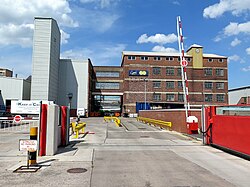
In 2005, the Caldewgate factory in Carlisle lost two months' production due to flooding. Production resumed after a £1 million government grant.[10]

The Caldewgate factory was flooded again on 6 December 2015, with levels exceeding five feet (over 150 cm). The floodwater damaged the brick ovens and resulted in product shortages on retail shelves.[10][11] After closure of the works for a month to repair and clear flood damage, production and distribution gradually resumed in spring 2016.[12]

See also

[edit]

References

[edit]
[edit]
Revisions and contributorsEdit on WikipediaRead on Wikipedia
from Grokipedia
Carr's is a British biscuit and cracker manufacturer founded in 1831 by Jonathan Dodgson Carr, a master baker, in Carlisle, Cumbria, England.[1][2] The company gained prominence for its Table Water Crackers, a simple yet enduring product made primarily from flour, water, salt, and yeast, first introduced around 1832 for social gatherings and long-lasting storage.[3][4] By 1841, Carr's received a Royal Warrant from Queen Victoria, recognizing its quality and establishing it as a supplier to the royal household, which contributed to its expansion across the United Kingdom.[5] Over nearly two centuries, Carr's has maintained production at its original Carlisle factory, innovating with steam-powered machinery in the Victorian era while preserving traditional recipes, and today operates under Pladis Global, a subsidiary of Yıldız Holding, focusing on premium crackers exported worldwide.[1][6] The brand's resilience is highlighted by its recovery from significant flooding in 2015 due to Storm Desmond, underscoring the factory's historical and economic importance to the region.[2]

Founding and Early Development

Establishment by Jonathan Dodgson Carr

Jonathan Dodgson Carr, a flour miller and baker originally from Kendal, established Carr's in 1831 by opening a small bakery and biscuit factory on Castle Street in Carlisle, England.[4][2] The venture began with manual production of bread and basic biscuits to serve local demand, leveraging Carr's experience in baking from his youth.[6][5] Operations initially centered on traditional baking methods, with Carr constructing a dedicated factory building that was completed by 1837 to support bread production alongside biscuits.[2] This setup reflected Carr's entrepreneurial drive to scale output beyond small-scale artisanal work, drawing on regional flour milling resources.[7] By 1841, the quality of Carr's products earned a royal warrant from Queen Victoria, marking the business as the first biscuit manufacturer to receive such recognition and enhancing its early credibility.[5][6][8]

Initial Innovations in Biscuit Manufacturing

In the late 1830s, Jonathan Dodgson Carr pioneered the integration of steam-powered machinery into biscuit production at his Carlisle facility, marking an early application of industrial engineering to food processing for enhanced consistency and scalability.[9] This included steam-driven dough mixers that automated ingredient blending, reducing manual labor variability and enabling uniform dough quality essential for large-scale output.[4] Additionally, mechanical presses and cutters were introduced to precisely shape and stamp biscuits, minimizing waste from irregular hand-cutting and allowing for repeatable production geometries that improved baking efficiency.[10][6] To support these mechanical advancements, Carr relocated and expanded his operations in 1837 to a new site at Caldewgate in Carlisle, constructing an integrated flour mill and bakery designed to handle increased throughput from mechanized processes.[11] This facility build-out facilitated the transition from artisanal batch production to continuous factory operations, with steam power driving not only mixing and cutting but also auxiliary functions like material handling, thereby linking technological input directly to output gains through reduced downtime and higher precision.[4] By 1846, these innovations had scaled Carr's production to approximately 400 tons of biscuits annually, employing around 90 workers and demonstrating the causal efficacy of steam mechanization in surpassing traditional bakery limits without relying on recipe changes alone.[4][10] Such empirical progress in dough handling and process control extended product viability by ensuring even moisture distribution during baking, grounded in the physical principles of mechanical uniformity over manual inconsistency.[9]

Product Evolution and Key Innovations

Development of Table Water Biscuits

In 1890, Theodore Carr, grandson of company founder Jonathan Dodgson Carr, developed the Table Water Biscuit as a refined iteration of the earlier Captain's Thin, a hardy, salty cracker intended for expeditions and extended sea travel. This innovation emphasized a precise water-to-flour ratio to produce a thinner, crispier profile while maintaining structural integrity and minimal flavor interference, enabling versatile pairings with cheeses, pates, or toppings.[1][12] The recipe's simplicity—relying on flour and water as primary components, eschewing fats for blending—facilitated extended shelf life and resistance to spoilage, essential for export and pre-refrigeration storage. Baking in traditional brick ovens further enhanced the biscuit's light, neutral character and snap, distinguishing it from denser predecessors like ship's biscuits. This approach prioritized durability and palatability for domestic and international markets, where the product's unadorned taste complemented rather than competed with accompaniments.[3][1] The Table Water Biscuit rapidly positioned Carr's as a leader in premium crackers, becoming the brand's defining product by the early 20th century and underpinning its emphasis on quality craftsmanship. Its adoption reflected demand for reliable, elegant table fare, with the biscuit's evolution from utilitarian voyage provisions to a staple of refined social gatherings.[1]

Expansion of Product Line and Quality Standards

Following the founder's death in 1884, Carr's heirs oversaw a swift diversification of the product line, expanding from around 70 varieties in 1860 to 128 distinct biscuit types by 1885, including refinements to the core table water biscuit formula that preserved its fat-free simplicity for extended shelf life while accommodating varied tastes.[4][7] This growth emphasized incremental adaptations, such as the 1890 introduction of the Table Water Biscuit by Theodore Carr as an enhanced iteration of earlier thin water crackers, prioritizing crispness and neutrality to pair with cheeses or preserves without overpowering flavors.[12] These variants supported export viability, as the inherent design—relying on water, flour, and minimal leavening—resisted spoilage during long sea voyages to British Empire markets.[13] Quality standards were upheld through mechanical innovations pioneered by Jonathan Dodgson Carr in the late 1830s, including custom machinery for precise cutting, stamping with branded logos, and uniform sizing, which ensured batch consistency and reduced variability that could compromise hygiene or palatability.[10] These protocols, rooted in Quaker-influenced commitments to reliable craftsmanship, preempted contamination risks in an era before modern refrigeration, with stamped identifiers facilitating traceability for export shipments.[4] The 1841 Royal Warrant from Queen Victoria further validated these practices, affirming the biscuits' suitability for elite consumption and signaling adherence to elevated purity benchmarks amid Victorian-era concerns over adulterated foods.[6] Empirical indicators of sustained quality included workforce expansion from 90 employees producing 400 tons annually in 1846 to over 1,000 workers by 1885, correlating with broadened international distribution that outpaced domestic competitors through dependable uniformity rather than novelty-driven changes.[4][14] This output surge underpinned market penetration into global territories, where the biscuits' proven durability—evidenced by their integration into imperial diets—reinforced Carr's reputation for empirical reliability over speculative enhancements.[15]

Business Growth and Ownership

19th-Century Expansion and Royal Recognition

In the mid-19th century, Carr's transitioned from a local bakery to one of Britain's largest biscuit manufacturers through vertical integration and process improvements initiated by founder Jonathan Dodgson Carr. By 1836, Carr had established a flour mill at Silloth to secure raw material supply, enabling scaled production of high-quality biscuits.[4] In 1846, the firm employed 90 workers and produced 400 tons of biscuits annually, reflecting rapid organic expansion driven by demand for durable, premium products like table water biscuits, which competed effectively in a market favoring consistency over cheaper alternatives.[4] This growth stemmed from Carr's adoption of steam-powered machinery and standardized recipes, which reduced costs and ensured uniformity, allowing the company to outpace artisanal competitors without reliance on subsidies or monopolies.[4] By 1860, Carr's marketed over 70 varieties, underscoring how quality differentiation—rooted in empirical testing of baking techniques—fueled market share gains in an era of rising consumer expectations for shelf-stable goods.[4] A pivotal prestige marker came in 1841 with the granting of a Royal Warrant by Queen Victoria, designating Carr's as the first biscuit maker supplier to the royal household and affirming the product's suitability for elite consumption.[4] This endorsement, based on the biscuits' crisp texture and longevity verified through palace trials, enhanced brand credibility and stimulated sales among affluent domestic buyers, as royal approval signaled rigorous quality standards unattainable by lower-tier producers.[6] The warrant's halo effect extended to export markets, where it differentiated Carr's from unbranded imports, contributing to international recognition by the 1860s without distorting competitive dynamics through artificial prestige.[4] Carlisle's strategic location facilitated distribution expansion, with proximity to emerging railway networks enabling efficient shipment of perishable-yet-durable biscuits to urban centers and ports by the 1860s.[6] This infrastructure leverage supported exporter status, as rail reduced transit spoilage risks compared to canal or road alternatives, allowing Carr's to capture shares in overseas trade routes demanding reliable provisions.[6] Locally, the firm's growth bolstered Carlisle's economy by employing expanding workforces—reaching hundreds by century's end—and funding worker housing and schools, measures aligned with Carr's Quaker principles of welfare to sustain productivity amid industrial demands, though conditions reflected era-typical factory rigors rather than modern ideals.[15] These developments exemplified market-driven scaling, where superior execution in supply chain and product merit propelled regional industrial clustering without state intervention.[4]

20th-Century Acquisitions and Corporate Changes

Carr's maintained family ownership and independent operations into the mid-20th century, navigating industry consolidation through strategic autonomy amid growing competition from larger manufacturers.[2] In 1964, the company was acquired by Cavenham Foods, a move that introduced external capital but preserved core production in Carlisle as the biscuit sector underwent mergers for efficiency.[2] By 1972, United Biscuits purchased Carr's from Cavenham Foods, incorporating it into a diversified portfolio that included brands like McVitie's and Crawford's, thereby enabling shared resources for distribution, marketing, and scale in a market dominated by multinational players.[2] [16] This integration facilitated survival in an era of intensifying competition, with United Biscuits leveraging Carr's established reputation for premium crackers to bolster overall group revenues without immediate shifts in brand-specific recipes or facilities. Ownership evolved further in 2014 when United Biscuits was acquired by Turkish conglomerate Yıldız Holding, prompting a 2016 restructuring that transferred Carr's and other brands to pladis Global, Yıldız's dedicated snacking entity focused on biscuits and confectionery.[1] Under pladis, Carr's retained operational independence for its heritage products while gaining access to international supply networks and R&D, as evidenced by targeted investments like a £1 million brand refresh in 2021 aimed at modernizing packaging and expanding savory variants.[17] These changes supported continued premium positioning, with pladis emphasizing Carr's brick-oven baking tradition dating to 1908 amid global sales growth for the group.[1]

Operations and Market Position

Production Facilities and Processes

The primary production facility for Carr's biscuits is situated in Carlisle, Cumbria, United Kingdom, where the company maintains its core manufacturing operations for products including table water biscuits.[18] This site employs continuous baking lines typical of modern biscuit production, enabling high-volume output through automated dough preparation, shaping, and oven transit systems.[19] Carr's table water biscuits are manufactured using a process that prioritizes low moisture content, typically achieved through precise baking to below 5% moisture levels, which contributes to their extended shelf life and characteristic crisp texture.[20] The dough formulation adheres closely to original recipes, incorporating primarily flour, water, and minimal additives such as salt and vegetable oil, mixed via automated systems to ensure consistency.[3] Quality controls, including in-line moisture and density checks, are integrated to verify product standards without altering traditional low-fat, low-sugar profiles.[21] The Carlisle facility supports an annual production capacity of approximately 80,000 tonnes of biscuits, reflecting standardized processes designed for efficiency and scalability.[22] Recent investments by parent company pladis, including upgrades to manufacturing equipment, have enhanced automation while preserving recipe integrity, allowing for resilient output of core lines like table water crackers.[23]

Global Reach and Brand Legacy

Carr's biscuits, as part of pladis Global's portfolio, benefit from distribution networks reaching over 110 countries worldwide.[24] The brand maintains strongholds in the United Kingdom and United States, where Table Water crackers are particularly favored as neutral accompaniments for cheeses and charcuterie, supporting their role in entertaining and gourmet pairings.[1] In the UK, annual sales reach approximately 12.3 million packs, reflecting sustained consumer demand for savoury crackers in premium contexts.[1] The brand's legacy embodies British baking traditions, characterized by crisp, oven-baked textures achieved through brick-oven methods and high-quality ingredients, fostering versatility over bold flavors.[1] This heritage-driven positioning emphasizes subtlety, allowing the biscuits to complement rather than overshadow toppings, which has sustained appeal in social and culinary settings like family gatherings and dinner parties.[1] In competitive landscapes, Carr's differentiates in the premium savoury segment through its neutral profile and historical authenticity, appealing to consumers seeking refined, non-sweet options amid a market dominated by flavored or sweeter alternatives.[25] Market metrics, such as the £9.3 million in sales for the Carr's Melts line alone (Nielsen data to March 2024), underscore its niche strength in the UK savoury category, valued at £522 million overall in 2022.[25][26] This endurance derives from consistent quality rather than transient trends, reinforcing the brand's status as a reliable choice for discerning consumers.[1]

The 2015-2016 Flooding Disruption

Causes and Immediate Effects

Storm Desmond, occurring on December 5–6, 2015, delivered exceptional rainfall totaling 341.4 mm in parts of Cumbria over 48 hours, accompanied by winds reaching 81 mph, which saturated soils and overwhelmed drainage systems across northwest England.[27] This meteorological event precipitated the overflow of the River Eden, a primary waterway traversing Carlisle, where flood defenses were breached in multiple locations, inundating low-lying industrial zones including the Caldewgate area housing United Biscuits' facility—the sole production site for Carr's Table Water Biscuits.[28] The factory's siting in this historically flood-vulnerable floodplain, previously affected in 2005 and earlier events dating back a century, exacerbated exposure, with floodwaters surging to depths of approximately 5 feet inside the premises on December 6.[29][30] The inundation prompted an immediate shutdown of operations at the Carlisle plant, which was secured by December 9 with all approximately 1,000 employees confirmed safe and no reported injuries or health incidents among staff.[31] Production of Carr's Table Water Biscuits and associated lines ceased entirely, rendering the facility unable to process orders or dispatch goods, as water damage compromised machinery, electrical systems, and storage areas.[32] This abrupt halt—initially projected to last several months due to the extent of submersion and decontamination needs—triggered acute supply shortages across UK retailers, particularly for Carr's products which lacked alternative manufacturing redundancy.[29] Short-term economic fallout included disrupted supply chains for wholesalers and supermarkets, contributing to broader biscuit scarcities beyond Carr's, such as McVitie's varieties produced at the same site, amid peak holiday demand.[33] United Biscuits reported the flooding's direct causation of production paralysis, with downtime extending through early 2016 and initial revenue impacts stemming from lost output volumes estimated in the context of the factory's role in everyday biscuit supply; insurance claims were pursued to offset material damages, though precise immediate loss figures were not publicly detailed at the time.[34] The event underscored the perils of geographic siting without sufficient upstream flood mitigation, amplifying operational vulnerabilities in an otherwise stable manufacturing process.[28]

Recovery Efforts and Long-Term Impacts

United Biscuits initiated recovery at the Carlisle factory immediately after the December 5, 2015, flooding, focusing on debris removal, water extraction, and equipment repairs. Workers cleared 540 tonnes of debris and pumped out approximately 40 million litres of water, enabling partial production restarts such as McVitie's Gold bars by mid-January 2016.[35][36] By February 2016, nearly all 640 employees had returned, supporting phased operations while damaged brick ovens for Carr's water biscuits were replaced.[37] Full production resumed by early April 2016, with Carr's water biscuits specifically back online on April 1, allowing deliveries to retailers within weeks and averting prolonged shortages.[22][38] This timeline, spanning about four months of disruption, exceeded initial expectations for recovery from severe electrical and oven damage, preserving market position without evidence of enduring share erosion.[34] In response, the company evaluated site vulnerabilities against relocation expenses, opting to retain the facility due to its established infrastructure and lower costs of targeted mitigation. United Biscuits, later under Pladis ownership, invested in flood defenses, including watertight barriers initially budgeted at £5 million, with installations such as large flood gates completed post-2015 to enhance resilience.[22][39] These measures, informed by prior flood history including events a century earlier, enabled ongoing operations through subsequent risks, as demonstrated by preparations averting closure during a 2024 near-miss.[30] Long-term effects included temporary sales and profit declines from the closure but underscored adaptive strategies over displacement, with the factory achieving sustained full output and no relocation. The incident highlighted dependencies on comprehensive insurance for rapid capital outlays in equipment replacement, while prompting reviews of supply continuity to buffer future interruptions.[34] By 2025, the site's fortified defenses supported uninterrupted biscuit production, affirming the efficacy of localized risk management in flood-prone areas.[30]

Criticisms and Challenges

Environmental and Supply Chain Vulnerabilities

The Carlisle facility, operational since 1831 and situated in a low-lying area adjacent to the Rivers Eden, Caldew, and Petteril, exemplifies chronic exposure to fluvial flooding inherent to the site's topography and the region's hydrology. Historical records document severe inundations in Carlisle during the 19th century, including major events in 1822 and 1856 that overwhelmed local infrastructure, predating the factory's establishment yet persisting as a foreseeable hazard for industrial placement.[28] The site's elevation, below critical flood thresholds, has repeatedly led to operational halts, as evidenced by inundations affecting the plant in 1925, 2005, and most disruptively in December 2015, when Storm Desmond's 180-200 mm of rainfall upstream breached defenses and submerged production lines.[30] [28] UK planning frameworks, governed by policies like Planning Policy Statement 25 (PPS25), require sequential testing and site-specific flood risk assessments (FRAs) to steer development away from high-probability zones (Flood Zone 3), yet historical permissions for industrial continuity in such areas suggest gaps in enforcement or adaptation, particularly for legacy sites where economic inertia overrides relocation.[40] In Carlisle's case, proximity to floodplains—despite post-2005 enhancements like raised barriers—failed to prevent 2015 losses exceeding £10 million in downtime and repairs, highlighting causal linkages between unmitigated locational choices and amplified disruptions rather than isolated weather anomalies.[22] Local authorities granted retrospective flood-resilient modifications in 2016, such as boundary wall demolitions and reinforcements, but these reactive measures underscore regulatory tolerance for vulnerability in established industries over proactive zonal restrictions.[39] Supply chain frailties compound site-specific risks, with dependencies on regional water sources for processing and logistics routes prone to UK weather variability, including prolonged Atlantic depressions that elevate river levels and saturate soils. The 2015 event severed access to proximate suppliers, halting inbound flour and outbound distribution for weeks and triggering national shortages of Carr's Table Water biscuits due to the facility's specialized brick-oven capacity not easily replicable elsewhere.[29] Minor historical disruptions, such as intermittent 20th-century overflows, have similarly strained ingredient procurement amid wetter harvest conditions that degrade wheat quality—UK cereal yields dropped 10-15% in flood-correlated wet years like 2000-2001—exposing over-reliance on domestic staples without diversified buffering.[41] While rapid recovery efforts restored output by April 2016, minimizing long-term deficits, enduring exposures necessitate private-led probabilistic modeling of multi-event cascades, prioritizing supply redundancy over subsidized public infrastructure that may foster complacency.[22]

Competitive Pressures in the Biscuit Industry

The UK biscuit industry has faced mounting competitive pressures from supermarket own-label pricing strategies, increased imports of lower-cost products, and evolving consumer preferences, resulting in a forecasted compound annual revenue decline of 2.4% to £3.3 billion by 2025-26.[42] These dynamics have intensified as domestic producers contend with global entrants offering mass-produced alternatives at reduced prices, eroding margins for premium segments.[42] Health-conscious trends have exacerbated these challenges, with consumers shifting toward low-sugar, high-fiber snacks amid rising awareness of obesity risks and regulatory scrutiny under high-fat, salt, and sugar (HFSS) guidelines.[43] Traditional biscuit volumes have declined accordingly, including notable drops such as 18% for certain varieties in 2023, as snacking occasions fell by over 15% from pandemic peaks and healthier options gained traction.[44][45] For Carr's, these external forces have necessitated adaptations like recipe reformulations in 2022 to achieve HFSS exemption, preserving shelf space amid restrictions effective from 2023 onward.[46] However, the brand's emphasis on traditional formulations has drawn observations of restraint in pursuing low-carb or organic extensions, areas where nimbler competitors have expanded into the growing healthy biscuits segment valued at projections exceeding USD 3 billion globally by 2030.[47] This positioning underscores a reliance on heritage-driven loyalty, which supports premium pricing even as industry volumes contract, reflecting market validation of enduring demand for established quality over transient health fads.[42]

References

User Avatar
No comments yet.