Hubbry Logo
California TrailCalifornia TrailMain
Open search
California Trail
Community hub
California Trail
logo
8 pages, 0 posts
0 subscribers
Be the first to start a discussion here.
California Trail
California Trail
from Wikipedia
Not found
Revisions and contributorsEdit on WikipediaRead on Wikipedia
from Grokipedia
The California Trail was an overland emigrant route extending approximately 2,000 miles from jumping-off points along the in present-day , , and to destinations in central and , primarily utilized between 1841 and 1869 by an estimated 250,000 settlers, farmers, and gold seekers. This pathway, which overlapped significantly with the for its initial segments before diverging westward, facilitated one of the largest mass migrations in American history, driven initially by promises of fertile land and dramatically accelerated by the 1848 discovery of gold at . Key features of the trail included challenging river crossings, vast arid deserts such as the 40-mile desert in , and steep mountain ascents over the Sierra Nevada, where emigrants faced severe hardships including starvation, disease, and exposure, with notable tragedies like the disaster at underscoring the perilous nature of the journey. Landmarks along the route, such as Chimney Rock in and Scotts Bluff in , served as critical waypoints for orientation and resupply, while visible wagon ruts persist today across public lands managed by agencies like the and . The trail's legacy lies in its role in populating , contributing to statehood in and the economic boom of , which extracted over 750,000 pounds of gold by 1855 and transformed the region from a sparsely settled territory into a hub of and , though at the cost of significant environmental alteration and displacement of indigenous populations.

Overview

Route Description and Historical Context

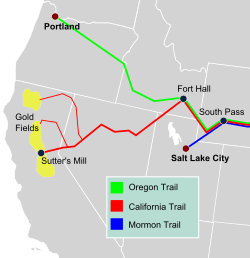
The California Trail comprised a network of overland routes spanning approximately 5,000 miles across ten states from to , with the primary path measuring about 2,000 miles from jumping-off points to the . Emigrants launched from towns such as and St. Joseph, , paralleling the Platte and North Platte Rivers through , passing landmarks like Chimney Rock—a prominent spire rising 325 feet—and , which offered a natural gateway with steep bluffs up to 800 feet high. The route continued to Fort Laramie in , a key fur trading post established in 1834, then to , a massive inscribed with thousands of emigrant names since the , and across South Pass, a broad 20-mile-wide saddle in the Rockies at 7,412 feet elevation that avoided high mountain barriers. From South Pass, travelers followed the Sweetwater River to Soda Springs in , where mineral springs provided relief, then diverged at near Raft River—splitting from the toward or the California-bound route. The trail skirted the via the Sublette Cutoff or , crossing arid basins into along the for 300 miles to its sink, enduring the waterless Forty-Mile Desert stretch that claimed numerous livestock and wagons due to heat and thirst. Final segments ascended the canyon, surmounting the Sierra Nevada via at 7,088 feet—site of the tragic 1846 entrapment—or alternatives like the Carson Route, descending to the fertile Central Valley and Yuba or Rivers by late summer. In historical context, the trail emerged from pre-1840s explorations by trappers like , who in 1826 became the first white man to cross the Sierra Nevada into , mapping Sierra passes that informed later routes, though his party suffered severe losses from Native American attacks. The inaugural wagon emigrant party, led by and Bartleson in 1841 with 69 participants from , reached after splitting from Oregon-bound travelers at Soda Springs, enduring starvation and navigational errors but validating overland feasibility without reliance on sea voyages. Usage escalated post-1848 gold discovery at , drawing 75,000 by 1850 amid economic pressures and ideology, with total emigration exceeding 250,000 by 1869—facilitating 's rapid population boom from 15,000 in 1848 to 93,000 by 1850 and statehood on September 9, 1850—yet marked by high mortality from disease, accidents, and exposure, estimated at 3-5% of travelers. The route's viability stemmed from its avoidance of impassable Rockies via low-elevation passes and river valleys, enabling freight wagons carrying 2,500 pounds of supplies for 4-6 month journeys, but declined sharply after the 1869 rendered it obsolete.

Significance in Westward Expansion

The California Trail facilitated the overland migration of over 250,000 emigrants from the frontier to between 1841 and 1869, serving as a primary artery for American settlement in the Far West. This volume of travel, part of a broader movement of nearly 500,000 individuals across the , , and Mormon Trails during the same period, accelerated the demographic transformation of from a Mexican territory ceded to the in 1848 into a state with sufficient population for on September 9, 1850. The trail's role underscored the practical implementation of expansionist ambitions, enabling settlers to claim and develop lands that secured U.S. presence on the ahead of European rivals. The discovery of gold at on January 24, 1848, dramatically intensified usage of the California Trail, drawing an estimated 140,000 emigrants between 1849 and 1854 alone and sparking the largest sustained migration in U.S. history up to that point. This influx, comprising fortune-seekers, families, and laborers from across the nation and abroad, generated immediate economic stimulus through mining output—valued at over $550 million in the first decade—and ancillary activities like commerce and agriculture, which laid foundations for California's enduring productivity. The resulting population boom, from fewer than 15,000 non-indigenous residents in 1848 to over 100,000 by 1852, not only strained but also catalyzed governance and infrastructure development, reinforcing federal commitment to transcontinental integration. Beyond demographics and economics, the California Trail embodied the causal drivers of westward expansion, including resource incentives and ideological imperatives like , which motivated emigrants to endure 2,000-mile journeys fraught with , terrain hazards, and indigenous conflicts that claimed up to 5% of travelers. By channeling human capital westward, the trail contributed to the erosion of Mexican claims post-1846 war and heightened sectional debates over in new territories, culminating in California's free-state entry that tipped balances in the Compromise of 1850. Its legacy persisted until the completion of the in 1869, which supplanted overland routes but affirmed the trail's foundational impact on national geography and polity.

Pre-Establishment Exploration

Early Expeditions and Mapping (1811-1840)

The foundations of the California Trail were laid by fur trappers and explorers during the early , with initial overland routes across the Rockies and established between 1811 and 1840 primarily for beaver hunting rather than settlement. These expeditions, conducted on horseback or foot, traversed harsh terrains and shared knowledge at annual rendezvous, gradually mapping paths that would later accommodate wagons. Key traversals included Wilson Price Hunt's 1811-1812 party from to the , which pioneered segments through present-day along the , influencing subsequent western routes despite its Oregon focus. Jedediah Strong Smith led the first documented American overland entry into in 1826, departing the Bear Lake rendezvous in present-day Utah-Idaho with 17 men and two Indian guides on August 7. Traveling southwest from the , the party endured 100-mile waterless stretches across Nevada's and the , reaching Mission San Gabriel on November 27 after killing horses for sustenance. Smith's route marked the initial U.S. penetration from the interior, though it followed a southern arc avoiding direct Spanish trails. In spring 1827, after trapping California's coastal rivers, Smith returned eastward, becoming the first American to cross the Sierra Nevada from west to east near the 38th parallel, likely via the Walker River drainage and vicinity. His party then navigated northeast through Nevada's Humboldt region—encountering its river—and reached the 1827 rendezvous on July 3, providing early intelligence on Sierra crossings and hydrology that informed later mappings. Smith's expeditions covered over 3,000 miles, with his dictated narratives and sketches contributing to rudimentary charts circulated among traders. Joseph Reddeford Walker's 1833 expedition further refined northern approaches, commissioned by Captain Benjamin de Bonneville to explore and trap west of the Rockies. Starting from the Green River rendezvous in with approximately 40 men in July, Walker proceeded to the , then westward across , identifying the as a reliable watercourse through the barren Forty-Mile Desert to its sink near present-day Lovelock. The party crossed the Sierra Nevada eastward-to-westward near in October-November, arriving at Monterey by late 1833 after viewing the distant Pacific. Walker's route along the Humboldt—spanning 300 miles—proved critical for wagon feasibility, as its gradual descent and riparian corridor mitigated desert hazards, directly prefiguring the California Trail's segment. His reports, relayed via Bonneville's 1837 publication, included sketches of topography and Native encounters, enhancing traders' collective knowledge despite lacking formal surveys. By 1840, cumulative trapper explorations had delineated viable passes like South Pass and river valleys, transitioning from isolated forays to proto-emigrant corridors, though full wagon adaptation awaited the .

Key Figures and Initial Parties

Jedediah Strong Smith led the first recorded American overland expedition to in 1826, departing from the region with a party of 17 men. His group traversed southern and the , marking the initial American penetration into the en route to the , though suffering losses from thirst and attacks. Smith's route skirted the future California Trail's southern extensions, providing early knowledge of desert crossings that informed later mappings. He reached Mission San Gabriel in November 1826, where Spanish authorities detained the trappers before permitting their return eastward in 1827. In 1827, Smith attempted a second expedition to California with 19 men, again crossing from the Rocky Mountains but facing severe hardships, including the loss of most of his party to Mohave Indian attacks near the Colorado River. Only Smith and a few survivors reached California, highlighting the perilous nature of these pre-emigrant ventures primarily driven by fur trapping rather than settlement. Joseph Reddeford Walker, scouting for Captain Benjamin Bonneville's expedition, conducted a pivotal exploration in 1833, leading about 40 men westward from the Green River in present-day . His party navigated the and crossed the Sierra Nevada eastward to westward near the future in late 1833, becoming the first Americans to view the range from that direction. Walker then proceeded to , before returning via the and Walker Pass in the in 1834, mapping viable routes through the southern Sierra that influenced subsequent trail development. These expeditions by Smith and Walker, focused on trapping and reconnaissance, laid foundational geographic insights for the California Trail without establishing regular emigrant usage until the 1840s.

Emigration and Peak Usage

Formation of Major Parties (1841-1845)

The Bidwell-Bartleson Party, organized in Sapling Grove, , on May 9, 1841, marked the first attempt by American emigrants to reach overland with wagons, comprising approximately 69 adults, including only five women and a few children, divided among 15 wagons. The group elected Talbot H. Green as president, as secretary, and John Bartleson as captain before departing , on May 18, 1841, initially intending to join Oregon-bound emigrants but redirecting toward after encountering Thomas Fitzpatrick. Facing uncharted terrain, the party abandoned their wagons near the in on October 8, 1841, proceeding on foot and with pack animals; they arrived in between and , 1841, with no fatalities, though the journey substantiated the feasibility of the route despite its hardships. This expedition, though not completing the full wagon traversal, provided critical firsthand accounts that encouraged subsequent parties and helped delineate early segments of the California Trail from the to the . Subsequent small parties in 1842 and 1843, such as the Chiles-Walker expedition, refined route variations by splitting from groups near and veering southwest through and , but lacked the organized scale of earlier efforts until the Stephens-Townsend-Murphy Party formed in late 1843. Departing , on May 22, 1844, this group of 50 individuals, including families and three experienced mountaineers, traveled in 11 s under the leadership of Elisha Stephens, with Joseph Murphy and others handling logistics. They pioneered the wagon crossing of the Sierra Nevada via what became , reaching the summit on November 25, 1844, after detaching wagons for a snowshoe-assisted advance party; the main wagons followed, arriving at intact, thus establishing a viable overland wagon path to California's Central Valley. This success, informed by prior explorations and emigrant reports, shifted the trail's viability from exploratory to practical for settlers. By 1845, emigration accelerated with parties like the Grigsby-Ide group, which assembled in spring near under John Grigsby and included , departing with dozens of participants aiming for via established and Humboldt routes. These formations relied on communal for defense, shared scouting, and supply management, drawing from 1841-1844 experiences to standardize compositions of 20-50 wagons, emphasizing armed escorts and herds numbering in the hundreds. The cumulative efforts of these early parties, totaling fewer than 1,000 emigrants by 1845, solidified the California Trail's core alignment, mitigating risks through iterative mapping and reducing the era's high attrition rates from 20-30% in unguided crossings to under 5% in organized trains.

Gold Rush Surge (1846-1852)

The Gold Rush surge along the Trail commenced following the discovery of gold on January 24, 1848, by during the construction of a sawmill for John A. Sutter on the South Fork of the near Coloma. Initially confined to local rumors, the find gained national credibility when President referenced substantial gold extractions from in his annual message to on December 5, 1848, prompting preparations for mass overland migration in 1849. This period saw emigration explode from a pre-1848 annual trickle of several hundred to tens of thousands, with 25,000 to 30,000 individuals—predominantly young men dubbed "Forty-Niners"—traversing the California Trail in 1849 alone. Departing from outfitting hubs like and St. Joseph, these parties followed the to South Pass, then veered southwest via or the Sublette Cutoff toward the , before tackling the Sierra Nevada via routes such as or . The volume overwhelmed trail capacity, depleting forage and water, and spurred adoption of shortcuts like Hudspeth's Cutoff in 1849 to shorten the crossing. Subsequent years sustained high traffic, with over 70,000 emigrants documented on the trail in 1849 and 1850 combined, contributing to an estimated 140,000 arrivals via the California Trail from 1849 to 1854. The 1850 season, marked by drought and doubled numbers, intensified hardships including livestock losses and alkali poisoning in the Humboldt region, yet the allure of placer mining propelled continued use through 1852. This surge not only accelerated California's population growth from about 15,000 non-natives in 1848 to over 100,000 by year's end but also facilitated route refinements, such as improved ferries and station developments, amid occasional clashes with Native American groups over resource competition.

Later Waves and Decline (1853-1869)

Following the peak of the , overland emigration via the California Trail continued but at significantly reduced volumes, with annual departures dropping from tens of thousands in the early to mere thousands by the late . In 1855, traffic declined sharply due to the depletion of accessible placers, which diminished the trail's primary economic draw, alongside the growing viability of faster sea routes via or that reduced travel time to weeks rather than months. Emigrants in these years increasingly included families seeking agricultural opportunities in California's fertile valleys, rather than prospectors, though the harsh overland conditions—such as outbreaks, alkali deserts, and Sierra Nevada snows—persisted, claiming lives at rates of 1-5% per party. The U.S. Civil War further curtailed migration from 1861 to 1865, as economic disruptions, military drafts, and border conflicts along the trail's starting points deterred large organized trains, reducing annual overland arrivals to to under 1,000 in some years. Post-war resumption saw brief upticks driven by renewed settlement interests, but these were overshadowed by competing transportation innovations; the (1860-1861) and transcontinental telegraph (completed 1861) improved communication but did little for passenger volume, while steamship lines captured most long-distance travelers. By 1869, cumulative overland migration to totaled approximately 250,000 since 1841, with later waves contributing a fraction compared to the 1849-1852 surge. The trail's decline accelerated with the completion of the on May 10, 1869, at Promontory Summit, , which offered a safer, faster alternative—reducing cross-continental travel to 7-10 days versus 4-6 months by —and shifted freight and passenger traffic to rails, rendering emigrant trains obsolete by year's end. Local freighters and ranchers continued using trail segments for access, but organized overland parties to ceased, marking the end of the trail's era as a primary migration corridor. Surviving ruts and markers along the route, such as those in , attest to the trail's physical legacy amid this transition to industrialized transport.

Preparation and Travel Logistics

Supplies, Wagons, and Outfitters

Emigrants preparing for the California Trail typically outfitted at jumping-off points along the , with , serving as the primary hub until around 1850 due to its central location and lack of commercial competition on the . Merchants there sold wagons, , provisions, and tools, turning outfitting into a major economic activity that extended from to Omaha. By the Gold Rush era, additional points like St. Joseph and Westport emerged, but Independence handled tens of thousands of emigrants annually in the peak years of 1849–1852. Wagons used were generally lighter farm-style vehicles adapted for overland travel, known as prairie schooners or emigrant wagons, measuring about 11 feet long, 4 feet wide, and 2 feet deep, with covers stretched over arched bows for weather protection. These differed from heavier Conestoga wagons suited for freight; prairie schooners prioritized mobility over capacity, carrying roughly 1,500 to 2,500 pounds when loaded for a family of four or five, though overloading often led to breakdowns. Oxen were preferred draft animals, with teams of four to six yokes (eight to twelve animals) providing steady power for the 2,000-mile journey, as they required less water and forage than mules or horses and could subsist on prairie grass. Supplies emphasized non-perishables for a four- to six-month trek, with each allocated about 150–200 pounds of , 75 pounds of or salted , plus , beans, , , and dried fruits to combat ; total food per person often exceeded 600 pounds. Essential tools included axes, shovels, ropes, chains, and repair kits for wagons, alongside firearms like rifles and pistols for and defense, with stockpiled at 25–50 pounds per person. Clothing focused on durability: or buckskin pants, hickory shirts, sturdy boots or moccasins, and multiple changes to allow washing; bedding comprised two blankets, a comforter, and ground cloths per family. Guides like Joseph Ware's 1849 recommendations stressed packing only necessities to avoid excess weight, warning that luxuries often proved burdensome amid breakdowns and scarcity. beyond draft animals—cows for milk, spare oxen, and sometimes sheep—added 50–100 head per train, traded or foraged along the route.

Organization of Emigrant Trains

Emigrant trains on the California Trail were typically organized into cohesive companies prior to departure from jumping-off points along the , such as or Westport, , to provide mutual protection against threats like Native American raids, enhance resource sharing, and maintain order over the 1,900-mile journey. These groups ranged in size from small parties of 50-70 individuals in the early 1840s, as in the 1841 Bidwell-Bartleson party of about 70 people, to larger trains of 50-100 wagons carrying 200-500 emigrants during the 1849-1852 peak, with each wagon often accommodating a family of four to six. Leadership was established through democratic election of a , or , by majority vote among adult males, who directed route decisions, enforced discipline, and coordinated logistics; some trains divided into sub-units with lieutenants or sergeants for oversight, as seen in the military-inspired hierarchies of mid-1840s companies. The 's authority derived from the group's consent, with provisions for removal by vote if faltered, reflecting a voluntary republican structure adapted to the trail's isolation where formal government was absent. Upon formation, trains adopted written constitutions or by-laws, often drafted in a single deliberative session with amendments, outlining rules for conduct, mutual obligations, and penalties to preserve harmony and efficiency. These documents prohibited , excessive , and straggling; mandated assistance to those losing or supplies; specified marching orders with lead wagons rotating daily to share trail-breaking burdens; and required night guards for herding. Decision-making on disputes or crimes involved councils or full-company votes, with trials using member juries for serious offenses like or , culminating in punishments such as extra guard duty, fines, or expulsion, as enforced in 1846 when James Reed was banished from his train near the border for a fatal altercation. Daily operations emphasized regimented routines: trains assembled in fixed order at dawn, traveled 15-20 miles before a midday "nooning" rest, then camped in a defensive corral formation with wagons circled and inside, under rotating guards to deter or attack. Sub-roles included scouts for , herders for animal management, and occasionally elected judges for minor infractions, ensuring the group's cohesion amid the trail's demands from crossings to Sierra Nevada ascents. Enforcement relied on and majority will rather than , with dissolution possible if consensus broke down, underscoring the trains' self-governing nature rooted in pre-trail agreements.

Guidance from Maps and Scouts

Emigrants navigating the California Trail depended on rudimentary maps derived from military expeditions and promotional guidebooks, supplemented by hired mountain men and internal scouting parties. John C. Frémont's surveys during his 1843-1844 expedition produced the influential "Map of Oregon and Upper California," which delineated routes from the Great Salt Lake to the Sierra Nevada, enabling emigrants to identify water sources, passes, and terrain hazards based on empirical measurements and astronomical observations. This map, published in 1845 and reprinted widely, informed overland parties by correcting earlier inaccuracies and emphasizing traversable paths, though it understated some desert aridity risks. Lansford W. Hastings' 1845 publication, The Emigrant's Guide to Oregon and , urged adoption of the southwest from , claiming a 200-mile and several-day savings over the main trail; however, the route's barren stretches, steep canyons, and scarce forage caused wagon damage and starvation for followers, including the 1846 Donner-Reed Party, which lost dozens to delays exceeding three weeks. , who lacked firsthand trail-testing for the cutoff and sought to accelerate American settlement in for personal political gain, personally scouted and advised parties like the Harlan-Young group in 1846 but provided misleading assurances about grass and water availability. Early wagon trains frequently employed fur trappers as paid guides to scout fords, springs, and Indian trails. , a veteran explorer, contracted with the 1843 Chiles-Dodge party for $300 to lead wagons across uncharted segments, establishing viable paths toward the despite navigational errors from incomplete prior knowledge. Similarly, Greenwood guided Elisha Stephens' 1844 train through the Sierra Nevada via after recruitment on the , leveraging his familiarity with Sierra crossings from trapping days to avoid dead ends. By the 1849 Gold Rush peak, reliance shifted from hired experts to emigrant-compiled journals, trail blazings like notched trees or rock cairns, and ad hoc scouts dispatched daily from trains to reconnoiter 10-20 miles ahead for viable routes and resources. These internal scouts, often mounted volunteers, mitigated risks from vague maps by verifying real-time conditions, though inexperience contributed to losses when deviating from proven segments; professional guides like , who mapped with Frémont, became rarer as collective trail lore accumulated among 250,000+ travelers.

Primary Routes and Variants

Eastern Segments: Missouri River to South Pass

The eastern segments of the California Trail commenced at ferry crossings of the near and St. Joseph in western , where emigrants organized wagon trains in the spring months from 1841 onward. From these points, travelers proceeded approximately 100 miles westward across rolling prairies to the in present-day , a broad, shallow waterway that served as a natural guide despite its challenging ford crossings prone to quicksand and swift currents. The route paralleled the Platte's south bank for about 300 miles to avoid northern marshes, traversing arid plains where grass was abundant for livestock but water quality was often poor, leading to digestive ailments among humans and animals. Key visual landmarks marked progress through , including Chimney Rock near Bayard, a distinctive 325-foot spire of clay and sandstone eroded into a chimney-like form, visible up to 30 miles away and symbolizing the halfway point to the Rockies for many parties. Further west, Scotts Bluff National Monument's towering bluffs, rising over 800 feet, provided a navigational beacon and occasional vantage for scouting ahead, though steep ascents like California Hill tested wagon durability and team strength, often requiring double-teaming oxen. These features, shared with the and Mormon Trails, facilitated collective travel in large trains for mutual aid during the peak years of 1849-1852, when daily advances averaged 12-15 miles amid dust clouds that obscured vision and irritated lungs. Entering , the trail reached Fort Laramie around 650 miles from the , a fur-trading post fortified as a U.S. Army outpost in 1849, offering resupply of flour, bacon, and ammunition at inflated prices, as well as veterinary services for worn livestock. Beyond the fort, emigrants followed the upstream past Casper to the Sweetwater River valley, crossing the latter nine times between and South Pass; , a 1,900-foot-long granite dome, bore thousands of carved inscriptions from 1840s travelers who aimed to arrive by Independence Day as a milestone indicating timely progress toward mountain crossings. Nearby Devil's Gate, a 370-foot-deep gash in granite through which the Sweetwater flowed, awed observers but was bypassed due to impassability for wagons. The segment concluded at South Pass, a broad, windswept saddle spanning 20 miles wide with a gradual 1-2% incline reaching 7,550 feet elevation, allowing wagons to traverse the Continental Divide without steep grades that plagued alternative Rocky Mountain routes. Discovered by fur trappers in 1824 and first used by wagons in 1832, this low-elevation portal—contrasting sharply with higher passes like South Pass's northern alternatives—enabled over 300,000 emigrants to cross unimpeded by snow in summer, though alkaline soils and sparse strained resources as parties descended toward Pacific Springs. By the 1860s, this eastern portion, roughly 1,000 miles from origins, represented the relatively navigable plains phase before escalating desert and mountain rigors.

Central Segments: Fort Bridger to Humboldt River

From , established as a fur trading post in 1843 by and Louis Vasquez, California-bound emigrants primarily followed the main trail northwestward along the Bear River valley toward Soda Springs and , seeking supplies, repairs, and guidance. This segment, traversed typically in late , offered relatively abundant grass and water compared to later desert stretches, though river crossings posed risks of swollen streams and . At Soda Springs, natural carbonated springs provided a rest stop, with emigrants noting the "steamboat spring" that erupted periodically. Fort Hall, a Hudson's Bay Company outpost founded in 1834 on the Snake River, served as a critical junction where California emigrants diverged southwest from the Oregon Trail, crossing the Raft River and proceeding through southern Idaho to City of Rocks. City of Rocks, with its granite spires evoking a "silent city" in emigrant diaries, marked a key landmark reached via Emigrant Canyon, where trails from Salt Lake converged. From there, the route continued west across Goose Creek Valley and into Nevada's Thousand Springs Valley, intersecting the Humboldt River near its South Fork around modern-day Wells, providing the vital water source for the Great Basin traverse. Several cutoffs altered this path for efficiency or promotion. The Sublette-Greenwood Cutoff, originating at before , allowed many California emigrants to bypass Bridger's southern loop, crossing arid sagebrush plains to rejoin near Soda Springs, saving approximately 46 miles and several days despite water scarcity. The Hudspeth Cutoff, blazed in 1849 from near Soda Springs, skirted to link directly with City of Rocks. Conversely, the , advocated by in his 1845 guidebook as a shortcut south from through Weber Canyon, across the and to Pilot Springs, proved grueling due to rocky terrain, deep sands, and an 80-mile waterless stretch; used notably by the 1846 , it delayed progress and was largely abandoned thereafter.

Great Basin Traverse: Humboldt to Sierra Nevada

After departing the at its sink—a vast, alkaline playa in present-day —emigrants confronted the 's arid expanse, a 40-mile desert stretch devoid of reliable water sources that marked the onset of the traverse to the Sierra Nevada. This segment, traversed primarily between 1844 and 1859, demanded careful water rationing and often nighttime marches to mitigate daytime heat exceeding 100°F (38°C), with alkali dust corroding wagon axles and poisoning surviving livestock. The served as a divergence point, where the trail split into the dominant route northward and the route southward, each offering distinct paths fraught with environmental perils. The route, pioneered by the Stevens-Murphy party in 1844 as the first to cross the Sierra Nevada via this path, directed emigrants northwest across the Forty-Mile Desert to the 's lower reaches near modern Wadsworth, . Once reaching the river—named for explorer but guided by Paiute Indians for early parties—travelers followed its northeast-to-southwest flow upstream for approximately 80 miles through rugged canyons and valleys, replenishing water supplies while navigating and steep banks that claimed numerous oxen. The route culminated at , where the ascent to began at elevations nearing 7,000 feet (2,134 m), a snow-prone barrier that trapped the infamous in 1846-1847, resulting in over 40 deaths from starvation and exposure. By the late , this path carried the majority of California-bound wagons, with trail ruts still visible near the pass summit. In contrast, the route, utilized by about one-third of emigrants and formalized after 1846 explorations by under John Frémont, veered southeast from the sink or slightly earlier near Lovelock, crossing parallel deserts to the Walker River before turning west to the valley. This 500-mile variant skirted deeper into the , passing through the —a similar dry basin—and ascending the river's canyon, where flash floods and dense underbrush posed hazards, though it offered marginally better grass in wet years. Emigrants reached the Sierra Nevada via lower crossings like the Emigrant Pass or continued to the valleys, avoiding Donner Pass's extremes but enduring longer exposure to Basin heat; Ragtown, a makeshift camp near the 's edge, became notorious for exhausted animals collapsing after the desert push. Both routes incurred massive losses—up to 75% in dry seasons—compelling many to cache goods, double-team wagons, or proceed on foot, underscoring the traverse's role as the trail's deadliest phase with mortality rates elevated by and .

Sierra Crossings and Final Approaches

The Sierra Nevada crossings marked the culminating challenge of the California Trail, demanding emigrants navigate steep ascents exceeding 7,000 feet in elevation amid risks of early snowfall and rugged terrain. Primary routes included the Truckee Trail over and the Carson Trail over , with successful traversal often requiring emigrants to cache supplies, lighten wagons, or abandon vehicles entirely for foot or travel. Timing was critical; delays into October heightened exposure to blizzards, as exemplified by the Donner Party's entrapment in 1846, where 87 members faced starvation and resorted to , resulting in 48 deaths before rescue in 1847. The Truckee Trail, pioneered by the Stephens-Townsend-Murphy Party in 1844, followed the westward from the Forty-Mile Desert, ascending gradually before a sharp climb to at approximately 7,100 feet. This route featured numerous river fords—up to 27 crossings—posing hazards of swift currents and boggy banks, though ample water mitigated dehydration risks. Upon summiting, emigrants descended to , then navigated boulder-strewn descents and forested slopes toward the Bear and Yuba Rivers, entering the near present-day Auburn by late summer or early fall for those departing timely from the . Despite its familiarity post-1844, the trail's exposure to northern Sierra weather led to its partial supersession by southern alternatives during peak years. In contrast, the Carson Trail, surveyed eastward by Mormon Battalion veterans in 1848 and popularized under Kit Carson's guidance, diverged south from the along the , requiring only three major crossings and traversing alkali flats before ascending at over 8,500 feet. This higher, more precipitous barrier demanded strenuous double-hauling of goods, with gradients steep enough to necessitate locking wagon wheels and using ropes for control on descents into Hope Valley. From there, the route followed the Upper Truckee or Mokelumne Rivers eastward initially before turning west to the and American Fork, facilitating access to and northern mining districts. By 1849, roughly one-third of emigrants opted for this path, drawn by reduced flooding risks and slightly milder southern exposures, with over 20,000 total users recorded before rail alternatives emerged in 1869; its favor grew as lessons from Donner tragedies underscored the perils of northern latitudes. Minor variants, such as those via or Walker Passes, saw limited wagon use due to even greater elevations and isolation, confining most traffic to the Donner and Carson corridors where over 250,000 emigrants ultimately crossed into California's fertile valleys between 1841 and 1869. Successful arrivals dispersed via riverine approaches to foothill settlements, enabling rapid integration into agricultural and gold-seeking economies, though the physical toll—exacerbated by altitude, exposure, and logistical strains—contributed to the trail's mortality rates peaking at 5-10% in hardship years.

Challenges and Risks

Environmental and Terrain Obstacles

Emigrants on the California Trail encountered severe environmental challenges, including unbridged river crossings fraught with swift currents from Rocky Mountain , which posed risks of and damage. Major rivers such as the Platte, North Platte, Green, and required fording at vulnerable points, often resulting in lost , overturned vehicles, and human fatalities when water levels peaked in spring and early summer. These crossings demanded careful and improvised techniques like doubling teams, yet accidents remained common due to the unpredictable depth and velocity of the flows. Arid plains and alkali flats exacerbated hardships through pervasive dust clouds raised by wagon trains, which irritated eyes, clogged respiratory passages, and coated supplies, contributing to exhaustion and health decline among travelers. Alkaline soils along segments like the valley yielded water toxic to draft animals, leading to weakened teams and abandoned wagons when succumbed to or . Heat in summer intensified these issues, with temperatures exceeding 100°F (38°C) drying out grass for grazing and prompting desperate searches for potable sources amid mirages and false leads. The Great Basin's desert stretches, particularly the Forty Mile Desert following the , presented the trail's most dreaded barrier, characterized by scorching days, freezing nights, and absolute scarcity of water over 40 miles (64 km) of scorching alkali flats and sand dunes. Emigrants departing the Humboldt River's terminus faced mass animal die-offs—sometimes thousands of and oxen per train—and human deaths from thirst, with shallow wagon ruts still visible today marking paths littered by bleached bones. This parched traverse, begun after the river evaporated into the sink around , forced parties to cache supplies and push weakened stock at night to evade daytime heat, yet failure rates remained high due to mirages misleading toward nonexistent oases. Culminating obstacles arose in the Sierra Nevada crossings, where steep, boulder-strewn ascents to passes like Donner (elevation 7,056 feet or 2,151 m) and Roller Pass confronted emigrants with deep snow accumulations, especially for late-season arrivals. The 1846 Donner Party's entrapment at Donner Pass, where blizzards buried wagons under 20-foot (6 m) drifts, illustrates the peril of early winter storms blocking routes and stranding parties without adequate provisions, leading to starvation and cannibalism among 87 members, of whom only 46 survived. Narrow, unstable trails with sheer drops amplified risks of avalanches and falls, compelling variants like Carson Pass for slightly lower but equally rugged terrain, though all demanded lightening loads and abandoning nonessential gear to summit before passes closed.

Disease Outbreaks and Health Crises

The most significant on the California Trail was the , which peaked in 1849 amid migration and persisted intermittently through the mid-1850s. Caused by the bacterium transmitted through contaminated water and poor sanitation, spread rapidly from overcrowded jumping-off towns along the , such as and St. Joseph, Missouri, where emigrants gathered in unsanitary conditions. Symptoms struck abruptly—profuse , , and severe —often leading to death within hours or days, with mortality rates exceeding 50% for those infected without treatment. Diarists recorded clusters of deaths along the , where alkaline water exacerbated and emigrants drank from shared, feces-polluted sources; one 1849 account noted burying multiple victims daily in shallow, unmarked graves. Dysentery, typhoid fever, and measles also contributed substantially to morbidity, particularly affecting children and the elderly due to weakened immune systems from exhaustion, , and exposure. , often bacterial (e.g., or ), resulted from fecal-oral contamination in campsites and contaminated food supplies, causing bloody and high fever; it accounted for a significant portion of non-cholera fatalities. emerged in the trail's later segments, especially the waterless traverse, from deficiency after weeks without fresh produce; symptoms included swollen gums, joint pain, and open wounds, delaying progress and increasing vulnerability to infection. Overall, diseases caused the majority of deaths, with estimates indicating 4-6% mortality across the Oregon-California Trails combined, though California-bound parties in 1849-1850 faced higher rates due to trail congestion—potentially 6,000-12,000 victims alone across western trails during peak years. Mitigation was limited by medical knowledge of the era, relying on folk remedies like or , which often worsened , though some parties isolated the sick or boiled water when possible. Infant and child mortality was disproportionately high, with diarrhea-related diseases claiming up to 10-15 lives per mile in worst-affected stretches. These crises were exacerbated by causal factors like delayed departures leading to hotter, drier conditions, overuse of limited grazing that sickened and thus travelers dependent on salted , and the trail's shared routes with and Mormon emigrants amplifying pathogen transmission. By the late , improved sanitation awareness and fewer migrants reduced outbreak severity, but cholera's legacy persisted in trail folklore as the "Asiatic destroyer."

Encounters with Native Americans

Emigrants on the California Trail encountered numerous Native American tribes, including the Pawnee and Sioux along the Platte River in present-day Nebraska, the Shoshone and Crow in the Rocky Mountains of Wyoming, the Ute and Goshute near the Great Salt Lake in Utah, and the Paiute and Western Shoshone in the Great Basin of Nevada. These interactions were predominantly peaceful, with tribes often providing essential services such as ferrying wagons across rivers, trading for food and horses, or offering guidance through difficult terrain, which aided emigrant survival in arid regions where local knowledge proved invaluable. Despite mutual wariness—emigrants frequently armed themselves in anticipation of hostility—recorded assistance from Natives outweighed conflicts, as tribes along the trail benefited from bartering manufactured goods like cloth, beads, and tools for livestock or provisions. For instance, groups near and South Pass occasionally guided parties or warned of hazards, reflecting pragmatic exchanges rather than inherent antagonism. Emigrant diaries from the and , such as those of the Donner Party's precursors, document these cooperative episodes, underscoring that Natives viewed transient wagon trains as temporary opportunities rather than existential threats until heavier traffic in the strained resources like grass and game. Violence remained rare, comprising a small fraction of trail perils; historian John Unruh's analysis of overland trail records from 1840 to 1869 estimates only 362 emigrant deaths attributable to Native attacks across all major routes, including the California Trail, out of approximately 500,000 travelers—a rate below 0.1%. Most incidents involved opportunistic theft of horses or cattle by small bands, particularly Goshute or Paiute groups in the water-scarce Humboldt Sink area, where emigrants' livestock competed directly with Native herds; outright massacres were exceptional and often stemmed from retaliatory cycles or isolated aggressions, such as sporadic raids on lagging wagons in the 1850s amid broader Plains intertribal disruptions. Emigrants' exaggerated fears, fueled by rumor and media sensationalism, contrasted with empirical outcomes, as disease, starvation, and accidents accounted for over 90% of fatalities. The trail's passage inadvertently disrupted Native lifeways by introducing epidemic diseases— and —to isolated populations, decimating bands along the Platte and Humboldt rivers without direct violence, while overgrazing depleted forage critical for tribal mobility. Paiute communities in , for example, faced accelerated cultural shifts as emigrant traffic from onward fragmented traditional hunting grounds, prompting some to adopt raiding as adaptation rather than initiation of conflict. These encounters, though numerically minor in emigrant narratives, contributed to long-term Native displacement as settlement pressures mounted post-1848 .

Statistics and Demographics

Emigrant Numbers and Origins

Between 1841 and 1869, more than 250,000 emigrants traversed the California Trail, marking it as one of the most heavily used overland routes to the American West. This figure encompasses travelers bound specifically for California, distinct from those diverging to Oregon or other destinations along shared early segments. Emigration peaked during the California Gold Rush from 1849 to 1852, when annual numbers reached tens of thousands; for instance, between 1849 and 1860 alone, approximately 200,335 overland migrants headed to California, comprising about 79% of total trail traffic in that era. Prior to 1849, usage was limited, with pioneer parties numbering in the dozens or hundreds, such as the 69-member Bidwell-Bartleson group in 1841. By the late 1860s, completion of the transcontinental railroad sharply declined overland travel, rendering the trail obsolete for mass migration. Emigrants originated predominantly from the eastern and , with primary assembly points—or "jumping-off places"—along the in western Missouri (e.g., and Westport) and eastern (e.g., Council Bluffs). These locales served as outfitting hubs for those from farther east, including states like , , , and , where economic pressures, land scarcity, and news of fertile valleys or gold discoveries prompted departure. Midwestern farmers and laborers formed the core, drawn by opportunities for homesteads under the 1841 Preemption Act or mineral wealth post-1848. A smaller but notable contingent included European immigrants who crossed the Atlantic before joining overland trains, though native-born Americans dominated, reflecting the trail's role in continental expansion rather than transoceanic settlement. Demographically, parties varied by era: pre-Gold Rush migrations often featured family units seeking agricultural prospects, while onward saw surges of predominantly young, single males—miners and adventurers—comprising up to 80-90% of some trains, as evidenced by contemporary censuses and diaries. Women and children, when present, typically traveled in organized family groups for mutual protection, averaging 15-20% of total emigrants across overland routes. Ethnic composition was overwhelmingly Anglo-American Protestant, with minimal representation from other groups until later decades.

Mortality Estimates and Causes

The mortality rate for emigrants on the California Trail and related overland routes is estimated at 4 to 6 percent of those who departed from crossings between 1840 and 1860, equating to roughly one death per 17 travelers. Higher rates of up to 10 percent occurred in peak years like 1849-1852 during , driven by and epidemics, with some analyses placing overall trail deaths at 20,000 to 30,000 out of 300,000 to 350,000 total emigrants across , , and Mormon routes. These figures derive from emigrant diaries, data, and grave counts, though underreporting of unburied or unmarked deaths likely inflates survival rates in records; for the California Trail specifically, which carried an estimated 250,000 travelers from 1841 to 1869, fatalities numbered in the thousands, concentrated after the 1849 outbreak. Disease caused approximately 90 percent of deaths, primarily through waterborne pathogens spread by poor sanitation, contaminated Platte River water, and close wagon-train proximity. , arriving via steamboats in 1849, killed rapidly—often within hours—claiming thousands annually through 1852, with mortality exceeding 20 percent in affected parties due to dehydration and misattributed causes like "God's will" rather than bacterial . Other prevalent illnesses included from spoiled food or alkali water, and typhoid in children, and from deficiency in the Great Basin's arid stretches, exacerbating fatigue and slowing progress. Accidents accounted for much of the remaining 10 percent, including wagon wheel overruns (common for children sleeping underneath), accidental gunshots from mishandled firearms during or defense, and drownings at river fords like the Platte or Humboldt where swift currents overturned overloaded ferries. Exposure to extreme weather—blizzards in the Sierra Nevada or in the deserts—combined with from depleted provisions led to additional fatalities, particularly for late-season trains. Encounters with Native Americans resulted in few deaths overall, with records indicating only 362 emigrants killed across all overland trails from 1840 to 1860, mostly post-South Pass raids rather than sustained warfare.

Economic and Logistical Costs

Emigrants embarking on the California Trail faced substantial economic outlays for outfitting, with costs in 1850 typically ranging from $800 to $1,200 per wagon outfit, sufficient to sustain a party through the 2,000-mile journey and provide for the first year of settlement without relying on immediate harvests. These expenses covered essential equipment, , and provisions, often financed through the sale of eastern or , representing a significant portion of a farmer's annual earnings—equivalent to roughly half a year's for many midwestern households. A breakdown of major components included a durable farm or lighter prairie schooner, priced at $70 to $150 depending on construction and reinforcements for rough terrain. Draft animals formed a critical , with a of oxen costing $30 to $50 each (requiring four to six per for reliability) or mules at similar rates, totaling $100 to $300 for a team capable of hauling 1,500 to 2,500 pounds of cargo. Provisions dominated the budget, necessitating 150 to 200 pounds of staples per adult—such as at $4 per , at $12 to $18 per , and smaller quantities of , , and —for the 4- to 6-month transit, often amounting to $200 to $400 for a family of four to six. Additional items like tools, , , and repair materials added $100 to $200, with variations based on party size and route contingencies like the Humboldt Sink's . Logistically, preparation demanded meticulous inventory planning to avoid shortages, as resupply points were sparse beyond Fort Laramie and , where overpriced goods from traders could inflate costs by 200-300% over , starting prices. Wagon trains organized into parties of 20 to 100 for shared labor and defense, incurring informal costs in time for elections of captains and division of tasks, while breakdowns—common on alkali plains or river crossings—necessitated on-site repairs using carried spares, potentially doubling animal feed expenses if progress slowed below 15-20 miles daily. Delays from high water in spring (typically April-May departures) or dry summers could exhaust reserves, forcing reliance on foraging or trade with Native groups, though such interactions rarely offset the baseline financial commitment required upfront.

Legacy and Modern Recognition

Contributions to California Settlement

The California Trail facilitated the overland migration of over 250,000 emigrants to between 1841 and 1869, serving as the primary route for settlers seeking and fertile farmlands following the 1848 discovery at . This pathway, diverging from the near modern-day , enabled access to the , Sierra Nevada foothills, and Central Valley, where arrivals established mining camps, farms, and early communities that formed the nucleus of permanent settlement. Prior to , usage was limited, with the inaugural Bidwell-Bartleson party of about 70 crossing in 1841, but post-1848 traffic surged, with approximately 200,000 overland migrants reaching from 1849 to 1860 alone. The trail's contribution extended beyond transient prospectors to include families and farmers who transitioned from to , populating regions like the San Joaquin and Sacramento Valleys with homesteads and systems that supported long-term economic viability. By , California's non-native had ballooned to nearly 100,000, with two-thirds comprising Americans who predominantly arrived via overland routes such as the California Trail, accelerating the shift from Mexican territorial oversight to American dominance. This demographic transformation, driven by the trail's accessibility compared to sea voyages around (which could take six months), fostered rapid urbanization and infrastructure development, including roads, ferries, and supply stations that anchored settlers in place. The influx via the trail was instrumental in California's swift path to statehood, as the population boom qualified it for admission to the Union on September 9, 1850, amid debates over slavery's extension, with emigrants' numbers providing the critical mass for congressional recognition. Without the trail's established network of guides, maps, and waypoints—refined by earlier explorers like Jedediah Smith and John Fremont—settlement would have lagged, reliant on costlier and slower maritime alternatives that transported roughly half of the Gold Rush arrivals. Ultimately, the trail's role cemented California's integration into the United States, laying the groundwork for its evolution into a populous, agriculturally rich state by mid-century.

Cultural and Economic Impacts

The California Trail facilitated the rapid economic transformation of by enabling the overland migration of hundreds of thousands of settlers, miners, and merchants, particularly following the discovery at . This influx drove a population surge from roughly 14,000 non-Native residents in to over 93,000 by and more than 300,000 by 1852, fueling mining production that extracted an estimated $550 million in between and 1853 alone, equivalent to about 10% of the U.S. gross national product at the time. The resulting economic boom spurred ancillary industries such as supply provisioning, transportation, and , with emigrant creating markets for , tools, and foodstuffs along the route, while post-arrival settlement laid the groundwork for California's statehood in September and its emergence as a key Pacific trade hub. Culturally, the trail embedded the archetype of the resilient pioneer into American folklore, exemplified by diarists' accounts of and communal aid that later inspired literature like Francis Parkman's The Oregon Trail (1849) and reinforced narratives of as a driver of national expansion. Women emigrants, comprising about 10-20% of travelers in peak years, often assumed non-traditional roles such as driving wagons and managing livestock, contributing to evolving gender dynamics in frontier society and challenging Eastern domestic ideals. However, the trail exacted severe cultural costs on indigenous populations, disrupting traditional economies and social structures among tribes like the , Paiute, and Washoe through resource competition—emigrant herds consumed vast grasslands, reducing forage for native game—and the spread of diseases, which decimated populations already vulnerable from prior contacts. Emigrant passage accelerated territorial displacement, as settlers claimed lands for ranches and farms, eroding tribal sovereignty and forcing adaptations such as increased reliance on Euro-American goods, with long-term effects persisting into the reservation era. These interactions, while occasionally involving , more frequently bred conflict over scarce resources, fundamentally altering indigenous cultural landscapes across , , and without commensurate benefits to affected communities.

Preservation as National Historic Trail

The National Historic Trail was designated by the on August 3, 1992, via Public Law 102-328, which amended the National Trails System Act to recognize the route's historical significance in the westward expansion. This approximately 5,700-mile trail spans portions of ten states: , , , , , , , , , and . Administered by the (NPS), the trail's management involves cooperative partnerships with federal agencies like the , state and local governments, tribal nations, and private landowners to promote preservation, education, and public access. Preservation efforts focus on protecting over 1,000 miles of surviving wagon ruts and traces, alongside an estimated 320 associated historic sites, through identification, documentation, and voluntary stewardship. The NPS certifies qualifying historic sites, interpretive centers, and auto tour routes that adhere to standards for resource protection and accurate storytelling, ensuring public engagement without compromising integrity. A Comprehensive Management and Use Plan, finalized in the and periodically updated, outlines strategies for resource stewardship, including mitigation of threats from erosion, use, and development pressures. Despite these initiatives, the National Historic Trail designation offers primarily commemorative status with minimal regulatory enforcement, depending heavily on landowner cooperation rather than widespread federal acquisition or strict protections. Specific challenges include encroachment from energy infrastructure projects and urban expansion, as seen in efforts by organizations like the Oregon-California Trails Association to advocate against threats to intact rut segments. Public guidelines emphasize non-intrusive visitation, prohibiting artifact collection, digging, or metal detecting to sustain archaeological integrity.

References

Add your contribution
Related Hubs
User Avatar
No comments yet.