


Community hub
Recent from talks
Contribute something
Nothing was collected or created yet.
Casio F-91W
View on Wikipedia
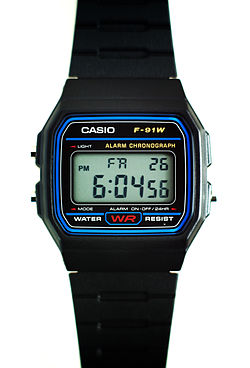
 Casio F-91W-1 watch with a resin case and resin strap | |
| Manufacturer | Casio |
|---|---|
| Type | Quartz |
| Display | Digital |
| Introduced | June 1989[1] |
The Casio F-91W is a digital watch manufactured by Japanese electronics company Casio. Introduced in June 1989[1][a] as a successor of the F-87W,[2] it is popular for its low price, long battery life and iconic design.[3] As of 2011, annual production of the watch is 3 million units, which makes it the most sold watch in the world.[4]
Specifications
[edit]Design
[edit]Designed by Ryūsuke Moriai as his first design for Casio,[5] the case of the F-91W measures 37.5 by 34.5 by 8.5 millimetres (1.48 by 1.36 by 0.33 in). The case is primarily made of resin,[6] with a stainless steel caseback and buttons, with the manufacturer's module number, 593, stamped on the caseback. The resin strap is 18 millimetres (0.71 in) at the fitting and 22 mm across the widest part of the lugs. The total weight is 21 grams (0.74 oz).
Features
[edit]The F-91W has a chronograph, featuring precision of 1⁄100 seconds with a count up to 59:59.99 (nearly one hour). The chronograph is also able to mark net and split times (i.e., laps). Other features include an hourly time beep, a single daily alarm lasting 20 seconds and an annual calendar. The watch does not make allowances for leap years as there is no provision to record the year. Due to this, the month of February is always counted as 28 days.[7] The watch uses a faint green LED backlight located at the left of the display for illumination (in earlier units it was an amber microlight). According to the manufacturer estimates, the watch is reported to be accurate to ±30 seconds per month.[7]
The quartz movement, designated Module 593, is powered by a single CR2016 3-volt lithium button cell rated to a stated battery life of 7 years.[8]
Water resistance
[edit]The front of the watch is marked "Water Resist".[7] The black version (F91W-1)[9] is "30 meter / 3 bar" (i.e., 100 feet / 44 psi), the ISO standard meaning of which is: "Suitable for everyday use. Splash/rain resistant. NOT suitable for showering, bathing, swimming, snorkeling, water related work and fishing".
Operation
[edit]
The watch is controlled by three side-mounted push-buttons.
- The upper left button, labeled "Light", turns on the light, cancels the alarm, resets the stopwatch or marks the split (lap) time, and is used for selecting settings.
- The lower left button, labeled "Mode", cycles the modes of the watch: time display, alarm, stopwatch, and time/date adjustment.
- The right button, labeled "Alarm On-Off/24hr", is the function button: when used, it starts and stops the stopwatch, changes the settings currently being adjusted, or switches between the 12- and 24-hour modes, depending on what mode the watch is currently in.[10]
The time or date is adjusted by pressing the lower left button three times to bring the watch to time adjustment mode. The top left button is used to cycle through seconds, hours, minutes, month, date, day and normal mode. The right button is used to adjust the flashing value displayed. Unlike any other value, the seconds can only be zeroed. Should this happen before 30 seconds, the watch will zero in at the beginning of the current minute. After 30 seconds it will start the next minute as displayed. When the adjustments are finished, the bottom left button can be pressed once to return the watch to normal mode.
The watch display shows the day of the week, day of the month, hour, minute, seconds and the signs PM in the afternoon – or 24H (24-hour clock) – at all times, the alarm signal status (bar of vertical lines), and the hourly signal status (double beep on the hour, shown as a bell) are present when activated in the alarm mode.
In stopwatch mode, minutes, seconds and hundredths of a second are shown.
Usage in terrorism
[edit]
The US government became suspicious of Afghans who wore Casio watches due to their ability to be used as timers for improvised explosive devices, a tactic favored by al-Qaeda.[11][12]
According to secret documents issued to interrogators at Guantanamo Bay, obtained[13] and released by The Guardian, "the Casio F-91W digital watch was declared to be 'the sign of al-Qaeda' and a contributing factor to continued detention of prisoners by the analysts stationed at Guantanamo Bay. Briefing documents used to train staff in assessing the threat level of new detainees advise that possession of the F-91W and the A159W, available online for as little as £4, suggests the wearer has been trained in bomb making by al-Qaeda in Afghanistan."[14] United States military intelligence officials have identified the F-91W as a watch that terrorists use in constructing time bombs.[15][16][17][18]
This association was highlighted in the Denbeaux study, and may have been used in some cases at Guantanamo Bay.[19] An article published in The Washington Post in 1996 reported that Abdul Hakim Murad, Wali Khan Amin Shah, and Ramzi Ahmed Yousef had developed techniques to use commonly available Casio digital watches to detonate time bombs.[20] Casio watches were mentioned almost 150 times in prisoner assessments from Guantanamo.[21]
On July 12, 2006, the magazine Mother Jones provided excerpts from the transcripts of a selection of the Guantanamo detainees.[17] The article informed readers:
More than a dozen detainees were cited for owning cheap digital watches, particularly "the infamous Casio watch of the type used by Al Qaeda members for bomb detonators".
The article quoted Guantanamo Bay detainee Abdullah Kamel Abdullah Kamel Al Kandari:
When they told me that Casios were used by Al Qaeda and the watch was for explosives, I was shocked ... If I had known that, I would have thrown it away. I'm not stupid. We have four chaplains [at Guantanamo]; all of them wear this watch.
Variants
[edit]| Model name | Description |
|---|---|
| F-91W-3, F-91WG-9 | Similar to the original F-91W, but including a green and gold trim respectively on the face. Gold variant has gold colored function buttons[22] |
| F-91-WB series | Simplified case print, print on face and strap: blue-gray on black, bronze on black, white on blue, gray on white. [23] |
| F-91-WC series | Neon colors for case, face and strap: orange, blue, green, pink, beige and yellow.[24] |
| F-91-WM series | Metallic colored cases with black straps: grey, army green, blue, silver and gold. |
| F-91-WS series | Translucent straps with muted case colors: blue, pink, white, and grey[25] |
| F-84W | Japanese Domestic Market (JDM) model. Uses the same 593 module, but the case design is more similar to the older F-28W and F-87W. It has lugs instead of an embedded strap. |
| F-94W | Circular icon arrangement in the display. |
| W-59 | Black case with rounded corners and blue accents on the face. Waterproof up to 50 meters. |
| A158W, A159W, A163W, A164W | Chrome plated case, stainless steel band. |
| A159WGEA-1 | Ion plated gold stainless steel band, gold colored chrome plated case. |
| F-105W, A168W, A168WG, A168WEGM, A168WEM, W-86 | Equipped with electroluminescent backlighting instead of the LED backlight in the other variants. Available in black color with a resin strap or in silver or gold colors with a stainless steel bracelet. Slightly different icon arrangement on the display and a thicker case due to the backlight system. Some versions also feature a negative display. |
| LA680 | A smaller variant, marketed towards women |
Counterfeits
[edit]
Counterfeits of this watch are very common, despite its low price tag. These counterfeits generally have a lower plastic build quality, narrower LCD viewing angles, louder and higher-pitched beeps, and significantly less accurate timekeeping than genuine models.[26] The newer models with the green LED light can be tested by holding the right button for over 3 seconds in the main timekeeping mode; this will lead the display to show "CASIo", as a test for authenticity. With the advancement in technology, however, some counterfeit models have also been developed to show this sign. A different way of assessing authenticity is to press all three buttons simultaneously, which has the watch enter a test mode. In that mode, an extra dot is seen with fake modules in some cases. [27] If the dot is not there, another indicator is if the dot that serves as a serif at the bottom of the leftmost day letter is a distance from the letter. A real F-91W will have the serif nearly touching the letter. [28]
Notes
[edit]- ^ The Wikipedia article had previously, since March 2009, reported an incorrect release year of 1991, which was repeated in a BBC article suspected of sourcing the date from Wikipedia (an example of circular reporting). The false release year was finally corrected in 2019, citing an article by KSNV about the error as a source.
References
[edit]- ^ a b Moyer, Phillip (June 15, 2019). "The case of an iconic watch: how lazy writers and Wikipedia create and spread fake 'facts'". KSNV. Retrieved June 19, 2019.
- ^ Casio: General Catalog (1984): The Casio Collection. A Superb Selection of Modern Timepieces
- ^ "Casio F91W-1: The retro watch with a strange double life". Montredo. February 4, 2020. Archived from the original on January 27, 2025. Retrieved January 27, 2025.
- ^ "Casio F-91W – the classic quartz digital watch". ICON. August 19, 2011. Archived from the original on July 29, 2019. Retrieved August 6, 2019.
- ^ Ariel Adams (April 16, 2017). "An Afternoon In Tokyo With The Man Who Designs Casio G-Shock Watches". [A Blog To Watch. Retrieved July 6, 2019.
- ^ "F-91W-1 | Digital | Youth | Timepieces | CASIO". CASIO Official Website. Retrieved February 16, 2022.
- ^ a b c "F91W-1 Classic Timepiece". Casio. Retrieved April 27, 2011.
- ^ "F91W-1 | Steel Black Digital Watch | CASIO". CASIO Official Website.
- ^ "F-91W-1XY". Casio. Archived from the original on May 30, 2011. Retrieved May 22, 2013.
- ^ "Manual" (PDF). Casio. Retrieved August 5, 2025.
- ^ Ball, James (April 25, 2011). "Guantánamo Bay files: Casio wristwatch 'the sign of al-Qaida'". The Guardian.
- ^ Winterman, Denise (April 26, 2011). "Casio F-91W: The strangely ubiquitous watch". BBC News.
- ^ "Guantánamo files: How interrogators were told to spot al-Qaida and Taliban members". The Guardian. April 25, 2011. Retrieved April 10, 2019.
- ^ Ball, James (April 25, 2011). "Guantánamo Bay files: Casio wristwatch 'the sign of al-Qaida'". The Guardian. London.
- ^ "USA v. al Qahtani" (PDF). US Department of Defense. November 7, 2005. Retrieved February 27, 2007.
- ^ "Combatant status review board for Mohammed Ahmad Said el Edah". The New York Times. October 6, 2004.
- ^ a b Gilson, Dave (July 12, 2006). "Why Am I in Cuba?". Mother Jones.
- ^ "Summary of Evidence for Combatant Status Review Tribunal" (PDF). October 13, 2004. p. 216. Archived from the original (PDF) on July 31, 2006.
- ^ "Empty Evidence". National Journal. February 3, 2006. Archived from the original on July 4, 2008.
- ^ Smith, R. Jeffrey (July 21, 1996). "New Devices May Foil Airline Security". The Washington Post. p. A01. Retrieved March 14, 2008.
- ^ Batya (July 9, 2020). "How did the Casio F91W Become a Terrorist Icon?". Reaper Feed. Archived from the original on July 28, 2020. Retrieved January 27, 2025.
- ^ "F-91WG-9 | VINTAGE SERIES | Timepieces | CASIO". CASIO Official Website. Archived from the original on August 4, 2020.
- ^ "Casio Product F-91WB-1". www.casio.com. Archived from the original on January 27, 2025. Retrieved January 27, 2025.
- ^ "Casio Collection | Timepieces | Products | CASIO". www.casio.co.uk. Archived from the original on May 30, 2011. Retrieved June 8, 2019.
- ^ "Casio International | Timepieces | Digital | F-91WS-2 | CASIO". www.casio-intl.com. Archived from the original on January 27, 2025. Retrieved January 27, 2025.
- ^ "Comparing a genuine Casio F91-W with a fake". July 2018. Archived from the original on January 27, 2025. Retrieved January 27, 2025.
- ^ "Comparing a genuine Casio F91-W with a fake".
- ^ "Reddit - the heart of the internet".
External links
[edit] Media related to Casio F-91W at Wikimedia Commons
- F91W-1 product page, Casio website

| Products |
| ||||||||||||||||||||||
|---|---|---|---|---|---|---|---|---|---|---|---|---|---|---|---|---|---|---|---|---|---|---|---|
| Other | |||||||||||||||||||||||

Casio F-91W
View on GrokipediaHistory
Development and Introduction
Casio Computer Co., Ltd. developed the F-91W as a minimalist quartz digital wristwatch, building on the company's established expertise in electronic timepieces since entering the watch market with its first model in November 1974.[6] The design emphasized cost efficiency through simplified components, including a basic LCD display and module 593 for timekeeping, alarm, stopwatch, and calendar functions, achieving production costs that enabled retail pricing around US$10.[7] This approach reflected Casio's late-1980s focus on accessible consumer electronics, prioritizing reliability and longevity over advanced features.[2] The F-91W was introduced in 1989, marking it as a successor in Casio's line of compact digital watches and quickly establishing itself as a bestseller due to its 7-year battery life and accuracy of approximately 30 seconds per month.[2][7] Initial production targeted broad market appeal, with the model retaining its core specifications unchanged for decades, underscoring its effective engineering for everyday use.[3] By the early 1990s, annual sales reached millions, contributing to over 100 million units produced cumulatively.[8]Production and Longevity
The Casio F-91W was introduced to the market in 1989 as a successor to earlier models like the F-87W, featuring the module 593 quartz movement.[7][1] Production has continued uninterrupted into 2025, spanning over 35 years with minimal design alterations, enabling Casio to maintain economies of scale through standardized manufacturing.[3] This longevity arises from the watch's basic construction—resin case, simple digital display, and essential functions—which requires few updates to meet ongoing demand for affordable timekeeping.[9] Annual production volume reached approximately 3 million units by the early 2010s and has sustained similar levels, reflecting consistent global sales driven by retail prices under $20 and broad utility in everyday and utilitarian applications.[7][3] Casio has not publicly disclosed exact cumulative figures, but estimates based on reported output suggest tens of millions of units manufactured since inception, underscoring its status as one of the highest-volume watch models ever produced.[10] The absence of obsolescence in its core quartz technology, combined with low failure rates from the CR2016 battery's 7-year lifespan, supports this extended production run without necessitating frequent redesigns.[10] Factors contributing to the model's endurance include its resistance to fashion cycles, as the utilitarian black resin design prioritizes function over aesthetics, and robust supply chain efficiencies from high-volume component sourcing.[11] Minor variants, such as color options or regional labeling, have appeared sporadically, but the core F-91W configuration remains unchanged, allowing Casio to leverage proven assembly processes in facilities optimized for digital watches.[12] This approach contrasts with more complex timepieces that require iterative updates, enabling the F-91W to persist as a staple in budget segments worldwide.[13]Design and Specifications
Physical Characteristics
The Casio F-91W is characterized by its compact and lightweight design, with a resin case measuring 38.2 × 35.2 × 8.5 mm and a total weight of 21 grams.[1] This slim profile facilitates comfortable wear during daily activities and sports.[14] The case and bezel are constructed from resin, paired with a resin strap that adjusts via a buckle clasp, emphasizing durability and minimalism over luxury materials.[1] The watch features three resin-covered buttons for operation, positioned on the right side for the mode and set functions, and a central button for lighting and starting/stopping the stopwatch.[15] A stainless steel caseback provides structural integrity, stamped with the module number 593.[16] The display consists of a small LCD screen, approximately 20 mm in height, protected by a resin crystal that offers basic scratch resistance suitable for casual use.[17] Lug width measures 18 mm, allowing compatibility with aftermarket straps, though the original resin band contributes to the overall featherweight feel.[18] These attributes underscore the F-91W's emphasis on functionality and portability rather than aesthetic embellishment.[19]Technical Specifications
The Casio F-91W employs quartz module 593 for timekeeping, featuring a digital LCD display with seven-segment digits for hours, minutes, seconds, month, date, and day of the week.[4][15] The module supports 12/24-hour format selection and an auto-calendar that adjusts for month lengths and leap years up to the year 2099.[20] Accuracy is rated at ±30 seconds per month under normal conditions.[21] Power is provided by a single CR2016 lithium battery, offering approximately 7 years of operation with typical daily use, including activation of the LED backlight.[1][22] Key timing functions include a daily alarm, hourly chime signal, and a 1/100-second stopwatch with a maximum capacity of 59 minutes, 59.99 seconds; the stopwatch supports elapsed time, split time, and first-to-second place timing modes.[23] The LED backlight illuminates the display for low-light visibility but lacks automatic activation.[20]| Specification | Details |
|---|---|
| Module | 593 (quartz)[4] |
| Display Type | LCD, seven-segment[15] |
| Battery | CR2016, ~7 years life[1] |
| Accuracy | ±30 seconds/month[21] |
| Stopwatch Resolution | 1/100 second[23] |
| Alarm Types | Daily, hourly chime[23] |
Water Resistance and Limitations
The Casio F-91W carries a water resistance rating of 30 meters (100 feet), equivalent to 3 atmospheres of pressure, as specified in product listings and consistent with industry standards for basic digital watches.[20] [17] This rating certifies the watch for resistance to accidental splashes, rain, or brief hand washing but explicitly excludes submersion, swimming, showering, or any pressurized water exposure.[1] [24] The design employs a simple resin case without gaskets on the caseback or push-button stems, limiting its ability to maintain integrity under sustained moisture or dynamic conditions like button presses in water, which can create pathways for ingress.[25] Casio's official guidance reinforces these constraints, stating the watch provides "peace of mind from accidental splashes" but is not suitable for bathing or water-related activities.[1] Independent tests, such as pressure chamber evaluations, confirm that stock units typically fail beyond superficial exposure, with water penetration leading to corrosion of the module or display fogging over time.[24] User experiences vary, with some reports of survival in showers or light submersion attributed to manufacturing tolerances or low-pressure scenarios, yet these are not reliable and contradict the rated specifications; failures often manifest as intermittent functionality or total module seizure after months of latent damage.[26] [27] Modifications, like oil-filling the case, have enabled extreme depths in controlled tests (e.g., 4,950 meters), but such alterations void standard usability and highlight the unmodified watch's inherent vulnerabilities.[28] For prolonged water avoidance, users are advised to remove the watch during exposure exceeding splashes, as empirical data shows degradation accelerates in humid or chlorinated environments.[29]Features and Operation
Core Functions
The Casio F-91W employs a quartz module 593 for timekeeping, displaying hours, minutes, seconds, and either 12- or 24-hour format, along with month, date, and day of the week via an auto-calendar that adjusts for varying month lengths and leap years without manual intervention.[14][17] It includes a single daily alarm function, which sounds at a user-set time, and an hourly time signal that beeps on the hour to aid time awareness.[30][20] The stopwatch operates as a 1/100-second chronograph with a capacity up to 59 minutes, 59.99 seconds, supporting elapsed time measurement, split time recording, and first-to-second place timing modes.[30][31] An LED backlight illuminates the display for low-light visibility, activated by a side button.[14][20]User Operation and Controls
The Casio F-91W employs three primary buttons for user interaction: the A button (typically upper right), which advances digits in settings, toggles 12/24-hour formats, starts/stops the stopwatch, and triggers an alarm demo when held in alarm mode; the C button (lower right), which cycles through operational modes and returns to timekeeping; and the L button (left side), which shifts between setting fields (e.g., from seconds to hours), resets the stopwatch, and stops the alarm buzzer.[32] The LCD display indicates regular timekeeping with hour, minute, second, AM/PM indicator, month, date, and day of the week, alongside mode-specific icons such as the alarm-on mark or stopwatch running symbol.[32] Mode navigation is achieved by pressing the C button repeatedly, sequencing through regular timekeeping, stopwatch, daily alarm, and time/calendar setting modes; inactivity for several minutes automatically returns the watch to timekeeping mode.[32] To set the time and calendar, enter the time/calendar setting mode by pressing C three times, then use L to cycle through fields starting from seconds (where holding A for over 2 seconds resets to zero and synchronizes to a time signal), followed by hours, minutes, month, date, and day; adjust values with short presses of A or hold for rapid advancement, and press C to exit.[32] Precise synchronization requires correcting seconds monthly against a reference time signal.[32] For the daily alarm, access alarm mode via C, then press L to select the hour field and A to set the value (holding A accelerates adjustment), repeat for minutes, and press A briefly to toggle the alarm and hourly time signal on or off (indicated by respective marks); the buzzer activates for 20 seconds at the preset time daily until manually stopped with L, or demoed by holding A.[32] The stopwatch, supporting measurements up to 59 minutes 59.99 seconds with 1/100-second resolution, operates in net time, split time, or 1st-2nd place modes: start and stop with A (accompanied by a confirmation signal), record splits or release with C, and reset to zero with L either during operation or after stopping; for timings exceeding capacity, reset mid-session to continue.[32] No additional controls exist for illumination or advanced features, emphasizing the watch's minimalist design.[32]Reliability and Durability
Battery Life and Maintenance
The Casio F-91W utilizes a single CR2016 lithium coin cell battery as its power source, which provides an approximate operational life of 7 years under normal usage conditions, including daily alarm activation and periodic backlight illumination.[1] [33] This duration is determined by the battery's nominal capacity of around 90 mAh at 3V, with the watch's low-power module 593 consuming minimal energy for timekeeping, alarm, stopwatch, and LED functions.[1] User reports occasionally document extended lifespans exceeding 10 years, attributable to infrequent feature use or manufacturing variances in battery quality, though official specifications conservatively estimate 7 years to account for average wear.[34] Battery replacement is a user-serviceable procedure requiring basic tools such as a small Phillips screwdriver, tweezers, and a replacement CR2016 cell, but it involves partial disassembly of the resin case to access the module.[35] The process entails removing the four case-back screws, prying off the back cover, detaching the strap lugs if necessary, and extracting the old battery from its holder within the module; care must be taken to avoid damaging the thin LCD seal or shorting contacts.[35] Upon installation of the new battery, the watch typically resets to initial mode, necessitating manual time and date adjustment via the three push-button controls, and testing of functions like the hourly chime and alarm.[36] Professional servicing is recommended only if seals are compromised, as the F-91W's simple construction allows most users to perform replacements without specialized equipment.[35] Maintenance beyond battery changes is minimal due to the watch's rugged, non-serviceable design, with no lubrication or calibration required for its quartz movement.[1] Indicators of impending battery failure include dimmed LCD segments, inconsistent backlight operation, or failure of the alarm chime, prompting timely replacement to prevent total power loss.[36] Avoid exposure to extreme temperatures during storage, as lithium cells degrade faster below -10°C or above 60°C, potentially shortening effective life.[1] Non-official modifications, such as substituting a thicker CR2032 battery for extended capacity, are possible but risk improper fit or module damage and void manufacturer warranty assurances.[37]Performance in Harsh Conditions
The Casio F-91W exhibits empirical durability exceeding its modest specifications in user-conducted extreme tests, including exposure to sub-zero temperatures and brief high-heat scenarios, where the watch often continues functioning after recovery from temporary display blackout or thermal stress. In freezing conditions, such as immersion in ice blocks simulating temperatures below -10°C, the LCD may cease displaying due to liquid crystal solidification, but timekeeping persists internally, with full recovery upon thawing to ambient temperatures around 20°C. Accuracy, rated at ±30 seconds per month under normal conditions (approximately 10–35°C), degrades in prolonged extremes due to quartz oscillator sensitivity, though unmodified units maintain operational integrity without permanent failure in short bursts of cold or heat up to 60°C as observed in informal benchmarks.[38][39] Regarding mechanical resilience, the F-91W lacks formal shock resistance certification akin to Casio's G-Shock line, yet resin case construction and integrated module design absorb impacts from drops onto hard surfaces (e.g., concrete from wrist height) and vibrational stresses in activities like mountain biking or field maneuvers, with failures rare unless buttons are repeatedly depressed under force. Dust and particulate ingress pose minimal issues in arid or sandy environments, as seals around the case-back and buttons provide incidental protection, corroborated by sustained performance in desert-like military deployments where soldiers report no module disruptions from grit exposure over months. Prolonged strap degradation occurs in UV-intense or chemically harsh settings, necessitating replacements, but the core timepiece endures.[4][29] In operational military contexts, such as patrols in high-altitude or tropical zones, the F-91W has logged reliable service for timing and alarms amid combined stressors like humidity fluctuations, altitude-induced pressure changes up to 3,000 meters, and rough handling, attributed to its lightweight 21-gram profile reducing snag risks without compromising basic quartz reliability. These outcomes stem from the module's simple electro-luminescent backlight and stepper motor design, which prioritize low power over advanced hardening, yet yield a mean time between failures exceeding seven years in aggregate user data from adverse exposures.[40][41]Cultural and Practical Significance
Everyday Popularity and Cultural Icon Status
The Casio F-91W has achieved widespread everyday popularity due to its affordability, typically retailing for around $20, combined with reliable basic functions including timekeeping, alarm, and stopwatch capabilities.[42] Its long battery life, lasting approximately seven years on a single CR2016 cell, minimizes maintenance needs, making it suitable for daily wear without frequent replacements.[3] Annual sales remain robust at about 3 million units, contributing to cumulative sales exceeding 100 million worldwide since its 1989 introduction, positioning it as one of the best-selling non-smartwatches.[43] This enduring demand stems from its lightweight resin construction, which withstands routine activities, and its unpretentious design that appeals to users seeking a functional "beater" watch for travel, work, or casual use.[44] As a cultural icon, the F-91W symbolizes minimalist functionality and accessibility in timepieces, evoking nostalgia for simpler digital technology from the late 20th century.[11] It has been worn by notable figures such as a young Barack Obama, highlighting its appeal across diverse socioeconomic backgrounds.[45] The watch's ubiquity in everyday scenarios has cemented its status in popular culture, often representing practicality over ostentation, and inspiring references in media and enthusiast communities for its role in democratizing precise timekeeping.[9] Despite its basic aesthetics, this mass-market success underscores a preference for durability and value, influencing perceptions of quartz watches as essential, no-frills tools.[42]Military and Field Use
The Casio F-91W has gained widespread adoption among military personnel across various armed forces due to its lightweight construction, long battery life exceeding seven years under typical use, and essential timing functions such as a stopwatch and hourly chime, which prove valuable for operational synchronization without drawing attention.[1] Its resin case, measuring 34 mm in diameter and 8.5 mm thick, withstands rough handling far beyond its rated 3 ATM water resistance, including exposure to dust, impacts, and temperature extremes encountered in field deployments.[4] Soldiers in the U.S. military, including Explosive Ordnance Disposal (EOD) units, frequently select the F-91W for its simplicity and reliability in high-stakes environments, where it serves as a personal tool for mission timing rather than official issue equipment.[46] British special forces operators have similarly favored it for its unobtrusive profile and consistent performance during extended patrols, prioritizing functionality over luxury in austere conditions.[4] In broader field applications, such as reconnaissance or survival scenarios, the watch's low-light audible alarm and 1/100-second stopwatch enable precise interval tracking without visual reliance, contributing to its endurance in prolonged operations across deserts, mountains, and urban combat zones.[40] User reports from military training and active duty highlight its resilience, with instances of the F-91W surviving submersion, drops from height, and vibrational stress from vehicle transport, often outlasting expectations for a budget digital timepiece.[4] This durability stems from the robust Module 593 quartz movement, which maintains accuracy within ±30 seconds per month under standard conditions, sufficient for tactical needs where atomic synchronization is unavailable.[1] While not designed for elite shock resistance like higher-end models, its affordability—typically under $20—allows replacements without logistical burden, making it a practical choice for rank-and-file troops in resource-constrained settings.[47]Controversies and Associations
Link to Terrorism and Bomb Timers
The Casio F-91W became associated with terrorism due to its widespread use by Al-Qaeda operatives as a reliable, low-cost timing device in improvised explosive devices (IEDs). Its 1/100-second stopwatch, hourly chime, and durable battery—lasting up to seven years—facilitate easy modification into electronic detonators by connecting the circuit to an ignition source, exploiting the watch's precise interval signaling.[48][10] In Al-Qaeda bomb-making training camps in Afghanistan during the late 1990s and early 2000s, the F-91W was distributed to trainees specifically for constructing timing mechanisms, leading U.S. interrogators to regard its possession as indicative of explosives expertise.[49] Leaked Guantánamo Bay detainee assessment files from 2002–2008 reference the black F-91W model in 32 cases, often linking it to IED facilities, explosives handling, or bomb courses; approximately one-third of such detainees had documented ties to terrorist bombing activities.[49] Over 50 assessments across models like the F-91W and similar A159W cited the watch as potential evidence of Al-Qaeda affiliation, contributing to prolonged detentions despite its ubiquity among civilians.[10] Notable incidents underscore its role: Ramzi Yousef incorporated a Casio watch into the 1993 World Trade Center bombing and a 1994 Philippine Airlines explosive device.[48] Ahmed Ressam, the "millennium bomber," acquired multiple F-91W units in 1999 for timers in planned attacks on Los Angeles International Airport.[49] Insurgents in Iraq and Afghanistan later adapted the F-91W for roadside IEDs, valuing its resistance to environmental extremes and availability in local markets.[10] These applications stem from the watch's technical simplicity rather than inherent design flaws, as similar functions exist in countless consumer timers.[48]Government Responses and Overreach Claims
In response to the Casio F-91W's documented use as a timer in improvised explosive devices (IEDs) by Al-Qaeda and affiliated groups, the United States Department of Defense identified it as a favored trigger mechanism in a 2006 intelligence update on IED components.[50] United States military intelligence officials similarly flagged the watch as an indicator of potential terrorist activity, noting its prevalence among captured insurgents in Afghanistan and Iraq for its reliable quartz movement and ease of modification into detonation circuits.[51] At Guantanamo Bay detention facility, possession of the F-91W was incorporated into detainee risk assessments as evidence of Al-Qaeda affiliation or bomb-making training, based on reports that the group distributed the watches during explosives courses in Afghanistan.[49] Leaked assessment files from 2002–2008 referenced the model in over 50 cases, with approximately one-third of affected detainees linked to known explosives handling, facilities, or expertise; interrogators viewed it alongside other items like specific Casio models (e.g., A159W) as a "sign of al-Qaida."[49] A U.S. government study further documented over 50 suspected Al-Qaeda members detained at Guantanamo wearing F-91W or similar variants, correlating possession with explosives training in about one-third of instances.[5] Critics have argued that these assessments represent evidentiary overreach, given the F-91W's extreme ubiquity—selling millions worldwide for under $20 since 1991—and its use by non-terrorists, including U.S. military personnel and civilians, rendering it an unreliable sole indicator of threat.[51] One detainee, assessed as an alleged Al-Qaeda facilitator, contested the inference by highlighting the watch's popularity among American troops and the general populace, questioning its specificity as intelligence.[52] Such claims underscore concerns over ambiguous correlations in post-9/11 counterterrorism profiling, where commonplace items were elevated to presumptive evidence without accounting for baseline prevalence, potentially inflating risk categorizations in detention decisions.[49] No formal civilian bans or purchase restrictions were imposed, but the association prompted heightened scrutiny in military and intelligence contexts, including CIA evaluations of captured ISIS suspects possessing the watch as potential timers.[5]Variants
Color and Aesthetic Variants
The Casio F-91W maintains a consistent square-shaped resin case and strap design across variants, measuring approximately 38.2 mm × 35.2 mm × 8.5 mm, with a digital LCD display featuring yellow-green electroluminescent backlighting.[1] The original and most iconic aesthetic is a matte black resin case and strap paired with a black display background, emphasizing minimalist functionality over ornamentation.[14] This black base tone appears in models like the F-91W-1 and F-91W-3, which differ primarily in minor trim accents rather than full color shifts.[14] Casual variants in the F-91WM series introduce metallic or colored resin cases while retaining the black strap and display for contrast.[14] Examples include silver-toned cases (F-91WM-7A), green resin cases (F-91WM-3A), and grey resin cases (F-91WM-1B), providing subtle aesthetic elevation without altering core dimensions or functionality.[53][54][55] Pop-oriented translucent resin variants, such as the F-91WS series, feature semi-transparent cases and straps in light-diffusing colors like clear or tinted hues, adding a modern, playful aesthetic while preserving the lightweight 21-gram profile.[14][56] Recent environmentally focused updates in the F-91WB series adopt bio-based resin materials for cases and straps in uniform monochromatic schemes, including all-black (F-91WB-1A), all-blue, and all-white (F-91WB-7A), with simplified display layouts to enhance minimalism.[23][57] Limited edition collaborations include the 2025 PAC-MAN model (F-91WPC-1A / F-91WPC-1AJR), released to celebrate 50 years of Casio watches and the 45th anniversary of PAC-MAN, featuring PAC-MAN and the four ghosts (Blinky, Pinky, Inky, Clyde) on the dial with vivid neon colors, a bio-based resin band, and retro design elements.[30]| Model Series | Key Aesthetic Features | Example Models |
|---|---|---|
| F-91W (Standard) | Matte black resin case/strap, black display | F-91W-1, F-91W-3[14] |
| F-91WM (Casual/Metallic) | Colored or metallic resin cases, black strap/display | F-91WM-7A (silver), F-91WM-3A (green), F-91WM-1B (grey)[53][54][55] |
| F-91WS (Translucent) | Semi-transparent resin case/strap | F-91WS-2, F-91WS-4, F-91WS-7CF (clear)[14][56] |
| F-91WB (Minimalist/Bio-based) | Uniform monochromatic bio-resin, simplified face | F-91WB-1A (black), F-91WB-7A (white)[23][57] |
Functional and Module Variants
The Casio F-91W consistently utilizes the module 593 quartz movement across its production run, with no official functional variants altering core operations. Introduced in 1989, this module delivers reliable timekeeping with an accuracy of ±30 seconds per month and supports both 12-hour and 24-hour formats.[1][3] Key functions include an annual auto-calendar that automatically adjusts for varying month lengths and leap years up to the year 2099, eliminating manual date corrections except for century years not divisible by 400. The integrated stopwatch offers 1/100-second resolution for the first 60 minutes, thereafter switching to 1-second increments, with net time and split time modes for timing events up to one hour.[1][17] Additional features comprise a single daily alarm, an hourly time signal for audible reminders on the hour, and an LED backlight activated by button press for illumination in dark conditions. Water resistance is rated to 30 meters, suitable for splashes and brief immersion but not prolonged submersion or high-pressure activities. Battery life extends approximately seven years using a CR2016 lithium cell, underscoring the design's emphasis on longevity and minimal maintenance.[14][1] While aftermarket modifications exist, such as replacement modules adding step counting or custom firmware, these are not produced or endorsed by Casio and fall outside standard variants. The uniformity of module 593 ensures interchangeable parts and consistent performance, contributing to the model's enduring appeal in utilitarian applications.[14]Counterfeits
Prevalence and Identification Methods
Counterfeits of the Casio F-91W are widespread, particularly on e-commerce sites like Amazon and eBay, where they are frequently offered at prices slightly below the genuine retail of around $15-20.[58] Despite Casio's annual production of over 3 million units as of 2011, the watch's iconic status and minimalistic design make it a prime target for imitation, with fakes comprising a notable portion of low-cost digital watch sales online.[9] Identification relies on examining external features, functionality, and internal components. A primary functional test involves holding the bottom-right button for three seconds; genuine models display "CASIo" (with a lowercase 'i') on the screen, while fakes typically do not or show errors.[59] [9] Key physical distinctions include:- Display markings: Genuine watches feature a tiny lowercase 'u' in the bottom-right corner beneath "RESIST"; fakes often have a larger, more prominent 'u'.[60]
- LCD segments: Authentic displays lack extraneous segments; counterfeits may show an extra segment in the digit layout.[60]
- Strap and case: Real straps exhibit no visible mold tags or lines; fake straps do. Buttons on genuine models are precisely milled to a point, and the brushed steel finish runs left-to-right, unlike the top-to-bottom pattern on fakes.[60]
- Back case engravings: Authentic rear covers are marked "China DH" or "Thailand ED"; deviations indicate counterfeits.[61]
- Screws and internals: Genuine case screws are smaller, blunt-ended, and compatible with flat-head drivers; fakes use larger pointed screws. Opening the case reveals superior PCB quality in originals, including shiny contacts, tuned solder joints, and Panasonic batteries, versus dull plating, sloppy epoxy, and off-brand cells in fakes.[60] [62]