


Community hub
Recent from talks
Contribute something
Nothing was collected or created yet.
Cessna Citation I
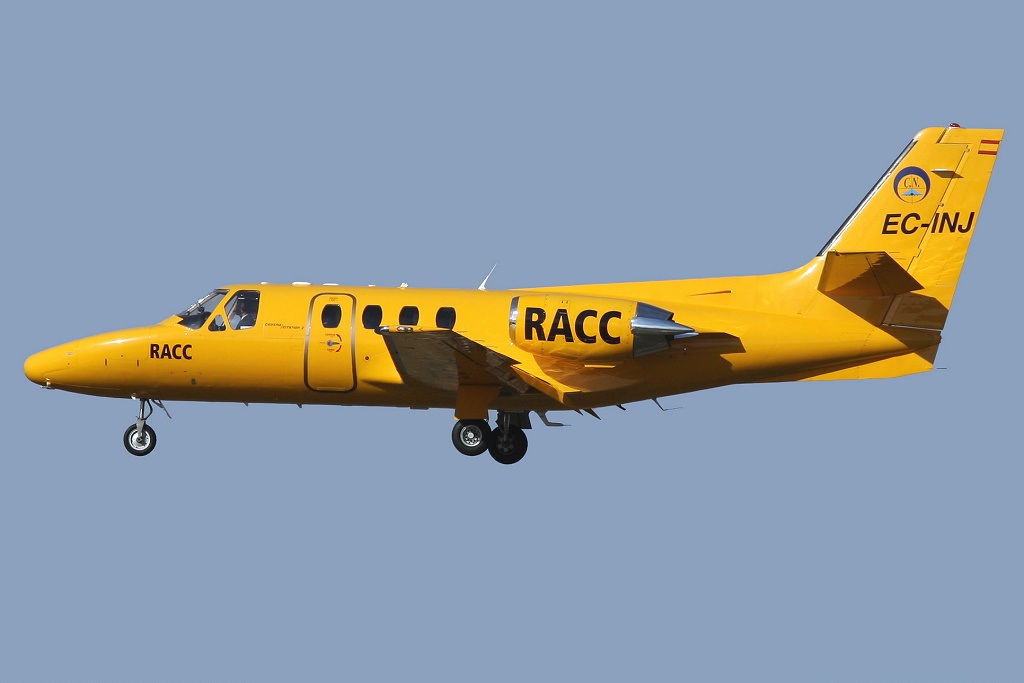
View on WikipediaThe Cessna 500 Citation I is a small business jet produced by Cessna, the basis of the Citation family. The Fanjet 500 prototype was announced in October 1968, first flew on September 15, 1969, and was certified as the 500 Citation on September 9, 1971. It was upgraded in 1976 as the Citation I, and the 501 Citation I/SP single-pilot variant was introduced in 1977. Production ended in 1985 with 689 of all variants produced. The straight wing jet is powered by JT15D turbofans. The aircraft was developed into the Citation II.
Key Information


Development
[edit].jpg)
In the early 1960s, the three major American general aviation aircraft manufacturers—Beechcraft, Cessna and Piper–faced a competitive challenge in the form of two newly-developed light business jets, the Learjet 23 and the Aero Commander 1121 Jet Commander, which were much less expensive to buy and operate than previous business jets such as the North American Sabreliner and Hawker Siddeley HS.125.[4] Previous efforts by Beechcraft and Cessna to market small jets had not met with success: the Cessna 407, a proposed civil version of the T-37 Tweet jet trainer, had not proceeded past the mockup stage due to insufficient customer interest,[5] while an effort by Beechcraft to market the Morane-Saulnier MS.760 Paris in North America had ended with only two aircraft sold.[6] However, the runaway success of the Learjet caused the two companies—which only manufactured piston engined aircraft at the time—to reconsider turbine engined aircraft, and Beechcraft launched two simultaneous efforts: the development of the turboprop-powered King Air 90 and an agreement to market the HS.125 in North America.[7]
Cessna quickly found that its premium twin piston-engine aircraft were uncompetitive with the King Air, which was substantially faster, yet could be flown by pilots with similar skills and licensing qualifications. However, the company also saw a broad gap between the King Air and existing light jets such as the Learjet, which were far faster but also relatively unforgiving to fly, requiring highly skilled pilots and long runways. Cessna reasoned that a market existed for a light jet that was faster than the King Air but similarly easy to fly, relatively inexpensive to buy and maintain, and able to access small airports with shorter runways. This type of aircraft would appeal to traditional Cessna buyers: amateur owner-pilots who intend to fly the aircraft themselves.[8][citation needed]
In October 1968 Cessna announced an eight place business jet capable of operating from airfields accessible to light twins. The Fanjet 500 prototype first flew on September 15, 1969. By then its unit cost was $695,000,[3] $5.96M today. The renamed 500 Citation had a relatively long development program with a longer forward fuselage, repositioned engine nacelles, a larger tail and more dihedral to the horizontal tail. It was FAA certified on September 9, 1971.[9]
In 1974, thrust reversers became optional, and in 1976, the gross weight was increased by 1,000 pounds (450 kg) to 10,850 pounds (4,920 kg).[10] In early 1976, the wingspan was increased from 43.9 to 47.1 ft (13.4 to 14.4 m).[11] The enhanced 500 Citation I was introduced later in 1976 with the higher gross weight, improved JT15D-1A engines and the increased span wing. Speed and range were enhanced, the aircraft's service ceiling increased from 35,000 to 41,000 feet (11,000 to 12,000 m), and the cabin pressure at altitude was increased from 7.6 to 8.6 psi (52 to 59 kPa).[9][10] Many of the original Citations, of which 349 were produced, were upgraded with the new engines.[12] The 501 Citation I/SP, certificated for single pilot operations, was delivered in early 1977. Production ended in 1985, it was developed into the Citation II/Bravo and the Citation V/Ultra/Encore.[9] 395 Citations and Citation Is and 296 I/SPs were built between 1971 and 1985.[9][13] The aircraft were dropped from production because JT15D engine prices had increased to the point that the price difference between the Citation I and Citation II series had become minimal, causing most buyers to opt for the larger and faster II and II/SP.[14]
By 2018, used 1970s model 500s were valued at $300,000, Citation ISPs at $695,000 to $1.25 million with the Eagle II package.[15]
Design
[edit]_(2)_(cropped).jpg)
The aircraft was powered by two Pratt & Whitney Canada JT15D-1 turbofan engines after Cessna's experience with the T-37 Tweet twinjet trainer. Its use of turbofans rather than turbojets and straight wings rather than swept wings made it cruise slowly compared to other business jets and Learjet salesmen mocked it as the "Nearjet" vulnerable to "bird strikes from the rear"; Cessna renamed it the "Citation" after the thoroughbred but it was nicknamed as "Slowtation".[16]
Operators
[edit]Government and Military operators
[edit]


Accidents and incidents
[edit]Notable accidents and incidents involving the Citation 500, Citation I and Citation I/SP:
- On August 2, 1979, New York Yankees player Thurman Munson was killed when his Citation I/SP, aircraft registration number N15NY, crashed short of the runway during touch-and-go landing practice at Akron-Canton Airport; the crash and post-crash fire destroyed the aircraft while Munson's two passengers escaped with serious injuries. The National Transportation Safety Board (NTSB) attributed the accident to Munson's failure to lower the flaps and maintain adequate airspeed.[22]
- On March 30, 2008, a Citation I/SP, registration VP-BGE, crashed near Biggin Hill Airport, killing former racing drivers David Leslie and Richard Lloyd, the two pilots, and another passenger, and causing a fire that destroyed two houses struck by the aircraft. The accident was attributed to the flight crew's improper emergency procedures in reaction to a perceived engine fault.[23]
- On October 13, 2016, a Citation 500, registration C-GTNG, crashed shortly after takeoff from Kelowna International Airport, killing former Premier of Alberta Jim Prentice, the pilot, and two other passengers. The Transportation Safety Board of Canada (TSB) was unable to conclusively determine the cause of the crash, but the flight profile was consistent with a spiral dive caused by spatial disorientation, and the pilot's lack of experience flying at night and in instrument meteorological conditions were thought to have contributed. The TSB also noted that although the aircraft had been outfitted for single-pilot operations in accordance with Transport Canada (TC) regulations, the operator lacked the required TC approval for single-pilot flights, and the TSB criticized TC for lax operator oversight.[24]
- On May 29, 2021, a Citation 501, registration N66BK, crashed into Percy Priest Lake shortly after takeoff from Smyrna Airport, killing American author Gwen Shamblin Lara and her husband, American actor Joe Lara, along with five other leaders of the Remnant Fellowship Church. The NTSB investigation determined the cause of the accident was pilot error related to somatogravic illusion (a type of spatial disorientation), due to heavy cloud cover.[25]
Specifications (Cessna Citation I)
[edit]Data from Jane's Civil and Military Aircraft Upgrades 1994-95 [26]
General characteristics
- Crew: Two (One pilot on I/SP)
- Capacity: 5 passengers
- Length: 43 ft 6 in (13.26 m)
- Wingspan: 47 ft 1 in (14.35 m)
- Height: 14 ft 4 in (4.37 m)
- Wing area: 278.5 sq ft (25.87 m2)
- Aspect ratio: 7.83:1
- Empty weight: 6,631 lb (3,008 kg)
- Max takeoff weight: 11,850 lb (5,375 kg)
- Fuel capacity: 564 US gal (470 imp gal; 2,130 L) usable fuel
- Powerplant: 2 × Pratt & Whitney Canada JT15D-1B turbofans, 2,200 lbf (9.8 kN) thrust each
Performance(above 28,000 ft (8,500 m)
- Maximum speed: Mach 0.705
- Cruise speed: 357 kn (411 mph, 661 km/h) at 35,000 ft (11,000 m)
- Stall speed: 82 kn (94 mph, 152 km/h) (CAS)
- Range: 1,328 nmi (1,528 mi, 2,459 km) at 41,000 ft (12,000 m) (45 min reserves, 1,562 lb (709 kg) payload)
- Service ceiling: 41,000 ft (12,000 m)
- Rate of climb: 2,719 ft/min (13.81 m/s)
See also
[edit]Related development
Aircraft of comparable role, configuration, and era
References
[edit]Notes
[edit]- ^ "500-Series Technical Review". Textron Aviation. April 28, 2015. Archived from the original on March 4, 2016.
{{cite web}}: CS1 maint: bot: original URL status unknown (link) - ^ a b Murdo Morrison (12 Oct 2018). "NBAA: Business jet designs that changed the industry". FlightGlobal.
- ^ a b "CESSNA'S JET AIRBORNE". Flight International. 2 October 1969.
- ^ Szurovy 1999, p. 11.
- ^ Olcott, John W. (5 May 2006). "Turbine Pilot: VLJ Deja Vu". aopa.org. Aircraft Owners and Pilots Association. Retrieved 17 April 2020.
- ^ Jerram, Mike (October 2010). "Morane-Saulnier Paris: the very first Very Light Jet" (PDF). General Aviation. International Council of Aircraft Owners and Pilots Associations. Retrieved 17 April 2020.
- ^ Szurovy 1999, p. 12.
- ^ Szurovy 1999, p. 12–14.
- ^ a b c d Gerard Frawley. "Cessna 500 & 501 Citation, Citation I & Citation I/SP". The International Directory of Civil Aircraft – via Airliners.net.
- ^ a b Szurovy 1999, p. 25.
- ^ Taylor, J.W.R. (editor) Jane's All the World's Aircraft 1976-77. London: Macdonald and Jane's, 1976. ISBN 0-354-00538-3, p.275.
- ^ Szurovy 1999, p. 26.
- ^ Simpson, R.W. (1991). Airlife's General Aviation. Shrewsbury, England: Airlife Publishing. p. 111. ISBN 1-85310-194-X.
- ^ Szurovy 1999, p. 28.
- ^ Mark Huber (December 2018). "For many models, market hitting the apex" (PDF). Aviation International News. pp. 20–21, 24. Archived from the original (PDF) on 2018-12-27. Retrieved 2018-12-27.
- ^ William Garvey (Feb 10, 2017). "Can A Cessna Succeed The G450?". Aviation Week & Space Technology.
- ^ "Angola receives maritime surveillance aircraft from Israel". Defence Web. 16 October 2017. Archived from the original on 19 October 2017. Retrieved 19 October 2017.
- ^ Martin, Guy (December 2017). "Angola acquires Citation MPA". Air International. Vol. 93, no. 6. p. 11. ISSN 0306-5634.
- ^ "FAA Registry: N-Number Inquiry Results: N54FT". Federal Aviation Authority. Archived from the original on 1 December 2017. Retrieved 27 November 2017.
- ^ Rivas, Santiago (September 2020). "Fighting Criminals all over Argentina". Air International. Vol. 99, no. 3. pp. 80–83. ISSN 0306-5634.
- ^ Flores, Santiago A. "From Cavalry to Close Air Support". Air International. May 2001, Vol. 60, No. 5, ISSN 0306-5634, p. 301.
- ^ "NTSB Aviation Accident Final Report CHI79FA064". National Transportation Safety Board. Retrieved April 6, 2021.
- ^ "Two Victims of Private Jet Crash Named". Sky News. 30 March 2008. Archived from the original on 16 May 2008. Retrieved 31 March 2008.
- ^ "Aviation Investigation Report A16P0186". Transportation Safety Board of Canada. June 4, 2019. Retrieved April 6, 2021.
- ^ "NTSB: Pilot error in crash killing diet guru Gwen Shamblin". AP. March 22, 2023. Retrieved March 23, 2023.
- ^ Michell, Simon, ed. (1994). Jane's Civil and Military Upgrades 1994-95. Coulsdon, Surrey UK: Jane's Information Group. pp. 300–301. ISBN 0-7106-1208-7.
Bibliography
[edit]- Szurovy, Geza (1999). Cessna Citation Jets. Osceola, Wisconsin: MBI Publishing Company. ISBN 0-7603-0785-7.
External links
[edit]
Cessna Citation I
View on GrokipediaDevelopment
Background and Announcement
In the late 1960s, Cessna Aircraft Company sought to enter the business jet market, which had been pioneered by competitors such as the Learjet in the early part of the decade. These early jets offered high speeds exceeding 500 miles per hour but required long runways, limiting their accessibility compared to slower turboprops cruising at around 250 miles per hour. Building on the legacy of founder Clyde Cessna, who established the company in 1927 and emphasized innovative general aviation designs, Cessna identified an opportunity to bridge this gap with a more versatile aircraft.[4][5][6] Market studies conducted by Cessna in the mid-1960s revealed strong demand for an affordable twin-engine business jet suitable for 4 to 6 passengers, capable of operating from short runways typically served by light twin turboprops, thereby expanding access for corporate and private operators without the high costs of existing jets like the Learjet or Hawker Siddeley HS.125. This positioned the new aircraft as an entry-level option in a growing segment, with projected acquisition costs around $695,000—significantly lower than competitors.[7][8] On October 7, 1968, Cessna publicly unveiled a full-scale mockup of the Fanjet 500 at the National Business Aircraft Association convention, announcing it as an eight-place pressurized executive jet with twin turbofan engines. The design promised a maximum cruise speed of up to 450 knots and a range of approximately 1,200 nautical miles with full passengers, emphasizing simplicity, low operating costs, and single-pilot certification potential. To power the aircraft, Cessna had partnered with Pratt & Whitney Canada as early as 1966, commissioning the development of the JT15D turbofan engine to deliver 2,200 pounds of thrust per unit while meeting the need for quiet, efficient performance in a compact package.[9])[10]Testing and Certification
The construction of the first prototype for the Cessna Citation I, initially designated as the Fanjet 500, took place at Cessna's Wichita, Kansas facility during 1969, culminating in its maiden flight on September 15, 1969, from Wichita Municipal Airport. Piloted by test pilots Milt Sills and J.L. LeSueur, the 1-hour and 45-minute flight evaluated basic systems and handling characteristics of the twin-engine light jet.[2][11] The subsequent flight test program spanned nearly two years and utilized multiple prototypes to validate airworthiness, encompassing evaluations of aerodynamics, propulsion integration, and overall performance under various conditions, including high-altitude operations and stall characteristics. During testing, engineers implemented several structural modifications, such as refinements to the wing and empennage configurations, to enhance longitudinal and directional stability and address handling qualities identified in early flights. These iterative changes were essential to meeting Federal Aviation Administration (FAA) requirements for transport-category certification.[12][13] The comprehensive test effort, which accumulated over 1,000 flight hours across the prototypes, ensured compliance with rigorous safety and performance standards before advancing to regulatory approval. On September 9, 1971, the FAA issued Type Certificate A22CE for the Model 500 Citation.[14][15] Entry into service followed shortly thereafter, with the first production aircraft delivered to American Airlines in January 1972, for use in their pilot training program. This milestone paved the way for broader commercial adoption of the Citation I as an accessible entry-level business jet.[16][17]Design
Airframe and Configuration
The Cessna Citation I is configured as a low-wing cantilever monoplane with straight wings, a T-tail empennage, and retractable tricycle landing gear, providing a clean aerodynamic profile suitable for its light business jet role.[18][19] Key dimensions encompass a length of 43 ft 6 in (13.26 m), wingspan of 47 ft 1 in (14.35 m), and height of 14 ft 4 in (4.37 m), with a basic empty weight of 6,631 lb (3,008 kg).[20][21] The fuselage accommodates up to 8 occupants (2 crew and 6 passengers) in a pressurized cabin and incorporates a swept-back vertical stabilizer to improve yaw stability during flight.[18] The airframe employs primarily aluminum alloy construction with a fail-safe structural design, utilizing riveted assembly for durability and redundancy.[18][22] Aerodynamic enhancements include automatic leading-edge slats and full-span trailing-edge flaps, enabling effective short-field operations by increasing lift at low speeds.[19]Engines and Systems
The Cessna Citation I is powered by two Pratt & Whitney Canada JT15D-1 turbofan engines, each rated at 2,200 lbf (9.8 kN) of thrust for takeoff, mounted in nacelles beneath the wings.[15] These lightweight, two-spool engines feature a bypass ratio of approximately 3.3:1 and incorporate efficient operation across the flight envelope.[23] The fuel system comprises integral tanks within the wings, providing a total usable capacity of 3,780 lb (1,714 kg) of Jet A or Jet A-1 fuel.[24] Fuel is delivered via electrically driven boost pumps in each tank, with crossfeed capability for balanced distribution to the engines in a non-return configuration; refueling occurs through overwing gravity ports or a single-point pressure receptacle on the left wing leading edge.[24] Hydraulic and pneumatic systems support actuation of the landing gear, wheel brakes, and speed brakes, with optional integration for thrust reversers. The hydraulic setup is an open-center, engine-driven system operating at 1,375–1,500 psi during demand, using fire-resistant Skydrol fluid stored in a 0.5-gallon reservoir in the tailcone; it does not power the electrically actuated flaps.[25] Pneumatic extension for the landing gear and emergency brakes relies on a 2,000 psi nitrogen bottle in the nose compartment, activated manually via a cockpit lever.[25] The 28 V DC electrical system draws from two engine-driven starter/generators, each rated at 200 A, supplemented by a 24 V nickel-cadmium battery for starting and emergency power, distributing via multiple buses to essential loads including fuel pumps and hydraulic controls.[20] Cabin pressurization employs engine bleed air modulated by an isobaric controller and dual outflow valves on the aft pressure bulkhead, achieving a maximum differential of 8.8 psi to maintain a nominal 8,000 ft cabin altitude during cruise at 41,000 ft.[26] Safety features include cabin altitude limit valves that seal at 13,000 ft and automatic oxygen mask deployment at 13,500 ft.[27] These systems enable a service ceiling of 41,000 ft and an initial climb rate of approximately 3,000 ft/min at sea level under standard conditions, contributing to the aircraft's efficient high-altitude performance for short- to medium-range missions.[20]Avionics and Cockpit
The Cessna Citation I features a standard Instrument Flight Rules (IFR) avionics suite designed for reliability in light business jet operations, typically including dual Collins VHF-20A communication radios for voice and navigation frequency management.[28] Navigation capabilities are provided by dual Collins VIR-30 receivers supporting VOR, ILS, and localizer approaches, complemented by a Collins ADF-60A for non-directional beacon homing.[28] The autopilot system, usually a Sperry SPZ-500 flight director/autopilot, offers basic coupled modes for altitude hold, heading, and navigation tracking to reduce pilot workload during en route and approach phases.[8] Early models may have incorporated Bendix or RCA equipment, but Collins became the predominant supplier by the late 1970s for standardized integration.[29] The cockpit is configured for a two-pilot crew with a side-by-side seating arrangement, emphasizing visibility through large wraparound windows spanning 340 degrees.[30] Instrumentation relies on analog electro-mechanical gauges, including a central attitude director indicator for pitch and roll reference, horizontal situation indicators for heading and course deviation, and dedicated engine instruments monitoring parameters such as turbine speed (N1/N2), exhaust gas temperature, and fuel flow.[31] Control yokes and throttle quadrant are ergonomically positioned for intuitive handling, with overhead panels housing essential switches for electrical, hydraulic, and environmental systems to maintain a clutter-free forward view.[3] Optional upgrades available on production models include the Bendix RDR-1100 color weather radar for precipitation detection and avoidance, enhancing situational awareness in adverse conditions.[31] Later variants from the early 1980s incorporated ground proximity warning systems (GPWS) as factory options to alert pilots of terrain conflicts, though these were not standard on initial deliveries.[29] The Cessna 501 Citation I/SP variant received single-pilot certification from the FAA in January 1977, featuring simplified control interfaces such as integrated checklists and reduced secondary monitoring requirements to enable operation by one pilot.[29] This certification emphasized the aircraft's docile handling characteristics and redundant systems, allowing cost-effective missions without a second crew member.[32] While the cockpit prioritizes pilot efficiency, the adjacent cabin provides executive accommodations for up to six passengers in club seating arrangements, with a semi-enclosed aft lavatory and forward refreshment center.[3] Baggage capacity includes an external compartment with 17 cu ft of volume, accessible via a dedicated door for convenient loading without intruding on passenger space.[20]Variants
Cessna 500 Citation I
The Cessna 500 Citation I, initially designated as Model 500, entered service in 1972 as Cessna's first business jet, marking the company's entry into the light jet market with a focus on affordability and efficiency for short-haul operations. Certified by the FAA in September 1971 following the prototype's first flight in 1969, it was powered by two Pratt & Whitney Canada JT15D-1A turbofan engines, each providing 2,200 lbf (9.8 kN) of thrust, which enabled reliable performance in a compact airframe.[13][33][23] Designed for standard two-pilot operation, the aircraft accommodated 4 to 6 passengers in a pressurized cabin, with a maximum takeoff weight of 12,500 lb (5,670 kg), making it suitable for regional travel by corporate executives and small groups. Production spanned from 1972 to 1985, resulting in 347 units built, with an original unit cost of approximately $695,000 in early 1970s dollars, which positioned it as an accessible option compared to larger jets of the era.[13][34][33] Relative to the prototypes, the production Cessna 500 incorporated refined wingtip fuel tanks that enhanced fuel efficiency and extended the maximum range to about 1,400 nautical miles with reserves, addressing initial limitations in endurance while maintaining the straight-wing configuration for simplicity and low-speed handling. As demand grew for variants with single-pilot certification and other upgrades, production of the baseline Model 500 phased out by 1985 in favor of improved models like the Citation I/SP, though the original design remained influential in establishing Cessna's dominance in light business aviation.[33][8]Cessna 501 Citation I/SP
The Cessna 501 Citation I/SP represented an evolution of the original Citation I, certified by the FAA on January 7, 1977, as a single-pilot variant capable of instrument flight rules (IFR) operations, enabled by an upgraded autopilot system that reduced the workload for solo pilots.[35][29] This certification under FAR Part 23 allowed the aircraft to operate below the 12,500-pound maximum takeoff weight threshold for single-pilot jets, making it more accessible for qualified pilots without requiring a second crew member.[29] Production of the 501 Citation I/SP spanned from 1977 to 1985, resulting in 312 units manufactured, with pricing comparable to the baseline model at around $1.1 million initially, though augmented by specialized avionics for single-pilot functionality.[36][20] The variant incorporated modifications such as Pratt & Whitney Canada JT15D-1A turbofan engines, each delivering 2,200 lbf of thrust for improved reliability over earlier iterations, enhanced noise suppression compliant with FAR Part 36 Stage 3 standards, and an integrated crew alerting system to support solo operations.[29][35] These upgrades contributed to performance enhancements, including a maximum range of approximately 1,325 nautical miles under typical conditions, achieved through better fuel efficiency and aerodynamic refinements.[21] The aircraft maintained a cruise speed of 357 knots at 35,000 feet, with a service ceiling of 41,000 feet, ensuring versatility for regional business missions.[29] Designed to attract smaller operators and individual owners, the Citation I/SP emphasized operational cost reductions by eliminating the need for a co-pilot, thereby lowering direct operating expenses while preserving the core capabilities of the foundational Cessna 500 Citation I.[37]Cessna 501 Citation IA
The Cessna 501 Citation IA was introduced in 1983 as the culminating upgrade to the Citation I/SP, incorporating a redesigned wing derived from the Citation II to enhance lift and aerodynamic performance. This modification improved low-speed handling and overall efficiency, allowing the aircraft to maintain the single-pilot certification of its predecessor while delivering superior climb rates and fuel economy. The IA variant addressed limitations in earlier models by focusing on refined aerodynamics, making it ideal for short-field operations and extended business missions without compromising the compact, cost-effective design of the original Citation I family.[38] Production of the Cessna 501 Citation IA occurred between 1983 and 1985, resulting in approximately 30 units built as the final iteration before Cessna discontinued the Citation I line. This brought the total production of the Citation I family to 689 aircraft, with the IA representing the pinnacle of the series' development in terms of capability and market appeal. The variant's enhancements ensured it remained competitive in the light business jet segment during its brief run, emphasizing reliability and versatility for corporate and private operators.[4][19] Significant changes in the IA included Pratt & Whitney Canada JT15D-1B turbofan engines, each producing 2,200 lbf of thrust, which supported a maximum takeoff weight of 12,500 lb (5,670 kg) and extended the aircraft's range to 1,600 nautical miles under typical conditions. These powerplant improvements, combined with the new wing, boosted high-altitude cruise performance and payload flexibility, enabling nonstop flights across continental distances with up to five passengers. The design prioritized operational simplicity, retaining the swept-wing configuration and T-tail for stable handling.[21] Certification for the Cessna 501 Citation IA was granted via an FAA supplemental type certificate in 1983, specifically targeting refinements to stall characteristics for better safety margins during approach and departure. This approval validated the aerodynamic and propulsion upgrades, confirming the variant's compliance with airworthiness standards while preserving the type's reputation for ease of maintenance and low operating costs. As the most advanced member of the Citation I lineage, the IA exemplified Cessna's iterative approach to evolving light jets for demanding real-world applications.[20]Operators
Civil Operators
The Cessna Citation I serves primarily as a corporate transport aircraft for business executives and in charter operations for short-haul flights accommodating up to six passengers.[3] Its design emphasizes reliability and access to smaller airports, making it suitable for private company fleets and on-demand charter services provided by specialized operators.[4] Notable charter firms operating the Citation I include Air Charter Service, which highlights its role in the Citation family for reliable private travel, and Linear Air, which offers it for light business jet charters with over five million cumulative flight hours logged by the active fleet.[3][39] Additionally, Paramount Business Jets utilizes the model for corporate and leisure charters, praising its spacious cabin and performance for up to six passengers.[40] According to industry data, 23 charter operators worldwide maintain the Citation 500/501 in their fleets for such applications.[41] As of 2023, 439 Citation I aircraft remain on the FAA registry, with the highest concentration in North America.[4] Globally, estimates suggest several hundred remain active in civil roles, though exact figures are unavailable. The aircraft's economic appeal stems from its relatively low direct operating costs compared to contemporaries like the Learjet 35A, with variable costs estimated at $2,076 per hour including fuel and maintenance.[4][34] As of 2025, retirements are increasing due to the model's age, with an average airframe age exceeding 40 years since production ended in 1985.[4]Military and Government Operators
The Cessna Citation I saw limited adoption by military and government operators, primarily for utility transport, VIP duties, and specialized reconnaissance roles, with aircraft often modified to include cameras or sensor equipment for aerial surveillance. In the United States, the Federal Aviation Administration (FAA) incorporated Cessna Citation jets, such as the UC-35, into its flight inspection fleet to validate and maintain navigation aids, instrument landing systems, and air traffic procedures.[42] Other U.S. operators included the Army, which used T-47 variants for training and transport. Internationally, the Mexican Air Force (Fuerza Aérea Mexicana) operates several Cessna 501 Citation I/SP variants, with at least two (registrations 3933 and 3934) equipped since 2017 with intelligence, surveillance, and observation systems, including ASIO by Bird Aerosystems, for monitoring infrastructure and border areas.[43][44] These aircraft, remotorized with Williams FJ44 engines, support utility transport and reconnaissance missions from Escuadrón Aéreo 701. The Argentine Federal Police employed the Cessna 500 Citation I (registration LQ-MRM) for operational support, including patrol and transport tasks.[45] Additional military operators have included the Angolan National Air Force, Ecuadorian Air Force, Pakistan Air Force, Spanish Air Force, and Venezuelan Air Force for similar utility roles.[46] Many such aircraft were phased out during the 2010s and replaced by newer Citation models like the CJ series due to age and advancing technology.[4]Operational History
Introduction to Service
The Cessna Citation I entered service following FAA certification on September 9, 1971, with the first delivery occurring in January 1972 to American Airlines, where it was utilized for crew training to support the airline's route development efforts.[17] This marked the beginning of commercial operations for the light business jet, which was designed for accessibility to pilots transitioning from turboprops, offering a pressurized cabin for up to six passengers at a competitive price of approximately $695,000.[47] Early adoption was swift, with the aircraft appealing to corporate users seeking efficient short-haul travel, and Cessna quickly positioned it as a benchmark for reliability and ease of operation in the emerging light jet category. Production ramped up rapidly after initial deliveries, with 52 aircraft handed over by the end of 1972, establishing the Citation I as the best-selling business jet in its debut year.[47] Output continued to grow through the 1970s, reaching approximately 70 units annually by the late decade, reflecting strong demand and Cessna's efficient manufacturing at its Wichita facility.[8] To support operators, Cessna partnered with training providers; in 1976, FlightSafety International opened a dedicated Cessna Citation Learning Center in Wichita, Kansas, offering type rating courses and simulator-based instruction to ensure safe integration into fleets.[48] The Citation I's market reception transformed the light jet segment, with Cessna's general aviation aircraft capturing nearly half of new shipments in 1979.[49] This success influenced Cessna's expansion into larger variants, such as the Citation II introduced in 1978, while international sales gained traction with the first European deliveries occurring in 1973, enhancing global accessibility and boosting overall orders.[50]Notable Missions and Uses
The Cessna Citation I found application in VIP transport, serving high-profile executives and celebrities who valued its efficiency and accessibility for personal and business travel. Notably, legendary golfer Jack Nicklaus acquired a Citation I in 1976, replacing his larger Lockheed JetStar with the more economical six-passenger jet to facilitate his demanding schedule of tournaments and commitments.[33] By 1978, Nicklaus relied on the aircraft for frequent cross-country flights, often accompanied by professional pilots, underscoring its role in enabling rapid, flexible mobility for prominent figures in the era.[51] In later years, some Citation I aircraft were adapted through aftermarket modifications to extend their operational life, including the Sierra Industries Longwing kit applied to over 120 early models. This upgrade enhanced range, climb performance, and fuel efficiency, allowing continued use in diverse roles well into the 21st century.[33]Incidents and Accidents
Notable Incidents
One of the earliest notable incidents involving the Cessna Citation I occurred on August 2, 1979, when a Cessna 501 (N15NY), piloted by New York Yankees catcher Thurman Munson, stalled and crashed short of the runway during practice landings at Akron-Canton Regional Airport in Ohio. The aircraft, which had recently been acquired by Munson, was on its fourth touch-and-go when the pilot failed to maintain sufficient airspeed after initiating an aborted landing, leading to a loss of control and impact with the ground; Munson was killed, while the two passengers sustained serious injuries. The National Transportation Safety Board (NTSB) determined the probable cause as the pilot's improper in-flight decision to delay the go-around until the aircraft was too low and slow to recover, compounded by inadequate training in the type.[52] In a 2001 accident linked to adverse weather, a Cessna 501 Citation I/SP (N405PC), operated by Travelers Express for business transport, encountered icing conditions during descent into Green Bay Austin Straubel International Airport in Wisconsin on April 2. The sole pilot, descending in instrument meteorological conditions with known moderate icing reported in the area, experienced an uncommanded airspeed decrease and responded by pitching the nose up excessively, leading to a stall and uncontrolled descent into an industrial building; the pilot was killed, and seven people on the ground, three of whom sustained serious injuries from burns and four minor injuries, from the resulting fire and structural damage. The NTSB attributed the crash to the pilot's improper response to the airspeed loss in icing, noting that the aircraft's de-icing systems were operational but the encounter exceeded the pilot's experience level with such conditions.[53] A severe bird strike incident took place on March 4, 2008, involving a Cessna 500 (N113SH) operated by Keyway Air LLC, which ingested multiple large birds into both engines shortly after takeoff from Will Rogers World Airport in Oklahoma City. The dual engine power loss caused the aircraft to descend rapidly and crash into a residential area, killing all five occupants, including the two pilots and three passengers; the impact and post-crash fire destroyed the aircraft but caused no ground injuries. Investigation by the NTSB revealed that the birds, identified as Canada geese, struck during a low-altitude climb, and while the engines suffered compressor damage, the pilots' delayed recognition and response to the power loss contributed to the outcome.[54] In Canada, a 2016 occurrence highlighted pilot decision-making issues when a privately operated Cessna 500 (C-GTNG) crashed near Kelowna, British Columbia, on October 13 following departure from Kelowna International Airport. The aircraft, en route to Calgary/Springbank Airport, entered a night visual flight rules departure but the pilot became spatially disoriented in dark terrain, leading to a loss of control, uncontrolled descent, and impact with rising ground about 15 nautical miles northeast of the airport; all four occupants were fatally injured, and the aircraft was destroyed. The Transportation Safety Board of Canada (TSB) found the probable cause as the pilot's inadvertent entry into instrument meteorological conditions without adequate instrumentation or training, resulting in spatial disorientation during an aggressive maneuvering attempt to regain visual contact.[55] On May 29, 2021, a Cessna 501 Citation I/SP (N66BK) crashed into Percy Priest Lake, Tennessee, shortly after takeoff from Smyrna Airport, killing all seven occupants. The NTSB determined the cause as the pilot's spatial disorientation in instrument meteorological conditions, leading to loss of control.[56] On June 3, 2025, a Cessna 500 (YV3217) crashed into the sea shortly after takeoff from Caracas-Simón Bolívar International Airport, Venezuela, killing all five occupants; the cause remains under investigation as of November 2025.[57]Safety Statistics and Analysis
The Cessna Citation I (Model 501) has recorded 54 accidents, including 19 hull losses and 13 fatal accidents resulting in 53 total fatalities, as of 2025.[58] These figures represent significant events documented in aviation safety databases, with the majority occurring during phases such as takeoff, climb, and approach.[58] Analysis of accident causes across the broader Cessna Citation fleet, which includes the Model 501, indicates that pilot-related factors account for over 50% of incidents, often involving loss of control or improper decision-making in instrument conditions.[59] Weather-related issues, such as icing and spatial disorientation in clouds, contribute to approximately 25% of cases, while mechanical failures—primarily engine-related—represent about 15%, though none of the fatal accidents in the Citation fleet have been attributed solely to mechanical problems.[59] Examples from Citation I investigations highlight engine issues with the Pratt & Whitney Canada JT15D turbofans as a recurring mechanical concern.[58] Key safety enhancements for the Citation I include multiple airworthiness directives (ADs) issued by the FAA starting in the 1980s for the JT15D engines, targeting compressor stalls, impeller cracks, and stator assembly vulnerabilities to mitigate in-flight failures.[60] Additionally, mandatory type-specific training for single-pilot operations, required under FAA certification for the model, has emphasized workload management and emergency procedures, contributing to a decline in pilot-error incidents over time.[61] The model's fatal accident rate of approximately 0.5 per 100,000 flight hours compares favorably to contemporaries like the Learjet 24, which exhibits a higher rate of around 1.2 per 100,000 hours based on proportional fleet exposure.[59] As of November 2025, the most recent fatal accident involving the Cessna Citation I was the June 2025 crash near Caracas, Venezuela, reflecting ongoing operational risks amid a fleet of over 600 aircraft produced between 1972 and 1985.[58] However, the aging airframes have prompted increased groundings for maintenance and parts availability, further supporting safety through proactive inspections.[20]Specifications
General Characteristics
The Cessna Citation I, a light twin-engine business jet developed in the 1970s, features a compact design optimized for short-haul operations with a crew of one or two pilots and a typical passenger capacity of four to six.[10][20] Its external dimensions include an overall length of 43 ft 6 in (13.26 m), a wingspan of 47 ft 1 in (14.35 m), and a height of 14 ft 4 in (4.37 m).[10][20] The aircraft has a basic empty weight of approximately 6,631 lb (3,008 kg) and a maximum takeoff weight of 11,850 lb (5,375 kg) for the standard Model 501 variant.[10][21] Usable fuel capacity is 3,807 lb (1,727 kg), supporting efficient operations within its design envelope.[21] The pressurized cabin offers a volume of 230 cu ft (6.51 m³), with baggage capacity totaling 57 cu ft (1.61 m³) distributed across internal and external compartments.[20][62]Performance
The Cessna Citation I, including its I/SP variant, offers efficient performance tailored for short- to medium-range business missions, powered by twin Pratt & Whitney Canada JT15D turbofan engines that enable high-altitude operations and rapid climbs. Its maximum operating speed is Mach 0.705, translating to approximately 404 knots true airspeed (KTAS) in high-speed cruise conditions at optimal altitudes above 28,000 feet.[37] This allows for a high-speed cruise of 357 KTAS and a long-range cruise of around 310 KTAS, with the I/SP model achieving a maximum range of 1,325 nautical miles (nm) under standard conditions with reserves.[21][10] Climb performance is robust for a light jet, with an initial rate of 2,719 feet per minute (fpm) at sea level, decreasing to approximately 826 fpm with one engine inoperative, enabling quick access to cruise altitudes.[20] Takeoff field length over a 50-foot obstacle is 2,930 feet at maximum takeoff weight, while landing distance over the same obstacle measures 2,270 feet, supporting operations from shorter runways typical of regional airports.[21] The service ceiling reaches 41,000 feet, and typical endurance on full fuel is about 4 hours, factoring in climb, cruise, and descent phases for missions up to the aircraft's range limit.[20][10]| Parameter | Value (Citation I/SP) |
|---|---|
| Maximum Speed | Mach 0.705 (404 KTAS) |
| High-Speed Cruise | 357 KTAS |
| Long-Range Cruise | 310 KTAS |
| Maximum Range | 1,325 nm |
| Initial Rate of Climb | 2,719 fpm |
| Takeoff Distance (over 50 ft) | 2,930 ft |
| Landing Distance (over 50 ft) | 2,270 ft |
| Service Ceiling | 41,000 ft |
| Endurance (typical) | ~4 hours |