


Community hub
Recent from talks
Contribute something
Nothing was collected or created yet.
Choir (architecture)
View on Wikipedia

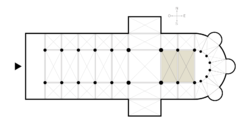
A choir, also sometimes called quire,[1] is the area of a church or cathedral that provides seating for the clergy and church choir. It is in the western part of the chancel, between the nave and the sanctuary, which houses the altar and Church tabernacle. In larger medieval churches it contained choir-stalls, seating aligned with the side of the church, so at right-angles to the seating for the congregation in the nave. Smaller medieval churches may not have a choir in the architectural sense at all, and they are often lacking in churches built by all denominations after the Protestant Reformation, though the Gothic Revival revived them as a distinct feature.
As an architectural term "choir" remains distinct from the actual location of any singing choir – these may be located in various places, and often sing from a choir-loft, often over the door at the liturgical western end.[2] In modern churches, the choir may be located centrally behind the altar, or the pulpit.[3] The place where the singers are based is sometimes called the ritual choir, as opposed to the architectural choir or constructional choir.[4]
The back-choir or retroquire is a space behind the high altar in the choir of a church, in which there may be a small altar standing back to back with the other.[5]
History
[edit]
In the Early Church, the sanctuary was connected directly to the nave. The choir was simply the east part of the nave, and was fenced off by a screen or low railing, called cancelli, which is where the English word chancel comes from. The development of the architectural feature known as the choir is the result of the liturgical development brought about by the end of persecutions under Constantine the Great and the rise of monasticism. The word "choir" is first used by members of the Latin Church. Isidore of Seville and Honorius of Autun write that the term is derived from the "corona", the circle of clergy or singers who surrounded the altar.
When first introduced, the choir was attached to the bema, the elevated platform in the centre of the nave on which were placed seats for the clergy and a lectern for scripture readings. This arrangement can still be observed at the San Clemente al Laterano in Rome.[6][7] Over time, the bema (or presbytery) and choir moved eastward to their current position. In some churches, such as Westminster Cathedral, the choir is arranged in the apse behind the altar.
The architectural details of the choir developed in response to its function as the place where the Divine Office was chanted by the monastic brotherhood or the chapter of canons. The chancel was regarded as the clergy's part of the church, and any choirboys from a choir school counted as part of the clergy for this purpose. After the Reformation, when the number of clergy present even in large churches and cathedrals tended to reduce, and lay singing choirs became more frequent, there were often objections to placing them in the traditional choir stalls in the chancel. The pulpit and lectern are also usually found at the front of the choir, though both Catholic and Protestant churches have sometimes moved the pulpit to the nave for better audibility. The organ may be located here, or in a loft elsewhere in the church. Some cathedrals have a retro-choir behind the high altar, opening eastward towards the chapels (chantries) in the eastern extremity.
After the Reformation Protestant churches generally moved the altar (now often called the communion table) forward, typically to the front of the chancel, and often used lay choirs who were placed in a gallery at the west end. The choir and rear of deep chancels became little used in churches surviving from the Middle Ages, and new churches very often omitted one. With the emphasis on sermons, and their audibility, some churches simply converted their chancels to seat part of the congregation. In 19th-century England one of the battles of the Cambridge Camden Society, the architectural wing of the Anglo-Catholics in the Church of England, was to restore the chancel, including the choir, as a necessary part of a church. By pushing the altar back to its medieval position and having the choir used by a lay choir, they were largely successful in this, although the harder end of the High Church objected to allowing a large group of laity into the chancel.[8] Different approaches to worship in the 20th century again tended to push altars in larger churches forward, to be closer to the congregation, and the chancel again risks being a less used area of the church.
Seating
[edit]
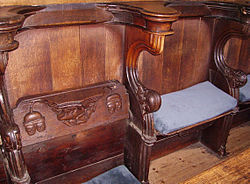
The choir area is occupied by sometimes finely carved and decorated wooden seats known as choir stalls, where the clergy sit, stand or kneel during services. The choir may be furnished either with long benches (pews) or individual choir stalls. There may be several rows of seating running parallel to the walls of the church.
The use of choir stalls (as opposed to benches) is more traditional in monasteries and collegiate churches. Monastic choir stalls are often fitted with seats that fold up when the monastics stand and fold down when they sit. Often the hinged seat will have a misericord (small wooden seat) on the underside on which he can lean while standing during the long services. The upper part of the monk's stall is so shaped as to provide a headrest while sitting, and arm rests when standing. Monasteries will often have strict rules as to when the monastics may sit and when they must stand during the services.
Choir benches are more common in parish churches. Each bench may have padded kneelers attached to the back of it so that the person behind may kneel at the appropriate times during services. The front row will often have a long prie-dieu running in front of it for the choir members to place their books on, and which may also be fitted with kneelers.
In a cathedral, the bishop's throne or cathedra is usually located in this space.[9]
Image gallery
[edit]-
-

-
 Eastern Orthodox choir stalls (kathisma) on the kliros (area for the choir) with analogia (lecterns) for liturgical books
 -
 Statuette of a wet nurse forming part of a parclose screen in the Basilica of Saint Maternus, Walcourt, Belgium
 -
 Choir bench made of limestone with still-visible traces of medieval paint, Burs Church, Gotland, Sweden
 -
 Choir bench of Santa Maria Gloriosa dei Frari, Venice
 -
 Choir stalls at the Church of the Good Shepherd (Rosemont, Pennsylvania)
 -
 17th-century choir stalls of the Pontigny Abbey, France
 -
 Choir stalls in Auch Cathedral - Seen from the high altar towards the choir organ


_-_Coro_dei_Frati.jpg)
.jpg)

_Choir_stalls_in_Cath%C3%A9drale_Sainte-Marie_d%27Auch_-_Seen_from_the_high_altar_towards_the_choir_organ.jpg)
See also
[edit]

References
[edit]- ^ OED, "Choir"
- ^ Schloeder, Steven J. (1998). Architecture in Communion: Implementing the Second Vatican Council Through Liturgy and Architecture. Ignatius Press. p. 137. ISBN 9780898706314.
In monasteries, when the choir of schola cantorum was composed of religious, it was usually within the cancelli in front of the sanctuary. The liturgical movement of the Baroque age removed it to a choir loft at the back of the church, thus enabling the sanctuary to be more integrated with the nave.
- ^ White, James F. (1 December 2007). Christian Worship in North America: A Retrospective, 1955–1995. Wipf and Stock Publishers. p. 243. ISBN 9781556356513.
One of the two dominant types is the concert-stage arrangement with tiers of choir stalls behind a pulpit platform at the foot of which appears the altar-table. The other type is the so-called divided chancel with the choir stalls and altar-table within the chancel and the pulpit at one side of its entrance. In both cases the liturgical space allotted to the congregation tends to be similar: a long, rectangular nave.
- ^ "Ritual Choir from the McClintock and Strong Biblical Cyclopedia". McClintock and Strong Biblical Cyclopedia Online.
- ^ One or more of the preceding sentences incorporates text from a publication now in the public domain: Chisholm, Hugh, ed. (1911). "Back-Choir". Encyclopædia Britannica. Vol. 3 (11th ed.). Cambridge University Press.
- ^ Poole, Thomas Henry (1908). "Choir (1)". Catholic Encyclopedia. Vol. 3.
- ^ "Choir". Encyclopædia Britannica. Vol. 6 (11th ed.). 1911. pp. 260–261.
- ^ White, James F., The Cambridge Movement: The Ecclesiologists and the Gothic Revival, 93–97, 1962 (2004 reprint), Wipf and Stock Publishers, ISBN 1592449379, 9781592449378, google books
- ^ Gietmann, Gerhard (1912). . In Herbermann, Charles (ed.). Catholic Encyclopedia. Vol. 14. New York: Robert Appleton Company.

External links
[edit]
 Texts on Wikisource:
- "Choir". Encyclopædia Britannica. Vol. 6 (11th ed.). 1911. pp. 260–261.
- Poole, Thomas Henry (1908). "Choir (1)". Catholic Encyclopedia. Vol. 3.
- Choir and Retro-Choir at Southwark Cathedral
| International | |
|---|---|
| National | |
| Other | |

Choir (architecture)
View on GrokipediaDefinition and Terminology
Definition
In church architecture, the choir refers to the designated space within a church or cathedral reserved for the seating of clergy and singers, typically situated in the western portion of the chancel, between the nave and the sanctuary.[2] This area facilitates the participation of the ritual participants in liturgical services, providing stalls or benches arranged to face the altar while maintaining separation from the congregation.[1] Functionally, the choir accommodates both the clergy, who conduct rituals, and the ritual choir—a group of singers who perform sacred music during worship—ensuring their proximity to the proceedings without encroaching on the sanctuary's altar space.[6] Unlike the sanctuary, which is the easternmost area housing the high altar for the Eucharist, the choir serves as a transitional zone focused on vocal and clerical support rather than the central sacrificial elements of the liturgy.[2] The term "choir" as a physical space must be distinguished from the "ritual choir," which denotes the ensemble of singers and may perform from alternative locations such as a choir loft in the nave or a gallery above; it also differs from the broader chancel, of which the choir forms only the western segment, excluding the sanctuary.[1] In the overall church layout, the choir acts as a spatial divider, shielding the sacred liturgical zones—including the sanctuary—from the nave, where the lay congregation gathers, thereby reinforcing hierarchical distinctions in worship.[6]Etymology
The term "choir" in the context of church architecture derives ultimately from the Greek khoros, referring to a place for dancing or a group of dancers, which evolved into the Latin chorus, denoting a chorus of singers or performers in ancient theater and ritual contexts.[3] This Latin form entered Old French as cuer or quer around the 13th century, initially signifying both a group of singers and the architectural space allocated for them within a church.[3] By the early 14th century, the English "choir" (first recorded c. 1300 as queor) specifically denoted the enclosed area in a church where clergy and singers assembled, reflecting the term's shift from a performative ensemble to a designated architectural enclosure.[3] Early Christian writers further shaped the term's architectural connotation by linking it to corona, Latin for "crown" or "circle," to describe the ring of clergy and singers surrounding the altar during sacred rites. Isidore of Seville, in his Etymologies (c. 636 CE), explicitly derived chorus from this circular arrangement, emphasizing how participants originally stood in a crown-like formation around the altar, which influenced the spatial organization of church interiors. This etymological association with enclosure and ritual performance persisted, distinguishing the choir as a bounded space for liturgical song and clerical functions. The related term "chancel," often overlapping with "choir" in usage, stems from a distinct but complementary origin: the Latin cancellus or cancelli, meaning latticework or low railings that screened off the altar area from the nave.[7] These barriers, common in early basilicas, led to the Old French chancel (c. 1300), denoting the screened eastern end of the church, and highlighted the choir's role as a separated, sacred zone.[7] An archaic English variant of "choir" is "quire," appearing in historical texts as an alternative spelling that retained the original pronunciation and meaning, such as in medieval descriptions of church layouts.[8] Over time, the terminology evolved to underscore the choir's enclosed nature, blending its Greek roots in communal performance with Latin influences on spatial division and ritual enclosure.[3]Historical Development
Early Origins
Following Constantine's Edict of Milan in 313 CE, which legalized Christianity, basilica designs proliferated, transforming the choir into a more defined fenced enclosure east of the nave for clergy and emerging monastic groups engaged in chant and prayer.[4] These basilicas, inspired by Roman civic halls, featured the choir as a transitional zone between the congregational nave and the apse sanctuary, often secured by cancelli to maintain liturgical order amid growing communities.[4] By the 7th century, councils such as the Concilium Toletanum IV (633 CE) formalized the choir as a distinct liturgical zone for spatial and functional purposes, incorporating monastic participation in services and evolving from ad hoc arrangements to integral architectural elements influenced by regional practices in Visigothic Spain and beyond.[4] This marked the choir's evolution into a dedicated space for clergy and singers. These cancelli, derived from Latin for "lattices," consisted of simple wooden or stone screens approximately 1 meter high, enclosing the presbytery area to separate the ordained from the laity while allowing visual and auditory connection during worship.[9] This arrangement reflected the early church's adaptation of civic spaces, prioritizing functional division over elaborate architecture, as evidenced in descriptions of early cathedrals like that in Tyre.[4] Byzantine architecture further integrated the choir with the bema, a raised platform for clerical functions, enhancing its ceremonial prominence in imperial worship.[10] In structures like Hagia Sophia, constructed between 532 and 537 CE under Emperor Justinian I, the choir accommodated extensive clerical ensembles and choirs, aligning with the acoustics and spatial hierarchy to evoke divine presence during elaborate liturgies attended by the court.[10] This design underscored the choir's role in bridging earthly ritual and heavenly symbolism, influencing Eastern Christian traditions.[10] A representative early example appears in the 4th-5th century Basilica of San Clemente al Laterano in Rome, where marble choir screens with symbolic motifs like vines and doves divided the space, preserving the cancelli tradition in a basilical layout.[11] These screens, later reused from the underlying 4th-century structure, illustrate the choir's foundational form as a screened extension facilitating clerical seclusion.Medieval Evolution
During the Romanesque period of the 11th and 12th centuries, choirs in Western European churches underwent significant elongation to accommodate expanding clerical communities within monastic and cathedral settings. This adaptation often involved extending the apse eastward, creating deeper spaces for liturgical processions and seating, supported by robust structural elements such as simple arcades of rounded arches and barrel vaults that distributed weight effectively over thick walls.[12] A prime example is Cluny Abbey in Burgundy, France, where the third church (Cluny III, begun c. 1088) featured an expansive choir with these characteristics, reflecting the Benedictine emphasis on communal worship in large-scale abbeys.[12] The transition to Gothic architecture in the 12th through 15th centuries introduced innovations that transformed choir design, emphasizing verticality and luminosity to enhance the spiritual experience.[13] Ribbed vaults with pointed arches allowed for taller, lighter constructions that reduced the need for massive supporting walls, enabling expansive clerestory windows filled with stained glass to flood the space with colored light symbolizing divine presence.[14] Ambulatory choirs, encircling the apse with radiating chapels, became a hallmark, facilitating processions while maintaining a clear demarcation between the clerical choir and the lay nave, underscoring the sacred enclosure's role in liturgical separation.[15] Monastic regulations profoundly shaped these developments, with Benedictine and Cistercian orders advocating for extended choirs to support the rigorous schedule of daily offices and communal prayer.[16] The Benedictine Rule, emphasizing stability and collective recitation of the Divine Office, influenced the proportional lengthening of choirs in abbeys like Cluny to house up to 200 monks. Cistercian reforms, initiated by St. Bernard of Clairvaux in the early 12th century, initially favored austere, elongated designs for unadorned worship spaces but later permitted expansions in choirs to accommodate growing communities, as seen in post-1153 rebuildings across their networks.[16] In some cathedrals, particularly in England and France from the 13th century onward, the choir shifted eastward toward the sanctuary, compressing the space between the high altar and the apse to create retrochoirs—additional areas behind the altar for secondary liturgical functions or pilgrims.[17] This reconfiguration, evident in structures like Ely Cathedral's eastern extensions, optimized the overall layout for processional flow while preserving the choir's symbolic centrality.[18]Post-Reformation Changes
The Protestant Reformation in the 16th century profoundly altered church architecture in regions adopting Lutheran and Calvinist traditions, often resulting in the reduction or elimination of traditional choir spaces to prioritize preaching and communal worship. Reformers emphasized the pulpit as the central element, moving the altar—rechristened as a communion table—forward to the nave's edge, which diminished the separated choir area formerly reserved for clergy and singers. In Lutheran churches, such as those in Strasbourg, existing Catholic structures were adapted by removing images and reorganizing interiors to focus on the sermon, though some retained organ lofts above entrances that echoed choir functions. Calvinist reforms went further, promoting austere designs in new "temples" like those in Lyon and Charenton, where barriers like screens were dismantled to foster direct congregational access to the word, effectively dissolving the choir's architectural distinction.[19][20] In response, the Catholic Counter-Reformation and ensuing Baroque period (17th-18th centuries) sought to retain and embellish choir spaces in churches to reaffirm sacramental mystery and visual splendor, countering Protestant simplicity. While some rood screens were removed to improve visibility of the altar during Mass, many cathedrals preserved or enhanced choirs with ornate ironwork, marble inlays, and gilded decorations, as seen in Roman examples like Santa Maria in Vallicella, where the choir was integrated into the sanctuary yet separated by balustrades for liturgical processions. Baroque architects like Gian Lorenzo Bernini incorporated dramatic choir enclosures in structures such as St. Peter's Basilica, using twisted columns and sculptural elements to draw worshippers' eyes toward the elevated space, symbolizing heavenly hierarchy. This embellishment extended to regional Catholic centers, where choirs became focal points of theatrical liturgy amid swirling frescoes and stucco work.[21][22] The 19th-century Gothic Revival, invigorated by the Oxford Movement in Anglicanism, prompted widespread restoration of traditional choirs in both Anglican and Catholic cathedrals, reviving medieval separations to underscore Eucharistic reverence. Architects like A. W. N. Pugin influenced intricate choir screens, while George Gilbert Scott designed examples such as the 1862 ironwork at Hereford Cathedral, drawing from 14th-century Gothic precedents to reinstate barriers between nave and chancel, often with symbolic carvings of saints and foliage. In Anglican contexts, this revival aligned with the Movement's push for "catholic" practices, as evidenced by Bodley's screen at All Saints', Cambridge, which emphasized liturgical depth. Catholic restorations, influenced by similar Romantic ideals, similarly reconstructed choirs in cathedrals like those in England and France, blending historical accuracy with Victorian innovation to heal post-Reformation losses.[23][24] Post-1950 developments, shaped by ecumenical dialogues and Vatican II's liturgical reforms, have trended toward choir designs that reduce physical separations for greater congregational integration. The Second Vatican Council's Sacrosanctum Concilium (1963) advocated active participation in the liturgy, prompting many Catholic churches to relocate choirs to nave sides or eliminate screens altogether, as in post-conciliar renovations emphasizing a unified worship space akin to the "heavenly Jerusalem."[25][26]Architectural Design
Location and Layout
In church architecture, the choir is typically positioned in the western portion of the chancel, directly east of the nave and west of the sanctuary, often extending across the full width of the central vessel to create a unified spatial transition. This placement reserves the area for clergy and singers, separating it from the congregational space of the nave while maintaining proximity to the altar in the sanctuary.[27] In cruciform church plans, the choir commonly intersects with the transepts at the crossing, the central junction where the nave's longitudinal axis meets the transverse arms of the transepts, thereby integrating the choir into the overall cross-shaped layout and enhancing ceremonial processions. This configuration allows the choir to serve as a pivotal zone between the laity's gathering area and the sacred eastern end.[27] Layout variations reflect functional and liturgical needs, with linear designs prevalent in basilican churches featuring straight rows of stalls along the sides of the axial space for straightforward access. In contrast, many cathedrals employ ambulatory layouts, providing a circulating pathway around the apse east of the choir to accommodate processions and pilgrims, often incorporating side aisles or radiating chapels for additional spatial depth.[28][27] The choir's dimensions vary to accommodate participants while ensuring visibility toward the sanctuary and favorable acoustics throughout the church. For example, at Notre-Dame de Paris, the choir spans 38 meters in length against a 60-meter nave, illustrating this scalable approach.[29]Key Features
The choir space in ecclesiastical architecture is typically enclosed from the nave by a choir screen, also known as a rood screen or jube, constructed from materials such as wood, stone, or metal to create a physical and symbolic barrier while allowing visual connection between the liturgical areas. These screens often feature intricate perforated designs, such as open tracery or latticework, that permit visibility and the passage of sound during services, enhancing the participatory experience for the congregation. For instance, stone choir screens in English Perpendicular Gothic churches, like those at York Minster, incorporate detailed carvings and cusped arches to balance enclosure with aesthetic integration. Structurally, the choir is defined by arcades that support the division between the main vessel and upper levels, often evolving into complex ribbed vaults in Gothic designs, such as sexpartite vaults that distribute weight efficiently while creating a sense of verticality. Clerestory windows above the arcades flood the space with natural light, emphasizing the altar and facilitating illumination for choral performances, as seen in the expansive glazing of the choir at Chartres Cathedral. These elements not only provide structural stability but also contribute to the spatial hierarchy, elevating the choir as a focal point for sacred rituals. Behind the high altar lies the retroquire, an extension of the choir that offers additional space for clergy or secondary services, sometimes accommodating a smaller altar for private masses or processions. This area maintains continuity with the choir's design, often featuring similar vaulting and enclosure to preserve the overall liturgical flow, as exemplified in the retroquire of Canterbury Cathedral, which supports extended ceremonial functions without disrupting the primary axis. Acoustic design in the choir prioritizes resonance for vocal ensembles, achieved through domed or barrel-vaulted ceilings that reflect and amplify sound evenly across the space. Such vaulting, common in Romanesque and later styles, creates a reverberant environment ideal for polyphonic music, with the curved surfaces minimizing harsh echoes while enhancing harmonic clarity, a principle evident in the barrel vaults of the choir at Durham Cathedral.Furnishings and Seating
Choir Stalls
Choir stalls consist of tiered wooden benches arranged in two facing rows along the sides of the choir, with seats oriented perpendicular to the nave's longitudinal axis to enable clergy and choristers to face one another across the central space during liturgical services.[30][31] This arrangement, common in medieval cathedrals, allows for antiphonal singing and promotes communal participation, with the stalls often screened from the nave to maintain the choir's sanctity.[32] The tiered structure rises in height from front to rear, accommodating varying ranks of participants while providing book ledges and kneelers for practical use.[32] Construction typically employs durable hardwoods like oak in English examples, valued for its strength and workability, though walnut appears in some continental designs for its rich grain.[33][31][34] Medieval workshops utilized advanced joinery techniques, such as mortise-and-tenon joints and openwork tracery, to assemble these structures, as evidenced in 14th-century English Perpendicular-style stalls at Gloucester Cathedral, where precise carpentry supports elaborate Gothic canopies.[35][36] These methods ensured longevity, with many stalls surviving centuries despite alterations or damage.[33] The stalls embody ecclesiastical hierarchy through graduated elaboration, with elevated rear positions reserved for canons or senior clergy, featuring canopies—known as testers—and elbow rests to signify authority.[32][33] At Lancaster Priory, for instance, the prior's stall includes a prominent canopy with traceried ogee arches and pinnacles, distinguishing it from simpler front benches for junior members.[33] This spatial and decorative hierarchy reinforces the ordered structure of the clergy during services.[37] A distinctive functional element is the misericord, a hinged undershelf that flips up to offer a supportive ledge for leaning during extended standing periods in the Divine Office, providing merciful relief to participants.[31][32] These ledges, integral to the seat design, are often richly carved on their undersides with motifs ranging from humorous grotesques to moral allegories, as seen in the 14 misericords at Lancaster Priory depicting sirens, wildmen, and daily life scenes to convey ethical lessons.[33] Beyond misericords, the stalls are adorned with intricate carvings illustrating biblical narratives, heraldic symbols, or naturalistic foliage, serving both decorative and symbolic purposes to inspire devotion.[33] In French 15th-century examples, such as those at The Metropolitan Museum of Art, these include imaginative figures on armrests and panels, blending artistry with theological commentary.[31] English Perpendicular stalls, like those at Gloucester, extend this tradition with geometric tracery and crocketed canopies, emphasizing verticality and light in line with the style's aesthetic principles.[35]Other Elements
In the choir of a church or cathedral, the lectern serves as a dedicated stand for scripture readings during liturgical services, typically positioned at the front for optimal visibility and audibility. Often crafted from brass, these lecterns frequently take the form of an eagle with outstretched wings, symbolizing Saint John the Evangelist and the soaring proclamation of the Gospel, while the eagle's base—depicting a globe—represents the word of God spreading across the world.[38][39] The eagle design, rooted in medieval symbolism where the bird's gaze toward the divine sun evokes enlightenment and resurrection, provides a practical sloped surface for holding the Bible, allowing the reader to face the congregation without obstruction.[39] The pulpit, typically located in the nave and sometimes positioned near the choir entrance, functions as an elevated platform from which sermons are delivered, enhancing the preacher's projection of voice and authority over the assembly. Constructed from durable materials such as stone—like the creamy Caen limestone used in Gothic examples for its acoustic resonance—or brass for ornate durability, pulpits are raised on a base with enclosing sides to focus attention and protect the speaker.[40][41] Symbolically, the elevation underscores the sermon's role in spiritual elevation, drawing from early Christian ambos that integrated reading and preaching into the choir's liturgical flow, while practical features like integrated shelves and shaded lighting ensure effective delivery.[41][42] Central to cathedrals, the bishop's cathedra is a throne-like seat embodying ecclesiastical authority, positioned at the apex of the choir—often on the south side beyond the stalls—to preside over the sanctuary and symbolize the bishop's role as shepherd and teacher. Crafted from wood, stone, or marble with ornate detailing, such as the blue-and-gold design in Durham Cathedral that matches surrounding liturgical elements, it serves both practically as the bishop's fixed position during services and symbolically as Christ's throne on earth, fostering communal unity in worship.[43][44] This placement, typically before the high altar, reinforces the cathedral's function as the diocese's spiritual heart.[44] Prie-dieux and kneelers provide essential aids for personal and collective prayer within the choir, consisting of portable wooden desks with sloped tops for books and attached padded cushions for kneeling during genuflection or adoration. Derived from the French "pray to God," these furnishings enable reverent postures in liturgical settings, often placed individually or as a continuous bench in front of choir stalls to support clergy and singers without fixed installation.[45] Their lightweight construction in oak or walnut allows flexibility for processions or private devotion, emphasizing humility and focus in prayer.[45] The organ console, integral to choral accompaniment, is strategically placed within or adjacent to the choir to facilitate musical leadership, with the organist maintaining clear sightlines to singers, the altar, and conductor. Often elevated on a platform near the stalls for acoustic balance, the console—featuring keyboards, stops, and pedals—directs pipe organs whose chambers may be integrated above or behind the choir loft, blending sound projection with architectural harmony.[46][28] This arrangement supports the choir's role in antiphonal singing while symbolizing the harmony of divine praise.[28]Variations and Examples
Regional Differences
In Western Europe, particularly during the Gothic period, choir designs in England and France emphasized elongated spaces to accommodate clergy and singers, often separated from the nave by ornate screens. English cathedrals featured rectangular choir plans that prioritized length over height, diverging from the more compact, ambulatory-focused layouts in France, allowing for extended processions and choral performances.[47][48] In the Perpendicular style prevalent in late medieval England, choirs incorporated intricate fan-vaulted ceilings, where slender stone ribs radiated like fans to create a sense of vertical unity and luminous height, as seen in structures like King's College Chapel.[49] French Gothic choirs, by contrast, integrated high-vaulted ambulatories around the apse for fluid circulation, with early examples like the choir of Saint-Denis pioneering ribbed vaults that influenced the style's spread.[50] These regional adaptations reflected liturgical needs, with English designs favoring screened enclosures to enhance acoustic intimacy for polyphonic music.[51] On the Iberian Peninsula, choir architecture in Spanish cathedrals incorporated Mudéjar influences, blending Islamic horseshoe arches and geometric ornamentation with Christian spatial organization, often elevating the choir on raised platforms known as coro alto to oversee the nave. This elevation, common in cathedrals like Seville and Toledo, created a hierarchical focal point for the liturgy, with the platform supported by sturdy piers and enclosed by wrought-iron rejás (screens) featuring interlaced tracery.[52] Mudéjar elements appeared prominently in choir stalls and ceilings, such as the walnut carvings with arabesque motifs in Seville Cathedral's retrochoir, where horseshoe arches framed the wooden ensembles to evoke a synthesis of cultural traditions post-Reconquista.[53] These designs adapted to local acoustics and processionals, prioritizing visibility and symbolic enclosure over open integration with the apse.[54] Eastern Orthodox choir designs integrated seamlessly with the iconostasis, a screen of icons dividing the nave from the centralized apse, minimizing dedicated stalls in favor of a unified liturgical space centered on the altar. Unlike Western elongated choirs, Orthodox architecture emphasized a rectangular or cruciform nave leading to a semicircular apse, where clergy and chanters positioned near the iconostasis doors facilitated antiphonal singing without fixed seating, as in the Dormition Cathedral within Moscow's Kremlin.[55] This configuration, rooted in Byzantine precedents, prioritized mystical enclosure and visual hierarchy through icons rather than physical barriers, with the apse conch often adorned with a Theotokos mosaic to symbolize divine presence. Russian examples in kremlins extended this by incorporating onion domes externally, but internally maintained the apse's centrality for choral responses during the Divine Liturgy.[56] In colonial Latin America, choir spaces adapted European Baroque forms through hybrid influences, blending ornate altarpieces and canopies with indigenous motifs to evangelize local populations while honoring syncretic traditions. Churches in regions like the Andes and Mexico featured raised chancels with gilded retablos incorporating native symbols—such as maize stalks, solar discs, or Andean textiles—carved by indigenous artisans into the choir enclosures, as exemplified in the Hybrid Baroque of Cuzco's cathedrals.[57] This mestizo style enriched the presbytery with layered symbolism, where European dramatic lighting and curves merged with pre-Columbian geometric patterns on choir screens and stalls, fostering cultural convergence in liturgical settings.[58] Such adaptations emphasized emotional intensity and communal participation, diverging from metropolitan models by embedding regional iconography directly into the architectural fabric.[59]Notable Examples
Bristol Cathedral in England exemplifies a 14th-century Gothic choir, constructed between approximately 1298 and 1332 as part of an innovative hall church design that unified the nave, aisles, and choir under a single expansive roofline.[60] This layout features continuous aisles that facilitate an ambulatory-like circulation around the high altar, enhancing spatial flow without traditional separation, while the intricate lierne vaulting in the choir—characterized by short, decorative ribs forming star patterns—demonstrates advanced Decorated Gothic techniques for structural support and aesthetic complexity.[61] The choir stalls, though primarily added in the 16th century with misericords depicting moral and biblical scenes, complement the medieval vaulting and underscore the space's liturgical function for clerical seating during services.[61] In Spain, the choir of Palencia Cathedral represents 16th-century Renaissance elaboration, particularly through its elevated wooden stalls (sillería) crafted around 1512 by Juan Alemán and his workshop, which are raised on a platform to create a distinct, enclosed liturgical zone typical of Iberian cathedrals.[62] The choir screen (reja), forged in wrought iron by Gaspar Rodríguez of Segovia between 1563 and 1571, encloses this elevated area with ornate Renaissance motifs including twisted columns, foliage, and heraldic elements, serving both as a barrier separating clergy from congregation and a sculptural masterpiece that highlights the transition from Gothic to Plateresque styles.[63] This configuration reflects the regional emphasis on richly decorated, multifunctional choir spaces in Spanish Renaissance architecture, where the retrochoir extension further integrates classical proportions with late Gothic elements.[64] Westminster Abbey's choir, spanning the 13th to 18th centuries, has served as the central venue for British royal coronations since at least 1066, with the current structure largely dating to Henry III's rebuilding from 1245 onward, featuring a long cruciform layout that extends into the nave for accommodating large ceremonial processions.[65] This space has hosted over 40 monarchal coronations, including those of Edward I in 1274 and Elizabeth II in 1953, and is the burial site for numerous royals, such as Edward the Confessor in the 13th century and Queen Anne in 1714, emphasizing its role as a national necropolis.[65] The Henry VII Chapel, constructed between 1503 and 1519 in Perpendicular Gothic style with fan vaulting, functions as a retroquire extension eastward of the main choir, housing tombs of Henry VII, Elizabeth of York, and later monarchs, thus expanding the liturgical and commemorative area while blending late medieval grandeur with Tudor symbolism.[66] A modern counterpart is Coventry Cathedral in England, consecrated in 1962 after the near-total destruction of its medieval predecessor during World War II bombings, where architect Sir Basil Spence designed a minimalist modernist choir integrated into a Brutalist structure of raw concrete, angular forms, and expansive open spaces to symbolize renewal and simplicity.[67] The choir area, positioned adjacent to the preserved ruins of the old cathedral—left as a poignant war memorial—facilitates processional movement while incorporating etched glass screens and sparse furnishings, reflecting 20th-century ecumenism through its emphasis on reconciliation and interfaith dialogue, as evidenced by the cathedral's founding of the Community of the Cross of Nails for global peace initiatives.[68]References
- https://commons.wikimedia.org/wiki/File:Catedral_de_Palencia._Reja_del_coro.jpg