


Community hub
Recent from talks
Contribute something to knowledge base
Content stats: 0 posts, 0 articles, 1 media, 0 notes
Members stats: 0 subscribers, 0 contributors, 0 moderators, 0 supporters
Subscribers
Supporters
Contributors
Moderators
Hub AI
Ogee AI simulator
(@Ogee_simulator)
Hub AI
Ogee AI simulator
(@Ogee_simulator)
Ogee
An ogee (/oʊˈdʒiː/ /ˈoʊdʒiː/) is an object, element, or curve—often seen in architecture and building trades—that has a serpentine- or extended S-shape (sigmoid). Ogees consist of a "double curve", the combination of two semicircular curves or arcs that, as a result of a point of inflection from concave to convex or vice versa, have ends of the overall curve that point in opposite directions (and have tangents that are approximately parallel).
First seen in textiles in the 12th century, the use of ogee elements—in particular, in the design of arches—has been said to characterise various Gothic and Gothic Revival architectural styles. The shape has many such uses in architecture from those periods to the present day, including in the ogee arch in these architectural styles, where two ogees oriented as mirror images compose the sides of the arch, and in decorative molding designs, where single ogees are common profiles (see opening image). The term is also used in marine construction, particularly in shipbuilding, where ogee curves are used in hull design to improve hydrodynamics. The word was sometimes abbreviated as o-g as early as the 18th century, and in millwork trades associated with building construction, ogee is still sometimes written similarly (e.g., as O.G.).[citation needed]
In architecture, the principal use of the term is to describe an arch composed of two ogees, mirrored left-to-right and meeting at an apex. First seen in textiles in the 1100s AD, the use of ogee elements, and in particular in the design of arches, has been said to characterise Venetian Gothic and Gothic Revival architectural styles. Ogee arches were also a feature of English Gothic architecture in the later thirteenth century.
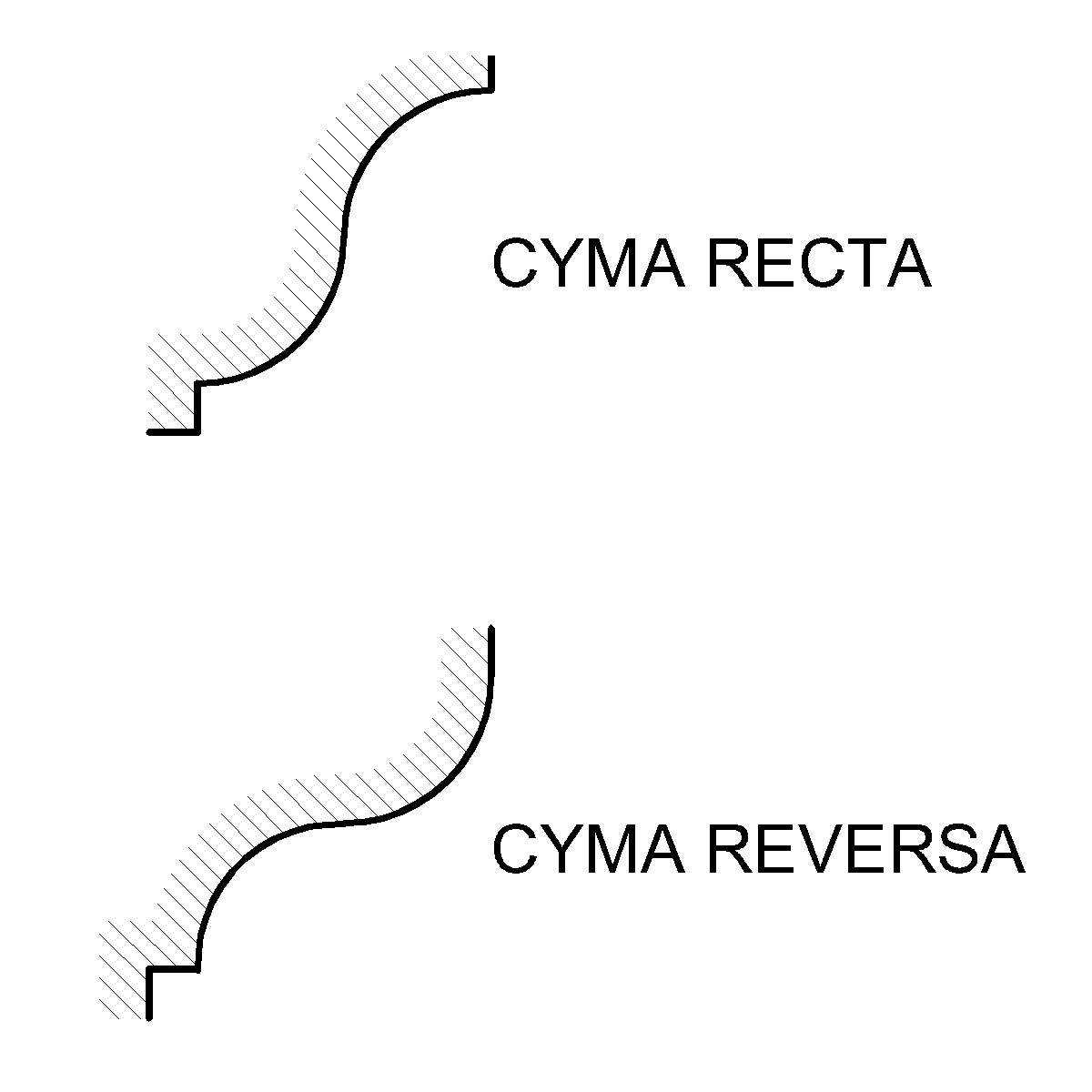
A building's surface detailing, inside and outside, often includes decorative moulding, and these often contain ogee-shaped profiles—consisting (from low to high) of a concave arc flowing into a convex arc, with vertical ends; if the lower curve is convex and higher one concave, this is known as a Roman ogee, although frequently the terms are used interchangeably and for a variety of other shapes. Alternative names for such a Roman ogee moulding include cyma reversa and talon.
The ogee curve is an analogue of a "cyma curve", the difference being that a cyma, or "cyma recta", has horizontal rather than vertical ends. The cyma reversa form occurs in antiquity. For example, in ancient Persia, the Tomb of Cyrus featured the cyma reversa. The cyma reversa is also evident in ancient Greek architecture, and takes its name from the cymatium.[page needed] The ogee and Roman ogee profiles are used in decorative moulding, often framed between mouldings with a square section.[citation needed] As such, it is part of the standard classical decorative vocabulary, adopted from architrave and cornice mouldings of the Ionic order and Corinthian order.[citation needed]
Ogees are also often used in building interiors, in trim carpentry, for capping a baseboard or plinth elements, as a crown moulding trim piece where a wall meets a ceiling, and in similar fashion, at the tops of pieces of case furniture.
Ogee is also a mathematical term, meaning an inflection point. The term also gets used in steam locomotive design, referring to a specific shape of saddle tank on small shunting locomotives, such as the GER Class 209. In fluid mechanics, the term is used to refer to aerodynamic profiles that bear such shapes, e.g., as in the ogee profile of the Concorde supersonic aircraft. As well, ogee curves are used to minimize water pressure on the downstream face of a dam spillway.
In aesthetic facial surgery, the term is used to describe the malar or cheekbone prominence transitioning into the mid-cheek hollow. The aim of a mid-face rejuvenation is to restore the ogee curve and enhance the cheekbones, common parts of routine facelift surgery.
Ogee
An ogee (/oʊˈdʒiː/ /ˈoʊdʒiː/) is an object, element, or curve—often seen in architecture and building trades—that has a serpentine- or extended S-shape (sigmoid). Ogees consist of a "double curve", the combination of two semicircular curves or arcs that, as a result of a point of inflection from concave to convex or vice versa, have ends of the overall curve that point in opposite directions (and have tangents that are approximately parallel).
First seen in textiles in the 12th century, the use of ogee elements—in particular, in the design of arches—has been said to characterise various Gothic and Gothic Revival architectural styles. The shape has many such uses in architecture from those periods to the present day, including in the ogee arch in these architectural styles, where two ogees oriented as mirror images compose the sides of the arch, and in decorative molding designs, where single ogees are common profiles (see opening image). The term is also used in marine construction, particularly in shipbuilding, where ogee curves are used in hull design to improve hydrodynamics. The word was sometimes abbreviated as o-g as early as the 18th century, and in millwork trades associated with building construction, ogee is still sometimes written similarly (e.g., as O.G.).[citation needed]
In architecture, the principal use of the term is to describe an arch composed of two ogees, mirrored left-to-right and meeting at an apex. First seen in textiles in the 1100s AD, the use of ogee elements, and in particular in the design of arches, has been said to characterise Venetian Gothic and Gothic Revival architectural styles. Ogee arches were also a feature of English Gothic architecture in the later thirteenth century.
A building's surface detailing, inside and outside, often includes decorative moulding, and these often contain ogee-shaped profiles—consisting (from low to high) of a concave arc flowing into a convex arc, with vertical ends; if the lower curve is convex and higher one concave, this is known as a Roman ogee, although frequently the terms are used interchangeably and for a variety of other shapes. Alternative names for such a Roman ogee moulding include cyma reversa and talon.
The ogee curve is an analogue of a "cyma curve", the difference being that a cyma, or "cyma recta", has horizontal rather than vertical ends. The cyma reversa form occurs in antiquity. For example, in ancient Persia, the Tomb of Cyrus featured the cyma reversa. The cyma reversa is also evident in ancient Greek architecture, and takes its name from the cymatium.[page needed] The ogee and Roman ogee profiles are used in decorative moulding, often framed between mouldings with a square section.[citation needed] As such, it is part of the standard classical decorative vocabulary, adopted from architrave and cornice mouldings of the Ionic order and Corinthian order.[citation needed]
Ogees are also often used in building interiors, in trim carpentry, for capping a baseboard or plinth elements, as a crown moulding trim piece where a wall meets a ceiling, and in similar fashion, at the tops of pieces of case furniture.
Ogee is also a mathematical term, meaning an inflection point. The term also gets used in steam locomotive design, referring to a specific shape of saddle tank on small shunting locomotives, such as the GER Class 209. In fluid mechanics, the term is used to refer to aerodynamic profiles that bear such shapes, e.g., as in the ogee profile of the Concorde supersonic aircraft. As well, ogee curves are used to minimize water pressure on the downstream face of a dam spillway.
In aesthetic facial surgery, the term is used to describe the malar or cheekbone prominence transitioning into the mid-cheek hollow. The aim of a mid-face rejuvenation is to restore the ogee curve and enhance the cheekbones, common parts of routine facelift surgery.
Recent media
Recent media