Hubbry Logo
Christian RadichChristian RadichMain
Open search
Christian Radich
Community hub
Christian Radich
logo
8 pages, 0 posts
0 subscribers
Be the first to start a discussion here.
Christian Radich
Christian Radich
from Wikipedia
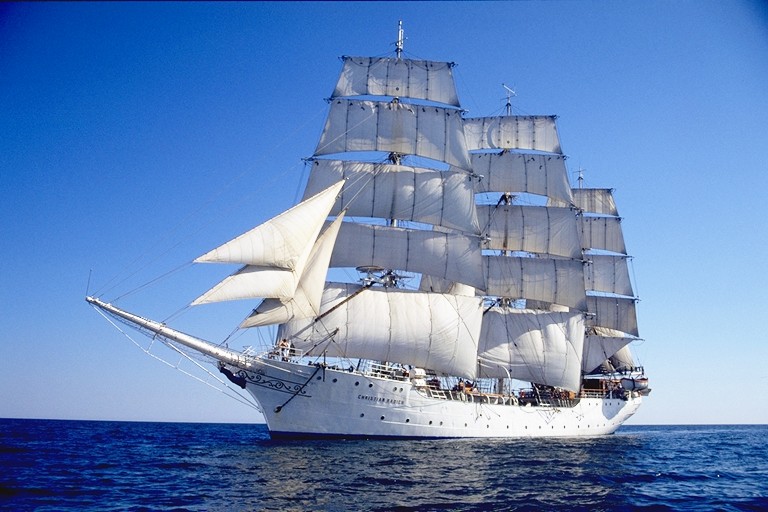
Christian Radich under sail
History
Norway
NameChristian Radich
BuilderFramnæs Mekaniske Værksted
LaunchedFebruary 1937
HomeportOslo
Identification
Statusin active service, as of 2022
General characteristics
Class & typeFull-rigged ship
Tonnage663 GT, 198 NT
Displacement1,050 tonnes (1,030 long tons)
Length62.5 m (205 ft) 73 m (240 ft) including bowsprit
Beam9.7 m (32 ft)
Height37.7 m (124 ft)
Draught4.7 m (15 ft)
Propulsion27 Sails, 1,360 m2 (14,600 sq ft) Engine, Caterpillar 900 HK
SpeedSails, 14 knots (26 km/h) Engine, 10 knots (19 km/h)
Complement18 permanent crew 88 passengers

Christian Radich is a Norwegian full-rigged ship, named after a Norwegian shipowner. The vessel was built at Framnæs shipyard in Sandefjord, Norway, and was delivered on 17 June 1937. The owner was The Christian Radich Sail Training Foundation, which was established by a grant from an officer of that name.[1]

Description

[edit]

Christian Radich is a full-rigged, three-masted, steel hulled ship, 62.5 metres (205 ft) long, with an overall length of 73 metres (240 ft), including the bowsprit and a beam of 9.7 metres (32 ft). It has a draught of approximately 4.7 metres (15 ft), and a displacement at full load of 1,050 tonnes (1,030 long tons; 1,160 short tons).

Her top speed under sail is 14 knots (16 mph; 26 km/h),[2] and 10 knots (12 mph; 19 km/h) under power. The vessel is maintained by a crew of 18, and can accommodate 88 passengers.

The class society of the vessel is Det Norske Veritas, DNV, and is built to +1A1, E0.[citation needed]

History

[edit]

The tall ship Christian Radich is well known through the international release of the 1958 Cinemiracle movie Windjammer. Christian Radich sailed to the United States in 1976 as part of the Bicentennial Celebration, and partook in the Operation Sail parade in New York Harbor on 4 July 1976. The ship also appeared in the 1970s BBC TV series The Onedin Line, as one of James Onedin's ships.[3]

The vessel was initially built to train sailors in the Norwegian merchant navy, and did so for many years. Since 1999, the ship has been on the charter market as well as sailing with paying trainees to foreign ports on summer trips, participating in the Cutty Sark Tall Ships Race, Operation Sail events, and large sail events in European ports. In 1980, the vessel won the OpSail 80 race from Boston, USA to Kristiansand, Norway, taking 17 days to do so. It was the first time a tall ship had beaten the racing yachts in both uncorrected and corrected time.

Christian Radich won the first race of the Tall Ships Race 2010 in Class A, from Antwerp to Skagen in Denmark, a distance of 787 km (489 mi) just under two days with an average speed of 10.2 knots (11.7 mph; 18.9 km/h), with the corrected time of 1 day, 4 hours, 29 minutes, and 44 seconds, and won the overall race 2010, making this the ship's fifth victory in the Tall Ships Race.[4]

Christian Radich at Operation Sail on 4 July 1976

Footnotes

[edit]
[edit]
Revisions and contributorsEdit on WikipediaRead on Wikipedia
from Grokipedia
Christian Radich is a Norwegian three-masted full-rigged built in 1937 as a for aspiring sailors, measuring 73 meters in length overall with a area of 1,360 square meters across 27 . Named after the philanthropist Christian Radich (1822–1889), a manager from who lived most of his life in and bequeathed funds toward the construction of a despite never sailing himself, the vessel was constructed at Framnæs Mekaniske Værksted in to honor his passion for the sea. Designed to accommodate 80–90 trainees in its orlop deck dormitories, along with facilities for work, , and originally a , Christian Radich has served primarily as a ship since its launch, fostering skills in and . The ship, with a of 663 tons and a displacement of 1,050 tons, can reach speeds of up to 14 knots under or 10 knots with its auxiliary engine, and it is crewed by 15–20 permanent members during voyages. Throughout its history, Christian Radich has participated in numerous international events, including multiple where it secured first-place finishes on corrected time, such as in 2009 (Gdynia to ) and 2010 (overall from Antwerpen to ), earning a reputation as one of Norway's premier ambassadors. From 1937 to 1998, it operated continuously as a dedicated training vessel; today, owned by the Christian Radich Sailing Foundation since 1998, it functions as a school ship for maritime students during winter months, while summers feature educational voyages, corporate charters, and public rallies. Homeported in , the ship remains operational and offers opportunities for trainees aged 15 and older to experience authentic adventures.

Overview and Specifications

Physical Dimensions

The Christian Radich is a three-masted full-rigged steel-hulled ship, designed with a traditional layout featuring multiple decks to support sail operations. Her hull measures 62.5 meters (205 feet) in length, extending to an overall length of 73 meters (240 feet) when including the . Key structural dimensions include a beam of 9.7 meters (32 feet) and a draught of 4.7 meters (15 feet), contributing to her stability as a large vessel. The displacement at full load is 1,050 , while her is rated at 663 gross tons (GT) and 198 net tons (NT). From to the top of the main mast, the height reaches 37.7 meters, emphasizing her imposing among tall ships. Internally, the ship's deck configuration includes orlop decks serving as dormitories, originally accommodating up to 80-90 cadets for berthing, though post-renovation capacity has been limited to a maximum of 80 to enhance comfort and safety. This layout, combined with dedicated spaces for and workshop functions, underscores her purpose-built design for extended voyages.
DimensionMetric (Imperial) Value
Hull Length62.5 m (205 ft)
Overall Length73 m (240 ft) including
Beam9.7 m (32 ft)
Draught4.7 m (15 ft)
Height (Keel to Mast Top)37.7 m
Displacement1,050 tonnes
663 GT
198 NT

Rigging and Performance

Christian Radich is configured as a three-masted full-rigged ship, featuring a comprehensive square-rig setup that supports traditional sailing operations. The rigging includes 27 sails with a total area of 1,360 square meters, enabling effective wind capture and maneuverability across various sea conditions. This sail plan, comprising courses, topsails, topgallants, and royals on each mast, facilitates hands-on training in sail handling and navigation for cadets and trainees. The main mast stands at 37.7 meters, complemented by nearly 9,000 meters of rope for rigging adjustments, which underscores the ship's design for rigorous instructional voyages. Propulsion is provided by a auxiliary rated at 900 horsepower, allowing the vessel to reach a maximum speed of 10 knots under mechanical power alone, useful for maneuvering in harbors or adverse winds. Under full , Christian Radich achieves up to 14 knots, demonstrating its as a swift training vessel capable of long-distance passages. The ship holds classification from Det Norske Veritas to +1A1, E0 standards, certifying its structural integrity and operational safety for unrestricted seaworthiness in . The vessel maintains a permanent crew of approximately 18 members, who oversee operations and instruction, while providing berths for up to 80 trainees or passengers in air-conditioned dormitories equipped with hammocks and bunk beds. Onboard facilities tailored for training include a spacious that prepares three daily meals to sustain the full complement during extended sails, a dedicated workshop for developing practical maintenance skills, and the adapted former space—now integrated into the area—to support and sail-related training activities. These elements collectively enable the ship's role in immersive maritime education.

Construction and Launch

Design Process

The Christian Radich was conceived in the 1930s as a dedicated sail training vessel to educate future Norwegian merchant navy officers in practical , at a time when the transition to steam and motor vessels had reduced the demand for traditional expertise but the need for disciplined maritime training persisted. This initiative aimed to preserve essential skills in , , and ship handling through hands-on experience on a , reflecting Norway's strong maritime heritage. The project was sponsored through a bequest from the estate of sawmill manager Simeon Christian Radich (1822–1889), who established a foundation in his will to support national maritime education and youth training at sea. Born in and based in Kristiania (now ), Radich was deeply passionate about the sea, inspired by tales from his cousin, a , and sought to contribute to the development of skilled seafarers amid Norway's role as a leading shipping nation. The Christian Radich Sail Training Foundation, formed from this grant, oversaw the vessel's creation to fulfill his vision of providing accessible training opportunities. Design goals prioritized the ship as a pure platform, eschewing cargo-carrying capabilities in favor of robust construction for extended voyages, spacious educational facilities, and a three-masted full-rigged configuration to simulate comprehensive operations. Key features included orlop decks accommodating 80–90 cadets, a large for culinary instruction, dedicated areas for and , and adherence to stringent Norwegian safety and durability standards to ensure longevity in harsh North Atlantic conditions. The design was developed by naval experts at the Framnæs Mekaniske Verksted in , blending traditional principles—such as extensive area and wooden-like aesthetics—with 20th-century construction for enhanced strength and maintainability, tailored specifically for educational voyages rather than commercial use.

Building and Delivery

Construction of the Christian Radich commenced in August 1936 at the Framnæs Mekaniske Værksted in , , where the hull was fabricated to serve as a dedicated vessel for the Norwegian . The , known for its expertise in building robust ships, oversaw the assembly of the three-masted full-rigged structure, including the installation of 37.7-meter-high masts capable of supporting 27 sails with a total area of 1,360 square meters. The hull was launched on February 5, 1937, during a where the vessel was christened Christian Radich in honor of Simeon Christian Radich (1822–1889), a prominent manager who had sponsored the project's funding through his estate. Following the launch, outfitting continued with the addition of specialized training facilities, including orlop deck dormitories designed to berth 80–90 cadets, a large galley for culinary instruction, and areas for carpentry practice to prepare trainees for maritime service. By June 1937, the construction was complete, and the ship was officially delivered on June 17 to the Christian Radich Sail Training Foundation, established to manage its operations on behalf of Norwegian merchant navy training programs. This handover marked the vessel's readiness for service, with its steel construction ensuring durability for long voyages while maintaining the traditional essential for hands-on sailor education.

Early and Wartime Service

Pre-War Training Operations

Following its delivery on 17 June 1937, the Christian Radich immediately entered service as a sail training vessel dedicated to preparing young Norwegian sailors for careers in the , with a focus on practical instruction in , , and sail handling. The ship was owned and operated by the Christian Radich Sail Training Foundation, established under Norwegian maritime oversight to bolster the supply of skilled officers amid the expanding merchant fleet of the era. The vessel's early voyages from 1937 to 1939 consisted primarily of cruises along European routes, serving as hands-on platforms for crews to develop discipline and technical proficiency under . Its maiden voyage departed shortly after commissioning, initiating a series of short coastal and regional trips that emphasized routine work, , and basic in familiar waters. In 1938, the ship participated in its first international event, joining a rally of vessels in from 14 to 19 June, organized by Swedish captain Arnold Schumburg, alongside ships from , , , , and Poland's Dar Pomorza. These outings typically followed and paths, providing cadets with exposure to varied weather conditions and operational demands typical of merchant service. Accommodating 80 to 90 trainees per voyage, the Christian Radich featured dedicated orlop decks as dormitories, a spacious for cooking instruction, and facilities for and training, all designed to foster and teamwork among the young sailors. The 1939 season marked a highlight with the ship's first to New York for the , departing in early summer under Captain Alf Bryde with 94 merchant marine cadets aboard, including Olav; the voyage returned to in late 1939, concluding the pre-war period of routine educational operations.

Role During World War II

Following the German invasion of on April 9, 1940, the Christian Radich was seized by occupation forces while moored at the . Under German control from 1940 to 1945, the vessel served primarily as a stationary barracks ship in , providing accommodation for personnel, including crews. Wartime conditions severely restricted its operations, with no significant sailing undertaken due to the dangers of Allied naval activity in Norwegian waters; the ship's original Norwegian crew was dispersed, and many former trainees and officers joined the Allied merchant marine efforts under the program in exile. Following the return from New York, the ship had been briefly requisitioned by the Royal Norwegian Navy for training in early 1940. In the war's final phase, the Germans relocated the Christian Radich to harbor in , where it was damaged and sunk by raids in 1945. Upon Norway's liberation in May 1945, the ship was returned to the Christian Radich Sail Training Foundation; inspections revealed the hull and decks largely intact despite the removal of most fittings and metal components, enabling repairs at Framnæs Mekaniske Værksted in and a resumption of training voyages by 1947. The vessel avoided direct combat involvement and suffered no major casualties among its pre-occupation personnel, embodying the broader resilience of Norway's maritime tradition amid occupation.

Post-War History

Institutional Service (1945-1998)

Following the conclusion of , Christian Radich underwent restoration and resumed full training operations in 1947, concentrating on cadet education to aid in rebuilding the Norwegian merchant fleet's skilled workforce. The ship, with berthing capacity for 80-90 trainees in its orlop deck dormitories, provided practical instruction in , , and sail handling under institutional oversight. In the through the , Christian Radich conducted extensive annual voyages across , the , and global routes, immersing up to 80 cadets in rigorous sail training programs each summer. These cruises emphasized hands-on experience aboard the full-rigged vessel, preparing participants for maritime careers despite the era's shift toward motorized shipping. A representative example was the 1956-1957 , which trained Norwegian and international cadets— including British youth from nautical schools—while traversing the Atlantic, , and Pacific, as captured in the documentary . Throughout this period, the ship remained under the management of the Christian Radich Sail Foundation, operating in partnership with Norwegian naval and maritime educational institutions to deliver structured programs. This arrangement sustained its role as a dedicated school ship, countering motorization trends by preserving traditional and training methods essential for officer development. During the years, Christian Radich engaged in regular international youth exchanges and nautical gatherings, promoting cross-cultural maritime education and Norway's seafaring heritage among allied nations. These activities, often involving collaborative cruises with foreign trainees, underscored the ship's enduring institutional value until its transition from state-aligned service in 1998.

Transition to Foundation Ownership

In 1998, the Christian Radich was retired from its primary role as a state training vessel for the Norwegian Navy, following a 1994 educational reform that eliminated the Nautical Basic Course and shifted maritime training toward modern methods such as simulators and specialized programs. This decommissioning marked the end of nearly six decades of exclusive institutional service, during which the ship had trained over 17,000 Norwegian students in basic . The last cohort of navy cadets disembarked on June 23, 1998, after which the vessel was docked at Skipsreparasjon for an extensive refit that would adapt it for broader public and commercial use. The transition to full foundation ownership and management occurred in 1999, when control returned to the Christian Radich Sail Training Foundation, the original owner established in to oversee the ship's operations as a sailing ambassador and educational platform. This shift ensured the vessel's preservation amid changing naval priorities, allowing it to continue active while generating revenue through diversified activities. The foundation's motivations centered on securing long-term viability by incorporating charter voyages alongside its core educational mission, thereby sustaining the ship without relying solely on state funding. As part of the initial changes, the ship underwent significant refits during the 1998–2000 period, including updates to meet new safety regulations and the issuance of a formal certificate. These modifications reduced the capacity from the original 80–90 berths to a maximum of 80, enhancing accessibility for volunteer crews and international participants rather than large-scale groups. The focus shifted toward inclusive operations, emphasizing through sail training for diverse groups while maintaining the vessel's role in promoting Norwegian maritime heritage.

Training and Operational Programs

Cadet and Trainee Programs

The and Programs aboard the Christian Radich provide structured, hands-on educational voyages aimed at building skills in , , and for youth and adults. These initiatives emphasize practical involvement in ship operations, with no prior experience required, allowing participants to contribute actively under supervision. Voyages typically last 1 to 4 weeks and are open to individuals aged 15 and older from and around the world, promoting personal growth through challenging maritime experiences. Each voyage accommodates up to 80 trainees, divided into three watch teams that rotate on a 4-hour duty and 8-hour rest schedule, day and night, to ensure continuous operation and learning opportunities. This setup fosters diversity, with crews often representing up to 18 nationalities and including groups from schools, youth organizations, and corporate teams seeking team-building exercises. The inclusive environment encourages collaboration across backgrounds, enhancing interpersonal skills alongside technical proficiency. The centers on core maritime competencies, including sail handling (such as setting, furling, and bracing yards), , watch-keeping duties like lookout and roles, and protocols encompassing procedures and equipment use. Trainees learn through direct participation in maneuvers like tacking and wearing ship, knot-tying, and deck maintenance, all guided by the permanent crew to build confidence and responsibility. These programs, facilitated by the Christian Radich Foundation, align with established Norwegian maritime practices. Annually, the Christian Radich conducts 10 to 15 such voyages, combining intensive training with the adventure of European waters or beyond, to deliver transformative experiences that emphasize discipline, resilience, and global camaraderie.

Charters and Educational Voyages

The Christian Radich is available for charter in the spring and autumn seasons, primarily from May to and to , offering day or evening fjord cruises departing from Akershuskaia in . These charters cater to corporate events such as conferences, summer parties, and team-building exercises for groups of 30 to 60 participants, with a maximum capacity of 240 passengers for quayside or onboard gatherings. Private groups and school field trips are also accommodated, providing hands-on sailing experiences that emphasize nautical skills without formal training curricula. In addition to commercial hires, the vessel supports educational voyages through partnerships with , focusing on nautical programs that introduce students to maritime heritage and practical . These outings, often short cruises for school classes, occur during the summer period alongside public access opportunities, fostering outreach and engagement with younger audiences. While the ship accommodates up to 80 trainees on longer voyages, educational charters prioritize smaller groups for interactive learning. Charters play a key role in the ship's revenue model, helping to fund ongoing maintenance and preservation efforts managed by the Christian Radich Foundation. Examples include themed group tours such as fjord cruises with aquavit or champagne tastings, as well as holiday sails like the New Year's voyage from . A recent instance of public outreach was the open ship day during a port visit to Saint Martin on January 19, 2025, where free access was provided from 10 a.m. to 4 p.m. at Galisbay Port, attracting visitors to explore the vessel.

Notable Voyages and Achievements

Participation in Tall Ships Races

The Christian Radich has been a regular competitor in the since the , establishing itself as a prominent Class A square-rigged vessel known for its speed and the skill of its trainee crew. Its debut in major international regattas came in with a first-place finish in the Plymouth to leg, followed by consistent participation that highlighted its role in sail training competitions organized by Sail Training International. One of its early notable appearances was in 1976, where it sailed into as part of the U.S. Bicentennial celebrations, joining a fleet of historic vessels in a grand parade that underscored international maritime camaraderie. In 1980, the ship achieved a landmark victory by winning the OpSail 80 race from to in first place overall, completing the transatlantic crossing in 17 days and marking the first time a outperformed modern racing yachts on both corrected and uncorrected times. This success solidified its reputation as a competitive force in long-distance ocean races. The Christian Radich continued its strong performance into the late 20th and early 21st centuries, participating in the starting in 1999, where it secured a second-place finish in the St. Malo to leg and first in to , earning the Trophy for the overall series. Notable victories include first place in the 2010 Tall Ships Race from to (covering approximately 787 km in about two days), clinching the overall Class A win and another Trophy. In 2011, it took first in the Waterford to leg and overall for that race, demonstrating exceptional handling in variable conditions. In 2025, Christian Radich participated in , achieving third place in the to leg, second place in the to leg, and first place overall in the to leg. Over its racing history, the Christian Radich has amassed multiple category wins in Class A, including five Trophies (1999, 2005, 2008, 2009, 2010) and the Class A Race Series in 2007, reflecting the vessel's optimized and the proficiency of its mixed of professionals and trainees. These achievements not only showcase its enduring competitiveness but also its contribution to international youth sail training programs.

Media Appearances and Cultural Events

The Norwegian full-rigged ship Christian Radich gained international prominence through its starring role in the 1958 Windjammer: The Voyage of the Christian Radich, which captured a 17,500-nautical-mile training voyage from across the Atlantic Ocean, through the , and to New York using innovative Cinemiracle multi-camera techniques to showcase the ship's operations and the cadets' experiences. The film, directed by Bill Colleran and Louis De Rochemont, highlighted the vessel's role in maritime education and was presented in a grand format similar to , drawing audiences to its vivid portrayal of traditional sailing amid modern technology. In television, Christian Radich featured prominently in the BBC historical drama series (1971–1980), where it appeared as one of the protagonist James Onedin's fleet of sailing vessels, embodying the era's maritime commerce and adventure. This exposure in the long-running series, which depicted 19th-century shipping life, further cemented the ship's status as an iconic representation of historical seafaring. As a cultural ambassador for , Christian Radich has participated in major international maritime festivals, including , where it serves as a symbol of Norwegian tradition during the biennial event's parades and public displays. During the 2025 edition of , the ship hosted public open days, allowing visitors to board and explore its decks prior to its departure from the harbor as part of the festival's grand sail-out. These appearances underscore its role in fostering global appreciation for maritime heritage. Nicknamed the "White Lady" due to its distinctive white hull, Christian Radich embodies Norway's enduring maritime legacy as one of the nation's premier sail training vessels, promoting seafaring skills and national pride through its elegant design and active service. This symbolism was notably evident during its 1976 voyage to the for the Bicentennial celebrations, where it joined the parade in .

Preservation and Modern Role

Maintenance and Restorations

Following the ship's transfer to the Christian Radich Sail Training Foundation in 1998, major refits have focused on preserving its structural integrity and updating systems for continued service. A significant overhaul in the late 1990s adjusted the orlop deck accommodations, reducing the maximum capacity from 90 to 80 to enhance safety and comfort standards. In the and , rigging inspections and reinforcements were conducted to address wear from extensive sailing, including renewal of mast sections and during periodic dry dockings. Hull reinforcements were also prioritized, with steel plating inspected and repaired to mitigate long-term exposure to marine environments. Routine maintenance is overseen by the classification society Det Norske Veritas (DNV), which conducts annual surveys to ensure compliance with international maritime regulations. Sail replacements occur as needed, with the full suit of 27 sails—totaling 1,360 square meters—periodically renewed to maintain performance under . The auxiliary engine was upgraded to a diesel unit delivering 900 brake horsepower, improving reliability for auxiliary propulsion at speeds up to 10 knots. These efforts address the vessel's age-related challenges, such as in the steel hull and superstructure built in 1937, through proactive treatments like anti-corrosive coatings and systems applied during overhauls. Funding for these preservation activities comes primarily from the foundation's charter revenues and donations, enabling sustained operations without compromising the ship's historical features. In the 2020s, recent work has emphasized for global voyages, including a four-week maintenance period in in early 2024 for system checks and upgrades. Safety enhancements, such as improved life-saving equipment and bow thruster servicing, were integrated during a 2018 refit at Damen Shiprepair Harlingen, which also involved comprehensive hull cleaning, painting, and general maintenance over five weeks. These interventions ensure the Christian Radich remains fit for international training and ambassadorial roles.

Current Operations and Legacy

The Christian Radich is based in at Akershusutstikkeren and remains an active vessel as of 2025, registered under the number 5071729 and 258373000. Operated by the Christian Radich Sail Training Foundation, it functions as a school ship for maritime students during winter months and hosts public voyages, charters, and events in summer. In 2025, the ship participated in major international events, including Sail Amsterdam 2025 with a voyage from Arendal to IJmuiden in August, and the Tall Ships Races 2025, featuring legs such as Dunkirk to Aberdeen in July. It also visited Saint Martin on January 19 for an open ship day at Galisbay Pier, allowing public access from 10:00 to 16:00. Ongoing involvement in Tall Ships Races underscores its role in global maritime gatherings. As a enduring symbol of Norwegian sailing tradition, the Christian Radich has served as one of the nation's prominent maritime ambassadors since its launch in 1937. Over its operational history, it has trained approximately 17,000 men and women in basic maritime , fostering skills in and . Through participation in international events like , it promotes youth exchange programs and the preservation of maritime culture, accommodating up to 80 trainees per voyage alongside a permanent of 15-20. Looking ahead, the foundation plans to sustain the ship's operations with educational voyages and cultural events, including a round-trip New Year's voyage from (29 December 2025 to 13 January 2026), ensuring its preservation as a ship dedicated to maritime heritage.

References

Add your contribution
Related Hubs
User Avatar
No comments yet.