Hubbry Logo
search
logo
Chugach
Chugach
current hub
2250286

Chugach

logo
Community Hub0 Subscribers
Read side by side
from Wikipedia

Chugach (/ˈɡæ/ CHEW-gatch), also known as Chugach Sugpiaq or Chugachigmiut, is the name of an Alaska Native people in the region of the Kenai Peninsula and Prince William Sound on the southern coast of Alaska. The Chugach people are an Alutiiq (Pacific Native) people who speak the Chugach dialect of the Alutiiq language.

Key Information

Name

[edit]

Their autonym Sugpiaq derives from suk, meaning "person" and -piaq, meaning "real".[1] The term Alutiiq derives from the Russian term for the Aleut people. According to Ethnologue, earlier terms for the Chugach such as Chugach Eskimo, South Alaska Eskimo, Sugpiak Eskimo, and Sugpiaq Eskimo, are pejorative.[2]

Settlements

[edit]

Chugach villages include Chenega Bay, Eyak, Nanwalek (English Bay), Port Graham, and Tatitlek.[1]

History

[edit]
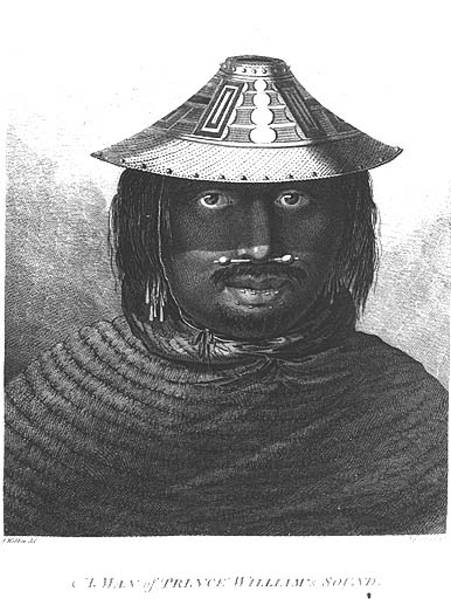
Chugach woven spruce-root hat with dentalium shells and trade beads, Museum of Cultures, Helsinki

The Chugach people have lived in the region around Prince William Sound for millennia, according to archaeological finds. They were the first indigenous Alaskans to encounter the Russian explorer Vitus Bering in 1741. The Russians were followed by Spanish, English, and American explorers. The Chugach have at times traded with or fought against neighboring groups, the Eyak, Ahtna, and the Tlingit.[1]

In 1964, a tsunami generated by the Good Friday earthquake destroyed the Chugach village of Chenega, Alaska. The fishing-based Chugach economy was badly affected by the environmental damage caused by the Exxon Valdez oil spill in 1989.

Language

[edit]

Chugach people speak one of two dialects of the Pacific Gulf Yupik language; the other being Koniag. These Central Yupik languages belong to the Alaskan Yupik language family. Once written in Cyrillic script, the language is now written in the Latin script.[2]

Social structures and gender

[edit]

There are historical accounts of some androgynous third gender or two spirit individuals among the Chugach, known as aranu'tiq.[3] According to anthropologists writing in the 1950s, these individuals were considered to be male on one side of their bodies and female on the other.[3] Some had descriptive names like "Tyakutyik" ("What Kind Of People Are These Two?"), but this description was given to many types of people in the community, and was not related to gender expression.[3]

Namesakes

[edit]

The Chugach people gave their name to Chugach National Forest, the Chugach Mountains, and Alaska's Chugach State Park, all located in or near the traditional range of the Chugach people in southcentral Alaska. Chugach Alaska Corporation, an Alaska Native regional corporation created under the Alaska Native Claims Settlement Act of 1971, also derives its name from the Chugach people, many of whom are shareholders of the corporation.

See also

[edit]

Notes

[edit]
[edit]
Revisions and contributorsEdit on WikipediaRead on Wikipedia
from Grokipedia
The Chugach, known also as Chugach Sugpiaq or Chugachigmiut, are an indigenous Alaska Native people of the coastal Chugach region in southcentral Alaska, spanning Prince William Sound, the lower Copper River delta, the eastern Kenai Peninsula, and the lower Cook Inlet.[1][2] They form part of the broader Alutiiq or Sugpiaq cultural and linguistic group, speaking the Chugach dialect of the Alutiiq language, which belongs to the Eskimo-Aleut family.[3] Archaeological evidence demonstrates continuous occupation of the region by Chugach ancestors for at least 10,000 years, following the retreat of glaciers and adaptation to post-Ice Age environments.[4] Traditionally, the Chugach maintained a maritime subsistence economy, excelling in kayak-based hunting of sea otters, seals, and whales, as well as fishing for salmon and harvesting shellfish, berries, and other coastal resources suited to their rugged, fjord-indented homeland.[3][5] Social organization featured hereditary chiefs and a rich material culture, including woven spruce root hats, bentwood visors, and elaborate wooden carvings reflective of their environmental mastery and inter-village trade networks with neighboring Eyak, Tlingit, and Athabascan groups.[1][6] European contact began in 1741 when Chugach people encountered Vitus Bering's Russian expedition at Kayak Island, initiating profound disruptions including disease epidemics, population declines, and cultural assimilation pressures under Russian and later American rule.[1][2] In the 20th century, the Alaska Native Claims Settlement Act of 1971 enabled the formation of the Chugach Alaska Corporation, distributing land and resources to shareholders while fostering economic self-determination, though challenges persist in language revitalization—with fewer than 200 fluent Alutiiq speakers region-wide—and environmental stewardship amid events like the 1989 Exxon Valdez oil spill in Prince William Sound.[7][8] Today, organizations such as the Chugach Regional Resources Commission and Chugachmiut advance tribal governance, cultural preservation, and resource management for approximately 1,500 enrolled tribal members and broader descendant communities.[9][10]

Etymology and Identity

Name Origins

The term "Chugach" originates as a placename in the Sugpiaq dialect of the Alutiiq language, rendered as Cuungaaciq, referring to specific islands and coastal locales in Prince William Sound and along the Kenai Peninsula. This toponym was adopted to designate the broader region and its indigenous inhabitants, with Russian explorers in the 1740s transcribing it as variants such as "Chugatz" or "Tchougatskoi" during early contacts.[11] The ethnonym "Chugachmiut" explicitly means "people of the Chugach," applied to Sugpiaq-speaking groups in these areas, distinguishing them from adjacent Eyak communities whose Athabascan language lacks direct equivalence to Cuungaaciq. Documented linguistic analyses treat Cuungaaciq as a proper noun without resolved morpheme breakdown into descriptive elements, rejecting unsubstantiated derivations like onomatopoeic ties to sounds (e.g., "ripping") or exclusive references to passages, in favor of its role in traditional Sugpiaq toponymy. Multilingual adaptations occurred historically due to trade and intermarriage in the region, but the core form remains rooted in Alutiiq rather than Eyak or external impositions.[11][12]

Self-Identification and Variants

The Chugach people, particularly the Yupik-speaking groups inhabiting Prince William Sound and the outer Kenai Peninsula, primarily self-identify as Sugpiaq, a term derived from suk ("person") and -piaq ("real" or "genuine"), signifying "real people" or "true persons."[13][3] This designation emphasizes their maritime cultural identity tied to coastal south-central Alaska. The Eyak-speaking subgroup, linguistically distinct as Na-Dené speakers and historically concentrated near the Copper River delta, uses Eyak (or dAXunhyuu in their language) as their primary self-designation, reflecting a separate ancestral lineage despite geographic proximity and occasional cultural overlap with Sugpiaq communities.[14][15] Collectively, these groups are encompassed under Chugachmiut, translating to "people of the Chugach" region, as promoted by modern tribal consortia focused on cultural revitalization.[16] Historical variants emerged from external documentation, notably Russian explorers who recorded the name as "Chugatz" or "Tchugatz" during early contacts in the 18th century, adapting local terms for administrative and trade purposes.[17] This transliteration persisted in colonial records before evolving into broader English usages like "Chugach Eskimo," though such labels often imposed exogenous categorizations that blurred intra-group distinctions between Sugpiaq and Eyak.[18] In contemporary contexts, self-identification as "Chugach Alaska Natives" appears in regional advocacy, but it remains secondary to linguistically rooted terms like Sugpiaq, especially amid efforts to counter assimilation pressures from Russian and American eras. Empirical data on self-reporting is limited in U.S. censuses, where individuals typically select broader "American Indian or Alaska Native" categories rather than specific tribal affiliations like Chugachmiut or Sugpiaq; for instance, the Chugach Census Area recorded approximately 7,102 residents in 2020, with Alaska Natives comprising a significant but unspecified proportion beyond aggregated statistics.[19] Tribal enrollment provides clearer metrics: the Sugpiaq/Alutiiq population is estimated at around 3,000, with affiliated organizations like Chugachmiut serving seven communities and emphasizing Sugpiaq/Eyak heritage in self-governance initiatives.[13][20] The Native Village of Eyak, a federally recognized entity, enrolls members who self-identify across Eyak, Chugach, and related ancestries, underscoring persistent diversity in identification amid declining traditional language use—only about 400 Sugpiaq speakers remain.[21][13]

Geography and Traditional Territory

Core Regions

The core regions of Chugach traditional territory center on Prince William Sound, the eastern Kenai Peninsula, and adjacent coastal zones extending from the eastern half of Hinchinbrook Island—encompassing areas like Mummy Island, Point Whitshed, and Hawkins Island—to Controller Bay along the mainland.[1][22] These regions feature over 3,500 miles of intricate, glacially carved coastline with deep fjords, tidewater glaciers descending from the Chugach Mountains, and nutrient-rich marine waters supporting dense populations of salmon, halibut, seals, sea otters, and shellfish.[23] Such environmental features enabled sustained human occupation for approximately 10,000 years since the retreat of the last ice age, as indicated by archaeological evidence of coastal adaptations including shell middens and maritime tools.[24] Territorial boundaries inland rarely exceeded 50 miles, aligning roughly with the crests of the Kenai and Chugach Mountains, which demarcate a narrow coastal strip from broader interior domains.[5] This coastal confinement fostered subsistence patterns centered on marine harvesting via skin boats and weirs, contrasting with the terrestrial big-game pursuits (e.g., caribou and moose) of inland Athabascan neighbors and the eulachon-focused fisheries of southeastern Tlingit groups, whose territories abutted but did not overlap extensively with Chugach domains.[25][26]

Key Settlements

The principal historic settlement of the Chugach was Nuchek, situated on Hinchinbrook Island in Port Etches, which functioned as a central village and hosted the Russian Fort Konstantine established around 1793; it was abandoned by the early 20th century amid epidemics, including smallpox outbreaks in the 1860s, and the closure of nearby mines in 1929 that undermined local economies.[27][28] Contemporary Chugach settlements center on the small villages of Chenega and Tatitlek in Prince William Sound, which sustain demographic and cultural continuity for a Native population of over 1,500 tribal members across the region despite historical relocations and depopulation events.[1] Chenega, originally at Chenega Bay, was obliterated by the 1964 Good Friday earthquake and subsequent tsunami that claimed over one-third of its inhabitants, prompting relocation to a new site on Evans Island approximately 42 miles southwest of Whittier; as of 2023, it has about 54 residents, mostly Alaska Natives, with infrastructure limited to air and marine access.[29][30][31] Tatitlek, positioned 22 miles southwest of Valdez on Tatitlek Narrows within the Chugach National Forest, supports a population of roughly 23 as of recent estimates and exemplifies adaptation through sustained small-scale residency amid regional shifts; like Chenega, it relies on boat and aircraft for connectivity, underscoring the remote, maritime-oriented nature of these communities.[32][33][34] Cordova, while a larger non-village community with around 2,400 residents, hosts significant Chugach presence as part of the broader Eyak-Chugach area and absorbed some Chenega evacuees post-1964, facilitating partial continuity for affiliates numbering approximately 2,100 shareholders in the Chugach Alaska Corporation.[35][36]

History

Pre-Contact Era

Archaeological investigations reveal that human occupation in Prince William Sound, the core pre-contact territory of the Chugach (also known as Sugpiaq in their language), commenced approximately 5,000 years before present, coinciding with the post-glacial retreat that exposed habitable shorelines and fjords.[37] Key sites, such as the Palugvik site on Hawkins Island and SEL-188 on the outer Kenai Peninsula, yield evidence of semi-permanent villages clustered in resource-rich bays protected from open-ocean swells.[38] Artifacts including toggling harpoons, bone fishhooks, and ground slate ulus indicate specialized technologies for exploiting marine mammals like seals, sea otters, and occasionally whales, as well as salmon runs and shellfish beds.[39] Chugach lifeways emphasized mobility within a coastal niche, with winter villages of semi-subterranean barabaras housing extended kin groups, supplemented by seasonal camps for hunting and processing. Dugout canoes, carved from red cedar and up to 30 feet long, enabled navigation through treacherous waters for hunting and transport, reflecting engineering adaptations to the sound's glacial silts, tidal rips, and ice floes.[40] Terrestrial resources were marginal due to dense spruce-hemlock forests, acidic soils, and short frost-free periods, compelling reliance on predictable but volatile sea harvests; overhunting risks and storm-induced famines imposed ecological limits, as evidenced by faunal remains showing selective predation on high-calorie prey.[41] Pre-contact trade mitigated resource gaps through networks linking Chugach coastal groups to interior Athabascans via overland trails and grease routes, bartering eulachon oil, dried fish, and sea mammal intestines for copper from native sources, beaver furs, and obsidian.[41][42] Such exchanges, documented via exotic artifacts in midden deposits, underscore causal dependencies on seasonal surpluses amid environmental stochasticity, with population densities—estimated at 1,000 to 2,000 individuals across 10–15 villages—constrained by the sound's finite productivity rather than expansive abundance.[43]

Russian Contact and Early Colonization (1741–1867)

The Chugach people initiated contact with Russians during Vitus Bering's Second Kamchatka Expedition in 1741, when the ships St. Peter and St. Paul under Bering and Aleksei Chirikov encountered Natives near Kayak Island in the Gulf of Alaska, close to Prince William Sound. This brief interaction, marked by trade of furs and goods, alerted Russians to the region's rich sea otter populations, whose pelts fetched high prices in China via Siberian markets. The expedition's reports fueled a rush of promyshlenniki—independent fur traders—who began arriving in Alaskan waters by the 1750s, bartering iron tools, beads, and firearms for sea otter skins from Chugach hunters, though direct sustained presence in Chugach territory lagged until later decades.[44][4][2] By the 1790s, Russian commercial interests formalized operations in Prince William Sound with the establishment of trading outposts, including Nuchek (also known as English Bay or Constantine Harbor) on Hinchinbrook Island in 1793 by traders affiliated with the Lebedev-Lastochkin Company. Nuchek served as a key hub for the maritime fur trade, where Russians directed Chugach and Alutiiq Natives to hunt sea otters using baidarka skin boats, often coercing labor through hostage-taking, enslavement, or threats of violence against villages. Sea otter pelts, numbering tens of thousands annually from Alaskan hunts in the early 19th century under the monopolistic Russian-American Company (chartered 1799), drove economic exploitation, depleting local populations and disrupting traditional subsistence patterns reliant on balanced marine harvesting.[45][46][47] Introduced Eurasian diseases devastated Chugach demographics, with epidemics of smallpox, influenza, and tuberculosis—lacking immunity among Natives—causing mortality rates estimated at 80–90% from pre-contact levels of several thousand to mere hundreds by the mid-19th century. A major smallpox outbreak in the 1830s–1840s, transmitted via Russian ships and trade networks, further accelerated this collapse, compounded by direct violence such as punitive raids on villages refusing tribute or harboring escaped laborers. Intermarriage between Russian men and Chugach women produced a Creole class granted privileged status under Russian law, blending European education with Native kinship ties, though this often masked ongoing exploitation and cultural erosion.[4][48][49] Chugach resistance manifested in sporadic raids on Russian vessels and outposts, including attacks on trading parties in Prince William Sound during the 1780s–1800s, where warriors used bows, spears, and later acquired firearms to defend territories and disrupt otter hunts. These actions, though limited by technological disparities and population losses, prompted Russians to fortify posts like Nuchek and rely on allied Tlingit or Aleut auxiliaries for enforcement, highlighting the coercive dynamics of colonial expansion rather than voluntary trade partnerships.[45][47]

American Acquisition and 19th–Early 20th Century Changes

The United States acquired Alaska from Russia through the Treaty of Cession signed on March 30, 1867, for $7.2 million, incorporating the territory into the U.S. without consulting or recognizing aboriginal rights of indigenous groups such as the Chugach in Prince William Sound.[50] The treaty's Article VI specified that "uncivilized native tribes" would be "subject to such laws and regulations as the United States may, from time to time, adopt in regard to aboriginal tribes of that country," establishing Alaska Natives as wards of the federal government without citizenship, voting rights, or formal land titles until the Indian Citizenship Act of 1924.[51] This wardship framework denied Chugach communal marine-based territories, essential for their subsistence economy of fishing and hunting sea mammals, leaving them vulnerable to non-Native encroachments without legal recourse.[52] The Alaska Native Allotment Act of May 17, 1906, permitted individual Natives to claim up to 160 acres of land, but its provisions proved inadequate for Chugach communities reliant on extensive coastal and marine resources rather than contiguous upland plots, resulting in minimal successful allotments and failure to protect traditional fishing grounds from overexploitation.[53] Concurrently, the late 19th-century gold rushes, including the 1898 influx to Valdez and Prince William Sound, drew thousands of prospectors who competed for salmon streams and disrupted Chugach access to key harvesting sites, exacerbating subsistence strains without early judicial remedies for Native claims.[54] Protestant missionaries, backed by federal funding from 1885 under Sheldon Jackson's oversight as General Agent for Education in Alaska, established schools that prioritized English instruction and Christian conversion, supplanting Russian Orthodox traditions among the Chugach and contributing to cultural erosion.[55] [56] Boarding schools, such as the Presbyterian-founded Sitka Industrial Training School opened in 1878, removed Chugach youth from families, enforcing policies that suppressed native languages like Eyak and Chugach Sugt'stun through corporal punishment and immersion in English-only environments.[57] [58] These pressures, compounded by epidemics including the 1918-1919 influenza pandemic, drove Alaska Native populations—including the Chugach—to historic lows, with territorial censuses reflecting a nadir around 1910-1930 amid ongoing disease and social disruption.[59] Early Native assertions of land rights, such as informal protests against mining and fishing intrusions, yielded no binding court victories, as federal policy viewed aboriginal title as unextinguished yet unenforceable absent congressional action.[52]

ANCSA and Corporate Formation (1971 Onward)

The Alaska Native Claims Settlement Act (ANCSA), enacted on December 18, 1971, resolved aboriginal land claims by extinguishing Native title in exchange for corporate ownership of specified lands and cash payments, establishing 12 regional for-profit corporations including Chugach Alaska Corporation (CAC) to represent Alaska Natives in the Chugach region.[60][61] This structure privatized communal claims into alienable shares, enabling market-driven management rather than federal trusteeship, which had previously constrained Native economic agency through bureaucratic oversight and dependency on government aid.[62] CAC received entitlements to approximately 1 million acres of land in southcentral Alaska, comprising surface and subsurface estates often limited to less developable areas like mountains and glaciers due to prior federal withdrawals, alongside a cash settlement portion of the ANCSA's $962.5 million total, estimated at around $22 million for the region based on shareholder enrollment.[63][64] Original enrollment included over 2,000 Chugach Native shareholders, each receiving 100 shares of stock, marking a transition from collective tribal holdings to individual equity stakes that could be traded, inherited, or leveraged for capital.[65] This allocation empowered shareholders with direct financial interest, contrasting with pre-ANCSA reliance on subsistence and intermittent federal support. The corporate model under ANCSA incentivized self-reliant development by tying resource stewardship to profit motives, as private ownership aligns individual incentives with long-term value creation, evidenced by CAC's diversification into federal contracting, real estate, and resource extraction.[7] Revenue grew from initial settlement funds to over $1 billion annually by the 2010s, employing around 5,000 people and generating shareholder dividends, such as $14.6 million distributed in 2022 and special payments like $12.50 per share in 2020.[66][67] These outcomes demonstrate causal effects of property rights in fostering enterprise, with CAC consistently ranking among Alaska's top businesses—seventh in 2022 with $745 million revenue—reducing welfare dependency through reinvested earnings and job creation.[68]

Exxon Valdez Oil Spill and Aftermath (1989–Present)

On March 24, 1989, the Exxon Valdez oil tanker struck Bligh Reef in Prince William Sound, releasing approximately 11 million gallons of crude oil that spread across over 1,300 miles of shoreline, including core areas of Chugach traditional territory such as regions near Chenega, Tatitlek, Cordova, Nanwalek, and Port Graham.[69] The spill resulted in acute ecological damage, with estimates of 250,000 seabirds, 2,800 sea otters, 2,300 harbor seals, 250 bald eagles, and 22 killer whales killed, alongside billions of salmon and herring eggs destroyed.[69] Herring populations in the Sound collapsed shortly after, with the commercial fishery failing to recover despite restoration efforts, as spawning stocks remained suppressed due to persistent oil residues in intertidal zones and disrupted food webs.[69] Pink salmon showed partial rebound by the mid-1990s, but long-term monitoring revealed ongoing sublethal effects like cardiac deformities in fish embryos from low-level hydrocarbon exposure, contributing to delayed overall ecosystem recovery beyond initial predictions of rapid healing.[70][71] Economically, the spill devastated Chugach-dependent fisheries and subsistence harvesting, leading to permit losses, business bankruptcies—including the shutdown of the Port Graham cannery—and a shift away from traditional foods like clams and herring spawn toward store-bought alternatives, exacerbating health vulnerabilities from reduced nutrient-dense diets.[69] Chugach Alaska Corporation, reliant on regional marine resources, filed for Chapter 11 bankruptcy protection in 1991 amid cascading failures in clam, herring, and seal populations that undermined shareholder dividends and operations.[72] Exxon settled civil claims for $900 million over 10 years (final payment in 2001) to federal and state trustees via the Exxon Valdez Oil Spill Trustee Council (EVOSTC), with funds allocated to habitat restoration projects like clam bed enhancements (1998–2001) and a mariculture center (1992–1997) that indirectly supported Chugach communities.[73][69] Settlement proceeds enabled Chugach Alaska Corporation's restructuring and diversification into non-resource sectors post-bankruptcy, though EVOSTC's use of funds for surface estate purchases from Native corporations created split-ownership conflicts on Chugach lands, sparking debates among shareholders and villages over resource control versus restoration priorities.[74] Lingering oil persists in subsurface pockets across affected beaches, with toxins detectable in sediments as of 2023, sustaining elevated polycyclic aromatic hydrocarbon levels that inhibit benthic recovery and pose ongoing risks to foraging species central to Chugach subsistence.[69][75] These effects have fueled generational shifts in cultural practices, with communities reporting trauma from disrupted harvesting traditions and incomplete ecological baselines hindering full damage assessments.[69]

Recent Developments (2000s–2025)

In the 2000s, Chugach Alaska Corporation expanded its operations through diversification into federal government contracting, leveraging its status as an Alaska Native Corporation under the Small Business Administration's 8(a) program. This shift began with early bids on federal contracts following legislative changes enabling sole-source awards, allowing Chugach Government Solutions to secure multi-year deals in facilities management, IT, and engineering services. By 2025, the corporation had won contracts such as a $164 million award from the Naval Information Warfare Center Atlantic for base operations support and an OASIS+ multiple-award vehicle from the General Services Administration for professional services procurement.[76][77] Chugach's business growth positioned it as a leading Alaska entity, ranking #10 on Alaska Business Magazine's 2024 Top 49ers list of largest private companies by gross revenues and maintaining inclusion in the 2025 edition with a reported 5% year-over-year revenue increase. Acquisitions in 2024, including Fairbanks-based HVAC, LLC and Alaska Integrated Services, LLC, further broadened its mechanical services portfolio, enhancing diversification beyond resource extraction.[78][79][80] Legislative efforts advanced in 2025 to address historical land discrepancies from the Exxon Valdez spill era, with the introduction of H.R. 3903, the Chugach Alaska Land Exchange Oil Spill Recovery Act. The bill proposes exchanging approximately 231,000 acres of Chugach subsurface estate for 65,374 acres of federal surface lands in Prince William Sound, aiming to consolidate ownership and enable resource development while resolving split-estate issues from the 1989 spill settlement. Chugach Chairman Joseph E. Balash testified before Congress on September 9, 2025, emphasizing the exchange's role in economic viability and cultural significance for shareholders.[81][82][83] Cultural revitalization gained momentum through the Chugach Heritage Foundation, which since 2016 has managed programs like the Nuuciq Spirit Camp—operating annually since 1995 to teach traditional skills, language, and subsistence practices to youth. Funding from the Exxon Valdez Oil Spill Trustee Council supported expanded culture camps in the Chugach region, totaling $2.4 million in 2021 for subsistence resource enhancement. In parallel, the Bureau of Indian Affairs awarded Tribal Climate Resilience grants to Chugachmiut in FY2024 for climate adaptation planning, integrating traditional ecological knowledge into vulnerability assessments for coastal communities. A 2025 shareholder vote approved open enrollment, extending eligibility to first-generation lineal descendants and missed-at-birth enrollees, bolstering community ties.[84][85][86][87]

Culture and Society

Language and Linguistic Heritage

The Chugachmiut, the indigenous people of the Prince William Sound and surrounding regions, historically spoke Sugpiaq (also known as Chugach Sugpiaq or Pacific Yupik), a dialect within the Eskimo-Aleut language family.[88] This language features polysynthetic structure typical of Yupik languages, with dialects varying between Prince William Sound and Lower Cook Inlet areas.[1] Adjacent to Chugach territories, the Eyak people spoke Eyak (dAXunhyuuga'), a Na-Dené language isolate genetically related to Athabaskan languages but distinct in phonology and morphology, with the name "Eyak" deriving from a Chugach Sugpiaq term for a village at the Eyak River mouth.[89] Both languages exhibit influences from historical Russian contact, incorporating loanwords for trade goods, tools, and administrative terms, as documented in early 19th-century vocabularies compiled by explorers like Nikolai Rezanov, which recorded over 1,100 Sugpiaq and Eyak words alongside related tongues.[90] English has since become dominant, supplanting native fluency through assimilation policies and intergenerational transmission loss, leaving Sugpiaq with fewer than 200 fluent speakers among approximately 3,500 ethnic Alutiiq/Sugpiaq individuals as of recent estimates, while Eyak is considered extinct following the death of its last fluent speaker in 2008.[91][92] Surveys indicate fluency rates below 10% for Sugpiaq dialects in the Chugach region, with most remaining speakers over 70 years old.[93] Revival efforts for Sugpiaq include community-led immersion programs, textbook development, and orthography standardization initiated in the late 1980s, with organizations like the Alutiiq Museum producing resources such as conversational phrasebooks and digital tools to build speaker cohorts.[94][95] For Eyak, Chugachmiut heritage groups have pursued reclamation through archival transcription and youth education modules, though progress remains limited by the absence of native models.[96] Empirical data from these initiatives highlight challenges: small base populations yield low immersion efficacy, with program outcomes showing partial conversational proficiency in under 5% of participants after multi-year exposure, underscoring the causal barriers of demographic scale over ideological commitment alone.[97][98]

Kinship and Social Structures

The Chugach people, aligned with broader Alutiiq cultural patterns in Prince William Sound, primarily followed a bilateral kinship system, where descent and inheritance traced through both maternal and paternal lines, as indicated by kinship terminology grouping relatives symmetrically without strong unilineal bias.[99] Ethnographic analyses note adaptive flexibility, with some evidence of matrilineal influences from neighboring Eyak groups, who emphasized maternal clan lineages and moieties such as Eagle and Raven, potentially shaping intermarriage and alliance practices in shared territories.[89] This hybridity arose from geographic proximity and historical interactions, enabling resource-sharing networks in a coastal environment prone to seasonal scarcities, rather than rigid egalitarianism; bilateral ties facilitated flexible household extensions for cooperative subsistence, including multi-family winter dwellings housing 20–50 individuals.[100] Social organization featured a stratified hierarchy with three classes—nobles (wealthy leaders), commoners (majority hunters and gatherers), and slaves (captives from raids or debt)—where positions were inherited patrilineally among elites, contrasting with bilateral kinship for commoners.[101] [100] Village chiefs, known as angayuqaq, held authority over labor mobilization, dispute resolution, and redistribution of marine resources like salmon and seals, supported by empirical accounts from Russian explorers in the 18th century documenting hereditary leadership and tribute systems.[102] Shamans (kas'aq or ritual specialists) wielded spiritual influence, conducting healing, divination, and ceremonies open to both genders, their roles sustained by community provisions rather than personal wealth, as hierarchies ensured survival in marginal fjord ecosystems through enforced reciprocity.[99] Status validation occurred via communal feasts resembling potlatch analogs, where chiefs hosted winter rituals involving masked dances, gift exchanges, and memorial observances to affirm alliances and redistribute surpluses, linking social rank to demonstrated generosity amid unpredictable harvests.[100] Eyak influences introduced moiety exogamy in some settlements, promoting cross-group marriages for conflict mitigation, but Chugach structures prioritized pragmatic hierarchy over clan totemism, as verified by 19th-century ethnographic reconstructions emphasizing chiefs' roles in raid defense and trade./4.%20De%20Laguna%20%20Matrilineal%20Societies%20in%20NW%20Pacific%20Coast/4.%20De%20Laguna%20%20Matrilineal%20Societies%20in%20NW%20Pacific%20Coast%20(Matrix%202:2,%20Autumn%202021%20-%20Winter%202022).pdf) This organization causally supported resilience, with stratification enabling specialized roles like shamanic mediation during famines, distinct from ideological equality narratives unsupported by explorer records.[103]

Gender Roles and Division of Labor

In traditional Chugach society, men primarily engaged in hunting sea mammals such as seals and sea otters, fishing, trapping, and crafting hunting tools like harpoons, lances, bows, arrows, and throwing boards, roles dictated by the physical demands of open-water pursuits requiring strength and endurance in Prince William Sound's harsh maritime environment.[104] Women focused on complementary tasks including food gathering, preservation, cooking, tanning hides, sewing waterproof garments from gutskins and furs, and child-rearing, utilizing specialized tools such as ulus (curved knives), gut scrapers, awls, and bone needles for processing animal products and maintaining household items essential for survival.[104] This division reflected adaptive specialization, with men's activities centered on acquisition through high-risk endeavors and women's on transformation and reproduction, ensuring group viability amid seasonal scarcities and biological imperatives like pregnancy and nursing that constrained female participation in distant hunts.[105] Ethnographic accounts from the mid-20th century, drawing on earlier fieldwork, confirm men's dominance in boat construction and warfare or raiding against neighboring groups like the Tlingit, where leadership and combat roles aligned with upper-body strength advantages, while women held rights over processed goods such as dried fish caches and sewn clothing, though ultimate household authority often rested with male providers.[106] Post-Russian contact in the 18th century and American acquisition in 1867, traditional roles persisted in subsistence economies but shifted with wage labor opportunities in commercial fishing and cannery work by the early 1900s, allowing some women entry into paid processing jobs while men adapted to salaried hunting or guiding, though gender-specific subsistence tasks endured into the late 20th century.[105] By the 1970s, household divisions in Chugach villages like Chenega Bay remained largely gendered, with men handling heavy outdoor labor and women domestic production, even as ANCSA-era corporate involvement introduced mixed-gender employment in resource sectors.[105] ![Spruce root hat crafted by Chugach women][float-right] These roles underscored causal linkages between physiology, environment, and efficiency—men's greater average muscle mass suiting spear-throwing and kayak navigation, women's dexterity and multitasking aptitude fitting fine sewing and multitasking with infants—without evidence of rigid hierarchy but with interdependence critical for caloric security in pre-industrial contexts.[104] Modern ethnographic observations note gradual blurring through mechanization and education, yet core patterns from Birket-Smith and de Laguna's 1953 synthesis of Chugach practices indicate enduring complementarity over imposed uniformity, as biological sex differences continued influencing task allocation in remote Alaskan Native communities as late as the 1990s.[106][105]

Traditional Subsistence and Spiritual Beliefs

The Chugach people's traditional subsistence practices revolved around a seasonal exploitation of marine, riparian, and terrestrial resources in the coastal environments of Prince William Sound and the Kenai Peninsula. Key staples included marine mammals such as harbor seals (Phoca vitulina) and sea lions (Eumetopias jubatus), harvested primarily in winter and spring using harpoons and kayaks, alongside salmon (Oncorhynchus spp.) runs in summer rivers and halibut (Hippoglossus stenolepis) via bottom fishing. Gathering supplemented these with berries (e.g., blueberries and devil's club berries), roots, and intertidal shellfish like clams and cockles, yielding an estimated annual harvest supporting small kin-based groups. Archaeological evidence from shell middens at sites like Uyak Bay and Prince William Sound dates these patterns to at least 4,000–5,000 years before present, revealing stratified layers of fish bones, mammal remains, and lithic tools indicative of pulsed, migratory settlements tied to resource peaks rather than permanent villages.[107][108] Artifacts such as ground slate ulus for skinning, bone toggles for harpoon lines, and woven spruce root containers underscore technological adaptations for efficient processing and storage, enabling survival through lean winters via smoked or dried provisions. These cycles demanded mobility, with families shifting between coastal hunting grounds in fall-winter and inland berry/fish camps in summer, as corroborated by oral histories and faunal analyses showing diversified diets to buffer environmental variability. While sustainable in aggregate due to low population densities (estimated at under 1,000 pre-contact individuals across the region), records of localized scarcities in ethnographic accounts highlight vulnerabilities to overharvesting without regulatory checks, challenging idealized notions of unfailing ecological balance.[104][105] Underpinning these practices were animistic spiritual beliefs attributing a vital essence, termed suk, to all animals, plants, and natural phenomena, which required ritual propitiation to secure future yields. Post-harvest ceremonies involved offering thanks through songs, dances, and precise disposal of remains (e.g., returning seal entrails to sea), ensuring the spirit's reincarnation and return; neglect invited misfortune like failed hunts, per oral traditions preserved in Chugach communities. Shamans, or spiritual intermediaries akin to regional angakkuq, invoked trance states via drumming or isolation to commune with animal masters, diagnose illnesses as spirit imbalances, or enforce taboos against waste—measures empirically linked to conservation by curbing excess kills and promoting selective harvesting. These beliefs, while deeply cosmological, functioned causally as adaptive strategies: ethnographic data from related Sugpiaq groups documents famine attributions to taboo breaches, reflecting real risks of depletion in finite coastal stocks absent such restraints.[109][105]

Economy and Modern Institutions

Chugach Alaska Corporation

Chugach Alaska Corporation was formed in 1972 as Chugach Natives, Inc. under the provisions of the Alaska Native Claims Settlement Act (ANCSA) of 1971, which established 12 regional for-profit corporations to settle aboriginal land claims through corporate ownership rather than communal tribal structures.[7] This structure vested title to approximately one million acres of land and nearly $1 billion in cash and revenue-sharing payments among the regional corporations, with Chugach receiving selections in the Prince William Sound region to support economic development for its roughly 2,700 original shareholders and descendants.[7] Unlike traditional tribal collectives, the ANCSA model emphasizes individual share ownership, enabling direct financial benefits to shareholders via dividends and stock inheritance, which incentivizes long-term value creation through market competition.[65] The corporation operates through subsidiaries focused on government services, facilities management, and commercial holdings, deriving significant revenue from federal contracts under programs like the Small Business Administration's 8(a) initiative, which provides sole-source contracting preferences to Native-owned firms.[76] In fiscal year 2022, Chugach reported $745 million in revenue, reflecting steady growth driven by expanded federal awards, including a February 2025 OASIS+ contract vehicle for professional services and acquisitions in mechanical contracting to bolster Alaska operations.[68][110] By September 2025, annual revenue estimates reached approximately $750 million, underscoring resilience amid economic fluctuations through diversification into information technology, logistics, and construction services.[111] Shareholder distributions have cumulatively exceeded $150 million in corporate dividends by the end of 2019, supplemented by trust dividends, elder benefits, and special payouts such as a $12.50 per share dividend issued in December 2020, totaling over $100 million in direct cash returns when including subsequent years.[112][66] These payments, ranging from $300 to $3,700 per 100 shares annually across ANCs in recent years, facilitate individual wealth accumulation and investment, contrasting with higher poverty persistence in non-corporate Native collectives where communal decision-making often dilutes incentives for productivity.[113] The profit-oriented framework of ANCs like Chugach demonstrably harnesses market signals to allocate resources efficiently, yielding lower effective poverty exposure for enrolled shareholders through employment opportunities—supporting over 2,000 jobs—and reinvestable capital, as evidenced by sustained dividend growth despite broader Alaska Native poverty rates hovering around 25 percent.[67][114]

Resource Management and Land Exchanges

Chugach Alaska Corporation manages nearly one million acres of land in southcentral Alaska, comprising 378,000 acres of full fee estate and 550,000 acres of subsurface estate, primarily in the Prince William Sound and Kenai Peninsula regions.[63] These holdings support sustainable resource use, including forestry, fisheries, and cultural preservation, with management practices emphasizing long-term viability over short-term exploitation to generate revenue for shareholder dividends and community programs.[63] Land exchanges have been pursued to address historical complications from the 1989 Exxon Valdez oil spill, where the Exxon Valdez Oil Spill Trustee Council acquired surface estates on approximately 65,000 acres of Chugach subsurface lands for restoration, creating split ownership that hindered unified development and subsistence access.[115] The Chugach Alaska Land Exchange Oil Spill Recovery Act of 2025, reintroduced on June 11, 2025, proposes swapping Chugach's subsurface rights on over 230,000 acres for federal full-estate and surface lands totaling about 65,000 acres, prioritizing culturally significant sites and economically productive areas to consolidate ownership and recover spill-related value losses.[81] This exchange aims to resolve federal management conflicts, enabling pragmatic development such as selective resource extraction while maintaining ecological integrity.[83] Resource management balances subsistence and commercial fishing through regulatory frameworks and harvest monitoring in Chugach territories, where salmon and other species sustain both traditional Native practices and regional economies.[116] Subsistence harvesting remains central to cultural identity, with Alaska Department of Fish and Game data indicating stable quotas that prevent overexploitation amid commercial pressures, as evidenced by annual reports showing consistent salmon returns supporting dual uses without depletion. Commercial fisheries contribute significantly to local revenue, funding infrastructure that indirectly bolsters subsistence access. Selective resource development, such as forest carbon credit sales rather than widespread logging, has empirically generated revenue—exceeding traditional timber harvests—while preserving habitats for subsistence and biodiversity; for instance, participation in California's cap-and-trade market since 2017 has provided ongoing income from stored carbon on Chugach lands, funding cultural and educational initiatives without ecosystem degradation.[117] Similarly, retiring coal reserves in the Bering River field via a 2023 conservation deal secured long-term forest carbon payments, demonstrating how targeted non-extractive strategies yield financial benefits equivalent to mining or logging outputs while retaining land for future Native use.[118]

Controversies and Criticisms

Debates on Corporate Development vs. Cultural Preservation

The Alaska Native Claims Settlement Act (ANCSA) of 1971 structured Native corporations like Chugach Alaska Corporation (CAC) to prioritize economic development through land and resource management, sparking ongoing debates over whether corporate pursuits erode traditional Chugach cultural practices or sustain them via generated wealth. Proponents of development argue that shareholder dividends and corporate revenues have directly funded cultural and educational initiatives, with CAC distributing approximately $14.6 million in dividends and elder payments to its 2,900 shareholders in 2022 alone, alongside scholarships and internships that build capacity for cultural continuity.[67] This economic model has enabled investments in entities like the Chugach Heritage Foundation, which supports college scholarships for shareholders and descendants while promoting traditional practices through cultural programs.[119] Critics, including some Alaska Native voices, contend that ANCSA's corporate framework has widened disparities between urban-based shareholders—who often reside in Anchorage or outside Alaska—and rural village communities, where traditional subsistence lifestyles persist but receive fewer direct benefits from corporate gains. Testimony and analyses highlight how younger shareholders' migration to cities dilutes village-level cultural transmission, with urban-oriented corporations like CAC focusing revenues on diversified businesses yielding $745 million in 2022, potentially sidelining remote areas' needs.[120][68] Empirical outcomes suggest corporate development causally bolsters rather than supplants cultural preservation, as ANCSA profits have financed land acquisitions for sacred sites and nonprofit partnerships advancing Chugach heritage, countering narratives of inevitable cultural loss without such market-driven resources. For instance, CAC's strategy integrates economic returns with cultural site protections, funding tribal nonprofits annually in the millions to sustain practices that pre-ANCSA subsistence alone could not scale amid modern pressures.[121][122] Preservationist sentiments overlook how undeveloped lands under prior federal oversight yielded minimal Native agency, whereas corporate equity growth—evident in CAC's repeated top rankings among Alaska firms—has empirically enabled revival efforts like heritage education and community presentations.[123][124]

Federal Contracting Preferences and ANC Scrutiny

The Small Business Administration's 8(a) Business Development Program grants Alaska Native Corporations (ANCs), including Chugach Alaska Corporation, eligibility for sole-source federal contracts up to $4.5 million for manufacturing and $7 million for other services, with exceptions allowing larger awards under certain conditions, bypassing competitive bidding to support economically disadvantaged Native entities.[125] Chugach has leveraged these preferences extensively, achieving $1 billion in annual revenue from federal contracting by the mid-2010s through subsidiaries focused on government services.[7] Across ANCs, 8(a) sole-source awards contributed $2.4 billion in 2006, comprising 34% of their total revenues and enabling rapid business scaling.[126] Critics, including Government Accountability Office (GAO) analyses, have scrutinized ANC 8(a) use for potential abuse, noting ANCs' disproportionate contract share—nearly two-thirds of ANC participants secured obligations in fiscal 2007 versus 44% of other 8(a) firms—and lax oversight on follow-on sole-source awards to subsidiaries, which evades standard program limits on repeat eligibility.[127][128] Specific concerns for Chugach and similar ANCs include reliance on non-Native executives for high-salary roles, prompting audits and Senate probes into whether profits sufficiently benefit Native shareholders amid claims of executive favoritism over Native hiring.[129][130] GAO reports from 2006 onward recommend tailored oversight to curb risks like improper subsidiary proliferation, though no widespread fraud was conclusively tied to Chugach itself.[131] Defenses of Chugach's 8(a) participation emphasize empirical outcomes, with ANC revenues funding dividends, shareholder distributions, and employment that exceed welfare alternatives in fostering self-sufficiency; for instance, 8(a)-driven profits have generated jobs and income streams for Native Alaskans, reducing dependency on federal assistance programs.[132][133] Chugach highlights the program as an "economic engine" complementing the Alaska Native Claims Settlement Act, enabling entrepreneurship through industry expertise and local job creation—employing thousands, many Native—while countering "cronyism" accusations as mischaracterizations of successful Native-led business growth over envious critiques of preferential access.[134][7] These metrics, including sustained revenue reinvestment into shareholder benefits, substantiate the program's role in elevating Native economic participation beyond subsistence or aid reliance.[133]

Environmental and Subsistence Impacts

The Exxon Valdez oil spill on March 24, 1989, released approximately 11 million gallons of crude oil into Prince William Sound, contaminating intertidal zones and subsurface sediments that persist today, with lingering hydrocarbons detected in sheltered beaches as of 2023.[135][69] These residues have entered marine food chains, affecting species like clams and fish consumed by Chugach subsistence users, leading to reduced harvest confidence and avoidance of certain resources in affected communities.[136] However, studies indicate that remaining oil is largely no longer bioavailable to key injured species, with ecosystem recovery progressing such that persistent toxins do not drive ongoing broad-scale ecological harm.[137] Logging activities in the Chugach National Forest, spanning over 4.8 million acres, have contributed to localized soil erosion and stream sedimentation, potentially impacting salmon spawning habitats critical for subsistence fisheries.[138] Yet, selective timber management also aids fire prevention by reducing fuel loads in fire-prone spruce and hemlock stands, mitigating risks from increasingly intense wildfires exacerbated by warmer, drier conditions; historical fire suppression policies have similarly altered forest composition, but controlled logging supports erosion control measures like revegetation.[139][140] Declines in Chugach subsistence harvests, including salmon and marine mammals, correlate more strongly with climate-driven shifts—such as retreating glaciers, ocean acidification, and erratic storm patterns—than direct corporate development, with regulatory burdens on tribal participation in federal management processes adding time and cost barriers to access.[141][26] For instance, post-1989 harvest data from affected communities show increased effort for scarcer resources, but broader trends link reduced yields to environmental variability rather than isolated industrial acts.[142] Human expansion inherently disrupts local ecosystems, yet Alaska Native Corporations like Chugach have leveraged development revenues—exceeding $745 million in 2022—to fund land stewardship, carbon credit sales for forest preservation, and habitat maintenance that sustains subsistence alongside economic returns, outperforming federal oversight in targeted mitigation.[68][63]

Legacy and Namesakes

Cultural Influence

Chugach Sugpiaq artifacts, including ceremonial masks carved from wood and depicting supernatural spirits, feature prominently in museum collections worldwide, reflecting their role in community rituals for spiritual communication.[143] [144] These masks, often collected in the 19th century by explorers like Alphonse Pinart, embody enduring artistic traditions tied to shamanic practices and seasonal ceremonies, with examples held at the Alutiiq Museum containing the largest set of such items representing multiple generations.[144] Traditional items like spruce root hats, woven for practical and ceremonial use, further illustrate Chugach craftsmanship, as seen in European collections from early Russian-era acquisitions.[104] Oral histories and legends central to Chugach identity, such as those acknowledging fire and tools in Sugpiaq origin stories, are preserved through initiatives by the Chugach Heritage Foundation, a nonprofit supported by Chugach Alaska Corporation, which funds archives and educational materials to maintain these narratives amid cultural continuity efforts.[104] These resources document pre-contact practices and post-Russian contact adaptations, ensuring transmission of knowledge on subsistence and spiritual elements without reliance on external academic interpretations prone to bias. Mixed Russian-Native customs persist in Chugach communities, notably through the annual Russian New Year celebration organized by the Chugach Heritage Foundation since at least 2017, blending Orthodox traditions with Sugpiaq elements like maaskalataq starring rituals, dances, and specialty foods prepared from marine harvests.[6] [145] Events feature potlucks incorporating traditional items such as seal oil, muktuk, and Russian-influenced dishes, alongside live music and communal gatherings held in Anchorage venues like Mark Begich Middle School, fostering intergenerational participation in syncretic festivities observed on dates aligning with the Julian calendar, such as January 14 or late January equivalents.[146] [147] Chugach subsistence practices influence regional Alaskan cuisine, emphasizing seasonal marine resources like fish and shellfish harvested over millennia, which sustain cultural events and contribute to broader Native foodways integrated into modern festivals without diluting empirical harvesting techniques.[148] [108] These elements appear in community potlucks and heritage programs, preserving nutritional and ceremonial roles of foods like those from coastal environments, distinct from broader commercial influences.[6]

Modern Recognition

Chugach Alaska Corporation earned placement on Alaska Business Magazine's 2025 Top 49ers list, recognizing it among the state's largest locally owned businesses by gross revenue, a testament to its sustained economic expansion through diversified operations in facilities support, technical training, and other sectors.[149] This ranking builds on prior achievements, such as its seventh position in 2023, reflecting strategic use of federal programs like 8(a) to foster Native-led enterprise growth independent of traditional subsistence models.[150] Additional honors include the 2022 Gold Pan Award from the Anchorage Chamber of Commerce for business excellence and multiple Public Relations Society of America awards for communications efficacy in 2022.[151][152] Chugachmiut's heritage preservation efforts have garnered acclaim for innovative language revitalization, particularly through the Sugt'stun-focused educational video game Nunaka: My Village – Where Language Comes to Play, which won four awards and earned two nominations by November 2024 for integrating cultural content with interactive learning to combat language attrition.[96] These initiatives extend to curriculum development and partnerships, such as 2025 grants enhancing youth programs rooted in Sugpiaq and Eyak traditions, prioritizing practical transmission over archival stasis.[153] The corporate model pioneered by ANCSA via entities like Chugach has influenced global indigenous economic strategies, positioning for-profit Native corporations as vehicles for self-determination and capitalism, as evidenced by their adaptation into competitive industries and emulation in other settler contexts for asset-based development.[154][7] This legacy underscores a shift from communal land claims to shareholder-driven enterprises, yielding measurable dividends—Chugach alone distributing substantial returns to its Native shareholders—while prioritizing market viability over perpetual reliance on external aid.[65]

References

User Avatar
No comments yet.