


Community hub
Recent from talks
Contribute something
Nothing was collected or created yet.
Cippus
View on Wikipedia
A cippus (pl. cippi) was a low, round, or rectangular pedestal set up by the Ancient Romans for purposes such as a milestone or a boundary post. They were also used for somewhat differing purposes by the Etruscans and Carthaginians.
Roman cippi
[edit]Roman cippi were made of wood or stone; inscriptions on the stone cippi indicate their function or the area that they surrounded, like sanctuaries and temple areas. In Rome they marked the limits of the pomerium after the city's walls were expanded further out, the course of aqueducts, and the cursus publicus. Cippi lined up in rows were also often numbered, often featuring the name of the person placing them or the distance to the nearest other cippus. The inscriptions on some cippi show that they were occasionally used as funeral memorials.[1]
Etruscan cippi
[edit]Between 800–100 BC, cippi were used by the Etruscans as tombstones, which were shaped differently depending on the place and time of origin. Cippi were set up as a stele, column or sculpture in the dromos of an Etruscan grave or at the grave entrance. They had magical and religious significance. Cippi may have the shape of a cube, knob, onion, egg, ball or cylinder. There are connections between certain shapes and the representation of canopic jars; cinerary urns that were made in the shape of a human torso, and the head as a lid.[2][3]
- In Cerveteri, the cippi of female and male burials were different. Male dead received a column (phallus), women small houses or temples.
- The Pietra fetida monuments (6th – 5th centuries BC) from the area around Chiusi show a combination of the cinerary urn and cippus. They contain the ashes of the dead in an opening in their base.
- In Orvieto two so-called warrior head cippi have images of human heads (late 6th century BC).
- In Perugia, fluted columns with acanthus were used.
- From the 4th century BC cippi also have name inscriptions.
The "Cippus Abellanus" (in the Oscan language), like the "Cippus Perusinus", is not a tombstone.[4]
Punic cippi
[edit]Carthaginian cippi have a base similar to Egyptian steles, which are sometimes also referred to as cippi (for example the "Metternich Cippi" in the Metropolitan Museum of Art). They are found in North Africa, but also in Sardinia (Cagliari, Teti, Tharros), Sicily (Motya) and Spain (Huelva and Barcelona).[1] The Cippi of Melqart, found in Malta, which bear a Phoenician and a Greek inscription, made it possible for the first time to understand the Phoenician alphabet.[5]
Gallery
[edit]-

-

-
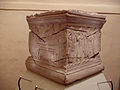 Etruscan "pietra fetida" cippus in Sarteano
 -
 Cippus surmounted by a pine cone, which symbolizes the tree of life
 -
 Castel Goffredo, La Pigna monument
 -
 Etruscan warrior head cippus


See also
[edit]References
[edit]- ^ a b Cippus (in German). Stuttgart. 1899. pp. 2563–2565 – via wikisource.org.
Band III,2
{{cite book}}:|work=ignored (help)CS1 maint: location missing publisher (link) - ^ Cebrián Fernández, Rosario (2000). Titulum fecit: la producción epigráfica romana en las tierras valencianas (in Spanish). Madrid: Real Academia de la Historia. p. 101. ISBN 9788489512733.
{{cite book}}:|work=ignored (help) - ^ Cooley, Alison E. (2012). The Cambridge Manual of Latin Epigraphy. Cambridge University Press. p. 58. ISBN 978-1-139-57660-4.
- ^ "National Archaeological Museum of Perugia – The Cippus of Perugia". Archived from the original on 2012-03-03. Retrieved 2021-03-06.
- ^ Pierret, Philippe (2001). "Mémoires, mentalités religieuses, art funéraire la partie juive du cimetière du Dieweg à Bruxelles". Annuaires de l'École pratique des hautes études (in French). 114 (110): 523–527. doi:10.3406/ephe.2001.12029.
Further reading
[edit]- Blumhofer, Martin (1993). Etruskische Cippi | Untersuchungen am Beispiel von Cerveteri (in German). Böhlau. ISBN 3-412-06993-0.
{{cite book}}:|work=ignored (help) - Kaimio, Jorma (2017). The South Etruscan Cippus Inscriptions. Institutum Romanum Finlandiae. ISBN 978-88-7140-781-4.
External links
[edit] Media related to Cippus at Wikimedia Commons
 Works related to 1911 Encyclopædia Britannica/Cippus at Wikisource


Cippus
View on GrokipediaOverview
Definition and Etymology
A cippus is a low, round, or rectangular pedestal or post employed in ancient Mediterranean cultures primarily as a marker for boundaries, milestones, tombs, or magical or religious purposes.[1] In Roman contexts, it typically served as a durable stone or marble monument, often inscribed, to delineate property lines or commemorate the dead, distinguishing it from taller columns or more elaborate stelae.[4] Similar forms appear across regions, such as the boundary and funerary markers in Etruria or the protective stelae in Egypt, though the term itself originates from Latin usage.[7] The word "cippus" derives from Latin, where it denoted a post, stake, block, or pillar, particularly in boundary or punitive contexts like stocks.[8] Etymologically, it stems from Proto-Italic *keipos, likely connected to the Proto-Indo-European root *(s)ḱéypos, meaning "pole" or "stick," with parallels in Sanskrit śepa ("penis, tail") suggesting an ancient association with upright wooden or stone supports. Earlier Italic roots may underlie this, as the term relates to scīpiō ("staff" or "rod"), reflecting a shared linguistic heritage among pre-Roman Italic peoples.[8] In Roman usage, "cippus" became standardized by the Republic and Empire for official markers, such as those defining the pomerium or imperial boundaries, evolving from simple wooden posts to inscribed stone artifacts.[4] The term later extended archaeologically to analogous objects in non-Roman cultures: Etruscan tombstones from the 8th to 3rd centuries BCE, Punic pillars like the Cippi of Malta dedicated to Melqart in the 2nd century BCE, and Egyptian Horus cippi from the Late Period through the Ptolemaic Period (c. 664 BCE–30 BCE) inscribed with protective spells.[7][9][10] This broader application highlights the cippus as a functional archetype rather than a strictly Roman invention, adapted across Mediterranean civilizations for demarcation and commemoration.General Forms and Materials
Cippi typically take the form of low pedestals, cylindrical pillars, rectangular blocks, or stele-like uprights, with heights commonly ranging from 0.5 to 2 meters depending on their intended placement and durability needs.[11][12][13] These structures are predominantly constructed from stone materials sourced locally for practicality, including limestone varieties such as bioclastic or white limestone, marble (e.g., Lunense or white marble), travertine, sandstone, and occasionally anhydrite or basalt in specific regions.[14][12][15][16][17] Early or portable examples may employ wood, often painted for protection and visibility, though stone dominates due to its longevity in outdoor settings.[11][18] Surfaces frequently feature carved inscriptions for identification, alongside aniconic elements like wreaths or plain disks, and symbolic reliefs such as animal figures or geometric motifs, sometimes enhanced with polychrome pigments including ochres and earth tones applied over preparatory mortar layers.[12][14][10]Roman Cippi
Boundary and Milestone Functions
Roman cippi played a crucial role in demarcating the sacred pomerium, the inviolable boundary surrounding the city of Rome that separated the urban center from the surrounding ager romanus. Established in legendary times and periodically expanded by victorious generals, the pomerium prohibited certain activities within its limits, such as bearing arms or conducting funerals, to maintain ritual purity. Emperor Claudius notably extended the pomerium in 49 CE following his British conquests, erecting a series of inscribed marble cippi to define the new limits, with examples bearing his titles as pontifex maximus, consul, and pater patriae, alongside serial numbers for precise placement. These markers, such as one discovered in 2021 near the Basilica of San Gregorio al Celio, underscored the pomerium's religious and jurisdictional significance.[19][20] Beyond the pomerium, cippi marked property lines and private land boundaries, aiding in the enforcement of Roman land division practices overseen by agrimensores, or land surveyors. These boundary stones delineated ager privatus from ager publicus, preventing encroachments and resolving disputes under laws like the Lex Julia, which imposed severe penalties for altering markers. In rural and suburban contexts, cippi along private roads indicated territorial limits, reflecting the Roman emphasis on precise cadastral surveys to support taxation and inheritance. Additionally, cippi protected aqueduct infrastructure by outlining their paths and reserved zones, prohibiting private construction that could damage conduits; for instance, along the Aqua Appia, Rome's first aqueduct completed in 312 BCE, such markers ensured the underground channel's integrity over its 16-kilometer course.[21][22][3] As milestones, cippi were strategically placed along the cursus publicus, the imperial road network facilitating communication and troop movements, with inscriptions denoting distances in Roman miles from key points like the Milliarium Aureum in Rome. Dating from the late Republic and proliferating from the 1st century BCE under Augustus's road reforms, these markers typically featured numerals, the reigning emperor's name, and locations to guide travelers and assert state control. A representative example is a Trajanic cippus from 107–108 CE near Orvieto, inscribed "XVII" to indicate 17 miles (approximately 25.5 km) from Volsinii along the Via Nova Traiana, crediting the emperor for its construction. Such inscriptions not only measured progress but also propagated imperial propaganda.[23] The legal and administrative importance of cippi extended to upholding Roman land laws and reinforcing imperial authority across provinces. By fixing boundaries immovably, they supported the agrimensorial system, where surveyors used groma instruments to align properties with cardinal directions, ensuring equitable distribution under imperial edicts. Violations, such as shifting a cippus, incurred fines up to 5,000 sesterces, as codified in the Twelve Tables and later statutes, thereby stabilizing agrarian economy and preventing conflicts. In the context of aqueducts and roads, cippi under the curator aquarum or viarum administrators symbolized centralized control, with restorations often inscribed to honor emperors like Augustus, who regulated water rights as a personal prerogative. This framework integrated practical demarcation with symbolic assertions of Roman dominion.[24][21]Funerary and Commemorative Uses
In Roman funerary practices, cippi served as grave markers placed at tombs or in columbaria, particularly from the Republican era through the late Empire, to identify burial sites and honor the deceased. These low, rectangular or cylindrical stone pillars, often made of limestone or marble, were commonly inscribed with epitaphs including the name, family lineage, age at death, and dates of birth and passing, reflecting a cultural emphasis on perpetuating memory (memoria). For instance, a 2nd–3rd century CE limestone cippus from Roman Cyprus features a Greek inscription reading "Good Artemidoros, farewell," accompanied by a portrait bust of the youth, and was used to mark a simple grave in a provincial necropolis.[25] Similar markers appear in urban columbaria near Rome, such as those for freedmen, where travertine cippi listed multiple family members in compact, standardized formats from the Claudian period onward.[26] Commemorative variants of cippi dedicated to deceased officials or soldiers highlighted public service and military loyalty, often erected by colleagues or heirs to evoke communal respect. In military contexts, these inscriptions detailed rank, legion, years of service, and place of origin, transforming the cippus into a testament of imperial duty.[27] While specific cippi from the Vatican Necropolis are less documented, analogous examples from nearby Republican-era tombs, like those along the Via Triumphalis, commemorate freed slaves and minor officials with dedications emphasizing familial bonds and social ascent.[28] Such monuments, peaking in the 1st–2nd centuries CE, contrasted with mass graves for battlefield casualties, underscoring individualized elite commemoration.[27] Symbolically, many cippi adopted cross-shaped or altar-like forms to facilitate libations during annual rituals like the Parentalia, evoking offerings to the Manes (ancestral spirits). Early Republican examples were simple posts with minimal decoration, but by the 2nd century CE, they evolved into more elaborate memorials with reliefs of garlands, wreaths, or ritual vessels, as seen in a 3rd-century CE Cypriot cippus of Olympianos featuring pine cones and fruit around a central disk for a painted portrait.[12] This progression mirrored broader shifts in Roman art toward personalization and imperial influence, with inscriptions sometimes adapting concise boundary styles for epitaphs to ensure legal perpetuity of the grave site.[29]Etruscan Cippi
Tombstone Designs and Placement
Etruscan cippi served as distinctive grave markers, characterized by a range of geometric and symbolic shapes that varied by region and period, spanning approximately 800 to 100 BCE. Common forms included cubic bases supporting spherical, onion-shaped, or pointed finials, as well as cylindrical pillars and more bulbous variants resembling eggs or balls, often reflecting phallic symbolism for male burials.[7][30] These designs were typically carved from local stones, such as the yellowish fetid limestone prevalent in the Chiusi area or tufa in volcanic regions like Cerveteri, allowing for easy sculpting while providing durability.[31][32] Placement of these cippi was integral to Etruscan funerary architecture, often positioned as stelae, columns, or sculptures within the dromos—the approach pathway leading to a tomb—or directly at chamber entrances to demarcate the burial site. In major necropoleis such as Banditaccia at Cerveteri and those at Tarquinia, cippi were frequently arranged in pairs or rows outside tumuli and rock-cut chamber tombs, enhancing visibility and serving as pure markers even in non-inscribed examples.[7][32] This strategic location integrated them with hypogeum structures, where the soft tufa rock facilitated excavation of dromoi and chambers, underscoring their role in guiding mourners and delineating sacred spaces within sprawling, city-like cemeteries.[33]Inscriptions and Cultural Significance
The inscriptions on Etruscan cippi were primarily composed in the Etruscan alphabet and served as epitaphs in funerary contexts, often naming the deceased along with filiation or metronymics to establish identity and lineage.[34] These texts frequently included formulaic phrases denoting professions, such as "fulu" indicating a fuller, reflecting the social status of the individual in Etruscan society.[35] Ritual elements appeared in some inscriptions, invoking protective or commemorative formulas tied to burial rites, though such examples remain conservative and highly standardized across regions like Vulci and Tarquinia.[34] Rare instances of non-Etruscan inscriptions on similar markers include the Oscan Cippus Abellanus, a 2nd-century BCE limestone slab detailing a legal arbitration over temple lands rather than funerary content.[36] Religiously, these inscriptions carried symbolic weight, linking cippi to broader funerary vessels such as cinerary urns and canopic-inspired jars that preserved remains or offerings, symbolizing the transition to the underworld.[37] They embodied magical protective functions, warding off malevolent spirits through inscribed rituals that invoked divine safeguarding, akin to boundary markers repelling underworld threats like the demons Charun and Vanth.[38] This protective role aligned with Etruscan beliefs in an active afterlife journey, where the inscribed cippus ensured the deceased's safe passage and integrity against spiritual perils. In cultural terms, the inscriptions on cippi reflected Etruscan divination practices, such as haruspicy and augury, by embedding ritual language that guided the soul's navigation through the afterlife, viewed as a continuation of earthly existence rather than oblivion.[39] These texts underscored a worldview emphasizing fate, omens, and posthumous judgment, with the cippus acting as a liminal object bridging the living and the dead.[40] By the 1st century BCE, however, such traditions declined amid Roman assimilation, as Etruscan script and language yielded to Latin, diminishing the production of these inscribed markers.[34]Punic Cippi
Archaeological Distribution
Punic cippi, often manifesting as upright stele-like stones bearing inscriptions in Punic script, exhibit a widespread archaeological distribution across the western Mediterranean, underscoring the expansive reach of Carthaginian commercial and colonial networks from the 6th to 2nd centuries BCE. The densest concentrations occur in North Africa, particularly at Carthage in modern Tunisia, where over 20,000 urns, accompanied by approximately 6,000 stelae, have been recovered from the Tophet of Salammbô, a sanctuary precinct dedicated to the deities Tanit and Baal Hammon; these artifacts, primarily limestone markers placed atop urn burials, date predominantly to the 8th–2nd centuries BCE and illustrate the ritual practices of the Punic heartland.[41] Additional key sites in the region include rural sanctuaries near Tunis and other coastal settlements, with examples preserved in the Bardo National Museum, reflecting the enduring Punic cultural presence even into the Roman era. In Sardinia, another major Punic stronghold, significant assemblages appear in tophet complexes at Tharros and Sulcis, where stelae and throne-like cippi from the 6th–3rd centuries BCE served similar votive functions amid what may have been child sacrifices, though this interpretation remains debated among scholars. Sicily yields comparable finds, notably at Motya's fortified island sanctuary and the necropolis of Lilybaeum (modern Marsala), where polychrome stelae dated to the 5th–2nd centuries BCE highlight Punic-Greek interactions in western settlements.[42] Further afield, Malta preserves iconic examples, such as the Cippi of Melqart unearthed at the Tas-Silġ temple complex near Marsaxlokk, dating to circa 200 BCE and representing dedications to the Phoenician god Heracles-Melqart within a Punic religious overlay. In Spain, Punic cippi are attested in the Balearic Islands, particularly Ibiza's Puig des Molins necropolis, where limestone stelae from the 5th–3rd centuries BCE, often featuring Tanit iconography, mark the westernmost extent of Punic maritime expansion. These discoveries trace a coherent pattern of dissemination tied to Phoenician-Punic trade routes, with artifacts concentrated in port cities and sanctuaries that facilitated cultural exchange. Egyptian stylistic influences, such as rounded bases and protective motifs, are evident in Punic designs, adapted within Carthaginian contexts. Major archaeological recoveries of Punic cippi span the 17th to 20th centuries, beginning with the Maltese pair in 1694 during Knights Hospitaller explorations, followed by systematic excavations at Carthage starting in 1817 under Jean-Émile Humbert and intensifying in the 1920s–1970s through French and American efforts that unearthed the bulk of the Tophet corpus. In Sardinia and Sicily, 19th-century digs at Tharros, Sulcis, and Motya by Italian archaeologists revealed clusters of stelae, while 20th-century work at Ibiza's necropolis expanded the Iberian record. Today, these artifacts are safeguarded in institutions like the National Museum of Archaeology in Valletta (Malta), the Antonino Salinas Regional Archaeological Museum in Palermo (Sicily), the Bardo National Museum in Tunis, and the Louvre in Paris, where one Maltese cippus resides; such preservation efforts have enabled detailed studies of Punic material culture. Typically crafted from durable local limestones or imported marbles, Punic cippi adopt a rectangular or pedestal form, averaging 1–1.5 meters in height, with incised or low-relief inscriptions on their faces and symbolic motifs atop pediments. Their stylistic features, including caduceus emblems and hieroglyphic-like symbols on examples like the Maltese cippi, evince clear influences from Egyptian prototypes, adapted within Punic votive traditions to denote divine favor or ritual dedication.Linguistic and Scriptural Importance
Punic cippi frequently bear bilingual inscriptions in the Punic-Phoenician language alongside Greek or Latin, providing essential parallels that facilitated the decipherment and interpretation of the Phoenician script and its variants. These texts often record votive dedications, revealing linguistic correspondences between Semitic and Indo-European languages in the Mediterranean context. A notable example is the pair of Cippi of Melqart from Malta, dated to the 2nd century BCE, which feature identical inscriptions in Phoenician and Greek scripts dedicating offerings to the Tyrian god Melqart by two brothers identifying as Tyrians. The Phoenician version employs terms like bʿl ṣr ("Lord of Tyre"), while the Greek equates Melqart with Herakles archegetes ("founder"), using 17 of the 22 Phoenician letters that proved pivotal for early script analysis.[43][44] Among specific artifacts, the Beccut cippus, a 1st-century CE funerary monument from Makthar in Tunisia, integrates Punic onomastic elements into Latin text, reflecting the persistence of Phoenician linguistic features in diaspora inscriptions and aiding the study of hybrid naming conventions. These examples highlight how cippus inscriptions bridged cultural and scriptural traditions, with Punic versions often invoking deities like Baal or Tanit in formulaic phrases. The inscriptions on Punic cippi significantly influenced 19th-century epigraphy, building on earlier decipherments to enable systematic translations of Carthaginian religious and administrative terminology. Excavations at sites like Carthage yielded numerous cippus-like stelae with standardized votive formulas, such as dedications to Tanit and Baal Hammon, which scholars used to clarify terms like mlk (offering) and civic titles. This work, exemplified by analyses of tophet inscriptions, expanded understanding of Punic syntax and vocabulary, contributing to broader Semitic linguistics and revealing administrative practices in Carthaginian colonies.[45][46]Egyptian Cippi
Cippi of Horus
The Cippi of Horus, also known as Horus stelae or magical stelae, are ancient Egyptian artifacts primarily produced during the Late Period and Ptolemaic era, spanning from approximately 664 BCE to 30 BCE. These stele-like objects feature the child god Horus, often depicted as Harpocrates, standing triumphantly on two crocodiles while grasping dangerous creatures such as snakes, scorpions, lions, and oryx by their tails or horns, symbolizing his dominion over perils associated with the desert and venomous animals. The youthful Horus is typically shown nude, adorned with a broad collar necklace, armlets, and a distinctive sidelock of hair falling from the right side of his head, emphasizing his role as a protector of the vulnerable. Above Horus, the dwarf god Bes frequently appears with a fierce expression, reinforcing the apotropaic theme, while the composition is often flanked by standards representing Upper Egypt (lotus) and Lower Egypt (papyrus).[47][48][49] Production of these cippi involved skilled carving in raised or sunk relief on various stones, including marble, black steatite, chlorite schist, basalt, and limestone, allowing for both durability and portability. Artisans created them in a range of sizes, from small amulets measuring around 10–20 cm in height—suitable for personal use—to larger examples like the Metternich Stela, which stands 83.5 cm tall and was crafted circa 380–343 BCE during the 30th Dynasty.[50] The surfaces, including the rounded tops, fronts, backs, and sides, were densely inscribed with hieroglyphic texts invoking protective spells, though the iconography remained consistent across variants. These artifacts originated in workshops near temple complexes, reflecting a blend of religious artistry and popular devotion.[47][51][48][49] The form of the Cippi of Horus evolved from earlier Shed stelae of the 18th Dynasty through the Third Intermediate Period, gaining prominence in the 26th Dynasty (circa 664–525 BCE) as protective talismans became more widespread. Over 100 examples survive today, with notable specimens in collections such as the Metropolitan Museum of Art, the British Museum, and the National Museum in Poznań, often discovered in domestic settings or temple deposits across Egypt, indicating their integration into both elite and everyday religious practices. This development highlights a continuity in Egyptian iconographic traditions, adapting older motifs to address contemporary fears of supernatural threats.[47][49][48]Magical and Protective Roles
Egyptian cippi, particularly those known as Cippi of Horus, served prominent apotropaic functions through inscribed protective spells that invoked divine intervention against supernatural and physical threats. These stelae were typically engraved with hieroglyphic texts comprising a series of magical incantations, often drawing from ancient myths such as the legend of Horus stung by a scorpion, where Thoth heals the child-god, thereby empowering the spells to neutralize venom. The inscriptions commonly included thirteen or more spells aimed at repelling or curing bites from scorpions, snakes, and other venomous creatures, as well as warding off demons and illnesses believed to stem from malevolent forces.[50][10] For instance, a recurring formula invoked Isis's plea, "Let the child live and the venom die," symbolizing Horus's triumph over poison, which extended protective efficacy to users reciting or activating the texts.[10] In practice, cippi functioned as versatile healing and protective devices integrated into daily and ritual life. Water or other liquids were poured over the stela's surface, believed to absorb the inscribed spells' potency and Horus's divine power, transforming the fluid into a curative elixir drunk by the afflicted or applied to wounds. Smaller cippi served as household amulets placed in homes for ongoing safeguarding, while larger examples were dedicated in temples for communal protection, such as against Nile floods or epidemics. This ritual use persisted from the Late Period (c. 664–332 BCE) through the Ptolemaic and Roman eras, with evidence of adaptations in early Christian contexts between the 4th and 7th centuries CE, where similar iconography appeared on Saint Menas ampoules, repurposing Horus's animal-taming motif for Christian healing flasks.[11][50][10] The magical legacy of Egyptian cippi extended into Greco-Roman traditions, influencing syncretic practices where Horus's protective attributes merged with Hellenistic and Roman magical texts, such as those in the Greek Magical Papyri that echoed venom-repelling incantations. As Christianity spread during the Coptic period (c. 4th–7th centuries CE), overt use of cippi declined amid iconoclastic shifts, yet their conceptual framework persisted in Coptic charm texts invoking Isis and Horus for protection against similar perils, and faint echoes survive in modern Egyptian folk medicine involving blessed water and amulets against scorpions.[10][52][53]References
- https://en.wiktionary.org/wiki/cippus