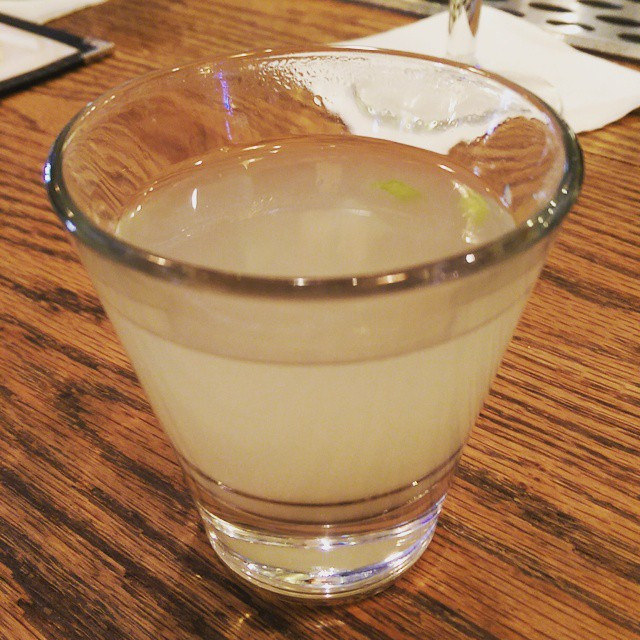

Clam juice
View on Wikipedia
Clam juice is a broth derived from steamed clams,[1] which can be consumed on its own or used as an ingredient in various dishes and beverages.
Preparation
[edit]Clam juice is typically prepared from the liquid obtained from steamed clams.[1] Clam juice may be prepared fresh for consumption,[2] or purchased in prepared bottled form.[1][3] Some companies mass-produce prepared clam juice, which is made by steaming fresh clams in water with salt, collecting the extracted liquid known as clam extract or clam liquor, and then filtering it.[1][4]
In 1937, William G. Frazier invented a clam opener devised to easily open clams and retain all of the clam juice, which was collected in a bowl.[5] A patent for the clam opener was issued by the United States Patent and Trademark Office on November 15, 1938.[5]
Use in dishes
[edit]
Clam juice is sometimes used in the preparation of clam chowder and other chowders.[3] It may be used as an ingredient in various sauces and meat sauces, seafood dishes, in soup bases, and as a condiment to top foods, similar to the manner that fish sauce may be used.[1][6][7]
Italian chefs sometimes use clam juice as an ingredient in seafood dishes and pasta sauces.[1] It is sometimes used during the deglazing process in cooking.[1] It may provide a mineral-like flavor to dishes, and serve as a substrate to assist in combining flavors present in a dish.[1]
As a beverage
[edit]Some restaurants and bars in the US serve shots of pure clam juice.[8] For example, the Old Clam House in San Francisco, California serves a shot glass of hot clam juice at the beginning of each meal.[8] In the early 1900s in the United States, clam juice was purported to be a hangover remedy.[1]

The Everleigh Club, a former brothel in Chicago, Illinois, that was in operation from 1900 to October 1911, would serve iced clam juice and a tablet of aspirin as a starter for breakfast, which began at 2:00 in the afternoon.[9][10]
Beverages with clam juice
[edit]Soda fountains
[edit]In the United States in the early 1900s, clam juice was used as an ingredient for various beverages at soda fountains.[11] Beverages prepared with clam juice included hot clam juice, hot clam soda, hot ginger clam broth, hot celery punch, hot clam cream, clam night cap, tomato clam broth and others.[11][12][13][14]
During this time, a recipe for hot clam juice used one-half to one-ounce of clam juice in an eight-ounce glass, the remainder of which was filled with hot water.[11] Accompaniments included soda crackers, celery salt, salt and pepper.[11] The beverage was sometimes prepared with the addition of milk or hot milk.[11] The addition of a small portion of butter would enhance the flavor of hot clam juice.[11]
Cocktails
[edit]In contemporary times, clam juice is sometimes used as an ingredient or drink mixer in cocktails, such as the Caesar,[2][15][16] also known as a Bloody Caesar.[17]
Clamato
[edit]
Clamato is a mass-produced beverage prepared with tomato juice concentrate, clam juice and spices.[18][19] It also contains high-fructose corn syrup, monosodium glutamate, salt and ascorbic acid.[19] Clamato is used as an ingredient in the Caesar cocktail.[20] The michelada, a beer cocktail, is sometimes prepared using Clamato as an ingredient.[21]
See also
[edit]- Clam sauce
- Fred Fear & Company – a former U.S. purveyor of clam juice
- List of juices
- Oyster sauce
 Drink portal

References
[edit]- ^ a b c d e f g h i Werner, Tommy (March 20, 2015). "What's your pantry (and cocktail) missing? Clam Juice". Epicurious. Retrieved January 19, 2016.
- ^ a b O'Hara, C.B.; Nash, W.A. (1999). The Bloody Mary: A Connoisseur's Guide to the World's Most Complex Cocktail. Lyons Press Series. Lyons Press. p. 77. ISBN 978-1-55821-786-7. Retrieved January 19, 2016.[permanent dead link]
- ^ a b Broyles, Addie (December 28, 2015). "Ring in New Year with fresh chowder". The Seattle Times. Retrieved January 19, 2016.
- ^ "Clam Juice". Cook's Illustrated. November 2008. Retrieved January 19, 2016.
- ^ a b "Patent US 2136816 A". United States Patent and Trademark Office. November 15, 1938. Retrieved 19 January 2016.
- ^ Chiarella, Tom (March 2, 2013). "The Endorsement: Clam Juice". Esquire. Retrieved January 19, 2016.
- ^ Burros, Marian (March 20, 1996). "Seafood, Pasta And Spice". Chicago Tribune. Retrieved January 19, 2016.
- ^ a b Lybarger, Jeremy (December 17, 2015). "The Old Clam House: Time-Worn Gem Turned Into Just Another Tourist Trap". SF Weekly. Archived from the original on January 26, 2016. Retrieved January 19, 2016.
- ^ Tait, Elaine (February 16, 1997). "Bordello Cooking: Mmm, Mmm Good!". The Philadelphia Inquirer. Archived from the original on January 26, 2016. Retrieved January 19, 2016.
- ^ Washburn, Charles (1934). "Come Into My Parlor" (PDF). National Library Press. p. 156. Retrieved 19 January 2016.
- ^ a b c d e f The Dispenser Soda Water Guide. D.O. Haynes & Company. 1909. p. 122.
- ^ Fountain, Soda (1915). The Dispenser's Formulary, Or, Soda Water Guide. D.O. Haynes. p. 92.
- ^ Fox, Irving P. (1911). "The Spatula". Volume 18. Spatula Publishing Company. p. 157. Retrieved 19 January 2016.
- ^ Practical Druggist and Pharmaceutical Review of Reviews. Lillard & Company. 1920. p. 60.
- ^ McCart, Melissa (December 31, 2015). "On the Table: Kick off the year with a bloody mary". Pittsburgh Post-Gazette. Retrieved January 19, 2016.
- ^ "Best Caesar". Canadian Broadcasting Corporation. April 10, 2013. Retrieved January 19, 2016.
- ^ "Calgary's Bloody Caesar hailed as nation's favourite cocktail". Canadian Broadcasting Corporation. May 13, 2009. Retrieved January 19, 2016.
- ^ Drane, Amanda (January 8, 2016). "Madame Barfly: The Library in Easthampton is about the booze, not the books". Daily Hampshire Gazette. Retrieved January 19, 2016.
- ^ a b O'Brien, Erin (February 20, 2008). "Drinking Responsibly". Cleveland Free Times. Archived from the original on May 17, 2008. Retrieved January 19, 2016.
- ^ Paul Harrington & Laura Moorhead (1998). Cocktail: the drinks bible for the 21st century. Designed and illustrated by Douglas Bowman. New York: Viking. pp. 68–69. ISBN 978-0-670-88022-5.
- ^ Gold, Jonathan (October 31, 2015). "At Colonia Publica, come home to a warm bowl of fideo". Los Angeles Times. Retrieved January 19, 2016.
Further reading
[edit]- Burnette, J.A.; Flick, G.J.; Miles, J.R.; Ory, R.L.; St. Angelo, A.J.; Dupuy, H.P. (March 1983). "Characterization and Utilization of Ocean Quahog (Arctica islandica) Clam Juice as a Liquid and Dehydrated Flavoring Agent". Journal of Food Science. 48 (2): 353–359. doi:10.1111/j.1365-2621.1983.tb10742.x. (subscription required)
- Burnette, J.A. (1979). Effect of Processing on Flavor and Acceptability of Clam Juice Obtained from the Ocean Quahog, A̲r̲c̲t̲i̲c̲a̲ I̲s̲l̲a̲n̲d̲i̲c̲a̲. Virginia Polytechnic Institute and State University. Retrieved January 19, 2016. 172 pages.
- Hill, Edward C. (M.D.) (1905). "Rational Diet in Disease". Medical News. Henry C. Lea's Son & Company.
Clam juice may be tried in the vomiting of pregnancy (Thompson).
p. 586.
| Fruit juice |  | |
|---|---|---|
| Vegetable juice | ||
| Animal liquid | ||
| Related | ||

Clam juice
View on GrokipediaHistory and Origins
Etymology and Early References
The term "clam juice" combines two English words with distinct linguistic roots. "Clam" derives from Old English clamm, meaning "bond," "fetter," or "grip," which evolved in Middle English to describe the clamping action of a bivalve mollusk's shell, with the sense applied to the mollusk itself emerging around 1500 in Scottish usage.[7] "Juice" stems from Old French jus (13th century), borrowed from Latin ius, originally denoting "broth," "sauce," or "soup," and later extended to any extracted liquid from plants, fruits, or meats.[8] Thus, "clam juice" specifically denotes the briny liquid exuded by clams during cooking or steaming. Early references to clam broth as a sustenance liquid trace back to coastal Native American practices predating European colonization. Tribes such as the Wampanoag, Pequot, and Mohegan in the northeastern United States relied on clams as a dietary staple, harvesting them from intertidal zones and incorporating the resulting broth into stews and soups for nourishment during long journeys or harsh seasons.[9] The phrase "clam juice" first appears in print in 19th-century American cookbooks, reflecting its integration into colonial-derived cuisine. In Maria Parloa's New Cook Book (1880), the Philadelphia clam chowder recipe directs cooks to steam clams, strain them to remove the excess juice due to its potent flavor, and use a milder broth instead, highlighting awareness of the liquid's distinct taste and potential overuse.[10] Commercialization of clam juice began in the early 20th century amid growing interest in canned seafood and its byproducts, with companies like Doxsee beginning to bottle it as part of canned clam production.[11] A key milestone occurred in 1937, when William G. Frazier of Philadelphia patented a specialized clam opener (U.S. Patent No. 2,136,816) designed to efficiently shuck clams while channeling and collecting the juice into a bowl.[12]Cultural Significance
In coastal Indigenous communities of North America, particularly among Algonquian-speaking tribes such as the Mohegans, Pequots, Narragansetts, and Mashpee Wampanoag, clam juice derived from quahogs served as a vital nutritional component in traditional diets, often incorporated into soups and stews combined with corn and beans to provide sustenance during periods of scarcity like winter storage needs.[9] These preparations emphasized resource efficiency, with the juice and meat preserved to ensure hydration and caloric intake amid seasonal famines, reflecting adaptive strategies honed over millennia in shellfish-rich environments.[9] During the 19th and early 20th centuries in North America, clam juice and broth gained recognition as a restorative tonic, particularly for addressing digestive issues such as a weak stomach, offering a gentle, nutrient-dense option in pre-pharmaceutical eras when natural remedies were commonplace.[13] In early 20th-century North America, clam juice was valued as a restorative tonic for feeling depleted or sluggish, providing nutrients in a pre-pharmaceutical era.[14] In New England fishing communities, clam juice holds importance within the ritual of clambakes, where steamed clams release a natural broth that serves as a savory element in the meal.[15] This practice underscores the juice's role in coastal traditions.Production and Preparation
Homemade Methods
To prepare clam juice at home, begin by selecting fresh hard-shell clams such as littleneck or cherrystone varieties, which are suitable for steaming due to their tender meat and flavorful liquor. Scrub the clams under cold running water to remove any grit or sand from the shells. Place the cleaned clams in a large pot with a minimal amount of liquid—typically 1/2 to 1 cup of water per 2 pounds of clams—to generate steam without diluting the resulting juice. Cover the pot tightly and cook over high heat until the shells open, which usually takes 5 to 10 minutes; discard any clams that remain closed after cooking, as they may be unsafe.[16][17] Once the clams have opened, remove them from the pot using tongs to prevent overcooking, and strain the hot liquid through a fine-mesh sieve or cheesecloth-lined colander to capture the clear clam juice while removing shell fragments and sediment. The yield from this basic process is approximately 1 to 2 cups of juice from 2 pounds of clams, depending on the clam size and the initial water added, providing a concentrated seafood stock rich in natural glutamates. This method mirrors the foundational steaming technique used in professional kitchens but on a small scale.[18][17] For variations, enhance the juice by incorporating aromatics during steaming, such as sliced garlic, chopped onions, or fresh herbs like parsley or thyme, along with a splash of white wine instead of water for added acidity and depth; these elements infuse subtle flavors without overpowering the briny essence of the clams. Steep the aromatics briefly with the clams for 3 to 5 minutes before straining, ensuring the juice remains versatile for later use. Compared to commercial versions, homemade juice offers fresher taste but requires more hands-on effort.[18][16] After preparation, allow the strained juice to cool to room temperature, then refrigerate it in an airtight container for up to 3 days to maintain freshness and safety, as seafood broths can spoil quickly due to their protein content. For longer storage, portion the cooled juice into freezer-safe containers or ice cube trays, leaving headspace for expansion, and freeze for up to 3 months; thaw in the refrigerator before use to preserve quality. Always check for off odors before consuming, and avoid refreezing thawed juice.[19][17]Commercial Processes
Commercial production of clam juice primarily utilizes hard-shell clams such as Mercenaria mercenaria, as well as surf clams (Spisula solidissima) and ocean quahogs (Arctica islandica), sourced from Atlantic waters along the U.S. East Coast, where these species support major fisheries and aquaculture operations from Canada to Florida. Global production hubs extend to Canada for similar hard clams, though U.S. operations dominate for Mercenaria-based products.[20][21] Clam juice is extracted as a byproduct during the industrial shucking and steaming of clams intended for meat canning or freezing, where the natural liquor released from the shellfish is captured rather than discarded.[22] Clams are first harvested via dredging, then washed and steamed—typically at temperatures around 132°C for 1–2 minutes—to open the shells and facilitate shucking, yielding the juice alongside the meat.[23] This process aligns with mechanized operations that handle high volumes, such as 50–162 tons of clams per day in U.S. facilities.[23] Following extraction, the juice undergoes filtration to remove solids, often using fine screens like 20-mesh Tyler sieves that recover up to 90% of suspended particles while reclaiming a portion of the product volume.[23] Additional separation may involve screening or settling to clarify the liquid before pasteurization, which ensures microbial safety in sterile bottling.[22] For concentrated variants, evaporation standardizes the juice to levels like 40° Brix, enhancing shelf stability without artificial additives in some formulations.[24] These processes adhere to FDA regulations under the Seafood Hazard Analysis and Critical Control Points (HACCP) program (21 CFR Part 123), which mandates controls for hazards like pathogens, chemical contaminants, and physical inclusions (e.g., glass fragments >7 mm) during receiving, steaming, filtration, and packaging of shellfish products.[25][26] Overall effluent limitations, set by the EPA under the Clean Water Act and codified in 40 CFR Part 408, further regulate wastewater from steaming and evaporation to limit biochemical oxygen demand (BOD5) and total suspended solids (TSS) in processing discharges.[23][27]Culinary Uses
In Soups and Stews
Clam juice serves as a foundational broth in Manhattan clam chowder, where it combines with tomatoes, vegetables like onions, celery, and carrots, and seasonings to create a tomato-based seafood stew that highlights the briny essence of clams without cream.[28] In contrast, New England clam chowder employs clam juice to intensify the natural clam flavor within a creamy base of milk or cream, potatoes, and onions, resulting in a richer, more velvety texture that emphasizes the seafood's subtle sweetness.[29][30] To integrate clam juice effectively, cooks typically simmer it with diced potatoes, bacon or salt pork for added smokiness, and fresh or canned clams over medium heat for 20 to 30 minutes, allowing the flavors to meld while the potatoes soften without becoming mushy.[31] A common guideline is to use about 2 cups of clam juice for 4 servings, adjusting based on desired broth intensity and incorporating reserved juices from canned clams to amplify authenticity.[32][33] Beyond American classics, clam juice adds depth to regional variations such as Portuguese clam and kale soup, a twist on caldo verde that incorporates linguica sausage, potatoes, and kale simmered in the juice for a hearty, green-hued stew reflective of coastal Portuguese traditions.[34] Similarly, in Italian zuppa di vongole, clam juice forms the broth base alongside garlic, tomatoes, parsley, and fresh clams, simmering briefly to preserve the shellfish's tenderness while infusing the soup with oceanic richness.[35]As a Flavor Enhancer and Stock
Clam juice serves as an effective substitute for fish stock or fumet in various recipes, typically at a 1:1 ratio, providing a briny depth and umami from its natural glutamates without introducing a pronounced fishy aftertaste.[3] This makes it particularly suitable for seafood-forward dishes such as risottos, paellas, and bouillabaisse, where it establishes a marine baseline that enhances the overall flavor profile.[3][1] Beyond full stock applications, clam juice functions as a versatile umami enhancer when added in smaller quantities, such as a quarter cup, to impart subtle seafood notes to pasta sauces, rice dishes, or vegetable stir-fries.[36][3] It can be incorporated into cooking liquids for polenta or used to deglaze pans, amplifying savoriness in a manner similar to a milder fish sauce.[1][37] To concentrate its flavor, clam juice can be reduced by simmering, creating a potent base for stews, braises, or sauces that requires adjustment for added salinity.[3] Its versatility extends to non-seafood contexts, where small additions enhance mushroom gravies or tomato-based sauces with subtle salinity and depth, avoiding any overt fishiness.[3][36][37]Beverage Applications
Non-Alcoholic Beverages
In the early 20th century, American soda fountains featured clam juice in innovative non-alcoholic hot beverages to sustain business during colder months, especially amid Prohibition's emphasis on alcohol-free options. A notable example was the "Reeking Smatch," documented in a circa 1909 soda water guide, which blended 1 ounce of clam juice with cream, butter, Jamaica ginger extract, hot water, and celery salt for a savory, invigorating drink.[38] By the mid-20th century, chilled combinations of clam juice and tomato juice gained popularity as refreshing, savory alternatives to sweeter sodas. A 1938 recipe in House & Garden magazine outlined a "Tomato-Clam Juice Cocktail" using equal parts tomato juice and clam broth, seasoned with salt and celery salt, then chilled and served for a tangy, umami-rich refresher.[39] Contemporary non-alcoholic applications often center on Clamato, a commercial product launched in 1969 that mixes clam juice with tomato juice and spices, providing a convenient base for drinks like the virgin Caesar. This mocktail typically involves combining 6 ounces of Clamato with dashes of Worcestershire sauce, hot sauce, and fresh lime juice, poured over ice and garnished with a lime wedge for a zesty, chilled beverage.[40][41] Pure clam juice contains natural electrolytes such as sodium and potassium, which support hydration and fluid balance.[42]Alcoholic Cocktails
Clam juice contributes a briny, umami depth to alcoholic cocktails, particularly those with savory profiles that balance spirits with seafood-inspired notes.[43] This ingredient is most prominently featured in variations of tomato-based highballs, where it enhances the cocktail's complexity without overpowering other flavors. The Bloody Caesar, a Canadian staple, exemplifies clam juice's role in mixology. Invented in 1969 by bartender Walter Chell at the Calgary Inn in Alberta, Canada, the drink was created to satisfy a guest's request for a complex Bloody Mary alternative.[44] Chell combined vodka with a proprietary "clam nectar" he prepared by mashing clams, which was later commercialized as Clamato—a blend of tomato juice and clam broth.[44] The standard recipe calls for 6 ounces of Clamato, 1 to 1.5 ounces of vodka, 2 dashes of hot sauce, 4 dashes of Worcestershire sauce, celery salt for rimming the glass, freshly ground pepper, and a lime wedge garnish, served over ice with a celery stalk.[43] This preparation technique emphasizes a high juice-to-spirit ratio to highlight the savory elements, making it a popular brunch or post-dinner beverage in North America.[45] Beyond the Bloody Caesar, clam juice appears in Michelada variations, a Mexican beer cocktail adapted with seafood notes. In these recipes, 4 ounces of Clamato or pure clam juice is mixed with 12 ounces of light beer, lime juice, Worcestershire sauce, and hot sauce, often rimmed with chili salt for added spice.[46] This version amplifies the drink's refreshing, effervescent quality while introducing a subtle oceanic tang, common in coastal regions of Mexico and the southwestern United States.[47] Martini twists incorporating clam juice offer a drier, spirit-forward option. The Low Tide Martini, for instance, blends 3 ounces of vodka, 0.5 ounces of dry vermouth, and 1 teaspoon of clam juice, shaken with ice and strained into a chilled glass.[48] This rinse-like addition provides a faint briny undertone reminiscent of a dirty martini, appealing to those seeking experimental savory profiles.[49] These cocktails enjoy widespread popularity in North America, particularly Canada and Mexico, where Clamato consumption accounts for a significant portion of regional beverage mixes.[50] Adaptations in Europe remain niche, often limited to expatriate communities or specialty bars recreating North American recipes.[51]Nutrition and Health
Nutritional Composition
Clam juice serves as a nutrient-dense liquid extracted from clams, offering a profile dominated by water with dissolved proteins and minerals. Per 100 g serving of canned clam liquid, it provides approximately 2 calories, 0.35 g of protein, negligible fat at 0.02 g, and carbohydrates at 0.12 g, making it a low-energy option suitable for flavor enhancement without significant caloric contribution.[52] Key micronutrients include sodium at 215 mg, potassium at 23 mg, vitamin B12 at 5 µg (208% of the daily value), supporting red blood cell formation and neurological health. Trace elements such as iron (0.2 mg) and zinc (0.18 mg) are present, alongside small amounts of polyunsaturated fatty acids derived from the clam's lipid content. The characteristic umami taste stems from free amino acids like glutamic acid extracted into the juice during processing.[52][53][54] Nutritional variations occur between commercial and homemade preparations. Bottled commercial clam juice often includes added salt, resulting in sodium levels from 200 mg to over 600 mg per 100 g; for instance, Crown Prince Natural Clam Juice contains about 667 mg sodium, 33 calories, and 6.7 g protein per 100 g, reflecting a more concentrated form. Low-sodium brands like Snow's or Bar Harbor offer around 40–60 mg sodium per 15 g serving with near-zero calories and protein. Homemade versions, typically made by steaming fresh clams and straining the resulting broth, tend to have lower sodium (naturally around 200–300 mg per 100 g) and potentially higher retained protein and minerals depending on straining thoroughness, though exact values depend on clam species and cooking duration; USDA data represents a baseline for such liquids without additives.[52][55]| Nutrient (per 100 g, canned liquid, USDA baseline) | Amount | % Daily Value* |
|---|---|---|
| Calories | 2 | - |
| Protein | 0.35 g | 1% |
| Total Fat | 0.02 g | 0% |
| Carbohydrates | 0.12 g | 0% |
| Sodium | 215 mg | 9% |
| Potassium | 23 mg | 0% |
| Vitamin B12 | 5 µg | 208% |
| Iron | 0.2 mg | 1% |
| Zinc | 0.18 mg | 2% |