


Community hub
Recent from talks
Contribute something
Nothing was collected or created yet.
Clausen function
View on Wikipedia
In mathematics, the Clausen function, introduced by Thomas Clausen (1832), is a transcendental, special function of a single variable. It can be expressed in the form of a definite integral, a trigonometric series, and various other forms. It is intimately connected with the polylogarithm, inverse tangent integral, polygamma function, Riemann zeta function, Dirichlet eta function, and Dirichlet beta function.
The Clausen function of order 2 – often referred to as the Clausen function, despite being but one of a class of many – is given by the integral:

In the range the sine function inside the absolute value sign remains strictly positive, so the absolute value signs may be omitted. The Clausen function also has the Fourier series representation:


The Clausen functions, as a class of functions, feature extensively in many areas of modern mathematical research, particularly in relation to the evaluation of many classes of logarithmic and polylogarithmic integrals, both definite and indefinite. They also have numerous applications with regard to the summation of hypergeometric series, summations involving the inverse of the central binomial coefficient, sums of the polygamma function, and Dirichlet L-series.
Basic properties
[edit]The Clausen function (of order 2) has simple zeros at all (integer) multiples of since if is an integer, then



It has maxima at
![{\displaystyle \theta ={\frac {\pi }{3}}+2m\pi \quad [m\in \mathbb {Z} ]}](https://wikimedia.org/api/rest_v1/media/math/render/svg/301caa56535304b0db827b753a2cd412f5665c12)

and minima at
![{\displaystyle \theta =-{\frac {\pi }{3}}+2m\pi \quad [m\in \mathbb {Z} ]}](https://wikimedia.org/api/rest_v1/media/math/render/svg/2fae98e863733e316c672bdd9098be49e228b375)

The following properties are immediate consequences of the series definition:


See Lu & Perez (1992).
General definition
[edit]

More generally, one defines the two generalized Clausen functions:
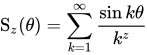
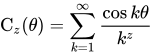
which are valid for complex z with Re z >1. The definition may be extended to all of the complex plane through analytic continuation.
When z is replaced with a non-negative integer, the standard Clausen functions are defined by the following Fourier series:
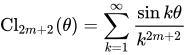
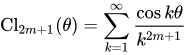
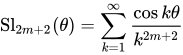
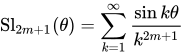
N.B. The SL-type Clausen functions have the alternative notation and are sometimes referred to as the Glaisher–Clausen functions (after James Whitbread Lee Glaisher, hence the GL-notation).

Relation to the Bernoulli polynomials
[edit]The SL-type Clausen function are polynomials in , and are closely related to the Bernoulli polynomials. This connection is apparent from the Fourier series representations of the Bernoulli polynomials:



Setting in the above, and then rearranging the terms gives the following closed form (polynomial) expressions:



where the Bernoulli polynomials are defined in terms of the Bernoulli numbers by the relation:

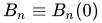
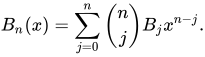
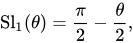
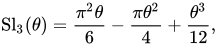
Explicit evaluations derived from the above include:


Duplication formula
[edit]For , the duplication formula can be proven directly from the integral definition (see also Lu & Perez (1992) for the result – although no proof is given):


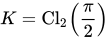
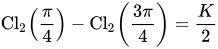
Denoting Catalan's constant by , immediate consequences of the duplication formula include the relations:
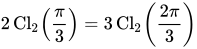
For higher order Clausen functions, duplication formulae can be obtained from the one given above; simply replace with the dummy variable , and integrate over the interval Applying the same process repeatedly yields:

![{\displaystyle \,[0,\theta ].\,}](https://wikimedia.org/api/rest_v1/media/math/render/svg/0c44a38c13c401abf6dbb2f057fd64ed963a251d)




And more generally, upon induction on

![{\displaystyle \operatorname {Cl} _{m+1}(2\theta )=2^{m}\left[\operatorname {Cl} _{m+1}(\theta )+(-1)^{m}\operatorname {Cl} _{m+1}(\pi -\theta )\right]}](https://wikimedia.org/api/rest_v1/media/math/render/svg/2441146c5765f07b3d22ff7d8ff9d94aa675b079)
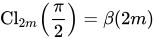
Use of the generalized duplication formula allows for an extension of the result for the Clausen function of order 2, involving Catalan's constant. For

![{\displaystyle \operatorname {Cl} _{2m}\left({\frac {\pi }{2}}\right)=2^{2m-1}\left[\operatorname {Cl} _{2m}\left({\frac {\pi }{4}}\right)-\operatorname {Cl} _{2m}\left({\frac {3\pi }{4}}\right)\right]=\beta (2m)}](https://wikimedia.org/api/rest_v1/media/math/render/svg/9ddd71810db9ae56ce6285cb7936562583ce2fba)
Where is the Dirichlet beta function.

Proof of the duplication formula
[edit]From the integral definition,
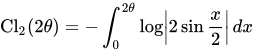
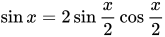
Apply the duplication formula for the sine function, to obtain
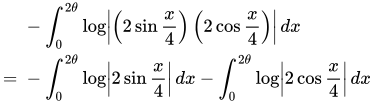
Apply the substitution on both integrals:

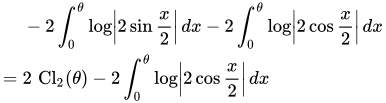
On that last integral, set , and use the trigonometric identity to show that:


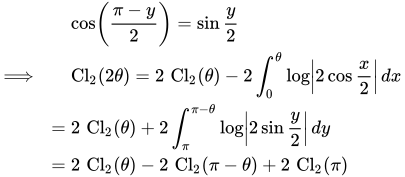

Therefore,

Derivatives of general-order Clausen functions
[edit]Direct differentiation of the Fourier series expansions for the Clausen functions give:




By appealing to the First Fundamental Theorem Of Calculus, we also have:
![{\displaystyle {\frac {d}{d\theta }}\operatorname {Cl} _{2}(\theta )={\frac {d}{d\theta }}\left[-\int _{0}^{\theta }\log \left|2\sin {\frac {x}{2}}\right|\,dx\,\right]=-\log \left|2\sin {\frac {\theta }{2}}\right|=\operatorname {Cl} _{1}(\theta )}](https://wikimedia.org/api/rest_v1/media/math/render/svg/4d9fa3c1d1d4975c26733d0592edcd47e0804bf8)
Relation to the inverse tangent integral
[edit]The inverse tangent integral is defined on the interval by


It has the following closed form in terms of the Clausen function:

Proof of the inverse tangent integral relation
[edit]From the integral definition of the inverse tangent integral, we have

Performing an integration by parts

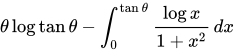
Apply the substitution to obtain

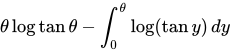
For that last integral, apply the transform : to get

![{\displaystyle {\begin{aligned}&\theta \log \tan \theta -{\frac {1}{2}}\int _{0}^{2\theta }\log \left(\tan {\frac {x}{2}}\right)\,dx\\[6pt]={}&\theta \log \tan \theta -{\frac {1}{2}}\int _{0}^{2\theta }\log \left({\frac {\sin(x/2)}{\cos(x/2)}}\right)\,dx\\[6pt]={}&\theta \log \tan \theta -{\frac {1}{2}}\int _{0}^{2\theta }\log \left({\frac {2\sin(x/2)}{2\cos(x/2)}}\right)\,dx\\[6pt]={}&\theta \log \tan \theta -{\frac {1}{2}}\int _{0}^{2\theta }\log \left(2\sin {\frac {x}{2}}\right)\,dx+{\frac {1}{2}}\int _{0}^{2\theta }\log \left(2\cos {\frac {x}{2}}\right)\,dx\\[6pt]={}&\theta \log \tan \theta +{\frac {1}{2}}\operatorname {Cl} _{2}(2\theta )+{\frac {1}{2}}\int _{0}^{2\theta }\log \left(2\cos {\frac {x}{2}}\right)\,dx.\end{aligned}}}](https://wikimedia.org/api/rest_v1/media/math/render/svg/ac1e40c055b307b1f1196786837809a1285052fb)
Finally, as with the proof of the Duplication formula, the substitution reduces that last integral to


Thus

Relation to the Barnes' G-function
[edit]For real , the Clausen function of second order can be expressed in terms of the Barnes G-function and (Euler) Gamma function:

Or equivalently

See Adamchik (2003).
Relation to the polylogarithm
[edit]The Clausen functions represent the real and imaginary parts of the polylogarithm, on the unit circle:


This is easily seen by appealing to the series definition of the polylogarithm.

By Euler's theorem,

and by de Moivre's Theorem (De Moivre's formula)

Hence


Relation to the polygamma function
[edit]The Clausen functions are intimately connected to the polygamma function. Indeed, it is possible to express Clausen functions as linear combinations of sine functions and polygamma functions. One such relation is shown here, and proven below:
![{\displaystyle \operatorname {Cl} _{2m}\left({\frac {q\pi }{p}}\right)={\frac {1}{(2p)^{2m}(2m-1)!}}\,\sum _{j=1}^{p}\sin \left({\tfrac {qj\pi }{p}}\right)\,\left[\psi _{2m-1}\left({\tfrac {j}{2p}}\right)+(-1)^{q}\psi _{2m-1}\left({\tfrac {j+p}{2p}}\right)\right].}](https://wikimedia.org/api/rest_v1/media/math/render/svg/d0df3f90937e191358fb288f9f467cc4ac557350)
An immediate corollary is this equivalent formula in terms of the Hurwitz zeta function:
![{\displaystyle \operatorname {Cl} _{2m}\left({\frac {q\pi }{p}}\right)={\frac {1}{(2p)^{2m}}}\,\sum _{j=1}^{p}\sin \left({\tfrac {qj\pi }{p}}\right)\,\left[\zeta \left(2m,{\tfrac {j}{2p}}\right)+(-1)^{q}\zeta \left(2m,{\tfrac {j+p}{2p}}\right)\right].}](https://wikimedia.org/api/rest_v1/media/math/render/svg/60025ebbc6e7a7d1676a7fdf206d7a31a4348af4)
Proof of the formula
|
|---|
|
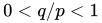
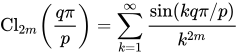
Let and be positive integers, such that is a rational number , then, by the series definition for the higher order Clausen function (of even index): We split this sum into exactly p-parts, so that the first series contains all, and only, those terms congruent to the second series contains all terms congruent to etc., up to the final p-th part, that contain all terms congruent to We can index these sums to form a double sum: Applying the addition formula for the sine function, the sine term in the numerator becomes: Consequently, To convert the inner sum in the double sum into a non-alternating sum, split in two in parts in exactly the same way as the earlier sum was split into p-parts: For , the polygamma function has the series representation So, in terms of the polygamma function, the previous inner sum becomes: Plugging this back into the double sum gives the desired result: |




![{\displaystyle {\begin{aligned}&\operatorname {Cl} _{2m}\left({\frac {q\pi }{p}}\right)\\={}&\sum _{k=0}^{\infty }{\frac {\sin \left[(kp+1){\frac {q\pi }{p}}\right]}{(kp+1)^{2m}}}+\sum _{k=0}^{\infty }{\frac {\sin \left[(kp+2){\frac {q\pi }{p}}\right]}{(kp+2)^{2m}}}+\sum _{k=0}^{\infty }{\frac {\sin \left[(kp+3){\frac {q\pi }{p}}\right]}{(kp+3)^{2m}}}+\cdots \\&\cdots +\sum _{k=0}^{\infty }{\frac {\sin \left[(kp+p-2){\frac {q\pi }{p}}\right]}{(kp+p-2)^{2m}}}+\sum _{k=0}^{\infty }{\frac {\sin \left[(kp+p-1){\frac {q\pi }{p}}\right]}{(kp+p-1)^{2m}}}+\sum _{k=0}^{\infty }{\frac {\sin \left[(kp+p){\frac {q\pi }{p}}\right]}{(kp+p)^{2m}}}\end{aligned}}}](https://wikimedia.org/api/rest_v1/media/math/render/svg/0abb29e3b9265e66eb7018f652f04098a17d91d4)
![{\displaystyle {\begin{aligned}&\operatorname {Cl} _{2m}\left({\frac {q\pi }{p}}\right)=\sum _{j=1}^{p}\left\{\sum _{k=0}^{\infty }{\frac {\sin \left[(kp+j){\frac {q\pi }{p}}\right]}{(kp+j)^{2m}}}\right\}\\={}&\sum _{j=1}^{p}{\frac {1}{p^{2m}}}\left\{\sum _{k=0}^{\infty }{\frac {\sin \left[(kp+j){\frac {q\pi }{p}}\right]}{(k+(j/p))^{2m}}}\right\}\end{aligned}}}](https://wikimedia.org/api/rest_v1/media/math/render/svg/93d3a4f119b0cbb92e6147b61bd28451604b8ee8)

![{\displaystyle \sin \left[(kp+j){\frac {q\pi }{p}}\right]=\sin \left(kq\pi +{\frac {qj\pi }{p}}\right)=\sin kq\pi \cos {\frac {qj\pi }{p}}+\cos kq\pi \sin {\frac {qj\pi }{p}}}](https://wikimedia.org/api/rest_v1/media/math/render/svg/d008f83fd90d3fdc35c7093aedbabe52cd9276a0)

![{\displaystyle \sin \left[(kp+j){\frac {q\pi }{p}}\right]=(-1)^{kq}\sin {\frac {qj\pi }{p}}}](https://wikimedia.org/api/rest_v1/media/math/render/svg/1506219055a797a00176b8c46dd48bfafd65ff31)

![{\displaystyle {\begin{aligned}&\sum _{k=0}^{\infty }{\frac {(-1)^{kq}}{(k+(j/p))^{2m}}}=\sum _{k=0}^{\infty }{\frac {(-1)^{(2k)q}}{((2k)+(j/p))^{2m}}}+\sum _{k=0}^{\infty }{\frac {(-1)^{(2k+1)q}}{((2k+1)+(j/p))^{2m}}}\\={}&\sum _{k=0}^{\infty }{\frac {1}{(2k+(j/p))^{2m}}}+(-1)^{q}\,\sum _{k=0}^{\infty }{\frac {1}{(2k+1+(j/p))^{2m}}}\\={}&{\frac {1}{2^{p}}}\left[\sum _{k=0}^{\infty }{\frac {1}{(k+(j/2p))^{2m}}}+(-1)^{q}\,\sum _{k=0}^{\infty }{\frac {1}{(k+\left({\frac {j+p}{2p}}\right))^{2m}}}\right]\end{aligned}}}](https://wikimedia.org/api/rest_v1/media/math/render/svg/01ce051d7cfe0c8342394d252d02154385293cda)

![{\displaystyle {\frac {1}{2^{2m}(2m-1)!}}\left[\psi _{2m-1}\left({\tfrac {j}{2p}}\right)+(-1)^{q}\psi _{2m-1}\left({\tfrac {j+p}{2p}}\right)\right]}](https://wikimedia.org/api/rest_v1/media/math/render/svg/26128b06fdb94c2a6db03c6dadef51a6ba4f2418)
![{\displaystyle \operatorname {Cl} _{2m}\left({\frac {q\pi }{p}}\right)={\frac {1}{(2p)^{2m}(2m-1)!}}\,\sum _{j=1}^{p}\sin \left({\tfrac {qj\pi }{p}}\right)\,\left[\psi _{2m-1}\left({\tfrac {j}{2p}}\right)+(-1)^{q}\psi _{2m-1}\left({\tfrac {j+p}{2p}}\right)\right]}](https://wikimedia.org/api/rest_v1/media/math/render/svg/db9811ae712344b8f051869b880fd4c33014a83d)
Relation to the generalized logsine integral
[edit]The generalized logsine integral is defined by:

In this generalized notation, the Clausen function can be expressed in the form:

Kummer's relation
[edit]

Relation to the Lobachevsky function
[edit]The Lobachevsky function Λ or Л is essentially the same function with a change of variable:

though the name "Lobachevsky function" is not quite historically accurate, as Lobachevsky's formulas for hyperbolic volume used the slightly different function

Relation to Dirichlet L-functions
[edit]For rational values of (that is, for for some integers p and q), the function can be understood to represent a periodic orbit of an element in the cyclic group, and thus can be expressed as a simple sum involving the Hurwitz zeta function.[citation needed] This allows relations between certain Dirichlet L-functions to be easily computed.


Series acceleration
[edit]A series acceleration for the Clausen function is given by

which holds for . Here, is the Riemann zeta function. A more rapidly convergent form is given by


![{\displaystyle {\frac {\operatorname {Cl} _{2}(\theta )}{\theta }}=3-\log \left[|\theta |\left(1-{\frac {\theta ^{2}}{4\pi ^{2}}}\right)\right]-{\frac {2\pi }{\theta }}\log \left({\frac {2\pi +\theta }{2\pi -\theta }}\right)+\sum _{n=1}^{\infty }{\frac {\zeta (2n)-1}{n(2n+1)}}\left({\frac {\theta }{2\pi }}\right)^{2n}.}](https://wikimedia.org/api/rest_v1/media/math/render/svg/3a1d4a1a5b2d04b3fd5d444f6f4ba039b7177983)
Convergence is aided by the fact that approaches zero rapidly for large values of n. Both forms are obtainable through the types of resummation techniques used to obtain rational zeta series (Borwein et al. 2000).

Special values
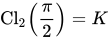
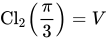
[edit]Recall the Barnes G-function, the Catalan's constant K and the Gieseking constant V. Some special values include






In general, from the Barnes G-function reflection formula,
Equivalently, using Euler's reflection formula for the gamma function, then,

Generalized special values
[edit]Some special values for higher order Clausen functions include




where is the Dirichlet beta function, is the Dirichlet eta function (also called the alternating zeta function), and is the Riemann zeta function.


Integrals of the direct function
[edit]The following integrals are easily proven from the series representations of the Clausen function:

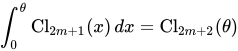
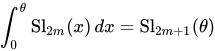

Fourier-analytic methods can be used to find the first moments of the square of the function on the interval :[1]

![{\displaystyle [0,\pi ]}](https://wikimedia.org/api/rest_v1/media/math/render/svg/3e2a912eda6ef1afe46a81b518fe9da64a832751)
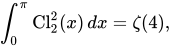

![{\displaystyle \int _{0}^{\pi }t^{2}\operatorname {Cl} _{2}^{2}(x)\,dx=-{\frac {2}{3}}\pi \left[12\zeta ({\overline {5}},1)+6\zeta ({\overline {4}},2)-{\frac {23}{10080}}\pi ^{6}\right].}](https://wikimedia.org/api/rest_v1/media/math/render/svg/d13a18ca3ea120e1cd61af71afab0eb1d9f6f29f)
Here denotes the multiple zeta function.

Integral evaluations involving the direct function
[edit]A large number of trigonometric and logarithmo-trigonometric integrals can be evaluated in terms of the Clausen function, and various common mathematical constants like (Catalan's constant), , and the special cases of the zeta function, and .


The examples listed below follow directly from the integral representation of the Clausen function, and the proofs require little more than basic trigonometry, integration by parts, and occasional term-by-term integration of the Fourier series definitions of the Clausen functions.







References
[edit]- ^ István, Mező (2020). "Log-sine integrals and alternating Euler sums". Acta Mathematica Hungarica (160): 45–57. doi:10.1007/s10474-019-00975-w.
- Abramowitz, Milton; Stegun, Irene Ann, eds. (1983) [June 1964]. "Chapter 27.8". Handbook of Mathematical Functions with Formulas, Graphs, and Mathematical Tables. Applied Mathematics Series. Vol. 55 (Ninth reprint with additional corrections of tenth original printing with corrections (December 1972); first ed.). Washington D.C.; New York: United States Department of Commerce, National Bureau of Standards; Dover Publications. p. 1005. ISBN 978-0-486-61272-0. LCCN 64-60036. MR 0167642. LCCN 65-12253.
- Clausen, Thomas (1832). "Über die Function sin φ + (1/22) sin 2φ + (1/32) sin 3φ + etc". Journal für die reine und angewandte Mathematik. 8: 298–300. ISSN 0075-4102.
- Wood, Van E. (1968). "Efficient calculation of Clausen's integral". Math. Comp. 22 (104): 883–884. doi:10.1090/S0025-5718-1968-0239733-9. MR 0239733.
- Leonard Lewin, (Ed.). Structural Properties of Polylogarithms (1991) American Mathematical Society, Providence, RI. ISBN 0-8218-4532-2
- Lu, Hung Jung; Perez, Christopher A. (1992). "Massless one-loop scalar three-point integral and associated Clausen, Glaisher, and L-functions" (PDF).
- Kölbig, Kurt Siegfried (1995). "Chebyshev coefficients for the Clausen function Cl2(x)". J. Comput. Appl. Math. 64 (3): 295–297. doi:10.1016/0377-0427(95)00150-6. MR 1365432.
- Borwein, Jonathan M.; Bradley, David M.; Crandall, Richard E. (2000). "Computational Strategies for the Riemann Zeta Function". J. Comput. Appl. Math. 121 (1–2): 247–296. Bibcode:2000JCoAM.121..247B. doi:10.1016/s0377-0427(00)00336-8. MR 1780051.
- Adamchik, Viktor. S. (2003). "Contributions to the Theory of the Barnes Function". arXiv:math/0308086v1.
- Kalmykov, Mikahil Yu.; Sheplyakov, A. (2005). "LSJK – a C++ library for arbitrary-precision numeric evaluation of the generalized log-sine integral". Comput. Phys. Commun. 172 (1): 45–59. arXiv:hep-ph/0411100. Bibcode:2005CoPhC.172...45K. doi:10.1016/j.cpc.2005.04.013.
- Borwein, Jonathan M.; Straub, Armin (2013). "Relations for Nielsen Polylogarithms". J. Approx. Theory. 193: 74–88. doi:10.1016/j.jat.2013.07.003.
- Mathar, R. J. (2013). "A C99 implementation of the Clausen sums". arXiv:1309.7504 [math.NA].
Clausen function
View on GrokipediaHistory and Definition
Historical background
The Clausen function was introduced by Danish mathematician and astronomer Thomas Clausen in 1832 as part of his investigations into series expansions related to trigonometric products. This work appeared in the Journal für die reine und angewandte Mathematik, marking the function's formal debut in mathematical literature.[6] Earlier, in the 1830s, Russian mathematician Nikolai Lobachevsky employed a closely related function in his foundational studies of hyperbolic geometry, particularly in deriving formulas for the volume of hyperbolic polyhedra, though without the explicit naming that Clausen later provided.[7] This predates Clausen's publication and highlights the function's nascent role in non-Euclidean geometry. Subsequent 19th-century advancements linked the Clausen function to polylogarithms through work on the zeta function and its extensions, establishing a deeper analytic framework. Ernst Kummer further expanded its theoretical scope with key relations and series developments during the mid-1800s, solidifying its place among transcendental functions.[8] In the 20th century, research accelerated with improved series representations, notably in a 1992 study by Hung Jung Lu and Christopher A. Pérez, who connected Clausen functions to Glaisher functions and one-loop integrals in quantum field theory contexts.[9] Victor Adamchik advanced symbolic computations and evaluations in 2003, integrating the function with multiple gamma functions for broader algorithmic applications.[10] Recent developments from 2023 onward have focused on explicit closed-form expressions using Hurwitz zeta functions.[8]General definition
The Clausen function, often denoted specifically as for the case of order 2, is defined by the integral representation where .[1] This form, known as the direct or principal Clausen function, arises in applications involving dilogarithms and trigonometric integrals. It is distinct from the generalized Clausen functions of arbitrary integer order , which extend the concept to higher powers in the denominator of the defining series. The generalized Clausen functions are defined piecewise based on the parity of : for even , is the sine-type function so ; for odd , it is the cosine-type function so .[1] These series converge for all real when . Equivalently, the functions admit representations in terms of the polylogarithm : where and denote the imaginary and real parts, respectively.[1] For general orders, an integral representation applicable beyond integer (with ) follows from the polylogarithm's contour integral form, yielding from which the real or imaginary part provides . This enables analytic continuation of the Clausen functions to complex orders via the meromorphic continuation of the polylogarithm in the order parameter.[2]Basic properties
The Clausen function of even order, defined as , is an odd function, satisfying .[11] Similarly, the Clausen function of odd order, , is even, with .[11] These symmetry properties follow directly from the Fourier series representations and the respective parity of the sine and cosine terms.[11] The Clausen function exhibits periodicity with period , such that for any integer order .[11] This arises from the periodic nature of the exponential or trigonometric arguments in its defining series expansion.[11] For even orders, for any integer , as each term .[11] This zero behavior at integer multiples of reflects the vanishing of the sine series under these arguments.[11] The second-order Clausen function attains its global maximum at (for integer ) with value , known as Gieseking's constant. By the odd symmetry, it reaches its global minimum at with value . In general, for , the Clausen function satisfies the bound , where is the Riemann zeta function, since or in the respective series.[1] This inequality holds uniformly over , with the right-hand side representing the supremum achieved only in the limiting case of aligned phases, which is not realized for finite .[1]Analytic Properties and Formulas
Relation to the Bernoulli polynomials
The Clausen function of even order, defined as , is connected to the Bernoulli polynomials through the Fourier series expansions of their periodic versions. The periodic Bernoulli polynomials , where denotes the fractional part of , admit the Fourier series representation for . This expansion links the polynomials to polylogarithmic sums, with the imaginary part yielding sine series that define the Clausen functions.[12] Historically, this connection has been utilized in the context of the Euler-Maclaurin summation formula, where Bernoulli polynomials approximate sums by integrals, and their Fourier representations involving Clausen functions provide insights into remainder terms and series acceleration for trigonometric sums. A sketch of the derivation begins with the generating function for the periodic case, obtained by Poisson summation or contour integration over the cotangent function, leading to the exponential sum; taking the imaginary part for even powers then aligns with the Clausen definition after rescaling the argument .[12]Duplication formula
The duplication formula for the Clausen function relates the value at twice the argument to values at the argument and its complement to π, facilitating analytical and numerical evaluations. This identity exists in distinct forms depending on whether the order is odd or even, reflecting the underlying sine or cosine series definitions of the function. For odd orders , where the Clausen function is defined via the cosine series , the formula is [13] For even orders , where , the analogous relation involves a difference: A specific instance for is .[14][15] These formulas can be proved using the series expansions of the Clausen functions combined with trigonometric double-angle identities. For the even case, start with the sine series and apply , which leads to a binomial expansion relating to sums involving powers of ; symmetry properties then yield the difference form. For the odd case, a similar approach uses , integrating or differentiating the even-order result to obtain the sum form after accounting for the odd parity and basic properties like adjusted for the series.[15] In computations, these identities are applied to reduce the argument of the Clausen function, particularly when combined with its periodicity and oddness , allowing efficient evaluation for large or arbitrary by halving angles iteratively until within the principal range .[15]Derivatives of general-order Clausen functions
The derivatives of the general-order Clausen functions are governed by simple relations derived from their defining Fourier series representations. For integer , the Clausen function is defined as when is even and when is odd.[1] Term-by-term differentiation of these uniformly convergent series on compact subintervals of yields for even and for odd .[1] These rules provide a recurrence mechanism to reduce the order of the function through differentiation, facilitating both analytical manipulations and numerical evaluations. For the boundary case , the odd-order Clausen function is the elementary expression with derivative This aligns with the general pattern upon approaching the first order, where further differentiation leads to elementary trigonometric functions rather than another Clausen function.[1] The inverse relations, obtained by integration, connect higher-order Clausen functions to integrals of lower-order ones, with appropriate signs: for even , and for odd , assuming the normalization for . Integration by parts applied to expressions involving products of and or similar forms thus reduces to lower-order Clausen functions, aiding in the derivation of functional equations and series accelerations. As representative examples, consider (odd): the relation gives , reducing the third-order cosine series directly to the well-known second-order sine Clausen function , which admits the integral representation . For (even), , linking the fourth-order sine series to the third-order cosine series; in the interval , explicit polynomial forms confirm this, as differentiation of the known expansion for the related sum yields the series for .[1] These reductions highlight the hierarchical structure of the Clausen functions under differentiation.Kummer's relation
Kummer's relations consist of functional equations for the polylogarithm function , discovered by Ernst Kummer in 1840, which connect values of at transformed arguments to lower-order polylogarithms and logarithmic terms. These equations hold for orders , with the case (dilogarithm) having a simpler five-term relation, and they extend to higher orders through generalizations. When specialized to arguments on the unit circle , the real and imaginary parts yield relations among Clausen functions of order and lower orders, distinguishing even and odd cases due to the alternating sine and cosine series definitions: for even orders and for odd orders.[16][17] For the even order case, such as , Kummer's equation expresses at multiple arguments in terms of lower-weight terms like , , , and . Specializing to the unit circle, this links to sums involving for integer multiples , with coefficients arising from binomial expansions in the argument transformations. For odd orders like , the trilogarithm equation is a nine-term identity relating at various arguments to logarithmic and zeta terms. These mix even and odd Clausen functions through the real/imaginary decomposition.[17] The proofs rely on multiple-angle formulas for and polylogarithm series manipulations, often using the integral representation for , combined with substitution and integration by parts to derive the argument transformations. For instance, the binomial theorem expands powers in the denominator, leading to sums over lower powers that correspond to lower-order polylogs. This approach briefly references the duplication formula for initial reductions but focuses on the full transformation.[16] These relations are instrumental in computing higher-order Clausen values from lower ones, reducing computational complexity in series evaluations or integral representations, particularly for even orders where can be expressed as linear combinations of for and suitable , with coefficients derived from the functional equation's structure. For (order 4), a derived form is , though exact multiples vary by the chosen transformation; numerical verification confirms consistency for , where . Such reductions are essential for applications in scattering amplitudes and number theory, enabling efficient evaluation without direct summation of the defining series.[18]Series acceleration
The defining series for the Clausen function of even order converges slowly for small and moderate , often requiring a large number of terms for high precision.[19] A classical acceleration method for the order-2 case employs a transformation involving Riemann zeta values, yielding the rapidly convergent series This formula derives from the Fourier series representation and properties of the polylogarithm, providing exponential convergence in powers of , in contrast to the algebraic rate of the direct partial sum up to terms.00336-8) The zeta values can be expressed using Bernoulli numbers via , linking the acceleration implicitly to these numbers for explicit computation. For higher even orders , endpoint subtraction techniques, inspired by Lanczos and Krylov, accelerate the Fourier series by approximating the tail after a finite sum. The method subtracts asymptotic contributions near the endpoints of the integration domain, transforming the slowly converging sum into a series of Lanczos-Krylov functions, which are themselves Clausen functions of lower order. For instance, the tail integral is expanded as with coefficients determined analytically, enabling computation to machine precision with fewer than 100 terms even for , compared to millions required by direct summation.[19] General sequence transformations like the Levin -transformation can further accelerate partial sums of the defining series for arbitrary , by fitting a polynomial model to the remainders and extrapolating to the limit. The transformation generates approximants , where solve a system for smooth decay, achieving superlinear convergence for oscillatory terms like . This is particularly effective for logarithmic convergence rates in low-order Clausen functions.[20] Asymptotic expansions aid acceleration for extreme parameters. For small , the zeta-based series above provides the leading behavior , with higher terms establishing the scale. For large order and fixed , the series is dominated by the first term, yielding , allowing truncation after few terms with negligible error. Direct series evaluation scales as per term, while accelerated methods reduce effective terms by orders of magnitude, e.g., from to for 10-digit accuracy in .[19]Relations to Logarithmic and Integral Functions
Relation to the polylogarithm
The polylogarithm function is defined for complex with by the power series and extended by analytic continuation to other regions of the complex plane, excluding a branch cut along the ray .[21] Substituting into this series gives where the real part is and the imaginary part is . This direct substitution derives the trigonometric series representations of the Clausen functions from the polylogarithm, separating the exponential terms via Euler's formula.[21] For integer orders , the Clausen function extracts the appropriate part: specifically, when is even and when is odd.[1] Thus, the even-order Clausen function is while the odd-order case is [1] The Clausen functions thereby arise as the restriction of the polylogarithm to the unit circle , with the real or imaginary part selected according to the parity of .[18] For , this places on the unit circle, which intersects the branch cut of only at the endpoints and (where ). The principal branch of the polylogarithm ensures the Clausen functions are well-defined and continuous on , with the values at the endpoints obtained as limits.[21]Relation to the inverse tangent integral
The order-2 Clausen function is related to the inverse tangent integral through their shared connection to the dilogarithm function and specific trigonometric substitutions. The inverse tangent integral is defined by the integral representation for real , or equivalently by its power series expansion This function also admits an expression in terms of the dilogarithm as , where denotes the imaginary part.[22] A direct relation between and arises via the substitution involving the tangent function. For , This identity allows the order-2 Clausen function to be expressed in terms of the inverse tangent integral as Rearranging similarly yields expressions for . These forms are valid within the principal range where the functions are real-valued and the logarithm is defined positively.[18] To derive the relation, one approach uses series comparison via the dilogarithm connection. The Clausen function is for . Substituting into the dilogarithm series and taking the imaginary part gives the sine series directly. For , substitute into its dilogarithm form , then expand using the identity , which relates to the argument on the unit circle after algebraic manipulation. The logarithmic term emerges from the branch structure of the dilogarithm, and the remaining terms match the Clausen contributions via Fourier series equivalence. Alternatively, integration by parts on the integral definition of yields since for . Further substitution and symmetry properties lead to the split into Clausen terms and the logarithmic factor.[22][18][21] For , the relation requires analytic continuation. The Clausen function satisfies and is odd, , allowing extension beyond by periodicity and reflection. The inverse tangent integral for uses the inversion formula for , combined with the series for , ensuring consistency with the continued Clausen values. Differences arise in the principal branch choices, particularly near points where diverges (e.g., ), requiring careful handling of the logarithm's branch.[22][21] Historically, the Clausen function was introduced by Thomas Clausen in 1832 through its series representation in the context of definite integrals, with the logarithmic sine integral form appearing soon after as a key representation tying it to trigonometric evaluations. The inverse tangent integral was systematized later by Leonard Lewin in his 1958 work on polylogarithms, where explicit links to Clausen functions were established for applications in physics and number theory.[21][18]Relation to the generalized logsine integral
The generalized log-sine integral of order is defined as This integral generalizes the basic log-sine integral and appears in evaluations of special values in number theory and analysis.[14] For , This equivalence highlights the integral representation of the order-2 Clausen function. For higher even orders , the generalized log-sine integrals relate to multiple Clausen functions. Using the Fourier series for , the power expands into multiple sums, which upon integration yield expressions involving the imaginary parts of multiple polylogarithms , corresponding to multiple Clausen functions.[23][24] These relations are useful for evaluating at special arguments via reductions to known values of multiple zeta functions and Clausen functions of lower orders.[23]Relation to the Lobachevsky function
The Lobachevsky function, denoted , is defined by the integral representation and coincides exactly with the order-2 Clausen function .[4] This equivalence stems from the standard integral form of , highlighting its role as a key special function in both transcendental analysis and geometry.[4] In hyperbolic geometry, the Lobachevsky function appears prominently in formulas for volumes and distances. Notably, the volume of an ideal tetrahedron in hyperbolic 3-space, with dihedral angles , , and satisfying , is given by .[25] Lobachevsky's formula also employs this function to compute hyperbolic distances, connecting angular measures to metric properties in non-Euclidean spaces. An important extension is the identity , where denotes Catalan's constant.[4] Geometrically, the function interprets the accumulation of hyperbolic volume through dihedral angles in ideal polyhedra, providing a direct link between trigonometric integrals and 3-dimensional hyperbolic structures without requiring explicit proofs of the volume formula. Lobachevsky introduced this function in his foundational 1829–1830 work on hyperbolic geometry.Relations to Gamma and G-Functions
Relation to the polygamma function
The Clausen functions and polygamma functions are linked through their shared connection to the Hurwitz zeta function and the functional equation that relates it to the polylogarithm, from which the Clausen function is derived as the appropriate real or imaginary part. The polygamma function of order m is defined as the (m+1)th derivative of the logarithm of the gamma function and satisfies where ζ(s, z) is the Hurwitz zeta function, for Re(z) > 0 and m = 1, 2, ….[26] This relation allows the polygamma to serve as a tool for evaluating the Hurwitz zeta at positive integer arguments. The Clausen function Cl_n(θ) is defined as the sum for even n and as the cosine sum for odd n, and it equals the imaginary part of the polylogarithm Li_n(e^{iθ}) (or real part for odd n, depending on convention). The polylogarithm on the unit circle is connected to the Hurwitz zeta via the functional equation valid for 0 < Re(s) < 1 and extended analytically. By setting a = θ/(2π), the argument aligns the exponential with e^{iθ}, and taking the appropriate real or imaginary part (depending on parity of n) yields the Clausen function as a linear combination of Hurwitz zeta values at the real arguments θ/(2π) and 1 - θ/(2π). For positive integer n, analytic continuation applies, and at negative integer arguments of zeta (1-n), it reduces to Bernoulli polynomials: ζ(1-n, a) = -B_n(a)/n. Substituting the polygamma expression for the Hurwitz zeta (via analytic continuation) provides indirect links, though explicit forms are parity-dependent.[21] The proof of this connection follows from the reflection formula for the Hurwitz zeta function, which originates from the integral representation involving the gamma function and contour integration around the poles of the cotangent, linking the values at s and 1-s. The phase and scaling arise from the exponential terms in the functional equation, and the imaginary part extracts the sine or cosine series corresponding to the Clausen definition. For integer n, analytic continuation ensures the relation holds.[21] For odd orders, the relations are particularly explicit using low-order polygamma functions like the digamma ψ(z) = ψ^{(0)}(z) and trigamma ψ'(z), with higher odd orders obtained by differentiation. The reflection formula for the digamma is which, upon integration, yields the order-1 Clausen function Cl_1(θ) = -ln|2 sin(θ/2)| as the integral of the cotangent term scaled appropriately. Differentiating gives the trigamma reflection linking to evaluations involving Cl_2 at multiples of θ via series expansion of the cosecant. For higher odd orders, such as Cl_3(θ) = ∑ cos(kθ)/k^3, successive differentiation of the general polygamma reflection produces terms whose Fourier series involve the odd-order Clausen functions. These reflections provide a direct path to compute Clausen values at rational multiples of π using polygamma at rational arguments, as in special cases like ψ'(1/4) involving Cl_2(π/2).[27] Bernoulli polynomials appear briefly in expansions underlying these relations, such as the finite-sum representation for even-order Clausen functions derived from Hurwitz zeta at negative integers, where ζ(-2n+1, a) = -B_{2n}(a)/(2n).Relation to the Barnes' G-function
The Barnes G-function , introduced by Ernest William Barnes as a multiple gamma function generalizing the Euler gamma function via the relation with , exhibits a fundamental connection to the Clausen function through reflection formulas derived from its functional properties.[10] For the second-order Clausen function, this link is expressed explicitly as valid for , where the contour of integration or analytic continuation ensures validity for complex avoiding poles.[10] This formula arises from the reflection principle for the double gamma function , providing a closed-form expression for in terms of and trigonometric terms, and it facilitates evaluation at rational arguments, such as , linking to polygamma values.[10] Generalizations to higher-order Clausen functions for even emerge in the context of multiple Barnes G-functions , where reflection formulas for triple and higher gamma functions incorporate higher Clausen terms in their logarithmic forms, extending the double case.[28] These relations stem from the integral representations of multiple gammas, such as the Binet-type contour integrals for , which parallel the Weierstrass products and enable analytic continuation across the complex plane.[29] In asymptotic expansions for large , the logarithm of the Barnes G-function includes terms involving Clausen functions through their appearance in the analytic continuation and zeta-regularized products. Specifically, the expansion of for in incorporates derivatives of the Hurwitz zeta function, with Clausen functions contributing to the constant and oscillatory components via special values like in the reflection-adjusted series.[10] For instance, where higher-order terms refine via Clausen-modulated zeta regularization to handle divergences in multiple gamma products.[10] Similar expansions for the triple gamma extend this, with Clausen terms aiding convergence in physical applications like string theory partition functions. These connections find applications in the theory of multiple gamma functions, where Clausen terms regularize infinite products in zeta function evaluations, such as in the Riemann hypothesis context through GUE random matrix correlations.[10] In zeta regularization, the Barnes G-function's asymptotic series, informed by Clausen contributions, provides finite values for otherwise divergent sums in quantum field theory determinants.[10] Victor Adamchik's 2003 work on symbolic and numeric computation further exploits these relations, deriving efficient algorithms for high-precision evaluation of using Clausen integrals and contour methods, enhancing computational tools in computer algebra systems like Mathematica.[10]Connections to L-Functions and Special Values
Relation to Dirichlet L-functions
The Clausen function of even positive integer order is connected to Dirichlet L-functions through its values at angles that are rational multiples of . These connections arise from the Fourier series representation of the Clausen function, which corresponds to the imaginary part of the polylogarithm evaluated at roots of unity. Specifically, for a primitive Dirichlet character modulo , the special value can be expressed as a linear combination involving sums of over , weighted by the character values. This relation stems from the decomposition of the polylogarithm over the cyclotomic field , where the Galois action induces the character sums.[30] A prominent example occurs at , where for all positive integers , with the non-principal Dirichlet character modulo 4 defined by if even, if odd. This equates the Clausen function to the Dirichlet beta function , a case of non-principal character values that do not reduce to the Riemann zeta function. For , this yields Catalan's constant . Such evaluations highlight the role of non-principal characters in capturing the oscillatory behavior encoded by the sine series in the Clausen definition.[4][31] More generally, linear combinations of Clausen functions at angles yield special values of L-functions for characters modulo . For instance, with the real primitive character modulo 7, the value . Similar formulas hold for higher even orders , extending the relation via the same Fourier analytic framework over cyclotomic extensions. These connections have been explored in the context of multiple L-values and their functional relations with multiple Clausen functions, providing tools for evaluating series in number theory and physics.[32][33]Special values
The Clausen function of even integer order evaluates to zero at multiples of π, since for all positive integers . Thus, for .[1] At , the second-order Clausen function equals Catalan's constant: .[4] More generally, for even orders, , where is the Dirichlet beta function , which coincides with the -function for the non-principal Dirichlet character modulo 4.[1][21] For , is known as Gieseking's constant and equals , or equivalently the generalized hypergeometric function . For odd integer orders at , , where is the Dirichlet eta function and is the Riemann zeta function.[1] The following table lists the first few special values with numerical approximations (to 6 decimal places):| Order | Argument | Closed form | Numerical value |
|---|---|---|---|
| 2 | 0.915966 | ||
| 2 | Gieseking's constant | 1.014942 | |
| 3 | -0.112737 | ||
| 4 | 0.988945 | ||
| 5 | -0.026822 |
Generalized special values
The Clausen function admits closed-form evaluations at certain non-standard arguments, such as rational multiples of π beyond simple fractions like π/2 or π/3, often expressible in terms of logarithms, algebraic numbers, and other special constants derived from polylogarithms at roots of unity.[34] For instance, values like Cl_2(2π/5) arise in the context of pentagonal symmetry and can be related to the dilogarithm at the fifth root of unity, yielding expressions involving square roots and logarithms of algebraic quantities tied to the golden ratio.[35] These generalized values extend the standard integer-order cases and are crucial for understanding reductions in multiple zeta values and modular forms.[36] For non-integer orders s, the Clausen function Cl_s(θ) is defined via analytic continuation of its Fourier series representation ∑_{k=1}^∞ sin(kθ)/k^s, initially convergent for Re(s) > 1, to the entire complex plane minus branch cuts along the real axis for θ in certain intervals.[37] This continuation allows evaluation at fractional s, such as s = 3/2, where integral representations facilitate connections to other special functions; for example, expressions involving the incomplete beta function emerge from Mellin-Barnes type integrals or hypergeometric transformations.[8] Such forms are particularly useful in extending properties like duplication formulas to non-integer parameters.[38]Integral Representations
Integrals of the direct function
The indefinite integral of the order-2 Clausen function can be expressed using integration by parts. Specifically, where for .[1] This form leads to integrals involving , which are connected to higher-order polylogarithms through series expansions or Fourier representations of the logarithm.[6] A notable definite integral is the Fourier cosine coefficient for , where is Apéry's constant; this follows from the Fourier series expansion of on .[39] More generally, the cosine-weighted integrals yield closed forms: for , the value above; for odd , ; and for even , , with the th harmonic number. These evaluate the symmetry properties of , which is odd overall () and satisfies .[39][39] Multiple integrals involving arise in contexts connecting to dilogarithm sums and geometric volumes. For instance, changing the order of integration in the double integral representation derived from the definition, links to evaluations of dilogarithm identities at roots of unity. Such forms appear in multiple zeta value theory, where iterated integrals of relate to sums like for complex . In hyperbolic geometry, double or triple integrals incorporating contribute to volumes of ideal polyhedra, as the dilogarithm (with imaginary part ) parametrizes these volumes via Lobachevsky's formula.[6][14] A representative weighted definite integral is where is the Catalan constant; this follows from series expansion and beta function evaluations tying to alternating zeta values.[40]Integral evaluations involving the direct function
The Clausen function provides closed-form evaluations for a variety of definite integrals that are not part of its standard definition, often appearing in Fourier analysis and related expansions where it serves as a building block for more complex expressions. In Fourier theory, the Clausen function Cl_2(θ) = \sum_{k=1}^\infty \frac{\sin(kθ)}{k^2} naturally arises as the sine series for periodic functions, enabling the evaluation of integrals representing Fourier coefficients. For instance, the cosine integrals \int_0^\pi \cos(kθ) \mathrm{Cl}_2(θ) , dθ for nonnegative integers k have exact closed forms expressed in terms of harmonic numbers H_n and a partial derivative of the generalized hypergeometric function {}_3F_2, providing insights into the periodic extension of the Clausen function itself.[41] These evaluations highlight how the series representation of Cl_2(θ) facilitates the summation of trigonometric integrals in expansions of piecewise smooth functions. Similar techniques apply to higher-order or generalized cases, such as the Fourier-cosine coefficients of x \mathrm{Cl}_2(2\pi x) on [0,1], given by a_0 = -\zeta(3)/\pi and a_n = \frac{1}{\pi} \left( \frac{H_n}{n^2} - \frac{3}{2n^3} \right) for n > 0, where H_n denotes the nth harmonic number. These coefficients contribute to evaluating integrals like \int_0^1 \log^2 G(x) G(1-x) , dx involving the Barnes G-function, with Clausen terms emerging from the series manipulation. A representative example of such an evaluation is the integral \int_0^\pi \log|\sin θ| , \mathrm{d}θ = -\pi \log 2, which relates to the Clausen function through differentiation, as \frac{d}{dθ} \mathrm{Cl}_2(θ) = -\log|2 \sin(θ/2)|, though more advanced combinations like products with Cl_2(θ) yield values in specialized contexts tied to log-sine identities.[4] In recent developments, the Fourier series property of the Clausen function has found application in audio signal processing, where Cl_2(θ) generates waveforms intermediate between sine and sawtooth waves, useful for synthesizing harmonic-rich sounds. For example, recordings using Clausen-based waves for musical pieces like "Ein Feste Burg" demonstrate its potential in creating pleasant audio signals with quadratic coefficient decay.[42]Applications and Numerical Evaluation
Applications in mathematics and physics
In number theory, Clausen functions facilitate the summation of certain hypergeometric series, particularly through their connections to polylogarithmic evaluations that appear in closed-form expressions for generalized hypergeometric functions. They also play a key role in evaluating multiple zeta values, where multiple Clausen values provide relations to Riemann zeta functions and central binomial sums, enabling reductions of complex series to simpler transcendental constants. These applications extend briefly to connections with Dirichlet L-functions, as special values of Clausen functions at rational arguments yield evaluations tied to L-function zeros and class numbers.[43] In physics, Clausen functions arise in quantum field theory through the evaluation of Feynman integrals, where dilogarithmic integrals in loop calculations reduce to combinations of Clausen function values at specific angles, providing exact expressions for quantum corrections in perturbative expansions.[44] For instance, a notable dilogarithmic integral encountered in QFT propagators has been expressed as a triplet of Clausen functions, simplifying computations in models involving Euler-Zagier sums represented via quantum field propagators that incorporate Bernoulli polynomials and higher-order Clausen terms.[45] Additionally, in scattering amplitudes, generalizations of Clausen functions to elliptic cases appear in the analytic structure of multi-loop integrals. In geometry, Clausen functions are integral to computing hyperbolic volumes through the Lobachevsky function, defined equivalently as the Clausen integral of order 2, which quantifies the volume of ideal hyperbolic polyhedra and tetrahedra.[46] This connection allows explicit formulas for volumes of hyperbolic manifolds, such as those derived from ideal simplices, where the Lobachevsky function evaluates the dihedral angle contributions to the total volume.[43] The imaginary part of the dilogarithm, equivalent to the Clausen function, further links these volumes to special values in hyperbolic geometry, underpinning computations for three-manifolds and their topological invariants.Numerical computation methods
The Clausen function of order is commonly computed using its defining Fourier series for even , though direct summation often converges slowly, particularly for small or near multiples of . Acceleration methods, such as expansions involving Bernoulli numbers for the power series near , enable efficient evaluation by transforming the series into rapidly converging forms.[5] Similarly, transformations based on orthogonal polynomials accelerate the tail of the series, reducing the number of terms needed for high accuracy.[47] For the second-order case , the integral representation facilitates numerical quadrature, especially for , where the integrand exhibits a manageable logarithmic singularity at the lower limit. Gauss-Legendre quadrature, applied after a suitable substitution to handle the endpoint behavior, provides high accuracy with few nodes due to the smoothness of the transformed integrand.[5] Custom Gaussian rules with hyperbolic weights further enhance efficiency for higher-order functions by approximating the infinite series via integral transforms.[48] Implementations in numerical libraries support practical computation. The GNU Scientific Library (GSL) includesgsl_sf_clausen for evaluating to double precision via optimized series methods.[49] In Mathematica, the ClausenCl[n, θ] function computes values to arbitrary precision, supporting up to 100 or more digits through adaptive series and integral evaluations.[50]
For large orders , admits a simple asymptotic approximation dominated by the leading term , as higher contributions decay exponentially. More refined expansions incorporate additional low- terms or leverage the connection to the polylogarithm , where Stirling's approximation to the gamma function aids in bounding the remainder for integral forms.[5]
Error analysis reveals challenges in convergence near and , where the series mimics a zeta function times , leading to logarithmic slowdowns for low . Bounds on truncation errors, typically below with 20-30 terms after acceleration, improve with higher or extracted initial sums. Duplication relations, such as those reducing to combinations of at shifted arguments, mitigate these issues by mapping problematic to intervals of faster convergence.[47][48]