


Community hub
Recent from talks
Contribute something
Nothing was collected or created yet.
Clay Travis
View on Wikipedia
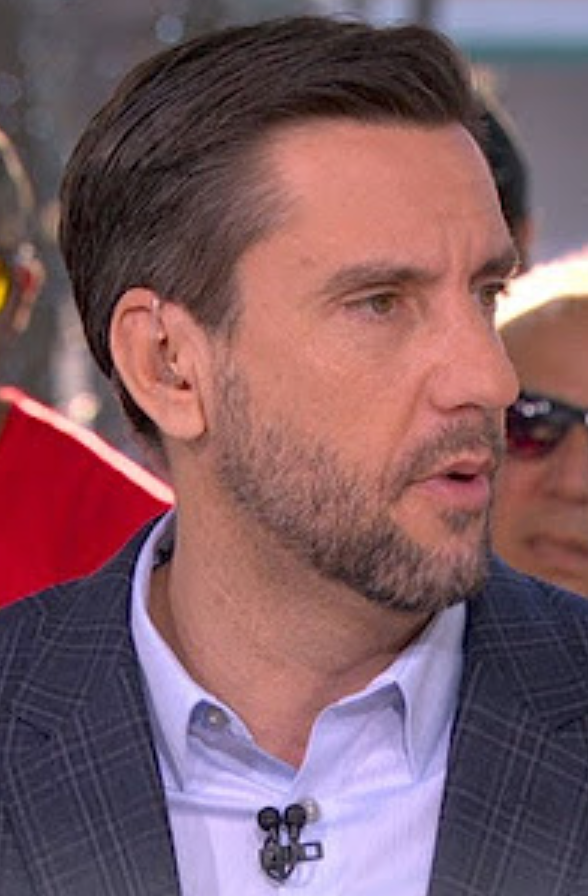
Richard Clay Travis (born April 6, 1979) is an American writer, lawyer, radio host and television analyst, and founder of OutKick.
Key Information


As a political commentator, he and Buck Sexton host The Clay Travis and Buck Sexton Show, a three-hour weekday conservative talk show which debuted on June 21, 2021 as the replacement of The Rush Limbaugh Show on many radio stations.[1] Travis describes himself as a "radical moderate" and said he was a lifelong Democratic voter before the election of Donald Trump in 2016.[2]
Early life
[edit]In 1997, Travis graduated from Martin Luther King Magnet at Pearl High School in Nashville.[3] He graduated from George Washington University in Washington, D.C., followed by Vanderbilt University Law School in Nashville.[4]
Career
[edit]
Travis originally worked as a lawyer in the U.S. Virgin Islands and Tennessee.[5] He attracted media attention in late 2004 with his personal blog written while he was living in the U.S. Virgin Islands and working for Dudley, Topper and Feuerzeig.[6] A Tennessee Titans fan, Travis was unable to get NFL Sunday Ticket, the satellite TV package to watch NFL games in the islands, and went on a "pudding strike", eating only pudding every day for 50 days, with the goal of forcing DirecTV to carry the package in the Virgin Islands.[7] The effort failed, but he blogged about the experience and received media attention.[8]
Travis began writing online for CBS Sports in September 2005, which for the first year was not paid.[9] In 2006, Travis gave up his law practice for good, and when he returned to Nashville he completed an MFA program in fiction writing at Vanderbilt University.[10] [11] Later, while writing for CBS, Travis began working on a book, Dixieland Delight, where he visited the football stadiums of the 12 then-current members of the Southeastern Conference.[5][a] After leaving CBS, Travis became a writer and editor at Deadspin, and then a columnist at FanHouse.[9]
Outkick the coverage
[edit]
After FanHouse was merged into Sporting News in 2011, Travis founded Outkickthecoverage.com.[9] The website later became one of the most visited college football sites on the web.[10] While there, he continued developing his reputation for occasionally "contrarian" opinions and several stories talking about OnlyFans models and adult movie stars.[12]
In 2008, Travis worked out at D1 Sports Training with NFL prospects preparing for the NFL draft. He later wrote a ten-part serial about the experience which he titled Rough Draft.[13]
In 2010, Nashville Scene named Travis "Best Sports Radio Host We Love To Hate" in the publication's "Best of Nashville" issue.[14]
He later became a co-host of a sports radio talk show, 3HL, on Nashville's 104.5 The Zone with Brent Dougherty and Blaine Bishop.[15] He also hosted a national sports radio show on NBC Sports.[9]
In 2023, the YouTube channel for OutKick hit 1,000,000 subscribers.
Fox Sports
[edit]In 2014, Travis resigned from his role on 3HL[15] and was hired by Fox Sports for its weekly college football Saturday pre-game show.[10] In 2015, he signed a deal with Fox Sports to license his entire sports media brand under Fox Sports, including Outkick the Coverage, which was folded into Fox Sports' website.[16] He also started a national weekly television show, started a daily Outkick the Show broadcast on Periscope and Facebook, and began a national radio show with Fox Sports Radio in 2016.[17]
In 2015, Travis was called out by DeMarcus Cousins for a 2010 prediction he had made that Cousins would be arrested within the next five years.[18][19] In response, Travis offered to donate to a charity of Cousins' choosing.[18][19]
In 2018, Travis began a daily sports gambling television show for Fox Sports on Fox Sports 1. The show aired for four seasons before ending in 2022. Since 2021 he has also been on Fox Sports’s Big Noon Kickoff college football pregame show.
Radio
[edit]Travis began a daily sports radio show on Nashville’s 104.5 The Zone, 3HL, in 2010. After leaving 3HL, in 2016 he began the “Outkick the Coverage” radio show for Fox Sports Radio nationwide mornings from 6-9 am et. Travis left that show in May 2021, when it was announced Travis and Buck Sexton would be taking over Rush Limbaugh's time slot on Premiere Networks.[20] That show debuted on June 21, 2021.
Political views
[edit]A self-described "radical moderate" who is pro-choice and against the death penalty, Travis said he voted for former President Barack Obama twice and previously never voted Republican. In 2016, Travis voted for Gary Johnson of the Libertarian Party.[2] As an undergrad, Travis interned for U.S. Representative Bob Clement for four years while in college at George Washington University.[21] In 2000, he worked on Al Gore's presidential campaign.[2] Travis was hired to work on U.S. Representative Jim Cooper's 2002 congressional campaign but was fired for wrecking Cooper's wife's car.[21]
In August 2016, Travis criticized his alma mater, Vanderbilt University, for planning to remove the word "Confederate" from its historic Confederate Memorial Hall, comparing the move to actions taken by "Middle Eastern terrorists."[22] Consequently, Travis lost a $3,000 promotion deal he had with Jack Daniel's.[22] Travis said online that a Jack Daniel's representative decided that his Twitter commentary on the statue "brings (the company) into public disrepute."[23]
On September 15, 2017, Travis appeared as a guest on CNN, with anchor Brooke Baldwin, to discuss free speech, specifically whether ESPN personality Jemele Hill should be fired for calling Donald Trump a "white supremacist" and stating that police officers are "modern-day slave catchers" on her personal Twitter page. Travis stated that it would be bad policy on ESPN's part to fire Hill for her private comments, just as it was bad policy when ESPN fired Curt Schilling for comments he made regarding transgender bathrooms on his personal Facebook page. Travis received criticism for using a phrase he commonly used on his radio show when he said "...I'm a First Amendment absolutist – the only two things I 100 percent believe in are the First Amendment and boobs..."[24] Baldwin cut the interview short and later responded, "when I first heard 'boobs' from a grown man on national television (in 2017!!!), my initial thought bubble was: 'Did I hear that correctly??..."[25]
On September 20, 2017, Travis announced he was considering running as an Independent for U.S. Senator of Tennessee in the 2018 election if incumbent Bob Corker decided not to run. Travis also stated that he believed with his name recognition he "could beat anyone in the state" and would make both major parties "incredibly nervous."[26] The following week, Senator Corker announced he would not be running for re-election,[27] but Travis did not enter the race.
In 2018, Travis wrote Republicans Buy Sneakers Too: How the Left Is Ruining Sports based on the Michael Jordan quote, which argued against what he saw as an increasing politicization of sports by liberal voices.[28]
During the U.S. national anthem kneeling protests, Travis was quite vocal in his opposition. When Nike released an advertisement with Colin Kaepernick in 2018, Clay denounced the move and claimed it would destroy Nike's reputation and stock.[29] However, Nike's sales and valuation increased that same year, and the stock price rose continuously over the next three to four years with a peak of over $160 a share in 2021.[30]
During the early months of the COVID-19 pandemic, Travis repeatedly downplayed the severity of the disease,[31][32][33][34] calling it "overrated",[35] claiming that it is less severe than the seasonal flu,[35] projecting that fewer than several hundred would die of the disease in the United States,[31] that victims of the disease probably have been "killed a month or two earlier" than they would have been otherwise,[36] and stated that the mortality rate for those under 80 and without pre-existing conditions is "virtually zero".[31] He suggested that some advocates for mitigation measures to slow the spread were "rooting for the virus to triumph".[37][38]
On October 30, 2020, Travis said that he would be voting for Donald Trump in that year's presidential election. He said it would be the first time he had ever voted for a Republican for president.[39]
On April 15, 2024, Travis suggested via Twitter that New Yorkers sympathetic to Donald Trump try to be selected for jury service and hide their sympathies during the selection process for the former president's "hush money" trial to ensure that he would not be convicted; it was pointed out by media observers and others, including Representative Eric Swalwell, that this post could be considered jury tampering.[40]
Personal life
[edit]Travis's wife, Lara, is a Vanderbilt Law School graduate and practicing attorney as well as a former Tennessee Titans cheerleader.[8]
Bibliography
[edit]- Dixieland Delight: A Football Season on the Road in the Southeastern Conference. HarperCollins, Inc. 2007. ISBN 978-0-06-143124-1.
- Man: The Book. Citadel. 2008. ISBN 978-0-8065-2871-7.
- On Rocky Top: A Front-Row Seat to the End of an Era. HarperCollins, Inc. 2009. ISBN 978-0-06-171926-4.
- Republicans Buy Sneakers Too: How the Left Is Ruining Sports with Politics. Broadside Books. 2018. ISBN 978-0062878533.
- Balls: How Trump, Young Men, and Sports Saved America. Center Street. 2025.
Footnotes
[edit]- ^ The SEC expanded to 14 members in 2012 and 16 in 2024.
References
[edit]- ^ "Clay Travis & Buck Sexton To Take Over Rush Limbuagh Show". RadioInsight. May 27, 2021. Retrieved May 28, 2021.
- ^ a b c Travis, Clay (August 14, 2017). "Yes, I've Turned Down TV Show(s)". Outkick the Coverage. Archived from the original on September 29, 2017. Retrieved September 29, 2017.
- ^ Travis, Clay (May 14, 2015). "The World's Changed A Ton Since 1997". OutKick.
- ^ Read, Jan (December 17, 2014). "Clay Travis '04: Playing to His Strengths". Vanderbilt University Law School.
- ^ a b "Clay Travis goes from couch crasher to sports media celeb". USA TODAY. Retrieved October 15, 2015.
- ^ "Transcript of Clay Travis interview". The Tennessean.
- ^ "Give Him Tv Football Or Give Him Pudding!". tribunedigital-orlandosentinel. October 21, 2004. Retrieved October 15, 2015.
- ^ a b Bliss, Jessica. "10/10/2004: Clay Travis protests lack of Titans on TV a spoonful at a time". The Tennessean.
- ^ a b c d "FOX Sports 1 Takes On ESPN With Unique Talent That Includes Clay Travis". Forbes. Retrieved October 15, 2015.
- ^ a b c "Sports Media Personality Clay Travis Creates Multi-Million Dollar Brand". Forbes. Retrieved October 15, 2015.
- ^ "Biography for Clay Travis, House Judiciary Committee Witness" (PDF). US Congressional Record. Retrieved January 21, 2025.
- ^ "Clay Travis re-signs with Fox Sports to expand his "sports media brand"". Awful Announcing. June 25, 2015. Retrieved October 15, 2015.
- ^ AOL. "Sports News & latest headlines from AOL".
- ^ England, Eric (October 7, 2010). "Politics & Media 2010: Writer's Picks". Nashville Scene.
- ^ a b Travis, Clay. "Signing off 3HL tomorrow, and radio ... for now".
- ^ "Clay Travis finds new home with Fox Sports megadeal". The Tennessean. Retrieved October 15, 2015.
- ^ "Clay Travis to launch national college football TV show". The Tennessean. Retrieved October 15, 2015.
- ^ a b "DeMarcus Cousins trolls writer who said he would be arrested". SI.com. January 30, 2015. Retrieved October 15, 2015.
- ^ a b "NBA player destroys writer who 5 years ago said there was a 100% chance he would be arrested within 5 years". Business Insider. Retrieved October 15, 2015.
- ^ Steele, Anne (May 27, 2021). "WSJ News Exclusive | Rush Limbaugh's Radio Show to Be Taken Over by Clay Travis and Buck Sexton". Wall Street Journal. ISSN 0099-9660. Retrieved May 27, 2021.
- ^ a b Rau, Nate (July 1, 2014). "Clay Travis: couch crasher to sports media celebrity". The Tennessean. Retrieved September 29, 2017.
- ^ a b Tamburin, Adam (August 17, 2016). "Jack Daniel's nixes Clay Travis deal over 'Confederate' controversy". The Tennessean. Retrieved August 18, 2016.
- ^ "Jack Daniel's nixes Clay Travis deal over 'Confederate' controversy". The Tennessean.
- ^ Concha, Joe. "Radio host on CNN: I believe in 'the First Amendment and boobs'". The Hill. September 15, 2017.
- ^ "Brooke Baldwin: Speaking like this to women in 2017? No way". September 16, 2017.
- ^ Conradis, Brandon (September 20, 2017). "Sports radio host and ESPN critic mulls Senate run in Tennessee". The Hill. Retrieved September 29, 2017.
- ^ Collins, Michael (September 26, 2017). "Sen. Bob Corker will not seek re-election next year". The Tennessean. Retrieved September 29, 2017.
- ^ Ruiz, David (October 27, 2018). "Clay Travis Believes in Two Things". Washington Free Beacon. Retrieved May 26, 2025.
- ^ Buitrago, Juan. "Clay Travis: Nike's Colin Kaepernick ad 'the dumbest move' in brand's history". The Tennessean.
- ^ "NIKE - 44 Year Stock Price History". MacroTrends.
- ^ a b c "The Ballad of Clay Travis". The Bulwark. April 10, 2020. Retrieved December 14, 2020.
- ^ Kalaf, Samer. "Fox Sports pundit Clay Travis is spreading the worst possible coronavirus advice". The Outline. Retrieved December 14, 2020.
- ^ Strauss, Ben (September 3, 2020). "Trump and the right loved Clay Travis. The fight over college football sealed their bond". The Washington Post. Retrieved December 13, 2020.
- ^ Silverman, Robert (July 26, 2020). "Inside the Right-Wing Sports Site Pushing COVID Trutherism". The Daily Beast. Retrieved December 14, 2020.
- ^ a b OutKick [@Outkick] (February 24, 2020). ""I believe the coronavirus is overrated and we are overreacting to it because it is a new and novel fear. The flu happens every year and affects far more people than the coronavirus does." -- @ClayTravis https://t.co/T8fpehP91A" (Tweet). Retrieved January 9, 2021 – via Twitter.
- ^ Travis, Clay [@ClayTravis] (June 8, 2020). "I suspect data at end of the year will reflect the coronavirus killed people a month or two earlier than they otherwise might have died in spring. But death rates for rest of summer will be lower than normal. And that total deaths in 2020 will be very similar to past five years" (Tweet). Retrieved January 9, 2021 – via Twitter.
- ^ Travis, Clay [@ClayTravis] (March 28, 2020). "It's truly astounding how many coronavirus bros there are on social media who are rooting for the virus to triumph and refuse to accept any positive numbers at all. I've never seen anything like it. It's wild" (Tweet). Retrieved January 9, 2021 – via Twitter.
- ^ "Clay Vs. Karen Rovell Boils Over After Karen Starts Rooting For Corona – Again". OutKick. July 13, 2020. Retrieved December 14, 2020.
- ^ "Clay: Why I'm Voting For Donald Trump". OutKick. October 30, 2020. Retrieved October 31, 2020.
- ^ "Swalwell accuses Clay Travis of jury tampering in Trump Trial". The Hill. April 15, 2024. Retrieved April 15, 2024.
External links
[edit]- OutKick.com
- Clay Travis on Twitter
- Clay Travis at IMDb
- "Clay Travis". Sports Line. Columnist. Archived from the original on February 2, 2007.
| International | |
|---|---|
| National | |
| Other | |

Clay Travis
View on GrokipediaRichard Clay Travis (born April 6, 1979) is an American sports media executive, author, radio host, and former attorney best known as the founder of OutKick, a digital platform delivering sports news, analysis, and cultural commentary with an emphasis on unfiltered, conservative perspectives that challenge prevailing narratives in mainstream sports journalism.[1][2] Born and raised in Nashville, Tennessee, Travis earned a bachelor's degree in history from George Washington University in 2001 and a Juris Doctor from Vanderbilt University Law School in 2004.[1][2] After a brief legal career, Travis pivoted to sports writing, contributing columns to CBS Sports.com before launching the blog Outkick the Coverage in 2011, which evolved into OutKick and became one of the nation's largest independent sports opinion websites, eventually acquired by Fox Corporation in 2021.[2][3] He has hosted national radio programs, including the syndicated Outkick the Coverage on Fox Sports Radio starting in 2016 and, since 2021, co-hosting the conservative talk show The Clay Travis and Buck Sexton Show, which airs weekdays and addresses sports intertwined with political and cultural issues.[1][3] Travis also produces OutKick The Show on FS1, featuring interviews with figures like Donald Trump and Stephen A. Smith, and maintains a presence as a television analyst.[1] A prolific author, Travis has written bestsellers chronicling SEC football culture, such as Dixieland Delight and On Rocky Top, alongside political works like American Playbook and Balls: How Trump, Young Men, and Sports Saved America, which argue for traditional masculinity and skepticism toward progressive influences in athletics.[2][1] His provocative style, often critiquing what he views as left-wing biases in sports institutions, has earned him a loyal following among conservative audiences while attracting backlash from establishment media outlets for positions on topics including transgender participation in women's sports and the politicization of athletics.[1][4]
Background
Early Life
Richard Clay Travis was born on April 6, 1979, in Nashville, Tennessee. Raised in the city amid the region's deep-rooted affinity for college athletics, particularly Southeastern Conference (SEC) football, Travis grew up in an environment where sports served as a central cultural touchstone.[5][2] As a child, Travis displayed an early penchant for sports discourse, phoning into local radio programs like George Plaster's show at approximately 11 or 12 years old to share opinions on SEC football matchups.[6] This grassroots involvement highlighted a fan-oriented approach, attuned to the unfiltered enthusiasm of Southern sports communities rather than polished elite commentary.Education and Legal Career
Travis earned his Juris Doctor from Vanderbilt University Law School in 2004, following his undergraduate studies at George Washington University.[2][7] The law school's curriculum provided rigorous training in legal analysis, argumentation, and statutory interpretation, skills that later informed his incisive commentary in media.[7] After graduation, Travis practiced law as a litigator and general practitioner, initially in the U.S. Virgin Islands, where he worked for a local firm, and subsequently in Tennessee.[8][9] His tenure was brief, spanning roughly two years of full-time engagement before tapering off as writing commitments grew.[10] Travis described the legal profession as bureaucratically constrained and personally unfulfilling, limiting opportunities for direct, unfiltered expression compared to journalistic outlets.[8][11] By 2006, Travis abandoned legal practice entirely, citing its mismatch with his preference for dynamic, opinion-driven work over procedural rigidity.[7][10] This pivot reflected a recognition that law's formal structures, while intellectually demanding, stifled the broader analytical freedom he sought.[12]Media Career
Entry into Sports Journalism
After practicing law following his graduation from Vanderbilt Law School in 2004, Clay Travis began his transition into sports journalism by writing online columns for CBSSports.com starting in 2005.[7] These columns, which he contributed for approximately four years, focused primarily on college football, including analysis of Southeastern Conference (SEC) games and broader national trends.[13] Travis's early work emphasized data-driven predictions and statistical breakdowns, often challenging prevailing media consensus on team rankings and player evaluations.[2] In 2009, Travis shifted to a national columnist role at AOL FanHouse, where he continued until 2011.[14] During this period, he expanded his coverage to include travel for major events, producing pieces that incorporated humor alongside quantitative insights into sports outcomes, such as betting odds and performance metrics.[15] His FanHouse contributions highlighted discrepancies between official narratives and observable fan experiences, critiquing instances of journalistic deference to institutional sources over empirical evidence from games and statistics.[2] This approach began distinguishing Travis from traditional sports writers, who often prioritized access and collegiality with coaches and administrators.[8] Travis's columns during these years built a readership by favoring unfiltered, fan-oriented perspectives rooted in verifiable data, such as win probabilities and historical precedents, rather than anecdotal insider accounts.[14] For example, his predictions and analyses frequently incorporated advanced metrics to forecast upsets in college football, gaining traction amid growing interest in analytics-driven sports discourse.[2] This foundation in contrarian, evidence-based commentary on platforms like CBSSports.com and AOL FanHouse positioned Travis as an emerging voice skeptical of mainstream sports media orthodoxies by 2011.[16]Founding and Growth of Outkick
Clay Travis launched Outkick the Coverage in 2011 as an independent digital platform delivering sports analysis, predictions, and commentary that diverged from mainstream outlets by prioritizing unfiltered perspectives on college football and broader athletic trends.[11] The site's initial content emphasized contrarian takes, including early critiques of established networks like ESPN, which helped cultivate a dedicated audience seeking alternatives to conventional sports narratives.[17] Operating from a home office in Nashville, Travis assumed significant entrepreneurial risks by forgoing stable writing roles at sites like CBSSports.com and FanHouse to build a self-sustained model reliant on reader engagement and ad revenue.[18][19] Outkick's expansion accelerated through viral articles, podcasts, and content innovations such as sports betting breakdowns, which aligned with emerging legalization trends and drew millions of monthly visitors by capitalizing on audience demand for bold, non-conformist insights resistant to prevailing cultural sensitivities in sports media.[20][21] This growth transformed the niche blog into a national brand with syndicated features, enabling Travis to scale from solo operations to a team producing multimedia across web, audio, and video formats.[22] By 2022, the platform had quadrupled its unique website traffic year-over-year, reflecting effective adaptation to digital consumption patterns and content that prioritized empirical predictions over sanitized reporting.[23] Fox Corporation acquired Outkick on May 5, 2021, for an undisclosed sum, integrating it into its portfolio to bolster sports betting and digital content while committing to maintain the brand's operational autonomy and Travis's leadership role.[24][21] Post-acquisition, Outkick expanded by recruiting additional talent and distributing material across Fox's ecosystem, including television and streaming, which supported sustained audience gains without altering its core editorial approach.[24][25] This move addressed Travis's prior challenges in funding independent growth, allowing investment in infrastructure while preserving the platform's reputation for audience-aligned innovation over corporate homogenization.[18]Radio Hosting
In September 2016, Clay Travis launched Outkick the Coverage on Fox Sports Radio, a three-hour weekday morning program airing from 6 to 9 a.m. ET across approximately 220 stations nationwide.[14] The format emphasized interactive elements such as live listener calls, sports predictions, and guest interviews, distinguishing it through direct audience engagement in an audio medium that prioritized national syndication over visual production.[1] This show positioned Travis as a prominent voice in sports radio, competing in a landscape where traditional outlets faced audience fragmentation due to streaming alternatives and cord-cutting.[2] Travis hosted Outkick the Coverage until May 2021, when he transitioned following the death of Rush Limbaugh on February 17, 2021.[26] He then co-launched The Clay Travis and Buck Sexton Show on June 21, 2021, via Premiere Networks (an iHeartMedia subsidiary), occupying Limbaugh's former 12 to 3 p.m. ET slot on hundreds of stations.[27] The program integrated Travis's sports expertise with Sexton's political analysis, fostering a hybrid talk format that incorporated caller interactivity and real-time commentary on news, culture, and athletics, thereby expanding beyond pure sports content to appeal to a broader conservative-leaning audience.[28] By March 2025, The Clay Travis and Buck Sexton Show had expanded to 550 affiliates, reflecting a 27% growth since inception and underscoring its resilience amid declining listenership for legacy talk radio amid digital shifts.[27] The show's success, including reaching over 6 million weekly listeners by mid-2024, highlighted its adaptation through unfiltered discourse and audience-driven segments, contrasting with more constrained television formats by leveraging radio's immediacy and affiliate-driven reach.[29]Television and Broadcasting Roles
Clay Travis entered Fox Sports' television lineup in 2018 as a host and panelist on Lock It In, the network's inaugural linear sports gambling program airing on FS1.[30] The daily show featured Travis delivering betting picks and analysis alongside co-host Rachel Bonnetta and panelists “Cousin Sal” Iacono and Todd Fuhrman, capitalizing on the expanding legal sports wagering market.[31] It ran for four seasons, emphasizing data-driven predictions and live discussions that highlighted Travis's contrarian takes on odds and player performances.[32] After Fox Corporation acquired OutKick in 2021 for $100 million, Travis's broadcasting presence deepened through network synergies, integrating OutKick's analytics into Fox's visual platforms.[33] He became a regular contributor to Big Noon Kickoff, Fox Sports' flagship college football pregame show, where he provides game breakdowns, cultural commentary, and betting edges drawn from OutKick's proprietary data.[32] The format's on-camera debates—often featuring heated exchanges over coaching decisions or NIL impacts—leverage television's visual immediacy, enabling Travis to confront panelists directly and underscore causal factors like market inefficiencies in real time, distinct from radio's narrative-driven audio exchanges. In September 2025, Travis launched The OutKick Show on FS1, debuting September 17 with a focus on NFL and college football analysis, further blending OutKick's independent voice with Fox's broadcast reach.[34] This weekly program extends his gambling expertise into broader sports discourse, incorporating live segments that amplify on-air confrontations over controversial topics like athlete endorsements and league policies.[32] Amid these roles, Travis has maintained crossovers to Fox News for sports-political intersections, such as critiquing gender policies in competitions, reflecting OutKick's post-acquisition multi-platform strategy.[34] As of October 2025, his Fox agreements remain active through year-end, amid reports of negotiations for extended or alternative broadcasting arrangements.[35]Political Commentary
Critiques of Mainstream Media Bias
Clay Travis has argued that mainstream sports media outlets, particularly ESPN, exhibited a pronounced left-leaning bias following the 2016 U.S. presidential election, prioritizing political advocacy over entertainment and thereby driving away audiences. He attributes this shift to an infusion of identity politics and social justice narratives into sports coverage, which he claims alienated a significant portion of viewers seeking escapism rather than ideological commentary. According to Nielsen estimates cited by Travis, ESPN experienced sharp subscriber losses correlating with these changes, including 621,000 subscribers in October 2016 alone—the network's worst monthly drop at the time—and an average of 19,600 subscribers lost per day over subsequent months.[36][37] By 2021, ESPN had shed 8 million subscribers, representing 10% of its base, amid ongoing politicization that Travis links causally to ratings erosion, as apolitical sports like golf outperformed politically charged leagues such as the NBA in viewership.[38] Travis contends that athlete activism, often amplified by biased media narratives, fosters fan alienation by injecting partisan divides into apolitical domains, resulting in measurable revenue declines. He points to causal mechanisms where players and leagues endorsing progressive causes, such as Black Lives Matter protests, repel roughly half of their customer base—predominantly conservative-leaning sports fans—leading to boycotts and reduced engagement. For instance, Travis highlights the NBA's regular season posting its lowest network TV ratings in history by April 2024, attributing this to sustained political stances that mirrored corporate missteps like Bud Light's, thereby diminishing league value to broadcasters.[39] He argues this pattern extends to other sports, where media endorsement of activism ignores first-principles economics: fans fund the industry, and lecturing them on politics erodes loyalty without expanding the audience.[40] In response, Travis positions OutKick as a corrective force, emphasizing merit-based analysis, entertainment value, and avoidance of identity-driven content to recapture alienated viewers. He credits this approach with contributing to the decline of "woke sports" by November 2024, as audience backlash demonstrated that prioritizing ideological conformity over broad appeal leads to financial self-sabotage, while neutral, fan-focused coverage sustains viability.[41] Travis maintains that mainstream outlets' failure to heed these empirical signals—evident in persistent subscriber hemorrhages—stems from institutional echo chambers resistant to market feedback.[42]Advocacy for Conservative Principles
Travis has expressed support for Donald Trump's presidential campaigns, announcing his vote for Trump on November 3, 2020, and again in the 2024 election, citing policy alignments on economic growth, opposition to reparations and defunding the police, and rejection of claims of systemic racism in American institutions.[43][44] He has described Trump's appeal as akin to an underdog triumphing over entrenched elites, drawing parallels to competitive dynamics in sports where outcomes favor resilience against favored opponents.[45] In advocating meritocracy, Travis has endorsed principles of selection based on performance over demographic quotas, arguing that diversity, equity, and inclusion (DEI) initiatives undermine competence by prioritizing identity factors, as evidenced by their limited application in high-stakes athletics where empirical results dictate success.[46][47] He has critiqued DEI's implementation in sports contexts, noting that professional leagues like the NBA succeed through merit-based competition rather than enforced representation mirroring population demographics, which would require displacing top performers.[48][49] Travis has aligned with figures like Elon Musk on free speech advocacy, praising Musk's 2022 acquisition of Twitter (now X) as a pivotal step toward platform transparency and reducing censorship, positioning it as a counter to elite-controlled narratives on national discourse.[50][51] This stance reflects his broader emphasis on deregulation in media and technology to foster open exchange, contrasting with regulatory approaches that he views as stifling innovation and truthful debate.[52]Intersection with Sports Culture
Travis analyzes athlete contracts, name, image, and likeness (NIL) deals, and conference realignments through a free-market framework, emphasizing profit maximization and structural reforms in college sports. In February 2024, he proposed merging the SEC and Big Ten into a for-profit superconference modeled after the UFC, limiting membership to approximately 50 top programs to enhance revenue efficiency and media rights packaging, which he estimated could rival the NFL's $11.5 billion annual deal.[53] He advocated integrating NIL into a collective bargaining agreement treating scholarship players as employees with guaranteed salaries derived from media revenue percentages, while restricting transfer portal mobility to stabilize rosters and avert antitrust litigation.[53] Such views frame athletic evolution as a business opportunity rather than regulatory overreach. In critiquing COVID-19 protocols' application to athletics, Travis opposed asymptomatic testing and resultant quarantines in professional leagues. A December 2021 Wall Street Journal op-ed by him urged ending these measures, noting that vaccinated athletes still transmitted the virus minimally and that policies disproportionately sidelined healthy players without reducing outbreaks, as evidenced by persistent NHL cases post-vaccination mandates.[54] He highlighted Olympic precedents where positive-testing athletes competed successfully, questioning media narratives that amplified risks to justify cancellations.[55] Travis contests normalized progressive stances on social justice in sports, arguing they erode meritocracy and fan engagement without enhancing on-field outcomes. He traces the "woke sports era" to Colin Kaepernick's 2016 anthem protests, which proliferated across leagues with Black Lives Matter branding, clashing with sports' unifying, excellence-driven ethos and alienating a right-leaning male audience.[41] Rather than bolstering performance, such activism correlated with viewership declines, including the NBA's annual rating lows since 2016, which he attributes to politicization over play.[41] This hybrid coverage—merging economic realism with skepticism of cultural impositions—has cultivated a conservative-leaning sports audience without forsaking core game analysis. OutKick's expansion, including staff growth to 75 amid 2015–2022 politicization spikes like Kaepernick's protests, reflects demand for alternatives to perceived mainstream bias.[56] Traffic metrics underscore appeal, with 8.6 million unique visitors in October 2024, a 61% month-over-month rise during election-adjacent cultural frictions in athletics.[57] Travis prioritizes broad accessibility by discouraging athlete partisanship, echoing Michael Jordan's apolitical stance to retain diverse fans.[56]Controversies
Clashes with Progressive Outlets
Travis's tenure as a contributor at Deadspin in the mid-2000s ended amicably, but by the early 2010s, his independent OutKick content increasingly provoked responses from the site, particularly for pieces critiquing politicized sports narratives on topics like player activism and media hypocrisy.[58] These interactions escalated to public blocks on Deadspin's platforms after Travis published content challenging progressive assumptions in sports, such as questioning the impact of Title IX expansions on competitive equity.[58] In April 2016, Travis explicitly stated that Deadspin had "died as a site" due to its shift toward politically correct coverage, exemplified by articles prioritizing social commentary over traditional sports irreverence, like critiques of co-ed bachelor parties as culturally regressive.[58] Deadspin contributors countered by dismissing Travis's work as outdated provocation, leading to severed online engagements and mutual exclusions from comment sections and social media interactions. From 2017 to 2020, ESPN personalities intensified disputes with Travis amid his reporting on the network's pivot to cultural politics in sports programming. In September 2017, coverage portrayed Travis as aligning with alt-right elements for his Trump-era support and critiques of ESPN's left-leaning hires, such as labeling on-air talent shifts as contributing to viewer exodus.[59] Public spats peaked in February 2020 when ESPN host Dan Le Batard accused Travis of producing content that "traffics in hate" following the abrupt cancellation of ESPN's "High Noon" debate show, which had featured Travis as a guest antagonist to progressive viewpoints.[60] Later that year, in December 2020, Travis publicly condemned ESPN analyst Domonique Foxworth's on-air suggestion that support for white quarterback Josh Allen reflected racial undertones among fans, framing it as divisive commentary amid broader 2020 tensions over police incidents in sports contexts.[61] These exchanges involved no formal bans but resulted in ESPN avoiding Travis as a contributor and issuing statements distancing from his platform. In January 2026, Travis accused Spotify of refusing to run advertisements from U.S. Immigration and Customs Enforcement (ICE), describing it as an "insane decision" targeting Trump voters.[62] The accusation led to backlash from his supporters, including calls for boycotts and subscription cancellations, while defenses noted that the government ad contract had ended in late 2025.[63]Allegations of Misinformation and Outrage
Media Matters, a progressive media monitoring organization, has accused Clay Travis of spreading COVID-19 misinformation through OutKick, including claims that vaccines were ineffective and contributed to health issues such as the cardiac arrest of Buffalo Bills player Damar Hamlin in January 2023.[64][65] Travis was further criticized for hosting then-President Donald Trump in 2020 to advocate resuming college football amid lockdowns, portraying pandemic restrictions as overstated.[66] Critics have labeled Travis a promoter of conspiratorial and racially charged narratives, such as downplaying police brutality against Black individuals during the 2020 George Floyd protests, which outlets like the South China Morning Post cited as part of broader misinformation efforts.[4][67] A 2023 Brookings Institution analysis ranked Travis's radio show among top spreaders of unsubstantiated claims, particularly on health topics like COVID-19, though the report encompassed broader conservative podcasting trends.[68] Allegations of outrage farming center on Travis's integration of Trump-era politics into sports commentary, which Politico described in 2017 as capitalizing on conservative grievances to build a following, dubbing him a "darling of the alt-right."[59] The New York Times, in a 2024 examination of politicized sports talk, portrayed Travis's approach as deliberate provocation blending sports and culture wars to drive engagement, contrasting it with mainstream outlets' left-leaning defaults.[69] Such critiques often frame his content as prioritizing clicks over substance, with Media Matters highlighting repeated promotion of right-wing talking points on a platform ostensibly focused on sports.[67]Defenses and Empirical Counterarguments
Travis has countered claims of irrelevance or market failure by highlighting Outkick's sustained audience expansion, which demonstrates empirical demand for its content amid competitors' stagnation or declines. For instance, in April 2025, Outkick recorded 6.2 million total desktop and mobile unique visitors, reflecting a 16% year-over-year increase, alongside 27 million total page views. [70] Similarly, October 2024 metrics showed 8.6 million unique visitors, up 44% from the prior year, underscoring growth trajectories that Travis attributes to providing unfiltered analysis rejected by establishment sports media. [57] This post-acquisition performance under Fox Corporation, following the 2021 purchase, further validates the platform's viability, with Q4 2024 achieving 7.8 million monthly visitors and the highest growth rate among peers. [71] [24] In response to allegations of spreading misinformation, Travis has argued that such labels function as tools to discredit non-conforming narratives, often proven erroneous by subsequent events. He has cited examples where media dismissed visual evidence as "cheap fakes" or disinformation, only for fuller context to affirm the original reporting, positioning these accusations as mechanisms to enforce ideological conformity rather than pursue accuracy. [72] Travis maintains that his commentary aligns with observable realities overlooked by biased outlets, such as underestimations of public sentiment on cultural and electoral issues, where pre-event polling frequently diverged from outcomes favoring conservative positions. This perspective frames "misinformation" charges not as evidence-based critiques but as efforts to marginalize dissent, with audience metrics serving as a market-driven rebuttal to claims of deception. [73] Travis emphasizes free speech protections in defending against legal or reputational challenges, asserting that robust debate, even if provocative, bolsters discourse over sanitized narratives. While specific defamation suits against him remain limited, he has publicly championed outcomes upholding expressive rights, such as court reversals of politically motivated fraud convictions, as affirmations that dissenting voices withstand scrutiny. [74] This stance aligns with his broader rebuttals, where empirical indicators like viewership surges and platform acquisitions empirically refute narratives of fringe appeal or factual unreliability.Writings and Publications
Authored Books
Clay Travis has authored several books spanning sports journalism, cultural commentary, and political analysis, often drawing on his background in Southeastern Conference (SEC) football fandom to explore broader themes of American identity, institutional biases, and conservative critiques of progressive influences in media and athletics. His early works focus on immersive accounts of college football, emphasizing regional traditions and the excesses of fan culture, while later publications extend these observations into examinations of political correctness's impact on sports and society, supported by sales data indicating robust independent market performance despite exclusions from certain bestseller lists attributed to methodological biases favoring establishment narratives.[75][76] His debut book, Dixieland Delight: A Football Season on the Road in the Southeastern Conference (HarperCollins, 2007), chronicles Travis's 2006 road trip following SEC games, portraying the conference's passionate rivalries, tailgating rituals, and Southern ethos as a microcosm of unapologetic regional pride amid national homogenization. The narrative blends humor with detailed game recaps and cultural anecdotes, such as the ironic spectacles of fan devotion, earning praise for its irreverent tone and insider perspective on an era of SEC dominance.[77][78] Subsequent sports-focused titles include On Rocky Top: A Front-Row Seat to the End of an Era (William Morrow, 2009), which details the University of Tennessee Volunteers' 2008 season struggles under coach Phillip Fulmer, linking on-field declines to administrative mismanagement and foreshadowing broader institutional failures in college athletics. Travis positions the book as a lament for lost competitive excellence, grounded in attendance figures and recruiting data showing a 20% drop in Vols' national ranking relevance post-era. Man: The Book (Citadel Press, 2016) shifts to satirical self-help, mocking modern masculinity critiques by advocating traditional male pursuits like hunting and competition, framed through empirical contrasts with declining male participation rates in youth sports (down 15% since 2000 per federal data).[79] Travis's political books integrate sports analogies to dissect cultural shifts. Republicans Buy Sneakers, Too: How the Left Is Ruining Sports and the Country (Broadside Books, 2018) argues that progressive ideologies, evidenced by corporate sponsorships and league policies (e.g., NFL's 2016 anthem protests correlating with a 10% viewership dip), erode merit-based traditions, using Nielsen ratings and ticket sales as causal metrics rather than accepting media attributions to unrelated factors. Despite selling over 10,000 copies in its debut week—three times some contemporaneous New York Times nonfiction entries—it was omitted from that list, a exclusion Travis and analysts link to opaque weighting favoring non-conservative titles.[80][81] More recent works like American Playbook: A Guide to Winning Back the Country from the Democrats (Broadside Books, 2024) apply football strategies to electoral politics, positing data-driven tactics such as targeting male voters (comprising 53% of 2024 Republican turnout per exit polls) to counter perceived Democratic overreach in education and media. Co-authored Balls: How Trump, Young Men, and Sports Saved America (Threshold Editions, 2024, with Buck Sexton) ties Trump's 2024 resurgence to revitalized male engagement in athletics, citing youth sports enrollment rebounds (up 5% post-2020) as empirical counter to narratives of cultural decay. Both achieved strong audiobook sales on platforms like Audible, reflecting Travis's radio audience overlap, though formal bestseller recognition remains contested due to documented list biases.[82][76][75]| Title | Publication Year | Publisher | Key Theme |
|---|---|---|---|
| Dixieland Delight | 2007 | HarperCollins | SEC football culture and Southern traditions[77] |
| On Rocky Top | 2009 | William Morrow | Decline of Tennessee Vols program[79] |
| Man: The Book | 2016 | Citadel Press | Defense of traditional masculinity via sports |
| Republicans Buy Sneakers, Too | 2018 | Broadside Books | Progressive erosion of sports integrity[81] |
| American Playbook | 2024 | Broadside Books | Sports tactics for political victories[82] |
| Balls (co-authored) | 2024 | Threshold Editions | Role of sports and Trump in male cultural revival[76] |