Hubbry Logo
LodoiceaLodoiceaMain
Open search
Lodoicea
Community hub
Lodoicea
logo
8 pages, 0 posts
0 subscribers
Be the first to start a discussion here.
Lodoicea
Lodoicea
from Wikipedia

Lodoicea
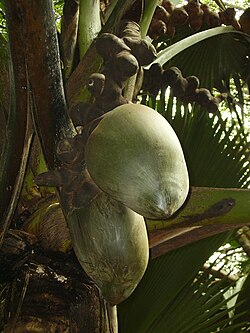
Habit, with fruit
Scientific classification Edit this classification
Kingdom: Plantae
Clade: Tracheophytes
Clade: Angiosperms
Clade: Monocots
Clade: Commelinids
Order: Arecales
Family: Arecaceae
Subfamily: Coryphoideae
Tribe: Borasseae
Genus: Lodoicea
Comm. ex DC.
Species:
L. maldivica
Binomial name
Lodoicea maldivica
Synonyms[2][3]
List
    • Borassus sonneratii Giseke
    • Cocos maldivica J.F.Gmel.
    • Cocos maritima Comm. ex H.Wendl.
    • Lodoicea callypige Comm. ex J.St.Hil.
    • Lodoicea sechellarum Labill.
    • Lodoicea sonneratii (Giseke) Baill.

Lodoicea,[4] commonly known as the sea coconut, coco de mer, or double coconut, is a monotypic genus in the palm family. The sole species, Lodoicea maldivica, is endemic to the islands of Praslin and Curieuse in the Seychelles. It has the largest seed in the plant kingdom. It was also formerly found on the small islets of St Pierre, Chauve-Souris, and Ile Ronde (Round Island), all located near Praslin, but had become extinct there for a time[quantify] until recently[when?] reintroduced.

Taxonomy

[edit]

The name of the genus Lodoicea was given by Philibert Commerson, without any explanation for its etymology. It may be derived from Lodoicus, a Latinised form of Louis (typically Ludovicus), in honour of King Louis XV,[5] while other sources say that Lodoicea is from Laodice, the daughter of Priam and Hecuba.[6]

Lodoicea belongs to the subfamily Coryphoideae and tribe Borasseae. Borasseae is represented by four genera in Madagascar and one in Seychelles out of the seven worldwide. They are distributed on the coasts surrounding the Indian Ocean and the existing islands within. Borassus, the genus closest to Lodoicea, has about five species in the Old World, one species in Africa, one in India, South-East Asia and Malaysia, one in New Guinea and two species in Madagascar.[7]

Description

[edit]
The Vallée de Mai palm forest in Praslin
Lodoicea maldivica seed from the Royal Ontario Museum's green plant herbarium.

It generally grows to 25–34 m (82–112 ft) tall. The leaves are fan-shaped, 7–10 m long and 4.5 m wide with a 4 m petiole in mature plants. However, juveniles produce much longer petioles, up to 9 m (30 ft) long.[8][9] It is dioecious, with separate male and female plants. The male flowers are arranged in a catkin-like inflorescence up to 2 m (7 ft) long[10] which continues to produce pollen over a ten-year period; one of the longest-living inflorescences known. The mature fruit is 40–50 cm in diameter and weighs 25–45 kg, and contains the largest seed in the plant kingdom.[11][12] The fruit, which requires 6–7 years to mature and a further two years to germinate, is sometimes also referred to as the sea coconut, love nut, double coconut, coco fesse, or Seychelles nut.[13]

While the functional characteristics of Lodoicea are similar to other trees of monodominant forests in the humid tropics, its unique features include a huge seed, effective funnelling mechanism and diverse community of closely associated animals. These attributes suggest a long evolutionary history under relatively stable conditions.[14] Of the six monospecific endemic palms in Seychelles, Lodoicea is the "only true case of island gigantism among Seychelles flowering plants, a unique feature of Seychelles vegetation".[15] It holds a number of botanical records:

  • It produces the largest wild fruit known, weighing up to 25–45 kg (55–99 lb),[11][12][16] although domesticated pumpkins and watermelons can be much heavier.
  • The fruit is composed of three carpels which are the largest of any flowering plant (although the carpels of Entada spp. are longer).
  • These fruit are the slowest to mature, requiring 8 to 10 years.[17][18]
  • The mature seeds weighing 10–25 kg (22–55 lb) are the world's heaviest.[16][12]
  • The seed upon germinating, produces the longest known cotyledon, up to 4 m (13 ft).[19] and on occasion as long as 10 m (33 ft).[20]
  • It is the slowest growing of all large trees,[21] although some small to medium-sized desert trees are slower. At the Peradenaya Royal Botanic Gardens, it grew an average of 33 mm (1 in) per year over a period of 40 years.
  • The female flowers are the largest of any palm, up to 10 cm (3.9 in) diameter.[7][22][23]
  • The male catkins, up to 2 m (7 ft) in length, are the longest known.[10]
  • The sepals, which grow with the fruit, are the largest known; up to 23 cm (9 in) long by 15 cm (6 in) wide.[24]
  • The leaves of Lodoicea have the longest lifespan of any monocot, nine years to develop in the terminal spike, and then nine more years as a fully functioning leaf.[25] However, adult Lodoicea can have as many as twenty leaves with a potential lifespan of 24 years.[26]
  • Finally, Lodoicea is the most efficient plant known at recovering nutrients from moribund leaves.[27][28]

Of the six endemic palms in Seychelles, it is the only dioecious species, with male and female flowers on different plants.[29]

Habit

[edit]

L. maldivica is robust, solitary, up to 30 m tall with an erect, spineless, stem which is ringed with leaf scars (Calstrom, unpublished). The base of the trunk is of a bulbous form and this bulb fits into a natural bowl, or socket, about 75 cm (30 in) in diameter and 45 cm (18 in) deep, narrowing towards the bottom. This bowl is pierced with hundreds of small oval holes about the size of a thimble with hollow tubes corresponding on the outside through which the roots penetrate the ground on all sides, never, however, becoming attached to the bowl; they are partially elastic, affording an almost imperceptible but very necessary "play" to the parent stem when struggling against the force of violent gales.[citation needed]

Leaves

[edit]

The crown is a rather dense head of foliage with leaves that are stiff, palmate up to 10 m in diameter and petioles of two to four metres in length. The leaf is plicate at the base, cut one third or more into segments 4–10 cm broad with bifid end which are often drooping. A triangular cleft develops at the petiole base.[7] The palm leaves form a huge funnel that intercepts particulate material, especially pollen, which is flushed to the base of the trunk when it rains. In this way, L. maldivica improves its nutrient supply and that of its dispersal-limited offspring.[14]

Flowers

[edit]
Two endemic species on a coco de mer in Vallée de Mai (March 2016)

The clusters of staminate flowers are arranged spirally and are flanked by very tough leathery bracts. Each has a small bracteole, three sepals forming a cylindrical tube, and a three-lobed corolla. There are 17 to 22 stamens. The pistillate flowers are solitary and borne at the angles of the rachis and are partially sunken in it in the form of a cup. They are ovoid with three petals as well as three sepals.[7] It has been suggested that they may be pollinated by animals such as the endemic lizards that inhabit the forest where they occur.[20] Pollination by wind and rain are also thought to be important.[29] Only when it begins to produce flowers, which can vary from 11 to 45 years or more old, is it possible to determine the sex of the plant visually. The nectar and pollen are also food for several endemic animals e.g. bright green geckos (Phelsuma sp.), white slugs (Vaginula seychellensis) and insects.[30]

Inflorescence

[edit]
Male inflorescence

The inflorescences are interfoliar, lacking a covering spathe and shorter than the leaves. The staminate inflorescence is catkin-like, one to two metres long by about 8 cm (3 in) in width and produces pollen over a period of 8 to ten years.[31] These catkins are generally terminal and solitary, but sometimes two or three catkins may be present. The pistillate inflorescences are also one to two metres long, unbranched, and the flowers are borne on a zig-zagging rachilla.[22]

Fruit

[edit]
Fruit
Nut (with outer husk removed), with affixed label designating its origin

The fruit is bilobed, flattened, 40 to 50 cm long ovoid and pointed, and contains usually one but occasionally two to four seeds. The epicarp is smooth and the mesocarp is fibrous. The endosperm is thick, relatively hard, hollow and homogenous. The embryo sits in the sinus between the two lobes. During germination, a tubular cotyledonary petiole develops that connects the young plant to the seed. The length of the tube is reported to reach about four metres.[7] In the Vallée de Mai, the tube may be up to 10 m long.[10][20]

L. maldivica was once believed to be a sea-bean or drift seed, a seed evolved to be dispersed by the sea. However, it is now known that viable nuts are too dense to float, with only rotted out nuts being found floating on the sea, explaining why the trees are limited in range to just two islands.[32]

Habitat

[edit]

Lodoicea maldivica inhabits rainforests where there are deep, well-drained soils[22] and open exposed slopes; although growth is reduced on such eroded soils.

Phylogeny

[edit]

Despite the proximity of the Seychelles to Africa, the broader diversity of palm life on the islands are considered to be slightly closer phylogenetically to that of south Asia;[15] with members of the palm subtribe Oncospermatinae occurring both in the Seychelles group and in the Mascarene Islands, Sri Lanka, Borneo, the Malay Peninsula, and the Philippines.[33] A genetic sequencing study of Lodoicea and other palms showed similarity between south Asiatic palms and Lodoicea. Lodoicea is one of four genera in the Lataniieae subtribe of the tribe Borrassae, and sequencing found them to be very closely related to Borassus and Borassodendron, although notably the phylogenetic placement of Lodoicea was among the least confident.[33] The genera Borassus and Borassodendron together include species in Southeast Asia, Malaysia, India, New Guinea, and Madagascar;[34] thus this study provided genetic evidence for the suspected close relationships between Lodoicea and south Asian palms.

Dispersal

[edit]

Genetic similarity between Lodoicea and south Asian palms, despite their geographical distance, raises questions about ancestral historical dispersal of Lodoicea to the Seychelles; and this natural history of Lodoicea is further obscured by the geology of the Seychelles, as the entirety of the archipelago (excluding some Pleistocene and coral reef formations) is composed of non-fossiliferous rock.[15] As such, the prehistoric origins of Seychelles flora is inferred using circumstantial geological and botanical evidence.[15]

Geologic drift-dispersal hypothesis

[edit]

The ancestral dispersal to the Seychelles may have occurred as Tertiary palm relatives native to Gondwanaland rode the Indian subcontinent during its northward continental drift, whereupon populations were deposited on the modern day Seychelles. This hypothesis derives from the geologic formation of the Seychelles themselves, and offers a strong explanation of the modern day relationship of Lodoicea to Asiatic palms. The granite which forms the majority of the Seychelles archipelago was formed within the Indian subcontinent, and was deposited in its modern-day location in the Indian Ocean following the detachment and northern drift of the subcontinent from Gondwana, before colliding with modern-day south-Asia ~50 mya.[35] Divergence between the palm populations would then follow from the isolation of the archipelago from the rest of Gondwonaland. Evidence suggests at least a proportion of the diversity of Flora on the islands are of "very ancient origin",[15] perhaps being evidence of the persistence of some aboriginal Indian subcontinental species, of which the ancestors of Lodoicea may have been a member. The plausibility of this hypothesis is dependent on whether the Seychelles remained at least in part above sea-level for the duration of their formation, as a complete inundation with sea water at any point during the formation of the islands would have killed any aboriginal flora. Whether such an inundation ever occurred during the formation of the Seychelles is unknown.[15]

Oceanic dispersal hypothesis

[edit]

A 2020 genetic-sequencing study of palm species found genetic evidence for an oceanic dispersal of the ancestors to modern Lataniieae palms, from south Asia to the Mascarene and Seychelle islands. Though modern viable coco de mer fruit are too heavy to float and thus would be unable to disperse oceanically, genetic evidence suggests that ancestors to Lataniieae palms underwent evolutionary periods of relatively rapid increases in seed size, with Lodoicea serving as the most extreme example. Thus, the ancestors of Lodoicea may have possessed small enough seeds for oceanic dispersal to be viable,[33] with an evolutionary increase in seed size occurring in the Seychelles after its ancestral dispersal. Furthermore, it is likely that at certain points during the geologic formation of the Seychelles, the oceanic gaps between landmasses were much smaller, making oceanic dispersal more viable still.[15] As such, a combination of the two hypotheses, wherein ancestral palms native to the Indian subcontinent rode the subcontinent during continental drift, and then dispersed oceanically to the Seychelles after their formation, but while the rest of the Indian subcontinent was relatively nearby.

Evolution of the coco de mer fruit's size

[edit]

Despite their relative recency of this divergence from the common ancestor shared with other palms, Lodoicea is unique across a variety of traits. Though Lodoicea is not the only palm in its tribe that produces very large fruit, the syncarpous clade of palms exhibit wide variation in seed sizes, ranging from the seeds of the Caryoteae palms of only several millimetres, to the seeds of Borasseae which are often several centimetres in length (Lodoicea is the most extreme example of this group).[33] For this reason, the ecological and genetic factors explaining the large size of Lodoicea fruit to such an extreme are of interest to evolutionary biologists. The divergence of size in Lodoicea fruit subsequent to its isolation from ancestors has been cited as an example of island gigantism,[34] which describes the tendency for traits or organisms to increase in size over evolutionary time subsequent to isolation from a primary population on an island (see also island biogeography). One hypothesis for the ecological driver of the development of the large seed of Lodoicea is the historic lack of ground dwelling mammalian predators on the Seychelles, allowing for large fruit on the ground to avoid predation for long enough for their large energy stores to be effectively used by growing offspring.[36] Agricultural surveys of the Seychelles tend to categorize the islands as having very shallow, nutrient-poor soils,[37] and the life-cycle of the coco de mer often involves a very long period of subterranean transversal of the primary apical shoot after fertilization and excision from the parent tree, wherein the growing plant cannot use solar radiation to undergo photosynthesis,[citation needed] These facts may jointly act as evolutionary incentives for the development of large, nutrient rich fruit, to feed the growing plant and increase likelihood of successful reproduction.

Competition may also be the driving factor in the evolution of the size of Lodoicea fruit. One hypothesis asserts that competition between parent tree and its progeny, as well as competition between sibling offspring, drove the large size of the coco de mer fruit. The hypothesis suggests that because coco de mer fruit fall directly at the base of their parental tree, there is strong competition between parent and offspring for resources, within which the already-established parent tree has a large asymmetric advantage. Furthermore, as the number of offspring produced by a specific parent increases, the number of individuals growing its immediate surroundings increases, and thus the competition for resources between its offspring worsens. Therefore, there exists a selective pressure favouring the production of fewer offspring, each with a maximal chance of successfully reaching adulthood conferred by large energy reserves in the fruit.[36] A related hypothesis states that low light availability in the rainforest understory favoured juveniles which could quickly produce tall and wide initial leaves, to maximize photosynthetic area as quickly as possible; which would be made possible by a large, nutrient-rich seed. This is perhaps corroborated by the coco de mer's noted ability to quickly produce a very large first stem and leaf,[36] perhaps suggesting that fast and robust initial growth is indeed heavily selected towards. It is also noteworthy that many of the hypotheses presented to explain the size of Lodoicea fruit are not mutually exclusive, and could act jointly.

History and mythology

[edit]

The species was formerly known as the Maldive coconut. Its scientific name, Lodoicea maldivica, originated before the 18th century when the Seychelles were uninhabited. In centuries past, the fruit that fell from the trees and ended up in the sea would be carried away eastwards by the prevailing sea currents. The nuts can only float after the germination process, when they are hollow. In this way many drifted to the Maldives where they were gathered from the beaches and valued as an important trade and medicinal item.[38][39]

Until the true source of the nut was discovered in 1768 by Dufresne, it was believed by many to grow on a mythical tree at the bottom of the sea. European nobles in the sixteenth century would often have the shells of these nuts polished and decorated with valuable jewels as collectibles for their private galleries. The coco de mer tree is now a rare and protected species.

Uses

[edit]
Tree in a Sri Lanka botanic garden

The species is grown as an ornamental tree in many areas in the tropics (including, for example, botanical gardens in Sri Lanka and Thailand), and subsidiary populations have been established on Mahé and Silhouette Islands in the Seychelles to help conserve the species.

The seeds of Lodoicea have been highly prized over the centuries; their rarity caused great interest and high prices in royal courts, and the tough outer seed coat has been used to make bowls such as for Sufi/Dervish beggar-alms kashkul bowls and other instruments.[22]

Threats

[edit]

Lodoicea maldivica is officially classified as an endangered species by the International Union for Conservation of Nature (IUCN), with only approximately 8,000 wild mature trees left as of 2019.[11] The history of exploitation continues today, and the collection of nuts has virtually stopped all natural regeneration of populations[40] with the exception of the introduced population on Silhouette. This palm has been lost from the wild from three Seychelles islands within its former range.[40] Habitat loss is one of the major threats to the survival of remaining populations, there have been numerous fires on the islands of Praslin and Curieuse, and only immature trees remain over large parts of these islands.[40]

Conservation

[edit]

The Seychelles is a World Heritage Site, and a third of the area is now protected.[41] The main populations of Lodoicea maldivica are found within the Praslin and Curieuse National Parks,[40] and the trade in nuts is controlled by the Coco-de-mer (Management) Decree of 1995.[40] Firebreaks also exist at key sites in an effort to prevent devastating fires from sweeping through populations.[40] Cultivated palms are grown on a number of other islands and are widely present in botanic gardens; although the collection of seeds in order to recruit these populations may be a further threat to the remaining natural stands.[40] Conservation priorities are the continued protection of populations, enforcement of regulations and effective fire control.[40]

A single cultivated plant at the Botanical Garden of Kolkata, maintained by the Botanical Survey of India, was successfully artificially pollinated in 2015.[42]

[edit]

References

[edit]

Further reading

[edit]
[edit]
Revisions and contributorsEdit on WikipediaRead on Wikipedia
from Grokipedia
Lodoicea is a monotypic of flowering plants in the palm family, , consisting solely of the Lodoicea maldivica, commonly known as the coco de mer, double , or sea coconut. This dioecious palm is renowned for producing the world's largest seeds, which can weigh up to 25 kilograms and measure nearly half a meter in length, featuring a distinctive double-lobed structure. Endemic to the archipelago, specifically the islands of and Curieuse, Lodoicea maldivica grows in lowland forests and reaches heights of up to 30 meters, with massive fan-shaped fronds spanning 10 meters across. The plant's reproductive cycle is exceptionally slow; female flowers develop into fruits that take six to seven years to mature, and the palm does not reach reproductive maturity until 20 to 40 years of age. plants are separate, with male inflorescences resembling purple catkins and female ones green-brown, contributing to its ecological role in ' biodiversity as a that provides habitat and resources for endemic . Historically, the seeds washed ashore on distant beaches, leading to myths of their origin from a mythical tree, and they hold cultural significance in the for crafts and as symbols of . Lodoicea maldivica is classified as Endangered on the due to threats from habitat degradation, , and illegal harvesting driven by demand for its nuts in and as souvenirs. Conservation efforts include strict protection within reserves like the Vallée de Mai UNESCO on , where mature wild palms number around 8,000, and research into propagation to bolster populations. The genus name Lodoicea honors of , reflecting its discovery and early European fascination in the .

Taxonomy

Classification

Lodoicea is a monotypic of flowering belonging to the palm family , encompassing the sole species Lodoicea maldivica, commonly known as the coco de mer or double coconut palm. The is classified within the order and represents a distinctive lineage in the subfamily Coryphoideae. The full taxonomic hierarchy for Lodoicea maldivica is as follows:
RankTaxon
KingdomPlantae
PhylumTracheophyta
ClassLiliopsida
OrderArecales
FamilyArecaceae
SubfamilyCoryphoideae
TribeBorasseae
SubtribeLataniinae
GenusLodoicea
SpeciesLodoicea maldivica
The species was originally described as Cocos maldivica by Johann Friedrich Gmelin in 1791, based on specimens from the Maldives, though it is actually endemic to the Seychelles. It was subsequently transferred to the genus Lodoicea by Christiaan Hendrik Persoon in 1807, with the authority cited as (J.F.Gmel.) Pers. The genus name Lodoicea was established by Philibert Commerson ex Augustin Pyramus de Candolle in 1800, honoring Louis XV of France (known as "Le Grand Monarque" or a play on "Lodoice"). A later synonym, Lodoicea sechellarum Labill., was proposed by Jacques Julien Houtou de La Billardière in 1807 but is now considered illegitimate and superseded by the accepted name. This classification reflects the consensus from major botanical authorities, emphasizing Lodoicea's position as a relictual species in the Borasseae , with no accepted or additional in the .

Etymology

The name Lodoicea was proposed by the French naturalist Philibert Commerson (1727–1773) during his botanical explorations and formally published by in 1800. Commerson provided no explicit explanation for the name's origin, but it is widely derived from Lodoicus, a Latinized form of "Louis," in honor of King of (1710–1774), whose colonial ambitions included the islands where the plant grows. This attribution aligns with the era's practice of commemorating monarchs in , particularly as French expeditions under Louis XV's rule, such as those led by in 1768–1769, first documented the as the palm's native habitat. The specific epithet maldivica originates from the Maldives (Maldivae in Latin), reflecting a historical misconception about the plant's provenance. Prior to European discovery of the in the mid-18th century, the palm's massive seeds—known as "Maldive coconuts"—frequently drifted ashore in the via monsoon-driven ocean currents, leading traders and naturalists to assume the tree grew there. This error persisted in early descriptions, including Johann Friedrich Gmelin's 1791 Cocos maldivica, before Christiaan Hendrik Persoon combined it with Commerson's name in 1807 to form the accepted binomial Lodoicea maldivica. The name thus encapsulates both royal patronage and maritime dispersal myths that shaped the species' early scientific identity.

Description

Habit and Growth

Lodoicea maldivica is a robust, solitary, unarmed, pleonanthic, dioecious tree palm characterized by an erect stem that is slightly expanded at the base and marked with inconspicuous leaf scars. The plant reaches a mature height of 25–34 meters, with the tallest recorded individuals on Island measuring up to 28.4 meters. Its overall reflects adaptation to insular environments, forming dense monodominant stands in humid, forested valleys and slopes where it modifies local microhabitats through leaf litter accumulation and shade provision. Growth in L. maldivica is exceptionally slow, with seedlings and juveniles exhibiting prolonged production intervals of 2.3–4.2 years per , shortening to 0.41–0.52 years in mature individuals. Estimated lifespan ranges from 6.4–6.8 years in adults, extending longer in younger stages, contributing to the palm's conservative strategy. Height increment occurs gradually via internode elongation, with mean lengths of 1.9–14 cm varying by population and ontogenetic stage; on , internodes peak early before declining, while Curieuse populations show more uniform short internodes. from its massive seeds takes approximately 2 years, followed by decades of juvenile growth under forest canopy, where plants can reach 15 meters before emerging into subcanopy positions. Time to reproductive maturity is notably protracted, with median ages of 77 years on and 83 years on Curieuse, ranging from 31–209 years across populations, underscoring the species' long lifespan—potentially exceeding 400 years for the tallest specimens. This slow pace aligns with its K-selected life history, emphasizing survival in nutrient-poor, fire-prone habitats over rapid expansion, though historical disturbances have impacted regeneration dynamics. Flowering commences after 20–50 years in some accounts, but empirical data confirm later onset, with fruit maturation requiring an additional 6–7 years on female trees.

Leaves

The leaves of Lodoicea maldivica are large and fan-shaped, forming a dense of approximately 15–25 fronds atop the mature trunk. In adult , each leaf reaches 7–10 meters in total length, comprising a robust petiole of about 4 meters and a broad blade up to 4.5 meters wide. Juvenile produce leaves with disproportionately longer petioles, extending up to 11 meters, which support the developing before trunk formation. Leaf production varies by life stage, with mature palms generating roughly 2 new leaves annually, each emerging from a terminal bud and unfolding over several months. The lifespan of individual leaves on mature trees averages 6.4–6.8 years, contributing to the plant's slow growth rate and . In cultivation, leaf emergence occurs at a rate of one per year in young specimens, reflecting the ' dioecious and slow-maturing . Structurally, the leaves are costapalmate, featuring a shortened central from which numerous, deeply incised segments radiate in a fan-like arrangement, with each segment 4–10 cm broad and plicate at the base. These induplicate folds enhance rigidity and water retention in the humid understory, while the overall form optimizes light capture in dense canopies. The petioles are armed with sharp spines along the margins, providing defense against herbivores.

Flowers and Inflorescence

Lodoicea maldivica, the sole species in the Lodoicea, is dioecious, with male and female reproductive structures occurring on separate individuals. The emerge interfoliar, positioned between the leaves, and are enclosed initially by two large bracts. Male inflorescences are catkin-like and pendulous, reaching lengths of 1–2 m, with a short peduncle bearing 1–3 cylindrical rachillae. Each rachilla features deep, pit-like depressions containing 60–70 spirally arranged flowers, and these inflorescences are long-lived, persisting for 3–4 months while sequentially producing flowers at an average rate of 185 per day. Male flowers are small and unisexual, enclosed by leathery s with a fibrous bracteole; they consist of three unequal, connate sepals forming a cylindrical tube, a three-lobed corolla with a long stalk-like base, and 17–22 stamens surrounding a rudimentary pistil. Nectaries on the margins produce copious , attracting pollinators such as and geckos, while the flowers emit a strong, musty-sweet scent detectable up to 20 m away. Individual male flowers last only one day before shedding. Female inflorescences are massive and woody, unbranched with a rachilla extending up to 1 m from the peduncle, bearing 5–13 flowers each subtended by sheathing bracts; these structures persist for many years as they support development. Female flowers are larger, measuring 4–5 cm wide, sessile, and ovoid in shape, protected by two large basal bracteoles. They feature three imbricate, coriaceous sepals and petals, three triangular staminodes, and a three-celled with three stigmas forming a trilobed structure with a 2 mm deep central depression containing sparse glands and a septal nectary. The stigma lobes are about 1 mm long and receptive for only a few hours daily, emitting a similar scent but detectable only within 2 m, primarily attracting dolichopodid flies for .

Fruit and Seeds

The fruit of Lodoicea maldivica is the largest known in the plant kingdom, typically in shape and measuring up to 50 cm in length, with a fibrous outer surrounding a hard, woody endocarp. Each fruit usually contains a single , though 9.2% may have two, and rarely three; the endocarp splits into two lobes, giving the seed its distinctive "double " appearance. The fruit develops from the female inflorescence, which can produce up to 43 fruits per tree, though the average is 1.17 fruits per year per female. The seeds are the heaviest produced by any , with fresh weights ranging from 1 to 25 kg (mean 8.5 kg), lengths of 17–50 cm (mean 29.57 cm), and diameters of 12.2–40.6 cm (mean 28.28 cm). The large provides substantial reserves for the , consisting primarily of carbohydrates and , which support prolonged development in nutrient-poor soils. allocation to reproduction is notable, with female trees investing 4.98 g of and 45.5 g of annually into , exceeding vegetative phosphorus use. Abnormal fruit development, affecting 51.2% of fruits, is more prevalent in degraded habitats due to and limitations. Fruit maturation requires 6–7 years on the , after which ripe fruits detach and in , distinguishing them from non-viable ones that float. is slow, often taking 1–3 years, with the emerging from the seed's basal pore before the elongates to absorb the . Seedlings establish in shaded conditions, reaching reproductive maturity only after 20–50 years. Seed dispersal occurs primarily by gravity, with a mean distance of 8.7 m from the parent and rare events up to 100 m on steep slopes, resulting in dense clusters. This limited dispersal contributes to high local kinship ( 0.0211) and benefits, enhancing survival without . The giant size likely evolved as an to reduce in the absence of effective dispersers and to provision seedlings in the shady, insular of the .

Distribution and Habitat

Geographic Range

Lodoicea maldivica, the sole in the genus Lodoicea, is endemic to the archipelago in the western . This palm is native exclusively to the islands of and Curieuse, where it forms the dominant species in lowland mixed forests. The species' wild populations are restricted to these two small granitic islands, with an estimated total of around 8,000 mature individuals remaining as of the early 2020s, primarily concentrated in protected areas such as the Vallée de Mai Nature Reserve on and across an area of less than 20 km². On Curieuse, smaller stands occur in coastal and inland forests. Due to habitat loss and overharvesting, L. maldivica has been extirpated from other Seychelles islands where it once grew, including St. Pierre, Chauve-Souris, and Round Island. Although its seeds can float long distances via ocean currents—historically washing up as far as the and —the palm does not establish viable wild populations outside the . Introduced subpopulations exist on other Seychelles islands like Mahé and for conservation purposes, and limited cultivation occurs in coastal regions of and , but these are not part of its natural range. The restricted distribution contributes to its classification as Endangered on the .

Environmental Preferences

Lodoicea maldivica is adapted to the tropical humid climate of the , where it is endemic to the islands of and Curieuse. Average annual temperatures range from 25°C to 30°C, with little variation throughout the year and highs rarely exceeding 32°C or dropping below 24°C. Annual rainfall totals approximately 2,200 mm, distributed across a (November to March) with higher and a drier season (May to September), supporting consistently moist conditions without extreme water stress. The palm prefers rainforests on deep, well-drained derived from highly weathered granitic , which are typically infertile and nutrient-poor. pH averages 4.93 (ranging from 3.76 to 6.34), with deficiencies in (mean 4.90 μg N/g ), (mean 3.72 μg P/g dry ), (mean 129.35 μg K/g dry ), calcium, and magnesium. These oligotrophic conditions contribute to the ' slow growth rate, but it tolerates a variety of types as long as drainage is adequate to prevent waterlogging. Growth is reduced on eroded, exposed slopes compared to sheltered forest interiors. Light requirements vary by life stage: seedlings and juveniles thrive in deep shade under the closed canopy of mature palm forests, where light levels are low for the first several decades. Mature trees can withstand full sun, particularly on open slopes, but optimal development occurs in partially shaded, humid environments with high atmospheric moisture. The species demands evenly moist and high , reflecting its native , and is intolerant of or temperatures below 1.7°C.

Evolutionary Biology

Phylogenetic Relationships

Lodoicea maldivica, the sole species in the monotypic Lodoicea, is classified within the palm family , specifically in the subfamily Coryphoideae, tribe Borasseae, and subtribe Lataniinae. The subfamily Coryphoideae comprises palmate-leaved palms and forms a well-supported sister to the combined Arecoideae and Ceroxyloideae subfamilies, with Calamoideae as the basal lineage in based on plastid phylogenomic analyses. Within Coryphoideae, two major clades are recognized: one including Phoeniceae, Trachycarpeae, Cryosophileae, and Sabaleae; the other encompassing Borasseae, Corypheae, Caryoteae, Hyophorbeae, Phytelephanteae, and Chuniophoeniceae, all with maximum bootstrap support (BS = 100%). Tribe Borasseae, which includes six genera and exhibits diverse seed sizes, is monophyletic with strong support (posterior probability [PP] = 1, BS = 100%) and is positioned sister to Corypheae within the second Coryphoideae clade, further sister to Caryoteae. The tribe has an ancestral area in the Indian Ocean region, with fossil evidence indicating origins at least 67–64 million years ago. The tribe divides into two subtribes: Hyphaeninae (including Hyphaene and Bismarckia) and Lataniinae, both monophyletic (PP = 1, BS = 100%). Within Lataniinae, Lodoicea is sister to the clade comprising Borassodendron and , with moderate to strong support (BS = 78%, PP = 0.9). This positioning aligns with morphological similarities, such as bilobed nut-like fruits, and suggests Lodoicea evolved from a more typical borassoid ancestor resembling , a savanna-dwelling palm widespread in . Molecular data from and nuclear regions confirm this relationship, highlighting Lodoicea's derivation within Borasseae following long-distance to the archipelago around 58 Ma.

Dispersal Mechanisms

The dispersal of Lodoicea maldivica fruits, which contain the largest known in the plant kingdom, is primarily limited to gravity-mediated mechanisms due to their massive size, with seeds weighing up to 25 kg and fruits measuring up to 50 cm in diameter. Fruits detach from the parent tree and fall directly beneath or roll short distances downhill, with a mean dispersal distance of 8.7 m and occasional extensions up to 100 m on steep slopes. This results in dense clusters of seedlings around mature female trees, often forming monospecific stands where offspring compete intensely for resources in the shaded . No animal-mediated dispersal occurs in the modern population, as the fruits lack attractive features for vertebrates and no suitable frugivores exist on the islands; historical isolation following the separation from mainland approximately 65 million years ago eliminated potential megafaunal dispersers that may have aided ancestors. Genetic studies confirm this short-distance pattern, revealing strong fine-scale spatial structuring and high relatedness among nearby individuals, which promotes but maintains overall population diversity through rare long-distance events. Ancestrally, Lodoicea seeds likely dispersed via oceanic currents and large vertebrates, as evidenced by phylogenetic analyses of the Borasseae showing 10 instances of large-seeded events across relatives. Modern seeds, however, do not float effectively and are killed by prolonged exposure, precluding viable long-distance today. This evolutionary shift from active dispersal to passive has contributed to the species' monodominance in endemic forests but limits and increases vulnerability to .

Fruit Size Evolution

The genus Lodoicea, comprising the single extant species L. maldivica, is renowned for producing the largest seeds and fruits among all plants, with mature fruits reaching diameters of up to 50 cm and weights of 20–25 kg. This extreme size represents a macroevolutionary outlier within the palm family (Arecaceae), particularly in the tribe Borasseae, where Lodoicea belongs. Ancestral seed (pyrene) sizes in Borasseae are estimated at 27–35 mm, and the lineage's diversification involved at least 10–13 independent size increases and 11–13 decreases across its syncarpous clade. In Lodoicea, seed size expanded by approximately 193% relative to its most recent common ancestor, occurring at an evolutionary rate of about 3.3% per million years (Ma), with linear dimensions increasing at up to 3.4 mm Ma⁻¹. The divergence of Lodoicea traces back to the , with the species colonizing the archipelago around 58–65 million years ago (Ma), likely via long-distance from mainland African ancestors similar to the genus Borassus. Post-isolation, the evolution of in fruit size appears driven by island-specific selective pressures, including limited dispersal and intense . Fruits typically fall near parent trees due to their mass, promoting sibling competition in nutrient-poor, shaded understories; large seeds provide extended nutrient reserves (via ) to support establishment for 3–4 years post-germination, enhancing survival in low-light conditions. This pattern aligns with the sibling competition hypothesis, where reduced selects for fewer, larger to outcompete kin. Complementary hypotheses emphasize allometric scaling and habitat constraints. Taller-statured palms like Lodoicea (reaching 30–40 m) correlate with larger seeds across Borasseae, suggesting biomechanical and physiological linkages where increased size facilitates greater reproductive investment. , another proposed driver, is supported by the species' origins in humid, closed-canopy forests, where large seeds buffer against resource scarcity during prolonged juvenile phases (fruit maturation takes 6–7 years). Insularity further accelerated evolutionary rates in Lodoicea and relatives, except in Madagascar lineages, though overall rates remain within typical palm variation and do not require unusually rapid shifts to explain the . Recent studies (as of 2025) on seed size evolution in mainland and highlight diverging trajectories in Borasseae relatives, providing additional context for these patterns. Despite its success as a dominating forests, the extreme size may represent an evolutionary dead-end, as limited dispersal restricts range expansion and heightens vulnerability to habitat degradation. funneling by the palm's massive leaves to the trunk base mitigates some limitations but underscores trade-offs, with 88% of a female tree's annual budget allocated to , constraining to 0–43 per year. size variation (1–25 kg) reflects these constraints, influenced by and availability, highlighting ongoing selective pressures in this ancient lineage.

Reproduction

Pollination

Lodoicea maldivica, the sole species in the genus Lodoicea, is dioecious, with separate plants producing catkin-like inflorescences that emerge from the leaf axils. Male inflorescences bear numerous small flowers that produce copious and emit a strong musty scent, attracting a variety of visitors. Female inflorescences, in contrast, feature fewer, larger flowers with a weaker scent and are receptive to for a limited period, estimated at less than 12 hours. The primary pollinator is the dolichopodid fly Ethiosciapus cf. bilobatus, which visits both male and female flowers and carries pollen on its legs in approximately 70% of observed instances. Secondary pollinators include the endemic honey bee Apis mellifera unicolor, which transports pollen on its thorax and abdomen, as well as calliphorid flies, slugs (Vaginulus seychellensis) that carry pollen in their mucus (accounting for about 20% of transfers), and geckos such as Ailuronyx trachygaster and Phelsuma species. These animal vectors facilitate pollen transfer over short distances, typically within the local population, contributing to the palm's mating system where close-kin interactions enhance offspring survival. Observations indicate that wind pollination is unlikely, as no pollen was detected on vaseline-coated slides placed near female flowers during receptive periods, despite the potential for anemophily in other palms. Instead, the floral rewards and scents underscore entomophily as the dominant mechanism, with pollinator activity peaking during the brief receptive window of female flowers to ensure efficient fertilization. This reliance on specific insect and animal pollinators highlights the vulnerability of L. maldivica's reproduction to habitat disturbances affecting these taxa.

Seed Development and Germination

The seeds of Lodoicea maldivica develop within large, woody fruits following of the female . Post-, the ovules expand rapidly over 5–6 months, attaining nearly their maximum size, after which the fruits mature slowly over an additional 6–7 years. During this extended phase, substantial and nutrient reserves accumulate, encased by a thick, hard formed from maternal tissues, enabling the production of the world's largest seeds, which can weigh up to 18 kg typically (with a record of 25 kg) and measure up to 50 cm in length. This prolonged development is limited by nutrient availability, particularly and , with fruit set often lower in degraded habitats. Mature fruits, typically containing a single (90% of cases) or rarely two, weigh 15–30 kg and feature a distinctive two-lobed structure resembling a double . These fruits abscise from the parent tree after 6–10 years of development and fall directly beneath the canopy, reflecting the ' limited dispersal adapted to its insular, shaded forest habitat in the . The seeds remain viable for several years post-maturity but require protection from and predation to initiate . Germination is a slow , generally taking 1–2 years under warm (25–30°C), humid conditions with consistent , typical of the environment. Upon , the elongates to form a prominent, tuber-like basal portion of the , known as a "sinker," which anchors deeply into the —requiring at least 1–1.5 m of depth in humus-rich substrates—and functions as an additional . The plumule then emerges as the first after several months, with the drawing on the seed's vast reserves to establish a robust and tolerate low light levels until reaching the canopy, a that underscores the species' to competitive, shaded conditions. Success rates are low, often below 20%, due to environmental stresses and disturbance.

Cultural and Historical Aspects

Historical Discovery and Trade

The seeds of Lodoicea maldivica, known as coco de mer, were encountered by European explorers in the as early as the , often washing ashore in the and inspiring myths of origin from an underwater palm tree. Italian explorer first documented the nuts during Ferdinand Magellan's (1519–1522), describing them as floating from a submerged source and noting their use in local remedies. In 1563, Portuguese physician referred to them as "coco das Maldivas" in his Colóquios dos Simples e Drogas da India, praising their supposed medicinal virtues, including as an to poisons and an , which fueled their allure in trade networks across and the . These early accounts linked the seeds to the due to ocean currents carrying them there, despite their true remaining unknown. The actual habitat of L. maldivica was discovered in 1768 by French explorer Marc-Joseph Marion du Fresne during an expedition to the Seychelles islands, where the palms were found growing on Praslin and Curieuse. This revelation dispelled the underwater myth and prompted scientific documentation; in 1769, French astronomer Alexis-Marie de Rochon provided the first formal description, while botanists Pierre Sonnerat and Philibert Commerson contributed further observations in the 1770s, with Sonnerat publishing detailed illustrations in his 1776 Voyage à la Nouvelle Guinée. Commerson proposed the name Lodoicea callipyge (alluding to the nut's "beautiful buttocks" shape), later formalized as Lodoicea maldivica in honor of Louis XV and the erroneous Maldivian association. These findings shifted European interest from legend to botanical curiosity, though the plant's remote location initially limited access. Trade in coco de mer nuts predated their discovery, thriving in commerce since the , where they were regulated as royal property in the and valued for their rarity, erotic form, and perceived therapeutic properties. Rudolf II acquired one in the late for 4,000 gold florins, commissioning it as an ornate ewer, while the Portuguese queen reportedly requested annual tributes. The nuts were also used as diplomatic gifts, such as from the King of the to the King of Siam. Post-1768, French traders like Captain Duchemin aggressively harvested seeds from the , exporting hundreds to Bombay in 1769 and nearly exhausting local stands, which drove prices higher in European courts and apothecaries. By the 19th century, the nuts featured in princely collections and artifacts from their durable shells, but overexploitation led to export bans starting in the 1970s under authority, with controlled sales (e.g., 6,000 to 10,000 nuts annually during the ) now funding conservation to curb . Subsequent regulations, including kernel export bans in 2012 and 2017, and a planned revision of the Coco de Mer Decree in 2025, continue to control to support conservation.

Mythology and Symbolism

The coco de mer (Lodoicea maldivica), with its massive seeds washing ashore on distant beaches, has long inspired myths of underwater origins, believed to grow in submerged palm groves that surfaced during storms. In the 16th century, Portuguese physician documented legends among Malay sailors that the nuts emerged from the ocean floor, linking them to ancient tales of a severing the from and creating mythical sea forests. Similarly, Maldivian portrayed the seeds, known as Thaavah Kaashi, as gifts from the , emerging from an undersea tree and symbolizing forbidden love and passion akin to a "." These beliefs persisted until the tree's discovery on islands in 1768, after which the myths evolved but retained their aura of mystery. The seed's distinctive bilobed shape, resembling female anatomy—often likened to buttocks or hips—has imbued it with profound erotic symbolism and lore across cultures. Early European explorers and sailors nicknamed it after this resemblance, leading to the archaic binomial Lodoicea callipyge (Greek for "beautiful rump"), and it was revered as a potent and in Indian, Southeast Asian, and Middle Eastern traditions. In the , the nuts were crafted into goblets for rajahs, believed to neutralize poisons like a , while their kernel was prized for enhancing and treating ailments, fetching high prices in trade as symbols of status and . Middle Eastern princes reportedly offered fortunes for the seeds, associating them with protection against toxins and romantic potency. In Seychellois legends, the dioecious nature of the palm—separate trees—fueled tales of nocturnal rituals, where the trees would sway and "embrace" during full moons or thunderstorms, producing an audible rustle; witnesses were said to risk or blindness for intruding on this sacred act. Some variants describe the trees wandering the forest to pair, emphasizing themes of shy, fertile union. This erotic imagery extended to broader symbolism, with British General Charles Gordon in 1881 proclaiming the coco de mer the biblical "Tree of Knowledge of " in the , due to Island's lush, primordial landscape and the seed's evocative form representing the dawn of human awareness and sensuality. Such associations have cemented its role as a cultural emblem of exotic rarity and human desire in global lore.

Uses

Traditional and Modern Applications

In traditional Seychellois culture, the leaves of Lodoicea maldivica have been utilized for crafting hats, baskets, mats, and for roofs and walls, providing durable materials for everyday needs. The hard, stony endocarp of the fruit serves as a robust , fashioned into , plates, drinking vessels, and other household utensils. The from mature fruits offers a nutty flavor, while the immature seed yields a sweet, jelly-like substance consumed as a ; additionally, the terminal bud can be harvested as a , though this practice destroys the palm. Young leaves are occasionally used as a stuffing in local preparations. Medicinally, the endosperm has been employed in to alleviate coughs and is incorporated into soups for its purported soothing effects. Historical accounts from the attribute the nut with , , , and antidiarrheal properties, reflecting early ethnobotanical knowledge. In and Ayurvedic traditions, it functions as a flavor enhancer in broths and is applied to ease , , and abdominal discomfort. In modern contexts, L. maldivica products are primarily valued for handicrafts and ornamentation due to strict conservation regulations under Appendix II, which limit harvesting and trade to sustainable levels. The endocarp is carved into decorative items, jewelry, and souvenirs, often halved, hollowed, and reassembled to highlight its unique shape, supporting local artisans in . Culinarily, the jelly from immature seeds appears in rare gourmet applications, such as ice creams, breads, and mousses at festivals, emphasizing its citrusy, coconut-like taste while adhering to quotas that prevent commercial overexploitation. These uses underscore the palm's role in eco-tourism and cultural heritage, with seeds occasionally gifted or traded rather than sold outright.

Economic Importance

The coco de mer (Lodoicea maldivica) plays a notable role in the economy of the , primarily through regulated trade in its nuts and as a for . The nuts are harvested under strict quotas to ensure , with annual collections historically limited to fewer than 2,000 mature nuts nationwide as of 2010, though some estimates suggest up to 3,000; the Coco de Mer Decree is scheduled for revision in 2025 to update measures. National sales from nuts contributed an estimated €310,000 to €670,000 annually as of 2008, with recent specific revenue figures unavailable but supporting local processing and conservation. Trade in whole nuts focuses on the domestic souvenir market, where symmetrically shaped specimens (classified as "A" grade) sell for SCR 6,000 (about $455 USD as of 2024) and less perfect "B" grade nuts for SCR 5,000 (about $379 USD), per official pricing; sales volumes doubled in 2022 compared to prior years due to tourism recovery. Export permits are required for all international shipments, reserved exclusively for licensed Seychellois companies, and non-emptied seeds cannot be exported to prevent unauthorized propagation. The kernel, rich in oil, commanded up to $100 per kilogram as of 2020 and is exported primarily to Asia for use in gourmet foods, cosmetics, and liqueurs, with one licensed processor generating around €215,000 from kernel sales in 2008. Beyond nut trade, the bolsters , which accounts for approximately 25% of ' GDP directly (around 60% including indirect contributions) as of 2024. The Vallée de Mai UNESCO on , a primary for L. maldivica, drew about 32% of all in 2023 (106,692 visitors out of 332,886 total), decreasing slightly to 100,536 in 2024; entrance fees comprised 76% of the managing Islands Foundation's income in 2009, while nut sales added 3.4% that year, with updated breakdowns funding protection. This draw not only highlights the palm's status but also funds protection and measures, indirectly sustaining jobs in guiding, , and product development. Minor economic contributions come from other parts, such as leaves used for and crafts, and wood for local construction, though these are secondary to the nut and sectors.

Conservation

Threats

The coco de mer (Lodoicea maldivica) is classified as Endangered on the due to a historical 30% over the past three generations (as assessed in 2007), with recent censuses (2023-2024) showing population increases in protected sites and an estimated 8,200 mature individuals remaining across less than 20 km² on the islands of and Curieuse in the . The species has experienced a 30% decline over the past three generations, driven primarily by anthropogenic pressures that disrupt its slow reproductive cycle, which can take over 30 years for trees to reach maturity. Illegal harvesting and poaching represent the most immediate , as mature nuts—prized for their size and cultural value—are targeted for the international black market, severely limiting natural recruitment. This , including the collection of immature nuts, has historically crippled regeneration, with models indicating that current harvesting intensities could lead to further population crashes over centuries if unchecked. Past exploitation for timber, palm hearts, and leaves has compounded this, reducing forest cover and adult survival rates, which are critical to the species' low growth rate. Forest fires, both human-induced and from natural wildfires, pose a escalating risk, exacerbated by the accumulation of dry, marcescent leaves on L. maldivica trees that fuel intense blazes in its endemic woodland habitat. These fires, often linked to land clearance or uncontrolled burning, destroy seedlings and young palms, while invasive alien species further degrade habitats by competing for resources and altering soil conditions. Climate change amplifies these vulnerabilities, with projected rises in temperature and altered rainfall patterns threatening to accelerate a further 30% over the next century through increased stress and . The ' restricted range on two small islands heightens susceptibility to these events, underscoring the need for integrated threat mitigation to prevent .

Conservation Efforts

Conservation efforts for Lodoicea maldivica, the coco de mer palm, focus on sustainable management, threat mitigation, and community engagement to address its endangered status as recognized by the IUCN Red List since 2011. In the Vallée de Mai Nature Reserve, a UNESCO World Heritage site on Praslin Island, the Seychelles Islands Foundation (SIF) implements a comprehensive 2021-2031 management plan that emphasizes science-based programs to reduce over-exploitation and enhance regeneration. Key actions include limiting commercial harvesting to 80% of mature nuts, with the remaining 20% reserved for replanting to ensure population stability, based on demographic models showing that current high harvesting rates (95%) lead to declining populations over time. Surveillance efforts since 2014 have significantly reduced poaching, while annual recruitment of 20% of planted nuts supports natural recovery. A community-driven planting initiative, launched in 2020 by in collaboration with the Ministry of Agriculture, and Environment (MACCE), encourages residents to cultivate up to five seeds on their properties to boost propagation and foster . By late 2020, over 100 applications were received for 422 nuts sourced from protected reserves like Vallée de Mai and Fond Ferdinand, with 96 nuts planted across 26 sites following eligibility assessments and a nominal fee. This scheme, which requires designated 10x10 meter plots, has promoted widespread participation, particularly on Mahé Island, and integrates monitoring by staff to track growth and reduce illegal trade. Broader initiatives target environmental threats through targeted interventions. The Fondation Franklinia-funded project (2021-2023), in partnership with , aimed to enhance resilience by mitigating forest fires and illegal harvesting via improved monitoring, community awareness campaigns, and control; the project contributed to a 2023-2024 showing increases across managed sites, including 5,497 adult trees in Vallée de Mai. These efforts address a 30% decline over three generations. Additionally, since 1978, a national permit system has regulated trade, with nuts numbered and tracked to curb and support long-term conservation. In 2025, hosted a validation workshop in March for the first Coco de Mer Species , initiated with Botanic Gardens Conservation International (BGCI), to guide future conservation and support re-evaluation based on recent census data showing . February 2025 marked the 130th anniversary of coco de mer protection at Fond Ferdinand, highlighting sustained government and NGO efforts since 1895.

References

Add your contribution
Related Hubs
User Avatar
No comments yet.