Hubbry Logo
Communication complexityCommunication complexityMain
Open search
Communication complexity
Community hub
Communication complexity
logo
7 pages, 0 posts
0 subscribers
Be the first to start a discussion here.
Contribute something
Communication complexity
from Wikipedia

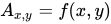
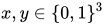
In theoretical computer science, communication complexity studies the amount of communication required to solve a problem when the input to the problem is distributed among two or more parties. The study of communication complexity was first introduced by Andrew Yao in 1979, while studying the problem of computation distributed among several machines.[1] The problem is usually stated as follows: two parties (traditionally called Alice and Bob) each receive a (potentially different) -bit string and . The goal is for Alice to compute the value of a certain function, , that depends on both and , with the least amount of communication between them.

While Alice and Bob can always succeed by having Bob send his whole -bit string to Alice (who then computes the function ), the idea here is to find clever ways of calculating with fewer than bits of communication. Note that, unlike in computational complexity theory, communication complexity is not concerned with the amount of computation performed by Alice or Bob, or the size of the memory used, as we generally assume nothing about the computational power of either Alice or Bob.

This abstract problem with two parties (called two-party communication complexity), and its general form with more than two parties, is relevant in many contexts. In VLSI circuit design, for example, one seeks to minimize energy used by decreasing the amount of electric signals passed between the different components during a distributed computation. The problem is also relevant in the study of data structures and in the optimization of computer networks. For surveys of the field, see the textbooks by Rao & Yehudayoff (2020) and Kushilevitz & Nisan (2006).

Formal definition

[edit]

Let where we assume in the typical case that and . Alice holds an -bit string while Bob holds an -bit string . By communicating to each other one bit at a time (adopting some communication protocol which is agreed upon in advance), Alice and Bob wish to compute the value of such that at least one party knows the value at the end of the communication. At this point the answer can be communicated back so that at the cost of one extra bit, both parties will know the answer. The worst case communication complexity of this communication problem of computing , denoted as , is then defined to be


minimum number of bits exchanged between Alice and Bob in the worst case.

As observed above, for any function , we have . Using the above definition, it is useful to think of the function as a matrix (called the input matrix or communication matrix) where the rows are indexed by and columns by . The entries of the matrix are . Initially both Alice and Bob have a copy of the entire matrix (assuming the function is known to both parties). Then, the problem of computing the function value can be rephrased as "zeroing-in" on the corresponding matrix entry. This problem can be solved if either Alice or Bob knows both and . At the start of communication, the number of choices for the value of the function on the inputs is the size of matrix, i.e. . Then, as and when each party communicates a bit to the other, the number of choices for the answer reduces as this eliminates a set of rows/columns resulting in a submatrix of .

More formally, a set is called a (combinatorial) rectangle if whenever and then . Equivalently, is a combinatorial rectangle if it can be expressed as for some and . Consider the case when bits are already exchanged between the parties. Now, for a particular , let us define a matrix

Then, , and it is not hard to show that is a combinatorial rectangle in .

Example: EQ

[edit]

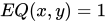
We consider the case where Alice and Bob try to determine whether or not their input strings are equal. Formally, define the Equality function, denoted , by if . As we demonstrate below, any deterministic communication protocol solving requires bits of communication in the worst case. As a warm-up example, consider the simple case of . The equality function in this case can be represented by the matrix below. The rows represent all the possibilities of , the columns those of .

EQ 000 001 010 011 100 101 110 111
000 1 0 0 0 0 0 0 0
001 0 1 0 0 0 0 0 0
010 0 0 1 0 0 0 0 0
011 0 0 0 1 0 0 0 0
100 0 0 0 0 1 0 0 0
101 0 0 0 0 0 1 0 0
110 0 0 0 0 0 0 1 0
111 0 0 0 0 0 0 0 1

In this table, the function only evaluates to 1 when equals (i.e., on the diagonal). It is also fairly easy to see how communicating a single bit divides someone's possibilities in half. When the first bit of is 1, consider only half of the columns (where can equal 100, 101, 110, or 111).

Theorem: D(EQ) = n

[edit]

Proof. Assume that . This means that there exists such that and have the same communication transcript . Since this transcript defines a rectangle, must also be 1. By definition and we know that equality is only true for when . This yields a contradiction.

This technique of proving deterministic communication lower bounds is called the fooling set technique.[2]

Randomized communication complexity

[edit]

In the above definition, we are concerned with the number of bits that must be deterministically transmitted between two parties. If both the parties are given access to a random number generator, can they determine the value of with much less information exchanged? Yao, in his seminal paper[1] answers this question by defining randomized communication complexity.

A randomized protocol for a function has two-sided error.

A randomized protocol is a deterministic protocol that uses an extra random string in addition to its normal input. There are two models for this: a public string is a random string that is known by both parties beforehand, while a private string is generated by one party and must be communicated to the other party. A theorem presented below shows that any public string protocol can be simulated by a private string protocol that uses O(log n) additional bits compared to the original.

In the probability inequalities above, the outcome of the protocol is understood to depend only on the random string; both strings x and y remain fixed. In other words, if R(x,y) yields g(x,y,r) when using random string r, then g(x,y,r) = f(x,y) for at least 2/3 of all choices for the string r.

The randomized complexity is simply defined as the number of bits exchanged in such a protocol.

Note that it is also possible to define a randomized protocol with one-sided error, and the complexity is defined similarly.

Example: EQ

[edit]

Returning to the previous example of EQ, if certainty is not required, Alice and Bob can check for equality using only messages. Consider the following protocol: Assume that Alice and Bob both have access to the same random string . Alice computes and sends this bit (call it b) to Bob. (The is the dot product in GF(2).) Then Bob compares b to . If they are the same, then Bob accepts, saying x equals y. Otherwise, he rejects.

Clearly, if , then , so . If x does not equal y, it is still possible that , which would give Bob the wrong answer. How does this happen?

If x and y are not equal, they must differ in some locations:

Where x and y agree, so those terms affect the dot products equally. We can safely ignore those terms and look only at where x and y differ. Furthermore, we can swap the bits and without changing whether or not the dot products are equal. This means we can swap bits so that x contains only zeros and y contains only ones:

Note that and . Now, the question becomes: for some random string , what is the probability that ? Since each is equally likely to be 0 or 1, this probability is just . Thus, when x does not equal y, . The algorithm can be repeated many times to increase its accuracy. This fits the requirements for a randomized communication algorithm.

This shows that if Alice and Bob share a random string of length n, they can send one bit to each other to compute . In the next section, it is shown that Alice and Bob can exchange only bits that are as good as sharing a random string of length n. Once that is shown, it follows that EQ can be computed in messages.

Example: GH

[edit]

For yet another example of randomized communication complexity, we turn to an example known as the gap-Hamming problem (abbreviated GH). Formally, Alice and Bob both maintain binary messages, and would like to determine if the strings are very similar or if they are not very similar. In particular, they would like to find a communication protocol requiring the transmission of as few bits as possible to compute the following partial Boolean function,

Clearly, they must communicate all their bits if the protocol is to be deterministic (this is because, if there is a deterministic, strict subset of indices that Alice and Bob relay to one another, then imagine having a pair of strings that on that set disagree in positions. If another disagreement occurs in any position that is not relayed, then this affects the result of , and hence would result in an incorrect procedure.

A natural question one then asks is, if we're permitted to err of the time (over random instances drawn uniformly at random from ), then can we get away with a protocol with fewer bits? It turns out that the answer somewhat surprisingly is no, due to a result of Chakrabarti and Regev in 2012: they show that for random instances, any procedure which is correct at least of the time must send bits worth of communication, which is to say essentially all of them.

Public coins versus private coins

[edit]

Creating random protocols becomes easier when both parties have access to the same random string, known as a shared string protocol. However, even in cases where the two parties do not share a random string, it is still possible to use private string protocols with only a small communication cost. Any shared string random protocol using any number of random string can be simulated by a private string protocol that uses an extra O(log n) bits.

Intuitively, we can find some set of strings that has enough randomness in it to run the random protocol with only a small increase in error. This set can be shared beforehand, and instead of drawing a random string, Alice and Bob need only agree on which string to choose from the shared set. This set is small enough that the choice can be communicated efficiently. A formal proof follows.

Consider some random protocol P with a maximum error rate of 0.1. Let be strings of length n, numbered . Given such an , define a new protocol which randomly picks some and then runs P using as the shared random string. It takes O(log 100n) = O(log n) bits to communicate the choice of .

Let us define and to be the probabilities that and compute the correct value for the input .

For a fixed , we can use Hoeffding's inequality to get the following equation:

Thus when we don't have fixed:

The last equality above holds because there are different pairs . Since the probability does not equal 1, there is some so that for all :

Since has at most 0.1 error probability, can have at most 0.2 error probability.

Collapse of Randomized Communication Complexity

[edit]

Let's say we additionally allow Alice and Bob to share some resource, for example a pair of entangled particles. Using that ressource, Alice and Bob can correlate their information and thus try to 'collapse' (or 'trivialize') communication complexity in the following sense.

Definition. A resource is said to be "collapsing" if, using that resource , only one bit of classical communication is enough for Alice to know the evaluation in the worst case scenario for any Boolean function .

The surprising fact of a collapse of communication complexity is that the function can have arbitrarily large entry size, but still the number of communication bit is constant to a single one.

Some resources are shown to be non-collapsing, such as quantum correlations [3] or more generally almost-quantum correlations,[4] whereas on the contrary some other resources are shown to collapse randomized communication complexity, such as the PR-box,[5] or some noisy PR-boxes satisfying some conditions.[6][7][8]

Distributional Complexity

[edit]

One approach to studying randomized communication complexity is through distributional complexity.

Given a joint distribution on the inputs of both players, the corresponding distributional complexity of a function is the minimum cost of a deterministic protocol such that , where the inputs are sampled according to .

Yao's minimax principle[9] (a special case of von Neumann's minimax theorem) states that the randomized communication complexity of a function equals its maximum distributional complexity, where the maximum is taken over all joint distributions of the inputs (not necessarily product distributions!).

Yao's principle can be used to prove lower bounds on the randomized communication complexity of a function: design the appropriate joint distribution, and prove a lower bound on the distributional complexity. Since distributional complexity concerns deterministic protocols, this could be easier than proving a lower bound on randomized protocols directly.

As an example, let us consider the disjointness function DISJ: each of the inputs is interpreted as a subset of , and DISJ(x,y)=1 if the two sets are disjoint. Razborov[10] proved an lower bound on the randomized communication complexity by considering the following distribution: with probability 3/4, sample two random disjoint sets of size , and with probability 1/4, sample two random sets of size with a unique intersection.

Information Complexity

[edit]

A powerful approach to the study of distributional complexity is information complexity. Initiated by Bar-Yossef, Jayram, Kumar and Sivakumar,[11] the approach was codified in work of Barak, Braverman, Chen and Rao[12] and by Braverman and Rao.[13]

The (internal) information complexity of a (possibly randomized) protocol R with respect to a distribution μ is defined as follows. Let be random inputs sampled according to μ, and let Π be the transcript of R when run on the inputs . The information complexity of the protocol is

where I denotes conditional mutual information. The first summand measures the amount of information that Alice learns about Bob's input from the transcript, and the second measures the amount of information that Bob learns about Alice's input.

The ε-error information complexity of a function f with respect to a distribution μ is the infimal information complexity of a protocol for f whose error (with respect to μ) is at most ε.

Braverman and Rao proved that information equals amortized communication. This means that the cost for solving n independent copies of f is roughly n times the information complexity of f. This is analogous to the well-known interpretation of Shannon entropy as the amortized bit-length required to transmit data from a given information source. Braverman and Rao's proof uses a technique known as "protocol compression", in which an information-efficient protocol is "compressed" into a communication-efficient protocol.

The techniques of information complexity enable the computation of the exact (up to first order) communication complexity of set disjointness to be .[14]

Information complexity techniques have also been used to analyze extended formulations, proving an essentially optimal lower bound on the complexity of algorithms based on linear programming which approximately solve the maximum clique problem.[15]

Omri Weinstein's 2015 survey[16] surveys the subject.

Quantum communication complexity

[edit]

Quantum communication complexity tries to quantify the communication reduction possible by using quantum effects during a distributed computation.

At least three quantum generalizations of communication complexity have been proposed; for a survey see the suggested text by G. Brassard.

The first one is the qubit-communication model, where the parties can use quantum communication instead of classical communication, for example by exchanging photons through an optical fiber.

In a second model the communication is still performed with classical bits, but the parties are allowed to manipulate an unlimited supply of quantum entangled states as part of their protocols. By doing measurements on their entangled states, the parties can save on classical communication during a distributed computation (see an application in Collapse of Randomized Communication Complexity).

The third model involves access to previously shared entanglement in addition to qubit communication, and is the least explored of the three quantum models.

Nondeterministic communication complexity

[edit]

In nondeterministic communication complexity, Alice and Bob have access to an oracle. After receiving the oracle's word, the parties communicate to deduce . The nondeterministic communication complexity is then the maximum over all pairs over the sum of number of bits exchanged and the coding length of the oracle word.

Viewed differently, this amounts to covering all 1-entries of the 0/1-matrix by combinatorial 1-rectangles (i.e., non-contiguous, non-convex submatrices, whose entries are all one (see Kushilevitz and Nisan or Dietzfelbinger et al.)). The nondeterministic communication complexity is the binary logarithm of the rectangle covering number of the matrix: the minimum number of combinatorial 1-rectangles required to cover all 1-entries of the matrix, without covering any 0-entries.

Nondeterministic communication complexity occurs as a means to obtaining lower bounds for deterministic communication complexity (see Dietzfelbinger et al.), but also in the theory of nonnegative matrices, where it gives a lower bound on the nonnegative rank of a nonnegative matrix.[17]

Unbounded-error communication complexity

[edit]

In the unbounded-error setting, Alice and Bob have access to a private coin and their own inputs . In this setting, Alice succeeds if she responds with the correct value of with probability strictly greater than 1/2. In other words, if Alice's responses have any non-zero correlation to the true value of , then the protocol is considered valid.

Note that the requirement that the coin is private is essential. In particular, if the number of public bits shared between Alice and Bob are not counted against the communication complexity, it is easy to argue that computing any function has communication complexity.[18] On the other hand, both models are equivalent if the number of public bits used by Alice and Bob is counted against the protocol's total communication.[19]

Though subtle, lower bounds on this model are extremely strong. More specifically, it is clear that any bound on problems of this class immediately imply equivalent bounds on problems in the deterministic model and the private and public coin models, but such bounds also hold immediately for nondeterministic communication models and quantum communication models.[20]

Forster[21] was the first to prove explicit lower bounds for this class, showing that computing the inner product requires at least bits of communication, though an earlier result of Alon, Frankl, and Rödl proved that the communication complexity for almost all Boolean functions is .[22]

Lifting

[edit]

Lifting is a general technique in complexity theory in which a lower bound on a simple measure of complexity is "lifted" to a lower bound on a more difficult measure.

This technique was pioneered in the context of communication complexity by Raz and McKenzie,[23] who proved the first query-to-communication lifting theorem, and used the result to separate the monotone NC hierarchy.

Given a function and a gadget , their composition is defined as follows:

In words, is partitioned into blocks of length , and is partitioned into blocks of length . The gadget is applied times on the blocks, and the outputs are fed into . Diagrammatically:

In this diagram, each of the inputs is a bits long, and each of the inputs is b bits long.

A decision tree of depth for can be translated to a communication protocol whose cost is : each time the tree queries a bit, the corresponding value of is computed using an optimal protocol for . Raz and McKenzie showed that this is optimal up to a constant factor when is the so-called "indexing gadget", in which has length (for a large enough constant c), has length , and is the -th bit of .

The proof of the Raz–McKenzie lifting theorem uses the method of simulation, in which a protocol for the composed function is used to generate a decision tree for . Göös, Pitassi and Watson[24] gave an exposition of the original proof. Since then, several works have proved similar theorems with different gadgets, such as inner product.[25] The smallest gadget which can be handled is the indexing gadget with .[26] Göös, Pitassi and Watson extended the Raz–McKenzie technique to randomized protocols.[27]

A simple modification of the Raz–McKenzie lifting theorem gives a lower bound of on the logarithm of the size of a protocol tree for computing , where is the depth of the optimal decision tree for . Garg, Göös, Kamath and Sokolov extended this to the DAG-like setting,[28] and used their result to obtain monotone circuit lower bounds. The same technique has also yielded applications to proof complexity.[29]

A different type of lifting is exemplified by Sherstov's pattern matrix method,[30] which gives a lower bound on the quantum communication complexity of , where g is a modified indexing gadget, in terms of the approximate degree of f. The approximate degree of a Boolean function is the minimal degree of a polynomial which approximates the function on all Boolean points up to an additive error of 1/3.

In contrast to the Raz–McKenzie proof which uses the method of simulation, Sherstov's proof takes a dual witness to the approximate degree of f and gives a lower bound on the quantum query complexity of using the generalized discrepancy method. The dual witness for the approximate degree of f is a lower bound witness for the approximate degree obtained via LP duality. This dual witness is massaged into other objects constituting data for the generalized discrepancy method.

Another example of this approach is the work of Pitassi and Robere,[31] in which an algebraic gap is lifted to a lower bound on Razborov's rank measure. The result is a strongly exponential lower bound on the monotone circuit complexity of an explicit function, obtained via the Karchmer–Wigderson characterization[32] of monotone circuit size in terms of communication complexity.

Open problems

[edit]

Considering a 0 or 1 input matrix , the minimum number of bits exchanged to compute deterministically in the worst case, , is known to be bounded from below by the logarithm of the rank of the matrix . The log rank conjecture proposes that the communication complexity, , is bounded from above by a constant power of the logarithm of the rank of . Since D(f) is bounded from above and below by polynomials of log rank, we can say D(f) is polynomially related to log rank. Since the rank of a matrix is polynomial time computable in the size of the matrix, such an upper bound would allow the matrix's communication complexity to be approximated in polynomial time. Note, however, that the size of the matrix itself is exponential in the size of the input.

For a randomized protocol, the number of bits exchanged in the worst case, R(f), was conjectured to be polynomially related to the following formula:

Such log rank conjectures are valuable because they reduce the question of a matrix's communication complexity to a question of linearly independent rows (columns) of the matrix. This particular version, called the Log-Approximate-Rank Conjecture, was recently refuted by Chattopadhyay, Mande and Sherif (2019)[33] using a surprisingly simple counter-example. This reveals that the essence of the communication complexity problem, for example in the EQ case above, is figuring out where in the matrix the inputs are, in order to find out if they're equivalent.

Applications

[edit]

Lower bounds in communication complexity can be used to prove lower bounds in decision tree complexity, VLSI circuits, data structures, streaming algorithms, space–time tradeoffs for Turing machines and more.[2]

Conitzer and Sandholm[34] studied the communication complexity of some common voting rules, which are essential in political and non political organizations. Compilation complexity is a closely related notion, which can be seen as a single-round communication complexity.

See also

[edit]

Notes

[edit]

References

[edit]
Revisions and contributorsEdit on WikipediaRead on Wikipedia
from Grokipedia
Communication complexity is a subfield of that quantifies the minimal amount of communication needed among distributed parties, each holding private inputs, to collectively compute a function of those inputs. It focuses on the efficiency of interactive protocols in scenarios where information is decentralized, providing insights into fundamental limits of distributed computation. The field was pioneered by in his 1979 paper, which formalized the two-party model where Alice receives input x{0,1}nx \in \{0,1\}^n and Bob receives y{0,1}ny \in \{0,1\}^n, and they exchange messages to output f(x,y)f(x,y) for some function f:{0,1}n×{0,1}n{0,1}f: \{0,1\}^n \times \{0,1\}^n \to \{0,1\}. The communication complexity of ff is the minimum, over all protocols computing ff, of the worst-case number of bits exchanged, with extensions to randomized protocols (allowing shared and bounded error) and nondeterministic protocols (using existential proofs). Multi-party models, such as the number-on-the-forehead variant, generalize this to kk players where each sees all but their own input. Central problems illustrate the field's depth: the equality function EQ, which checks if x=yx = y, has deterministic complexity Θ(n)\Theta(n) but randomized complexity O(1)O(1); the set disjointness DISJ, determining if two nn-bit sets intersect, requires Ω(n)\Omega(n) communication even under randomization, a landmark result by Razborov (1992). Lower bound techniques include fooling sets, matrix rank (where complexity is at least log\rank(f)\log \rank(f)), discrepancy methods, and information complexity, often yielding tight bounds like Θ(n)\Theta(n) for DISJ. Beyond theory, communication complexity yields impossibility results in diverse areas, including Ω(n)\Omega(n) space lower bounds for streaming algorithms estimating frequency moments, depth lower bounds for monotone circuits, and communication barriers in distributed graph algorithms like triangle detection (Ω(n2)\Omega(n^2)). It also connects to , extension complexity, and proof systems, underscoring its role in revealing inherent trade-offs in computational models.

Deterministic Communication Complexity

Formal Definition

In the deterministic two-party communication model, introduced by Yao, Alice receives an input x{0,1}nx \in \{0,1\}^n and Bob receives an input y{0,1}ny \in \{0,1\}^n, and their goal is to compute the value of a fixed Boolean function f:{0,1}n×{0,1}n{0,1}f: \{0,1\}^n \times \{0,1\}^n \to \{0,1\} by exchanging bits of information. A deterministic protocol π\pi for ff is represented as a binary protocol tree, where each internal node specifies a bit position for one party to send (Alice sends a bit of her input if the node is hers, and similarly for Bob), the edges are labeled by the possible bit values (0 or 1), and each leaf is labeled with the output value f(x,y)f(x,y). For any inputs (x,y)(x,y), the execution follows the unique path from the root to a leaf determined by the bits revealed along the way, ensuring the output at the leaf equals f(x,y)f(x,y). The communication cost of a protocol π\pi is the worst-case number of bits exchanged over all inputs, which equals the depth of the (the length of the longest root-to- path). The deterministic communication complexity of ff, denoted D(f)D(f), is the minimum cost over all deterministic protocols that correctly compute ff. Equivalently, D(f)=log2(f)D(f) = \lceil \log_2 \ell(f) \rceil, where (f)\ell(f) is the minimum number of leaves in any for ff, since each corresponds to a unique transcript of the communication. The function ff can also be represented by its communication matrix MfM_f, a 2n×2n2^n \times 2^n matrix where rows are indexed by Alice's possible inputs xx, columns by Bob's inputs yy, and each entry (Mf)x,y=f(x,y)(M_f)_{x,y} = f(x,y). In any deterministic protocol, the sets of input pairs leading to the same transcript form combinatorial rectangles in this matrix: a subset R{0,1}n×{0,1}nR \subseteq \{0,1\}^n \times \{0,1\}^n is a rectangle if it is a Cartesian product A×BA \times B for some A{0,1}nA \subseteq \{0,1\}^n and B{0,1}nB \subseteq \{0,1\}^n. Moreover, each such rectangle corresponding to a transcript must be monochromatic, meaning f(x,y)f(x,y) is constant for all (x,y)R(x,y) \in R. The protocol thus partitions the entire matrix into at most 2D(f)2^{D(f)} monochromatic rectangles. This rectangularity property is a cornerstone of the model, linking the combinatorial structure of MfM_f to the communication requirements.

Basic Examples

One canonical example in deterministic communication complexity is the equality function, denoted EQ_n, defined on inputs ∈ {0,1}^n where EQ_n(x, y) = 1 if and only if x = y. A deterministic protocol for computing EQ_n has Alice send the bits of her input x one by one. After receiving each bit x_i, if x_i ≠ y_i, Bob sends a 1-bit message indicating "not equal" and the protocol halts with output 0; otherwise, Alice continues. If all n bits are sent without interruption, both parties know the inputs are equal and output 1. This protocol has a worst-case communication cost of n bits. This cost is optimal, as the deterministic communication complexity of EQ_n is n. To understand the lower bound, consider the communication matrix M for EQ_n, a 2^n × 2^n matrix with rows indexed by possible x values, columns by y values, and M_{x,y} = 1 precisely when x = y (i.e., along the ) and 0 otherwise. Any deterministic protocol induces a partition of this matrix into monochromatic rectangles, where each rectangle consists of rows R ⊆ {0,1}^n and columns C ⊆ {0,1}^n such that M_{x,y} is constant for all x ∈ R and y ∈ C. For the 1-entries, each must lie in a separate monochromatic rectangle, as no two 1-entries share a row or column; thus, at least 2^n such rectangles are required to cover all 1-entries. The communication complexity is at least the logarithm (base 2) of the number of leaves in the protocol tree, which equals the number of monochromatic rectangles in the partition, yielding a lower bound of n bits. A related basic example is the AND function on n bits, defined with Alice holding x = (x_1, ..., x_n) ∈ {0,1}^n and Bob holding y = (y_1, ..., y_n) ∈ {0,1}^n, where the output is ∧_{i=1}^n (x_i = y_i), which is equivalent to the equality function EQ_n and thus also requires n communication in the deterministic setting. The communication matrix for this function mirrors that of EQ_n, leading to the same monochromatic rectangle partition argument and lower bound of n bits. Another fundamental example is the disjointness function DISJ_n, where Alice holds a subset A ⊆ represented as its characteristic vector x ∈ {0,1}^n, Bob holds B ⊆ as y ∈ {0,1}^n, and DISJ_n(x, y) = 1 if and only if A ∩ B = ∅. An efficient deterministic protocol has Alice send the bits of her vector x one by one. After each bit x_i, if x_i = y_i = 1, Bob sends a 1-bit message indicating "intersect" and halts with output 0; otherwise, Alice continues. If all n bits are sent without interruption, both output 1 (disjoint). This achieves n bits in the worst case. The deterministic communication complexity of DISJ_n is Θ(n). The lower bound for DISJ_n follows from the structure of its 2^n × 2^n communication matrix M, where M_{x,y} = 1 if x and y have no overlapping 1-bits. Any deterministic protocol partitions M into monochromatic rectangles. A key insight is that the rank of M over the reals is 2^n (full rank), and since the deterministic communication complexity is at least the logarithm of the rank of the communication matrix, at least n bits are required. This full-rank property implies that no fewer than 2^n monochromatic rectangles can partition the matrix, as lower-rank matrices admit coarser partitions. Randomized protocols, such as those using hashing or fingerprinting, can reduce the complexity for EQ_n (and thus the AND function) to O(1) expected bits, but these fall outside the deterministic model.

Key Theorems and Bounds

One fundamental lower bound technique in deterministic communication complexity is the fooling set method. For a boolean function f:X×Y{0,1}f: \mathcal{X} \times \mathcal{Y} \to \{0,1\}, a fooling set FX×YF \subseteq \mathcal{X} \times \mathcal{Y} is a set of pairs such that f(xi,yi)=zf(x_i, y_i) = z for all (xi,yi)F(x_i, y_i) \in F (where z{0,1}z \in \{0,1\}), and for any distinct (xi,yi),(xj,yj)F(x_i, y_i), (x_j, y_j) \in F, there exists either (xi,yj)(x_i, y_j) or (xj,yi)(x_j, y_i) with ff evaluating to 1z1-z. This ensures no two elements of FF can lie in the same monochromatic rectangle of a deterministic protocol. The size of the largest such fooling set, denoted fool(f)\mathsf{fool}(f), satisfies D(f)log2fool(f)D(f) \geq \log_2 \mathsf{fool}(f), as the protocol must distinguish these pairs using at least log2F\log_2 |F| bits to separate them into distinct leaves of the protocol tree. This method was introduced by Aho, Ullman, and Yannakakis in their work on information transfer in VLSI circuits. A canonical application is the equality function EQn:{0,1}n×{0,1}n{0,1}\mathsf{EQ}_n: \{0,1\}^n \times \{0,1\}^n \to \{0,1\}, defined by EQn(x,y)=1\mathsf{EQ}_n(x,y) = 1 if and only if x=yx = y. The set F={(x,x)x{0,1}n}F = \{(x,x) \mid x \in \{0,1\}^n\} forms a 1-fooling set of size 2n2^n, since EQn(x,x)=1\mathsf{EQ}_n(x,x) = 1 for all such pairs, but for xxx \neq x', EQn(x,x)=0\mathsf{EQ}_n(x,x') = 0. Thus, D(EQn)nD(\mathsf{EQ}_n) \geq n. The sequential protocol described above achieves the upper bound of n bits. Thus, D(EQn)=nD(\mathsf{EQ}_n) = n. Another key lower bound arises from the linear algebra method using the communication matrix MfM_f, whose rows index Alice's inputs, columns index Bob's inputs, and entries are f(x,y)f(x,y). The deterministic communication complexity satisfies log2\rank(Mf)D(f)log2\rank(Mf)+1,\log_2 \rank(M_f) \leq D(f) \leq \log_2 \rank(M_f) + 1, where rank is the rank over the reals (or any field). The lower bound follows because a protocol with c bits partitions MfM_f into at most 2c2^c rank-1 monochromatic rectangles, so \rank(Mf)2c\rank(M_f) \leq 2^c. The upper bound is obtained via a protocol where one party sends a basis for the row space or similar linear encoding. This technique is particularly effective for functions where MfM_f has provably high rank, such as those related to geometric problems or combinatorial designs. The bound originates from early linear algebraic analyses in the field. For additional lower bounds in the deterministic setting, the corruption method (or its variants) measures how much a protocol's output distribution changes when inputs are slightly perturbed. In the deterministic case, a simple corruption bound relates the number of input pairs sensitive to a single bit flip to the required communication: if χ(f)\chi(f) denotes the minimum over bits of the fraction of pairs where flipping that bit changes ff, then D(f)=Ω(log(1/χ(f)))D(f) = \Omega(\log(1/\chi(f))). This captures functions robust to small input changes as potentially low-complexity. More refined versions connect to discrepancy and are detailed in works bridging linear algebra and protocol analysis. Trivially, for any f:{0,1}n×{0,1}n{0,1}f: \{0,1\}^n \times \{0,1\}^n \to \{0,1\}, D(f)2nD(f) \leq 2n: Alice sends her n-bit input to Bob, who computes f(x,y)f(x,y) and sends the 1-bit output (or both parties exchange full inputs for verification). This universal protocol establishes an absolute upper bound, though tighter ones exist for specific functions like EQn\mathsf{EQ}_n.

Randomized Communication Complexity

Definitions and Models

In randomized communication complexity, protocols allow Alice and Bob to use to compute a function f:X×Y{0,1}f: X \times Y \to \{0,1\}, where the inputs are distributed between them, and the output is correct with high probability over the randomness. A randomized protocol specifies that the parties' actions depend on their inputs and random bits, ensuring correctness with probability at least 2/32/3 for every input pair, where the probability is taken over the random bits used in the protocol. This model extends the deterministic setting, which can be viewed as a special case with no . The bounded-error randomized communication complexity, denoted R(f)R(f), is the minimum communication cost over all randomized protocols that compute ff with error at most 1/31/3 on every input. More generally, Rϵ(f)R^\epsilon(f) denotes the minimum cost for protocols with error bounded by ϵ<1/2\epsilon < 1/2. These definitions typically consider two-sided error, where the protocol may err on both yes and no instances of ff. In contrast, the zero-error randomized complexity R(f)R^\infty(f) (or R0(f)R_0(f)) requires protocols that are always correct on every input, though randomness is permitted to reduce the worst-case communication; it satisfies D(f)R(f)R(f)D(f) \leq R^\infty(f) \leq R(f), where D(f)D(f) is the deterministic complexity. Randomized protocols can employ either public coins, where Alice and Bob share a common random string visible to both, or private coins, where each party generates independent random bits unknown to the other. The public-coin model often simplifies analysis, as shared randomness simulates a distribution over deterministic protocols. By Yao's minimax principle, the bounded-error complexity satisfies R(f)=maxμminπC(π,μ)R(f) = \max_\mu \min_\pi C(\pi, \mu), where the maximum is over input distributions μ\mu, the minimum is over randomized protocols π\pi, and C(π,μ)C(\pi, \mu) is the expected communication cost of π\pi under μ\mu.

Examples and Protocols

One prominent example of how randomness can drastically reduce communication complexity is the equality function EQ_n, where Alice holds an n-bit string x and Bob holds y, and they must determine if x = y. In the deterministic setting, the communication complexity is Θ(n), as Alice may need to send her entire input in the worst case. However, with public randomness, a fingerprinting protocol achieves R^{pub}(EQ_n) = O(\log n). The protocol proceeds as follows: using shared randomness, they select a random prime p from a suitable range (e.g., around n^2) and a random seed for a universal hash function; Alice computes and sends the O(\log n)-bit fingerprint of x modulo p, and Bob verifies if it matches that of y. The error probability is at most 1/n due to the low collision probability of the hash, and repetition can reduce it further if needed. Another key example is the Gap-Hamming Distance (GHD_n) problem, a promise problem where Alice and Bob, holding x, y ∈ {0,1}^n, must distinguish whether the Hamming distance d(x,y) ≤ n/2 - √n (low case) or d(x,y) ≥ n/2 + √n (high case). The randomized communication complexity is Θ(n). A protocol achieving the O(n) upper bound uses public randomness to generate s = Θ(n) biased random vectors r_j ∈ {0,1}^n (each coordinate 1 with probability ≈ 1/n), for j = 1 to s. Alice computes and sends the s-bit string of inner products ⟨x, r_j⟩ mod 2 (one bit each). Bob computes ⟨y, r_j⟩ mod 2 locally and estimates the fraction of positions where ⟨x, r_j⟩ ≠ ⟨y, r_j⟩ mod 2, which equals ⟨x ⊕ y, r_j⟩ mod 2. This fraction approximates d(x,y)/n with sufficient accuracy to resolve the gap, due to concentration properties of the biased parities. The total communication is O(n) bits with constant error probability. For set disjointness DISJ_n, where Alice and Bob hold subsets A, B ⊆ (represented as characteristic vectors in {0,1}^n) and must decide if A ∩ B = ∅, the deterministic complexity is Θ(n). A naive randomized sampling protocol, using public randomness to select O(√n) random indices from , requires Alice to send the O(√n \log n)-bit list of indices in A ∩ sample (encoding each index in \log n bits); Bob checks for overlaps with his sample. This detects large intersections via birthday paradox-like collisions but fails for small intersections, yielding high error. However, the exact randomized complexity is R(DISJ_n) = Θ(n), with the O(n) upper bound achieved trivially by Alice sending her entire set. The Ω(n) lower bound can be established via the discrepancy method: the discrepancy of DISJ_n is 2^{-\Omega(n)}, implying R(DISJ_n) = \Omega(\log(1/\disc(DISJ_n))) = \Omega(n) by the connection between discrepancy and randomized complexity (full proof via direct or corruption arguments in advanced settings).

Public vs Private Randomness

In the public-coin model of randomized communication complexity, Alice and Bob have access to a shared infinite random string, which they can use jointly during the protocol execution. This shared randomness allows them to coordinate without additional communication for random choices. In contrast, the private-coin model provides each party with their own independent infinite source of private randomness, which the other party cannot access directly. Public coins are at least as powerful as private coins, since the parties can simulate private randomness by partitioning the shared string into separate portions for each. The public-coin model can achieve strictly lower communication in some cases; for the equality function on nn-bit inputs, a public-coin protocol uses O(1)O(1) communication by having the parties share a random hash function and Alice send the hash of her input for Bob to compare. A private-coin protocol for equality, relying on independent hashing (such as Alice selecting and sending a random prime along with her input modulo that prime), requires Θ(logn)\Theta(\log n) communication. Despite such gaps, the models are computationally equivalent up to a logarithmic factor, as established by Newman's theorem. Newman's theorem states that any public-coin protocol with communication complexity CC can be transformed into a private-coin protocol with communication complexity at most C+O(logn)C + O(\log n), where nn is the input size. The proof works by amplifying the private randomness: the party with higher-entropy private coins publicly broadcasts a short seed (using O(logn)O(\log n) bits) that allows the other party to generate an approximation of that randomness distribution, ensuring the protocol's error probability remains bounded. This simulation shows that public coins can emulate private coins with only a small overhead. For most computational tasks in communication complexity, public-coin protocols suffice due to this near-equivalence, allowing researchers to focus on the simpler shared-randomness model without loss of generality up to logarithmic factors. Private coins, however, offer advantages in information-theoretic settings, where the shared randomness in public-coin protocols could inadvertently leak information about the inputs beyond the communicated bits.

Advanced Concepts

In randomized communication complexity, a key result establishing equivalence between models involves the collapse to distributional complexity. By Newman's theorem, any public-coin randomized protocol can be simulated by a private-coin protocol with only an additive increase of O(logn)O(\log n) bits in communication, assuming the input distribution has entropy Ω(n)\Omega(n), where nn is the input size. Combined with hardness amplification techniques that boost the entropy of hard distributions, this implies that the public-coin randomized complexity Rpub(f)R^{\text{pub}}(f) collapses to the distributional complexity up to constant factors. Distributional complexity provides a fundamental lower bound tool for randomized protocols. For a function ff, distribution μ\mu over inputs, and error parameter ε>0\varepsilon > 0, the ε\varepsilon-distributional complexity DCε(μ,f){\rm DC}^\varepsilon(\mu, f) is the minimum cost of a deterministic protocol that computes ff correctly on all but an ε\varepsilon-fraction of the inputs under μ\mu. By Yao's minimax principle, the public-coin randomized complexity satisfies Rpub(f)maxμDC1/3(μ,f)R^{\text{pub}}(f) \approx \max_\mu {\rm DC}^{1/3}(\mu, f), up to logarithmic factors, reducing the problem of proving randomized lower bounds to finding hard input distributions. Information complexity offers a finer-grained measure that captures the revealed during communication and yields direct lower bounds on randomized complexity. For a protocol π\pi, distribution μ\mu, and error ε\varepsilon, the ε\varepsilon- complexity ICε(μ,f,π){\rm IC}^\varepsilon(\mu, f, \pi) is the I(XY;Πμ)I(XY ; \Pi | \mu), where X,YX, Y are Alice's and Bob's inputs, and Π\Pi is the protocol transcript under π\pi and μ\mu. The complexity of ff under μ\mu is the minimum over all ε\varepsilon-error protocols π\pi, and it lower bounds the randomized communication complexity R(f)R(f) since the transcript must reveal sufficient to compute ff with low error. A significant property of information complexity is its direct sum theorem, which addresses composition of functions. For kk independent copies of ff, denoted fkf^k, the information complexity satisfies IC(fk)kIC(f)o(k){\rm IC}(f^k) \geq k \cdot {\rm IC}(f) - o(k), implying that solving multiple instances requires nearly kk times the information of a single instance, unlike some communication measures that may subadditively scale. This separation highlights the cost of parallel computation in interactive settings. Hardness amplification techniques, often leveraging discrepancy, further strengthen lower bounds by converting mildly hard distributions into strongly hard ones for rectangle-based arguments. The hereditary discrepancy disc(f)\text{disc}(f) of a function ff measures the minimum over all signings of the maximum imbalance in any combinatorial , and low discrepancy implies high communication complexity via bounds on the size of monochromatic rectangles in the communication matrix. Amplification via theorems or XOR lemmas preserves or boosts this hardness, enabling tight lower bounds; for instance, these methods have been applied to establish Ω(n)\Omega(n) bounds for the disjointness function in randomized protocols.

Quantum Communication Complexity

Basics and Protocols

In the quantum communication complexity model, two parties—Alice holding input xx and Bob holding input yy—aim to compute a function f(x,y)f(x, y) by exchanging qubits over a . Protocols consist of alternating rounds where each performs local unitary operations on their qubits (including the input encoded as a and any communication qubits), followed by sending a to the other , and concluding with a to output the result. The quantum communication complexity Q(f)Q(f) is defined as the minimum number of qubits exchanged in the worst case over all inputs, such that the protocol computes f(x,y)f(x, y) correctly with probability at least 2/32/3. Unlike classical bits, qubits enable superposition, allowing parties to process multiple possibilities in parallel within a single message, which can lead to more efficient encodings of input-dependent information. Protocols may also incorporate shared entanglement, such as Einstein-Podolsky-Rosen (EPR) pairs, as a prior resource that does not count toward the communication cost but assists in the computation; this variant is often denoted Q(f)Q^*(f). For instance, shared EPR pairs allow for , where two classical bits can be transmitted using one . A foundational example is the equality function EQn(x,y)=1EQ_n(x, y) = 1 if x=yx = y and 0 otherwise, for nn-bit strings. The quantum fingerprinting protocol provides an efficient solution in the simultaneous message model (where both parties send messages to a without interaction), requiring only O(logn)O(\log n) qubits per party. Alice and Bob each create a quantum fingerprint state ϕx=1mi=1miUix|\phi_x\rangle = \frac{1}{\sqrt{m}} \sum_{i=1}^m |i\rangle |U_i x\rangle
Add your contribution
Related Hubs
Contribute something
User Avatar
No comments yet.