Hubbry Logo
Cornus capitataCornus capitataMain
Open search
Cornus capitata
Community hub
Cornus capitata
logo
8 pages, 0 posts
0 subscribers
Be the first to start a discussion here.
Contribute something
Cornus capitata
Cornus capitata
from Wikipedia

Cornus capitata
Scientific classification Edit this classification
Kingdom: Plantae
Clade: Tracheophytes
Clade: Angiosperms
Clade: Eudicots
Clade: Asterids
Order: Cornales
Family: Cornaceae
Genus: Cornus
Subgenus: Cornus subg. Syncarpea
Species:
C. capitata
Binomial name
Cornus capitata
Synonyms

Benthamia fragifera
Benthamidia capitata
Dendrobenthamia capitata

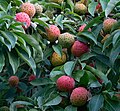
Cornus capitata is a species of dogwood known by the common names Bentham's cornel, evergreen dogwood, Himalayan flowering dogwood, and Himalayan strawberry-tree.[2] It is native to the low-elevation woodlands of the Himalayas in China, India, Pakistan, Nepal, and Bhutan. It is naturalized in parts of Australia and New Zealand, but is also grown elsewhere as an ornamental. This is an evergreen tree growing to 12 meters in height and width. The leaves are gray-green and pale and fuzzy underneath, and several centimeters long. It flowers during the summer in white blooms. The infructescence is a small aggregate of several individual fruits fused into a red body 2 or 3 centimeters across. It is edible but sometimes bitter. There are several varieties and hybrids.

The species is naturalised in the states of New South Wales and Victoria in Australia.[2]

The common name Bentham's cornel derives from the alternative label Benthamia fragifera, coined by John Lindley in honour of fellow botanist George Bentham.[3]

References

[edit]
[edit]
Revisions and contributorsEdit on WikipediaRead on Wikipedia
from Grokipedia
Cornus capitata, commonly known as the Himalayan strawberry tree or dogwood, is an to semi- or small in the dogwood , Cornaceae, native to the Himalayan and parts of eastern . It typically grows 6–15 meters tall with a bushy, spreading habit, featuring horizontal branches, leathery opposite leaves that are ovate to lanceolate (5–12 cm long), dark green above and gray-green below, and showy inflorescences with creamy white to pale yellow bracts surrounding tiny white flowers, followed by edible, strawberry-shaped crimson fruits (2–3 cm across). It is assessed as Least Concern by the IUCN. Taxonomically, C. capitata belongs to the genus Cornus, with the species epithet "capitata" referring to the head-like clustering of its bracts. It was first described by Nathaniel Wallich in 1825, with synonyms including Benthamia fragifera and Dendrobenthamia capitata. The plant includes subspecies such as C. capitata subsp. capitata and subsp. emeiensis, and it is distinguished from other dogwoods by its evergreen foliage and tropical affinity within the temperate genus. Native to mixed and forests in the temperate at elevations of 1,000–3,200 meters, C. capitata occurs across , (Guizhou, , , ), (including and the western and ), , , , and extends to , , and . It thrives in deep shade with organically rich, well-drained soils and mild, humid conditions, often in association with other broadleaf s. The species has been introduced to regions like , , and parts of and , where it is valued in cultivation for its ornamental bracts, fruits, and foliage, though it prefers USDA zones 8–9 and can suffer leaf drop in harsh winters. Notable for its ecological role in attracting birds with its fruits and its low-maintenance nature in suitable climates, C. capitata blooms from May to , producing s up to 8 cm long that mimic large flowers, and its berries ripen in autumn, turning from green to vibrant red. It exhibits deer tolerance and resistance to serious pests or diseases, making it a popular choice for coastal gardens in mild areas, with cultivars like 'Mountain Moon' selected for enhanced size.

Taxonomy

Classification

Cornus capitata is classified within the kingdom Plantae, phylum Tracheophyta, class Magnoliopsida, order Cornales, family Cornaceae, genus , and species C. capitata. The species is placed in the subgenus Syncarpea (previously recognized as such, now defined phylogenetically as the Syncarpea ), which is distinguished from the typical deciduous dogwoods of subgenus Cornus by features such as large petaloid bracts and fused red fruits forming a compound . Historically, Cornus capitata was classified under the Benthamia as Benthamia capitata following its initial in , and later as Dendrobenthamia capitata in the mid-20th century. Its reclassification into the Cornus occurred in the late 20th century, supported by morphological evidence of shared structures and molecular phylogenetic analyses demonstrating the of , including the big-bracted encompassing Syncarpea. These studies utilized extensive genomic , such as 312 nuclear genes and RAD-Seq loci, to resolve relationships within Cornaceae and confirm the inclusion of former segregate genera. Subspecies recognition for C. capitata varies across taxonomic authorities. According to (Kew Science), two subspecies are accepted: C. capitata subsp. capitata, distributed from to south-central , and C. capitata subsp. angustata, endemic to southern . Other treatments, such as in the , recognize C. capitata subsp. emeiensis and subsp. brevipedunculata. The subspecies differ morphologically; for example, subsp. angustata is characterized by narrower leaves (typically 1–3 cm wide) compared to the broader leaves (up to 5 cm wide) of subsp. capitata.

Synonyms and etymology

The scientific name Cornus capitata originates from the genus , derived from the Latin word for "horn," alluding to the exceptional hardness and density of the wood in cornel trees. The specific epithet capitata comes from the Latin capitatus, meaning "having a head" or "head-like," a reference to the dense, clustered arrangement of the that resembles a compact head. Common names for Cornus capitata reflect its distinctive features and origins, including Bentham's cornel—honoring George Bentham—evergreen dogwood, Himalayan flowering dogwood, and Himalayan strawberry-tree, the latter evoking the fruit's strawberry-like appearance. The species was first formally described by Wallich in 1820 as Cornus capitata in his edition of William Roxburgh's Flora Indica. Subsequent nomenclatural history includes several synonyms arising from reclassifications and morphological observations. Notably, Benthamia fragifera was proposed by in 1833, honoring George Bentham while using fragifera (Latin for "strawberry-bearing") to describe the fruit's resemblance to those of the genus . Other synonyms encompass Benthamidia capitata (Wall.) Hara and Dendrobenthamia capitata (Wall.) Hutch., which stemmed from 19th- and 20th-century attempts to place the species in distinct genera based on its evergreen habit and inflorescence structure before its reinstatement in .

Description

Growth form

Cornus capitata is a broadleaf or small that typically attains heights of 6 to 12 meters (20 to 40 feet) with a comparable spread, though it can reach up to 15 meters in optimal conditions. It exhibits a medium growth rate, developing gradually into a mature form over several decades. The often grows multi-stemmed from the base, forming a bushy, spreading habit with horizontal branches that create a rounded or low canopy. Young stems are grayish-green and pubescent with white appressed trichomes, becoming grayish-brown and slightly fissured on older branches with age. Its dense, horizontal branching enhances wind resistance, aiding survival in exposed high-elevation environments.

Leaves and bark

The leaves of Cornus capitata are arranged oppositely on the stems and are simple, structures that persist year-round, contributing to the plant's in subtropical to temperate climates. They are typically elliptic to ovate or lanceolate in shape, measuring 5–12 cm in length and 2–4 cm in width, with a leathery to thinly leathery texture that provides durability against environmental stress. The upper surface is dark green and glabrous or slightly scabrous, while the lower surface is gray-green and densely covered in pale, fuzzy, appressed white trichomes, giving it a tomentose appearance. Venation is pinnate, with 3–4 pairs of secondary veins that arch toward the margins, often appearing nearly parallel due to their close spacing and looping near the edge; the margins themselves are entire, though occasionally slightly curled upward, which can make the leaves appear narrower. Seasonal changes in the foliage are minimal owing to its nature, but older leaves may develop purplish or reddish tinges in fall before some drop in spring, while new growth emerges with a brighter green flush. The bark of C. capitata is thin and develops on mature trees as brown to blackish gray or grayish brown in color, with young branches showing a grayish hue and pubescence from appressed trichomes. On older stems, it exfoliates in patches, creating a mottled pattern of tan, gray, and occasionally revealing lighter inner layers, which adds ornamental interest during winter. The bark and branches are rich in , historically utilized in medicinal and tanning applications.

Flowers

The of Cornus capitata is a terminal, dense capitulum or globose cyme, forming a hemispherical head 1–2 cm in diameter that spans 5–10 cm overall when including the subtending bracts. It comprises 50–100 tiny, bisexual flowers clustered tightly at the apex of young shoots. These inflorescences emerge singly or in small groups, with the floral display dominated by 4–6 (rarely more) large, petal-like bracts that surround and conceal the inconspicuous true flowers. The bracts are ovate to rounded, pointed at the apex, and measure 2–5 cm long by 3–4 cm wide, providing a striking visual contrast against the foliage. Each true flower is minute, 2–3 mm across, and consists of a tubular calyx about 1 mm long with four small sepals and four petals approximately 3 mm in length, often appearing yellowish- in color. The flowers are perfect and hermaphroditic, facilitating self-compatibility though the species is primarily . The bracts persist for 5–7 days after , outlasting the individual flowers, which remain open for 1–2 days each, extending the overall capitulum display to 3–4 days. Blooming in Cornus capitata occurs from late spring to early summer, typically early May to mid-June in its native Himalayan range, aligning with peak pollinator activity. The flowers produce minute quantities of nectar as a reward and emit low levels of volatiles—12 compounds identified, including 4-ethylbenzoic acid as the dominant (26.42%)—resulting in a mild fragrance detectable primarily by insects, though often imperceptible to humans. This combination of visual bracts and olfactory cues effectively attracts pollinators such as bees.

Fruits and seeds

The fruits of Cornus capitata consist of an aggregate of drupes that fuse into a strawberry-like syncarp, typically measuring 2-3 cm in diameter. These pendent, fleshy structures turn bright red upon ripening and are ornamentally attractive as well as a source for birds. Fruit development follows the flowering period, with the syncarps maturing in late summer to autumn (August-October) and often persisting on the branches into winter. Each within the syncarp encloses a single hard-coated , forming a bony . exhibit that requires presowing treatments such as stratification for germination, with viability ranging from 63-83% depending on and storage conditions, potentially lasting up to 2 years under proper moist cold stratification. The fruit flesh is technically for humans but is often bitter or due to high content (approximately 21 mg GAE/g in condensed ). Nutritionally, it provides antioxidants such as phenolics (27 mg GAE/g) and supports health through bioactive compounds, though levels are notable in related species. Seeds are primarily dispersed by birds that consume the fruits.

Distribution and habitat

Native range

Cornus capitata is native to the Himalayan region and adjacent areas, occurring in (northern regions and ), , , , , , and (South-Central and Southeast, including the provinces of , , Xizang (), and ). The species grows at elevations ranging from 1,000 to 3,200 meters above , primarily in subtropical to temperate and mixed forests, often on slopes under deep shade. In these habitats, the climate is characterized by cool, moist summers with average temperatures around 25°C and mild winters averaging 10°C, accompanied by occasional ; annual rainfall typically falls between 1,000 and 2,000 mm.

Introduced populations

_Cornus capitata has become naturalized in parts of and following introductions as an in the 19th century. In , it is established in temperate southeastern regions, including (such as the upper Blue Mountains) and Victoria (such as the and near Mount Beauty). In , it is naturalized in various areas, where it was introduced for horticultural purposes and has since spread beyond cultivation. The species is widely planted as an ornamental in , particularly in mild coastal regions of the (such as ) and , where it was first introduced from the in 1825 and thrives in gardens with suitable microclimates. In the United States, it is cultivated in USDA hardiness zones 8-9, including the , where it serves as a landscape tree or shrub valued for its evergreen foliage and showy fruits. It is also grown ornamentally in parts of , including , in regions with compatible climates. Spread of C. capitata in introduced areas primarily occurs through bird-dispersed seeds from garden plantings, enabling establishment in nearby s and disturbed sites. This dispersal mechanism contributes to its potential weedy status in mild, temperate climates, though it remains confined to localized populations. Ecological impacts are minor, with some competition observed in woodland habitats where it may displace native species, but C. capitata is not classified as invasive on a global scale and is not widely regulated.

Ecology

Habitat requirements

Cornus capitata thrives in the of and mixed forests across its native Himalayan range, typically at elevations from 1,000 to 3,200 meters, where it encounters moderate environmental conditions. In natural settings, the species prefers well-drained loamy or sandy soils that retain moderate moisture without becoming waterlogged, though it can tolerate heavier clay soils if drainage is adequate. It favors acidic to neutral levels between 5.5 and 7.0 but demonstrates adaptability to mildly alkaline conditions up to pH 8.0. The plant accommodates partial shade to full sun exposure, reflecting its occurrence in light woodland and open forest edges. Temperature tolerances align with , enduring minima of -10°C during , with potential damage from prolonged exposure below -15°C. Water needs are moderate, with a preference for consistently moist soils in humid forest environments; once established, it exhibits some drought tolerance but remains vulnerable to extended dry spells that stress its evergreen foliage.

Reproduction and pollination

Cornus capitata exhibits an entomophilous pollination syndrome, relying primarily on insect vectors for pollen transfer. The main pollinators are bees of the genus Anthophora, which account for approximately 88–91% of floral visits, with syrphid flies (Eristalis arbustorum) comprising a smaller but notable portion of visitors. Thrips have also been observed as secondary pollinators in some populations. The showy white bracts surrounding the inflorescence play a critical role in attracting these pollinators by providing high visual contrast against the foliage, with a color distance of 0.26 units and 72.9% green contrast; experimental removal of bracts reduced bee approaches by 83%. The breeding system of C. capitata is predominantly , promoting through xenogamy, though some self-compatibility exists via and . Studies indicate no fruit set from manual in controlled experiments (0% success), confirming obligate dependence on pollinators in certain populations, while open-pollinated flowers achieve a natural fruit set of about 30.8%. is absent in this species, with individuals being hermaphroditic. occurs primarily from outcrossed fruits, with significant differences in seed set between natural and selfing treatments (t = 11.84, p < 0.01). Fruits develop over 4-6 months post- in native ranges. Seed production in C. capitata is variable but can be substantial under favorable conditions, with each producing 4.0 × 10⁷ to 9.3 × 10⁷ grains annually to support high potential yields. of requires cold moist stratification, typically for 30–90 days at around 4°C, to overcome ; rates vary from 10% to over 70% under optimal conditions with or without additional treatments, and can be slow (up to 18 months) for stored ; without stratification, is often poor. Flowering phenology in C. capitata is adapted for efficiency, with peaking synchronously between 08:00 and 10:00 across flowers within an , influenced by micro-environmental factors such as light and temperature (F = 243.8, p < 0.001). Across populations, flowering typically spans early May to mid-June in native Himalayan ranges, though initiation can begin as early as in warmer sites, ensuring temporal overlap with peak activity. Individual flowers last 1–2 days, while the capitulum persists for 3–4 days, facilitating concentrated pollinator visits.

Ecological interactions

_Cornus capitata engages in primarily through zoochory, where its fleshy, strawberry-like fruits are consumed by birds such as thrushes and various mammals, facilitating long-distance spread across forested landscapes. The bright red, edible berries ripen in late summer to fall, attracting frugivores that ingest the pulp and excrete viable seeds away from the parent plant, enhancing colonization in suitable habitats. The species is susceptible to several pests and diseases that influence its interactions within ecosystems, including borers, such as the dogwood borer (Synanthedon scitula), which tunnel into the bark and , weakening the tree and creating entry points for pathogens. infestations occur occasionally, but these are often regulated by natural predators like ladybugs (), which feed on the and help maintain population balance without significant long-term damage. Mutualistic relationships are prominent, with C. capitata forming arbuscular mycorrhizal associations with fungi that enhance nutrient uptake, particularly , from nutrient-poor Himalayan soils. The flowers provide resources for various insects, supporting communities and contributing to trophic interactions in layers. As a mid-story or small in montane forests, it bolsters by offering structural , , and winter fruits that sustain and food webs during scarce periods.

Cultivation and uses

Growing conditions

Cornus capitata performs best in sites offering full sun to dappled shade, where it can receive at least six hours of direct daily while avoiding intense afternoon exposure in hotter climates. A sheltered position protected from strong winds is essential to safeguard its foliage from and physical damage. This species is hardy in USDA zones 8 to 9, tolerating minimum temperatures down to about -12°C (10°F), though specimens in zone 7 may require additional winter protection such as ing the root zone heavily or using burlap wraps to prevent frost damage. preparation should focus on organically rich, well-drained substrates to support healthy root development; incorporate or aged into native to enhance fertility and structure, aiming for a slightly acidic to neutral of 5.5 to 7.0. Applying a 2- to 3-inch layer of organic , such as bark or leaf litter, around the base helps retain , regulate temperature, and suppress weed competition without allowing it to contact the stem. Watering needs are highest during the first one to two years after planting, with consistent to keep the top 6 to 8 inches of evenly damp but never soggy; established require moderate , particularly during prolonged dry spells. Fertilization in early spring with a balanced, slow-release formula (such as 10-10-10) promotes vigorous growth, but avoid over-application to prevent imbalances. Root rot, often caused by fungal pathogens like in waterlogged conditions, poses a significant in heavy or poorly drained soils; selecting elevated sites and ensuring adequate drainage is crucial for prevention. In marginal hardiness zones, wrapping the trunk and major branches in winter can protect against and bark splitting.

Propagation methods

Cornus capitata can be propagated through several methods, including seeds, cuttings, layering, and grafting, with success depending on environmental control and timing. Seed propagation begins with collecting ripe, strawberry-like fruits in late summer or autumn, followed by cleaning the seeds to remove the inhibitory pulp. Stored seeds require cold stratification for 3-4 months at around 4°C (39°F) to break dormancy, after which they are sown in a well-draining medium in spring under protected conditions like a cold frame or greenhouse. Germination may take several months to up to 18 months, with seedlings needing overwintering in a controlled environment for the first year. Without proper stratification, seed viability remains low due to natural dormancy mechanisms. For vegetative , semi-hardwood cuttings of 6-inch (15 cm) length are taken in late summer or early autumn from current-season growth, dipped in rooting hormone, and inserted into a moist, well-draining medium under high humidity, such as mist propagation. Alternatively, hardwood cuttings from mature wood can be collected in autumn and rooted in a with appropriate care. These methods ensure clonal reproduction, preserving desirable traits like foliage, though consistent moisture and indirect light are essential to prevent during rooting, which typically occurs within several weeks to months. Layering provides a natural propagation option by bending low branches to the ground in or , wounding the underside, and covering with to encourage root development over about 9 months. This technique leverages the plant's ability to form adventitious roots on new growth and is suitable for small-scale propagation in garden settings. Grafting is employed for hybrid or selected cultivars, typically using Cornus capitata scions onto rootstocks of related species like var. chinensis to improve vigor and adaptability. This method is usually performed by specialists in winter or early spring under controlled conditions to ensure compatibility and successful union. Overall, propagation succeeds best in temperate climates with protected environments to mitigate challenges like slow rooting or variable germination.

Ornamental and practical applications

Cornus capitata is widely cultivated for its ornamental qualities, particularly its foliage, showy s, and attractive fruits, making it a popular choice in gardens seeking year-round interest. The grey-green leaves, which measure up to 12 cm long and remain persistent through winter, provide a lush backdrop, while the creamy white to pale yellow s (4-8 cm across) surrounding small green flower clusters emerge in summer, creating a striking display. In fall, the produces pendulous, strawberry-like red fruits (up to 2.5 cm across) that add vibrant color and appeal to the landscape. Notable cultivars include 'Mountain Moon', selected for its enhanced size. In , it serves effectively as a specimen or in residential settings, borders, gardens, or near patios, where its spreading, bushy habit (reaching 6-15 m tall and wide) and horizontal branching contribute to structural interest. Its aids in on slopes, supporting in suitable sites. The plant pairs well in shaded or partially shaded areas, enhancing Asian-themed or naturalistic designs with its Himalayan origins. The fruits of Cornus capitata are and can be consumed raw or cooked, offering a bitter-sweet flavor reminiscent of over-ripe , though the tough is often discarded; they are traditionally used in the for making jams and preserves after removing any bitterness. In practical contexts, the bark serves as a source of and is employed in traditional Himalayan as an , such as for treating diarrhoea. Additionally, the hard, close-grained wood is utilized for crafting small tools, while the plant's shade-providing canopy holds potential in systems.

References

Add your contribution
Related Hubs
Contribute something
User Avatar
No comments yet.