Hubbry Logo
County magistrateCounty magistrateMain
Open search
County magistrate
Community hub
County magistrate
logo
8 pages, 0 posts
0 subscribers
Be the first to start a discussion here.
County magistrate
County magistrate
from Wikipedia

County magistrate
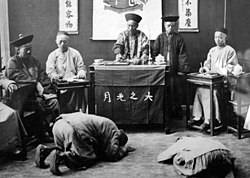
A magistrate holds court (late 19th century)
Qin–Tang
Traditional Chinese縣令
Simplified Chinese县令
Transcriptions
Standard Mandarin
Hanyu Pinyinxiànlìng
Wade–Gileshsien-ling
Song–Qing
Traditional Chinese知縣
Simplified Chinese知县
Transcriptions
Standard Mandarin
Hanyu Pinyinzhīxiàn
Wade–Gileschih-hsien
Modern
Traditional Chinese縣長
Simplified Chinese县长
Transcriptions
Standard Mandarin
Hanyu Pinyinxiànzhǎng
Wade–Gileshsien-chang
Vietnamese name
Vietnamese alphabetTri huyện / Huyện trưởng
Hán-Nôm知縣 / 縣長

The county magistrate or local magistrate, known by several Chinese names, was the official in charge of the xian ("county"), the lowest level of central government in Imperial and early Republican China. The magistrate was the official who had face-to-face relations with the people and administered all aspects of government on behalf of the emperor.

The emperor appointed magistrates from among those who passed the imperial examinations or had purchased equivalent degrees. Education in the Confucian Classics included no practical training, but indoctrinated the officials with a shared ideology which helped to unify the empire. A magistrate acquired specialized skills only after assuming office. Once in office, the magistrate was caught between the demands of his superiors and the needs and the resistance of his often-unruly constituents. Promotion depended on the magistrate's ability to maintain peace and lawful order as he supervised tax collection, roads, water control, and the census; handled legal functions as both prosecutor and judge; arranged relief for the poor or the afflicted; carried out rituals; encouraged education and schools; and performed any further task that the emperor chose to assign.

Allowed to serve in any one place for only three years, he was also at the mercy of the local elites for knowledge of the local scene. There was a temptation to postpone difficult problems to the succeeding magistrate's term or to push them into a neighboring magistrate's jurisdiction. The Yongzheng emperor praised the magistrate: "The integrity of one man involves the peace or unhappiness of a myriad." [1] However, a recent historian said of the magistrate that "if he had possessed the qualifications for carrying out all his duties, he would have been a genius. Instead, he was an all-around blunderer, a harassed Jack-of-all trades...." [2]

The Republic of China made extensive reforms in county government, but the position of magistrate was retained.[3] Under the People's Republic of China, the office of county magistrate, sometimes translated as "mayor", was no longer the lowest level of the central government, which extended its control directly to the village level.[4]

Names

[edit]

From the Qin until the end of the Tang dynasty in the 8th century, the chief magistrate of a county was known as a xiànlìng (traditional Chinese: 縣令; simplified Chinese: 县令). In subsequent dynasties, he was called a zhīxiàn (知縣; 知县). In 1928, the title was changed to xiànzhǎng (縣長; 县长).[4] Because he was expected to rule in a disciplined but caring way and because the people were expected to obey, the county magistrate were informally known as the "mother-and-father" or "parental official" (父母官; fùmǔ guān).[5]

History and changing functions

[edit]
Ming dynasty magistrate.

The county (xian) was established as the basic unit of local government around the year 690 B.C.E., during the Warring States period marked by competition between small-scale states. The Qin empire unified much of China in 221 BCE. and established the jun-xian Chinese: 郡县; pinyin: jùnxiàn ("commandery"/"county") system, which divided the realm into jun ("commanderies") and xian ("counties"). Local administrators appointed by the central government replaced the leaders of feudal cities. In spite of many changes, the xian remained the basic unit of local government until the 20th century.[6]

Before the Qin unification in 221 BCE, local officials inherited office, which strengthened great families against the central government. After that unification, no official except the emperor was allowed to inherit or bequeath office. The control of local government then became a contest between the central bureaucracy, which represented the interests of the emperor, and local nobility and elites. Imperial power undercut the local aristocracy by appointing scholar officials chosen by merit through the examination system who were not necessarily of noble descent. The Han dynasty regularized the position, and initiated the "rule of avoidance", which forbade a magistrate to serve in his home county because of the danger of nepotism and favoritism to family or friends.[7] After the Sui dynasty in the sixth century, the rule of avoidance was strictly enforced; in later dynasties a magistrate could serve only up to four years in any one place before being transferred.[1]

The magistrate was supervised by the prefect (zhifu) or the equivalent, who in turn was ordinarily under the circuit intendant (dao), or perhaps a circuit intendant with such special responsibilities as waterworks, grain, or salt. Above them were the provincial administrators and the governor. Above all of these, of course, was the central government and the emperor. Each of these layers could issue orders to the local magistrate and each required reports and memorials from him.[8]

The county magistrate supervised units of control below the county level. These included village elders, local institutions, and self-rule organizations, especially the township (xiang), which had been made formal under the Han dynasty, and the baojia system, a system of mutual responsibility formally organized by Wang Anshi in the 11th century, during the Song dynasty. Under Mongol rule in the Yuan dynasty, the county magistrates were all Mongol, though their subordinates were Han Chinese.[9] In the Ming and Qing dynasties the growth of the economy and increase in population led magistrates to hire administrative secretaries and to rely on local elite families, or scholar-gentry. These local elites had friends whose influence could counteract the magistrate if he displeased them.[1]

When the People's Republic was founded in 1949, the central government once again appointed local officials who wielded civil, criminal, and bureaucratic power. Some suggest that workers and villagers feel they cannot question the authority of these "father and mother" officials, making corruption easier and dissent harder.[10]

Responsibilities and powers

[edit]
The Kaifeng Court of Bao Zheng, a tourist attraction modeled after typical magistral office.

The magistrate's responsibilities were broad but not clearly defined. The emperors believed that Heaven entrusted their government with relations with the physical universe, cosmic morality, human institutions, and social harmony, and the magistrate was his representative in all these matters.[11]

Yet the magistrate's power was circumscribed, as reflected in the saying "Heaven is high and the emperor far away." The county government bureaucracy was thin in relation to the population, and the official staff of a larger county might consist only of a magistrate, a vice-magistrate, perhaps an assistant magistrate or recorder, and the captain of the militia. As early as the 12th century this small group was expected to supervise a population that could easily be 150,000 in the more densely populated sections of the country.[12] In later dynasties, magistrates took on larger staffs. In the counties of the prosperous Lower Yangzi valley, the total staff of clerks, secretaries, yamen runners, medical examiners, jailers, and other such lesser employees might be some 500 people for a population of 100,000 to 200,000.[4] The eminent historian Kung-chuan Hsiao, however, argued that local government became more despotic and the county magistrate had unlimited powers to control the people.[13]

Tax collection and labor

[edit]

The county government collected the land tax, grain tribute, and all other taxes except the customs duties and likin, which were introduced in the 19th century. The provincial treasurer prepared the quotas for the land and labor services tax due from each county according to the number of ding (male adults), as well as other taxes, and in theory adjusted the rates every ten years.[14] The magistrate also had responsibility for local infrastructure and communications. Each village was required to contribute free labor, or the corvee, for building and maintaining local roads, canals, and dams under the supervision of the county government.[15]

Taxes on the land were collected in silver, which was brought to the magistrate's court, where it was counted and recorded in his presence. He was allowed to keep a specified amount for local functions such as salaries, stipends for government school students, and relief for the poor, then forward the rest to the provincial treasurer. In later dynasties, the money assigned for local functions was too little, and magistrates imposed further fees and taxes, such as title deed taxes, brokerage tax, pawnshop tax, and many more.[16]

Law and judicial functions

[edit]

After tax collection, law enforcement and legal disputes occupied most of the magistrate's time and energy. Social harmony was paramount. The annual review for promotion graded the magistrate on his ability to catch thieves and prosecute robberies. One demerit was given for every five cases in which he arrested fewer than half the offenders and one merit for every five cases in which he arrested more than half.[17]

Yamen at Shaoxing Fu, Zhejiang Province, 1803.

The magistrate lived, worked, and held court in the yamen, a walled compound which housed the local government. In theory, any commoner could submit a lawsuit, petition, or complaint after striking a large bell at the entrance to the compound.[18] The magistrate administered both judicial and administrative law. Scholars in the West once felt that the magistrate did not often become involved in civil disputes and that citizens were reluctant to bring them to the local courts, but research has shown that in fact local society was extremely litigious and that the local government was involved in all types of disputes.

Legal systems in some parts of the world distinguish civil, criminal, and administrative law, but under the Chinese legal system, the magistrate administered both judicial and administrative law. The magistrate was not allowed arbitrary decisions or to rely on local customary law but was constrained both by imperial edicts, which had the force of law, and the law codes. These dynastic law codes, such as the Tang Code or the Great Qing Code, included both civil law and criminal law. Cases ranged from murder and theft to accusations that a neighbor did not tie his horse or dog or that someone had been kicked or bitten. Litigants also went to the magistrate with disputes over marriage, adoption, inheritance, and land, and these often had consequences for country revenue or taxes and tax collection. The Codes described offenses in detail, but the magistrate was also allowed to make an analogy to an existing provision of the code by using the rule: "Everyone who does that which ought not to be done will receive forty strokes of the light bamboo. If the matter is adjudged to more serious, he will be punished by eighty strokes with the heavy bamboo." Death sentences under the Qing were reviewed by the emperor, and serious cases of any nature could be appealed or reviewed, sometimes even to the emperor himself.[11]

The magistrate, as in the inquisitorial system of continental European law, was both prosecutor and judge. He decided which cases to accept, directed the gathering of evidence and witnesses, then conducted the trial, including the use of torture. The magistrate was the sole judge of guilt or innocence and determined the punishment or compensation. Still, his decisions could be reviewed by higher officials, even up to the emperor in capital cases. Since he could be reprimanded for not investigating thoroughly, for not following correct procedure, or even for writing the wrong character, magistrates in later dynasties hired specialized clerks or secretaries who had expertise in the law and bureaucratic requirements.[11]

Yet law was not simply a matter of codes and procedures. Law was understood to reflect the moral universe, and a criminal or civil offense would throw that universe out of balance in a way that only just punishment could restore. The official Five Punishments (wu xing) prescribed under the Qing Code included beating with the light bamboo, beating with the heavy bamboo, penal servitude, exile, and execution. In calibrating punishment, the magistrate had to take into account not only the nature of the offense but the relation between the guilty party and the victim. An offense by a son against a father was far more serious than one by a father against a son, likewise an offense by a wife or other member of the family.[11]

The magistrate's role in practice faced many other constraints. The runners and yamen officials who were sent to investigate a crime were locals, often in league with the criminals. Magistrates commonly would therefore set a deadline for bringing in the criminals, threatening to take the policeman's family members as hostage if the deadline was not met. When the accused was brought before him, the magistrate could use torture, such as flogging or making the defendant kneel on an iron chain, but there were clear restrictions. The instruments had to be of a standard size and individually approved by the next higher yamen, and some could not be used on women or people over the age of seventy. The magistrate could order the use of the ankle-squeezer, for instance, only in cases of murder and robbery, and its use had to be specifically reported to the higher level. Some officials avoided the use of torture because they feared that it would produce false confessions. The magistrate had to make sure that any confession was recorded accurately, word for word, to prevent the clerk from introducing intentional errors that might prejudice the case. The magistrate himself could be punished if he invoked the wrong law or imposed a sentence that was either too harsh or too lenient.[17]

Schools and moral leadership

[edit]

The magistrate oversaw and supported but did not administer education. Primary schools were established by families, temples, villages, or clans and were entirely private in their organization and finance. But the curriculum was almost entirely based on the Confucian texts needed to pass the imperial exams. The magistrate under the Qing dynasty conducted the reading of the Sacred Edict and conducted ceremonies and rituals, especially in time of drought, famine, or disaster.

Clerks and secretaries

[edit]

The magistrate's wide-ranging duties in dealing with larger and larger populations required the help of secretaries, clerks, prison guards, and runners, but there was no budget to pay for this staff. Instead, the magistrate paid his secretaries from his own pocket, which he was expected to refill from local sources, and the other staff were expected to collect fees from those who were unlucky enough to come in contact with them. These fees might be arbitrary and extortionate, and in later dynasties corruption was widespread.[11]

Changes in late imperial China

[edit]

Local government in the Ming and Qing dynasties accumulated responsibilities without increased resources. As the population grew, the number of counties remained roughly the same, with populations that could grow to perhaps 200,000. Ming rulers tightened the rule of avoidance which prevented magistrates from serving in their home districts, where it was justifiably feared that they would favor their friends and families, and the term of office was generally limited to two or three years. These rules ran the danger of posting magistrates to unfamiliar areas where they could not speak the local dialect and could not accumulate knowledge of local circumstances. The Qing government continued the Ming practice of requiring the magistrate to pay his subordinates from local taxes, not central government revenue; clerks, runners, jailers and such collected “informal fees” from the people. Confucian ideals also held that the state should stay out of the lives of the common people, who were to carry out public security functions on their own. The village head was responsible for tax collection, and the magistrate held him personally responsible for any shortfall.[19]

Under the Qing dynasty (1644–1911), the last dynasty of imperial rule, local government became even more tightly stretched as population and wealth grew but government administrative institutions – and tax revenue – did not.[20] The magistrate was in a difficult situation. His salary had not risen with the long-term inflation. In the 1720s the Yongzheng Emperor allowed the magistrate to deduct "meltage fees" from the land tax he was required to remit, but this did not address the structural problem.[21] The unintended result was that by the early 19th century, major functions of local government had been abandoned by harried and underpaid magistrates and left to the gentry, who mediated disputes, supervised schools and irrigation works, organized local militia, and even collected taxes. Although magistrates were grateful to have this help, the local gentry often used these functions to reward themselves and punish their enemies.[19]

Magistrates in the Qing, however, also became more professional in several respects. They studied administration as a craft rather than something which a cultivated Confucian scholar-bureaucrat was expected to perform on the basis of moral training and knowledge of the Confucian classics. Since the emperor, in order to reward loyalty, increased the quota of those who were allowed to pass the exams without increasing the number of positions, there came to be more degree holders than there were entry level appointments. Many of these unassigned men took positions as secretaries or clerks to county magistrates, forming a virtual sub-profession of experts on various aspects of the law, water-works, taxation, or administration. Others, especially those who held only lower degrees, became tutors or local school teachers with little prestige or adequate income.[1]

Twentieth century and Republican China

[edit]
The Yamen at Qingdao, early 20th century

The late Qing reforms of the early 20th century made basic changes. With the abolition of the centrally administered examination system, magistrates came to be selected by a local or ad hoc examinations, at least in theory, though recommendation and personal relations were more important in practice.[22] The law of avoidance remained in effect, though it too was no longer enforced rigorously, and the political chaos of the period was reflected in rapid turnover and shorter terms of office. One study found that most magistrates were appointed by the militarists who controlled the area. [23] In the years leading up to the founding of the Nationalist government in 1928, however, there was a noticeable improvement in the education and technical training of the magistrates, particularly in law and administration. The study also concluded that the civilian bureaucracy became more and more militarized.[24]

The County Organic Law, passed by the Nationalist government in 1928, defined the county as the basic level of government, and stipulated that the county magistrate, now called xianzhang, would be appointed by the provincial authorities. The county was supervised also by the Nationalist Party, which operated in parallel with the county government, an arrangement in accordance with the Party's Leninist structure. In addition, the new government organized a larger bureaucracy at the local level. [25]

During the Chinese Civil War, which lasted for several decades starting in 1927, the Chinese Communist Party built a bureaucratic base in many parts of China using the Soviet Union as a model.[26] After the civil war ended, the ROC retained the magistrate on Taiwan. They became the heads of the county after the central government streamlined all provinces which effectively downsized to non-self-governing bodies in 1998, and in 2019 all provincial governmental organs were formally abolished.[27][28]

The People's Republic of China

[edit]

After the Chinese Communist Revolution of 1949, local government took far more control of village life than had ever been possible in Chinese history, but local officials still faced many of the same problems as county magistrates under the empire. One foreign scholar wrote from his observations in 2015 that "grass-roots level civil servants are still seen as paternalistic 'father mother officials,' who are expected to take care of the ordinary people, enjoy a high degree of authority, but at the same time an equally high degree of mistrust." [29]

[edit]
Bao Zheng judges a court case in The Seven Heroes and Five Gallants, a prototype for gong'an fiction
Yanluo Wang, the ruler of the Chinese Buddhist underworld, depicted as a local magistrate holding court
A magistrate (right) portrayed as a comedic character in Peking Opera.

The magistrate was the hero in much popular fiction. The "detective story," for instance, in China took the form of the gong'an, or “court case,” in which the protagonist is not a private detective or police officer but the county magistrate, who is investigator, prosecutor, and judge. The magistrate solves a crime which has already been described to the reader, so that the suspense comes not from discovering the criminal but from seeing how the magistrate solves the crime through clever stratagems.[30] Among these magistrate-detectives were the historical Tang dynasty official Di Renjie, who inspired a series of Judge Dee stories, and the Song dynasty official, Bao Zheng the hero of a set of stories and operas.

Since Chinese popular religion considered the world of life after death to closely resemble this one, the gods were part of a great bureaucracy which had the same structure as the imperial bureaucracy. The process of justice was pictured as being much the same in both worlds. The Magistrates of Hell presided over a court in much the way that the county magistrate did and their offices closely resembled the earthly ones.[31] The short story "Execution of Mayor Yin" by Chen Ruoxi (in which "xianzhang" is translated as "Mayor") describes the career of Mayor Yin from the early 1950s through the Cultural Revolution and dramatizes the dilemma of an official who is caught between the necessity of serving both his superiors and his constituents.[32]

See also

[edit]

Notes

[edit]

References

[edit]

Further reading

[edit]
Revisions and contributorsEdit on WikipediaRead on Wikipedia
from Grokipedia
The county magistrate (知縣, zhixian), also termed , was the lowest-ranking full civil official in the local administrative hierarchy of imperial , particularly during the Ming (1368–1644) and Qing (1644–1911) dynasties, tasked with comprehensive governance of a (xian, 縣). This role positioned the magistrate as the direct representative of the imperial state at the grassroots level, overseeing a typically encompassing 100,000 to 200,000 residents and functioning as the pivotal link between central authority and local communities. County magistrates bore multifaceted responsibilities, including judicial of civil and criminal cases, levying and collection, maintenance of public order, development such as roads and water control, agricultural promotion, and management. As surrogate embodiments of the locally, they enforced statutes, mediated disputes, and ensured compliance with imperial edicts, with their performance evaluated through periodic reviews that influenced promotions or demotions. Judicial duties were central, involving personal investigations, interrogations, and sentencing within legal bounds, though capital cases required higher-level ratification to curb abuses. Selection typically occurred via the system, with appointees often rotated every three years to minimize entrenched corruption and local alliances, though this mobility sometimes hindered deep familiarity with regional conditions. The office demanded versatility, as magistrates lacked specialized staff and relied on personal acumen for diverse exigencies like disaster relief and bandit suppression, rendering it a for bureaucratic competence amid systemic pressures including fiscal shortfalls and clerical influence. Defining characteristics included the headquarters as the administrative and judicial hub, symbolizing state presence, and the expectation of Confucian moral uprightness to legitimize authority over a populace skeptical of distant rule.

Terminology and Titles

Historical Designations

The county (xian 縣), as the foundational unit of local administration in imperial , was first systematically established under the (221–206 BCE), with its chief official designated as a xianling (縣令, "county commander") for smaller jurisdictions or xianzhang (縣長, "county chief") for larger ones typically encompassing over 10,000 households. This distinction reflected the scale of administrative demands, with the xianzhang holding equivalent rank to a commandery assistant but focused on local , including collection, judicial matters, and public order. During the (206 BCE–220 CE), the nomenclature persisted, with xianzhang appointed to populous counties (wan hu xian, exceeding 10,000 households) and xianling to less populated ones (qian hu xian, under 10,000 households), both seventh-rank officials under the , ensuring centralized oversight amid feudal remnants. Subsequent periods like the Wei, Jin, Sui, and Tang dynasties (220–907 CE) largely retained the xianling title as the standard designation for the magistrate, emphasizing the official's role as a direct imperial appointee responsible for civil and criminal administration at the grassroots level. By the Song dynasty (960–1279 CE), the title shifted to zhixian (知縣, "one who knows the county"), signifying the magistrate's intimate knowledge of local conditions for effective rule, a term that underscored the civil service examination system's influence on appointments. The Yuan dynasty (1279–1368 CE) briefly adopted xianyin (縣尹, "county director"), adapting Mongol administrative preferences while maintaining the xian's structural integrity. This reverted to zhixian under the Ming (1368–1644 CE) and Qing (1644–1912 CE) dynasties, where it denoted the lowest-ranking full civil official (seventh rank on the nine-rank scale), typically a recent examination graduate serving three-year terms to prevent local entrenchment and corruption. In the Qing era, approximately 1,477 such magistrates operated nationwide, embodying the emperor's authority in routine governance.

Modern and Equivalent Terms

In the , the position historically held by the county magistrate is now fulfilled by the xianzhang (县长), translated as county head or , who leads the county-level people's government as its primary administrative officer. This role involves directing local governance, including economic planning, public services, and policy execution, under the overarching authority of the county secretary (xianwei shuji, 县委书记). The xianzhang is typically appointed by the provincial or municipal government and confirmed by the local people's congress, reflecting a centralized cadre selection process rather than direct imperial appointment. In the Republic of China (), the equivalent term remains xianzhang (縣長), but these officials are popularly elected for four-year terms, presiding over administrations until recent consolidations reduced the number of counties through mergers into special municipalities as of 2010–2014. This contrasts with the mainland's appointive model, emphasizing democratic accountability in local leadership while retaining core responsibilities for county-level affairs such as and welfare. Outside Chinese contexts, analogous roles include the or , who manages fiscal and administrative duties at the level, though without the historical fusion of judicial and executive powers typical of imperial magistrates. These modern equivalents prioritize bureaucratic oversight and party or electoral alignment over the singular, multifaceted authority of pre-modern county officials.

Historical Development

Origins in Early Imperial China

The county (xian) administrative unit, governed by a magistrate (xianling), emerged during the (770–476 BCE) as a local subdivision in feudal states such as Jin and , serving to manage populations of approximately 10,000 households through appointed officials responsible for basic governance. This system reflected early efforts to decentralize authority while maintaining oversight, with magistrates handling routine affairs like and amid fragmented polities. Under the (221–206 BCE), following unification by in 221 BCE, the xian was formalized as the lowest tier in a hierarchical structure of 36 initial commanderies (jun), later expanded to 42, each subdivided into counties numbering in the hundreds empire-wide. Qin magistrates, directly appointed from the central and rotated frequently to prevent local entrenchment, wielded executive, judicial, and fiscal powers, enforcing Legalist policies such as standardized taxation at rates of one-fifteenth of grain harvest and labor mobilization for projects like the Great Wall. Their role emphasized coercive control, with authority to investigate crimes, impose punishments up to execution for minor offenses, and suppress dissent, aligning with Qin's merit-based precursors that prioritized administrative efficiency over hereditary nobility. The (206 BCE–220 CE) inherited and refined this framework, increasing county numbers to over 1,000 by the Western Han's end, while magistrates retained core duties of census-taking, irrigation oversight, and Confucian-infused moral instruction alongside Legalist enforcement. Early Han reforms under Emperor Wen (r. 180–157 BCE) introduced inspections to curb magisterial abuses, yet the position remained pivotal for bridging imperial directives to rural realities, where officials managed populations via subordinate bailiffs and village heads without salaried local staff, relying on fees and perquisites that often fostered . This structure's durability stemmed from its scalability, enabling centralized rule over vast territories through delegated yet revocable local autonomy.

Institutionalization in Ming and Qing Dynasties

![Yamen meeting][float-right] In the (1368–1644), the county magistrate, designated as zhixian (知縣), was institutionalized as the principal executive official at the county (xian) level, the foundational unit of local administration. Appointed centrally through the examination system or imperial selection, zhixian held the rank of 7A and functioned as "paternal officials" (fumu guan), embodying direct imperial authority in remote areas. This structure, codified under the (r. 1368–1398), emphasized bureaucratic uniformity, with magistrates prohibited from serving in their native provinces to mitigate and , typically holding three-year terms subject to performance evaluations. The zhixian's role encompassed comprehensive oversight, including household registration, land surveys for taxation, of civil and minor criminal cases, maintenance of granaries, suppression of , and coordination of corvée labor and disaster relief. Supported by a minimal —often just assistants like the county vice-magistrate (xian cheng) and registrar (zhu shou)—magistrates relied heavily on non-official local clerks (shuli) and runners (kuai zi) for operational execution, a division that preserved central control while leveraging local knowledge. This institutional design tested administrative competence, with capable zhixian occasionally promoted to higher central posts in the early Ming. The (1644–1912) inherited and refined the Ming framework, retaining the zhixian as the lowest full-ranking official amid an expanded network of approximately 1,477 counties by the late imperial period. Appointments continued via the examination quota system, with the Board of Personnel allocating posts based on merit lists, though avoidance rules extended to ancestral homes and the purchase of qualifications emerged as supplements in the amid fiscal pressures. Qing zhixian navigated increased demands from demographic growth—population rising from 150 million in 1700 to over 400 million by 1850—and recurrent crises like the (1850–1864), yet the paternalistic model endured, prioritizing fiscal extraction and social stability under Manchu oversight. Key institutional continuities included the as the administrative headquarters, where zhixian conducted audiences and trials, and periodic rotations to prevent entrenchment, though actual tenures often shortened due to evaluations or scandals. Reforms under the (r. 1722–1735), such as the secret memorial system, enhanced imperial surveillance of local performance, reinforcing accountability without altering core structures. This system exemplified causal realism in governance: centralized appointment ensured loyalty, while localized execution adapted to varied terrains, though it strained under late-Qing modernization pressures.

Reforms and Adaptations in Late Imperial Period

In response to rapid —from approximately 150 million in 1700 to over 400 million by the mid-19th century—and expanding , county magistrates (zhixian) increasingly delegated routine tasks to private secretaries (muyou) and relied on local for in civil disputes and tax collection, as the traditional single-magistrate model proved inadequate for overseeing larger jurisdictions. This adaptation preserved the formal structure of the while compensating for the magistrate's limited personal capacity, though it often entrenched informal networks prone to , with clerks handling up to 90% of administrative paperwork. Fiscal strains prompted significant reforms during the Yongzheng reign (–1735), notably the legalization of the huo-hao (meltage fee) surcharge on land and head taxes, set at rates of 10–30% depending on the province (e.g., 10% in and , 20% in ), which generated hundreds of thousands of taels annually for redistribution as yang-lian allowances to supplement magistrates' meager official salaries of around 45 taels per year. This policy, formalized in , aimed to curb by channeling informal surcharges into public coffers for yamen operations, runner stipends (e.g., 1,700 taels annually in An-yang ), and , while a deficit investigation exposed millions of taels in and mandated repayments without immediate to restore . Provincial variations emerged, with northern areas like achieving surpluses through higher retention rates (up to 30% of quotas), enabling funding for local projects, whereas southern provinces leaned on commercial levies like salt taxes. Under the late Qing New Policies (xinzheng, 1901–1911), magistrates assumed expanded roles amid modernization efforts, including establishing police forces, conducting censuses, regulating , founding schools, and overseeing railroad construction and economic bureaus, particularly in provinces like where unrest demanded reorganized militias and aid distribution. To address the "thin" state presence exacerbated by demographic pressures, reformers proposed augmenting bureaucracies with new salaried positions such as police chiefs (jingwuzhang), development agents (quanyeyuan), and tax supervisors (jingzheng weiyuan), alongside district-level professional police (quzhang), aiming to enhance direct state control over rural policing and reduce dependence on hereditary clerks. These changes, however, faced resistance from entrenched local interests and incomplete implementation, as magistrates remained the sole centrally appointed officials, perpetuating hybrid reliance on both formal and informal mechanisms until the dynasty's fall.

Administrative Structure and Support

Yamen Organization

The yamen of the county magistrate (zhixian) functioned as the central administrative hub, encompassing offices for governance, judicial proceedings, a residence for the magistrate and family, and facilities such as a prison. Headed solely by the centrally appointed magistrate, who bore personal responsibility for all county affairs, the yamen relied on a parallel structure of local, non-official personnel including clerks (shuli) and runners (yaya or kuai). This staffing model persisted from the Ming into the Qing dynasty, with the magistrate typically an outsider rotated every three years to prevent corruption and local entrenchment. Clerks formed the core operational staff, organized into specialized sections mirroring broader bureaucratic functions but adapted locally. In the Qing period, these typically numbered ten offices handling personnel management, granaries, revenue collection, rites and sacrifices, , , taxation, , household registration, and land records. Clerks were hereditary locals recruited within the province, excluded from formal exams, and unsalaried; they sustained themselves through customary fees (chengbao) and informal surcharges on official transactions, often leading to practices of fee extraction that supplemented inadequate imperial funding. Hierarchy among clerks featured senior specialists overseeing juniors, with numbers varying by county size—smaller yamens had 20-30 clerks, while larger ones like Ba county in employed over 100, reflecting economic demands and administrative load. Runners supported enforcement roles, such as serving summonses, effecting arrests, escorting prisoners, and maintaining order during trials, operating under supervision but with direct access to the . Like clerks, runners were local and dependent on fees, forming family networks that dominated operations and sometimes extended influence beyond official bounds. The absence of magistrates meant the 's efficiency hinged on the 's oversight of this informal cadre, whose expertise in local compensated for the official's transience but introduced risks of abuse, as documented in Qing efforts targeting clerk-runner . Physical layout reinforced hierarchy: a front with a drum led to an audience hall for public sessions, backed by clerical offices and private quarters, symbolizing the 's paternal authority over the populace.

Role of Clerks and Subordinates

Clerks (shuli), the administrative backbone of the county yamen, managed the voluminous paperwork essential to , including ledgers, registers, case files, and correspondence. Organized into specialized sections (fang) such as those for civil litigation, criminal , fiscal accounts, and public rituals, they drafted documents, verified facts, and advised the on precedents and procedures, compensating for his limited local familiarity during short tenures. In Qing counties like Ba in , clerks handled growing archival demands from expanding administrative loads, bridging formal statutes with practical implementation through inherited expertise passed across generations. This locally recruited, hereditary system ensured continuity but fostered semiautonomous practices outside central oversight. Runners (kuai or yamen runners), serving as enforcement agents, executed the magistrate's directives in the field by issuing summonses, conducting arrests, transporting prisoners to court or higher jurisdictions, and enforcing judgments such as corporal punishments. Numbering variably by county size but typically forming a corps of field operatives, they maintained courtroom order, guarded detainees, and sometimes doubled as messengers or tax collectors' escorts, embodying state power in direct community interactions. Their physical presence, often backed by martial skills, distinguished them from sedentary clerks, though both groups operated under the magistrate's nominal authority. Supplementary subordinates encompassed jailers overseeing county prisons, gatekeepers controlling yamen access, and guards providing security, with occasional roles for executioners or coroners in judicial processes. Absent formal imperial salaries, clerks and runners sustained themselves via regulated "customary fees" (liqian) for services, a mechanism intended to align incentives with efficiency but prone to excess, as subordinates leveraged local ties to extract unofficial payments. Archival from Qing disputes reveals these staff self-legitimized as Confucian functionaries integral to orderly rule, challenging elite narratives of inherent by highlighting their role in adapting rigid laws to causal local realities like networks and economic pressures. This structure persisted from Ming to Qing, with the magistrate's rotation—often every three years—amplifying subordinates' influence on sustained administration.

Responsibilities and Powers

Fiscal and Tax Collection Duties

County magistrates in the Ming (1368–1644) and Qing (1644–1912) dynasties held primary accountability for fiscal administration at the county level, including the assessment, collection, and remittance of taxes to provincial and central authorities. As the chief local representatives of the imperial bureaucracy, they supervised the compilation of tax registers through periodic land surveys and population censuses, ensuring compliance with quotas set by higher echelons such as the Ministry of Revenue. Land taxes (tianfu), levied primarily on agricultural output and assessed in grain or silver equivalents, constituted the core of county fiscal duties, often comprising up to 80% of local revenue obligations under the post-Single Whip Reform system that consolidated miscellaneous levies into simplified payments by the late Ming. Magistrates coordinated with subordinate clerks (shuban) and local elites to enforce collections, with shortfalls directly impacting their performance evaluations and promotion prospects. In addition to land taxes, magistrates managed commuted corvée labor services (dingcha) into silver payments known as lijin or dingyin, which funded local and imperial military needs; by the Qing era, these averaged around 0.5–1 tael per adult male annually across counties. They also oversaw supplementary collections, such as fees or commercial levies where authorized, and maintained county treasuries and granaries to store surpluses against famines or deficits, remitting fixed quotas upward while retaining margins for local expenditures. Tax collection timelines were standardized, typically culminating in autumn harvests for and spring submissions for silver, with magistrates liable for any uncollected balances from personal funds if evasion or disasters occurred. Despite systemic corruption—wherein magistrates routinely exacted surcharges (often 10–20% above quotas) to offset clerical bribes or personal enrichment—overall collection efficiency remained high, enabling the Qing state to sustain revenues averaging 30–50 million taels of silver annually from land taxes alone by the mid-18th century. This duality arose from the magistrate's paternalistic role, blending coercive enforcement with negotiation via local intermediaries, though abuses like unauthorized levies eroded peasant trust and fueled periodic revolts, as evidenced in late Qing fiscal strains during the (1850–1864). Reforms under emperors like Yongzheng (r. 1722–1735) attempted to curb irregularities by centralizing audits, yet local fiscal pressures persisted due to the magistrate's overburdened multifunctionality.

Judicial and Law Enforcement Functions

The county magistrate, as the chief local official in Ming and Qing , held primary responsibility for adjudicating civil and criminal cases within their , serving as , investigator, and enforcer in a where local courts operated under the imperial legal code. They personally oversaw trials, interrogating witnesses, examining evidence, and applying statutes from compilations like the Da Qing lü li (Great Qing Code), often integrating Confucian moral principles to resolve disputes over , contracts, marriage, and minor assaults. For routine matters, magistrates could impose penalties such as fines, via bamboo flogging (up to 100 strokes for lesser crimes), or short-term in county jails, without higher approval. Capital cases, however, required submission of detailed case records (gongban) to provincial authorities for review, with the magistrate compiling confessions obtained through , sometimes involving judicial permitted under code provisions for stubborn suspects. In , magistrates directed yamen runners—subordinate constables numbering typically 20-50 per county—who executed arrests, served summonses, and patrolled to prevent disorder, banditry, and public disturbances. They initiated investigations upon reports from locals or self-initiated patrols, maintaining household registration rolls (huangce) to track potential offenders and enforce laws. Magistrates also mediated communal conflicts, such as land boundary disputes or clan feuds, to preserve social harmony, often prioritizing restorative outcomes over strict legalism to avoid escalation. This fused role demanded magistrates balance codified with discretionary equity, as higher officials rarely intervened in routine enforcement unless appealed. During crises like rebellions, they mobilized local militias under their command for suppression, reporting outcomes to the throne via the Board of Punishments.

Public Works, Labor Mobilization, and Infrastructure

County magistrates in imperial , particularly during the Ming (1368–1644) and Qing (1644–1912) dynasties, held primary responsibility for initiating, supervising, and ensuring the completion of local projects critical to and disaster prevention. These duties encompassed the construction and maintenance of irrigation canals, dikes, embankments, roads, and bridges, which were essential for flood control, water distribution, and transportation within their jurisdictions. Magistrates coordinated these efforts through detailed surveys of local needs, often drawing on household registers to assess available resources and labor capacity, with performance in management directly influencing their imperial evaluations and potential promotions. Labor mobilization relied heavily on the yaoyi (徭役) system, under which able-bodied males from villages provided unpaid seasonal labor for state-mandated projects, such as repairing dikes after seasonal floods or widening roads for grain transport. The allocated quotas proportionally across villages and townships (li 里), enforcing compliance through subordinates and local elites while mitigating hardships by exempting the elderly, infirm, or ; in the Qing era, urgent mobilizations for river conservancy could involve thousands of laborers per county, as seen in responses to breaches. By the mid-Qing, partial commutation of into silver taxes (dingyao 丁徭) reduced direct labor demands for routine maintenance, allowing hired workers for specialized tasks, though retained oversight to prevent of funds or neglect leading to infrastructural failures. Infrastructure initiatives under magistrates often addressed region-specific challenges, such as bolstering dike systems in flood-prone areas like the basin, where local officials like those in Qing-era Tongjiyan oversaw expansions irrigating over 20,000 hectares to sustain cultivation and revenues. Evaluations emphasized causal links between maintenance diligence and outcomes, with dereliction—such as unaddressed breaches causing crop losses—resulting in demotions, as documented in Qing archival performance reviews. This localized approach complemented central directives from the Ministry of Works, ensuring adaptability but exposing magistrates to accountability for natural calamities beyond full control.

Education, Moral Guidance, and Social Welfare

County magistrates in imperial , particularly during the Ming and Qing dynasties, bore responsibility for fostering local education rooted in Confucian principles. They oversaw county schools (shexue), where students memorized classical texts and received instruction in and to prepare for the examinations. The magistrate conducted the initial district-level exams, evaluating candidates' mastery of Confucian doctrines and , thereby serving as the gatekeeper for talent recruitment into the . This system ensured that education emphasized not only scholarly knowledge but also the cultivation of virtues like and propriety, aligning local instruction with imperial ideology. In terms of moral guidance, magistrates acted as exemplars and enforcers of Confucian norms, issuing public proclamations and community compacts (xiangyue) to promote filial piety, mutual aid, and social harmony among the populace. These efforts included organizing rituals at Confucian temples, admonishing against vices such as gambling and adultery through edicts and punishments, and encouraging gentry-led moral suasion to maintain order without constant coercion. Such initiatives reflected the belief that moral self-cultivation, guided by local officials, was essential for societal stability, though effectiveness varied with the magistrate's personal integrity and local resistance to state intrusion. Social welfare duties centered on mitigating poverty and disasters via state-managed ever-normal granaries (changpingcang), which magistrates replenished post-harvest and drew upon during famines to distribute grain at subsidized rates or as direct aid, stabilizing prices and preventing unrest. In the Qing era, this system, formalized since the eighteenth century, required annual inspections and reports, with magistrates coordinating relief for the indigent, orphans, and widows, often supplementing imperial funds with local levies or gentry donations. Failures in execution, such as embezzlement or inadequate storage, frequently exacerbated crises, highlighting systemic vulnerabilities in decentralized administration.

Transition and Decline in the Early 20th Century

Impact of the

The , triggered by the on October 10, 1911, and culminating in the abdication of the Qing emperor on February 12, 1912, dismantled the imperial chain of command that had appointed county magistrates through the Board of Personnel in Beijing. In revolutionary strongholds like , local assemblies and militias seized county yamens, displacing Qing loyalists and compelling magistrates to resign or depart, as seen in cases where prominent citizens convened to fill vacancies left by fleeing officials. This upheaval disrupted tax collection, judicial proceedings, and public order in affected counties, exacerbating and in regions with delayed transitions. Despite these disruptions, the Republican provisional government prioritized administrative stability, retaining the county magistrate office rather than abolishing it outright, with many Qing-era incumbents co-opted by pledging loyalty to the new regime under Yuan Shikai's influence. Appointment authority devolved to provincial governments, breaking the imperial norm of rotating non-local officials to curb corruption and factionalism; in , for example, about 90 percent of post-revolution magistrates were provincial natives, reflecting a pragmatic shift toward localized control amid weak central oversight. This continuity preserved the magistrates' integrated roles in fiscal, judicial, and infrastructural duties, as provincial resources strained to implement sweeping changes. Judicial reforms under the sought to disentangle magistrates' administrative and legal functions by establishing courts in , yet implementation faltered, with magistrates in uncourt-equipped areas continuing to adjudicate cases alongside tasks, effectively sustaining imperial precedents. This partial persistence underscored the Revolution's causal limits at the level—overthrowing dynastic legitimacy without immediately supplanting entrenched bureaucratic habits or local power dynamics, setting the stage for incremental modifications rather than radical overhaul.

Republican Era Modifications

Following the , the Republican government retained the county magistrate (xianzhang) as the chief administrative officer at the county level, but implemented modifications aimed at modernizing local governance by drawing on Western administrative models and reducing the characteristic of the imperial era. These changes included streamlining the administrative hierarchy to emphasize provinces and counties as primary units, as formalized in Nationalist efforts during the (1927–1937), though enforcement varied amid warlord fragmentation and civil conflict. A core modification involved the separation of judicial and administrative functions, divesting magistrates of their traditional role as local judges to promote . Under Republican judicial reforms initiated in the Beiyang period (1912–1928) and continued by the Nationalists, separate county-level courts and trial offices were established, transferring adjudicatory powers from magistrates to professional judicial personnel trained in modern law. This shift, intended to align with principles of and , reduced magistrates' direct involvement in criminal and civil cases, confining them primarily to executive oversight, though in practice, incomplete implementation often led to overlapping influences due to resource shortages and local power dynamics. Appointment processes also evolved, prioritizing educational qualifications and administrative expertise over imperial examination success or familial networks. Provincial authorities selected magistrates, increasingly favoring graduates of modern law or administrative schools, with patterns in regions like showing reduced emphasis on native-place origins to curb localism. By the 1930s, under influence, political loyalty supplemented merit-based criteria, yet the role's scope narrowed to fiscal management, , and policing, excluding education and duties increasingly handled by specialized bureaus. These adaptations reflected aspirations for bureaucratic rationalization but were undermined by ongoing instability, including the Japanese invasion from 1937 onward.

Modern Role in the People's Republic of China

Post-1949 Reestablishment

Following the proclamation of the People's Republic of China on October 1, 1949, county-level administration was promptly reorganized into people's governments, adapting the longstanding xian (county) as the core rural administrative unit while integrating it into a hierarchical socialist structure comprising provinces, counties, and townships. The county magistrate (xianzhang), serving as the executive head of the county people's government, was reestablished to oversee local implementation of central policies, though real authority rested with the parallel Chinese Communist Party county committee, reflecting the principle of party leadership over state organs. This setup inherited elements of the Republican-era county framework but emphasized mass-line governance, cadre mobilization, and suppression of class enemies during transitional campaigns. In the early 1950s, county magistrates directed critical initiatives such as the 1950–1953 , which redistributed approximately 47 million hectares of land to over 300 million peasants, and the 1950–1951 suppression of counter-revolutionaries, targeting an estimated 2.45 million executions or imprisonments as reported in official tallies. These efforts relied on county s to organize peasant associations and militias, often bypassing formal judicial processes in favor of mass trials and cadre-led verdicts, establishing the magistrate's role in fusing administrative, political, and punitive functions under . By 1953, as the First Five-Year Plan commenced, counties numbered around 2,200, each with a government structure mirroring higher levels, including a nominal people's congress for electing officials—though selections were vetted by party . The 1954 Constitution and of Local People's Governments codified this reestablishment, mandating county people's governments to manage economic construction, , and welfare within their bounds, accountable to both superior administrative levels and the . Magistrates, typically numbering one principal and several deputies, handled daily operations like tax collection (evolving into state procurement quotas) and infrastructure projects, but their autonomy was constrained by frequent central campaigns and rectification movements, such as the 1957 , which purged over 550,000 cadres including local officials. This period marked the institutionalization of the magistrate as a conduit for top-down directives, diverging from imperial precedents by prioritizing ideological conformity over autonomous rule.

Selection Process and Political Integration

In the , county magistrates (xianzhang) are formally elected by the county-level people's congress from among nominated candidates, as stipulated in the of the Local People's Congresses and Local People's Governments. The process begins with nominations typically proposed by the of the people's congress or a group of deputies, followed by a vote requiring a of over half the deputies present. However, candidates are pre-selected through the Chinese Communist Party's (CCP) cadre management system, which dominates the stage via organizational departments at higher levels. The CCP's Regulations on the Selection and Appointment of Party and Government Leading Cadres outline a multi-step procedure for identifying suitable candidates, including democratic recommendations from peers and subordinates, vetting for political reliability, competence assessments, and approval by the party committee at the next higher level. County magistrates, classified as leading cadres, must demonstrate loyalty to the CCP's core leadership, ideological alignment with , and performance in prior roles, often rising through township or departmental positions. This party-led vetting ensures that only vetted individuals—nearly always CCP members—advance, with the people's congress election serving as a procedural rather than a competitive contest. Political integration of county magistrates into the CCP structure subordinates their administrative authority to the county party committee, headed by the party secretary who holds ultimate power. Magistrates participate in party committee meetings, implement central directives through local , and undergo regular performance evaluations tied to party goals such as poverty alleviation campaigns or drives. This dual leadership model, reinforced since the reforms, aligns county executives with national policies while allowing the party to monitor and discipline officials via bodies like the . Under Xi Jinping's tenure, selection has intensified scrutiny on personal ties to factional networks, favoring those with proven loyalty over pure technocratic merit, as evidenced in cadre reshuffles prioritizing compliance and ideological purity.

Contemporary Duties and Challenges

In the , county magistrates, known as xianzhang, serve as the heads of county-level people's governments, functioning as executive organs responsible for implementing national laws, policies, and development plans within their jurisdictions. They formulate and execute local economic and social development plans, manage budgets, and oversee public services including and social security. Additional duties encompass protecting citizens' rights and property—encompassing socialist, collective, and private forms—and promoting ethnic unity while safeguarding minority interests. These officials also ensure compliance with central directives on , such as . Contemporary emphases include advancing rural revitalization, a national strategy prioritizing agricultural modernization, infrastructure improvements, and income equalization in rural . County governments bear primary responsibility for securing supplies, planning territorial spatial development, and channeling financial resources toward rural industries and public goods. People's governments at or above the county level must prioritize fiscal support for these efforts, integrating them with broader goals like ecological and reducing urban-rural disparities. County magistrates face significant challenges, including mounting debt exacerbated by the post-2021 downturn and structural fiscal deficits, which strain maintenance and service delivery. Hidden debts, often accumulated through local financing vehicles, have prompted central interventions like the 10 trillion yuan (approximately $1.38 trillion) debt relief package announced in November 2024, yet persistent borrowing risks undermine long-term stability. Other pressures involve reconciling top-down mandates—such as and controls—with local economic imperatives, amid reports of high debts, , and sporadic social protests stemming from uneven policy implementation. Demographic shifts, including rural depopulation and aging populations, further complicate achieving rural revitalization targets without adequate central fiscal transfers.

Criticisms, Abuses, and Legacy

Historical Instances of Corruption and Overreach

In the Ming and Qing dynasties, county magistrates often supplemented their meager official salaries—typically around 40-90 taels of silver annually—through extortionate practices such as demanding "courtesy gifts" (yangli) from litigants and taxpayers, which systematically burdened rural populations and eroded local trust in governance. These extractions were rationalized as necessary to cover administrative costs, but they frequently escalated into overreach, with magistrates employing underlings to coerce payments under threat of fabricated charges or delayed justice. Judicial corruption represented a particularly egregious form of , as magistrates held sole authority over local trials, including capital cases, enabling widespread to influence verdicts or suppress evidence. In eighteenth-century , for example, officials manipulated grain-to-silver commutation rates in tax collection to skim profits, imposing de facto surcharges on peasants that exceeded legal quotas and provoked unrest, such as during the precursors in the 1770s. Economic analyses of the period indicate that optimal corruption strategies by magistrates equated to an implicit mirroring formal land levies, often doubling effective burdens on households and contributing to fiscal instability. Overreach extended to public works and labor mobilization, where magistrates arbitrarily requisitioned beyond imperial mandates to fulfill superiors' demands or personal , as seen in nineteenth-century cases where local officials falsified project records to extract unallocated funds. Such practices not only violated Confucian ideals of benevolent rule but also amplified systemic vulnerabilities, with imperial edicts repeatedly decrying magistrates' "squeeze" tactics yet failing to curb them due to inadequate oversight from distant prefectural superiors. Harsh punishments, including and public display, were prescribed for convicted offenders, but enforcement was inconsistent, allowing to persist as a structural feature of the magistrate's isolated role.

Evaluations of Effectiveness and Systemic Flaws

The county magistrate system demonstrated notable effectiveness in maintaining imperial cohesion across diverse localities, as evidenced by its role in standardizing tax collection and under centralized oversight. In the (1644–1912), magistrates successfully adapted fiscal policies to local conditions through informal networks, enabling revenue stability amid economic fluctuations; for instance, the rationalization of surcharges in the eighteenth century helped offset official shortfalls without immediate collapse of the revenue system. This adaptability contributed to the dynasty's longevity, with annual audits and performance evaluations enforcing accountability, though enforcement waned during crises like the 1744 audits, where magistrates' low budgets and small staffs limited operational capacity. Overall, the system's hierarchical structure prevented widespread rebellion in rural areas for much of imperial history, channeling local grievances into judicial channels rather than outright disorder. Despite these strengths, systemic flaws undermined long-term efficacy, primarily through structural incentives for and administrative overload. Magistrates, rotated every three years and barred from native locales to curb factionalism, lacked deep local knowledge, fostering dependence on untrustworthy underlings who extracted unofficial fees, exacerbating in judicial and processes. Low salaries—often insufficient for basic operations—necessitated "squeezes" via legalized extras or illicit gains, with models estimating high incomes in Ming (1368–1644) and Qing eras, where optimal "" rates on and could exceed formal pay by multiples. In the eighteenth century, this manifested in manipulated commutation rates for labor services, imposing undue burdens on peasants while officials pocketed differences, a practice contemporaries decried as a core scourge eroding public trust. Further flaws included multifunctional overload without specialization, as outlined in Ming-era handbooks like Lü K'un's Shih-cheng lu (1597), which detailed magistrates' burdens in juggling judicial, fiscal, and welfare duties amid inadequate resources, leading to delays and inconsistent rulings. Evaluations in late Qing (1902–1911) reveal high turnover and crisis-induced demotions, signaling weakened enforcement of merit-based assessments and vulnerability to external shocks like famines or rebellions. These issues compounded information asymmetries between center and periphery, allowing petty abuses to accumulate into fiscal shortfalls that hastened dynastic decline, as corrupt practices devolved fiscal control and eroded . Historians attribute partial mitigation to periodic censors and audits, yet persistent underfunding and short tenures perpetuated a cycle where personal integrity alone could not sustain systemic integrity.

Enduring Influence on Chinese Governance

The county (xian) administrative unit, originating in the around 221 BCE as the foundational level of imperial governance, has endured as a core element of China's territorial division, with magistrates (xianling or zhixian) serving as the pivotal local enforcers of central authority. This structure emphasized a single official's comprehensive responsibility for taxation, judicial matters, public order, and policy execution within delimited jurisdictions, a model that minimized local autonomy while ensuring upward accountability to the . In the (PRC), established in 1949, the xian persists as the primary rural administrative layer, numbering approximately 1,469 counties alongside county-level cities and districts as of , forming the interface between central directives and grassroots implementation. The modern xianzhang (county executive) mirrors the imperial magistrate's role in coordinating local party committees, , and , adapting traditional bureaucratic mechanisms to communist cadre evaluation systems that prioritize loyalty and performance metrics over imperial merit exams. This continuity manifests in systemic features like official rotation to curb entrenched local power—practiced in imperial eras to avoid native-place favoritism and retained in PRC cadre policies—and a hierarchical chain of command where local leaders bear personal responsibility for meeting quotas, echoing the magistrate's "one-man rule" (yiren zhi xian) under imperial oversight. Empirical studies indicate that variations in historical governance quality, such as fiscal capacity and administrative during the late Qing (1644–1912), correlate with modern economic outcomes, suggesting path-dependent effects where robust imperial local institutions fostered enduring institutional trust and development trajectories. However, while the framework enables centralized mobilization across China's vast terrain, it inherits vulnerabilities like overreach and , as local officials, incentivized by promotion tied to visible results, may prioritize short-term compliance over sustainable , a flaw traceable to imperial precedents without democratic checks. Causal realism underscores that this legacy stems not from ideological affinity but from pragmatic adaptation: the PRC's Leninist structure overlays imperial , where a strong center delegates execution to atomized localities to maintain control amid scale, but risks principal-agent problems without independent verification mechanisms. Post-1949 reforms, including the 1950s land reforms and ongoing township consolidations, preserved the xian as a stable buffer, enabling policies like the (1958–1962) or recent poverty alleviation drives (2013–2020) through magistrate-like directives, yet amplifying errors when central signals distort local realities. Thus, the county magistrate's archetype informs contemporary challenges, including fiscal centralization under since 2012, which reinforces akin to dynastic tiao-zhi (vertical control) over kuai-kuai (horizontal fragmentation).

Cultural Representations

In Classical Literature and Historical Records

In historical records from the Eastern (25–220 CE), county magistrates were commemorated through inscriptions that detailed their administrative tenure and moral conduct, such as the 173 CE for Jing Yun, who served as magistrate of Quren County in the southwest before advancing to governorship; the inscription highlights his efforts in local governance amid frontier challenges. Pre-Tang legal judgments (panwen) preserved in compilations further illustrate magistrates' judicial roles, as in a Han-era case where a magistrate adjudicated paternity and inheritance disputes based on witness and familial . Dynastic histories within the , such as biographies in the Song Shi, record magistrates' appointments and evaluations, emphasizing their proximity to the populace as the lowest-ranking officials directly interfacing with commoners on taxation, litigation, and order maintenance. Classical literature portrays county magistrates as archetypal local enforcers of imperial law, often embodying Confucian virtues of impartiality and diligence amid corruption risks. In Song-era exemplars like (compiled from earlier sources), Yu Qianlou is depicted as Chanling County magistrate who resigned after ten days upon intuiting his mother's distress, prioritizing over duty. The Northern Song official (999–1062 CE), initially magistrate of Jianchang County, features in biographical accounts and evolving gong'an (crime-case) tales as a paragon of justice, resolving disputes through rigorous inquiry rather than favoritism, as evidenced in 13th–15th century ballad-stories where, as Dingyuan County magistrate, he unraveled murders via supernatural clues and forensic logic. These narratives, rooted in historical precedents, underscore magistrates' autonomy in courts but also their vulnerability to elite influence, reflecting realist critiques of bureaucratic overreach in texts like the 14th-century Shuihu Zhuan (), where a county magistrate's office employs corrupt underlings like . Such depictions in and records prioritize empirical —interrogations, collection, and edicts—over , though later embellishments introduce ghosts or omens to symbolize moral causation, as in Bao tales where spectral appearances guide verdicts to affirm . This contrasts with idealized , where magistrates' effectiveness hinged on personal integrity amid systemic pressures like quota-driven collection, a tension evident in Qing compilations of earlier casebooks like Lan Dingyuan's, which document real depravities masked by routine administration.

In Modern Media and Scholarship

In contemporary Chinese television productions, county magistrates often serve as protagonists or antagonists in historical costume dramas, emphasizing their roles in local adjudication and administration amid dynastic intrigue. The 2024 series The Double, produced by iQIYI, centers on a magistrate's daughter who impersonates nobility to seek vengeance after her family's ruin, portraying the official's position as vulnerable to elite corruption yet pivotal to personal redemption narratives. Likewise, the 2014 CCTV miniseries Donkey and the County Magistrate sets a Qing-era official against comedic and suspenseful rural disputes, underscoring the magistrate's broad mandate over taxation, policing, and dispute resolution in pre-modern locales. Scholarly works in the late 20th and 21st centuries have dissected magistrates' judicial practices, revealing a pragmatic fusion of codified law, Confucian ethics, and customary norms rather than rigid precedent-based adjudication. Analyses of Qing dynasty cases, for example, categorize decisions into those warranting severe penalties versus lighter ones, where magistrates exercised discretion influenced by social harmony over strict legalism, as evidenced by archival reviews contrasting Japanese sinologist Shiga Shūzō's emphasis on moral suasion with Philip Huang's focus on community mediation. Quantitative historiography, drawing on databases of over 31,000 officials from 1830 to 1911, quantifies how environmental and fiscal crises affected magistrate promotions or demotions, tying career outcomes to measurable governance efficacy amid systemic pressures like population growth and revenue shortfalls. Contemporary studies also critique earlier Western portrayals of magistrates as despotic enforcers, instead highlighting their embeddedness in a bureaucratic that prioritized examination-based selection and periodic rotations to curb local entrenchment, though prone to abuses like documented in local gazetteers. Translations and editions of 17th-century manuals, such as Huang Liu-hung's for magistrates, inform modern reassessments by detailing routine duties from case hearings to welfare provision, illustrating a holistic "parent-official" ethos that balanced with benevolence. These interpretations, often from peer-reviewed journals, counterbalance institutional biases in global academia toward viewing imperial systems as uniformly extractive, privileging empirical case reconstructions over ideological narratives.

References

Add your contribution
Related Hubs
User Avatar
No comments yet.