Hubbry Logo
Group actionGroup actionMain
Open search
Group action
Community hub
Group action
logo
8 pages, 0 posts
0 subscribers
Be the first to start a discussion here.
Group action
Group action
from Wikipedia
The cyclic group C3 consisting of the rotations by 0°, 120° and 240° acts on the set of the three vertices.

In mathematics, a group action of a group on a set is a group homomorphism from to some group (under function composition) of functions from to itself. It is said that acts on .

Many sets of transformations form a group under function composition; for example, the rotations around a point in the plane. It is often useful to consider the group as an abstract group, and to say that one has a group action of the abstract group that consists of performing the transformations of the group of transformations. The reason for distinguishing the group from the transformations is that, generally, a group of transformations of a structure acts also on various related structures; for example, the above rotation group also acts on triangles by transforming triangles into triangles.

If a group acts on a structure, it will usually also act on objects built from that structure. For example, the group of Euclidean isometries acts on Euclidean space and also on the figures drawn in it; in particular, it acts on the set of all triangles. Similarly, the group of symmetries of a polyhedron acts on the vertices, the edges, and the faces of the polyhedron.

A group action on a vector space is called a representation of the group. In the case of a finite-dimensional vector space, it allows one to identify many groups with subgroups of the general linear group , the group of the invertible matrices of dimension over a field .

The symmetric group acts on any set with elements by permuting the elements of the set. Although the group of all permutations of a set depends formally on the set, the concept of group action allows one to consider a single group for studying the permutations of all sets with the same cardinality.

Definition

[edit]

Left group action

[edit]

If is a group with identity element , and is a set, then a (left) group action of on X is a function

that satisfies the following two axioms:[1]

Identity:
Compatibility:

for all g and h in G and all x in .

The group is then said to act on (from the left). A set together with an action of is called a (left) -set.

It can be notationally convenient to curry the action , so that, instead, one has a collection of transformations αg : XX, with one transformation αg for each group element gG. The identity and compatibility relations then read

and

The second axiom states that the function composition is compatible with the group multiplication; they form a commutative diagram. This axiom can be shortened even further, and written as .

With the above understanding, it is very common to avoid writing entirely, and to replace it with either a dot, or with nothing at all. Thus, α(g, x) can be shortened to gx or gx, especially when the action is clear from context. The axioms are then

From these two axioms, it follows that for any fixed g in , the function from X to itself which maps x to gx is a bijection, with inverse bijection the corresponding map for g−1. Therefore, one may equivalently define a group action of G on X as a group homomorphism from G into the symmetric group Sym(X) of all bijections from X to itself.[2]

Right group action

[edit]

Likewise, a right group action of on is a function

that satisfies the analogous axioms:[3]

Identity:
Compatibility:

(with α(x, g) often shortened to xg or xg when the action being considered is clear from context)

Identity:
Compatibility:

for all g and h in G and all x in X.

The difference between left and right actions is in the order in which a product gh acts on x. For a left action, h acts first, followed by g second. For a right action, g acts first, followed by h second. Because of the formula (gh)−1 = h−1g−1, a left action can be constructed from a right action by composing with the inverse operation of the group. Also, a right action of a group G on X can be considered as a left action of its opposite group Gop on X.

Thus, for establishing general properties of group actions, it suffices to consider only left actions. However, there are cases where this is not possible. For example, the multiplication of a group induces both a left action and a right action on the group itself—multiplication on the left and on the right, respectively.

Notable properties of actions

[edit]

Let G be a group acting on a set X. The action is called faithful or effective if gx = x for all xX implies that g = eG. Equivalently, the homomorphism from G to the group of bijections of X corresponding to the action is injective.

The action is called free (or semiregular or fixed-point free) if the statement that gx = x for some xX already implies that g = eG. In other words, no non-trivial element of G fixes a point of X. This is a much stronger property than faithfulness.

For example, the action of any group on itself by left multiplication is free. This observation implies Cayley's theorem that any group can be embedded in a symmetric group (which is infinite when the group is). A finite group may act faithfully on a set of size much smaller than its cardinality (however such an action cannot be free). For instance the abelian 2-group (Z / 2Z)n (of cardinality 2n) acts faithfully on a set of size 2n. This is not always the case, for example the cyclic group Z / 2nZ cannot act faithfully on a set of size less than 2n.

In general the smallest set on which a faithful action can be defined can vary greatly for groups of the same size. For example, three groups of size 120 are the symmetric group S5, the icosahedral group A5 × Z / 2Z and the cyclic group Z / 120Z. The smallest sets on which faithful actions can be defined for these groups are of size 5, 7, and 16 respectively.

Transitivity properties

[edit]

The action of G on X is called transitive if for any two points x, yX there exists a gG so that gx = y.

The action is simply transitive (or sharply transitive, or regular) if it is both transitive and free. This means that given x, yX there is exactly one gG such that gx = y. If X is acted upon simply transitively by a group G then it is called a principal homogeneous space for G or a G-torsor.

For an integer n ≥ 1, the action is n-transitive if X has at least n elements, and for any pair of n-tuples (x1, ..., xn), (y1, ..., yn) ∈ Xn with pairwise distinct entries (that is xixj, yiyj when ij) there exists a gG such that gxi = yi for i = 1, ..., n. In other words, the action on the subset of Xn of tuples without repeated entries is transitive. For n = 2, 3 this is often called double, respectively triple, transitivity. The class of 2-transitive groups (that is, subgroups of a finite symmetric group whose action is 2-transitive) and more generally multiply transitive groups is well-studied in finite group theory.

An action is sharply n-transitive when the action on tuples without repeated entries in Xn is sharply transitive.

Examples

[edit]

The action of the symmetric group of X is transitive, in fact n-transitive for any n up to the cardinality of X. If X has cardinality n, the action of the alternating group is (n − 2)-transitive but not (n − 1)-transitive.

The action of the general linear group of a vector space V on the set V ∖ {0} of non-zero vectors is transitive, but not 2-transitive (similarly for the action of the special linear group if the dimension of v is at least 2). The action of the orthogonal group of a Euclidean space is not transitive on nonzero vectors but it is on the unit sphere.

Primitive actions

[edit]

The action of G on X is called primitive if there is no partition of X preserved by all elements of G apart from the trivial partitions (the partition in a single piece and its dual, the partition into singletons).

Topological properties

[edit]

Assume that X is a topological space and the action of G is by homeomorphisms.

The action is wandering if every xX has a neighbourhood U such that there are only finitely many gG with gUU ≠ ∅.[4]

More generally, a point xX is called a point of discontinuity for the action of G if there is an open subset Ux such that there are only finitely many gG with gUU ≠ ∅. The domain of discontinuity of the action is the set of all points of discontinuity. Equivalently it is the largest G-stable open subset Ω ⊂ X such that the action of G on Ω is wandering.[5] In a dynamical context this is also called a wandering set.

The action is properly discontinuous if for every compact subset KX there are only finitely many gG such that gKK ≠ ∅. This is strictly stronger than wandering; for instance the action of Z on R2 ∖ {(0, 0)} given by n⋅(x, y) = (2nx, 2ny) is wandering and free but not properly discontinuous.[6]

The action by deck transformations of the fundamental group of a locally simply connected space on a universal cover is wandering and free. Such actions can be characterized by the following property: every xX has a neighbourhood U such that gUU = ∅ for every gG ∖ {eG}.[7] Actions with this property are sometimes called freely discontinuous, and the largest subset on which the action is freely discontinuous is then called the free regular set.[8]

An action of a group G on a locally compact space X is called cocompact if there exists a compact subset AX such that X = GA. For a properly discontinuous action, cocompactness is equivalent to compactness of the quotient space X / G.

Actions of topological groups

[edit]

Now assume G is a topological group and X a topological space on which it acts by homeomorphisms. The action is said to be continuous if the map G × XX is continuous for the product topology.

The action is said to be proper if the map G × XX × X defined by (g, x) ↦ (x, gx) is proper.[9] This means that given compact sets K, K the set of gG such that gKK′ ≠ ∅ is compact. In particular, this is equivalent to proper discontinuity if G is a discrete group.

It is said to be locally free if there exists a neighbourhood U of eG such that gxx for all xX and gU ∖ {eG}.

The action is said to be strongly continuous if the orbital map ggx is continuous for every xX. Contrary to what the name suggests, this is a weaker property than continuity of the action.[citation needed]

If G is a Lie group and X a differentiable manifold, then the subspace of smooth points for the action is the set of points xX such that the map ggx is smooth. There is a well-developed theory of Lie group actions, i.e. action which are smooth on the whole space.

Linear actions

[edit]

If g acts by linear transformations on a module over a commutative ring, the action is said to be irreducible if there are no proper nonzero g-invariant submodules. It is said to be semisimple if it decomposes as a direct sum of irreducible actions.

Orbits and stabilizers

[edit]
In the compound of five tetrahedra, the symmetry group is the (rotational) icosahedral group I of order 60, while the stabilizer of a single chosen tetrahedron is the (rotational) tetrahedral group T of order 12, and the orbit space I / T (of order 60/12 = 5) is naturally identified with the 5 tetrahedra – the coset gT corresponds to the tetrahedron to which g sends the chosen tetrahedron.

Consider a group G acting on a set X. The orbit of an element x in X is the set of elements in X to which x can be moved by the elements of G. The orbit of x is denoted by Gx:

The defining properties of a group guarantee that the set of orbits of (points x in) X under the action of G form a partition of X. The associated equivalence relation is defined by saying x ~ y if and only if there exists a g in G with gx = y. The orbits are then the equivalence classes under this relation; two elements x and y are equivalent if and only if their orbits are the same, that is, Gx = Gy.

The group action is transitive if and only if it has exactly one orbit, that is, if there exists x in X with Gx = X. This is the case if and only if Gx = X for all x in X (given that X is non-empty).

The set of all orbits of X under the action of G is written as X / G (or, less frequently, as G \ X), and is called the quotient of the action. In geometric situations it may be called the orbit space, while in algebraic situations it may be called the space of coinvariants, and written XG, by contrast with the invariants (fixed points), denoted XG: the coinvariants are a quotient while the invariants are a subset. The coinvariant terminology and notation are used particularly in group cohomology and group homology, which use the same superscript/subscript convention.

Invariant subsets

[edit]

If Y is a subset of X, then GY denotes the set {gy : gG and yY}. The subset Y is said to be invariant under G if GY = Y (which is equivalent GYY). In that case, G also operates on Y by restricting the action to Y. The subset Y is called fixed under G if gy = y for all g in G and all y in Y. Every subset that is fixed under G is also invariant under G, but not conversely.

Every orbit is an invariant subset of X on which G acts transitively. Conversely, any invariant subset of X is a union of orbits. The action of G on X is transitive if and only if all elements are equivalent, meaning that there is only one orbit.

A G-invariant element of X is xX such that gx = x for all gG. The set of all such x is denoted XG and called the G-invariants of X. When X is a G-module, XG is the zeroth cohomology group of G with coefficients in X, and the higher cohomology groups are the derived functors of the functor of G-invariants.

Fixed points and stabilizer subgroups

[edit]

Given g in G and x in X with gx = x, it is said that "x is a fixed point of g" or that "g fixes x". For every x in X, the stabilizer subgroup of G with respect to x (also called the isotropy group or little group[10]) is the set of all elements in G that fix x: This is a subgroup of G, though typically not a normal one. The action of G on X is free if and only if all stabilizers are trivial. The kernel N of the homomorphism with the symmetric group, G → Sym(X), is given by the intersection of the stabilizers Gx for all x in X. If N is trivial, the action is said to be faithful (or effective).

Let x and y be two elements in X, and let g be a group element such that y = gx. Then the two stabilizer groups Gx and Gy are related by Gy = gGxg−1.

Proof: by definition, hGy if and only if h⋅(gx) = gx. Applying g−1 to both sides of this equality yields (g−1hg)⋅x = x; that is, g−1hgGx.

An opposite inclusion follows similarly by taking hGx and x = g−1y.

The above says that the stabilizers of elements in the same orbit are conjugate to each other. Thus, to each orbit, we can associate a conjugacy class of a subgroup of G (that is, the set of all conjugates of the subgroup). Let (H) denote the conjugacy class of H. Then the orbit O has type (H) if the stabilizer Gx of some/any x in O belongs to (H). A maximal orbit type is often called a principal orbit type.

Orbit–stabilizer theorem

[edit]

Orbits and stabilizers are closely related. For a fixed x in X, consider the map f : GX given by ggx. By definition the image f(G) of this map is the orbit Gx. The condition for two elements to have the same image is In other words, f(g) = f(h) if and only if g and h lie in the same coset for the stabilizer subgroup Gx. Thus, the fiber f−1({y}) of f over any y in Gx is contained in such a coset, and every such coset also occurs as a fiber. Therefore f induces a bijection between the set G / Gx of cosets for the stabilizer subgroup and the orbit Gx, which sends gGxgx.[11] This result is known as the orbit–stabilizer theorem.

If G is finite then the orbit–stabilizer theorem, together with Lagrange's theorem, gives In other words, the length of the orbit of x times the order of its stabilizer is the order of the group. In particular that implies that the orbit length is a divisor of the group order.

Example: Let G be a group of prime order p acting on a set X with k elements. Since each orbit has either 1 or p elements, there are at least k mod p orbits of length 1 which are G-invariant elements. More specifically, k and the number of G-invariant elements are congruent modulo p.[12]

This result is especially useful since it can be employed for counting arguments (typically in situations where X is finite as well).

Cubical graph with vertices labeled
Example: We can use the orbit–stabilizer theorem to count the automorphisms of a graph. Consider the cubical graph as pictured, and let G denote its automorphism group. Then G acts on the set of vertices {1, 2, ..., 8}, and this action is transitive as can be seen by composing rotations about the center of the cube. Thus, by the orbit–stabilizer theorem, |G| = |G ⋅ 1| |G1| = 8 |G1|. Applying the theorem now to the stabilizer G1, we can obtain |G1| = |(G1) ⋅ 2| |(G1)2|. Any element of G that fixes 1 must send 2 to either 2, 4, or 5. As an example of such automorphisms consider the rotation around the diagonal axis through 1 and 7 by 2π/3, which permutes 2, 4, 5 and 3, 6, 8, and fixes 1 and 7. Thus, |(G1) ⋅ 2| = 3. Applying the theorem a third time gives |(G1)2| = |((G1)2) ⋅ 3| |((G1)2)3|. Any element of G that fixes 1 and 2 must send 3 to either 3 or 6. Reflecting the cube at the plane through 1, 2, 7 and 8 is such an automorphism sending 3 to 6, thus |((G1)2) ⋅ 3| = 2. One also sees that ((G1)2)3 consists only of the identity automorphism, as any element of G fixing 1, 2 and 3 must also fix all other vertices, since they are determined by their adjacency to 1, 2 and 3. Combining the preceding calculations, we can now obtain |G| = 8 ⋅ 3 ⋅ 2 ⋅ 1 = 48.

Burnside's lemma

[edit]

A result closely related to the orbit–stabilizer theorem is Burnside's lemma: where Xg is the set of points fixed by g. This result is mainly of use when G and X are finite, when it can be interpreted as follows: the number of orbits is equal to the average number of points fixed per group element.

Fixing a group G, the set of formal differences of finite G-sets forms a ring called the Burnside ring of G, where addition corresponds to disjoint union, and multiplication to Cartesian product.

Examples

[edit]
  • The trivial action of any group G on any set X is defined by gx = x for all g in G and all x in X; that is, every group element induces the identity permutation on X.[13]
  • In every group G, left multiplication is an action of G on G: gx = gx for all g, x in G. This action is free and transitive (regular), and forms the basis of a rapid proof of Cayley's theorem – that every group is isomorphic to a subgroup of the symmetric group of permutations of the set G.
  • In every group G with subgroup H, left multiplication is an action of G on the set of cosets G / H: gaH = gaH for all g, a in G. In particular if H contains no nontrivial normal subgroups of G this induces an isomorphism from G to a subgroup of the permutation group of degree [G : H].
  • In every group G, conjugation is an action of G on G: gx = gxg−1. An exponential notation is commonly used for the right-action variant: xg = g−1xg; it satisfies (xg)h = xgh.
  • In every group G with subgroup H, conjugation is an action of G on conjugates of H: gK = gKg−1 for all g in G and K conjugates of H.
  • An action of Z on a set X uniquely determines and is determined by an automorphism of X, given by the action of 1. Similarly, an action of Z / 2Z on X is equivalent to the data of an involution of X.
  • The symmetric group Sn and its subgroups act on the set {1, ..., n} by permuting its elements
  • The symmetry group of a polyhedron acts on the set of vertices of that polyhedron. It also acts on the set of faces or the set of edges of the polyhedron.
  • The symmetry group of any geometrical object acts on the set of points of that object.
  • For a coordinate space V over a field F with group of units F*, the mapping F* × VV given by a × (x1, x2, ..., xn) ↦ (ax1, ax2, ..., axn) is a group action called scalar multiplication.
  • The automorphism group of a vector space (or graph, or group, or ring ...) acts on the vector space (or set of vertices of the graph, or group, or ring ...).
  • The general linear group GL(n, K) and its subgroups, particularly its Lie subgroups (including the special linear group SL(n, K), orthogonal group O(n, K), special orthogonal group SO(n, K), and symplectic group Sp(n, K)) are Lie groups that act on the vector space Kn. The group operations are given by multiplying the matrices from the groups with the vectors from Kn.
  • The general linear group GL(n, Z) acts on Zn by natural matrix action. The orbits of its action are classified by the greatest common divisor of coordinates of the vector in Zn.
  • The affine group acts transitively on the points of an affine space, and the subgroup V of the affine group (that is, a vector space) has transitive and free (that is, regular) action on these points;[14] indeed this can be used to give a definition of an affine space.
  • The projective linear group PGL(n + 1, K) and its subgroups, particularly its Lie subgroups, which are Lie groups that act on the projective space Pn(K). This is a quotient of the action of the general linear group on projective space. Particularly notable is PGL(2, K), the symmetries of the projective line, which is sharply 3-transitive, preserving the cross ratio; the Möbius group PGL(2, C) is of particular interest.
  • The isometries of the plane act on the set of 2D images and patterns, such as wallpaper patterns. The definition can be made more precise by specifying what is meant by image or pattern, for example, a function of position with values in a set of colors. Isometries are in fact one example of affine group (action).[dubiousdiscuss]
  • The sets acted on by a group G comprise the category of G-sets in which the objects are G-sets and the morphisms are G-set homomorphisms: functions f : XY such that g⋅(f(x)) = f(gx) for every g in G.
  • The Galois group of a field extension L / K acts on the field L but has only a trivial action on elements of the subfield K. Subgroups of Gal(L / K) correspond to subfields of L that contain K, that is, intermediate field extensions between L and K.
  • The additive group of the real numbers (R, +) acts on the phase space of "well-behaved" systems in classical mechanics (and in more general dynamical systems) by time translation: if t is in R and x is in the phase space, then x describes a state of the system, and t + x is defined to be the state of the system t seconds later if t is positive or t seconds ago if t is negative.
  • The additive group of the real numbers (R, +) acts on the set of real functions of a real variable in various ways, with (tf)(x) equal to, for example, f(x + t), f(x) + t, f(xet), f(x)et, f(x + t)et, or f(xet) + t, but not f(xet + t).
  • Given a group action of G on X, we can define an induced action of G on the power set of X, by setting gU = {gu : uU} for every subset U of X and every g in G. This is useful, for instance, in studying the action of the large Mathieu group on a 24-set and in studying symmetry in certain models of finite geometries.
  • The quaternions with norm 1 (the versors), as a multiplicative group, act on R3: for any such quaternion z = cos α/2 + v sin α/2, the mapping f(x) = zxz* is a counterclockwise rotation through an angle α about an axis given by a unit vector v; z is the same rotation; see quaternions and spatial rotation. This is not a faithful action because the quaternion −1 leaves all points where they were, as does the quaternion 1.
  • Given left G-sets X, Y, there is a left G-set YX whose elements are G-equivariant maps α : X × GY, and with left G-action given by gα = α ∘ (idX × –g) (where "g" indicates right multiplication by g). This G-set has the property that its fixed points correspond to equivariant maps XY; more generally, it is an exponential object in the category of G-sets.

Group actions and groupoids

[edit]

The notion of group action can be encoded by the action groupoid G′ = GX associated to the group action. The stabilizers of the action are the vertex groups of the groupoid and the orbits of the action are its components.

Morphisms and isomorphisms between G-sets

[edit]

If X and Y are two G-sets, a morphism from X to Y is a function f : XY such that f(gx) = gf(x) for all g in G and all x in X. Morphisms of G-sets are also called equivariant maps or G-maps.

The composition of two morphisms is again a morphism. If a morphism f is bijective, then its inverse is also a morphism. In this case f is called an isomorphism, and the two G-sets X and Y are called isomorphic; for all practical purposes, isomorphic G-sets are indistinguishable.

Some example isomorphisms:

  • Every regular G action is isomorphic to the action of G on G given by left multiplication.
  • Every free G action is isomorphic to G × S, where S is some set and G acts on G × S by left multiplication on the first coordinate. (S can be taken to be the set of orbits X / G.)
  • Every transitive G action is isomorphic to left multiplication by G on the set of left cosets of some subgroup H of G. (H can be taken to be the stabilizer group of any element of the original G-set.)

With this notion of morphism, the collection of all G-sets forms a category; this category is a Grothendieck topos (in fact, assuming a classical metalogic, this topos will even be Boolean).

Variants and generalizations

[edit]

We can also consider actions of monoids on sets, by using the same two axioms as above. This does not define bijective maps and equivalence relations however. See semigroup action.

Instead of actions on sets, we can define actions of groups and monoids on objects of an arbitrary category: start with an object X of some category, and then define an action on X as a monoid homomorphism into the monoid of endomorphisms of X. If X has an underlying set, then all definitions and facts stated above can be carried over. For example, if we take the category of vector spaces, we obtain group representations in this fashion.

We can view a group G as a category with a single object in which every morphism is invertible.[15] A (left) group action is then nothing but a (covariant) functor from G to the category of sets, and a group representation is a functor from G to the category of vector spaces.[16] A morphism between G-sets is then a natural transformation between the group action functors.[17] In analogy, an action of a groupoid is a functor from the groupoid to the category of sets or to some other category.

In addition to continuous actions of topological groups on topological spaces, one also often considers smooth actions of Lie groups on smooth manifolds, regular actions of algebraic groups on algebraic varieties, and actions of group schemes on schemes. All of these are examples of group objects acting on objects of their respective category.

[edit]

See also

[edit]

Notes

[edit]

Citations

[edit]
  1. ^ Eie & Chang (2010). A Course on Abstract Algebra. p. 144.
  2. ^ This is done, for example, by Smith (2008). Introduction to abstract algebra. p. 253.
  3. ^ "Definition:Right Group Action Axioms". Proof Wiki. Retrieved 19 December 2021.
  4. ^ Thurston 1997, Definition 3.5.1(iv).
  5. ^ Kapovich 2009, p. 73.
  6. ^ Thurston 1980, p. 176.
  7. ^ Hatcher 2002, p. 72.
  8. ^ Maskit 1988, II.A.1, II.A.2.
  9. ^ tom Dieck 1987.
  10. ^ Procesi, Claudio (2007). Lie Groups: An Approach through Invariants and Representations. Springer Science & Business Media. p. 5. ISBN 9780387289298. Retrieved 23 February 2017.
  11. ^ M. Artin, Algebra, Proposition 6.8.4 on p. 179
  12. ^ Carter, Nathan (2009). Visual Group Theory (1st ed.). The Mathematical Association of America. p. 200. ISBN 978-0883857571.
  13. ^ Eie & Chang (2010). A Course on Abstract Algebra. p. 145.
  14. ^ Reid, Miles (2005). Geometry and topology. Cambridge, UK New York: Cambridge University Press. p. 170. ISBN 9780521613255.
  15. ^ Perrone (2024), pp. 7–9
  16. ^ Perrone (2024), pp. 36–39
  17. ^ Perrone (2024), pp. 69–71

References

[edit]
[edit]
Revisions and contributorsEdit on WikipediaRead on Wikipedia
from Grokipedia
In , a group action is a fundamental concept in where a group GG operates on a set XX through transformations that preserve the group's , effectively describing symmetries or permutations induced by the group elements. Formally, a group action is a function ϕ:G×XX\phi: G \times X \to X, often denoted (g,x)gx(g, x) \mapsto g \cdot x, satisfying two axioms: the eGe \in G acts trivially, so ex=xe \cdot x = x for all xXx \in X, and the action is compatible with group multiplication, so g(hx)=(gh)xg \cdot (h \cdot x) = (gh) \cdot x for all g,hGg, h \in G and xXx \in X. This turns XX into a G-set, allowing the group to "act" on it in a consistent manner. Group actions generalize the notion of symmetry groups, such as the acting on the vertices of a by rotations and reflections, and are essential for analyzing how groups interact with geometric, algebraic, or combinatorial objects. Central to the theory are orbits and stabilizers: the orbit of xXx \in X is the set {gxgG}\{ g \cdot x \mid g \in G \}, representing all points reachable from xx via the action, while the stabilizer of xx is the {gGgx=x}\{ g \in G \mid g \cdot x = x \}, consisting of elements that fix xx. The orbit-stabilizer establishes a key relationship: if GG is finite, the size of the orbit equals the index of the stabilizer in GG, providing a tool to compute cardinalities and classify actions as transitive (single orbit), free (trivial stabilizers), or faithful (injective action map). Beyond basic properties, group actions enable profound applications across mathematics. In , the acts on the roots of a , with orbits corresponding to irreducible factors, linking algebra to field extensions. In , uses fixed points of group elements to count distinct objects under symmetry, such as necklace colorings or molecular configurations. Actions also extend to topological and geometric settings, where continuous group actions model symmetries in manifolds or spaces, influencing , , and physics via symmetry groups in and . These concepts, first systematically explored in the context of permutation groups and Galois correspondences in the , remain indispensable for proving theorems like Sylow's in finite group theory and understanding modular forms.

Definitions

Left actions

A left action of a group GG on a set XX is a map G×XXG \times X \to X, denoted (g,x)gx(g, x) \mapsto g \cdot x, satisfying the identity condition ex=xe \cdot x = x for all xXx \in X, where ee is the of GG, and the compatibility condition (gh)x=g(hx)(gh) \cdot x = g \cdot (h \cdot x) for all g,hGg, h \in G and xXx \in X. These axioms ensure that the action respects the group structure, allowing elements of GG to "transform" points in XX in a consistent manner that mirrors group . The notation for such an action is commonly expressed as GG acting on XX, with gxg \cdot x often simplified to gxgx. This shorthand facilitates concise descriptions in algebraic contexts, emphasizing the operational nature of the action. The structured pair (X,)(X, \cdot), where the action is specified, is termed a GG-set, encapsulating both the underlying set and the group operation on it. The concept of group actions has roots in 19th-century permutation group theory, with the modern abstract definition formalized in early 20th-century developments in group theory.

Right actions

A right action of a group GG on a set XX is a function X×GXX \times G \to X, written (x,g)xg(x, g) \mapsto x \cdot g, that satisfies two axioms: the eGe \in G acts trivially, so xe=xx \cdot e = x for all xXx \in X, and the action respects the group operation from the right, so (xg)h=x(gh)(x \cdot g) \cdot h = x \cdot (gh) for all xXx \in X and g,hGg, h \in G. This contrasts with the standard left action, where the group operation is applied from the left: g(hx)=(gh)xg \cdot (h \cdot x) = (gh) \cdot x. The notation for right actions often uses xgx^g to denote xgx \cdot g, or simply xgxg, emphasizing the rightward application. Right actions arise naturally in contexts like permutation representations where the order of group elements matters for composition, such as when viewing as acting on the right in certain studies. However, right actions are equivalent to left actions up to inversion of group elements. Specifically, given a right action xgx \cdot g, one defines a corresponding left action by gx=xg1g \cdot x = x \cdot g^{-1}; this map satisfies the left action axioms because inversion turns the right compatibility into left compatibility: g(hx)=(xh1)g1=x(h1g1)=x(gh)1=(gh)xg \cdot (h \cdot x) = (x \cdot h^{-1}) \cdot g^{-1} = x \cdot (h^{-1} g^{-1}) = x \cdot (gh)^{-1} = (gh) \cdot x. The converse holds similarly, establishing a between right GG-actions on XX and left GG-actions on XX. When the group GG is abelian, left and right actions coincide in a stronger sense because the inversion map gg1g \mapsto g^{-1} is itself a group homomorphism: (gh)1=g1h1=h1g1(gh)^{-1} = g^{-1} h^{-1} = h^{-1} g^{-1}. This makes the equivalence canonical and preserves the group structure directly.

Fundamental Properties

A group action of a group GG on a set XX is called transitive if for every pair of elements x,yXx, y \in X, there exists an element gGg \in G such that gx=yg \cdot x = y. Equivalently, the action is transitive if and only if XX forms a single orbit under the action of GG. A stronger notion is that of a doubly transitive action, where for any two ordered pairs of distinct elements (x1,x2),(y1,y2)X×X(x_1, x_2), (y_1, y_2) \in X \times X with x1x2x_1 \neq x_2 and y1y2y_1 \neq y_2, there exists gGg \in G such that gx1=y1g \cdot x_1 = y_1 and gx2=y2g \cdot x_2 = y_2. Every doubly transitive action is transitive, but the converse does not hold in general. An action is termed faithful if the associated homomorphism ϕ:GSym(X)\phi: G \to \mathrm{Sym}(X) from GG to the symmetric group on XX is injective, meaning the kernel is trivial and only the identity element of GG fixes every point in XX. In other words, if gx=xg \cdot x = x for all xXx \in X implies gg is the identity. Finally, an action is regular if it is both faithful and transitive, and in such cases, the cardinalities satisfy G=X|G| = |X|. Equivalently, for any x,yXx, y \in X, there is exactly one gGg \in G such that gx=yg \cdot x = y. Regular actions provide a canonical way to realize GG as a permutation group on a set of the same size.

Primitivity

In group theory, a subset BXB \subseteq X of the set XX on which a group GG acts is called a block if 1<B<X1 < |B| < |X| and for every gGg \in G, either gB=BgB = B or gBB=gB \cap B = \emptyset. Such blocks correspond to the parts of nontrivial partitions of XX that are preserved by the action of GG. A group action of GG on a set XX is primitive if it is transitive and admits no nontrivial blocks. Equivalently, the only GG-invariant partitions of XX are the trivial ones consisting of singletons or the full set {X}\{X\}. Primitivity thus captures a notion of "maximal transitivity" in the sense that the action cannot be refined into a coarser transitive action on a system of blocks without losing transitivity on XX. A key characterization of primitive actions is that a transitive action of GG on XX is primitive if and only if the stabilizer GxG_x of any point xXx \in X is a maximal subgroup of GG. This equivalence highlights the structural rigidity of primitive actions: the point stabilizers leave no room for intermediate subgroups that could induce nontrivial block systems. In the context of permutation groups, this means that primitive subgroups of the SnS_n arise precisely as the images of transitive actions where stabilizers are maximal. Primitive actions are particularly significant for simple groups, as their faithful primitive representations embed the group as a primitive permutation subgroup of some symmetric group SnS_n, providing insights into the embedding problem and the classification of finite simple groups via permutation representations.

Orbits and Stabilizers

Orbits and invariant subsets

The orbit of an element xXx \in X under a group action of GG on XX is the set \OrbG(x)={gxgG},\Orb_G(x) = \{ g \cdot x \mid g \in G \}, consisting of all elements of XX that can be obtained by acting on xx with elements of GG. This set is the equivalence class of xx under the relation \sim defined by xyx \sim y if and only if there exists gGg \in G such that y=gxy = g \cdot x; the relation \sim is an equivalence relation on XX. The induced by the group action partitions the set XX into disjoint , decomposing XX as a of these . Each is stable under the action, and the restriction of the action to an yields a transitive action on that . A YXY \subseteq X is invariant under the group action if gY=Yg \cdot Y = Y for all gGg \in G. Equivalently, every invariant is a union of , and conversely, every union of is invariant. Thus, the collection of invariant corresponds precisely to the of XX that are saturated with respect to the partition into .

Stabilizers and fixed points

In group theory, given a group GG acting on a set XX, the stabilizer of an element xXx \in X, denoted StabG(x)\operatorname{Stab}_G(x) or simply Stab(x)\operatorname{Stab}(x), is the consisting of all elements of GG that fix xx under the action. Specifically, StabG(x)={gGgx=x}.\operatorname{Stab}_G(x) = \{ g \in G \mid g \cdot x = x \}. This set forms a of GG because it is nonempty (containing the ), closed under the group operation (if gx=xg \cdot x = x and hx=xh \cdot x = x, then (gh)x=g(hx)=gx=x(gh) \cdot x = g \cdot (h \cdot x) = g \cdot x = x), and closed under inverses (if gx=xg \cdot x = x, then g1x=xg^{-1} \cdot x = x by applying g1g^{-1} to both sides of the equation). Different elements of XX may have distinct stabilizers, and the stabilizer captures the "symmetry" preserving a particular point. For a fixed group element gGg \in G, the fixed points of gg are the elements of XX that remain unchanged when acted upon by gg. Formally, the fixed-point set of gg, denoted FixG(g)\operatorname{Fix}_G(g) or XgX^g, is defined as FixG(g)={xXgx=x}.\operatorname{Fix}_G(g) = \{ x \in X \mid g \cdot x = x \}. This set measures the extent to which gg acts trivially on XX, and it always includes the points stabilized by gg alone. The eGe \in G has FixG(e)=X\operatorname{Fix}_G(e) = X, as it fixes every point by definition. An action of GG on XX is termed fixed-point-free if the only element of GG with nonempty fixed-point set beyond the trivial case is the identity, meaning FixG(g)=\operatorname{Fix}_G(g) = \emptyset for all gG{e}g \in G \setminus \{e\}. Equivalently, such an action is called free, where every non-identity element moves all points in XX, implying that stabilizers are trivial (StabG(x)={e}\operatorname{Stab}_G(x) = \{e\} for all xXx \in X). Free actions are fundamental in studying coverings and quotients, as they ensure the action is "as injective as possible" on points. When the set XX is itself a group (say HH) and GG acts on HH by conjugation, the stabilizer of an element hHh \in H coincides with the centralizer of hh in GG, defined as {gGghg1=h}\{ g \in G \mid g h g^{-1} = h \}, or equivalently {gGgh=hg}\{ g \in G \mid g h = h g \}. This specializes the general stabilizer concept to actions preserving the group structure, highlighting commutativity relations within GG.

Orbit-stabilizer theorem

The -stabilizer theorem establishes a fundamental relationship between the of an element under a group and the stabilizer of that element. For a group GG acting on a set XX, and for any xXx \in X, the cardinality of the OrbG(x)\operatorname{Orb}_G(x) equals the index of the stabilizer StabG(x)\operatorname{Stab}_G(x) in GG: OrbG(x)=[G:StabG(x)].|\operatorname{Orb}_G(x)| = [G : \operatorname{Stab}_G(x)]. If GG is finite, this simplifies to OrbG(x)=G/StabG(x)|\operatorname{Orb}_G(x)| = |G| / |\operatorname{Stab}_G(x)|. The proof proceeds by constructing a bijection between the set of left cosets G/StabG(x)G / \operatorname{Stab}_G(x) and OrbG(x)\operatorname{Orb}_G(x). Define the map ϕ:G/StabG(x)OrbG(x)\phi: G / \operatorname{Stab}_G(x) \to \operatorname{Orb}_G(x) by ϕ(gStabG(x))=gx\phi(g \operatorname{Stab}_G(x)) = g \cdot x. This is well-defined because if gStabG(x)=gStabG(x)g \operatorname{Stab}_G(x) = g' \operatorname{Stab}_G(x), then g1gStabG(x)g'^{-1} g \in \operatorname{Stab}_G(x), so gx=gxg' \cdot x = g \cdot x. It is surjective since every element in the orbit is gxg \cdot x for some gGg \in G. It is injective because if ϕ(gStabG(x))=ϕ(gStabG(x))\phi(g \operatorname{Stab}_G(x)) = \phi(g' \operatorname{Stab}_G(x)), then gx=gxg \cdot x = g' \cdot x, implying g1gStabG(x)g^{-1} g' \in \operatorname{Stab}_G(x) and thus gStabG(x)=gStabG(x)g \operatorname{Stab}_G(x) = g' \operatorname{Stab}_G(x). For a right action, the proof uses right cosets analogously. When GG is finite and the action is transitive (i.e., XX is a single ), the implies that X|X| divides G|G|, since StabG(x)|\operatorname{Stab}_G(x)| divides G|G| by . In a regular action, where the action is both transitive and free (stabilizers are trivial), it follows that X=G|X| = |G|. For infinite groups, the ensures that the of the equals the of the index [G:StabG(x)][G : \operatorname{Stab}_G(x)], providing a cardinal arithmetic analogue.

Burnside's lemma

Burnside's lemma, also known as the Cauchy–Frobenius lemma, is a fundamental result in group theory that enumerates the number of orbits in a on a set. For a GG acting on a XX, the lemma states that the number of orbits X/G|X / G| is equal to the average number of points fixed by each group element: X/G=1GgGFix(g),|X / G| = \frac{1}{|G|} \sum_{g \in G} |\mathrm{Fix}(g)|, where Fix(g)={xXgx=x}\mathrm{Fix}(g) = \{ x \in X \mid g \cdot x = x \} denotes the fixed points of gg. This formula aggregates the fixed-point data over the entire group to yield a global count of distinct orbits under the action. The proof proceeds by double counting the set of pairs (g,x)G×X(g, x) \in G \times X such that gx=xg \cdot x = x. The size of this set is gGFix(g)\sum_{g \in G} |\mathrm{Fix}(g)|. Alternatively, fixing xXx \in X first, the number of such gg is Stab(x)|\mathrm{Stab}(x)|, so the total is xXStab(x)\sum_{x \in X} |\mathrm{Stab}(x)|. By the orbit-stabilizer theorem, Stab(x)=G/Orbit(x)|\mathrm{Stab}(x)| = |G| / |\mathrm{Orbit}(x)|, yielding xXG/Orbit(x)=GxX1/Orbit(x)\sum_{x \in X} |G| / |\mathrm{Orbit}(x)| = |G| \sum_{x \in X} 1 / |\mathrm{Orbit}(x)|. The inner sum equals the number of orbits, since each orbit contributes exactly once regardless of its size. Thus, X/G=1GgGFix(g)|X / G| = \frac{1}{|G|} \sum_{g \in G} |\mathrm{Fix}(g)|. For infinite groups, a version of holds when GG is a compact equipped with a normalized μ\mu (satisfying μ(G)=1\mu(G) = 1). If GG acts continuously on a discrete set XX with finitely many orbits, the number of orbits is GFix(g)dμ(g)\int_G |\mathrm{Fix}(g)| \, d\mu(g). This generalizes the finite average, leveraging the invariance of the under group translations. A significant combinatorial application of is Pólya's enumeration theorem, which originated as a method to count the number of distinct colorings of a structure up to group symmetries by incorporating the cycle structures of group elements into a known as the .

Examples and Applications

Classical examples

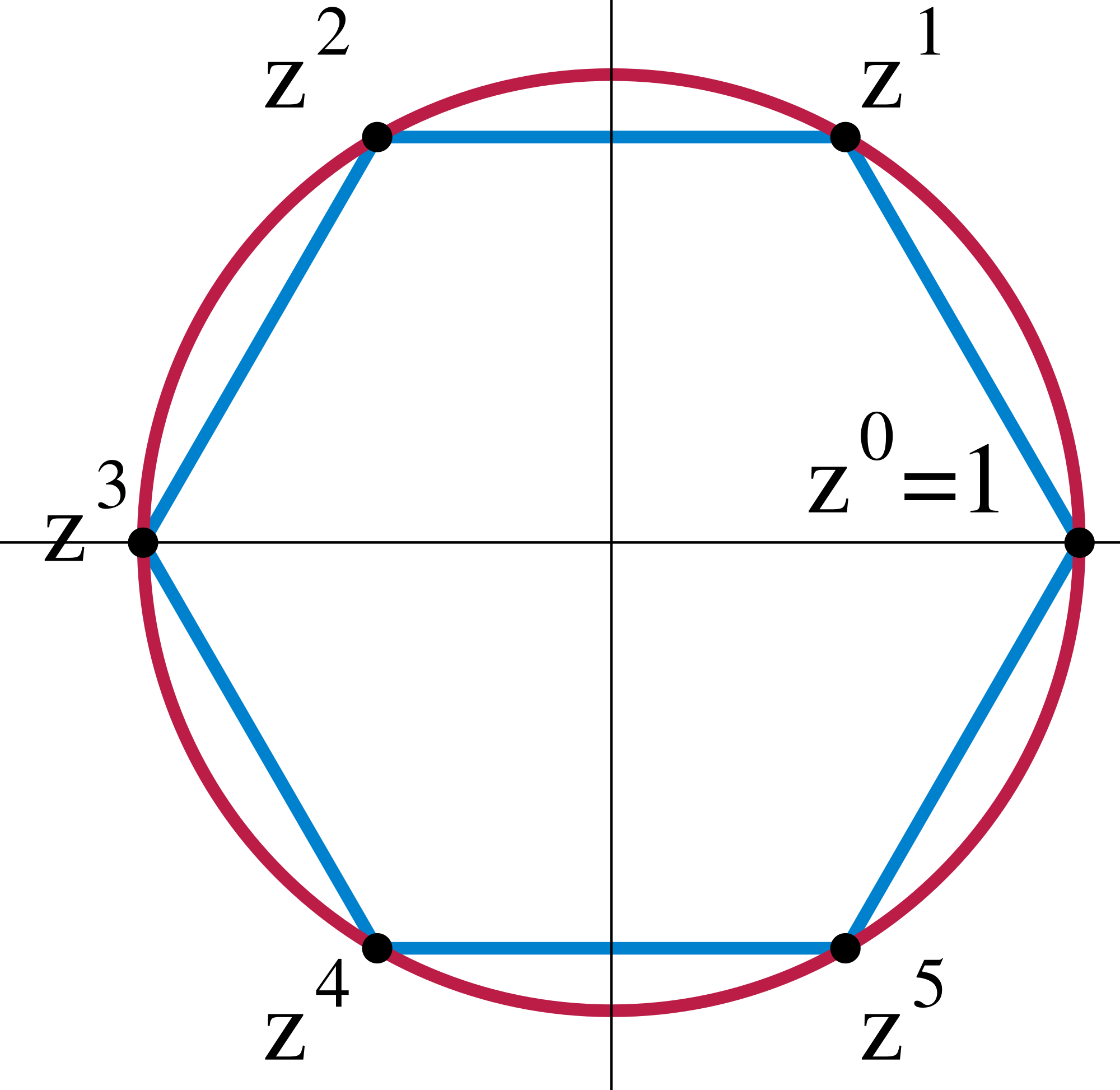
One of the most fundamental examples of a group action is the natural action of the SnS_n on the X={1,2,,n}X = \{1, 2, \dots, n\}, where each σSn\sigma \in S_n acts by σi=σ(i)\sigma \cdot i = \sigma(i) for iXi \in X. This action is faithful, meaning the kernel of the corresponding SnSym(X)S_n \to \mathrm{Sym}(X) is trivial, as distinct permutations move elements differently. It is also transitive, since any two elements in XX can be mapped to each other by some permutation, and primitive for n2n \geq 2, as the only blocks are trivial singletons or the full set. Another classical example involves the Cn=rC_n = \langle r \rangle of order nn, acting regularly on the set of nn-th of unity in the complex numbers, denoted μn={e2πik/nk=0,1,,n1}\mu_n = \{ e^{2\pi i k / n} \mid k = 0, 1, \dots, n-1 \}, via : rkζ=rkζr^k \cdot \zeta = r^k \zeta for ζμn\zeta \in \mu_n. Here, μn\mu_n itself forms a under , isomorphic to CnC_n, and the action is regular because the stabilizer of any is trivial and the of any is the entire set. The DnD_n of order 2n2n, consisting of the symmetries of a regular nn- (rotations and reflections), acts on the set of nn vertices of the by rigidly mapping the figure to itself. This action is transitive, as any vertex can be mapped to any other via a suitable or reflection. Furthermore, it is primitive if and only if nn is prime, since non-prime nn allows nontrivial blocks corresponding to divisors of nn. A simple yet illustrative example is the trivial action of any group GG on an arbitrary nonempty set XX, defined by gx=xg \cdot x = x for all gGg \in G and xXx \in X. In this case, every element of XX is a fixed point, so each singleton {x}\{x\} is both an orbit and a fixed set, and the action has trivial stabilizers everywhere. Finally, every group GG acts on itself by conjugation, where gh=ghg1g \cdot h = g h g^{-1} for g,hGg, h \in G. The orbits of this action are precisely the conjugacy classes of GG, which partition GG into subsets of elements sharing the same cycle type (in the symmetric group case) or equivalent under inner automorphisms more generally. The stabilizer of hh is the centralizer CG(h)C_G(h), and this action is useful for studying the structure of GG via its class equation.

Combinatorial applications

Group actions find prominent applications in , particularly in enumerating distinct objects up to through the use of , which counts the orbits of the action. This approach is essential for problems where symmetries, such as rotations or reflections, identify equivalent configurations, allowing the computation of inequivalent structures by averaging the fixed points over the group elements. A classic example is the counting of necklaces, where the cyclic group CnC_n acts on the set of colorings of nn beads with a fixed number of colors. Here, two colorings are considered the same if one can be obtained from the other by , and determines the number of distinct necklaces by summing the fixed colorings for each group element and dividing by the group order. For instance, with cc colors, the formula yields the number of rotationally distinct arrangements, providing a practical tool for such symmetric enumerations. In , the Aut(G)\operatorname{Aut}(G) of a graph GG acts on the set of proper kk-colorings, where the orbits correspond to colorings that are inequivalent under the graph's symmetries. Applying counts these orbits, yielding the number of distinct colorings up to , which is useful for classifying structures. Burnside's lemma also appears in the of orbits within combinatorial , where group actions on labeled structures help count unlabeled by considering symmetries in generating functions. Historically, Burnside introduced the lemma in his 1897 book Theory of Groups of Finite Order, applying it to combinatorial problems in theory.

Morphisms of Actions

Homomorphisms between G-sets

A homomorphism between two G-sets XX and YY, also known as a G-equivariant map, is a function ϕ:XY\phi: X \to Y satisfying ϕ(gx)=gϕ(x)\phi(g \cdot x) = g \cdot \phi(x) for all gGg \in G and xXx \in X. This condition ensures that ϕ\phi intertwines the actions of GG on XX and YY, preserving the group action structure. The collection of all G-sets, together with these G-s as morphisms, forms a category denoted SetG\mathbf{Set}^G. Any group action of GG on a set XX induces a representation, which is a ρ:GSym(X)\rho: G \to \mathrm{Sym}(X) defined by ρ(g)(x)=gx\rho(g)(x) = g \cdot x for all gGg \in G and xXx \in X, where Sym(X)\mathrm{Sym}(X) is the on XX. This homomorphism embeds the action into the category of permutation groups, allowing the study of actions via their images in Sym(X)\mathrm{Sym}(X). The kernel of a group action on XX is the set ker(ρ)={gGgx=x xX}\ker(\rho) = \{ g \in G \mid g \cdot x = x \ \forall x \in X \}, which coincides with the kernel of the induced homomorphism ρ:GSym(X)\rho: G \to \mathrm{Sym}(X). As the kernel of a group homomorphism, ker(ρ)\ker(\rho) is a normal subgroup of GG. An action is faithful if and only if this kernel is trivial. By the first isomorphism theorem for groups, the image im(ρ)\mathrm{im}(\rho) is a of Sym(X)\mathrm{Sym}(X) isomorphic to the G/ker(ρ)G / \ker(\rho). This isomorphism identifies the of GG modulo its kernel with a acting on XX. G-equivariant maps preserve , mapping the orbit of xXx \in X into the orbit of ϕ(x)Y\phi(x) \in Y.

Isomorphisms and conjugacy

A G-isomorphism between two G-sets (X,)(X, \cdot) and (Y,)(Y, \circ) is a bijective map f:XYf: X \to Y that is a G-homomorphism, meaning f(gx)=gf(x)f(g \cdot x) = g \circ f(x) for all gGg \in G and xXx \in X, with the additional property that its inverse f1:YXf^{-1}: Y \to X is also a G-homomorphism. Since ff is bijective, the equivariance of the inverse follows automatically from the group action axioms, ensuring that isomorphisms preserve the entire structure of the actions. Two group actions on sets XX and YY are said to be if their corresponding G-sets are isomorphic, i.e., there exists a G-isomorphism between them. This classifies actions up to structural similarity, preserving key features such as the orbit-stabilizer theorem: isomorphic G-sets have corresponding orbits of equal and stabilizers that are isomorphic as subgroups of GG. For instance, the left regular action of GG on itself is equivalent to any transitive free action on a set of G|G|. Conjugate actions provide another way to relate actions of the same group GG on a fixed set XX. Given an action :G×XX\cdot : G \times X \to X and an α\Aut(G)\alpha \in \Aut(G), the conjugate action α\cdot_\alpha is defined by gαx=α(g)xg \cdot_\alpha x = \alpha(g) \cdot x for all gGg \in G and xXx \in X. This defines a new group action, as α\alpha preserves the group operation, and it twists the original action by relabeling elements of GG via α\alpha. The conjugation action of GG on itself, defined by gx=gxg1g \cdot x = g x g^{-1} for g,xGg, x \in G, is a related example, yielding orbits as conjugacy classes. Cayley's theorem illustrates these concepts through the regular action: every group GG embeds as a of the \Sym(G)\Sym(G) via the left regular action λ:G\Sym(G)\lambda: G \to \Sym(G) defined by λ(g)(h)=gh\lambda(g)(h) = gh for g,hGg, h \in G, yielding a faithful transitive action isomorphic to the standard permutation representation. This embedding is unique up to conjugacy in \Sym(G)\Sym(G), meaning any two such regular embeddings differ by conjugation by some permutation in \Sym(G)\Sym(G), reflecting the equivalence of regular actions under relabeling of the set.

Advanced Variants

Topological group actions

A GG acts continuously on a XX if the action map μ:G×XX\mu: G \times X \to X, defined by μ(g,x)=gx\mu(g, x) = g \cdot x, is continuous with respect to the on G×XG \times X. This joint continuity ensures that the action respects the topological structures of both GG and XX, distinguishing it from merely set-theoretic actions by requiring that nearby group elements act in a controlled manner on points in XX. In many cases, such as when GG is a and XX is locally compact, this implies that each fixed gGg \in G acts via a on XX, though the converse requires additional assumptions like separate continuity. Topological transitivity extends the algebraic notion of transitivity to the continuous setting: an action is topologically transitive if, for every pair of nonempty open sets U,VXU, V \subseteq X, there exists gGg \in G such that gUVg \cdot U \cap V \neq \emptyset, or equivalently, the GUG \cdot U is dense in XX. In compact metric spaces, this is equivalent to the existence of at least one dense . Topological transitivity captures mixing or ergodic-like behavior in dynamical systems arising from group actions, where orbits densely fill the space without collapsing to finite sets as in the discrete case. A continuous action is proper if the map G×XX×XG \times X \to X \times X, (g,x)(x,gx)(g, x) \mapsto (x, g \cdot x), is a proper map, meaning that the preimage of every compact subset of X×XX \times X is compact in G×XG \times X. Equivalently, for every compact KXK \subseteq X, the set {(g,x)G×XxK,gxK}\{(g, x) \in G \times X \mid x \in K, g \cdot x \in K\} is compact. Proper actions ensure well-behaved spaces and stabilizers, often compact, which is crucial for constructions like orbifolds; compact groups always act properly on Hausdorff spaces. A classic example is the continuous action of the special orthogonal group SO(3)SO(3), the group of 3D rotations, on R3{0}\mathbb{R}^3 \setminus \{0\} by matrix-vector multiplication: for ASO(3)A \in SO(3) and vR3{0}v \in \mathbb{R}^3 \setminus \{0\}, Av=AvA \cdot v = Av. This action is continuous since matrix multiplication is a polynomial map, hence continuous, and proper because SO(3)SO(3) is compact. The orbits are spheres centered at the origin, illustrating how properness prevents "accumulation at infinity." In modern dynamical systems, such topological group actions underpin the study of qualitative behaviors like chaos and recurrence on non-compact spaces, extending classical ergodic theory to broader group structures.

Linear representations

A linear group action on a vector space arises when a group GG acts on a VV over a field kk in a manner that respects the linear structure of VV. Specifically, the action satisfies g(av+bw)=a(gv)+b(gw)g \cdot (a v + b w) = a (g \cdot v) + b (g \cdot w) for all gGg \in G, scalars a,bka, b \in k, and vectors v,wVv, w \in V. Such actions are equivalently described by group homomorphisms ρ:G\GL(V)\rho: G \to \GL(V), where \GL(V)\GL(V) is the general linear group of invertible linear endomorphisms of VV; here, gv=ρ(g)vg \cdot v = \rho(g) v. These homomorphisms are termed linear representations of GG on VV. Associated to any such representation is its character χ:Gk\chi: G \to k, defined by χ(g)=\trace(ρ(g))\chi(g) = \trace(\rho(g)), the trace of the linear map ρ(g)\rho(g). An under a linear representation ρ\rho is a subspace WVW \subseteq V such that ρ(g)wW\rho(g) w \in W for all gGg \in G and wWw \in W. A representation is irreducible if the only invariant subspaces are {0}\{0\} and VV itself, meaning no nontrivial proper exist. Irreducible representations form the building blocks of more general representations, as they cannot be decomposed further into simpler linear actions. For finite groups GG, Maschke's theorem provides a key decomposition result: if the characteristic of kk does not divide the order G|G|, then every finite-dimensional representation of GG over kk is completely reducible, meaning it decomposes as a of irreducible representations. This holds in particular over fields of characteristic zero, such as the complex numbers, but also over finite fields when the characteristic avoids dividing G|G|; in cases where the characteristic divides G|G|, representations may fail to be completely reducible, as seen in over fields like Fp\mathbb{F}_p for pp-groups.

Actions on groupoids

A is defined as a small category in which every is an . This structure generalizes groups, which are groupoids with a single object, by allowing multiple objects connected by invertible arrows representing symmetries or equivalences between them. An action of a group GG on a C\mathcal{C} consists of actions of GG on both the set of objects Ob(C)\mathrm{Ob}(\mathcal{C}) and the set of morphisms Mor(C)\mathrm{Mor}(\mathcal{C}), compatible with the category structure of C\mathcal{C}. Specifically, for each gGg \in G, the map on morphisms g():Mor(C)Mor(C)g \cdot (-) : \mathrm{Mor}(\mathcal{C}) \to \mathrm{Mor}(\mathcal{C}) satisfies s(gf)=gs(f)s(g \cdot f) = g \cdot s(f) and t(gf)=gt(f)t(g \cdot f) = g \cdot t(f) for source ss and target tt, preserves composition via g(fh)=(gf)(gh)g \cdot (f \circ h) = (g \cdot f) \circ (g \cdot h), and maps identities to identities gidx=idgxg \cdot \mathrm{id}_x = \mathrm{id}_{g \cdot x}. This compatibility ensures that each gg induces an of the C\mathcal{C}, and the map GAut(C)G \to \mathrm{Aut}(\mathcal{C}) is a . Ordinary group actions on sets recover this framework when C\mathcal{C} is the discrete on the set, with only identity morphisms. In geometric contexts, actions on groupoids extend to pseudogroup actions, where a pseudogroup—a collection of local homeomorphisms satisfying group-like axioms—acts on a space by generating local transformations, unifying global group actions with infinitesimal symmetries like actions. Such structures are essential for studying foliations and orbifolds, where the pseudogroup encodes local equivalence relations. Modern developments in , particularly Baez's work on groupoidification in the 2000s, reinterpret group actions on groupoids categorically to "categorify" linear algebra: vector spaces become groupoids, and linear maps become spans of groupoids, yielding insights into representation theory and quantum protocols via weak quotients and orbit-stabilizer relations. Morphisms of such actions, generalizing G-set homomorphisms, are functors intertwining the group actions.

Generalizations

Partial actions

In group theory, a partial action of a GG on a set XX generalizes the classical notion of a group action by allowing the action of certain group elements to be undefined on parts of the set. Specifically, it consists of a family of subsets {DgXgG}\{D_g \subseteq X \mid g \in G\}, called domains, together with bijections θg:Dg1Dg\theta_g : D_{g^{-1}} \to D_g for each gGg \in G, satisfying the following conditions: De=XD_e = X and θe\theta_e is the identity map on XX, where ee is the group identity; for all g,hGg, h \in G, the set equality Dgh=θg(Dh1)D_{gh} = \theta_g(D_{h^{-1}}) holds, and the maps compose as θgh=θgθh\theta_{gh} = \theta_g \circ \theta_h whenever the composition is defined, i.e., on Dh1g1D_{h^{-1} g^{-1}}. The partial action is then denoted by gx=θg(x)g \cdot x = \theta_g(x) for xDg1x \in D_{g^{-1}}, with the action undefined otherwise. This structure ensures partial compatibility with the group operation, preserving bijectivity where defined. A set XX equipped with such a partial action is termed a partial GG-set. The domains DgD_g often exhibit additional structure, such as forming a graded where intersections and images align with the group , enabling the partial GG-set to behave like a subsystem of a full action. For instance, invariant subsets of XX under the partial action can naturally serve as domains in extensions or restrictions of the structure. Partial GG-sets generalize full GG-sets, where Dg=XD_g = X for all gg, and every partial action embeds into a full action on a larger set via constructions like the universal enveloping action, which adjoins elements to make the action total while preserving the original partial dynamics. Partial actions find significant applications in , where they extend to actions on algebras, allowing groups to act partially on non-unital or rings. In this context, a partial action α\alpha of GG on a ring RR assigns to each gGg \in G an AgRA_g \subseteq R (playing the role of DgD_g) and a ring αg:Ag1Ag\alpha_g : A_{g^{-1}} \to A_g, with analogous compatibility conditions. This leads to the partial skew RαGR \rtimes^\alpha G, a generalization of the classical skew group ring that captures crossed product-like structures even when full actions are unavailable. The emerged in the late , with foundational work establishing conditions for —embedding partial actions into full actions on larger rings—and associativity of the partial skew group ring, particularly for s-unital rings. These algebraic partial actions have facilitated developments in noncommutative , where they describe extensions of rings under group symmetries that are not globally defined, and in the of simple Artinian rings via partial Galois correspondences. For rings, every partial action admits a weak enveloping action, ensuring the partial skew group ring is well-behaved and Morita equivalent to a full crossed product under certain regularity conditions. This framework, built on contributions from the 2000s onward, underscores partial actions' role in bridging set-theoretic dynamics with algebraic invariants.

Mackey functors

In equivariant homotopy theory and , Mackey functors provide a generalization of group actions by axiomatizing the induction, restriction, and conjugation operations that arise in the study of G-sets and representations for a G over a R. A Mackey functor M assigns to each H ≤ G an M(H), together with natural maps: restriction res^K_H : M(H) → M(K) for K ≤ H, induction ind^H_K : M(K) → M(H), and transfer (or conjugation) tr^g : M(H) → M(^g H) for g ∈ G, satisfying axioms such as res^G_H ∘ ind^G_K = ind^H_K ∘ res^K_H (projection formula), decompositions (Mackey formula), and Frobenius reciprocity. Mackey functors generalize the , where the category of R G-modules forms a Mackey functor via Hom and tensor operations. They form an Mack_R(G), with examples including the Burnside ring (counting orbits), groups H^n(G, U), and K-groups of group rings. This structure captures the dynamics of group actions on categories rather than sets, enabling computations in equivariant and . Mackey functors have applications in , where they classify equivariant spectra and compute groups, and in for decomposing induced modules via Mackey decomposition formulas. Historically, the concept was formalized in the building on George Mackey's work on induced representations, with key developments by Peter Webb and others in the for functorial approaches to .

References

Add your contribution
Related Hubs
User Avatar
No comments yet.