Hubbry Logo
Lysimachia nummulariaLysimachia nummulariaMain
Open search
Lysimachia nummularia
Community hub
Lysimachia nummularia
logo
8 pages, 0 posts
0 subscribers
Be the first to start a discussion here.
Lysimachia nummularia
from Wikipedia

Lysimachia nummularia
Scientific classification Edit this classification
Kingdom: Plantae
Clade: Tracheophytes
Clade: Angiosperms
Clade: Eudicots
Clade: Asterids
Order: Ericales
Family: Primulaceae
Genus: Lysimachia
Species:
L. nummularia
Binomial name
Lysimachia nummularia

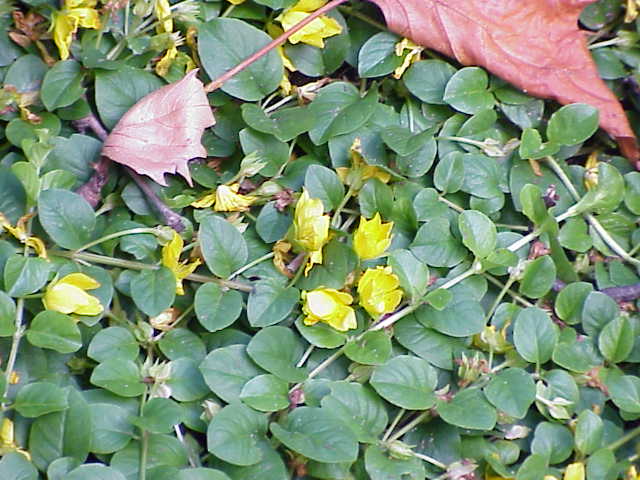
Lysimachia nummularia is a species of flowering plant in the primrose family Primulaceae. Its common names include moneywort, creeping jenny,[a] herb twopence and twopenny grass.[2]

Description

[edit]

It is a vigorous, prostrate, evergreen perennial growing to 5 cm (2 in) in height and spreading rapidly and indefinitely by stem-rooting. It has rounded leaves arranged in opposite pairs, and cup-shaped yellow flowers 2 cm in diameter, in summer. It is particularly associated with damp or even wet areas, though in cultivation it will tolerate drier conditions.[3] It is hardy, surviving lows of −15 °C (5 °F) (RHS H5).[2]

Distribution

[edit]

It is native to Europe, but has been introduced to North America, where it is considered an invasive species in some areas.[4] It aggressively spreads in favorable conditions, such as low wet ground or near ponds. It can be weeded by hand, if all stems and stem fragments are removed, to prevent the stems from rooting and regrowing.[4]

Etymology

[edit]

The Latin specific epithet nummularia means "like a coin",[5] referring to the shape of the leaves; hence the common names, such as "moneywort", which also references coins.

Cultivation

[edit]

The cultivar 'Aurea' (golden creeping Jenny) has yellow leaves, and is somewhat less aggressive than the undomesticated species. It is cultivated as an ornamental plant, for groundcover where the range of its growth can be limited. It is also suitable as a bog garden or aquatic marginal plant.[6] It has gained the Royal Horticultural Society's Award of Garden Merit.[7]

Chemistry

[edit]

The plant contains a number of phenolic acids.[8]

Notes

[edit]

References

[edit]
[edit]
Revisions and contributorsEdit on WikipediaRead on Wikipedia
from Grokipedia
Lysimachia nummularia, commonly known as creeping Jenny or moneywort, is a low-growing, mat-forming perennial herbaceous plant in the family Primulaceae, native to and extending to southwestern and northwestern , featuring rounded, slightly ruffled leaves approximately 0.75 inches in diameter and solitary, bright yellow, cup-shaped flowers about 0.75 inches across that bloom from May to August. This species typically reaches a of 2 to 4 inches while spreading indefinitely up to 1.5 to 2 feet or more, forming dense carpets through its creeping stems that root at nodes, thriving in temperate biomes. It prefers moist, humus-rich, well-drained soils in full sun to partial shade, with medium to wet moisture levels, making it well-suited to damp meadows, banks, woodlands, and edges in its native range. Widely introduced to , where it has naturalized and become invasive in parts of the eastern and northwestern United States, including states like and , L. nummularia is valued in as a ground cover for banks, paths, rain gardens, and containers, as well as an aquatic marginal plant near water features, though its vigorous spread requires containment to prevent escape into natural areas. Popular cultivars such as 'Aurea' with golden-yellow foliage enhance its ornamental appeal, providing lime-green color in shade and brighter hues in sun, but the plant is hardy in USDA zones 3 to 9 and susceptible to and diseases.

Taxonomy

Classification

Lysimachia nummularia is classified in the genus Lysimachia of the family Primulaceae, within the order Ericales and subclass Asteridae of the class Magnoliopsida in the phylum Tracheophyta. The accepted binomial name, Lysimachia nummularia L., was established by Carl Linnaeus in the first edition of Species Plantarum in 1753, where it was described based on specimens from European habitats. The original diagnosis reflects a creeping herb with rounded leaves and yellow flowers. The genus encompasses approximately 288 of primarily herbaceous perennials, distributed mainly across temperate regions of the , with a center of diversity in eastern ; recent phylogenomic studies have expanded the genus to include former genera such as and Glaux, contributing to the current count. These are characterized by their often prostrate or erect stems and simple leaves, though detailed morphological traits are covered elsewhere. Historically, was treated within the Primulaceae but was transferred to the Myrsinaceae in the early 2000s following molecular phylogenetic analyses of and nuclear DNA sequences that demonstrated a closer relationship to genera like Myrsine. Subsequent studies, including broader phylogenomic surveys, led to the merger of Myrsinaceae into Primulaceae as the subfamily Myrsinoideae, restoring the current placement while recognizing the clade's . Notable synonyms include Lysimachia zawadzkii Wiesner (1884), a later heterotypic based on material from . A minor orthographic variant, Lysimachia nummelaria, appears in some early literature but is not accepted.

Etymology

The genus name honors (c. 360–281 BCE), a Macedonian general and king of who succeeded ; according to ancient , he used a from this genus to calm an enraged , demonstrating its soothing properties. The specific epithet nummularia derives from the Latin nummulus, meaning "small coin," alluding to the plant's rounded, coin-like leaves. Common names for Lysimachia nummularia reflect both its morphology and growth habit. "Moneywort" originates from the coin-shaped leaves, echoing the Latin and evoking the appearance of small currency. "Creeping Jenny" (also known as "Running Jenny" or "Wandering Jenny") is an folk name highlighting the plant's vigorous, prostrate spreading habit. "Creeping Charlie" serves as a regional variant, though it is sometimes confused with the unrelated . "Herb Twopence," a historical British name, stems from 16th-century herbalist William Turner's observation that pairs of opposite leaves resemble rows of two-pence coins. Lysimachia nummularia was first formally described by in his (volume 1, page 148) in 1753, establishing its .

Description

Morphology

Lysimachia nummularia is a low-growing, creeping herb that forms dense mats typically 5–10 cm tall, with trailing stems measuring 20–50 cm in length and rooting at the nodes to facilitate vegetative spread. The stems are slender, branched, and prostrate or ascending at the tips, generally glabrous or sparsely pubescent, with colors ranging from light green to reddish-brown. The leaves are arranged in opposite pairs along the stems, nearly sessile with short petioles of 1–5 mm, and exhibit a rounded to cordate shape with diameters of 0.5–2 cm. They are glossy green on the upper surface, herbaceous in texture, entire-margined, and characterized by small translucent glandular dots, which may appear red to black in some specimens. Flowers emerge solitarily from the leaf axils on short pedicels, measuring 15–20 mm in diameter, and display a bright golden-yellow corolla with five rounded to obovate petals, often dotted with reddish glands near the base. The calyx consists of five lanceolate sepals, 5–8 mm long, fused at the base into a short tube; flowering occurs from May to . The is a spherical, one-celled capsule approximately 3–4 mm in diameter that dehisces vertically at maturity, containing 1 to 5 small, elliptic seeds about 2 mm long. Notable cultivars include 'Aurea', which retains the species' growth habit but features variegated golden-yellow foliage for ornamental appeal.

Reproduction

Lysimachia nummularia exhibits a mixed reproductive strategy, relying primarily on vegetative propagation while capable of through insect-pollinated flowers and seed production, though the latter is often limited in introduced ranges. The plant's flowering occurs during the summer months, typically from May to August in its native European range, with blooms appearing from leaf axils on upright stems. Flowers are hermaphroditic, featuring five yellow petals that attract pollinators, and the species generally promotes through , though self-compatibility has been observed in certain populations, particularly in eastern and southeastern , allowing occasional self-fertilization. Pollination is predominantly entomophilous, facilitated by a variety of insects including bees (such as melittid bees, honey bees, carpenter bees, bumble bees, and sweat bees), butterflies, flies, wasps, and beetles, which visit the nectar-rich flowers. Following pollination, the plant develops dehiscent capsules containing 1 to 5 small seeds each, though seed production is rare and often results in inviable seeds in North American populations, possibly due to the absence of specialized pollinators or genetic factors. Seed dispersal occurs mainly through hydrochory, with seeds carried by water flows in wetland habitats, supplemented by gravity near the parent plant and occasional epizoochory via adhesion to animals; long-distance dispersal is limited without viable seeds. Vegetative reproduction serves as the primary mode of spread, enabling rapid clonal expansion through creeping stems that root at nodes upon contact with moist soil, forming dense mats and allowing the plant to colonize new areas via stem fragments transported by water or human activity. As a perennial herb, L. nummularia maintains semi-evergreen foliage in mild climates, overwintering as a chamaephyte with buds at or near ground level, and exhibits vigorous regrowth each spring from rhizomes and rooted stems to perpetuate its life cycle.

Distribution and Habitat

Native Range

Lysimachia nummularia is native to a broad expanse of Europe, ranging from the United Kingdom and Ireland westward across temperate continental areas to Russia, encompassing Scandinavia (including Denmark, Norway, and Sweden) and the Mediterranean fringes such as Albania, Greece, Spain, and Italy. Its distribution within Europe includes the Baltic States, Belarus, Belgium, Bulgaria, Central European Russia, Czechia-Slovakia, France, Germany, Hungary, the Netherlands, Poland, Romania, Switzerland, and Ukraine, among others. The species extends eastward into temperate , occurring in southwestern (West Siberia and Altay regions), the , and northwestern . Historical records trace its recognition in European botanical literature back to , where it was documented in texts as a versatile medicinal herb referred to as "Centrum Morbidium," meaning healer of many ailments. In its native range, L. nummularia inhabits diverse ecosystems such as woodlands, wet meadows, and riverbanks, typically at elevations from to approximately 600 meters. It shows a preference for moist conditions within these habitats.

Introduced Range

Lysimachia nummularia, commonly known as creeping Jenny or moneywort, was introduced to from its native range in and western as an ornamental ground cover in the . It was first recorded in the United States by 1739, with seeds commercially available by 1833, and became established outside of cultivation by 1900 through escape from gardens and spread via discarded plant material. In , the species is now naturalized across a broad but discontinuous range in temperate regions. It occurs throughout the east of the , from southward to and eastward to Georgia and , as well as in southern , southern , and the Canadian Maritime provinces. Additional populations are found in , , and , along the Pacific coastal states of Washington and west of the , in the northern Sierra Nevada of , and in southwestern including . The has spread extensively, particularly in the central and eastern U.S., often colonizing disturbed, moist habitats. Beyond , L. nummularia has naturalized in parts of . In , it is established in southeastern regions, including (), central-southern Victoria, and northeastern , where it grows in wet riverbeds and damp areas. In , the species is naturalized in damp places such as riverbanks, forming creeping mats. Overall, it is widespread in temperate zones outside its native range, frequently appearing in disturbed sites.

Ecology

Habitat Preferences

Lysimachia nummularia thrives in moist, humus-rich soils that are well-drained to wet, tolerating a range of textures including clay, , and . It tolerates levels from 4.0 to 7.2 but prefers moderately acidic to neutral soils, growing best between approximately 5.5 and 7.2, and performs well in fertile soils enriched with , though it may decline in areas with excessive . The plant adapts to full sun to partial shade, with optimal growth in dappled light or partial shade where it avoids scorching in intense . It can tolerate full shade in settings but may produce fewer flowers under dense canopy cover. Lysimachia nummularia prefers consistently moist conditions and is commonly found in damp habitats such as stream banks, s, , and seeps, where it can grow in shallow or intermittently flooded soils. It prefers consistently moist conditions and is classified as an species in certain regions, though it can tolerate drier sites occasionally. , it is typically rated as (OBL) or facultative wetland (FACW) depending on the region, indicating a high probability of occurrence in wetlands. In its native European range, Lysimachia nummularia associates with riparian and wetland communities including species like Urtica dioica and Filipendula ulmaria. In introduced ranges, it often inhabits disturbed moist sites such as roadsides, ditches, and floodplain forests with associates like silver maple (Acer saccharinum) and green ash (Fraxinus pennsylvanica), or fringed sedge (Carex crinata) wetlands. This species exhibits broad climatic tolerance, hardy in USDA zones 3 to 9, surviving winter temperatures as low as -40°C in temperate regions with annual precipitation ranging from 900 to 1,300 mm.

Ecological Interactions

Lysimachia nummularia serves as a nectar source for various pollinators, including Halictid bees (Lasioglossum spp.), small carpenter bees (Ceratina spp.), and hoverflies (Syrphidae family), which are drawn to its small, yellow, cup-shaped flowers. These insects facilitate cross-pollination, though the plant is also self-fertile and primarily spreads vegetatively. In addition, the foliage occasionally attracts aphids (Aphididae spp.) that feed on stems and roots, while mammalian herbivores such as rabbits (Oryctolagus cuniculus) and groundhogs (Marmota monax) graze on it sporadically; however, bitter secondary compounds in the leaves reduce its palatability, limiting consumption by white-tailed deer (Odocoileus virginianus) and woodland jumping mice (Napaeozapus insignis). Fungal pathogens, including rust fungi, occasionally infect the plant, causing leaf spots and weakening growth in humid conditions. The plant's extensive root system contributes to , particularly in riparian zones where it helps bind soil particles and mitigate along streambanks and edges. By forming a dense of trailing stems, L. nummularia effectively covers bare ground, reducing runoff in flood-prone areas and promoting retention during periodic inundation. This role is especially notable in moist, disturbed habitats where the species establishes quickly following flooding or anthropogenic activity. In terms of , L. nummularia forms thick, low-growing mats that suppress in moist environments by shading the surface and reducing light penetration to the surface by over 80% in some dense mats (e.g., certain cultivars), thereby inhibiting and growth of native herbaceous species. Its rapid vegetative spread via rooting nodes allows it to outcompete slower-growing in damp meadows, seeps, and edges. Regarding nutrient cycling, the plant thrives in fertile, wet s and acts as a nutrient sink, taking up and through its endomycorrhizal associations, which enhance resource acquisition and may contribute to localized accumulation in sediments. Within native European habitats, L. nummularia plays a minor ecological role, integrating into diverse communities without dominating . In introduced ranges, such as North American s, its mat-forming habit leads to displacement of native , resulting in minor reductions in local populations and altered structure, though large-scale remains limited.

Cultivation and Uses

Horticulture

Lysimachia nummularia, commonly known as creeping Jenny, is a popular ornamental valued for its low-growing, mat-forming habit and bright foliage, making it suitable for various settings. It thrives in USDA hardiness zones 3 to 9, where it can be grown as an in milder climates or semi-evergreen in colder areas. This plant prefers moist, fertile soils and partial shade, though it tolerates full sun with adequate watering. Propagation of L. nummularia is straightforward and can be achieved through division, stem cuttings, or . Division involves separating established clumps in spring or autumn, replanting the sections immediately into prepared . Stem cuttings, taken as 4-inch sections, quickly in moist or water, often within a few weeks, due to the plant's tendency to form roots at stem nodes. can be sown in trays or directly in the ground, though germination may take longer and requires consistent moisture. For planting, space plants 30-45 cm (12-18 inches) apart to allow for their spreading growth as a ground cover. They perform best in moist, well-drained, fertile with a neutral to slightly acidic , in locations providing partial shade to prevent scorching in hot sun. Incorporate into the prior to planting to enhance moisture retention. Maintenance requirements are low, with regular watering essential to keep the consistently moist, especially during dry periods. Apply a layer of around to retain and suppress weeds. or trimming is recommended to control spread and remove any leggy or damaged growth, particularly in late summer or fall, which also encourages denser foliage. Fertilize sparingly with a balanced product in early spring if growth appears weak. Notable cultivars include 'Aurea', featuring golden-yellow leaves that brighten shady areas, and 'Goldilocks', a compact form with similar golden foliage ideal for smaller spaces. Both are less vigorous than the species and hardy in zones 3-9. L. nummularia is commonly used as a ground cover, for edging paths, in hanging baskets, or rock gardens, and it tolerates light foot traffic once established.

Medicinal Applications

In European folk medicine, Lysimachia nummularia, commonly known as moneywort or creeping Jenny, has been traditionally employed as an , , and expectorant for treating conditions such as , coughs, eczema, dropsy, and issues related to the liver and . Historical accounts, including those from herbalist , describe its use as a wound-healing agent and for internal applications like and hemorrhages when prepared as a . However, there is insufficient to rate the effectiveness of moneywort for these uses. In , L. nummularia has been utilized for its anti-inflammatory properties, promoting , and addressing conditions like and , while related species such as Lysimachia christinae are employed for urinary and gallstones. Common preparations include infusions from the leaves and stems brewed as teas for internal use, and poultices applied topically for skin conditions like eczema. Historical sources recommend small doses, such as 10 grains (about 0.65 grams) of powdered dried herb, often in ; modern sources advise consulting a healthcare provider due to lack of standardization. The plant's therapeutic effects are attributed to bioactive compounds such as , which help control , and expectorant , which aid in loosening for relief (detailed in the Chemistry section). Lysimachia nummularia is generally considered safe when used in moderation, but it is not recommended for pregnant women due to its effects, which could potentially stimulate uterine activity.

Chemistry

Bioactive Compounds

Lysimachia nummularia contains several bioactive compounds, notably triterpene saponins isolated primarily from its underground parts. A key example is nummularoside, a novel cytotoxic triterpene saponin first isolated in 2013, characterized as the 3β,23-dihydroxy-oleanoic acid glycoside with a complex pentasaccharide chain attached at the C-3 position, specifically 3-O-β-{{[β-D-xylopyranosyl-(1→2)]-[β-D-xylopyranosyl-(1→4)]-β-D-glucopyranosyl-(1→4)}-[β-D-glucopyranosyl-(1→2)-]-α-L-arabinopyranosyl}} protoprimulagenin A. This compound exhibits significant in vitro cytotoxic effects against prostate cancer cell lines DU145 and PC3 (EC₅₀ values of 1.2 and 7.4 μg/mL, respectively), glioblastoma cells (EC₅₀ 6.0 μg/mL), and moderate activity against melanoma cells (EC₅₀ 17.5–23.2 μg/mL), while showing low toxicity to normal cells (EC₅₀ 30 μg/mL). The plant is also rich in polyphenolic compounds, including and phenolic acids, which contribute to its and properties. such as quercetin derivatives (e.g., , quercitrin, and quercetin-3-O-hexosyl-desoxyhexoside-7-O-desoxyhexoside), glycosides (e.g., myricitrin as the predominant compound), and glycosides have been identified in aerial parts and leaves, with myricitrin comprising a major portion of the profile. Phenolic acids, including , , , , and , are present in both free and bound forms across roots, leaves, and flowers, with often detected at higher concentrations in flowers (up to 22.10 mg/g equivalent). These polyphenolics have been quantified using (HPLC) with diode-array detection (DAD), revealing higher contents in leaves (~0.3% in crude methanolic extracts) compared to roots. Additional bioactive constituents include , which impart properties. Extraction of these compounds typically involves solvents like 70% via methods such as Soxhlet, maceration, or ultrasound-assisted extraction from underground parts for and aerial parts for polyphenolics. Pharmacological studies have demonstrated activity through and ABTS assays, attributed to the polyphenolic fraction, and effects linked to phenolic acids .

Invasiveness

Impacts

Lysimachia nummularia forms dense, mat-like growth in wetlands and moist habitats, altering habitat structure by suppressing light penetration to the soil surface by over 80% and increasing herb layer density, which disrupts natural water flow in areas such as springs and seeps. This vegetative dominance excludes native vegetation, particularly in floodplain forests and understories, leading to changes in plant community composition and moderate reductions in native species diversity. In the US Midwest, long-term studies along rivers like the Wisconsin River have documented its increased presence correlating with declines in native plant populations, outcompeting species in disturbed and semi-natural wetlands. The plant contributes to by displacing desirable native in wet meadows, swamps, and stream banks, forming impenetrable covers that prevent seedling establishment and alter microhabitats suitable for wetland-dependent organisms. While direct quantification of diversity loss varies, its mat-forming habit has been observed to reduce populations of native herbaceous species without evidence of complete extirpation in most cases. Spread occurs primarily through vegetative propagation via rooting stems and fragments transported by water flow, with seed banks reaching densities of up to 240 seeds per square meter, facilitating rapid colonization in riparian zones. Human activities, including ornamental plantings and disposal, further promote dispersal, allowing individual plants to expand coverage vigorously in suitable moist conditions, often forming extensive patches over time. Regionally, L. nummularia is recognized as invasive in several states, particularly in the eastern and midwestern regions, as well as Pacific coastal areas in Washington and , including , , , New York, , and . It is prohibited from sale in states such as , (except certain cultivars), and , due to threats to sensitive habitats like and stream banks. Economically, the species incurs minor costs through escapes from ornamental use, necessitating increased maintenance in public parks and along waterways where dense growth can clog drainage and require removal efforts to preserve access and functionality.

Management

Mechanical control methods are suitable for small infestations of Lysimachia nummularia. Hand-pulling or digging out the plants is effective when all stems, roots, and fragments are removed to prevent re-rooting, particularly in dry conditions to minimize fragment dispersal. Repeated mowing can exhaust the plant's reserves over time, though it is less effective due to the plant's low-growing habit and ability to root at nodes; this approach works best when combined with other methods. Prolonged submergence in can also kill the plant, making it a viable option in settings. Chemical control involves the use of herbicides, with (such as for aquatic sites) and being effective options for broadleaf weeds like L. nummularia. These should be aquatic-labeled formulations when applied near wetlands, following label directions and state regulations to ensure environmental safety. Spot treatments with provide good initial control, while targets broadleaves selectively; efficacy data is limited, but repeated applications may be necessary for complete eradication. Fall applications can enhance root kill by targeting the plant during nutrient translocation to belowground parts, though specific timing studies for this species are sparse. Biological control agents have not been released for L. nummularia, and no specific pathogens or insects are currently recommended. However, by shows potential as a non-selective method to suppress growth in larger areas, particularly when integrated with other controls, though evidence for this is anecdotal and not widely documented. Prevention strategies emphasize avoiding introduction and spread. Planting should be avoided near natural areas, wetlands, or forests to limit escapes; instead, opt for less aggressive cultivars like 'Aurea', which is slower-spreading than the wild type. Regular monitoring of sites multiple times per year, along with minimizing soil disturbance, helps detect and contain early infestations. Following control efforts, restoration enhances long-term success by reintroducing native plants, such as grasses, to shade out regrowth and compete for resources. Integrated approaches combining mechanical removal, herbicides, and native plantings yield higher success rates than single methods, often reducing reinvasion over multiple seasons. Prescribed may also be used in fire-adapted habitats, with repeated burns in spring or fall to deplete seed banks and aboveground .

References

Add your contribution
Related Hubs
User Avatar
No comments yet.