Hubbry Logo
Zhenbao IslandZhenbao IslandMain
Open search
Zhenbao Island
Community hub
Zhenbao Island
logo
8 pages, 0 posts
0 subscribers
Be the first to start a discussion here.
Zhenbao Island
Zhenbao Island
from Wikipedia

46°29′08″N 133°50′40″E / 46.48556°N 133.84444°E / 46.48556; 133.84444

Zhenbao Island

Key Information

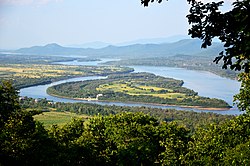
Zhenbao Island (simplified Chinese: 珍宝岛; traditional Chinese: 珍寶島; pinyin: Zhēnbǎo dǎo; lit. 'Rare Treasure Island') or Damansky Island[2] (Russian: о́стров Дама́нский, romanizedostrov Damanskiy) is an island in Hulin,[3] Jixi, Heilongjiang Province, China, with an area of only 0.74 square kilometres (0.29 sq mi). It is on the Ussuri River on the border between Primorsky Krai, Russia, and Heilongjiang Province, China.

Prior to the 1991 Sino-Soviet Border Agreement, the island was disputed between China and the Soviet Union. It got its Russian name from the railway engineer Stanislav Damansky, who died there in an incident in 1888 while he was charting the future route for the Trans-Siberian Railway.

Conflict between Soviet Union and China

[edit]
Map of the region showing the island at center right (AMS, 1957)

The island was the subject of a territorial dispute between the Soviet Union and China. China (PRC) held that "in the absence of an explicit treaty provision, the central line of the main channel—the Thalweg principle—provided a legal basis for delimiting the boundary in the two rivers. On this basis, Beijing claimed that 600 of the rivers’ 700 islands—including Zhenbao Island on the Ussuri River, just 180 miles southwest of an important Soviet city, Khabarovsk—belonged to the P.R.C."[4] Battles were fought with a considerable loss of life during the Sino-Soviet border conflict in mid-1969.[5] The dispute over Zhenbao raised concerns that it could ignite World War III until an initial resolution of the conflict in November 1969.

In his memoir, US President Richard Nixon recounted a story that Premier Zhou Enlai (Chou En-lai) had told him about the border dispute: "Later on, when he had loosened up considerably, he told an amusing story that he said took place during a Sino-Soviet border flare-up in 1969. "We had a hot line between the Soviet Union and ourselves then," he said, "but it had already become cold because the Kremlin never used it. At the time of the Chen Pao [Zhenbao Island] border incident, however, Kosygin picked it up and called us. When our operator answered, he said, 'This is Premier Kosygin. I would like to speak to Chairman Mao.' The operator, completely on his own, said, 'You are a revisionist, and therefore I will not connect you.' So Kosygin said, 'Well, if you will not try to reach the Chairman, will you please connect me with Prime Minister Chou.' But the operator gave the same unauthorized reply and broke the connection.""[6]

On 19 May 1991, both sides came to an agreement that the island was part of the territory of China, and the Soviet troops withdrew.

A 2004 Russian documentary film, Damansky Island Year 1969. ("Остров Даманский. 1969 год"), was made about the 1969 Zhenbao incident.

See also

[edit]

References

[edit]
[edit]
Revisions and contributorsEdit on WikipediaRead on Wikipedia
from Grokipedia
Zhenbao Island, known in Russian as Damansky Island, is a small, measuring 0.74 square kilometers situated in the Ussuri River, approximately 200 meters from the Chinese bank in Hulin, Jixi, Province, and 300 meters from the Russian bank in . The island gained international notoriety as the site of intense clashes between Chinese and Soviet forces in March 1969, initiated by a Chinese on Soviet guards on March 2 that killed around 30 Soviets, followed by a Soviet on , resulting in approximately 58 Soviet and 70 Chinese deaths amid broader escalatory risks including nuclear threats. These incidents, part of simmering Sino-Soviet ideological and territorial disputes, marked a pivotal rupture in communist bloc unity, prompting the to seek rapprochement with the West and facilitating U.S.- under Nixon. over Zhenbao Island remained contested until resolution through the , which transferred it to , affirmed by subsequent 1997 and 2004 protocols that delineated the river boundary along the main channel favoring Chinese claims based on historical treaties and principles.

Geography and Location

Physical Description and Strategic Importance

Zhenbao Island, known internationally as Damansky Island, is a small, uninhabited landmass measuring 0.74 square kilometers, located in the River along the Sino-Russian border near Hulin in China's Province and Russia's . The island lies approximately 200 meters from the Chinese riverbank and 300 meters from the Russian side, positioned within the main navigational channel of the , which flows northward toward its confluence with the River. Its coordinates are approximately 48°22′55″N 134°46′40″E. The terrain consists of elongated, low-lying features typical of riverine environments, covered in reeds, shrubs, and sparse forest vegetation, rendering it a prone to seasonal inundation from the Ussuri's fluctuating levels. Lacking permanent structures or human habitation, the island's natural state provides limited elevation but offers concealment amid dense growth, which has historically complicated border surveillance. Strategically, Zhenbao Island's placement bisects the River's channel, affording potential control over riverine navigation routes vital for regional transport and commerce along this border waterway exceeding 500 meters in width at the site. Its proximity to both banks enables it to serve as a forward observation point or outpost for monitoring cross-river movements, facilitating patrols or defensive positions in contested frontier zones due to the river's role as a natural . The island's central location in the flow enhances its tactical value for influencing access to adjacent territories without requiring extensive infrastructure.

Historical Claims and Naming

Pre-Modern Ownership Disputes

The River region, including Zhenbao Island, was traditionally used by indigenous Tungusic peoples such as the Hezhen (also known as Nanai) and Manchu for seasonal fishing, hunting, and riverine livelihoods, reflecting patterns of nomadic resource exploitation rather than formalized territorial sovereignty. These groups inhabited the river basins and confluences of the (Heilong), Songhua, and rivers, deriving sustenance from migratory fish stocks and wildlife, with archaeological and ethnographic records indicating continuous presence since at least the medieval period but no evidence of centralized administrative control over specific islets like Zhenbao prior to imperial expansion. The Qing Dynasty established effective control over the and river systems in the mid-17th century through military consolidation originating from Manchu conquests of Jurchen and other local tribes, followed by defensive campaigns against early Russian probes, such as the 1652-1689 border skirmishes that culminated in the (1689), which delimited the as a Qing sphere north of the river while affirming broader regional authority. Administrative records, including imperial edicts and tribute systems, documented the treatment of the as under general jurisdiction, with sporadic garrisons at key posts like Aigun enforcing tax collection on indigenous fishing and , though the area's remoteness limited dense settlement or detailed cartographic surveys of minor islands. Empirical evidence from Qing gazetteers and expedition logs, such as those from the Kangxi era (1661-1722), portrays the region as an outer frontier integrated via bannermen oversight rather than contested foreign domain. Initial Russian encroachments began with exploratory forays in the , accelerating after the Empire's consolidation of Siberian territories, but focused on reconnaissance rather than occupation of riverine features like Zhenbao. Expeditions, including those along the by figures like in 1867, produced route surveys and nomenclature—such as the Russian designation "Damansky" derived from later 19th-century railway engineering efforts—but yielded no permanent settlements or administrative claims on the island prior to the 1858 Aigun Treaty, with records indicating transient patrols amid Qing-dominant usage patterns. These surveys, documented in reports, prioritized strategic mapping over territorial assertion, highlighting the island's marginal status in pre-industrial contexts.

19th and 20th Century Treaties

The Treaties of Aigun (May 16, 1858) and Peking (November 14, 1860) established the eastern segment of the Sino-Russian border along the and rivers, ceding approximately 1 million square kilometers of territory north of the and east of the from the Qing Empire to the . These agreements delineated the boundary as following the rivers' courses but omitted explicit provisions for the hundreds of islands within them, including Zhenbao Island (known as Damansky Island to Russians) approximately 300 kilometers southwest of in the River. In practice, the principle—dividing navigable rivers along their deepest channel, a norm in 19th-century international boundary treaties—would have placed Zhenbao and many other islands under Chinese sovereignty, as the main channel lay closer to the Chinese bank; however, Russian imperial forces soon administered the islands de facto, exploiting ambiguities and Qing military weakness following the . Chinese historiography characterizes these as "unequal treaties" imposed under duress amid Qing vulnerability to Western and Russian expansionism, arguing they violated first-possession claims to the Amur-Ussuri basin dating to Ming and early Qing eras, though Russian perspectives emphasize mutual recognition of the riverine lines without island specification. Subsequent 19th-century protocols, such as the 1881 Treaty of , addressed minor adjustments but reinforced the river borders without resolving island ownership, perpetuating administrative control by over Zhenbao through settlement and patrols. In the early 20th century, following the 1917 Bolshevik Revolution, Soviet protocols from the 1929 Sino-Soviet armed conflict over the —resolved by the December 1929 Khaborovsk Protocol and border agreements—reaffirmed Russian/Soviet administrative rights along the Amur-Ussuri frontier, including patrols on disputed islands, despite Nationalist Chinese protests asserting under the . These arrangements maintained the status quo of Soviet dominance but highlighted ongoing frictions, as Chinese authorities challenged patrols on islands like Zhenbao as encroachments. The 1945 Sino-Soviet Treaty of Friendship, Alliance, and Mutual Assistance, signed August 14 amid World War II's endgame, explicitly upheld the 1858–1860 border demarcations as the legal basis for the Amur-Ussuri line, influenced by concessions granting the USSR restored privileges in from earlier Russo-Japanese pacts. While fostering wartime unity against , the treaty's affirmation of pre-revolutionary boundaries later fueled Chinese revanchist arguments post-1949, as the rejected "unequal" tsarist gains, sowing discord despite the communist ideological .

Prelude to the 1969 Conflict

Sino-Soviet Ideological Split

The Sino-Soviet ideological split originated with Nikita Khrushchev's "Secret Speech" on February 25, 1956, which denounced Joseph Stalin's cult of personality and purges, initiating a policy of de-Stalinization that Mao Zedong viewed as a revisionist betrayal of Marxist-Leninist principles. Mao, who had modeled aspects of Chinese communism on Stalinist methods including mass mobilization and centralized control, rejected Khrushchev's critique as undermining revolutionary purity and accused the Soviet leadership of capitulating to bourgeois influences. This divergence escalated during the late 1950s, as Mao defended Stalinism while criticizing Soviet "revisionism" for diluting class struggle, a stance that positioned China as the true guardian of orthodox Marxism against perceived Soviet apostasy. Tensions intensified with the Soviet withdrawal of technical aid and experts from in mid-1960, abruptly halting over 1,390 joint projects that had been established under the 1950 Sino-Soviet Treaty of Friendship, Alliance, and Mutual Assistance. This move, prompted by Khrushchev's frustration with Mao's and independent nuclear ambitions, left economically isolated and fueled grievances that the USSR prioritized its own interests over , exacerbating Mao's narrative of Soviet hegemonism. Ideological polemics further polarized the alliance, with Mao rejecting Khrushchev's doctrine of "peaceful coexistence" with capitalist states as a concession that postponed inevitable revolutionary confrontation, advocating instead for "continuous revolution" through perpetual class struggle and support for national liberation movements in the Third World. These theoretical disputes manifested in proxy rivalries, such as competing influences in , , and , where China portrayed the USSR as conciliatory toward imperialists, heightening mutual suspicions of ideological sabotage. By the mid-1960s, the rift contributed to border frictions, as Soviet forces increased patrols and constructed fortifications along disputed frontiers starting around 1964, actions interpreted by Beijing as expansionist encroachments backed by revisionist betrayal rather than defensive measures. This perception aligned with Mao's broader framing of the USSR as a social-imperialist power, transforming abstract doctrinal conflicts into tangible security dilemmas that eroded the facade of communist solidarity.

Border Tensions in the 1960s

Throughout the mid-1960s, Sino-Soviet border incidents along the and Rivers intensified, with mutual accusations of territorial encroachments and patrols crossing demarcation lines. Following the deterioration of relations after 1960, such violations rose markedly in frequency, prompting public diplomatic protests by 1963. Chinese authorities documented thousands of alleged Soviet incursions, including patrols landing on disputed islands and helicopter overflights into Chinese territory, particularly in the region bordering the Ussuri. In 1967 and 1968, these tensions manifested in minor skirmishes short of sustained combat, such as vessel rammings between Chinese fishing boats and Soviet border craft on the rivers during summer months, and confrontations involving zealous Chinese crossing ice in winter. November 1967 saw initial armed clashes between troops, while January 1968 recorded the first Chinese fatalities from such encounters. Soviet reports countered by attributing provocations to Chinese forces, including unauthorized island occupations and forays. Responding to these developments, Chinese under emphasized "active defense," defined as offensive engagements within a defensive posture to preempt aggression, leading to heightened preparations along the frontier. This included arming local militias in Province for roles and fortifying positions near contested areas like Zhenbao Island, framed as countermeasures to Soviet . Parallel to physical confrontations, propaganda warfare escalated through state-controlled media, with denouncing Soviet "hegemonism" and revisionist claims over historical territories, while portraying Moscow's actions as imperialistic betrayals of socialist . Soviet outlets reciprocated by labeling Chinese moves as chauvinistic adventurism aimed at destabilizing the border, amplifying mutual distrust without resolving underlying territorial ambiguities from 19th-century treaties.

The 1969 Clashes

March 2, 1969 Incident

On the morning of March 2, 1969, a Soviet border patrol consisting of approximately 50-60 troops entered for a routine amid ongoing tensions over the disputed territory in the Ussuri River. Chinese forces, numbering around 300 and positioned in prepared sites on the and surrounding areas, initiated the attack by opening fire on the Soviet patrol, catching them by surprise. Declassified analyses indicate the Chinese fired first, with the targeting the Soviet post commander and his men, leading to an intense firefight involving small arms and grenades. Soviet reinforcements, including T-62 tanks and artillery units from nearby positions, responded by advancing onto the island and shelling Chinese positions, which allowed them to temporarily secure the area by the afternoon. Official Soviet casualty figures for the March 2 clash reported 58 killed, though this encompasses the initial patrol losses and subsequent engagements that day; Chinese reports acknowledged 29 dead among their forces. Chinese accounts framed the incident as a defensive action against an alleged Soviet incursion onto territory they claimed as their own, asserting that People's Liberation Army troops repelled invaders who had crossed the border line. In the immediate aftermath, both sides issued conflicting protests: the Soviet Union accused China of a premeditated ambush violating border protocols, while China countered with claims of Soviet aggression provoking a justified response. Soviet forces maintained a brief presence on the island following the clash, but the skirmish escalated propaganda efforts on both sides, with each declaring a tactical victory—Soviets emphasizing their armored counterattack and Chinese highlighting the initial rout of the patrol. Declassified U.S. intelligence assessments, drawing from signals intercepts and refugee reports, corroborated the Soviet narrative of surprise but noted mutual provocations in prior patrols had heightened risks.

March 15, 1969 Escalation

In response to the incident, Soviet forces initiated a large-scale counteroffensive on Zhenbao Island early on March 15, 1969, deploying an estimated 600 troops equipped with armored personnel carriers such as BTR-60s, tanks, and supported by heavy artillery units including 122mm howitzers and the newly introduced multiple rocket launchers for the first time in combat. The assault began before dawn with prolonged artillery and rocket barrages that devastated Chinese positions and much of the island's terrain, employing scorched-earth tactics to deny cover and suppress defenders. Soviet , advancing in mechanized waves, engaged Chinese troops—numbering around 2,000 in fortified positions—in intense close-quarters fighting characterized by machine-gun , grenades, and anti-tank weapons. Unlike the , which relied on and surprise, the Soviet operation emphasized integration, with providing rolling support ahead of armored thrusts, though initial probes faced stiff resistance from Chinese mortars and small arms. By afternoon, sustained bombardment forced a Chinese withdrawal, leaving Soviet units in control of key sectors amid burning vegetation and destroyed bunkers. Casualties were significantly higher than in the initial clash, with Soviet accounts reporting 24 border guards and soldiers killed specifically on , contributing to overall Soviet losses of approximately 58 dead and 94 wounded across the March engagements. Chinese losses were estimated at 60-100 killed by Soviet sources, though official Chinese figures claimed around 29 dead for ; accounts from Chinese defectors and archival analyses suggest higher numbers, potentially hundreds, evidenced by mass burial sites observed near the island. Declassified Soviet documents and defector testimonies indicate premeditation on both sides, with Chinese forces having reinforced the island in advance using and prepared broadcasts, while Soviet planning involved detailed and coordination to reclaim disputed areas. This escalation highlighted tactical disparities: Soviet reliance on firepower and mechanization contrasted with Chinese emphasis on manpower and defensive entrenchments, resulting in disproportionate material destruction on the small island.

Soviet and Chinese Military Responses

Following the March 15, 1969, clash on Zhenbao Island, Soviet forces in the were placed on high alert, with strategic rocket units activated until March 20. Reinforcements rapidly bolstered border deployments, expanding from prior levels of about 14 divisions in 1965 to 27-34 divisions—totaling 270,000 to 300,000 troops, roughly half in combat-ready condition—by late March. These included heavy concentrations of , tanks, and , as demonstrated by the March 15 operation involving 50 tanks and armored personnel carriers, over 10,000 rounds, and 36 air sorties. The Soviet posture emphasized offensive conventional capabilities, with construction of fortified defenses resembling a "" to secure key border areas against potential Chinese incursions. China responded by mobilizing additional People's Liberation Army units, deploying approximately 59 lightly armed, non-motorized divisions along the border to reinforce existing formations. directed preparations for a protracted "," prioritizing deep defensive echelons, extensive foxhole networks, and integration of militia and border guards for guerrilla-style against anticipated Soviet mechanized assaults. This mobilization strained Chinese logistics, diverting personnel and supplies from southern commitments, including aid to , while nationwide alerts accelerated industrial dispersal and measures. Both adversaries thus assumed near-war stances, with mutual force concentrations exceeding 500,000 troops in the region alone, amplifying risks of unintended escalation through miscalculation.

Near-War Crisis and De-escalation

Nuclear Threats and International Reactions

In the aftermath of the March 1969 clashes on Zhenbao Island, Soviet leaders escalated rhetoric and military posturing, with declassified assessments indicating considerations of preemptive strikes against China's nascent nuclear infrastructure to eliminate the perceived threat. Soviet Premier and General Secretary weighed options for targeted attacks on facilities like the test site and uranium enrichment plants, viewing China's emerging atomic capability as destabilizing amid border hostilities. This saber-rattling intensified in summer 1969, as Moscow deployed additional forces and conducted exercises simulating strikes, prompting U.S. intelligence to alert Washington of a potential "mortal blow" capability against Beijing's limited arsenal of roughly a dozen warheads and rudimentary delivery systems. Soviet diplomats, including Second Secretary Boris Davydov, probed U.S. officials through backchannels in for reactions to such operations, framing them as a means to destroy China's nuclear potential and avert future escalation; these soundings sought tacit neutrality or cooperation but elicited firm opposition from the Nixon administration. Advisor , informed by CIA Director , conveyed to Soviet counterparts that any attack on Chinese nuclear sites would be viewed as a broader to global stability, potentially triggering U.S. retaliation and complicating efforts. This U.S. stance, corroborated by intercepted communications and embassy reports, deterred Moscow from proceeding, as Brezhnev's debated but ultimately shelved the plans amid fears of uncontrolled escalation. The Nixon exploited the crisis opportunistically, leveraging Soviet overtures to accelerate ; intelligence assessments highlighted the Sino-Soviet rift as a chance to court while pressuring on , with Kissinger authorizing discreet signals of U.S. non-involvement in any Soviet action but readiness to defend global norms. Internationally, reactions emphasized restraint to avert nuclear spillover, though few neutral powers intervened directly; U.S. allies like expressed alarm over regional fallout risks, while European diplomats urged through multilateral channels. The episode underscored the fragility of deterrence, with Soviet warnings to Washington of intent to "wipe out the Chinese threat" revealing a near-miss where miscalculation could have ignited broader conflict, as evidenced by heightened alerts and global monitoring.

Diplomatic Efforts

On March 21, 1969, Soviet Premier attempted to establish direct contact with Chinese leaders via telephone to discuss de-escalation following the Zhenbao Island clashes, but Chinese operators refused the call, reflecting Mao Zedong's initial strategy of limited provocation without immediate negotiation. Tensions remained high through the summer, with both sides amassing troops and engaging in rhetorical escalations, yet pragmatic considerations—such as the risk of nuclear confrontation—prompted Soviet initiatives for dialogue amid internal debates on retaliation. De-escalation accelerated with an unannounced two-hour meeting on September 11, 1969, between Kosygin and Chinese Premier at Capital Airport, arranged at Moscow's request during Kosygin's stopover en route to . The discussion, conducted without territorial concessions or ideological reconciliation, yielded a limited accord: both parties pledged to withdraw forces to pre-March 2 positions, cease hostile actions, and direct field commanders to prevent firing incidents, effectively establishing a non-aggression framework along the border. This pragmatic outcome prioritized crisis stabilization over resolving underlying disputes, with withdrawals beginning in October 1969. To sustain communication and avert miscalculations, a direct hotline linking and was operationalized shortly after the airport talks, serving as a dedicated channel for high-level exchanges during ongoing border consultations. Third-party involvement included , whose leadership under —positioned as a dissenter—facilitated indirect messaging to bridge the impasse, though with limited success in prompting formal mediation. Concurrently, U.S. diplomatic signals to Soviet counterparts, conveyed through backchannels, emphasized Washington's opposition to unilateral Soviet aggression against , deterring escalation by implying potential American countermeasures rather than neutrality. These efforts collectively shifted focus from to managed tension, averting broader conflict without addressing over Zhenbao Island.

Resolution of the Dispute

Post-1969 Negotiations

Following the 1969 clashes on Zhenbao Island, Sino-Soviet border negotiations opened on October 20, 1969, in , with subsequent rounds in and expert-level consultations aimed at delineating disputed territories along the and rivers. These efforts yielded limited results, including minor such as direct hotlines between border commanders to prevent escalations and mutual pledges to restrain patrols near sensitive islands like Zhenbao, but repeatedly deadlocked over China's insistence on abrogating "unequal" 19th-century treaties and Soviet demands for recognition of de facto control. Persistent mutual distrust, fueled by ideological polemics and massive troop deployments—over one million Soviet forces along the border—prevented substantive concessions, with talks stalling by the mid-1970s despite occasional renewals, such as Moscow's initiative in November 1976. The Soviet invasion of on December 24, 1979, intensified tensions, as perceived it as hegemonic expansion bordering its sphere, leading to suspend border consultations in January 1980 and demand withdrawal as a precondition for progress. This halted momentum amid broader geopolitical strains, including Soviet support for Vietnam's occupation of , reinforcing Chinese wariness of Moscow's intentions despite shared communist ideology. Under Mikhail Gorbachev's from 1985, economic reforms and a doctrinal shift toward de-ideologized prompted Soviet overtures to ease Asian burdens, including partial troop reductions and revival of dialogue. Separate normalization talks began in , decoupling economic ties from border issues, while border-specific efforts accelerated; in August 1987, Gorbachev conceded that disputed eastern sectors followed the main navigation channels of the and rivers—abandoning prior claims to the Chinese bank—paving the way for a joint demarcation commission focused on technical surveys excluding final sovereignty rulings. Trade expansion, from negligible levels in the early to burgeoning exchanges in machinery and resources, incentivized stability, as both sides linked commercial normalization to de-escalation, though withheld full trust pending verifiable pullbacks from . Distrust lingered, evident in Beijing's three-obstacle framework demanding Afghan and Cambodian withdrawals alongside Mongolian reductions.

1991 Sino-Soviet Border Agreement

The Agreement on the Eastern Section of the Border between the Union of Soviet Socialist Republics and the was signed on May 16, 1991, in by Soviet Foreign Minister and Chinese Foreign Minister Qian Qichen. The treaty delineated the approximately 4,300-kilometer eastern border from the Mongolia tripoint to the estuary, establishing the line along river channels where applicable. For disputed riverine areas like the , the border followed the main navigation channel, or —the deepest continuous channel suitable for international navigation—resolving over islands including Zhenbao (Damansky) Island in China's favor, as the thalweg positioned the island on the Chinese side of the boundary. The agreement included protocols for joint demarcation commissions to survey and mark the border with physical boundary pillars, a process that commenced immediately after signing but faced delays due to the Soviet Union's dissolution in December 1991. Supplementary protocols addressing technical adjustments and remaining ambiguities in the eastern sector were negotiated and ratified by and in 2004–2005, enabling full implementation of the 1991 delineations. These efforts resulted in the placement of over 2,000 demarcation markers along the and rivers, with Zhenbao Island explicitly incorporated into Chinese territory via adjusted maps annexed to the treaty. Post-agreement, bilateral mechanisms initiated joint patrols and along the newly demarcated segments, reducing around Zhenbao and facilitating administrative of the island to Chinese control without further incidents. The treaty's provisions emphasized mutual non-encroachment and in border management, marking the culmination of negotiations that had traced back to provisional understandings on river boundaries.

Current Status and Administration

Sovereignty Confirmation

The Complementary Agreement on the Eastern Section of the China-Russia Boundary, signed on October 14, 2004, finalized the demarcation of the border, explicitly affirming Chinese over Zhenbao Island as established in prior agreements. This protocol was ratified by China's Standing Committee on April 27, 2005, and by the Russian on May 20, 2005, without reservations or conditions challenging Chinese control. The agreement entered into force on July 21, 2008, following on-site demarcation work. Since ratification, has lodged no official territorial claims or revanchist assertions regarding Zhenbao Island, confirming the legal finality of Chinese sovereignty. The island remains under exclusive Chinese administration as part of Hulin City, Jixi Prefecture, Province, with border management handled by Chinese authorities. Empirical indicators of unchallenged control include the absence of joint patrols or Russian markers on the island post-2005, consistent with the ratified border line.

Modern Use and Border Management

Zhenbao Island remains uninhabited and functions mainly as a site for Chinese border patrol and monitoring along the Ussuri River. As a designated military-administrative zone under Chinese sovereignty, general public access, including , is prohibited for both residents and foreigners to maintain operational . Limited exceptions allow occasional organized visits by Chinese groups for commemorative purposes, often tied to anniversaries of historical events, with nearby facilities like a museum drawing over 500,000 annual visitors, predominantly domestic. The island supports environmental conservation as part of the Zhenbao Island Wetland National , encompassing 0.74 square kilometers of wetlands, riparian forests, and floodplain habitats restored through ongoing efforts to enhance biodiversity. This reserve aids ecological connectivity for species under state protection, including the Amur tiger, , and , via corridors linking to adjacent protected areas. Border management adheres to the 1991 Sino-Soviet Border Agreement's demarcation protocols, with handling island administration while bilateral mechanisms—such as regular border troop consultations and incident prevention hotlines—facilitate stability along the Ussuri sector. Complementary Sino-Russian cooperation extends to Amur River basin initiatives for flood control and riverine monitoring, indirectly supporting habitat preservation near Zhenbao without direct joint operations on the island.

Legacy and Controversies

Differing National Narratives

In the official Chinese historical narrative, the clashes on Zhenbao Island in March 1969 are portrayed as a defensive response to Soviet , with forces repelling an invasion by Soviet troops labeled as practitioners of "social-imperialism." This framing elevated the incident to a symbol of national heroism, reinforcing Mao Zedong's leadership during the ; heroes from the battles were publicly honored at the 9th Congress in April 1969, bolstering Mao's amid internal turmoil. Memorials on the island, including a museum and park established by post-1991, commemorate the events as a victorious stand against expansionism, emphasizing Chinese casualties of around 29 killed while claiming Soviet losses exceeded 60, though these figures lack independent verification and serve propagandistic purposes. The Soviet and post-Soviet Russian perspective, conversely, depicts the incident as a provoked reaction to Chinese provocations, with border guards patrolling disputed territory when ambushed by PLA troops on March 2, 1969, resulting in 31 Soviet deaths that day. Official accounts minimized glorification of the conflict even during the , attributing it to Chinese expansionism amid the , and post-1991 narratives further downplay it to avoid commemorating losses or territorial concessions, reflecting a pragmatic avoidance of nationalist escalation in improved bilateral ties; Russian sources report total Soviet casualties at 58 killed and 94 wounded, disputing higher Chinese claims as inflated. Controversies persist over the initiator, with Chinese narratives insisting Soviet patrols constituted an unprovoked incursion into Chinese territory, while Soviet records and declassified Western analyses indicate Chinese forces deliberately set an ambush to escalate tensions, possibly as a Maoist ploy to unify domestic support or deter further Soviet pressures. Casualty figures remain disputed without neutral observers, as each side's archival evidence—shaped by state control—supports lower own losses and higher enemy ones, underscoring mutual fueled by ideological rifts and ambiguities rather than pure victimhood on either part. Independent assessments, drawing from U.S. intelligence and defector accounts, highlight how pre-existing incidents and troop buildups created a , but reject unsubstantiated claims of unprovoked by either, privileging evidence of premeditated Chinese action on over defensive rationales.

Impact on Sino-Russian Relations

The 1969 clashes on Zhenbao Island intensified the , transforming latent ideological and territorial frictions into a direct military confrontation that nearly escalated to full-scale war, including nuclear threats from . Soviet leaders, perceiving Chinese actions as aggressive under Mao Zedong's radicalism, reinforced their with over a million troops and deployed tactical nuclear weapons along the , while mobilized its forces for potential invasion, highlighting the fragility of communist solidarity amid power rivalries. This crisis accelerated China's strategic pivot toward the , as the perceived Soviet menace prompted secret U.S.-China communications by late 1969, culminating in President Richard Nixon's February 1972 visit to and the , which realigned global dynamics against . The , compelled to divert substantial resources to its 4,000-kilometer border with —estimated at 20-25 divisions by 1970—faced strategic overextension that strained its economy and military, factors analysts link to the USSR's eventual 1991 dissolution by exposing the limits of ideological alliances in the face of territorial . Post-Cold War, Sino-Russian relations pivoted to pragmatic partnership, with the demarcating most disputed frontiers and averting renewed hostilities, fostering economic ties that reached $100 billion in bilateral trade by 2018. Yet, the Zhenbao legacy perpetuates latent distrust, evident in Russia's maintenance of robust border defenses and cautious joint military exercises, such as those under the , where both nations prioritize power balances over unqualified trust, underscoring realist imperatives in authoritarian interstate dynamics.

References

Add your contribution
Related Hubs
User Avatar
No comments yet.