Hubbry Logo
search
logo
2312710

Delta modulation

logo
Community Hub0 Subscribers
Read side by side
from Wikipedia
Fig. 1: Principle of an asynchronous delta pulse-width modulation (PWM). The output signal (blue) is compared with the limits (green). The limits (green) correspond to the reference signal (red), offset by a given value. Every time the output signal reaches one of the limits, the PWM signal (purple) changes state.

Delta modulation (DM, ΔM, or Δ-modulation) is an analog-to-digital and digital-to-analog signal conversion technique used for transmission of voice information where quality is not of primary importance. DM is the simplest form of differential pulse-code modulation (DPCM) where the difference between successive samples is encoded into n-bit data streams. In delta modulation, the transmitted data are reduced to a 1-bit data stream representing either up (↗) or down (↘). Its main features are:

  • The analog signal is approximated with a series of segments.
  • Each segment of the approximated signal is compared to the preceding bits and the successive bits are determined by this comparison.
  • Only the change of information is sent, that is, only an increase or decrease of the signal amplitude from the previous sample is sent whereas a no-change condition causes the modulated signal to remain at the same ↗ or ↘ state of the previous sample.

To achieve high signal-to-noise ratio, delta modulation must use oversampling techniques, that is, the analog signal is sampled at a rate several times higher than the Nyquist rate.

Derived forms of delta modulation are continuously variable slope delta modulation, delta-sigma modulation, and differential modulation. Differential pulse-code modulation is the superset of DM.

Principle

[edit]

Rather than quantizing the value of the input analog waveform, delta modulation quantizes the difference between the input signal and the integral of all previous quantization steps. This quantized signal effectively represents the derivative of the input signal,[1][2] so the original signal is recovered by integration, as shown in the block diagram in Fig. 2:

Fig. 2: Block diagram of a Δ-modulator/demodulator[a]

In its simplest form, the quantizer can be realized with a comparator referenced to 0 (a two-level quantizer), whose output is 1 or -1 depending on whether the quantizer's input is positive or negative. The demodulator contains an integrator (just like the one in the feedback loop) whose output rises or falls with each 1 or -1 received. An optional low-pass filter will remove high frequency zigzags (see the blue output signal of Fig. 1), so only frequencies in the band of interest remain, to recover a smooth cleaned version of the original signal.

Because each sample is only 1 bit, the transmission bit rate equals the sampling rate.

Transfer characteristics

[edit]

The two sources of noise in delta modulation are slope overload, when step size is too small to track the original waveform, and granularity, when step size is too large. But a 1971 study shows that slope overload is less objectionable compared to granularity than one might expect based solely on SNR measures.[3]

Slope overload

[edit]

In delta modulation, there is no limit to the number of pulses of the same sign that may occur, so it is capable of tracking signals of any amplitude without clipping provided that the signal doesn't change too rapidly.[4] However, if an input signal has a derivative larger than

,

where is the sampling frequency and is the quantization step size, then the signal changes too fast, causing slope overload. For example, if the input signal is a cosine wave with frequency and amplitude ,

,

then its derivative,

,

can be as large as

.

Thus, slope overload won't occur for a sinusoidal input if

.

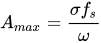
Consequently, a sinusoidal signal can be transmitted without slope overload if its amplitude is not bigger than

.

A real input signal may be more complex than a single sinusoid, but this example illustrates how a transmitted signal may be attenuated depending on the sampling frequency, step size, and the input signal's frequency.

While slope overload (also referred to as slope clipping) can be avoided by increasing the quantum step size or sampling rate, very high sampling rates, typically 20 times the highest frequency of interest, are required to achieve the same quality as pulse-code modulation (PCM).[4][clarification needed]

Inability to transmit DC

[edit]

Because the modulated signal contains only the derivative of the input, any DC and low-frequency content of the signal is lost (which may be ok for voice and other applications which do not have low frequencies), transmission errors are accumulated, and high-frequency noise is amplified. An improvement to DM called delta-sigma modulation avoids these downsides by rearranging the integrator's position so that the modulated signal represents the amplitude of the input signal instead of just its derivative.[1][2]

History

[edit]

The seminal[5] paper combining feedback with oversampling to achieve delta modulation was by F. de Jager of Philips Research Laboratories in 1952.[6] Initial patents include:

  • "Communication system utilizing constant amplitude pulses of opposite polarities" by Maurice Deloraine et. al. (French patent issued 1946, US patent filed 1947).[7]
  • "Differential quantization of communication signals" by C. Chapin Cutler (filed 1950),[8] which describes differential PCM and delta modulation (1-bit DPCM).

Asynchronous delta modulation

[edit]

The 1947 Deloraine, 1950 Cutler, and 1952 Jager designs were synchronous (or time-quantized). Delta modulation is also possible without a fixed sampling rate. A February 1966 paper by H. Inose "Asynchronous delta-modulation system"[9] uses Schmitt triggers to detect when the input signal exceeds the local demodulator by a predetermined difference, with the benefit of reducing the number of output pulses. A November 1973 paper "Signal Coding Using Asynchronous Delta Modulation" (presented in 1974)[10] investigates an algorithm that varies the sampling rate to transmit fewer samples during periods of small signal variation.

Adaptive delta modulation

[edit]

Adaptive delta modulation (ADM) was first published by Dr. John E. Abate (Bell Labs Fellow) in his doctoral thesis at NJ Institute Of Technology in 1968.[11] ADM was later selected as the standard for all NASA communications between mission control and space-craft.

In the mid-1980s, Massachusetts audio company DBX marketed a commercially unsuccessful digital recording system based on adaptive delta modulation. See DBX 700.

Adaptive delta modulation or Continuously variable slope delta modulation (CVSD) is a modification of DM in which the step size is not fixed. Rather, when several consecutive bits have the same direction value, the encoder and decoder assume that slope overload is occurring, and the step size becomes progressively larger.

Otherwise, the step size becomes gradually smaller over time. ADM reduces slope error, at the expense of increasing quantization error. This error can be reduced by using a low-pass filter. ADM provides robust performance in the presence of bit errors meaning error detection and correction are not typically used in an ADM radio design, it is this very useful technique that allows for adaptive-delta-modulation.

Applications

[edit]

Video game sound effects

[edit]

The Nintendo Entertainment System's audio processing unit (the Ricoh 2A03 chip) includes a Delta Modulation Channel (DMC) to demodulate percussion and sound effects. The DMC reads delta-encoded audio data via direct memory access into a shift register, which gets shifted out serially into an up/down counter acting as the demodulator's integrator. Because the shift register is clocked by a configurable timer, the audio's frequency can be shifted by adjusting the playback speed. The counter's value is outputted though a 7-bit digital-to-analog converter (DAC). Note: writing PCM samples directly to the counter bypasses the DM demodulation to instead provide low-bit PCM output.[12][13][14]

Satellite Business Systems 24 kbps delta modulation

[edit]

Delta modulation was used by Satellite Business Systems (SBS) for its voice ports to provide long distance phone service to large domestic corporations with a significant inter-corporation communications need (such as IBM). Each traffic channel had a 32 kbit/s bitrate.[15] This system was in service throughout the 1980s. The voice ports used digitally implemented 24 kbit/s delta modulation with Voice Activity Compression (VAC) and echo suppressors to control the half second echo path through the satellite. They performed formal listening tests to verify the 24 kbit/s delta modulator achieved full voice quality with no discernible degradation as compared to a high quality phone line or the standard 64 kbit/s μ-law companded PCM. This provided an eight to three improvement in satellite channel capacity. IBM developed the Satellite Communications Controller and the voice port functions.

The original proposal in 1974, used a state-of-the-art 24 kbit/s delta modulator with a single integrator and a Shindler Compander[definition needed] modified for gain error recovery. This proved to have less than full phone line speech quality. In 1977, one engineer with two assistants in the IBM Research Triangle Park, NC laboratory was assigned to improve the quality.

The final implementation replaced the integrator with a predictor implemented with a two pole complex pair low-pass filter designed to approximate the long term average speech spectrum. The theory was that ideally the integrator should be a predictor designed to match the signal spectrum. A nearly perfect Shindler Compander replaced the modified version. It was found the modified compander resulted in a less than perfect step size at most signal levels and the fast gain error recovery increased the noise as determined by actual listening tests as compared to simple signal to noise measurements. The final compander achieved a very mild gain error recovery due to the natural truncation rounding error caused by twelve bit arithmetic.

The complete function of delta modulation, VAC and Echo Control for six ports was implemented in a single digital integrated circuit chip with twelve bit arithmetic. A single digital-to-analog converter (DAC) was shared by all six ports providing voltage compare functions for the modulators and feeding sample and hold circuits for the demodulator outputs. A single card held the chip, DAC and all the analog circuits for the phone line interface including transformers.

Notes

[edit]

See also

[edit]

Sources

[edit]
  • Steele, R. (1975). Delta Modulation Systems. London: Pentech Press. ISBN 0-470-82104-3.
  • Public Domain This article incorporates public domain material from Federal Standard 1037C. General Services Administration. Archived from the original on 2022-01-22. (in support of MIL-STD-188).
  1. ^ a b Razavi, Behzad (2016-06-21). "A Circuit for all Seasons: The Delta-Sigma Modulator" (PDF). IEEE Solid-State Circuits Magazine. 8 (2): 10–15. doi:10.1109/MSSC.2016.2543061. Archived (PDF) from the original on 2024-02-09. Retrieved 2024-03-16.
  2. ^ a b Inose, H.; Yasuda, Y. (1963-11-01). "A unity bit coding method by negative feedback". Proceedings of the IEEE. 51 (11): 1524–1535. doi:10.1109/PROC.1963.2622. ISSN 1558-2256.
  3. ^ Jayant, N. S.; Rosenberg, A. E. (1971). "The Preference of Slope Overload to Granularity in the Delta Modulation of Speech". Bell System Technical Journal. 50 (10): 3117–3125. doi:10.1002/j.1538-7305.1971.tb01849.x. ISSN 0005-8580. Archived from the original on 2013-01-19 – via IEEExplore.
  4. ^ a b Kester, Walt (2008). "ADC Architectures II: Sigma-Delta ADC Basics" (PDF). Analog Devices. Archived (PDF) from the original on 2023-08-18. Retrieved 2023-08-20.
  5. ^ Wooley, Bruce A. (2012-03-22). "The Evolution of Oversampling Analog-to-Digital Converters" (PDF). IEEE. Archived (PDF) from the original on 2023-06-28. Retrieved 2023-06-28.
  6. ^ de Jager, F. (February 1952). "Delta modulation, a method of PCM transmission using the 1-unit code" (PDF). Philips Research Reports. 7: 442–466. Archived (PDF) from the original on 2024-05-18.
  7. ^ US2629857A, Maurice, Deloraine Edmond & Boris, Derjavitch, "Communication system utilizing constant amplitude pulses of opposite polarities", issued 1953-02-24 
  8. ^ US2605361A, Cutler, Cassius C., "Differential quantization of communication signals", issued 1952-07-29 
  9. ^ Inose, H.; Aoki, T.; Watanabe, K. (March 1966). "Asynchronous delta-modulation system". Electronics Letters. 2 (3): 95–96. Bibcode:1966ElL.....2...95I. doi:10.1049/el:19660077. ISSN 0013-5194.
  10. ^ Hawkes, T.; Simonpieri, P. (March 1974). "Signal Coding Using Asynchronous Delta Modulation". IEEE Transactions on Communications. 22 (3): 346–348. doi:10.1109/TCOM.1974.1092185. ISSN 0090-6778.
  11. ^ Abate, John Edward. "Linear and adaptive delta modulation (1967)". Digital commons @ New Jersey Institute of Technology.
  12. ^ Collins, Karen (2007). "In the Loop: Creativity and Constraint in 8-bit Video Game Audio". Twentieth-Century Music. 4 (2): 214. doi:10.1017/S1478572208000510. ISSN 1478-5730.
  13. ^ "NES APU Sound Hardware Reference".
  14. ^ Taylor, Brad (2004-04-23). "2A03 technical reference".
  15. ^ "SBS SYSTEM DESCRIPTION", W. H. Curry, Jr., Manager System Definition and Control Satellite Business Systems McLean, Virginia.https://commons.erau.edu/cgi/viewcontent.cgi?article=2543&context=space-congress-proceedings
[edit]
Revisions and contributorsEdit on WikipediaRead on Wikipedia
from Grokipedia
Delta modulation (DM) is a simple form of differential pulse-code modulation (DPCM) used for analog-to-digital conversion, in which an oversampled analog input signal is approximated by a staircase waveform, with each step representing the quantized difference (delta) between the current sample and the previous approximation using a single bit.[1] The technique encodes signal changes rather than absolute values, producing a binary output where a '1' indicates a positive step size (+Δ) and a '0' indicates a negative step size (-Δ), enabling efficient transmission of voice or other band-limited signals at high sampling rates.[2] The basic operation of a delta modulator involves comparing the input signal with a locally generated prediction (the accumulated previous steps), quantizing the error to one bit via a comparator and hard limiter, and then accumulating the quantized steps to update the approximation, which is fed back to the comparator.[3] At the demodulator, the received bit stream drives an integrator or accumulator followed by a low-pass filter to reconstruct the smooth analog signal from the staircase.[2] Delta modulation requires oversampling at rates significantly higher than the Nyquist rate—often 20 times or more the signal's bandwidth—to minimize distortion, as the fixed step size Δ must balance tracking rapid signal changes without introducing excessive quantization noise.[1] Invented in 1946 at ITT Laboratories in France by E. M. Deloraine, S. Van Mierlo, and B. Derjavitch, delta modulation was an early approach to improving transmission efficiency over pulse-code modulation (PCM) by focusing on signal deltas rather than full amplitude encoding.[1] It was independently rediscovered in 1952–1953 at Philips Laboratories in the Netherlands and further advanced by C. C. Cutler's U.S. patent filed in 1950, which emphasized its practical implementation for telephony.[1] Key advantages of delta modulation include its structural simplicity, requiring minimal hardware such as a single-bit quantizer and no amplitude limiting, allowing it to track signals of arbitrary size without clipping.[1] It also achieves a low bit rate of just one bit per sample, reducing bandwidth needs compared to multi-bit PCM for similar quality in oversampled scenarios.[3] However, it suffers from three primary limitations: slope overload distortion, where rapid signal changes exceed the maximum slope (Δ/T_s, with T_s as the sampling period), causing lag in the approximation; granular noise, an idle channel effect from small errors in flat signal regions; and inability to transmit DC components, as the encoding focuses on signal differences, resulting in loss of absolute level upon reconstruction.[2] These issues often necessitate adaptive variants or higher sampling rates for improved performance. Delta modulation found early applications in digital telephony and voice transmission systems, where its efficiency suited band-limited signals like speech (e.g., 3 kHz bandwidth sampled at 100 kHz).[2] It also served as a foundational technique for later developments, including sigma-delta modulation used in modern high-resolution analog-to-digital converters, and has been applied in areas such as PCM encoding preprocessors and simple data compression for control systems.[1]

Fundamentals

Principle of Operation

Delta modulation is an analog-to-digital conversion technique that encodes the differences between consecutive samples of an input signal, transmitting only the incremental changes (deltas) rather than the full amplitude values, thereby simplifying the process compared to multi-bit methods.[4] This approach enables efficient tracking of signal variations with minimal bandwidth requirements.[1] At its core, the operation relies on a feedback loop in which the input analog signal is continuously compared to a locally reconstructed approximation of the signal. The difference, or error, between them is quantized into a single-bit decision: a positive step of size Δ\Delta if the input exceeds the approximation (encoded as a '1'), or a negative step of size Δ-\Delta if the input is lower (encoded as a '0'). This 1-bit code is then integrated to update the approximation, forming a closed-loop system that aims to minimize the error over time.[4] To ensure accurate representation without significant distortion, sampling occurs at a rate substantially higher than the Nyquist frequency—typically 4 to 20 times greater—allowing the modulator to follow rapid signal changes as if in continuous time.[1] The transmitted bitstream reconstructs a staircase-like waveform at the receiver by accumulating these incremental steps, creating a piecewise constant approximation that closely follows the original signal's trajectory. This staircase is subsequently smoothed via low-pass filtering to recover an estimate of the input.[5] Mathematically, the reconstructed signal at the nth sampling instant is expressed as
y^(n)=y^(n1)+Δe(n), \hat{y}(n) = \hat{y}(n-1) + \Delta \cdot e(n),
where y^(n)\hat{y}(n) is the predicted signal value, Δ\Delta denotes the fixed step size, and e(n)e(n) is the binary error signal taking values ±1\pm 1 based on the sign of the difference at the current step.[5] As a simpler alternative to pulse-code modulation, which requires multiple bits to quantize absolute signal levels, delta modulation achieves comparable performance for bandlimited signals using just one bit per sample, at the cost of higher sampling rates.[4]

System Components and Encoding Process

Delta modulation systems typically comprise a set of key hardware and algorithmic components that facilitate the differential encoding of analog signals into a 1-bit digital stream. The primary elements include a sampler for oversampling the input signal, a subtractor to compute the prediction error, a 1-bit quantizer to decide the step direction, an accumulator or integrator in the feedback loop to generate the predicted signal, and a clock generator to control the high sampling rate. These components form a closed-loop structure that tracks the input signal through incremental steps.[6][7] In the encoding process, the input analog signal x(n)x(n) is first sampled at a rate significantly higher than the Nyquist frequency, typically 4 to 20 times higher, to enable fine-grained tracking. The subtractor then forms the difference signal e(n)=x(n)y^(n1)e(n) = x(n) - \hat{y}(n-1), where y^(n1)\hat{y}(n-1) is the predicted value from the previous step, representing the system's approximation of the input. This error is passed to the 1-bit quantizer, which thresholds it at zero and outputs a binary decision: +Δ if e(n)>0e(n) > 0 (indicating the prediction is too low) or -Δ if e(n)0e(n) \leq 0 (indicating it is too high), where Δ is the fixed step size. The quantized value is then integrated with the previous prediction to update y^(n)=y^(n1)+q(n)\hat{y}(n) = \hat{y}(n-1) + q(n), where q(n)q(n) is the ±Δ output, producing a staircase approximation fed back to the subtractor. This process builds on the principle of differential tracking by incrementally adjusting the prediction based on the sign of the error.[6][7] The decoding process at the receiver is notably simple, relying on synchronization with the encoder's clock to reconstruct the signal from the received bitstream. The decoder features an integrator that accumulates the sequence of ±Δ steps corresponding to each bit—typically interpreting '1' as +Δ and '0' as -Δ—to form the same staircase approximation y^(n)\hat{y}(n) as in the encoder. An optional low-pass filter may follow the integrator to smooth the reconstructed signal, mitigating the granular nature of the staircase and approximating the original analog waveform more closely. This symmetric structure ensures minimal additional complexity beyond the transmission channel.[6][7] The fixed step size Δ plays a crucial role in determining the system's resolution and trade-offs, as it sets the magnitude of each incremental adjustment; a larger Δ allows faster tracking of signal changes but risks overshooting, while a smaller Δ provides finer granularity at the cost of slower response. In practice, Δ is chosen based on the expected signal amplitude and dynamics, often around 0.5 V for speech applications. The overall bit rate is determined by the sampling frequency multiplied by 1 bit per sample, yielding rates such as 32 kHz to 256 kHz for typical voice signals, which supports efficient transmission but requires precise clock synchronization between encoder and decoder to avoid drift in the reconstructed signal.[6][7]

Signal Characteristics

Transfer Function

The transfer function of a delta modulation system characterizes the steady-state input-output relationship, defined as the ratio of the output signal amplitude to the input signal amplitude for sinusoidal signals when the system operates without slope overload. In ideal conditions, this ratio is unity, indicating faithful reproduction of the input amplitude, as the staircase approximation generated by the modulator closely tracks the input waveform.[8] For a sinusoidal input $ x(t) = A \sin(\omega t) $, where $ A $ is the amplitude and $ \omega = 2\pi f $ is the angular frequency, the output follows the input provided the maximum derivative (slope) of the input does not exceed the modulator's maximum slope capability of $ \Delta f_s $, with $ \Delta $ the fixed step size and $ f_s $ the sampling frequency. The input's maximum slope is $ A \omega = 2\pi f A $, leading to the overload condition $ 2\pi f A > \Delta f_s $. Rearranging yields the critical frequency $ f_c = \frac{\Delta f_s}{2\pi A} $, below which the transfer characteristic is linear with a slope of 1 (output amplitude equals input amplitude), and above which overload occurs, limiting the output amplitude to roughly $ \frac{\Delta f_s}{2\pi f} $ and resulting in a gain less than 1. To derive this, consider the modulator's step updates at each sampling interval $ T_s = 1/f_s $; the maximum change per step is $ \Delta $, so the maximum trackable slope is $ \Delta / T_s = \Delta f_s $. For the sinusoid, the slope peaks at $ A \omega $, enforcing the inequality for linear tracking.[8][9] The frequency response of the system shows unity gain for frequencies well below the critical frequency $ f_c $, with attenuation occurring above $ f_c $ due to slope overload. The differential encoding emphasizes changes, which can lead to some attenuation for very low-frequency components due to granular noise effects, reducing effectiveness for slowly varying signals where the step size dominates.[10] Representative plots of the amplitude transfer characteristic illustrate a straight line of unity slope from DC up to $ f_c $, beyond which the curve flattens, with output amplitude saturating and decreasing inversely with frequency. Phase response plots show minimal lag (near 0°) at low frequencies, increasing gradually to about 90° near $ f_c $ due to the accumulative integration in the decoder, before distorting in overload.[8]

Slope Overload Distortion

Slope overload distortion arises in delta modulation when the input signal's rate of change exceeds the modulator's ability to track it using the fixed step size. Specifically, this occurs if the absolute value of the input signal's derivative, |dx/dt|, surpasses the maximum slope the system can produce, which is Δ · f_s, where Δ is the fixed quantization step size and f_s is the sampling frequency.[11] In such cases, the accumulator in the modulator outputs a sequence of pulses with the same polarity, causing the reconstructed staircase waveform to lag behind the input, resulting in a clipping-like effect.[12] The effects of slope overload include the generation of unwanted harmonic components in the output signal and an increase in total harmonic distortion (THD), which degrades audio quality, particularly in speech processing. For instance, in continuously variable slope delta modulation (CVSD) systems operating at lower bit rates like 16 kb/s, THD can reach up to 24%, though it decreases to around 6% at 32 kb/s with optimized parameters.[12] Additionally, high-frequency components of the signal experience attenuation, as the modulator fails to capture rapid variations, leading to overall signal fidelity loss at frequencies beyond the system's tracking capability. This distortion is most pronounced during steep signal transitions, such as in voiced speech segments with high pitch.[13] Mathematically, for a sinusoidal input signal x(t) = A \sin(2\pi f t), the maximum slope is 2\pi f A, so slope overload occurs when 2\pi f A > \Delta \cdot f_s. The corresponding overload threshold frequency is thus given by
fol=Δfs2πA, f_{ol} = \frac{\Delta \cdot f_s}{2\pi A},
beyond which the signal cannot be accurately tracked without distortion.[11] To mitigate slope overload, the sampling rate f_s can be increased or the step size \Delta enlarged, though the latter risks amplifying granular noise in steady-state conditions; adaptive step size adjustments offer a more robust approach but are explored in specialized variants.[11] In typical waveform illustrations, slope overload manifests as the output staircase remaining flat or stepping in one direction while the input signal rises or falls sharply, creating visible lags and flattened peaks that highlight the modulator's limitations during dynamic signal changes.[14]

Granular Noise and DC Limitations

Granular noise in delta modulation manifests as random fluctuations in the reconstructed waveform around the input signal, caused by the coarse 1-bit quantization steps that create a staircase approximation unable to finely track slowly varying or near-constant signals. This noise resembles a granular texture due to the limited resolution, occurring primarily when the step size Δ\Delta is large relative to the local signal slope, leading to excessive oscillations in idle or low-activity conditions.[15] The power spectral density of granular noise is approximately uniform up to the sampling frequency, contributing to overall quantization-like noise across the signal band after low-pass filtering. An approximation for the noise variance, derived from uniform quantization models, is given by
eg2=Δ212, e_g^2 = \frac{\Delta^2}{12},
where Δ\Delta is the fixed step size; this models the error as uniformly distributed within the quantization interval [-\Delta/2, \Delta/2].[16] A key limitation of delta modulation is its inability to accurately represent or transmit DC components, as the system encodes only the differences (deltas) between successive samples rather than absolute signal values, resulting in a zero average step size for constant inputs and potential drift or oscillation in the output.[4] For a constant DC input, the reconstructed signal cannot achieve steady-state equilibrium and instead oscillates around the true value with an amplitude of Δ/2\Delta / 2, introducing a persistent bias error due to the alternating sign of the quantization error.[17] This behavior stems from the feedback loop's reliance on error prediction, where even a perfect constant input triggers repeated step reversals, preventing convergence to the exact DC level.[17] Compared to pulse code modulation (PCM), delta modulation produces higher granular noise for low-amplitude signals owing to its 1-bit resolution, though its structural simplicity enables lower complexity and bit rates in bandwidth-constrained scenarios.[15]

Historical Development

Origins in the 1940s

Delta modulation emerged in the mid-1940s as a pioneering technique for digital encoding of analog signals, particularly voice, offering a simpler and more bandwidth-efficient alternative to pulse-code modulation (PCM). Invented at the ITT Laboratories in France by engineers E. M. Deloraine, S. Van Mierlo, and B. Derjavitch, the method addressed the limitations of existing digital transmission systems by using a single-bit representation of signal differences rather than multi-bit quantization. This innovation stemmed from ongoing efforts to optimize telephony communications, where high bandwidth demands strained available channels for transatlantic cables and radio links. The foundational patent for delta modulation was filed in France as No. 932,140 on August 10, 1946, describing a system that transmits constant-amplitude pulses of opposite polarities to encode incremental changes in the input signal, enabling reconstruction through integration at the receiver. (Corresponding U.S. patent US2629857A filed October 8, 1947, issued February 24, 1953.)[18] The technique's core principle involved comparing the input waveform to a locally generated approximation and outputting a binary pulse to adjust a storage element accordingly, thereby approximating the original signal with minimal bits per sample. This 1-bit approach significantly reduced the data rate compared to PCM, making it suitable for resource-constrained telephony applications amid post-World War II reconstruction of communication infrastructure.[18] These innovations built on differential encoding concepts explored in pulse modulation research during the 1930s, such as Alec Reeves' foundational PCM work.[19] By simplifying the analog-to-digital conversion process, delta modulation laid the groundwork for subsequent advancements in digital signal processing, though its initial adoption was tempered by the era's computational constraints.

Key Advancements and Adoption

In the 1950s, significant advancements in delta modulation were driven by researchers at Bell Laboratories, where C. C. Cutler filed a key patent in 1950 on differential pulse-code modulation (DPCM), introducing concepts of transmitting signal differences rather than absolute values, which directly influenced delta modulation's efficiency for voice transmission. Concurrently, F. de Jager at Philips Research Laboratories published a foundational 1952 paper detailing delta modulation as a simplified PCM method using a single-unit code, enabling 1-bit per sample encoding that reduced complexity while maintaining acceptable quality for analog-to-digital conversion. These innovations facilitated research into integration with early PCM systems, where delta modulation variants were explored for voice encoding at bit rates around 24-32 kbps per channel, potentially supporting multiplexing in digital telephony networks with lower bandwidth demands than standard 64 kbps PCM.[20] The 1960s saw the introduction of adaptive delta modulation (ADM) to mitigate issues like slope overload distortion, with John E. Abate at Bell Laboratories publishing his doctoral thesis in 1967 on ADM algorithms that dynamically adjusted step sizes based on signal characteristics, improving performance for non-stationary inputs like speech. N. S. Jayant further contributed analytical models for noise in ADM systems during this period, enhancing quantization accuracy. These refinements led to practical adoption in military communications for secure voice digitization and satellite links, where low-bitrate encoding (around 16-32 kbps) proved robust against channel errors and bandwidth constraints, as evidenced by U.S. Department of Defense implementations in the late 1960s.[21] By the 1970s, delta modulation gained standardization in telecommunications through CCITT (now ITU-T) recommendations, including discussions in the 1972 Yellow Book on characteristics for delta-modulated digital systems to ensure interoperability in international networks.[22] This era also marked its adoption in emerging digital audio applications, such as sound effects in video games, where continuously variable slope delta (CVSD) variants enabled efficient playback of sampled audio on resource-limited hardware like early arcade machines and home consoles. De Jager's earlier noise analysis continued to inform these adaptations, emphasizing granular noise reduction for better perceptual quality.[23] Delta modulation's prominence waned in the 1980s as more efficient codecs like adaptive differential PCM (ADPCM) and linear predictive coding (LPC) offered superior compression ratios and quality at similar bitrates, leading to its replacement in mainstream telephony and broadcasting; however, it retained legacy use in niche military and satellite systems due to its simplicity and low computational overhead.[24]

Variants

Asynchronous Delta Modulation

Asynchronous delta modulation is a variant of delta modulation that eliminates the need for clock synchronization between the encoder and decoder by transmitting bits only when the input signal changes sufficiently, effectively employing a run-length encoding scheme to convey timing information through the durations of bit patterns.[25] In this approach, the encoder continuously compares the input signal to a locally reconstructed approximation and generates a bit (0 or 1) only upon a threshold exceedance, initiating a new run; subsequent identical bits are not sent individually but are implied by the run length, which represents the period over which the approximation remains constant.[26] The operation relies on pause-length modulation, where sequences of identical bits (runs of 1s indicating positive steps or 0s for negative steps) denote the integration duration at the decoder before a transition; a change in bit value triggers an update to the reconstructed signal by adding or subtracting the fixed step size for the length of the subsequent run.[27] This event-driven mechanism allows the decoder to infer timing solely from the bit stream's pattern lengths, reconstructing the signal through stepwise integration without an external clock. Compared to fixed-rate delta modulation, which uses uniform sampling intervals, asynchronous delta modulation adapts the effective sampling rate to the signal's dynamics.[25] Key advantages include a lower average bit rate for slowly varying signals, as extended periods of constancy result in longer runs and fewer transitions, thereby reducing data volume; additionally, it minimizes synchronization overhead by embedding timing in the data itself, making it suitable for bandwidth-constrained environments.[26] However, the decoder's timing recovery from run lengths introduces higher implementation complexity, particularly in extracting precise durations from the bit stream. Furthermore, it is sensitive to bit errors, which can misinterpret run lengths and cause cumulative drift in the reconstructed signal, potentially leading to loss of tracking.[27] This technique was developed in the 1960s, with seminal work by Inose, Aoki, and Watanabe in 1966, aimed at enabling low-bitrate voice transmission over noisy channels where traditional synchronized methods were inefficient.[25]

Adaptive Delta Modulation

Adaptive delta modulation dynamically varies the step size Δ(n) based on recent error history or signal activity, aiming to balance slope overload distortion and granular noise while optimizing tracking of the input signal. In contrast to fixed-step delta modulation, this adaptation allows the system to increase the step size during periods of high signal slope to prevent overload and decrease it during quiescent periods to reduce granular noise.[28] A simple reference to slope overload issues in basic systems underscores the motivation for such variability.[29] Key algorithms include the one-bit memory adaptation, where the step size adjustment depends on the polarity of the current transmitted bit and the previous error sign, requiring only minimal memory for implementation. For instance, if consecutive bits are identical, indicating lagging prediction, the step size increases; if they alternate, suggesting excessive noise, it decreases. Another approach is syllabically compelled delta modulation, which adjusts the step size at a slower syllabic rate (typically 10-20 Hz for speech) based on the signal's short-term average magnitude or energy, providing companding to handle the wide dynamic range of voice signals. The adaptation often follows a multiplicative rule, such as
Δ(n)=Δ(n1)×k, \Delta(n) = \Delta(n-1) \times k,
where k>1k > 1 (e.g., 1.5) for acceleration during overload conditions and k<1k < 1 (e.g., 0.75) for deceleration, ensuring the product of increase and decrease factors approximates 1 for long-term stability.[29] In the one-bit memory scheme, parameters P (increase factor) and Q (decrease factor) are tuned such that PQ ≈ 1, with simulations showing optimal performance around P=1.5 and Q=0.67 for speech encoding at 16 kbps.[28] This technique yields improved signal-to-noise ratio (SNR) compared to fixed delta modulation, particularly for speech signals with varying dynamics, achieving 2-5 dB gains in SNR at low bit rates (e.g., 32-48 kbps) while maintaining good perceptual quality. However, the added adaptation logic increases encoder and decoder complexity, potentially introducing delay or requiring more hardware, and improper parameter selection can lead to instability or hunting oscillations in the step size.[29]

Continuous Variable Slope Delta Modulation

Continuous Variable Slope Delta Modulation (CVSD) is a differential pulse-code modulation technique that enhances basic delta modulation by continuously adjusting the step size in an analog manner to better track input signal variations, often incorporating companding to extend the dynamic range.[30] This adjustment is achieved through a variable gain or integrator leak mechanism that responds to the input signal's slope, allowing for smoother adaptation compared to discrete methods.[31] In operation, the CVSD encoder compares the band-limited analog input signal to the output of a feedback reconstruction integrator using a comparator, generating a one-bit digital output that determines the polarity of the step. The feedback path features an exponential (leaky) integrator with a nominal time constant of 1 ms, which receives variable-amplitude pulses from a pulse amplitude modulator (PAM). A syllabic filter, typically with a 4-5 ms time constant, processes the error signal—derived from sequences of consecutive bits in a 3-bit shift register (indicating potential overload)—to continuously adjust the integrator's gain or effective time constant τ, thereby varying the step size to prevent slope overload during rapid signal changes.[30][31][32] This adaptation occurs at a syllabic rate matching human speech patterns, enabling the system to increase the step size for steep slopes and decrease it for shallow ones, while the decoder mirrors this process using a similar integrator to reconstruct the signal.[30] Key features of CVSD include its use of syllabic companding for improved dynamic range handling and its optimization for voice signals, achieving low idle channel noise levels of -40 dBm0 at 16 kbps and -50 dBm0 at 32 kbps. It has been widely adopted in secure voice systems, such as the U.S. military's VINSON family (e.g., KY-57 and KY-58 modules), where it digitizes speech at 16 kbps for encrypted tactical communications, providing robust performance in bandlimited environments like 300-3400 Hz telephony.[30][33][34] The mathematical model for CVSD centers on the adaptive slope, expressed as $ s(n) = \frac{\Delta}{\tau(n)} $, where $ \Delta $ is the base step increment and $ \tau(n) $ is the variable time constant of the integrator, adjusted by the syllabic filter based on the prediction error from the shift register logic (e.g., overload detected as three consecutive bits: $ XYZ + \overline{XYZ} $, with X, Y, Z as register bits). The overall encoder transfer function can be approximated as $ H_{ENC}(z) = Q(z) [1 - P(z)] $, where $ Q(z) $ is the quantizer and $ P(z) = a z^{-1} $ (with $ a < 1 $) models the leaky predictor for stability.[30][31] Advantages of CVSD include superior handling of transients through rapid step-size increases, which mitigate slope overload distortion, and a signal-to-noise ratio (SNR) of approximately 27-30 dB for voice inputs at 32 kbps, enabling efficient compression ratios up to 21:1 while maintaining intelligibility (MOS scores of 3-4) even under bit error rates up to 1%. This makes it particularly suitable for high-fidelity, low-bitrate applications in bandlimited signals.[31][32][30]

Applications

Speech and Audio Processing

Delta modulation, particularly its adaptive variants such as continuously variable slope delta modulation (CVSD), serves as a primary method for low-bitrate speech coding in telephony applications, operating at rates of 16-32 kbps to enable efficient transmission over bandwidth-limited channels.[31] This approach exploits the temporal redundancies in voice signals, using a single-bit quantizer to encode differences between consecutive samples, which halves the bitrate compared to standard 64 kbps pulse code modulation (PCM) while maintaining intelligible communication.[35] In historical telephone systems from the 1940s to the 1970s, delta modulation reduced transmission requirements from PCM's 64 kbps per channel to approximately 32 kbps, facilitating preprocessing in digital switches for multiplexing and switching.[35] The technique is well-suited to the standard telephony voice band of 300-3400 Hz, where it provides adequate performance for conversational speech, achieving signal-to-noise ratios (SNR) of around 20-25 dB with adaptive step-size control to mitigate slope overload during amplitude variations.[31] Adaptive mechanisms, as standardized in military telephony protocols like MIL-STD-188-113 at 16/32 kbps, dynamically adjust the quantization step based on recent signal history, ensuring robust encoding for voice over noisy or variable links and serving as a precursor to modern digital voice systems.[31] Granular noise, a form of quantization error prominent in low-amplitude segments, can subtly affect audio fidelity but is minimized through adaptivity in speech contexts.[35] Despite its efficiency for voice, delta modulation yields poorer quality for music signals due to increased granular noise and limited spectral resolution, making it unsuitable for broadband audio applications beyond narrowband telephony.[31] This limitation stems from the method's focus on waveform tracking rather than preserving harmonic structures, resulting in audible distortions for non-speech content at these bitrates.[36]

Video Game Sound Effects

In the 1980s, delta modulation was adopted in early video game consoles, most notably the Nintendo Entertainment System (NES), to handle one of its five sound channels dedicated to generating basic audio effects and waveforms. The NES's Audio Processing Unit (APU) featured a Delta Modulation Channel (DMC), which enabled the encoding and playback of simple sampled sounds within the constraints of 8-bit hardware. This approach was particularly suited to the era's cartridge-based systems, where storage space was limited, allowing developers to include audio assets that would otherwise be infeasible.[37][38] The implementation in the NES involved fixed-rate encoding of generated tones, where audio signals were represented as a 1-bit stream indicating incremental changes (up or down) to the signal amplitude, reconstructed through a simple integrator circuit. This method required minimal computational overhead, making it ideal for real-time synthesis on the NES's modest 1.79 MHz CPU, as the decoding process only involved basic addition or subtraction operations without complex multiplications. For instance, square waves could be approximated via the bitstream's binary transitions, producing the characteristic lo-fi tones used for effects like jumps or explosions; in Super Mario Bros. 3 (1988), delta modulation was employed for percussion sounds, such as drum hits, to add variety beyond the console's synthesized waveforms.[39][40][41] A key advantage of delta modulation in this context was its compact storage footprint, using just 1 bit per sample, which maximized the length of audio clips on ROM cartridges limited to kilobytes of capacity—enabling effects that felt dynamic despite the hardware's simplicity. However, by the early 1990s, as consoles evolved to 16-bit architectures like the Super Nintendo Entertainment System (SNES), delta modulation was phased out in favor of Adaptive Differential Pulse Code Modulation (ADPCM), which offered superior fidelity and compression for more nuanced sampled audio without the granular noise inherent in 1-bit schemes.[38][42]

Satellite and Telecommunications

Delta modulation was employed in satellite communications during the 1970s to enable efficient voice and data multiplexing over bandwidth-constrained orbital environments.[43] This approach allowed for the integration of multiple low-bit-rate channels into higher-capacity transponders, leveraging the technique's simplicity. Implementations highlighted delta modulation's role in early digital satellite telephony, where it facilitated demand-assigned multiple access schemes for dynamic resource allocation.[43] In telecommunications infrastructure, delta modulation functioned as an intermediate encoding step in T1 and E1 carrier systems prior to final conversion to pulse code modulation (PCM), optimizing bandwidth usage in multiplexed lines.[44] This intermediate role enabled the transmission of analog voice signals in a compact digital form compatible with existing PCM hierarchies, such as the North American T1 standard at 1.544 Mbps for 24 channels or the European E1 at 2.048 Mbps for 30 channels. The technique's primary advantages in satellite and telecom applications include robustness against channel noise, achieved through its one-bit differential encoding that limits error impact to local slope distortions rather than full sample corruption.[45] Furthermore, delta modulation's minimal processing requirements result in low latency, essential for real-time voice relay over long-haul links prone to propagation delays.[46] Despite these strengths, delta modulation suffers from error propagation in the bitstream, where a single transmission error can accumulate and degrade subsequent signal reconstruction, often requiring forward error correction codes like convolutional or Reed-Solomon to maintain reliability in noisy satellite channels.[47] Adaptive variants briefly address varying channel conditions by dynamically adjusting step sizes, though they introduce minor synchronization overhead.[48]

Modern Digital Signal Processing

In contemporary digital signal processing, delta modulation has experienced a revival through software implementations in real-time audio plugins, where it enables efficient encoding of signal differences for creative effects. The DeltaModulator plugin by Xfer Records, for example, applies delta modulation to audio streams, producing bitcrushed sounds reminiscent of early digital limitations while operating within standard VST/AU formats for modern digital audio workstations. This software adaptation highlights delta modulation's simplicity and low computational overhead, making it viable for real-time processing in music production and effects chains.[49] In embedded systems for Internet of Things (IoT) voice applications, delta modulation facilitates low-power encoding of audio signals, particularly in resource-constrained devices. Adaptive variants transmit intelligible voice at bit rates of 16–32 kbit/s, outperforming traditional pulse-code modulation (PCM) in bandwidth efficiency for voice-band signals up to 4 kHz. For instance, low-power delta modulation-based analog-to-digital converters (ADCs) achieve consumption as low as 68 nW at 0.8 V supply, with effective number of bits (ENOB) up to 10.9 and signal-to-noise-and-distortion ratio (SNDR) of 67.4 dB, supporting wearable and sensor nodes in biomedical IoT. These designs leverage voltage-to-time conversion to quantize signal variations, reducing data rates while preserving fidelity for voice-like biosignals.[50][51] Delta modulation principles underpin hybrid systems as a precursor to delta-sigma ADCs in oversampled converters, where the basic first-order structure evolves into higher-order loops with feedback for enhanced noise shaping. Unlike pure delta modulation's single integrator, delta-sigma variants employ multi-stage integrators and quantizers to push quantization noise to higher frequencies, enabling resolutions beyond 16 bits in audio and sensor applications through oversampling ratios of 64–256. This distinction allows delta-sigma hybrids to achieve figures of merit as low as 20.41 fJ/conversion in 180 nm CMOS, with 84.8 dB SNR for low-frequency signals like those in biomedical sensors.[52][53] Key applications include low-power sensors, where delta modulation enables ultra-efficient ADCs for electrocardiogram (ECG) monitoring in wearables, as noted earlier. In ultrasound imaging encoding, log-delta ADCs compress raw radiofrequency (RF) signals by encoding differences with 2 bits per sample, achieving a fivefold data reduction from 60 Gb/s while maintaining structural similarity index (SSIM) >0.95 for clinical heart imaging. For machine learning feature extraction, oversampling delta-sigma modulators integrate analog feature detection—such as amplitude, slope, and turning points—directly during conversion, consuming only 1.62 µW for ECG wave delineation in real-time inference tasks.[51][54][55] Advancements in field-programmable gate array (FPGA) implementations incorporate adaptive algorithms to boost signal-to-quantization noise ratio (SQNR) and dynamic range, tailoring modulation steps dynamically for edge computing. All-digital adaptive delta-sigma modulators on FPGAs enhance performance by one bit of resolution through variable quantization, supporting real-time signal processing in 2020s edge devices with low latency and reconfigurability. These designs are particularly suited for distributed IoT nodes, where partial reconfiguration allows on-the-fly adaptation to varying signal conditions without full hardware redesign.[56][57] Looking to future potential, delta modulation's low-complexity encoding supports ultra-low-latency audio in 5G and 6G networks, with adaptive forms enabling bit rates under 10 kbps through one-bit-per-sample efficiency enhanced by AI-driven noise reduction. In 5G fronthaul, delta-sigma variants transport digitized signals for multiple LTE channels at reduced complexity, paving the way for AI-augmented compression in tactile internet applications requiring sub-millisecond delays. This positions delta modulation hybrids as enablers for energy-efficient, real-time voice in next-generation wireless systems.[58]

References

User Avatar
No comments yet.