


Community hub
Recent from talks
Contribute something
Nothing was collected or created yet.
Units of textile measurement
View on WikipediaTextile fibers, threads, yarns and fabrics are measured in a multiplicity of units.
- A fiber, a single filament of natural material, such as cotton, linen or wool, or artificial material such as nylon, polyester, metal or mineral fiber, or human-made cellulosic fibre like viscose, Modal, Lyocell or other rayon fiber is measured in terms of linear mass density, the weight of a given length of fiber. Various units are used to refer to the measurement of a fiber, such as: the denier and tex (linear mass density of fibers), super S (fineness of wool fiber), worsted count, woolen count, linen count (wet spun) (or Number English (Ne)), cotton count (or Number English (Ne)), Number metric (Nm) and yield (the reciprocal of denier and tex).
- A yarn, a spun agglomeration of fibers used for knitting, weaving or sewing, is measured in terms of cotton count and yarn density.

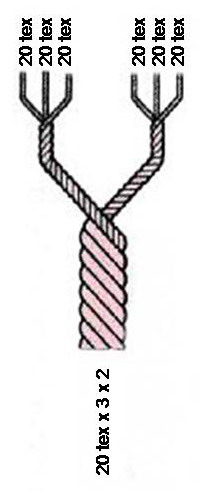
Thread made from two threads plied together, each consisting of three yarns - Thread, usually consisting of multiple yarns plied together producing a long, thin strand used in sewing or weaving, is measured in the same units as yarn.
- Fabric, material typically produced by weaving, knitting or knotting textile fibers, yarns or threads, is measured in units such as the momme, thread count (a measure of the coarseness or fineness of fabric), ends per inch (e.p.i) and picks per inch (p.p.i).

Fibers
[edit]Micronaire
[edit]Micronaire is a measure of the air permeability of cotton fiber and is an indication of fineness and maturity.[1] Micronaire affects various aspects of cotton processing.[2]
Micron
[edit]One millionth of a metre, or one thousandth of a millimetre; about one-fourth the width of a strand of spider silk.
Cotton Bale Size
Cotton lint is usually measured in bales, although there is no standard and the bale size may vary country to country. For example, in the United States it measures approximately 0.48 cubic metres (17 cu ft) and weighs 226.8 kg (500 lb).[3] In India, a bale equals 170 kg (370 lb).[4]
S or super S number
[edit]Not a true unit of measure, S or super S number is an index of the fineness of wool fiber and is most commonly seen as a label on wool apparel, fabric, and yarn.
Slivers, tops and rovings
[edit]
Slivers, tops and rovings are terms used in the worsted process. The sliver come off the card, tops come after the comb, rovings come before a yarn, and all have a heavier linear density.
Grams per metre
[edit]If the metric system is in use the linear density of slivers and tops is given in grams per metre. Tops destined for machine processing are typically 20 grams per metre. Hobby spinners typical use a little heavier top.
Yield
[edit]Similar to tex and denier, yield is a term that helps describe the linear density of a roving of fibers. However, unlike tex and denier, yield is the inverse of linear density and is usually expressed in yards per pound (yd/lb).
| Tex (g/km) | Yield (yd/lb) |
|---|---|
| 550 | 900 |
| 735 | 675 |
| 1,100 | 450 |
| 1,200 | 413 |
| 2,000 | 250 |
| 2,200 | 225 |
| 2,400 | 207 |
| 4,400 | 113 |
Yarn and thread
[edit]Twist
[edit]
Twists per inch
[edit]Number of twists per inch.[5]
Twists per metre
[edit]Number of twists per metre.[5]
Linear density
[edit]There are two systems used for presenting linear density, direct and indirect. When the direct method is used, the length is fixed and the weight of yarn is measured; for example, tex gives the weight in grams of one thousand metres of yarn. An indirect method fixes the weight and gives the length of yarn created.
Units
[edit]The textile industry has a long history and there are various units in use. Tex is more likely to be used in Canada and Continental Europe, while denier remains more common in the United States.
- tex: Grams per 1,000 metres of yarn. Tex is a direct measure of linear density.[5]
- den (denier): Grams per 9,000 metres of yarn. Den is a direct measure of linear density.[5]
- dtex (deci-tex): Grams per 10,000 metres of yarn. Dtex is a direct measure of linear density.[5]
- gr/yard: Grains per yard of yarn. Gr/yard is a direct measure of linear density, but is rarely used in the modern textile industry.
- ECC or NeC or Ne (English Cotton Count): The number of 840 yd lengths per pound. ECC is an indirect measure of linear density. It is the number of hanks of skein material that weighs 1 lb. Under this system, the higher the number, the finer the yarn. In the United States cotton counts between 1 and 20 are referred to as coarse counts.[5]
- NeK or NeW (Worsted Count): The number of 560 yd lengths per 1 lb of yarn. NeK is an indirect measure of linear density.[5] NeK is also referred to as the spinning count.
- NeL or Lea (Linen Count): The number of 300 yd lengths per 1 lb of yarn. NeL is an indirect measure of linear density.
- NeS (Woollen Count or Yorkshire Skeins Woollen): The number of 256 yd lengths per 1 lb of yarn. NeS is an indirect measure of linear density. One of the best known of the many different woolen yarn counts.[5]
Conversion table
[edit]The following table summarizes several measures of linear density and gives equivalences.
| tex | dtex | den | (gr/yd) | NeL or Lea | Nm | NeC or Ne | NeK or NeW | NeS | metric or imperial | |
|---|---|---|---|---|---|---|---|---|---|---|
| tex | tex | dtex ÷ 10 | den ÷ 9 | (gr/yd) × 70.86 | 1,653.5 ÷ NeL | 1,000 ÷ Nm | 590.5 ÷ NeC | 885.5 ÷ NeK | 1,937.7 ÷ NeS | grams per 1 km |
| dtex | tex × 10 | dtex | den ÷ 0.9 | (gr/yd) × 708.6 | 16,535 ÷ NeL | 10,000 ÷ Nm | 5,905.4 ÷ NeC | 8,855.8 ÷ NeK | 19,377 ÷ NeS | grams per 10 km |
| den | tex × 9 | dtex × 0.9 | den | (gr/yd) × 637.7 | 14,882 ÷ NeL | 9,000 ÷ Nm | 5,314.9 ÷ NeC | 7,972.3 ÷ NeK | 17,439 ÷ NeS | grams per 9,000 m |
| gr/yd | tex ÷ 70.86 | dted ÷ 708.6 | den ÷ 673.7 | gr/yd | 23.33 ÷ NeL | 14.1 ÷ Nm | 8.33 ÷ NeC | 12.5 ÷ NeK | 27.34 ÷ NeS | grains per yard |
| NeL | 1,653.5 ÷ tex | 16,535 ÷ dtex | 14,882 ÷ den | 23.33 ÷ (gr/yd) | NeL | Nm × 1.6535 | NeC × 2.8 | NeK × 1.87 | NeS × 0.8533 | 300 yards per lb |
| Nm | 1,000 ÷ tex | 10,000 ÷ dtex | 9,000 ÷ den | 14.1 ÷ (gr/yd) | NeL ÷ 1.6535 | Nm | NeC × 1.6934 | NeK × 1.13 | NeS × 0.516 | 1,000 m per kg |
| NeC | 590.5 ÷ tex | 5,905.4 ÷ dtex | 5,314.9 ÷ den | 8.33 ÷ (gr/yd) | NeL ÷ 2.8 | Nm ÷ 1.6934 | NeC | NeK ÷ 1.5 | NeS ÷ 3.28 | 840 yards per lb |
| NeK | 885.8 ÷ tex | 8,858 ÷ dtex | 7,972.3 ÷ den | 12.5 ÷ (gr/yd) | NeL ÷ 1.87 | Nm ÷ 1.13 | NeC × 1.5 | NeK | NeS ÷ 2.187 | 560 yards per lb |
| NeS | 1,937.7 ÷ tex | 19,377 ÷ dtex | 17,439 ÷ den | 27.34 ÷ (gr/yd) | NeL ÷ 0.8533 | Nm ÷ 0.516 | NeC × 3.28 | NeK × 2.187 | NeS | 256 yards per lb |
Denier
[edit]Denier (/ˈdɛniər/) or den (abbreviated D), a unit of measure for the linear mass density of fibers, is the mass in grams per 9,000 metres of the fiber.[6] The denier is based on a natural reference: a single strand of silk is approximately one denier; a 9,000-metre strand of silk weighs about one gram. The term denier comes from the French denier, a coin of small value (worth 1⁄12 sou). Applied to yarn, a denier was held to be equal in weight to 1⁄24 ounce (1.2 g).
There is a difference between filament and total measurements in deniers. Both are defined as above, but the first relates to a single filament of fiber (commonly called denier per filament (DPF)), whereas the second relates to a yarn.
Broader terms, such as fine may be applied, either because the overall yarn is fine or because fibers within this yarn are thin. A 75-denier yarn is considered fine even if it contains only a few fibers, such as thirty 2.5-denier fibers; but a heavier yarn, such as 150 denier, is considered fine only if its fibers are individually as thin as one denier.[6]
The following relationship applies to straight, uniform filaments:
- DPF = total denier / quantity of uniform filaments
The denier system of measurement is used on two- and single-filament fibers. Some common calculations are as follows:[7]
| 1 denier | = 1 g / 9,000 m |
| = 0.11 mg/m |
In practice, measuring 9,000 m (30,000 ft) is both time-consuming and unrealistic. Generally a sample of 900 metres is weighed, and the result is multiplied by ten to obtain the denier weight.
- A fiber is generally considered a microfiber if it is one denier or less.
- A one-denier polyester fiber has a diameter[8] of about ten micrometres.
- In tights and pantyhose, the linear density of yarn used in the manufacturing process determines the opacity of the article in the following categories of commerce: ultra sheer (below 10 denier), sheer (10 to 30 denier), semi-opaque (30 to 40 denier), opaque (40 to 70 denier) and thick opaque (70 denier or higher).[9]
For single fibers, instead of weighing, a machine called a vibroscope is used. A known length of the fiber (usually 20 mm) is set to vibrate, and its fundamental frequency measured, allowing the calculation of the mass and thus the linear density.
Yarn length
[edit]Given the linear density and weight the yarn length can be calculated; for example:
l/m = 1693 × lm/Nec × m/kg, where l/m is the yarn length in metres, lm/Nec is the English cotton count and m/kg is the yarn weight in kilograms.
The following length units are defined.
- Bundle: usually 10 lb (4.5 kg)
- Thread: a length of 54 in (1.4 m)—the circumference of a warp beam
- Lea: 120 yd (110 m)
- Hank: a length of 7 leas or 840 yd (770 m)
- Spyndle: 14,400 yd (13,200 m)—used in the English rope industry
Fabrics
[edit]Grams per square metre (GSM)
[edit]Fabric weight is measured in grams per square metre or g/m2 (also abbreviated as GSM). GSM is the metric measurement of the weight of a fabric—it is a critical parameter for any textile product. The weight may affect density, thickness and many physical properties of the fabric, such as strength. GSM is accountable for the linear metres and specific use of the fabric. The fabric weight is measured in grams. In the metric system, the mass per unit area of all types of textiles is expressed in grams per square metre (g/m2).
The gram (alternative spelling: gramme; SI unit symbol: g) is a metric system unit of mass. A gram is defined as one thousandth of the SI base unit, the kilogram, or 1×10⁻³ kg. Square metre (alternative spelling: square meter; SI unit symbol: m2) is a superficial area equal to that of a square whose sides' lengths are each one metre.
Typically a cheap T-shirt fabric is approximately 150 g/m2. GSM of fabric helps in determining the consumption, cost and application. The more the gsm transposes to thicker and heavy construction.[10][11]
Mommes
[edit]Mommes (mm), traditionally used to measure silk fabrics, the weight in pounds of a piece of fabric if it were sized 45 inches by 100 yards (1.2 m by 90 m). One momme = 4.340 g/m2; 8 mommes is approximately 1 ounce per square yard or 35 g/m2.
The momme is based on the standard width of silk of 45 inches (1.1 m) wide (though silk is regularly produced in 55-inch (1.4 m) widths and uncommonly in larger widths).
The usual range of momme weight for different weaves of silk are:
- Habutai—5 to 16 mm
- Chiffon—6 to 8 mm (can be made in double thickness, i.e. 12 to 16 mm)
- Crepe de Chine—12 to 16 mm
- Gauze—3 to 5 mm
- Raw silk—35 to 40 mm (heavier silks appear more "wooly")
- Organza—4 to 6 mm
- Charmeuse—12 to 30 mm
The higher the weight in mommes, the more durable the weave and the more suitable it is for heavy-duty use. Also, the heavier the silk, the more opaque it becomes. This can vary even within the same weave of silk: for example, lightweight charmeuse is translucent when used in clothing, but 30-momme charmeuse is opaque.
Thread count
[edit]Thread count, also called threadcount or threads per inch (TPI),[12] is a measure of the coarseness or fineness of fabric. It is measured by counting the number of threads contained in one square inch of fabric or one square centimetre, including both the length (warp) and width (weft) threads. The thread count is the number of threads counted along two sides (up and across) of the square inch, added together. It is used especially with cotton linens such as bed sheets, and has been known to be used in the classification of towels.
There is a common misconception that thread count is an important consideration when purchasing bedding. However, linen experts claim that beyond a thread count of 400, there is no difference in quality. They further highlight that sheet material is of greater importance than thread count.[13] The amount of thread that can fit into a square inch of fabric is limited, suggesting that bedding beyond 400 count is likely a marketing strategy.[14] Inflated thread counts are usually the result of including the number of strands in a twisted yarn in the claimed thread count.[15]
Industry standard
[edit]Thread count is often used as a measure of fabric quality, thus "standard" cotton thread counts are around 150 while "good-quality" sheets start at 180 and a count of 200 or higher is considered "percale". Some (but not all) extremely high thread counts (typically over 500) mislead as they usually count the individual threads in "plied" yarns (a yarn that is made by twisting together multiple finer threads). For marketing purposes, a fabric with 250 two-ply yarns in both the vertical and horizontal direction could have the component threads counted to a 1,000 thread count although according to the National Textile Association (NTA),[16] which cites the international standards group ASTM International, accepted industry practice is to count each thread as one, even threads spun as two- or three-ply yarn. The Federal Trade Commission in an August 2005 letter to the NTA agreed that consumers "could be deceived or misled" by inflated thread counts.[17]
In 2002, ASTM proposed a definition for "thread count"[18] that has been called "the industry's first formal definition for thread count".[19] A small number of the ASTM committee argued for the higher yarn count number obtained by counting each single yarn in a plied yarn and cited as authority the provision relating to woven fabric in the Harmonized Tariff Schedule of the United States, which states each ply should be counted as one using the "average yarn number."[19] In 2017, the Federal Trade Commission issued a General Exclusion Order barring entry of woven textile fabrics and products marked with inflated thread counts. The inflated thread counts were deemed false advertising under section 43 of the Lanham Act, 15 U.S.C. 1125(a)(1)(B).[20]
In tartans
[edit]In the context of tartans, thread counts are used not for determining coarseness, but rather for recording and reliably repeating the cross-striped pattern of the cloth. Such a thread count (which for the typical worsted woollen cloth used for a kilt must in total be divisible by 4) is given as a series of colour-code and thread-count pairs. Sometimes, with typical symmetrical (reflective) tartans, slash (/ ) markup at the ends is used to indicate whether (and how much of) a "pivot" colour is to be repeated when the design is mirrored and repeated backwards. For example, B/24 W4 B24 R2 K24 G24 W/2 calls for a pattern of (left to right) blue, white, blue, red, black, green, and white, and indicates that when mirrored the two white threads (going one direction) or 24 blue threads (going the other) are repeated after mirroring, resulting in a total of 4 white going rightward and 48 blue heading left. This is known as a half-count at pivot thread count. The same sett (technically a half-sett) could also be represented /B48 W4 B24 R2 K24 G24 W4/, in a full-count at pivot thread count; this indicates that after the four white threads, the pattern resumes backwards with 24 green without repetition of any of the white count.[21] The old style, without slash markup—B48 W4 B24 R2 K24 G24 W4—is considered ambiguous, but is most often interpreted as a full count. The comparatively rare non-symmetrical tartans are given in full setts and are simply repeated without mirroring.
Ends per inch
[edit]Ends per inch (EPI or e.p.i.) is the number of warp threads per inch of woven fabric.[12][22] In general, the higher the ends per inch, the finer the fabric is.
Ends per inch is very commonly used by weavers who must use the number of ends per inch in order to pick the right reed to weave with. The number of ends per inch varies on the pattern to be woven and the thickness of the thread. The number of times the thread can be wrapped around a ruler in adjacent turns over an inch is called the wraps per inch. Plain weaves generally use half the number of wraps per inch for the number of ends per inch, whereas denser weaves like a twill weave will use a higher ratio like two-thirds of the number of wraps per inch. Finer threads require more threads per inch than thick ones and thus result in a higher number of ends per inch.
The number of ends per inch in a piece of woven cloth varies depending on the stage of manufacture. Before the cloth is woven, the warp has a certain number of ends per inch, which is directly related to the size reed being used. After weaving, the number of ends per inch will increase, and it will increase again after being washed. This increase in the number of ends per inch (and picks per inch) and shrinkage in the size of the fabric is known as the take-up. The take-up depends on many factors, including the material and how tightly the cloth is woven. Tightly woven fabric shrinks more (and thus the number of ends per inch increases more) than loosely woven fabric, as do more elastic yarns and fibers.
Picks per inch
[edit]Picks per inch (or p.p.i.) is the number of weft threads per inch of woven fabric.[22] A pick is a single weft thread,[23] hence the term. In general, the higher the picks per inch, the finer is the fabric.
Courses and wales
[edit]Loops are the building blocks of knitted fabrics, and courses and wales in knitted fabrics are importantly similar to ends and pick in woven fabrics. The knitting structure is formed by intermeshing[24] the loops in consecutive rows.
- Courses are the total number of horizontal rows measured in per inch or per centimetre. The course is a horizontal row of loops formed by all the adjacent needles during one revolution. Course length is obtained by multiplying loop length with the number of needles involved in the production of the course.
- Wales are the number of vertical columns measured in per inch or per centimetre.
- Because the number of courses and wales per inch or per centimetre infers (more or less) the tight and loose knitting. Stitch or loop density is the total number of loops in a unit area such as per square centimetre or per square inch.[25]
- Stitch/loop length is a major factor in a knitted fabric's overall quality, affecting dimensional stability, drape and appearance, etc. Loop length is the length of yarn contained to form a loop.[26]
Air permeability
[edit]Air permeability is a measure of the ability of air to pass through a fabric.[27] Air permeability is defined as "the volume of air in cubic centimetres (cm3) which is passed through in one second through 100 cm2 of the fabric at a pressure difference of 10 cm head of water",[28] also known as the Gurley unit. It is standardized by, among others, norm ASTM D737-18 and norm ISO 9237-1995.
Factors that affect air permeability include porosity, fabric thickness and construction, yarn density, twist, crimp, layering, and moisture within the fabric.
The concept of air permeability is important for the design of active wear[27] and insect netting.[28]
References
[edit]- ^ "Fiber Properties". cottoninc.com. Cotton Incorporated. Retrieved 2018-05-23.
- ^ "Cotton value addition – The impact of cotton fibre properties on textile". CottonGuide.org. International Trade Centre. Retrieved 2018-05-21.
- ^ "U.S. Cotton Bale Dimensions". cotton.org. Retrieved 2020-09-19.
- ^ "Measurements - The Farm Hub - Textile Exchange". farmhub.textileexchange.org. Archived from the original on 2021-05-14. Retrieved 2020-09-19.
- ^ a b c d e f g h Gohl, Erhard; Vilensky, Leo (1990). "26: Sundry Facts about Yarns". Textiles For Modern Living. Melbourne: Longman Cheshire. p. 190,191. ISBN 0582874149.
- ^ a b Haynes, Williams (1946). "XVII: New Fibres: New Fabrics". This Chemical Age. London: Secker and Warburg. p. 217.
- ^ "ASTM D1907 / D1907M – 12 Standard Test Method for Linear Density of Yarn (Yarn Number) by the Skein Method". ASTM.org. ASTM International. Archived from the original on 2016-11-13. Retrieved 2016-12-18.
- ^ Jaouadi, Mounir; Msehli, Slah; Sakli, Faouzi (September 2007). "Evaluation of real yarn diameter". The Indian Textile Journal. Archived from the original on 2013-10-03. Retrieved 2016-02-18.
- ^ "UK Tights & My Tights Is Earth's Largest Hosiery Store". uktights.com. Archived from the original on 2015-03-18. Retrieved 2016-12-18.
- ^ Gandhi, Kim (2019). Woven Textiles: Principles, Technologies and Applications. Elsevier Science. p. 309. ISBN 9780081024980.
- ^ "What is GSM in Fabrics?". Gentelle. Retrieved 2021-07-13.
- ^ a b "Fahrradreifen – Schwalbe Fahrradreifen und Rollstuhlreifen". Schwalbe.de. Retrieved 2016-12-18.
- ^ "What is Thread Count?". doublejersey.be. 25 March 2021.
- ^ Louie, Elaine (14 May 2018). "High Thread Counts May Not Lead to Sweet Dreams". The New York Times. Archived from the original on 16 November 2017.
- ^ "Busting the thread count myth". dipanddoze.com. 2018-10-25. Retrieved 2019-02-13.
- ^ "ケータリング情報館". Nationaltextile.org. Archived from the original on 2016-12-19. Retrieved 2016-12-18.
- ^ "Federal Trade Commission Letter" (PDF). nationaltextile.org. Archived from the original (PDF) on 2009-02-27.
- ^ "ASTM Fabric Count Tech News". ASTM.org. ASTM International. Archived from the original on 2011-08-10. Retrieved 2016-12-18.
- ^ a b Felgner, Brent (2004-10-25). "Down For the (Thread) Count". Home Textiles Today. Archived from the original on 2008-04-11. Retrieved 2008-01-21.
- ^ International Trade Registry (2017-03-24). Certain Woven Textile Fabrics and Products Containing Same; Issuance of a General Exclusion Order; Termination of the Investigation. Federal Register (Report). National Archive. Retrieved 2019-02-12.
- ^ "Guidance – Threadcount". Scottish Register of Tartans. 2019. Archived from the original on 3 April 2019. Retrieved 14 March 2020.
- ^ a b Curtis 1921
- ^ "Pick". The Oxford English Dictionary. 2nd ed. 1989.
- ^ "Intermeshing". Merriam-Webster Thesaurus. Retrieved 2020-09-19.
- ^ Wellington Sears Handbook of Industrial Textiles. CRC Press. 6 October 1995. p. 127. ISBN 9781566763400.
- ^ Knitting Technology. Elsevier. 20 May 2014. p. 245. ISBN 9781483182230.
- ^ a b Stevens, K; Fuller, M (2015). "Thermoregulation and clothing comfort". Textile-Led Design for the Active Ageing Population. p. 117. doi:10.1016/B978-0-85709-538-1.00009-2. ISBN 9780857095381.
- ^ a b "What Is Air Permeability?". Acadian Industrial Textiles. 19 September 2017. Retrieved 2018-05-23.
Bibliography
[edit]- Collier, Ann M (1970). A Handbook of Textiles. Pergamon Press. p. 258. ISBN 0-08-018057-4.
- Curtis, H P (1921). Glossary of Textile Terms. Arthur Roberts Black Book. Manchester: Marsden & Company, Ltd. Retrieved 2009-01-11.
External links
[edit]Units of textile measurement
View on GrokipediaFiber Measurements
Micronaire
Micronaire is an indirect measure of cotton fiber fineness and maturity, determined by assessing the air permeability of a compressed fiber sample, which reflects the specific surface area of the fibers. This unit combines aspects of fiber diameter and cell wall thickness, providing a single value that influences processing performance in the textile industry. Typical micronaire readings for upland cotton range from 2.5 to 5.0, with values outside 3.5 to 4.9 often incurring discounts in market classification due to potential impacts on yarn quality.[10][11] The micronaire test was developed in the mid-20th century, with pioneering work by researchers like Hertel and Lord in the 1940s and 1950s, who established the airflow principle for fiber evaluation. The United States Department of Agriculture (USDA) formally adopted micronaire as an official standard in 1956 for cotton futures contracts and integrated it into the national grading system by 1963, standardizing its use through the Agricultural Marketing Service. This development marked the first objective instrumental method in cotton classification, calibrated against reference standards to ensure consistency across instruments.[12][13][14] In the measurement process, a conditioned sample of approximately 3.5 to 5.0 grams of cotton fibers is compressed into a cylindrical chamber of fixed dimensions, and air is forced through the plug using a micromanometer under a controlled pressure differential, typically around 1 cm of water. The airflow rate (Q) is recorded at this constant pressure drop (δP), and the micronaire value is derived from the relationship Q / δP = C / S_o², where C is an instrument constant and S_o is the specific surface area per unit mass of the fibers; the sample weight normalizes the reading to account for density variations. Modern high-volume instruments (HVI) automate this, directly outputting the micronaire reading calibrated to the ASTM D1448 standard. Lower micronaire values (e.g., below 3.5) suggest finer, less mature fibers with thinner walls, leading to higher yarn breakage risks, while higher values (e.g., above 4.9) indicate coarser, more mature fibers that may cause excessive trash or uneven dyeing.[14][15] Micronaire is critical for applications in cotton ginning, where it guides fiber separation to minimize immaturity; in spinning, it predicts yarn strength and neps formation for blend optimization; and in overall quality control, as it directly affects market pricing and end-product performance in textiles. By ensuring fiber uniformity, micronaire helps mitigate processing inefficiencies, such as reduced mill efficiency with immature fibers or higher waste with coarse ones.[16][14][10]Micron
The micron (symbol: μm), equivalent to one millionth of a meter or meters, serves as a standard unit for quantifying the diameter of individual textile fibers, enabling precise assessment of fineness across natural and synthetic types. In cotton, average fiber diameters typically fall between 11 and 22 μm, while wool fibers range from 12 μm in fine varieties to over 50 μm in coarse ones.[17][18] Silk fibers measure approximately 10 to 13 μm, contributing to their renowned smoothness, and linen (flax) fibers average 15 to 20 μm, influencing the fabric's crisp texture.[19][20] Several established methods exist for measuring fiber diameter, including projection microscopy, which involves magnifying fiber snippets for direct visual measurement; laser diffraction, which analyzes light scattering patterns from fiber suspensions to determine size distributions; and airflow techniques, which infer diameter from air permeability through a fiber mat.[21][22][23] These approaches provide both average values and distributions, essential for quality control in fiber processing. Fiber diameter plays a critical role in textile performance, directly affecting yarn strength through inter-fiber cohesion, fabric softness via reduced surface roughness, and processing efficiency by minimizing breakage during spinning and weaving.[24] Finer diameters, such as those below 20 μm, generally yield smoother, more luxurious fabrics with enhanced drape and comfort, though they may require gentler handling to avoid fragility.[25] International standards guide these measurements, with ISO 137:2015 outlining the projection microscope method for wool fiber diameter determination under controlled conditions. For cotton, while direct micron measurements apply universally, the micronaire index offers an indirect fineness proxy based on airflow resistance.S or Super S Number
The S or Super S number is a grading system for assessing the fineness of wool fibers, primarily based on their mean diameter, where the S value inversely correlates with fiber thickness—higher numbers indicate finer fibers capable of producing smoother, more luxurious textiles. This system applies specifically to wool intended for worsted spinning, distinguishing it from other fiber measurements by emphasizing diameter as a proxy for spinnability and quality. For instance, an 80s grade wool falls within a mean fiber diameter range of 17.7 to 19.14 μm per USDA standards, while a Super 120s grade has a maximum mean fiber diameter of 17.75 μm per IWTO specifications.[26][27] The system originated in 19th-century England during the development of the worsted spinning process, evolving from the traditional yarn count method that measured the number of 560-yard hanks (a standardized length) that could be spun from one pound of cleaned wool. In this historical context, the S number directly reflected the wool's potential fineness for yarn production, with higher counts signifying superior quality for apparel rather than coarser uses. The "Super" prefix emerged post-1950s to designate exceptionally fine grades beyond the original scale, coinciding with advancements in breeding Australian Merino sheep for ultra-fine fibers and the adoption of precise diameter measurements.[28][29] The grading scale spans from coarse to ultra-fine wools, with traditional S numbers starting at around 40s for rugged applications and extending to modern Super designations up to 250s for premium fabrics; actual values are determined through standardized testing for precision. Representative examples include:| Grade | Maximum Mean Diameter (μm) |
|---|---|
| 40s | 38.1 |
| 80s | 19.1 |
| Super 120s | 17.75 |
| Super 200s | 13.75 |
Fiber Length Units
Fiber length in textiles refers to the measurement of the length of staple fibers, which are short fibers used in spinning yarns, typically ranging from natural sources like cotton, wool, and flax. The primary units for expressing fiber length are inches for cotton and millimeters for wool and other fibers, with cotton fibers generally measuring 0.5 to 2 inches (12.7 to 50.8 mm) and wool fibers from 30 to 150 mm (1.2 to 5.9 inches).[31][32] Flax fibers, as bast fibers, are notably longer, often exceeding 12 inches (300 mm), up to 24 inches.[33] These units facilitate standardization in textile processing, where length directly influences spinning performance and yarn properties. Staple fibers are classified by length into categories such as short, medium, and long to guide selection for specific applications. Short staple fibers, like those in cotton under 1.5 inches (38 mm), are common for everyday fabrics due to their abundance and processability. Medium staple lengths, typical of wool at 2 to 6 inches (50 to 150 mm), support durable yarns for apparel and upholstery. Long staple fibers, such as flax over 12 inches (300 mm), enable stronger, smoother yarns suitable for high-quality linens.[31][34][33] Fiber length is measured using methods that capture both average length and distribution, including the array method, digital fibrograph, and Almeter. The array method manually sorts fibers by length to determine distribution, while the digital fibrograph uses photoelectric scanning for rapid assessment of parameters like upper half mean length (UHML), the average length of the longest 50% of fibers by weight, and uniformity index. The Almeter employs capacitive sensing to provide detailed mass- and number-based distributions in increments as fine as 0.125 mm. These techniques yield metrics such as mean length and UHML, essential for quality control, with UHML often reported in inches or millimeters for cotton.[35][36][37][38] Longer fibers enhance yarn quality by reducing breakage during spinning, improving evenness, and increasing strength, as they allow better inter-fiber cohesion and fewer ends per unit length. For instance, Pima cotton, with UHML of 1.1 to 1.4 inches, produces superior yarns compared to Upland cotton at 0.9 to 1.1 inches, enabling finer counts and reduced defects. Standards like ASTM D1440 govern cotton length determination via the array method, ensuring reproducible results for trade and processing.[39][40][35]Sliver, Top, and Roving Measurements
Linear Density
Linear density refers to the mass per unit length of slivers, tops, and rovings in textile processing, typically measured in grams per meter (g/m) or kilotex (ktex), where 1 ktex equals 1 g/m or 1 kg per kilometer. These untwisted fiber assemblies are key intermediates in the drafting process, where linear density quantifies the material's thickness before further attenuation into yarn. Common units like g/m are used for their direct applicability in machine settings, while ktex provides a standardized metric aligned with the international tex system.[41][42] Measurement involves weighing representative samples of a fixed length, often 1 meter or more, under controlled conditions to ensure uniformity; the linear density is calculated using the formula , where is the linear density, is the mass in grams, and is the length in meters. This gravimetric approach accounts for variations in fiber packing and moisture content, with standards recommending multiple samples for precision. Typical values vary by fiber: cotton slivers are around 4-6 g/m (equivalent to 50-70 grains per yard), while wool tops exhibit 18-25 g/m in worsted systems; these are reduced slightly through drawing for further processing.[42][43] In spinning, linear density directly influences the draft ratio—the ratio of input to output length—which determines fiber attenuation and yarn fineness; higher densities require greater drafts to produce finer yarns, while excessively high densities can lead to coarser end products or processing inefficiencies. For example, wool tops at 18-25 g/m suit worsted systems, balancing draft control with fiber alignment, whereas cotton slivers at ≈5 g/m enable efficient drafting in carded systems. These variations ensure optimal fiber parallelization and minimize defects like neps or unevenness. Yield, a related efficiency metric, indirectly depends on consistent linear density to maximize output from input materials. Standards like ASTM D1577 outline procedures for accurate determination, emphasizing sample preparation from clean ends of slivers or tops.[43][44][42]Yield
In the production of slivers and tops from raw fibers, particularly wool, yield represents the percentage of clean fiber obtained from the initial raw material weight after removal of impurities during scouring and cleaning. It is defined as yield = (clean fiber weight / raw weight) × 100%, where the clean fiber is measured at a standard moisture regain to reflect commercial conditions. For wool top production, typical yields range from 50% to 60% following scouring, though this can vary based on fiber quality and processing efficiency; similar metrics for cotton often yield 85-95% after cleaning.[45][46][47] Several factors influence yield, including the content of vegetable matter, which remains largely intact after scouring, moisture regain—standardized at 16.5% for wool under commercial conditions—and the removal of defects such as grease, suint, dirt, and mineral matter. Higher vegetable matter or defect levels reduce the clean fiber output, while optimal scouring minimizes losses without damaging the fiber.[46][48][49] Yield calculations account for moisture regain to ensure accurate commercial assessments, with the oven-dry wool base (WB) serving as the foundation. The commercial yield formula is given by:where WB is the oven-dry mass of wool free of impurities, regain is typically 16.5% for wool, and the denominator adjusts for residual non-fiber components. This approach converts laboratory oven-dry measurements into practical trade values.[46][48][45] Yield measurements have been employed since the 19th century in wool pricing, evolving from subjective classing to more objective evaluations of clean content to standardize trade values during the Industrial Revolution's expansion of wool processing.[50][51] In practical applications, yield directly determines the economic value of slivers and tops in trading, as it quantifies the usable clean fiber and influences pricing negotiations between producers and processors. Higher yields enhance profitability by maximizing output from raw materials.[45][52]
Yarn and Thread Measurements
Twist per Inch
Twist per inch (TPI) refers to the number of turns or twists imparted to a yarn or thread per linear inch, serving as an imperial measure of twist intensity in textile production. This unit quantifies how tightly fibers are bound together during spinning, directly influencing the yarn's structural integrity and suitability for end-use applications. For staple fibers like cotton, typical TPI values range from 14 to 25, balancing strength and flexibility in common spun yarns.[53][54] To measure TPI, a standard length of yarn—often one inch or more—is placed under controlled tension to simulate processing conditions, then untwisted or unraveled while counting the complete rotations the end makes relative to the fixed point. This direct-counting method, outlined in ASTM D1423, ensures accuracy by averaging multiple samples to account for variability along the yarn length.[55][56] Increasing TPI generally enhances yarn strength by applying greater radial force to hold fibers in place, reducing slippage under load, but it simultaneously decreases yarn bulk and diameter, resulting in smoother, less lofty structures that produce denser, harder fabrics.[41][57] Twist direction also plays a key role: Z-twist (clockwise rotation, resembling a "Z") is prevalent in weaving for stability, while S-twist (counterclockwise, resembling an "S") suits knitting to minimize curling.[58] In the United States, TPI remains a standard specification for yarns in sewing threads and hosiery, where precise twist levels ensure durability and comfort in apparel production.[59] For international contexts, TPI converts approximately to 39.37 twists per meter (TPM).[60]Twist per Meter
Twist per meter (TPM) is a metric unit that quantifies the number of complete turns or twists in one meter length of yarn, serving as a key indicator of yarn structure and performance in textile production.[61] This measurement applies to both single and plied yarns, influencing properties such as strength, elasticity, and surface texture; higher TPM generally results in tighter, more compact yarns, while lower values produce looser structures.[41] The standard method for determining TPM is outlined in ISO 2061, which specifies procedures for direct counting of twist turns in yarns, including the direction (S or Z twist) and length change upon untwisting.[62] This international standard ensures consistent measurement across laboratories by using tensioned yarn samples and precise counting techniques, applicable to staple fiber and filament yarns alike.[62] A critical factor in TPM selection is the twist multiplier (TM), calculated as TM = TPM / √(tex), where tex represents the yarn's linear density; this dimensionless value helps balance yarn strength against hand feel and processability.[63] For instance, lower TM values yield softer, bulkier yarns suitable for knitting, while higher TM enhances durability for weaving.[41] Following the widespread metrication in the textile sector during the 1960s and 1970s, TPM supplanted twist per inch (TPI) as the global standard in metric-aligned industries.[64] Typical TPM values vary by yarn type and end-use; for worsted wool yarns, ranges include 1,700 TPM for knitwear and up to 2,900 TPM for extra-strong variants to optimize fiber alignment and strength.[41] High-twist yarns for crepe fabrics often reach 1,575 to 2,953 TPM (equivalent to 40-75 TPI), creating the characteristic crinkled texture upon relaxation.[54] In contrast, low-twist bulk yarns, such as those for soft apparel, typically feature around 80-200 TPM to promote volume and comfort without compromising cohesion.[65]Linear Density Units
Linear density in textiles refers to the mass of a fiber, yarn, or thread per unit length, serving as a fundamental measure of its thickness or coarseness.[66] This property is essential for characterizing the fineness of textile materials, where lower values indicate finer structures suitable for specific applications.[66] The tex system provides a universal metric for linear density, defined as the mass in grams per kilometer of material, and it is recognized as the SI-derived unit for this purpose in the textile industry.[43] One tex equals 1 gram per 1,000 meters, allowing for straightforward decimal scaling that facilitates international standardization and conversions between different yarn types.[67] Related units include the decitex (dtex), which is one-tenth of a tex (grams per 10,000 meters), commonly used for finer filaments, and the millitex (mt), which is one-thousandth of a tex (milligrams per kilometer), applied in precision measurements of very fine fibers.[43] The tex system's advantages lie in its metric coherence, enabling easy interconversion—such as 1 tex = 10 dtex = 1,000 millitex—without complex factors, unlike non-metric alternatives like denier.[43] Linear density is typically measured using gravimetric methods, such as those outlined in ISO 7211-5, which involve removing yarn from fabric, determining its mass, and calculating density from the straightened length.[68] For individual fibers, the vibroscope method per ISO 1973 applies vibrational frequency analysis under tension to derive linear density non-destructively. This measurement is crucial for assessing yarn fineness, as lower tex values correspond to finer yarns that produce sheer, lightweight fabrics like chiffon or organza, where yarn counts below 11 tex are common.[69] In contrast, higher tex values denote coarser yarns for durable, heavier textiles.[70] In yarn numbering systems, linear density directly relates to count: in indirect systems (e.g., English cotton count), the count is inversely proportional to density, expressed as count = 1 / linear density (adjusted for units).[43] Denier serves as a non-metric alternative, measuring grams per 9,000 meters.[43]Yarn Count Systems
Yarn count systems provide a standardized method to express the fineness or coarseness of yarn, primarily through indirect numbering conventions that measure the length of yarn per unit weight, where a higher count indicates finer yarn. These systems originated in the textile industries of Europe during the Industrial Revolution, adapting to the needs of mechanized spinning and weaving. Unlike modern universal metrics, traditional yarn counts vary by fiber type and region, reflecting historical practices in cotton, wool, and linen production.[43] Indirect systems dominate traditional yarn measurement, with the English cotton count (Ne) serving as a key example developed in 18th-century Lancashire mills, where cotton spinning boomed amid the rise of powered machinery. In the Ne system, the count represents the number of hanks—each 840 yards long—per pound of yarn; for instance, Ne 20 means 20 hanks, or 16,800 yards, per pound, signifying a medium-fine yarn suitable for shirting. This system evolved from manual spinning traditions but standardized with factory production in England's cotton heartland.[43][71] For wool, the worsted Nm (metric count) system measures the number of 1,000-meter lengths per kilogram, offering a finer yarn as the number increases; it traces its roots to the metric system formalized in France in 1795, later adapted for textiles in the 19th century to align with continental standards. An Nm 40 wool yarn, for example, equates to 40 kilometers per kilogram, commonly used for suiting fabrics due to its smoothness from long-staple wool. This metric approach facilitated international trade and precision in woolen mills.[41][72] Linen employs a similar indirect system via the lea (NeL), where the count denotes the number of 300-yard lengths per pound, originating from ancient flax-processing techniques refined in European linen regions by the 18th century. A NeL 40 linen yarn provides 12,000 yards per pound, prized for its strength in tablecloths and apparel. These fiber-specific units highlight how yarn counts were tailored to material properties, such as cotton's shortness versus wool's length.[73] Direct systems, measuring weight per unit length, contrast by increasing with yarn coarseness but are less emphasized in traditional counts; however, they underpin conversions from indirect measures like Ne or Nm. Challenges in converting between systems arise from fiber density variations—cotton floats more than wool, affecting mass-length ratios—necessitating specialized tables rather than fixed formulas for accuracy.[43] In modern practice, the Ne system persists in apparel manufacturing, particularly for cotton blends in the United States and United Kingdom, while Nm prevails in metric-oriented regions for wool and synthetic yarns, supporting global supply chains despite ongoing standardization efforts.[43][41]Denier
The denier is a unit of linear mass density used primarily for measuring the fineness of continuous filament fibers and yarns, defined as the mass in grams of 9,000 meters of the material.[74] For example, a 15 denier nylon yarn, common in fine hosiery such as sheer pantyhose, indicates a lightweight and translucent fabric suitable for elegant legwear.[75] This unit originated in the 19th-century French silk trade centered in Lyon, where it was initially defined as the weight equivalent to 1/24 of an avoirdupois ounce for 450 meters of silk filament, allowing traders to standardize the quality and pricing of raw silk.[76] Over time, the system evolved into the modern international standard based on the 9,000-meter length to accommodate synthetic fibers, though it retained its name from the historical French coin of small value used as a reference weight.[77] To calculate the denier value from a sample, the formula is denier = (mass in grams × 9,000) / length in meters, which provides a direct measure of linear density.[78] In terms of conversion to the modern metric equivalent, 1 denier equals approximately 0.111 tex, where tex represents grams per kilometer.[79] Denier is widely applied to synthetic fibers such as nylon and polyester, with 70 denier being a common specification for lightweight ripstop fabrics used in outdoor gear like windbreaker linings and tent components due to its balance of durability and low weight.[80] Traditionally, it is not used for staple fibers like wool or cotton, which rely on number-based count systems instead of this direct mass-per-length approach.[75] The determination of denier follows standardized procedures outlined in ASTM D1907, which involves reeling yarn into skeins of specified length under controlled tension, conditioning or drying the samples, and weighing them to compute the average linear density, ensuring consistency for commercial acceptance testing.[74] This method accounts for variations in moisture and stretch, making it suitable for filaments up to 2,000 tex in fineness.[74]Skein Length Units
Skein length units define the standardized lengths of yarn packaged as skeins or hanks, which are loosely coiled forms essential for handling, measurement, and processing in textile production. These units facilitate consistent packaging and enable the calculation of yarn fineness through indirect count systems, where the number of such lengths per unit weight indicates yarn thickness. The term "skein" derives from the Old French escaigne (14th century), denoting a fixed quantity of yarn that is doubled and knotted, with uncertain earlier origins possibly linked to Medieval Latin or Irish terms.[81] Practices of winding yarn into set-length skeins emerged by at least the sixteenth century, when worsted spinners in England delivered yarn reeled into hanks for quality assessment and trade, reflecting early efforts to standardize textile measurements amid growing industrial demands.[82] Common skein lengths vary by fiber type to suit material properties and traditional systems. For cotton, one hank equals 840 yards (768 meters), comprising seven leas of 120 yards each.[83][84] Worsted wool uses 560 yards per hank, aligning with its spinning traditions.[85] For thrown or raw silk, the standard skein length is 1,000 yards, though heavier silks may use 800 yards.[86] Yarn is measured into skeins using a wrap reel, a device that winds a precise length under controlled tension to form a hank, ensuring uniformity for count determination.[87] The yarn count is then calculated as the number of such standard-length hanks per pound (or kilogram in metric systems); for cotton, this means a count of n corresponds to n hanks of 840 yards weighing one pound.[88] These units are applied in dyeing, where the open structure of a skein allows even dye penetration to all fibers without tangling, and in handcrafts like knitting, where skeins provide manageable portions for projects.[89] For example, in cotton yarn numbering, a 20/2 yarn—two plies of 20-count singles—yields 8,400 yards per pound (20 × 840 / 2), integrating skein length with count systems for specifying fineness in knitting or weaving.[85] Metric variations, such as 768 meters for the cotton hank or 512 meters for wool, support international standardization while preserving traditional imperial measures.[84]Fabric Weight Measurements
Grams per Square Meter
Grams per square meter (GSM), also denoted as g/m², is a metric unit that quantifies the mass of a fabric sample per unit area, specifically the weight in grams of one square meter of material. This measurement provides a standardized way to assess fabric density and heaviness, which directly impacts its suitability for various end-uses, such as apparel or furnishings.[90] For instance, a typical T-shirt fabric ranges from 150 to 200 GSM, offering a balance of lightness and durability for everyday wear.[91] The standard method for determining GSM follows ISO 3801, which outlines a cut-and-weigh procedure for woven fabrics conditioned in a controlled atmosphere. Samples are first acclimatized to 20 ± 2°C and 65 ± 4% relative humidity as specified in ISO 139, ensuring consistent moisture content that could otherwise affect weight. A representative sample of known area (often 200 cm² or larger) is then cut using a template, weighed on a precision balance, and the mass per unit area calculated by dividing the sample mass by its area. This approach minimizes variability from fabric structure and is applicable to most textiles, though adaptations exist for nonwovens or knits.[90] Several factors influence GSM, primarily the yarn's linear density (thicker yarns increase weight) and the weave or knit structure (tighter constructions pack more material per area). For example, upholstery fabrics often exceed 300 GSM to provide robustness against wear, while denim typically falls between 340 and 540 GSM, equivalent to 10-16 ounces per square yard in imperial terms. These variations highlight how GSM serves as a key indicator of fabric performance without delving into thread-specific metrics.[92][93][94] In practice, GSM is integral to quality control during manufacturing, where it ensures batch consistency and compliance with specifications, often tested at multiple production stages to detect deviations. It also features prominently in product labeling, allowing consumers and designers to select fabrics based on intended use—lighter weights for summer garments and heavier for structured items. As a metric system unit, GSM offers universality and precision in global trade, contrasting with imperial counterparts like ounces per square yard that are more regionally limited.[95][96]Ounces per Square Yard
Ounces per square yard (oz/yd²) measures the areal density of fabric as the weight in ounces of one square yard of material, providing an indication of its thickness, durability, and suitability for various end uses.[97] For instance, lightweight shirting fabrics, such as cotton chambray or poplin, typically range from 3 to 5 oz/yd², offering breathability and drape for summer apparel.[98] This unit has been prevalent in the US textile trade since the 19th century, when it was commonly applied to cotton goods during the antebellum period to specify product quality and pricing.[99] By the mid-1800s, manufacturers routinely described fabrics like sheeting in terms of ounces per square yard to meet domestic market demands for standardized specifications.[99] The conversion between oz/yd² and the metric equivalent, grams per square meter (GSM), is approximately 1 oz/yd² = 33.9 GSM, facilitating comparisons in global contexts where GSM serves as the standard.[100] Measurement follows ASTM D3776, a standardized procedure that determines mass per unit area by cutting and weighing samples from the fabric, ensuring consistency across woven, knitted, and nonwoven textiles.[97] In apparel applications, oz/yd² guides specifications for performance; for example, canvas fabrics for bags, sails, or outerwear often fall between 10 and 18 oz/yd², balancing strength and flexibility for heavy-duty uses.[101] Due to the globalization of textile trade, oz/yd² is increasingly supplanted by GSM for international specifications, as metric units align better with ISO standards and reduce conversion errors in cross-border transactions.[102]Mommes
Mommes (mm) is a traditional unit of measurement specifically used for assessing the weight and quality of silk fabrics. It quantifies the density by determining the weight in pounds of a piece of silk fabric measuring 45 inches wide by 100 yards long, with 1 momme equaling approximately 4.340 grams per square meter.[103][104] This metric provides a standardized way to evaluate silk's thickness and durability, where higher values indicate heavier, more robust material suitable for varied uses.[105] Originating in Japan as early as the 14th century, mommes was developed to measure the quality of silk, initially drawing from units used for weighing precious metals before being adapted for textiles.[106] It became a key standard in Japanese silk production, reflecting the cultural emphasis on precision in sericulture and fabric grading.[107] The calculation of mommes is based directly on the fabric's areal weight, derived by weighing a specified area and converting to the equivalent pounds per standard dimensions, or more commonly today, dividing grams per square meter by 4.340. While primarily a weight measure, higher momme values often correlate with denser weaves and finer thread counts, enhancing the silk's strength and longevity without separate density computations.[103][105] For instance, silk at 20 mommes typically features a tighter construction than at 10 mommes, contributing to greater resistance to wear.[104] In applications, mommes guides silk selection for specific garments; lightweight 8 mommes silk is common for sheer chiffon used in scarves and overlays, while 12 to 20 mommes suits traditional kimono fabrics for their balance of drape and durability. Heavier 40 mommes silk, with its substantial density, is employed in upholstery for resilience against friction.[104][108][109] In modern standards, mommes has been integrated into international silk trade, with the metric equivalent (grams per square meter) facilitating comparisons in Western markets since the mid-20th century, though the unit remains prevalent in premium silk specifications.[103][110]Fabric Density Measurements
Thread Count
Thread count refers to the total number of horizontal and vertical threads woven into one square inch of fabric, specifically the sum of the warp yarns (known as ends per inch, or EPI) and filling yarns (known as picks per inch, or PPI) in woven textiles, particularly those used for bedding and linens.[111] For example, a fabric with 100 ends per inch and 100 picks per inch has a thread count of 200.[112] This metric provides a measure of the fabric's density and is commonly used to indicate perceived quality in consumer products like bedsheets. The concept of thread count as a marketing standard gained prominence in the 1990s within the bedding industry, where manufacturers began promoting higher numbers to signify luxury and superior craftsmanship, transforming it from a technical specification into a key selling point.[113] However, this rise has led to significant marketing controversies, as some producers inflate counts by using multi-ply yarns—where multiple strands are twisted together and counted as separate threads—artificially boosting the number without improving actual fabric performance.[114] True quality in thread count fabrics depends more on factors such as fiber type (e.g., long-staple cotton for softness and durability) and finishing processes (e.g., mercerization to enhance luster and strength) than on the numerical value alone.[115] There is no single international standard strictly defining thread count as the combined sum, though measurement of its components follows established protocols like ASTM D3775, which outlines methods for accurately determining end and pick counts in woven fabrics using magnification to count yarns as single units regardless of ply.[116] Equivalent international guidelines, such as ISO 7211-2, specify procedures for assessing threads per unit length in woven fabrics, ensuring consistency in testing.[117] Despite these, high thread counts exceeding 400 are not inherently superior; they can result in denser, stiffer fabrics with reduced breathability and comfort, often prioritizing marketing appeal over practical benefits like drape and airflow.[118][119]Ends per Inch
Ends per inch (EPI), also known as warp density or sett, measures the number of vertical warp yarns per linear inch in a woven fabric, influencing the overall structure and closeness of the weave.[120] The standard method for measuring EPI is outlined in ISO 7211-2:2024, which details three approaches: direct counting of threads over a measured length using a low-power magnifier or pick glass, unraveling a section of the fabric to manually count the warp ends, and microscopic examination for high-precision analysis in cases of very fine or complex constructions.[121] Higher EPI contributes to tighter fabric weaves by packing more warp yarns closely together, which improves durability, stability, and resistance to wear while reducing yarn slippage under stress.[122] In weaving preparation, the desired EPI is achieved through the sett, where the reed's dents per inch determine how many warp ends are threaded per dent to distribute the yarns evenly across the fabric width.[120] Representative examples include plain weave cotton fabrics at 90–100 EPI for balanced constructions, poplin shirting at 165 EPI for a crisp finish, and broadcloth at 133 EPI for medium-weight applications.[123][124][125]Picks per Inch
Picks per inch (PPI), also known as weft density, measures the number of weft yarns (picks) inserted per inch in the filling direction of a woven fabric.[126] This metric is essential for assessing fabric construction and quality in woven textiles.[126] The measurement of PPI follows the same procedures as for ends per inch (EPI), involving the use of a counting glass or magnifier to count threads over a defined length, typically reported per inch or converted from per centimeter, as specified in ISO 7211-2. PPI works in balance with EPI to achieve overall fabric equilibrium, where equal or proportional values promote stability and even drape; higher PPI values create a denser fill, enhancing fabric compactness, strength, and resistance to shear.[127] Representative examples include twill fabrics with 50-70 PPI for balanced durability, satin weaves exceeding 80 PPI to promote surface sheen through tight weft packing, and denim at around 60 PPI for its characteristic firmness.[128] PPI forms one component of thread count, calculated as the sum of EPI and PPI.[127] In weaving, factors such as loom speed limit the maximum achievable PPI, as higher densities require slower insertion rates to prevent yarn breakage or uneven beating.[129]Knitted Fabric Measurements
Courses per Inch
Courses per inch (CPI), also known as course density, refers to the number of horizontal rows of interconnected loops, or courses, in a weft-knitted fabric measured per linear inch along the fabric's length.[130] This metric quantifies the horizontal density of the knit structure, which primarily determines the fabric's lengthwise extension and overall compactness. Unlike wale density, which measures vertical columns, CPI focuses on the row-wise arrangement formed during knitting.[130] The standard measurement of CPI follows ASTM D8007, which specifies procedures for counting courses in weft-knitted fabrics produced on circular or flat-bed machines. The method involves selecting a representative sample, conditioning it under standard atmospheric conditions, and using a ruler, magnifying glass, or digital imaging to count the number of courses over a 1-inch length, typically averaging multiple measurements to account for variations. This test is applicable to structures like jersey and rib but excludes warp knits such as tricot. Results are reported in courses per inch, with tolerances often referenced against ASTM D3887 for fabric specifications.[131] Machine gauge, defined as the number of needles per inch on the knitting machine, primarily influences wale density but indirectly affects CPI through interactions with stitch length and tension settings. A higher gauge (more needles per inch) allows for finer structures, but CPI is adjusted via yarn feed and loop formation to achieve desired density, independent of gauge in post-knitting relaxation.[132] In applications, CPI controls key fabric properties such as smoothness, stretch, and durability; tighter knits with higher CPI yield smoother surfaces and better shape retention but reduced elasticity, ideal for fitted apparel, while looser CPI enhances stretch and bulk for activewear.[133] Higher CPI also decreases pore size, improving air permeability control and thermal insulation in comfort-focused garments.[134] Representative examples include single jersey fabrics, where greige CPI measures around 46 courses per inch, increasing to 51-52 after relaxation and finishing processes like dyeing or compaction, demonstrating how post-knitting treatments tighten the structure.[133] In rib knits, CPI typically ranges higher to support elastic recovery, though specific values vary with yarn and machine settings.Wales per Inch
Wales per inch (WPI) is defined as the number of vertical columns of interlocked loops, known as wales, present in a knitted fabric per linear inch measured across the fabric's width.[130] These wales form the longitudinal ridges characteristic of weft-knitted structures, produced on circular or flat-bed machines, and serve as a key indicator of the fabric's structural density in the vertical direction.[131] The measurement of WPI follows the procedure in ASTM D8007, the standard test method for wale and course counts in weft knitted fabrics, which requires conditioning the sample under standard atmospheric conditions before counting wales over a minimum length of 2 inches using a ruler, magnifying glass, or digital imaging for accuracy.[131] This method ensures reproducible results by specifying at least five replicate measurements to account for variations in fabric construction. WPI plays a critical role in determining the overall width of the knitted fabric and its dimensional stability, as higher values correspond to a finer needle gauge and tighter loop structure, leading to reduced lateral shrinkage and enhanced rigidity in the horizontal direction.[130] In contrast, fleece fabrics may have approximately 30 WPI to accommodate bulkier pile loops and provide insulation without excessive density.[135] Machine type influences WPI attainment; circular knitting machines set WPI primarily via the cylinder's needle gauge, producing uniform tubular fabrics, whereas flat-bed machines enable variable WPI across widths for shaped garments like sweaters.[136] WPI complements courses per inch as the vertical counterpart in assessing overall stitch density.[131]Other Fabric Properties
Air Permeability
Air permeability measures the rate of airflow passing perpendicularly through a textile fabric under a specified pressure differential, serving as a key indicator of fabric breathability. It is typically expressed in units such as cubic feet per minute per square foot (ft³/min/ft²) in ASTM standards or millimeters per second (mm/s) in ISO methods.[137][138] This property quantifies how easily air can penetrate the fabric structure, which is essential for assessing comfort in applications where moisture vapor and heat dissipation are critical. The standard measurement for air permeability in textiles is conducted using the Frazier tester as outlined in ASTM D737, which applies a pressure drop of 0.5 inches of water across the fabric sample clamped in a circular test area.[137] The airflow rate is then recorded, providing a volumetric flow value that reflects the fabric's openness to air passage. Factors influencing air permeability include yarn density and weave openness; denser yarns or tighter weaves reduce airflow, while looser constructions enhance it.[139] For instance, higher thread densities from structural parameters like ends per inch can limit permeability by creating a more compact fabric matrix.[140] In practical applications, air permeability guides fabric selection for performance apparel; sportswear fabrics often exhibit high values exceeding 100 ft³/min/ft² to promote ventilation and cooling during activity.[141] Conversely, windproof garments prioritize low permeability, typically below 10 ft³/min/ft² or even 1 ft³/min/ft² to minimize wind chill without fully compromising breathability.[142] Cotton shirting fabrics, for example, commonly range from 100 to 200 ft³/min/ft², balancing everyday breathability with durability.[141] Complementary standards like ISO 9237 extend testing to nonwovens and industrial fabrics, using variable pressure drops up to 200 Pa for broader applicability.[138]Weave Density Conversion
Weave density in textiles often requires conversions between units to facilitate international standards and comparisons. The primary relation for thread count (TC) in woven fabrics is given by TC = EPI + PPI, where EPI represents ends per inch (warp threads) and PPI represents picks per inch (weft threads); this summation provides a total measure of threads per inch under standard conditions.[111] In balanced weaves, such as plain or twill structures, EPI approximates PPI to achieve uniform density and stability.[129] Unit conversions from imperial to metric systems are straightforward and essential for global trade compliance. To convert EPI to ends per centimeter, multiply by 2.54, as one inch equals 2.54 centimeters; similarly, picks per centimeter = PPI × 2.54. Historical shifts toward metric units in textiles accelerated during the 1970s, with sectors in countries like the United Kingdom adopting metric measurements from 1972 to align with European standards, though imperial units persisted in regions such as the United States for consumer-facing products.[143] For more precise analysis, advanced weave density evaluations incorporate crimp factor adjustments to account for true density, reflecting the actual yarn path rather than projected spacing in the fabric plane. Crimp percentage, defined as the ratio of excess yarn length due to waviness to the fabric segment length, influences effective density calculations; true density is adjusted by factoring in crimp to estimate yarn consumption and fabric compactness accurately. The International Organization for Standardization (ISO) 7211 series provides methods for consistent reporting, with Part 2 specifying thread counts per unit length and Part 3 detailing crimp determination by straightening yarn samples under controlled tension.[144] The following table illustrates sample conversions for common weave densities:| EPI | PPI | TC | Ends per cm (EPI × 2.54) | Picks per cm (PPI × 2.54) |
|---|---|---|---|---|
| 60 | 50 | 110 | 152.4 | 127.0 |
| 80 | 70 | 150 | 203.2 | 177.8 |
| 100 | 100 | 200 | 254.0 | 254.0 |