Hubbry Logo
Dhanu jatraDhanu jatraMain
Open search
Dhanu jatra
Community hub
Dhanu jatra
logo
8 pages, 0 posts
0 subscribers
Be the first to start a discussion here.
Dhanu jatra
Dhanu jatra
from Wikipedia
Dhanu jatra
Kansa of Bargarh Dhanu Jatra
Also calledWorld's largest open air theatre
Observed byResidents of Bargarh and Ambapali with other non-local visitors
BeginsPausha Shukla Chaturthi
EndsPausha Purnima
Related toSri Krishna, Kansa

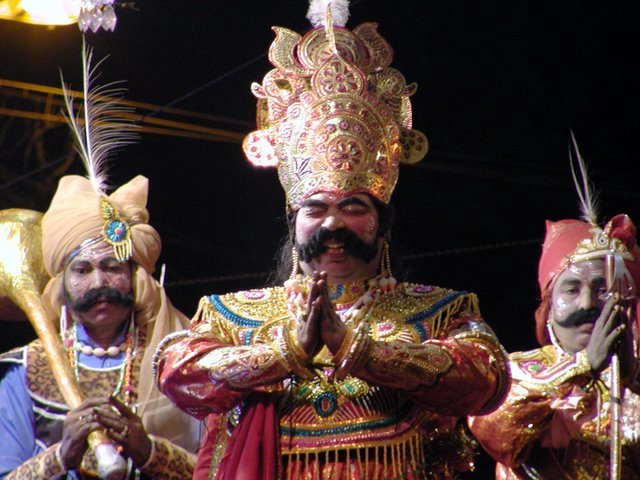
Dhanu Jatra or Dhanu Yatra is an annual drama-based open air theatrical performance celebrated in Bargarh, Odisha. Spread across a 8 km radius area around the Bargarh municipality, it is the world's largest open air theater, one that finds a mention in the Guinness Book of World Records.[1][2][3][4][5][6][7] It is based on mythological story of Krishna (locally known as Krushna), and his demon uncle Kansa. Originating in Bargarh, in the present day play, the enactments of the play are being performed in many other places in Western Odisha. The major one of these is the original one at Bargarh.[8] It is about the episode of Krishna and Balaram's visit to Mathura to witness the Dhanu ceremony organized by their (maternal) uncle Kansa. The plays start with the dethroning of emperor Ugrasena by the angry prince Kansa, over the marriage of his sister Debaki with Basudeba, and ends with death of Kansa, and restoring Ugrasen back to become the king. There is no written script used in these enactments. During this festival Kansa can punish people with penalty for their mistakes. Biju Patnaik, the former Chief Minister of Odisha was fined once along with his ministers.[7] The department of Culture of the Government of India has accorded National Festival status to Dhanu Yatra in November 2014.[9]

History

[edit]
Kansa being killed by Krishna in the Dhanu jatra at Bangomunda, Balangir district, Odisha.

It is said by some old people that as a way to celebrate the freedom, of newly formed independent India after the British rulers, the labor class workers started this festival. The death of Kansa symbolised the end of colonial rules.[10]

Venues

[edit]

The main municipality area turns into the historical town of Mathura Nagari, river Jeera turns into Yamuna, Ambapaali village (now a ward - part of Bargarh municipality) becomes Gopapura. A Pond by the side of Jeera river in Ambapali becomes the Kalindi Lake of the mythology. Since 2005, Nishamani School Ground has been used as the Rangamahal - Cultural stage of the festival.

There are many other towns and villages of western Odisha, where this drama enactment is done in recent years, following the success and popularity of the Bargarh stage. The notable places are village Chicholi of Ambabhona block is considered to be the second most famous in that area, apart from this Thuaapaali, Remanda are also notable.

Mathura

[edit]

Two stages in the town. The daily vegetable market inside the heart of the town becomes the main stage of the festival. Second stage is set up in Nishamani High School field near Kalimandir. A temporary stage is built up using bamboo, cloth and other decorating materials. The cement concrete roof of market shops around works as main platform. Whereas in Nishamani field, there is ample space in the ground to enjoy the show. Cultural troops, perform there in presence of King Kansa, invited guests and eager audience ranging from children to old people.

There is the historical place of starting point, at the rear area of the daily market, where the holy mast is erected a few days before the actual festival begins. Historically this place has been used by "Sanchaar" dance [11] form performers. It is declining and going extinct as a form of dance. Only handful old performers of this dance form are left, who still come every year to perform. This dance goes on throughout the night to keep the visitors of the villages engaged with entertainment, questions and answers.

Gopapura

[edit]

Nearby village Ambapaali is rendered as Gopapura, during the festival. Villagers paint their houses to the themes of the mythology, hand drawings on walls showing various stories of Krishna. Wall writing of poetic stanzas are quite common on almost all walls of the village.

Yamuna River

[edit]

Jeera river, flowing on West side to the main town, is transformed into river Yamuna for these 10 days. The river is used in the drama in 3 days of the play:

  1. When Krishna is born and Vasudeva goes to leave Krishna, his son at king Nanda's place, for the safety from the killer hands of Kansa
  2. During Raas Leela of Krishna with Gopis along the banks of the river (Gopapura - Ambapaali)
  3. When minister Akrura goes and brings Krishna Balaram Brother duos to show them Dhanu jatra at Mathura (Bargarh) city.

Ashramas

[edit]

Gobindpaali:

Year-wise prime actors

[edit]

2009–2015 Dhanuyatra - Kansa- Hrushikes bhoi

Makeup artist Ghasiram Sahu of Bargarh, Odisha, actively associated with this festival since 1951 without a break, died at the age of 84 years on 31 July 2015. He is credited for giving unique tyrant look to Kanssa, the principal actor of this play.

Events that require a special mention

[edit]

Known as the world's biggest open-air theatre,[12][13] it is held at bargarh since 1947.[14]

See also

[edit]

References

[edit]
[edit]
Revisions and contributorsEdit on WikipediaRead on Wikipedia
from Grokipedia
Dhanu Jatra, also spelled Dhanu Yatra, is an annual open-air theatrical festival held in , , , recognized by the as the world's largest open-air theater spanning an area of approximately 8-10 kilometers. It enacts dramatic episodes from the Puranic mythology of Lord Krishna's life, including his birth in , youthful exploits with brother , and ultimate slaying of the tyrannical King Kansa in , symbolizing the victory of over . The 11-day event, occurring from the fifth day of the waxing moon phase (Shukla Paksha) in the month of to the full moon (), typically falls between mid-December and mid-January according to the , and transforms town into ancient while nearby Ambapali village becomes Gopapura (), with the Jira River serving as the . Originating in 1948 shortly after India's independence, the festival emerged amid post-colonial nationalistic fervor, where Kansa's character allegorically represented British imperialism and Krishna-Balarama embodied patriotic aspirations for freedom and justice. Its roots draw from the broader Krishna cult in Hindu tradition, though the exact origins of this folk drama style remain somewhat mysterious, blending elements of Odia folk theater with Puranic narratives like Krishna Leela, Vijaya, and Kansa Vadha. Participants from the entire local community, numbering in the thousands, take on roles without professional actors dominating, with dialogues often delivered extempore in Sambalpuri dialect for authenticity and spontaneity; the performances incorporate traditional Odia , champa poetry, chhanda verses, and dances like sanchara. The festival commences with inaugural processions, the symbolic ascension of Kansa to the throne in Bargarh's "Rajdarbar" (), and celebrations of Krishna's birth in Ambapali, progressing through key events such as Kansa's battles with demons, Krishna's lifting of Govardhana Hill, and culminating on the final day with Kansa's defeat, the burning of his effigy, and the coronation of as righteous king. During this period, normal traffic is suspended in the performance zone, and Kansa's "rule" allows for playful fines on "subjects" to fund community activities, fostering immersive participation and unity across castes and religions. Dhanu Jatra holds profound cultural significance in preserving 's intangible heritage, promoting moral values, and boosting local economy through tourism, while attracting diverse performers from across for parallel cultural programs like folk dances and music. The 78th edition, scheduled from December 24, 2025, to January 3, 2026, features increased funding from the government to enhance its global appeal.

Overview

Description

Dhanu Jatra is an annual drama-based open-air theatrical performance held in , , , that depicts key episodes from Lord Krishna's early life, particularly his journey to and the slaying of the tyrannical king Kansa. The festival spans 11 days, commencing on Pausha Shukla Chaturthi and concluding on , typically falling in late December to early January; for instance, the 77th edition occurred from January 3 to 13, 2025, while the 78th is scheduled for December 24, 2025, to January 3, 2026. Encompassing an area spanning approximately 8-10 km across the town, it transforms the entire town of Bargarh into a living stage, with performances occurring across multiple locations and involving nearly the whole local population as actors and participants; it is regarded as the world's largest open-air theater. The core format features no fixed script, relying instead on improvised dialogues delivered extempore by the actors in Odia, drawing from traditional verses and folk elements, while encouraging active audience participation to immerse viewers in the narrative.

Mythological Basis

The mythological basis of Dhanu Jatra is rooted in the ancient Hindu epics, particularly the Bhagavata Purana and Harivamsa, which narrate the divine life of Krishna as the eighth avatar of Vishnu, destined to restore dharma by vanquishing adharma. In Mathura, the tyrannical King Kansa, uncle to Krishna, imprisoned his sister Devaki and her husband Vasudeva after a celestial voice prophesied that their eighth child would end his rule. Driven by fear, Kansa systematically killed Devaki's first six sons, while the seventh child, Balarama, was miraculously transferred to the womb of Rohini in Gokul to escape detection. Krishna's birth occurred under divine circumstances in the prison cell, where he appeared in his four-armed form as Vishnu before transforming into a human infant; Vasudeva then carried him across the Yamuna River to the cowherd village of Gokul (also called Gopapura), exchanging him with Yashoda's newborn daughter, who was Yoga-maya incarnate. When Kansa attempted to slay the girl, she revealed her divine form and reaffirmed the prophecy of his doom. During his childhood in , Krishna and exhibited superhuman feats, slaying demons dispatched by Kansa to eliminate the perceived threat. Notable exploits include Krishna killing the witch , who disguised herself as a nurse to poison him with her toxic milk, and Trinavarta, a whirlwind demon sent to abduct the child. Other vanquished foes encompassed the serpent , the crane , and the asses and , whose poisoning of the River was rectified by Krishna's dance upon its hoods. These acts, detailed in the Bhagavata Purana's Tenth Canto, underscored Krishna's role as protector of the innocent and harbinger of Kansa's downfall, building tension toward the prophesied confrontation. The Harivamsa, an appendix to the Mahabharata, parallels these narratives, emphasizing Krishna's divine lineage within the Yadu dynasty and his early triumphs as manifestations of cosmic order. The pivotal event is the Dhanu Yagna, or bow sacrifice, organized by Kansa in as a grand festival to assert his power and lure the prophesied child. As young men, Krishna and entered the city incognito, where Krishna straightened the hunchbacked servant Trivakra and admired the opulent preparations. At the arena, Krishna effortlessly strung and shattered the massive sacrificial bow (Shankha-Dhanush), an act symbolizing the rupture of Kansa's tyranny, which echoed like thunder and incited panic among the guards he and swiftly dispatched. This led to further trials, including the slaying of Kansa's massive Kuvalayapida and victories in rigged wrestling matches against champions like Chanura and Mushtika. Enraged, Kansa summoned Krishna to the dais, but Krishna leapt up, dragged him down by the hair, and slew him decisively, fulfilling the prophecy and liberating from oppression. similarly eliminated Kansa's eight brothers who attacked in retaliation. Symbolically, the narrative celebrates the triumph of good over evil, with Krishna's victory representing dharma's inevitable restoration against adharma's chaos. Dhanu Jatra's timing in the Dhanu (Sagittarius) month aligns with invocations for prosperity and bountiful harvests, mirroring the epic's themes of renewal and divine protection in agrarian societies.

History

Origins

Dhanu Jatra originated in , , in 1947-48, immediately following India's independence from British rule, as a vibrant celebration that transformed the town into an open-air stage for enacting episodes from the life of Lord Krishna. The festival drew from the traditional Odia folk theater form known as Jatra, adapting mythological narratives to resonate with the era's fervor for national liberation. The inception was spearheaded by a group of local devotees and enthusiasts, including figures such as Late Kangali Nayak, Late Aparti Panigrahi, Late Rishab Kar, and Late Ratan Darji, among 36 initiators who organized the first performances starting on January 12, 1948. This debut event, held in the post-harvest season, focused on the Krishna-Kansa storyline from the , where the demon king Kansa's tyranny and eventual defeat by Krishna served as a powerful for the overthrow of colonial , instilling a sense of national pride among participants and spectators. In its early years, Dhanu Jatra was entirely community-driven, relying on volunteer actors, improvised dialogues in local dialects, and minimal resources without formal infrastructure or sponsorships, which underscored its grassroots origins amid the economic constraints of newly independent . These initial performances emphasized themes of triumphing over , fostering unity and cultural revival in Bargarh's rural setting.

Evolution and Recognition

Following its inception in , Dhanu Jatra underwent phases of notable growth during the and 1970s, with increasing numbers of local participants and spectators contributing to its expansion as a community-driven spectacle that encompassed broader areas of and surrounding villages. By the early 2000s, organizational enhancements further formalized the event, including a shift in 2005 to the Nishamani School Ground as the primary Rangamahal or cultural stage, allowing for larger-scale performances and improved logistics. This evolution has sustained the festival's annual tradition, culminating in the 78th edition in 2025, which continues to draw thousands while preserving its open-air theatrical essence. Key milestones underscore its rising prominence: Three years later, in November 2014, the Government of India's Department of Culture officially declared it a National Festival, affirming its cultural importance and enabling greater institutional support. These recognitions have elevated the event from a regional folk to a nationally celebrated heritage activity. Recent developments reflect adaptations to contemporary challenges and efforts. The led to cancellations in 2020 and 2021, followed by limited crowds in 2022 under health protocols before full resumption in 2023. The 2025 edition, held from January 3 to 13, received special emphasis from the government, including Rs 1 crore in financial aid to highlight and promote . Innovations such as on digital platforms and LED screens in major cities, alongside international via the (bargarhdhanuyatra.in), have broadened its global audience in editions from 2023 onward.

Venues and Setting

Transformation of Bargarh

During the Dhanu Jatra festival, the town of undergoes a profound physical and symbolic metamorphosis, effectively converting an 8 km radius area around the municipality into the ancient city of for a duration of 11 days. This transformation turns streets, homes, markets, and public spaces into immersive elements of the mythological narrative, with the local river Jeera symbolically renamed the to evoke the sacred river from Krishna's lore. The entire locale serves as an open-air stage, where everyday infrastructure blends seamlessly with the dramatized world, fostering a collective suspension of modernity in favor of ancient legend. Streets and key areas are adorned with vibrant decorations to enhance the mythical ambiance, including rangolis depicting episodes from Krishna Leela spread across stretches like a 700-meter main road, colorful drapes, arch gates, and decorative lights illuminating venues such as the Ranga Mahal. Homes and markets feature props like temporary stages and thematic installations, with 14 to 22 such platforms constructed across the town to host performances, ensuring the visual landscape mirrors Mathura's grandeur. These elements are meticulously planned to draw spectators into the story, where the boundary between audience and setting dissolves. The community plays a pivotal role in this reinvention, with residents actively participating as extras portraying the "praja" (subjects) under the tyrannical rule of King Kansa, who enacts mock governance by imposing symbolic fines and taxes on officials and locals for perceived infractions, such as irregularities in administration or daily activities. To preserve the immersive experience, modern intrusions like vehicles are restricted in core performance zones, compelling participants and visitors to engage on foot and reinforcing the festival's temporal shift. This communal involvement extends beyond , as households and shopkeepers contribute to decorations and logistics, embodying the festival's ethos of collective storytelling. Logistically, the event mobilizes over 5,000 participants, including principal actors, cultural troupe performers, and support staff, across 170 troupes and multiple venues. Preparations commence months in advance, with auditions for key roles like Kansa held as early as , followed by intensive rehearsals at dedicated spaces like the Akhada Sala and set-building for elaborate structures such as the 42-foot-tall Kansa's Raj Darbar. This extensive groundwork, involving community committees and government aid, ensures the seamless execution of daily enactments, highlighting the festival's scale as the world's largest open-air theater.

Key Locations

The Dhanu Jatra transforms specific areas of into symbolic venues that embody the mythological landscape of Krishna's life, enabling the narrative to unfold across an expansive open-air stage spanning approximately 8 kilometers. These locations are integral to depicting the conflict between Kansa's tyranny in and Krishna's divine interventions in Gopapura, with the Jeera River serving as a natural divider between the opposing realms. The central municipality area of represents Nagari, the heart of King Kansa's kingdom, where scenes of proceedings and the final confrontation between Krishna and Kansa take place. This urban core, including sites like Hatpada for the Raj Darbar, captures the opulence and oppression of Kansa's rule, with processions and dramatic enactments drawing crowds to its streets. In contrast, the eastern neighborhood of Ambapali symbolizes Gopapura, Krishna's nurturing village across the river, serving as the setting for his childhood leelas and the home of . Established as a key site since the festival's beginnings in 1948 under the leadership of Neelamani Pujari, Ambapali—about 6 kilometers from central —hosts vignettes of Krishna's playful exploits, such as the slaying of Shankhachuda, amid its rural landscapes and stages like Brundavan Tota. The Jeera River, flowing between Mathura Nagari and Gopapura, stands in for the sacred River and facilitates pivotal river-crossing scenes in the narrative. Its banks and bridges are used for depictions of Vasudeva's nocturnal journey carrying the infant Krishna to safety, often incorporating props to evoke the perilous escape from Kansa's , enhancing the festival's immersive quality. Peripheral sites, such as schools and community grounds, represent and hermitages where sages recount tales of Kansa's cruelties. For example, the Muni Ashram in Govindapali, about 3 kilometers from central areas, and grounds at Nishamani High School serve as venues for philosophical discourses and supporting episodes, portraying the moral backdrop to the main conflict. The town-wide setup of , with painted backdrops and temporary structures, unifies these diverse spots into a cohesive mythological world. Additional locations include the at Samaleswari Temple in Taliapada, which depicts the prison holding and , underscoring Kansa's ruthless regime. Remanda and other outskirts host peripheral events, while satellite performances of similar Dhanu Jatra traditions extend the festival's influence to nearby towns like Barpali and Padampur.

Performance Elements

Script and Structure

The Dhanu Jatra features no fixed written script, relying instead on oral traditions derived from the , where performers improvise dialogues and actions to enact the mythological narrative of Krishna's life. This extempore approach allows for spontaneous poetic expressions that adapt to the audience and context, drawing directly from Krishna Leela episodes such as the birth of Krishna, his exploits against demons, and the culmination in Kansa's defeat. The absence of a scripted text ensures the performance remains dynamic, with actors channeling the essence of the Puranic tales through immediate, unscripted storytelling. The overall structure unfolds over 11 days with acts performed in the afternoon and evening hours, methodically progressing through key events from Krishna's birth in to his slaying of the tyrant Kansa. These acts incorporate traditional songs, dances, and folk musical elements to enhance the dramatic flow, creating a rhythmic blend of devotion and spectacle that immerses participants in the epic's moral and heroic themes. The narrative arc maintains chronological fidelity to the source material while allowing room for local interpretations, ensuring the story's progression feels both timeless and immediate. Staging emphasizes immersive, street-level techniques that transform everyday spaces into mythological realms, featuring grand processions with decorated chariots (raths) carrying principal characters through the town. , such as simulating battles between Krishna and demons like or Kansa's forces, heighten the visual drama during climactic scenes. Audience interaction is integral, with performers like Kansa directly engaging residents by "interrupting" daily routines—such as entering offices or homes to assert his tyrannical rule—blurring the boundaries between spectators and the unfolding drama. This participatory element fosters a communal experience, where the entire town becomes both stage and cast in the living enactment.

Actors and Roles

The actors in Dhanu Jatra are primarily voluntary participants drawn from the local of and surrounding areas, reflecting the festival's origins and emphasis on collective cultural expression. Selection for principal roles occurs through an open audition process organized by the Dhanuyatra Mahotsava Samitee, typically held in and , with applications accepted in person or via to ensure transparency and broad participation. A of directors and experts evaluates candidates based on skills, voice modulation, and suitability for the , while supporting roles are filled by members without formal auditions. Children from the locality are specifically chosen for youthful characters like the young Krishna and , often through informal nominations to highlight the festival's intergenerational involvement. Central to the performance are archetypal roles derived from the Krishna-Kansa mythology, with Kansa portrayed as the tyrannical king of , embodying cruelty and ambition as the uncle who fears the prophesied slayer of his rule. Krishna and serve as the divine protagonists—Krishna as Vishnu's raised by foster parents, and as his loyal, strength-endowed brother—symbolizing and heroism. Supporting characters include , the cunning who aids Krishna's escape, and Chanura, the formidable wrestler in Kansa's service, adding layers of intrigue and conflict to the narrative. These roles demand physical presence and improvisational dialogue, with actors transforming everyday streets into a living stage. Notable performers have become cultural icons, often holding roles for extended periods and elevating the festival's prestige. Early pioneers include Bundi Rath, who enacted Kansa in the inaugural 1948 performance, setting the tone for the character's authoritative demeanor. Judhistir Satapathy portrayed Kansa for over two decades from 1957 to 1980, while Gopal Sahu took on the role from 1984–1998 and 2001–2008, known for his commanding stage presence; Sahu passed away on August 12, 2024. Hrushikesh Bhoi, a local artist, played Kansa multiple times, marking his 10th tenure in 2022, though he was later ineligible due to administrative issues. Bhubaneswar Pradhan, a seasoned theater practitioner from the region, performed as Kansa in the 2025 festival before retiring from the role. For Krishna, long-serving actors like the Birtia family—spanning Chhanda Charan (1968–1971) to Samir (2000–2003)—have maintained continuity. A distinctive feature is the absence of professional compensation; participants receive only a modest , such as Rs 10,000, underscoring the event's community-driven ethos rather than commercial intent. The Kansa actor assumes a symbolic "reign" during the festival, imposing mock fines on locals and dignitaries for perceived infractions like tardiness, enforcing the immersive atmosphere—most famously, in the 1960s when then-Chief Minister was fined on stage for arriving late, paying Rs 51 amid cheers from the crowd. Makeup traditions enhance these portrayals, with Ghasiram Sahu, a dedicated artist, crafting Kansa's fearsome visage using greasepaint and local techniques from 1951 until his death in 2015, a legacy now carried by his family. While historically male-dominated, female community involvement has grown, with women increasingly taking on roles like and courtiers, broadening participation in recent editions.

Schedule and Events

Daily Performances

The Dhanu Jatra unfolds over 11 days, beginning with the of Devki and followed by Kansa's ascension to the throne on the first day, and progressing through key episodes from the life of Krishna as depicted in the and . On the second day, Krishna's birth is enacted, along with Vasudeva's journey to Gopapura and Kansa's dispatching of demons. Days three through five focus on Krishna's childhood leelas in Gopapura, including the slaying of demons like and Shadajambha, the uprooting of the Yamalarjuna trees, and the subduing of in the river. From days six to eight, the narrative shifts to preparations in Mathuranagari, such as royal council discussions, the dispatch of to invite Krishna and , and Krishna lifting . Days nine and ten cover the journey to Mathura, the breaking of the bow at the festival, and the brothers' entry into the city amid wrestling preparations. The festival culminates on the eleventh day with the wrestling matches and Krishna's slaying of Kansa, followed by Ugrasena's coronation. Performances occur daily in the afternoon and evening, typically featuring cultural processions starting around 2 PM along the streets of Mathuranagari, followed by main dramatic episodes from approximately 7 PM onward, extending into the night. Each day covers one or two major episodes, with scenes enacted simultaneously or sequentially across divided stages representing Mathura and Gokul. Hundreds of local residents participate as performers, portraying principal roles like Krishna, Kansa, and Balarama alongside supporting characters, musicians, and dancers, creating an immersive open-air theater experience. The events rotate between venues in Bargarh town (Mathuranagari, symbolizing and Kansa's kingdom) and rural outskirts like Ambapali (Gopapura, representing and ), with the Jeera River serving as the for riverine scenes. This logistical division allows parallel enactments, such as Kansa's court proceedings in the town while Krishna's leelas occur in the villages, ensuring the narrative flows across an 8 km radius without fixed stages. The final day concludes with the ceremonial end of Kansa's reign, restoring order to the symbolic kingdom.

Special Highlights

One of the most iconic moments in Dhanu Jatra is the mock court sessions presided over by King Kansa, where the character interacts with real locals and officials, imposing humorous fines for perceived infractions to satirize everyday life and authority. This tradition dates back to the festival's early years, with notable instances including the fining of then-Chief Minister in 1994, as recounted by veteran actor Bhubaneswar Pradhan, who portrayed Kansa at the time. Such interactions extend to contemporary fines, like those levied on drivers for traffic violations or officials for administrative lapses, blending mythology with and drawing crowds to witness the playful tyranny. Another highlight is the dramatic wrestling match between Krishna, Balarama, and the demon wrestlers Chanura and Mushtika, enacted on the festival's later days as a climactic display of youthful valor against brute force. This scene, drawn from the Krishna legend, features performers using physical prowess to depict the mythological bout, symbolizing the triumph of over and captivating audiences with its high-energy choreography across open streets. Historically, Dhanu Jatra gained early recognition for its scale, earning a place in the Book of World Records as the world's largest open-air theater, a testament to its expansive staging over an 8 km radius that transforms into a living set. In recent years, the festival has embraced digital innovations, particularly after the disruptions that led to its cancellation in 2021; the 2022 edition marked a vibrant resumption with elements to reach wider audiences. The 2025 edition introduced further modern touches, including a robotic animal show integrating technology with traditional performances for the first time, alongside live broadcasts timed for to highlight Odia globally. This year also featured over 170 artists, with a Rs 10,000 per participant to encourage broader involvement, including through open auditions and roles that foster intergenerational continuity. Additionally, the government announced plans to seek status, underscoring the festival's evolving role in preserving and promoting regional traditions.

Cultural Significance

Local and Regional Impact

Dhanu Jatra significantly strengthens community bonds in Bargarh by mobilizing residents and visitors as active participants in its open-air performances, creating a shared sense of unity and cultural immersion across the town's 8 km radius. This mass involvement fosters social solidarity, as nearly all locals take on roles or contribute to the event, transforming everyday life into a collective celebration of mythological narratives. The festival promotes the and folklore through enactments of Puranic stories like Krishna Leela, preserving traditional narratives in their original linguistic and cultural forms. It empowers local participants, including women in non-traditional roles such as dance performances in the Kansa durbar, a development seen increasingly since the with guest artists like Ollywood actress joining in 2024. This inclusion highlights evolving gender dynamics, allowing women to engage prominently in a historically male-dominated theatrical . Economically, Dhanu Jatra is expected to attract over 1 million visitors annually, as for the 2025 edition, providing a substantial boost to Bargarh's sector by supporting local artisans, hotels, and crafts through events like the Meena Bazaar and handloom expos. These activities generate revenue via trade and visitor spending, with accompanying fairs featuring over 100 stalls that stimulate regional commerce. For the 2025 edition, increased government funding of INR , plus an additional INR 50 lakh for live telecasting, further enhances its economic viability by drawing larger crowds and promoting local enterprises; additionally, a Rs 10,000 was provided to each of approximately 150-170 participating artistes. Regionally, Dhanu Jatra has influenced similar festivals in nearby towns like , where an inaugural five-day version launched in 2024, adapting Bargarh's format to local Sambalpuri dialect while maintaining the core Krishna narrative. This spread preserves tribal elements from , integrating folk traditions into the performances to sustain indigenous cultural practices amid modernization.

National and Global Recognition

In November 2014, the Department of Culture, , officially declared Dhanu Jatra a national festival, recognizing its cultural significance and scale as an open-air theatrical tradition. This designation has elevated its profile within India's cultural calendar, facilitating greater institutional support and visibility beyond . At the state level, Dhanu Jatra has been integrated into Odisha's initiatives, with the allocating Rs 1 in funding for the 2025 edition to enhance production quality, live broadcasting, and promotional efforts. The Odisha Tourism Department further supported the event through social media campaigns and financial assistance, positioning it as a key attraction for in 2024-25. In February 2025, the government sanctioned over Rs 12.79 for the construction of a permanent Raj Mahal structure to support future editions. Globally, Dhanu Jatra holds a as the largest open-air , a recognition that underscores its unique scale spanning an 8 km radius in . The festival attracts international visitors, with the 2025 edition expected to draw over a million attendees, including cultural enthusiasts from abroad, amid efforts to amplify its worldwide appeal. Odisha's government is actively pursuing status for Dhanu Jatra, announcing the formation of an expert committee in December 2024 to prepare the nomination and develop a dedicated GPS-enabled website for global outreach. Following the disruptions, the festival gained enhanced post-2020 visibility through online live streams on platforms like , enabling international audiences to access performances during the 2023-2025 editions. These digital efforts, combined with collaborations for live broadcasts, have supported ongoing international promotion.

References

Add your contribution
Related Hubs
User Avatar
No comments yet.