Hubbry Logo
DharmrajeshwarDharmrajeshwarMain
Open search
Dharmrajeshwar
Community hub
Dharmrajeshwar
logo
8 pages, 0 posts
0 subscribers
Be the first to start a discussion here.
Dharmrajeshwar
Dharmrajeshwar
from Wikipedia

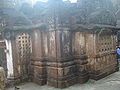
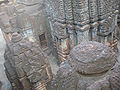
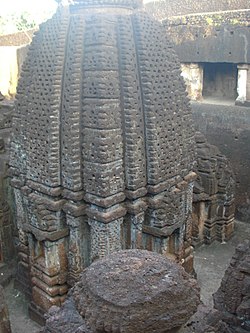
The Dharmarajeshwara temple is a rock-cut temple site 100kms from Mandsaur in Madhya Pradesh, India.[1] The complex features well-preserved Hindu shrine and bears some resemblance to the rock-cut heritage sites at Ellora, Maharashtra.

Key Information

The temple complex dates to the 8th century and initially featured a shrine dedicated to Vishnu but was later remodelled as a Shiva temple. Consequently, the sanctum sanctorum features both an icon of Harihara as well as a Shivalinga. The Mahashivaratri is the primary festival celebrated at Dharmarajeshwara.[1]

[edit]

References

[edit]
Revisions and contributorsEdit on WikipediaRead on Wikipedia
from Grokipedia
Dharmrajeshwar is an ancient rock-cut temple complex located in the Garoth tehsil of , , , approximately 106 kilometers from the district headquarters and near Chandwasa village. Constructed in the fifth and sixth centuries CE according to local records (though some sources suggest an 8th-century date), it originated as a temple but was later rebuilt and dedicated to Lord , featuring a prominent Shivalinga and a symbol in its . The temple exemplifies early , carved monolithically from a solid hill into a structure measuring 50 meters long, 20 meters wide, and 9 meters deep, reminiscent of the style seen at Ellora. It includes a main Hindu shrine surrounded by seven smaller temples and numerous associated caves, some with Buddhist influences (nearby Dhamnar caves), highlighting a syncretic religious heritage from the early medieval period. Intricate carvings of deities such as and adorn the entrance, while the site's engineering precision—excavated vertically from the hilltop—demonstrates advanced ancient construction techniques. Dharmrajeshwar holds cultural and religious significance as a protected monument under the Archaeological Survey of India, attracting pilgrims and tourists for its historical depth and architectural marvel. The primary festival observed here is Mahashivratri, drawing devotees for rituals and fairs that celebrate its Shaivite devotion. Accessible via the Shamgarh railway station (22 km away) or by road from Mandsaur (about 120 km), the site underscores Madhya Pradesh's rich legacy of cave temples and interfaith architectural fusion.

Location and Discovery

Geographical Setting

The Dharmrajeshwar temple is situated near Chandwasa village, within of , , , approximately 4 km from Chandwasa, at coordinates 24°11′38.22″N 75°29′56.42″E. This places it in a rural expanse of the region, approximately 106 km from headquarters, 22 km from headquarters, and 22 km from Shamgarh. The site is carved into a natural hill known historically as Chandan Giri, descending 9 meters below ground level into solid rock, amid a characterized by sparse and limited modern . This rock-cut configuration aligns briefly with Madhya Pradesh's tradition of ancient cave temples, such as those at Udayagiri or Bagh. Accessibility relies primarily on road networks, with connectivity via state highways from or ; the nearest railway station is at Shamgarh, facilitating onward travel by or local transport. The surrounding area's minimal development preserves its secluded, agrarian setting, with no major urban encroachments.

Modern Rediscovery

The modern rediscovery of the Dharmrajeshwar temple complex began in 1962 when archaeologist Dr. Vishnu Shridhar Wakankar identified the site as a significant rock-cut architectural ensemble during his explorations in . Wakankar's work highlighted the temple's monolithic construction and its potential historical depth, marking a pivotal moment in bringing attention to this lesser-known heritage site near Chandwasa village in . Initial archaeological surveys conducted following Wakankar's discovery uncovered evidence of the site's multi-religious character, encompassing Hindu, Buddhist, and Jain influences across its caves and shrines. A notable find was a clay seal unearthed by Wakankar, inscribed with references to "Chandan Giri Mahavihara," which corroborated the site's ancient monastic and devotional associations. These surveys also revealed architectural transitions, such as the main shrine's original dedication to later adapted for worship, underscoring layers of religious evolution. In the ensuing years of the 1960s, the (ASI) took formal involvement, initiating detailed mapping of the complex and implementing preliminary protective measures to safeguard its structures from natural decay and encroachment. This period laid the groundwork for recognizing Dharmrajeshwar as a nationally protected , integrating it into broader efforts to document Madhya Pradesh's rock-cut heritage. The site's proximity to other ancient locales in further contextualized its role within a regional network of early medieval religious centers.

History

Legendary Origins

According to local traditions, the Dharmrajeshwar temple is believed to have been constructed by the during their period of exile as described in the epic. Specifically, , the second brother known for his immense strength, is said to have carved the temple out of a single rock to honor his eldest brother , revered as Dharmraj for embodying or righteousness. This act of devotion during their wanderings underscores the site's mythological ties to themes of duty and moral uprightness in Hindu lore. The hill on which the temple stands, known historically as Chandan Giri, features prominently in these legends as a hidden refuge for the , providing them shelter amid their adversities. Folklore recounts stories of divine intervention aiding the carving of the caves, with the natural rock formations symbolizing the protective embrace of the gods during the brothers' trials. These narratives portray the site not merely as a place of construction but as a sacred haven intertwined with the epic's tales of and perseverance. The name "Dharmrajeshwar" derives from "Dharmraj," a title for as the upholder of , combined with "eshwar," meaning lord, reflecting the temple's dedication to while evoking ideals of righteous governance. This etymology reinforces the mythological linkage to the , positioning the as a symbol of ethical lordship. These legendary origins have been preserved through oral traditions in the local folklore of the region, often recounted during festivals such as Mahashivratri. Devotees believe that spending the night at the temple on this occasion grants or spiritual liberation, blending the epic myths with ongoing practices that sustain the stories across generations.

Historical Development

The Dharmrajeshwar temple was constructed in the 5th-6th centuries CE, with initial rock-cut excavations forming part of a larger complex that includes surrounding caves showing Buddhist influences, such as those at nearby Dhamnar. Archaeological evidence points to the site's original purpose incorporating elements of a Buddhist or Jain vihara, or , supported by the presence of surrounding monk caves and remnants of idols within the complex. Over time, particularly by the early medieval period, the site underwent religious transformation, shifting from a shrine—characterized by early dedications to the deity—to a temple, as indicated by the installation of a Shivalinga in the . This remodeling reflects broader syncretic trends in medieval Indian religion, exemplified by the icon (a composite form of and ) preserved in the sanctum, highlighting the blending of Vaishnava and Shaiva traditions. The temple's development aligns with Malwa's rich rock-cut architectural tradition, drawing influences from nearby sites such as , which feature similar monolithic excavations and early medieval patronage patterns in the region. Local beliefs occasionally reference legendary origins tied to the , though these lack empirical support and are distinct from the site's documented historical phases.

Architecture

Main Temple Structure

The Dharmrajeshwar temple exemplifies , constructed as a monolithic structure by excavating solid natural rock from a hill in the 5th to 6th century CE. Similar in technique to the Kailasa Temple at Ellora, the main temple was carved vertically downward, reaching a depth of 9 meters to form its core layout. Visitors descend through rocky terrain to access the entrance, emphasizing the site's integration with the natural hillside. The overall design measures approximately 50 meters in length, 20 meters in width, and 9 meters in depth, comprising a single main chamber preceded by an antechamber in a layout adapted from the Nagara style to the cave form. No mortar or external materials were used, relying entirely on the precision of ancient stone-cutting techniques for structural integrity. The , or , houses a central Shivalinga dedicated to Lord , alongside a idol representing the composite form of half- and half-Shiva, reflecting the temple's historical evolution from a Vaishnava to a Shaivaite one. Intricately carved pillars support the , or pillared hall, which serves as an assembly space leading to the sanctum, with entrance carvings depicting Lord and Goddess . Engineering feats are evident in the precise alignment of the temple, where the first rays of sunrise illuminate the Shivalinga. An adjacent small well within the temple provides a perennial water source. The main structure is briefly extended by seven surrounding minor shrines, each housing deities such as , , and , enhancing the site's spiritual coherence without altering the central rock-cut focus.

Surrounding Cave Complex

The surrounding cave complex at Dharmrajeshwar, known as the Dhamnar caves and adjacent to the main temple, encompasses a network of approximately 51 rock-cut caves excavated into the hills of Chandwasa, forming an expansive ancillary site. Primarily Buddhist in character, these include viharas and chaityagrihas that served as monastic residences, with first-floor levels specifically adapted as quarters for meditating monks, alongside the main and possible Jain elements. These elements highlight the site's early multi-religious character, where Buddhist viharas feature idols of in meditative postures, such as dhyanasana. The layout consists of interconnected passages and circumambulatory paths linking the caves across the hill, spanning about 5.2 hectares and integrated into the natural contours of the landscape for seamless access. Some passages feature verandahs and shafts that provide natural ventilation and light, facilitating the site's use as a monastic complex, though certain areas remain sealed by the (ASI) due to structural instability in the friable rock. This arrangement underscores the communal and contemplative purpose of the peripheral caves, distinct from the centralized focus of the main Shiva temple. Construction techniques involved primarily horizontal excavations from the front to the rear of the hill, supplemented by vertical cuttings in select viharas, resulting in rudimentary carvings on walls and pillars that contrast with the more elaborate motifs of the central temple. These caves date to phased developments between the 5th and 7th centuries CE, with evidence from Brahmi inscriptions confirming early monastic activity under the influence of regional dynasties. Additional structures include smaller shrines dedicated to local deities, such as those in the minor temples, which blend into the hill's undulating terrain and further illustrate the site's adaptive .

Religious Significance

Deities and Iconography

The central deity at Dharmrajeshwar is Lord , manifested as Dharmrajeshwar through the prominent Shivalinga housed in the . This aniconic form represents Shiva's embodiment of and cosmic balance, underscoring themes of moral order and universal harmony central to Shaivite philosophy. A key feature of the sanctum is the composite icon of , illustrating the theological unity between and Shiva. The sculpture divides the figure symmetrically, with the left half depicting Shiva bearing the trident () and drum () to evoke destruction and creation, while the right half portrays Vishnu adorned with the conch () and discus () to symbolize preservation and protection. This syncretic representation, dating to the temple's remodeling phase when it transitioned from a Vaishnavaite to a Shaivite focus, highlights the harmonious integration of Vaishnava and Shaiva traditions prevalent in medieval Indian devotion. Surrounding the main temple, seven smaller shrines enshrine additional deities like (Shiva's fierce form), , , and (Vishnu's mount), further enriching the devotional landscape. The site's iconography extends to peripheral elements indicating , with nearby caves featuring meditative icons of and Jain Tirthankars, such as Parshvanath, , Neminath, Shantinath, and . These reflect the temple complex's multifaceted heritage, blending Hindu, Buddhist, and Jain influences in a shared . The overall iconographic style exhibits post-Gupta influences from the 5th-6th centuries, characterized by stylized human proportions, elongated limbs, and intricate detailing that emphasize spiritual abstraction over realism. Symbolic motifs abound, including lotuses signifying purity and enlightenment, and serpents representing protection and the energy, which are recurrent in the carvings to invoke divine safeguarding and transcendence. Worship practices at Dharmrajeshwar evolved from early Buddhist and Jain meditative veneration of these icons toward Hindu devotional rituals centered on the Shivalinga, mirroring broader regional shifts from heterodox to orthodox traditions during the early medieval period. Mahashivratri remains a key observance honoring Shiva's cosmic role.

Festivals and Beliefs

The primary festival at Dharmrajeshwar is Mahashivratri, during which devotees participate in night-long vigils and rituals centered on the Shivalinga, with a widespread belief that staying overnight at the temple grants or spiritual liberation. Celebrations include elaborate prayers, devotional chants, and abhishekam, the ritual bathing of the deity, drawing pilgrims seeking divine favor and purification. This event transforms the site into a hub of fervent worship, underscoring its role as a center for Shaivite devotion in the region. An annual astronomical phenomenon occurs at sunrise, where the first rays of the sun directly illuminate the Shivalinga in the , interpreted as a divine symbolizing enlightenment and the temple's cosmic harmony. beliefs further enhance the site's sanctity, with the temple revered as a destination for dharma-seekers, tied to legends of , the embodiment of righteousness from the , who is said to have worshipped here during the Pandavas' era. Daily rituals maintain the temple's spiritual rhythm, featuring aarti ceremonies with lamps and incense, alongside offerings of flowers and bilva leaves to the Shivalinga, fostering a continuous atmosphere of reverence. Syncretic elements are evident in the peripheral caves, originally Buddhist monastic spaces later adapted for Hindu use. The cultural impact extends to an annual fair held during Mahashivratri, which attracts thousands of visitors and integrates devotional activities with Malwa folk traditions, such as music, , and regional crafts, promoting communal .

Preservation and Tourism

Conservation Measures

The Dharmrajeshwar temple, integrated within the Dhamnar cave complex in , , falls under the oversight of the (ASI) as a centrally protected (Brahmanical rock-cut temple, Dhamnar). This status ensures regular structural assessments to mitigate risks such as rockfalls in the excavated areas, which reach depths of up to 10 meters in some sections. Conservation efforts gained momentum in the early , with the ASI's circle implementing a targeted restoration in 2015 to reinforce the site's . This initiative focused on stabilizing pillars and sealing unstable passages through non-invasive methods, including the application of a "laterite pack" composed of powdered , brick surkhi, and to repair cracks in the porous laterite rock without altering the original carvings or aesthetic integrity. The addressed key challenges like from seepage and natural , which had destabilized several structures, while prioritizing minimal intervention to preserve the site's historical authenticity. The site is governed by the Ancient Monuments and Archaeological Sites and Remains Act, 1958 (as amended), which prohibits unauthorized construction within a 100-meter prohibited area and a 200-meter regulated area surrounding the to prevent further environmental or human-induced damage. As of November 2025, ASI has directed its regional circles, including , to develop detailed conservation strategies for all 3,697 centrally protected monuments, incorporating digital documentation and low-impact solutions like LED installations to enhance visibility while minimizing deterioration from artificial illumination. These efforts are supported by partnerships with state tourism authorities in to secure sustainable funding for ongoing maintenance.

Visitor Information

The site is particularly recommended for visits during Mahashivratri in or March, when vibrant festivals and fairs draw large crowds of pilgrims. Overnight accommodation is not offered on-site, though guesthouses and hotels can be found in nearby towns like Garoth and Shamgarh. Visitors should wear comfortable shoes for the 250-foot descent along the carved path to the temple complex. season visits (June-September) are discouraged due to slippery and potentially hazardous paths. The temple is promoted as the "Ajanta-Ellora of " for its and is part of broader tourism circuits, including excursions to nearby ghats in .
Add your contribution
Related Hubs
User Avatar
No comments yet.