Hubbry Logo
DamaruDamaruMain
Open search
Damaru
Community hub
Damaru
logo
8 pages, 0 posts
0 subscribers
Be the first to start a discussion here.
Damaru
Damaru
from Wikipedia
Damaru
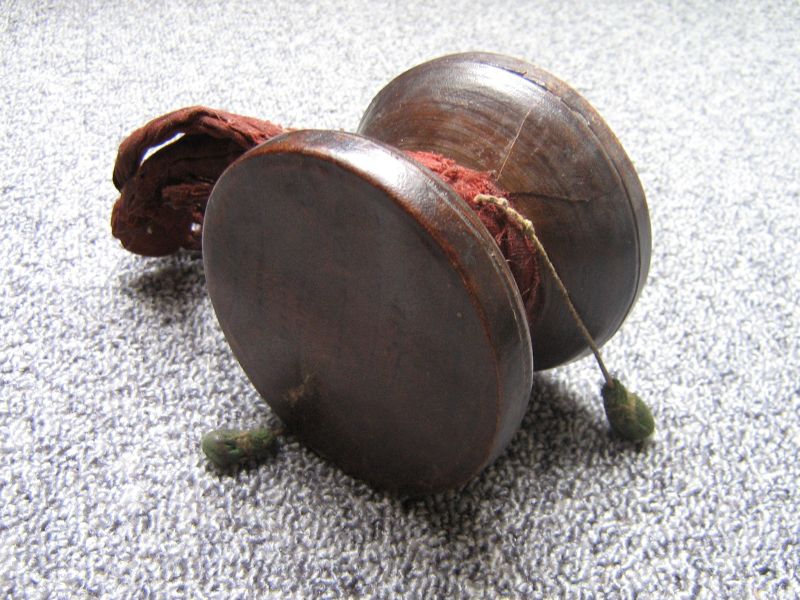
A Tibetan damaru
Hornbostel–Sachs classification212.241
(Membranophone. Individual hourglass-shaped rattle vi drums (under revised Hornbostel Sachs classifications)[1][2])

A damaru (Sanskrit: डमरु, IAST: ḍamaru; Tibetan ཌ་མ་རུ་ or རྔ་ཆུང) is a small two-headed drum used in Hinduism and Tibetan Buddhism. In Hinduism, the damaru is known as the instrument of the Hindu deity Shiva, associated with Tantric traditions. It is said to be created by Shiva to produce spiritual sounds by which the whole universe has been created and regulated.[3] In Tibetan Buddhism, the damaru is used as an instrument in meditation practices.[4]

Description

[edit]

The damaru is typically made of wood, metal with leather damaru heads at both ends. The resonator is made of brass. Its height ranges from a few inches to a little over one foot. It is played single-handedly. The strikers are typically beads fastened to the ends of leather cords around the waist of the damaru. Knots in the leather can also be used as strikers; crocheted material is also common. As the player waves the drum using a twisting wrist motion, the strikers beat on the drumhead.

In Hinduism

[edit]
Damaru

The damaru is very common throughout the Indian subcontinent. It is associated with the Hindu deity Shiva. It is believed that Sanskrit language was recognized by the drumbeats of the damaru (see Shiva Sutra for the sounds), and his performance of the cosmic dance of tandava. The damaru is used by itinerant musicians of all stripes, due to its small portable size.

Damaru-coinage of Kosambi

[edit]
Two Damaru-shaped coins from the Gangetic Valley

In the post-Mauryan period a tribal society at Kosambi (modern Prayagraj district) made cast copper coinage with and without punchmarks. Their coinage resemble the damaru-drum. All such coinage has been attributed to the Kosambi. Many Indian museums, such as the National Museum, have these coins in their collections.[5]

In Tibetan Buddhism

[edit]

In the Tibetan Buddhist tradition, the damaru is part of a collection of sacred implements and musical instrument was adopted from the tantric practices of ancient India. These reached the Himalayas from the 8th to 12th century, persisting in Tibet as the practice of Vajrayana flourished there, even as it vanished in the subcontinent of India.[6]

Skull damaru

[edit]

The skull (thöpa) damaru is made from a male and female skull bone or calvarium, cut well above the area of the ear, and joined at their apex. Inside, male and female mantras are appropriately inscribed in gold. The skins are traditionally cured by burying them with copper and other mineral salts, and special herbal formulas for about two weeks. These are then stretched and applied to the two sides, giving the skins their familiar blue or green mottled appearance. A collar of simple brocade, or copper or silver, has a hand-hold, and is the site of attachment of the beaters, whose knit cover represents two eyeballs. The skulls are also carefully chosen for their attributes and source. After the Tibetan diaspora in 1960, they began to be manufactured in India and Nepal, with a continued degradation of quality. Today, India is no longer a source, and their creation and export from Nepal are banned, because of the acquiring of human bone through illegal practices. One still does find occasionally those with painted skins and without the proper mantras or other characteristics.

The symbolism and energetic properties of the drums is extensive. These human skull damaru or chang te'u are used in a wide range of Vajrayana ritual, as a standard right hand accompaniment to the bell, held in the left hand. Usually used together as an accent or punctuation during various tantric practices, the drum can also keep time during entire passages. For the solo practitioner, it is an essential tool, while in larger assemblies, only the presiding Rinpoches and chant masters use them, in concert with the long horns (radung), short horns (gyaling), large cymbals (silnyen and rolmo) and large temple drums (lag-na).

Chöd drum

[edit]

The Chöd drum (or chöda) is a specialized form of damaru. It is generally larger in circumference and has a more round shape than its smaller counterpart. The Chöd drum is used in the tantric practice of Chöd.

Drum damaru – the Asia and Pacific Museum in Warsaw

With no known antecedent, the chod is traditionally made of acacia wood (seng deng), though a variety of woods are acceptable, as long as the tree is not toxic and does not possess thorns or other negative attributes. Made as a one-piece, double-sided (two-headed) bell shape, size varies from 8 inches to 12 inches in diameter. Usually featuring only a thin veneer of varnish, so that the grain of the wood shows, they come from the common red (marpo), black (nakpo) or rare yellow (serpo) type of acacia, and are very occasionally painted with skulls, the eight charnel grounds, or other symbols. The waist or belt is traditionally made of leather, though often brocades are used. A set of mantras are traditionally painted on the interior of the drum prior to its skinning.

The pitch of the drum varies, and the tone may vary depending on conditions of dampness, temperature and so on. Played slowly, and methodically, the droning of the damaru accompanies the haunting melodies and chants of the chod ritual, as of which are accompaniments for the inner meditations and visualizations that are at the heart of this spiritual practice.

The above applies to the ideal manufacture of the damaru, and as still described in the definitive modern work, the "Mindroling Handbook of Vajrayana Implements". Those manufactured in India and Nepal are made of indeterminate and cheap woods, with painted skins, often no interior mantras, and altogether deviating from the many other essentials, as prescribed in technical literature such as the Mindroling Handbook. Such copies are now widespread and in use by Eastern monastics and Western students.

Chöpen

[edit]

Damaru of all kinds are traditionally paired with a long sash or tail called a chöpen. The chöpen is attached to the end of the drum's handle so that it waves about while the drum is being played. They are most commonly made of brocade or silk using the colors of the tantric elements. On smaller damaru, the chöpen is usually found without adornment, but on chöd damaru, the tail will often feature several items which have been sewn onto the fabric. These adornments commonly include but are not limited to: a polished silver mirror or melong, a set of small bells, strips of tiger and/or leopard skin, one/more precious stones (i.e. dzi bead), and an unspecified amount of small brass trinkets.

See also

[edit]
  • Dhadd – Musical instrument
  • Dhyāngro – Musical instrument
  • Kangling – Musical instrument
  • Na – Musical instrument
  • Udukai – Musical instrument

References

[edit]

Further reading

[edit]
[edit]
Revisions and contributorsEdit on WikipediaRead on Wikipedia
from Grokipedia
The damaru is a small, hourglass-shaped , typically crafted from wood with two drumheads of animal skin connected by lacing, and played by rapidly twisting the to make attached beads or pellets strike the membranes alternately, producing a distinctive rattling or rhythmic . Originating in the over a millennium ago, as evidenced by its depiction in 10th-century CE temple sculptures, the instrument symbolizes creative energy and cosmic rhythm, with its beats evoking the primordial of creation. In Hinduism, the damaru is inseparably linked to the deity Shiva, particularly in his form as Nataraja, the cosmic dancer, where it is held in his upper right hand to represent the rhythmic pulse of the universe's formation and dissolution. The drum's sound is believed to generate the foundational vibrations (nada) from which all matter and existence emerge, underscoring themes of duality—such as male and female principles or creation and destruction—in tantric philosophy. Artisans, including communities like the Chundara in Nepal, construct it using traditional measurements such as handspans and digits, passing down ethnomathematical knowledge through generations to ensure precise proportions that affect pitch and timbre. It is employed in temple rituals, by wandering ascetics (sadhus), and in folk performances, including street theater and dances, where its portable design allows for versatile accompaniment. Within Tibetan Buddhism, the damaru—known as thod-rnga or "skull drum"—adapts the form for esoteric tantric practices, often fashioned from the joined crowns of two human skulls (ideally from a young boy and girl to maximize symbolic potency), covered with leather and fitted with clappers on strings. Introduced from Indian tantric traditions around the 8th century CE and integrated into Tibetan rituals by the 11th century through figures like Machik Labdrön, the founder of the Chöd practice, it embodies impermanence (anitya) and the severance of ego attachment. Played in the right hand while the left holds a bell, its rotations generate sounds that invoke protective deities, facilitate meditative visualizations of self-offering, and mark the bliss of enlightenment, contrasting the skull's reminder of mortality with the drum's vibrant life force. In Chöd ceremonies, it accompanies chants and dances in charnel grounds to confront fears and illusions, highlighting its role in advanced Vajrayana paths toward liberation.

Physical Description

Form and Materials

The damaru is characterized by its distinctive hourglass-shaped body, which consists of two rounded chambers connected by a narrow central , allowing it to be compact and easily handheld. This form typically measures 4 to 8 inches in height, with the diameter of each end ranging from 3 to 5 inches, though variations exist based on regional craftsmanship. The body is most commonly constructed from , carved from a single solid block to ensure structural integrity and , with examples including dense hardwoods suited to intricate turning and finishing. In some traditions, metal or may be used for the body, providing durability or ornamental value, as seen in South Indian specimens from the . The two drumheads are affixed to the open ends of the chambers, each covered with a of animal hide such as or buffalo skin, stretched taut to produce a clear, resonant tone when struck. These hides are secured using leather lacing or thongs that wrap around the body, often interlaced in a pattern to maintain tension and allow for tuning adjustments. The heads are typically attached to circular frames made of or cane embedded within the body's ends, enhancing the drum's acoustic projection. At the central or waist of the , the body narrows to facilitate the attachment of a , cord, or string, enabling the instrument to be held or twirled during play. To generate its characteristic rattling , small beads, pellets, or knotted cords are affixed to strings or cords encircling the waist, which strike the drumheads rhythmically when the damaru is rotated. This standard small handheld configuration prevails, though sizes may vary slightly for practical use in performances.

Sound Production

The damaru is typically held in the right hand by a central formed from twisted cords or a string looped around the middle of the hourglass-shaped body, allowing for precise control during performance. To produce sound, the player twists or waves the instrument rapidly using and motions, causing attached beads, pellets, or knotted cords—suspended from the handle—to strike the two drumheads alternately due to . This motion generates impact without the use of mallets, creating a combination of membranophonic effects from the vibrating skins and idiophonic effects from the rattling strikers. The resulting timbre is sharp and rattling, characterized by discrete beats from individual strikes and continuous ringing from rapid oscillations, which together form rhythmic patterns. The pitch of the sound varies based on the tension of the drumheads and the materials used in , such as the type of animal skin (e.g., or buffalo) stretched over the wooden or metal shell, with tighter tension producing higher tones. This rattling quality evokes natural phenomena like or thunder through its percussive, irregular pulses. Tuning the damaru involves adjusting the skin tension by tightening or loosening the lacing that connects the two heads through the central waist, enabling subtle pitch variations—often a small range—while maintaining distinct high-pitched tones suitable for its role in or solo play. This mechanical adjustment allows performers to adapt the instrument's acoustic response to specific musical contexts, emphasizing its versatility as a device.

Historical Origins

Etymology

The term damaru originates from the word ḍamaru (डमरु), which denotes a small, hourglass-shaped and is considered onomatopoeic, imitating the sharp, resonant sound (ḍama) produced when it is played. This is supported by classical lexicons, where ḍamaru is defined as a sacred associated with rhythmic beats evoking surprise or tumult. Related linguistic elements include damar, meaning "to beat" or "strike," and connections to dama or damara, terms in ancient texts referring to low-status groups involved in drumming and music-making, such as wandering musicians or performers of sounds. In Tibetan Buddhism, the instrument is transliterated as damaru (ཌ་མ་རུ་, ḍa ma ru), retaining the core nomenclature without significant alteration. The word appears in classical Sanskrit texts, such as the —including the Śivapurāṇa (2.3.27)—where it is specifically linked to ritual and divine contexts. Beyond these Indo-Aryan roots, damaru has no notable modern loanwords or regional variants, maintaining its classical form across South Asian traditions.

Early Evidence and Depictions

The earliest textual evidence for drums akin to the damaru appears in the (c. 1500 BCE), where hymns reference generic percussion instruments used in ritual and martial contexts, such as the dundubhi, symbolizing rhythmic invocation during Vedic ceremonies. References to percussion instruments evolve in post-Vedic literature, with the damaru gaining prominence in later texts. Archaeological evidence includes damru-shaped copper coins from the Kaushambi region (ancient ) in the Vatsa/Magadha area (c. 5th–2nd century BCE), suggesting its recognition as a ritual object in early urban centers along the Valley, likely linked to proto-Shaivite or tribal practices. Sculptural depictions provide further confirmation, though possible proto-forms on Indus Valley Civilization seals (c. 2500 BCE), such as hourglass-like motifs in ritual scenes, remain speculative and debated among archaeologists. Confirmed examples appear by the early medieval period in Shaivite . By the (4th–6th century CE), the damaru appears as an attribute of in sculptural depictions at sites like Udayagiri, symbolizing creative vibration in anthropomorphic . The damaru spread beyond the via trans-Himalayan trade routes and cultural exchanges in the CE, particularly through Buddhist missionaries introducing tantric practices to and .

Symbolism and Significance

Cosmic Symbolism

The damaru symbolizes the primal known as nāda, the cosmic that underlies the of creation, preservation, and destruction in tantric philosophy. This , often equated with the syllable Om, represents the fundamental pulse from which the manifests, embodying the eternal cycle of cosmic processes. According to tantric texts, the drum's resonant beat evokes the heartbeat of the , illustrating the dynamic interplay of as the origin of all manifestation and the bridge between the unmanifest and the formed reality. The hourglass shape of the damaru further embodies the cycle of time (kāla), signifying the impermanence and eternal recurrence of existence in broader Indic cosmology. Its narrow waist, connecting two opposing ends, illustrates duality—such as the union of male and female principles, heaven and earth, or method and wisdom—merging into a singular cosmic whole. This form reflects the philosophical notion that opposites converge at the center, projecting and dissolving the universe through their interplay, as described in tantric symbolism where the halves' separation denotes cosmic dissolution. In tantric philosophy, the damaru's sound serves as the and the , linking sonic to the process of naming and cognizing . The fourteen primary sounds (māheśvara sūtras) emanating from the drum form the foundational syllables of , symbolizing how cosmic structures linguistic and existential order from primordial chaos. This underscores the drum's role in evoking the impermanence of all phenomena, reminding practitioners of the transient governing creation and .

Deity Associations

The damaru is most prominently associated with the Hindu deity , especially in his manifestation as , the cosmic dancer. In this form, holds the damaru in his upper right hand while performing the , the vigorous dance of creation and destruction, where the drum's beats produce the primal rhythm that generates of the universe and sets the cycle of cosmic manifestation in motion. This association underscores 's role as the originator of sound and vibration, essential to the act of divine creation. In yogic and tantric traditions, the damaru appears in the iconography of specific Shakti deities linked to the chakras. Rakini, the presiding Shakti of the Svadhisthana chakra, is depicted with four arms holding a spear, a lotus, a damaru, and a battle-axe, embodying the transformative energies of desire and fluidity. Similarly, Hakini, the Shakti of the Ajna chakra, is shown with six arms grasping a book, a rosary, a skull, a damaru, and gestures of boon-granting and fear-dispelling, symbolizing higher wisdom and command over the mind. These depictions, drawn from classical tantric texts, highlight the damaru's role in channeling Shakti's dynamic power within the subtle body. Within tantric , the damaru signifies Shakti's creative potency, often interpreted as an emblem of that animates existence. Its hourglass shape, with two heads representing opposing polarities, embodies the sacred union of () and Shakti (), illustrating the non-dual harmony at the core of tantric philosophy. In Tibetan Buddhist tantric traditions, the damaru parallels associations with , serving as a implement in practices invoking protective and transformative forces.

Religious Uses

In Hinduism

In Hinduism, the damaru plays a central role in Shaivite traditions, particularly among ascetics such as Nath yogis and priests who employ it during temple s, pujas, and performances of the dance to invoke the presence of . Nath yogis, followers of the Shaiva sect, carry the damaru as a ritual implement during worship and meditative practices, using its rhythmic beats to symbolize the cosmic heartbeat and facilitate spiritual immersion. In temple settings, priests integrate the damaru into daily pujas and festival processions, where its sound accompanies invocations and dances depicting as , the lord of the cosmic dance, thereby channeling creative and destructive energies. The instrument is integral to tantric sadhana, serving as a tool for nada yoga, a meditative practice focused on inner sound vibrations originating from . Practitioners beat the damaru to mark the beginning and end of chants, creating a sonic framework that aligns the mind with primordial nada, the unstruck sound of creation. This usage underscores the damaru's association with 's role as the source of all vibrational energy, enhancing the efficacy of tantric rituals through auditory focus. In folk Hindu traditions, the damaru is used by ascetics and devotees in communal worship and devotional practices, embodying the instrument's broader cosmic symbolism of rhythm and renewal.

In

In , the damaru—typically the skull damaru known as thod-rnga, fashioned from the crowns of two human skulls— was introduced through Indian tantric influences during the 8th century CE, coinciding with the establishment of practices by figures like , who brought esoteric rituals from to . This adoption integrated the instrument into the core repertoire of tantric tools, adapting its role to suit the sonic and symbolic needs of high-altitude monastic and lay environments. The damaru is employed by lamas in rituals to accent mantras, invoke deities, and signal transitions into trance states, often producing a sharp, resonant sound that punctuates sacred recitations. In ngakpa—lay tantric practitioners—traditions and ceremonies, it serves to emphasize invocations and empower offerings, drawing ethereal beings like dakinis to the ritual space through its rhythmic beats. Its sound, evoking the dissipation of phenomena, symbolizes and underscores the impermanence central to these practices. In visualization meditations, the damaru's sound aids practitioners in cultivating the enlightened mind by aligning auditory cues with mental imagery of deities, fostering a state of non-dual awareness. It is frequently used in conjunction with the bell () and , where the drum's percussive tones complement the bell's resonant chime and the vajra's symbolism; the and bell together represent the union of method and , enhancing the meditative focus on enlightened qualities. This combination is standard in tantric sadhanas, helping to generate and stabilize the visualization of enlightened forms. The skull damaru also plays a key role in practices like , where it accompanies chants and dances to confront fears and invoke impermanence.

Variations

Skull Damaru

The skull damaru, known as thod-rnga in Tibetan, is a specialized variant of the damaru constructed from the upper calvaria () of two skulls, typically one and one , joined at their apexes to form an hourglass-shaped . The drumheads, made from skins of s, goats, or snakes, are stretched across the open ends and secured by cords threaded through drilled holes in the skull edges. The skullcaps are traditionally sourced from two skulls, ideally those of a young and who died prematurely or violently, believed to carry potent residual energy for tantric rites, though modern ethical and legal restrictions often lead to the use of synthetic or animal bone alternatives. Symbolically, the skull damaru embodies the transcendence of ego and the impermanence of death, serving as a potent reminder of emptiness (śūnyatā) in tantric philosophy, where the hollow chamber represents the dharmakāya (truth body) and the paired skulls signify the union of method and wisdom. Its handle, crafted from bone, wood, or leather, is gripped between the thumb and index finger, allowing rotation to produce resonant sounds through attached clappers. In tantric contexts, the skull damaru is employed during advanced empowerments (wang) to invoke fierce deities such as Mahākāla, generating sonic offerings that purify obstacles and sever delusions, thereby facilitating the practitioner's realization of non-duality. Held in the right hand alongside a bell in the left, it amplifies the ritual's transformative power, drawing on the deceased's residual merit to enhance efficacy in initiations. This use underscores its role as a tool for transcending samsaric attachments, integral to esoteric Tibetan Buddhist practices.

Chöd Drum

The Chöd drum, a specialized variant of the skull , serves as a central ritual instrument in the practice of , a tradition established by the female (1055–1153). This practice, known for its emphasis on severing ego attachment through visionary , employs the drum to facilitate profound symbolic acts of . Constructed from the upper hemispheres of two human skulls joined at their crowns and covered with hide, the Chöd damaru is typically grasped by a long handle or strap, allowing for dynamic rhythmic play during extended rituals. In rituals, the drum's beat is used to invoke and summon spirits, creating an auditory call that draws ethereal beings into the practitioner's . This sound accompanies the core visualization of offering one's body symbolically to demons and negative forces, enacting a dissolution of the ego by transforming fear and attachment into opportunities for and realization. The instrument is frequently adorned with multicolored silk ribbons or tails extending from the handle, symbolizing the five families and their transformative wisdoms, which infuse the practice with vibrant energetic qualities. These rituals are traditionally performed in charnel grounds, desolate sites of death and decay that amplify the practice's confrontation with impermanence.

Chöpen

The chöpen is a ritual accessory integral to the practice in , consisting of a long, flowing sash or tail attached to the handle of the damaru drum. Crafted from vibrant silk brocade in the five colors symbolizing the families—blue for , white for , red for , green for air, and yellow for —it serves as a victory banner pendant that waves dynamically during performance. This accessory enhances the damaru's symbolic presence, representing the vanquishing of the four maras (demons of death, affliction, pride, and desire) and the radiant of enlightened mind, while invoking the feminine wisdom energy of the dakinis. In rituals, the chöpen's movement accompanies the drum's rhythmic invocations, supporting the practitioner's (chöpa's) visualization of offering the body to spirits and deities, thereby balancing the intense sonic elements like the trumpet through visual and energetic . Historically associated with nomadic Tibetan yogins who performed in charnel grounds and wilderness settings, the chöpen embodies the practice's roots in peripatetic dating back to the 11th century founder . Though less ubiquitous in contemporary urban or monastic settings due to the simplification of rituals post-Tibetan exile, it remains available from specialized artisans preserving traditional methods, underscoring its enduring role in authentic transmissions.

References

Add your contribution
Related Hubs
User Avatar
No comments yet.