Hubbry Logo
Karla CavesKarla CavesMain
Open search
Karla Caves
Community hub
Karla Caves
logo
8 pages, 0 posts
0 subscribers
Be the first to start a discussion here.
Contribute something
Karla Caves
Karla Caves
from Wikipedia

The Karla Caves, Karli Caves, Karle Caves or Karla Cells, are a complex of ancient Buddhist Indian rock-cut caves at Karli near Lonavala, Maharashtra. It is just 10.9 Kilometers away from Lonavala. Other caves in the area are Bhaja Caves, Patan Buddhist Cave, Bedse Caves and Nasik Caves. The shrines were developed over the period from the 2nd century BCE to the 5th century CE. The oldest of the cave shrines is believed to date back to 160 BCE, having arisen near a major ancient trade route, running eastward from the Arabian Sea into the Deccan.

Key Information

The group at Karla is one of the older and smaller of the many rock-cut Buddhist sites in Maharashtra. It is one of the best-known because of the famous "Grand Chaitya" (Cave 8), the largest and most completely preserved chaitya hall of the period, containing unusual quantities of fine sculpture on a large scale.[1]

Many traders, Western Satraps of Saka origin and Satavahana rulers made grants for construction and support of these caves. Karla's location in Maharashtra places it in a region that marks the division between North India and South India.[2] Buddhists, having become identified with commerce and manufacturing through their early association with traders, tended to locate their monastic establishments in natural geographic formations close to major trade routes so as to provide lodging houses for travelling traders.[3] Today, the cave complex is a protected monument under the Archaeological Survey of India.[4]

Affiliation

[edit]

The caves were historically associated with the Mahāsāṃghika sect of Buddhism which had great popularity in this region of India, as well as wealthy patronage.[5][6] The caves house a Buddhist monastery dating back to the 2nd century BC. The monastery was once home to two 15-meter grand pillars outside the chaitya. Now only one of these remains, and the remaining space is occupied by a temple dedicated to the goddess Ekveera, who is worshipped most notably by the Aagri and Koli community of Mumbai.

Architecture

[edit]
Path to the Karla Caves.

The Karla cave complex is built into a rocky hillside around 60 kilometres (37 mi) from Pune, with large windows cut into the rock to light the cave interiors.[7] The caves are among a large numbers of similar caves excavated in the Sahyadri Hills in the early 1st millennium CE. There are altogether 16 caves in the group, with 3 of them being Mahayana caves. Most of the caves are lenas, with the major exception being the Great Chaitya, Cave No. 8.[8]

Great Chaitya cave

[edit]

The main cave, called the Great Chaitya cave, or Cave No. 8, features a large, intricately carved chaitya within a prayer hall, dating back to 50-70 CE.[9][10] This is the largest rock-cut chaitya in India, measuring 45 metres (148 ft) long and up to 14 metres (46 ft) high. The hall features sculptures of both males and females, as well as animals such as lions and elephants.

Patrons

[edit]
Verandah inscription mentioning the completion by Bhutapala

This Great Chaitya cave, the largest in South Asia, was probably constructed between 50 and 70 CE according to the paleography of the various donatory inscriptions.[9][10] Numerous donors, mainly local merchants, several of them Yavanas (Greeks),[11] as well as numerous Buddhist monks and nuns, provided donations for the construction of the chaitya cave, as recorded by their dedicatory inscriptions.[12] An inscription among the sculpted decorations at the left end of the veranda mentions the completion of "this stone mansion" by a local merchant or banker (a "setthi") named Bhutapala, from Vaijayanti,[13][14] but this may only refer to the completion of the ornate sculptures of the veranda.[15]

Upon completion, an inscription mentioning the Western Satraps ruler Nahapana was placed next to the central gate, reporting the dedication of a village to the monks of the Karla chaitya by Nahapana's son-in-law Ushavadata. But neither Nahapana nor Ushavadata are directly mentioned as having created or completed the Karla chaitya itself,[10][16][17][18] although Ushavadata is otherwise known to have built and dedicated a cave with similar design characteristics not far away: Nasik Cave No. 10.[19]

About a generation after Nahapana, the Satavahana ruler Vasishthiputra Pulumavi (130-159 CE) also left a dedicatory inscription on the other side of the central gate.[20]

Numerous decorative panels representing the Buddha with attendants were later added to the veranda during the Mahayana period, and have been dated to the 6th century CE.[21][22]

Comparative chronology

[edit]
The Great Chaitya, partially obscured from view, in the 19th century.

The Great Chaitya cave of Karla follows, but improves upon, several other Chaitya caves which had been built in Western India under royal sponsorship.[23] It is thought that the chronology of these early Chaitya Caves is as follows: first Cave 9 at Kondivite Caves, then Cave 12 at the Bhaja Caves and Cave 10 of Ajanta Caves, around the 1st century BCE.[8] Then, in chronological order: Cave 3 at Pitalkhora, Cave 1 at Kondana Caves, Cave 9 at Ajanta, which, with its more ornate designs, may have been built about a century later,[23] Cave 18 at Nasik Caves, and Cave 7 at Bedse Caves, to finally culminate with the "final perfection" of the Great Chaitya at Karla Caves.[8]

Characteristics

[edit]

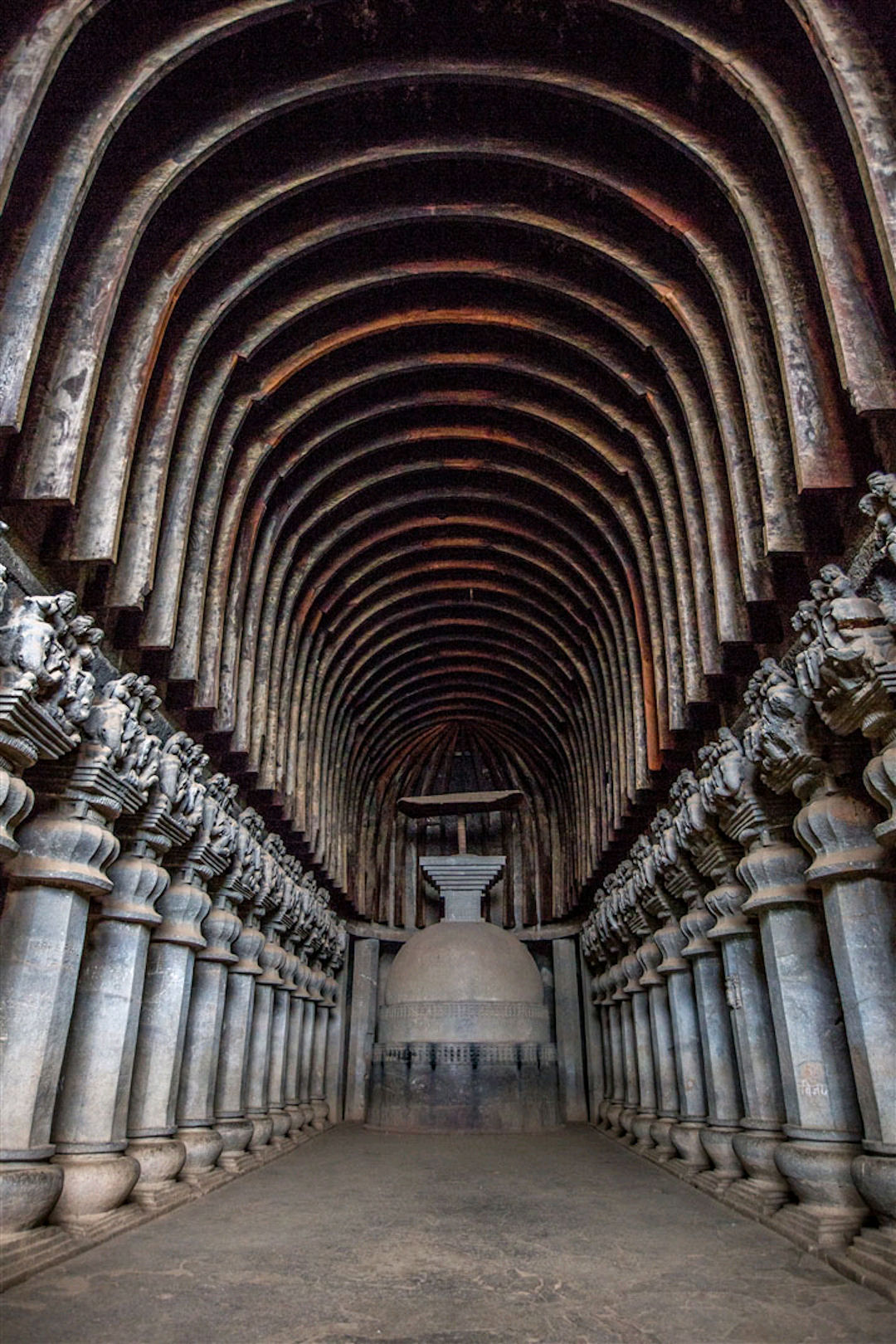
The chaitya follows the usual pattern for the period, but is unusually large. It is exceptional for preserving original elements in wood: the prominent lateral ribs and other roof timbers, and the umbrella over the stupa. The chaitya hall only survives in rock-cut examples, but these replicate in stone the form of examples in wood and thatch. In most rock-cut chaityas, the roof timbers are replicated in stone, to considerable visual effect, but in others actual timber was used, for purely aesthetic rather than structural reasons. In most of these cases the timber has long decayed away, as for example in the chaitya at Cave 3, Kanheri Caves. Here, although some were replaced under Lord Curzon in the 19th century, most are original.[24]

R. C. Majumdar quoting James Fergusson explains:

"It resembles an early Christian church in its arrangement; consisting of a nave and side-aisles terminating in an apse or semi-dome, round which the aisle is carried... Fifteen pillars on each side separate the nave from the aisle; each pillar has a tall base, an octagonal shaft, and richly ornamented capital, on the inner front of which kneel two elephants, each bearing two figures, generally a man and a woman, but sometimes two females, all very much better executed than such ornaments usually are; behind are horses and tigers, each bearing a single figure."[25]

Great Chaitya Cave at Karla[16]
General views

Great Chaitya Cave at the extreme right
It is certainly the largest as well as the most complete chaitya cave known in India, and was excavated at a time when the style was in its greatest purity. In it all the architectural defects of the previous examples are removed: the pillars of the nave are quite perpendicular. The screen is ornamented with sculpture -its first appearance apparently in such a position- and the style had reached a perfection that was never afterwards surpassed.[26]

The general dimensions of the interior are 124 ft. 3 in. from the entrance to the back wall, by 45 ft. 6 in. in width. The side-aisles, however, are quite narrow, the central one being 25 ft. 7 in., so that the others are only 10 ft. wide, including the thickness of the pillars. In height, however, Karla is only 45 ft. from the floor to the apex.[26]
In advance of the Chaitya stands the lion-pillar, in this instance a plain shaft with sixteen flutes, or rather faces, surmounted by a capital not unlike that at Kesariya, but at Karle supporting four lions instead of one. They seem almost certainly to have supported a chakra or Buddhist wheel. A similar pillar probably stood on the opposite side, but it had either fallen or been removed to make way for the little Hindu temple that now occupies its place.[26]

Veranda

Left veranda panel and portion of the entrance
The outer porch, or veranda, is considerably wider than the body of the building, being 52 ft. wide by 15 ft. deep, and is closed in front by a screen composed of two stout octagonal pillars, without either base or capital, supporting what is now a plain mass of rock, but which was once ornamented by a wooden gallery forming the principal ornament of the facade. Above this a dwarf colonnade or attic of four columns between pilasters admitted light to the great window, and this again was surmounted by a wooden cornice or ornament of some sort.[26]
Entrance

Panorama of the entrance
The entrance, consists of three doorways under a gallery, one leading to the center, and one to each of the side-aisles; and over the gallery the whole end of the hall is open, as in all chaitya halls, forming one great window, through which all the light is admitted. This great window is formed in the shape of a horseshoe, and exactly resembles those used as ornaments on the facade of this cave, as well as on those of Bhaja, Bedsa, and at Nasik, and which are met with everywhere at this age. Within the arch is a framework or centering of wood standing free. It is, like the ribs of the interior, coeval with the building.[26]

The sculpture on the screen wall between the doors is mostly of much later date than the cave itself. All the figures of Buddha there represented are of late date and belong to the Mahayana school: these decorative panels next to the main entrance have been dated to the 6th century CE.[27] The larger pairs of figures with Mithuna couples, however, are earlier and may be original. The later inscriptions are of the time of the Satavahana king Pulumavi.[26]

Hall

Hall of the Great Chaitya Cave at Karla (120 CE)

The interior is solemn and grand. An undivided volume of light coming through a single opening overhead at a very favorable angle, and falling directly on the dagoba or principal object in the building, leaving the rest in comparative obscurity. The effect is considerably heightened by the closely set thick columns that divide the aisles from the nave, as they suffice to prevent the boundary walls from ever being seen, and, as there are no openings in the walls, the view between the pillars is practically unlimited.[26]

Immediately under the semidome of the apse, and nearly where the altar stands in Christian churches, is placed the Dagoba, in this instance a plain dome, on a two-storeyed circular drum, the upper margins of each section being carved with rail ornaments. Just under the lower of these are holes or mortices for woodwork, which may have been adorned with hangings, which some of the sculptured representations would lead us to suppose was the usual mode of ornamenting these altars. It is surmounted by a capital or Tee, and on this still stand the remains of an umbrella in wood, somewhat decayed and distorted by age. This canopy was circular and minutely carved on the under surface.[26]

Fifteen pillars on each side separate the nave from the aisles; each pillar has a tall base, an octagonal shaft, and richly ornamented capital, on the inner front of which kneel two elephants, each bearing two figures, generally a man and a woman, but sometimes two females, all very much better executed than such ornaments usually are; behind are horses and tigers, each bearing a single figure. The seven pillars behind the altar are plain octagonal piers, without either base or capital, and the four under the entrance gallery differ considerably from those at the sides. The sculptures on the capitals supply the place usually occupied by frieze and cornice in Greek architecture; and in other examples plain painted surfaces occupy the same space.[26]
Above this springs the roof, semicircular in general section, but somewhat stilted at the sides, so as to make its height greater than the semi-diameter. It is ornamented even at this day by a series of wooden ribs, probably coeval with the excavation, which prove that the roof is not a copy of a masonry arch, but of some sort of timber construction.[26]

Main inscriptions

[edit]
Bhutapala
Bhutapala inscription
Great Chaitya inscription of Buthapala, on the left wall of the veranda, between the row of elephants and the multi-storied mansion.

An inscription on the left wall of the veranda, over the line of facing elephants and under the scultpture of a multi-storied building, mentions the completion of the "rock mansion" by a setthi (merchant) from Vaijayanti (Banavasi) named Bhutapala:

(This) rock-mansion, the most excellent in Jambudvipa, has been completed by the Setthi Bhutapala from Vaijayanti.

— Inscription 1 of Buthapala, Karla Caves.[30]

The "completion" of the "rock-mansion" mentioned by Bhutapala may only refer to the ornate sculptures of the veranda, specifically to the multi-storied mansion sculpted on top of the inscription, rather than the cave as a whole, since the various components of the Karla caves generally bear inscriptions by their individual donators.[15]

Yavana (Greek) donors
Left pillar No.9 of the Great Chatya. This pillar was donated by a Yavana circa 120 CE, like five other pillars. The inscription of this pillar reads: "Dhenukakata Yavanasa/ Yasavadhanana[m]/ thabo dana[m]" i.e. "(This) pillar (is) the gift of the Yavana Yasavadhana from Denukakata".[31] Below: detail of the word "Ya-va-na-sa" in old Brahmi script: .

There are also inscriptions by private donors, who contributed parts of the Great Chaitya, including self-described Yavana (Asiatic Greek or Indo-Greek)[32][33] donors, who donated six of the pillars, although their names are Buddhist names.[34] They account for nearly half of the known dedicatory inscriptions on the pillars of the Chaitya.[35]

  • 3rd pillar of the left row:
"(This) pillar (is) the gift of the Yavana Sihadhaya from Dhenukataka"[36][37]
  • 4th pillar of the left row:
"Of Dhamma, a Yavana from Dhenukakata"[38]
  • 9th pillar of the left row:
"(This) pillar (is) the gift of the Yavana Yasavadhana from Denukakata"[31]
  • 5th pillar of the right row:
"This pillar is the gift of the Yavana Vitasamghata from Umehanakata"[28]
  • 13th pillar of the right row:
"(This) pillar (is) the gift of the Yavana Dhamadhaya from Denukakata"[39]
  • 15th pillar of the right row:
"(This) pillar (is) the gift of the Yavana Chulayakha from Dhenukakata". Next to the inscription is a Buddhist Swastika.[40]

The city of Dhenukakata is thought to be Danahu near the city of Karli.[34] It is said by another donor in another inscription that it has a "vaniya-gama" (A community of merchants).[41]

The Yavanas are also known for their donation of a complete cave at the Nasik Caves (cave No.17), and for their donations with inscriptions at the Junnar caves.

Nahapana

An important dedicatory inscription relates to Nahapana on the lintel to the right of the entrance of the Great Chaitya (Valurak is thought to be an ancient name for Karla Caves):

Nahapana inscription
Great Chaitya inscription 13 of Nahapana, at the right of the main entrance.

Success!! By Usabhadata, the son of Dinaka and the son-in-law of the king, the Khaharata, the Kshatrapa Nahapana, who gave three hundred thousand cows, who made gifts of gold and a tirtha on the river Banasa, who gave to the Devas and Bramhanas sixteen villages, who at the pure tirtha Prabhasa gave eight wives to the Brahmanas, and who also fed annually a hundred thousand Brahmanas- there has been given the village of Karajika for the support of the ascetics living in the caves at Valuraka without any distinction of sect or origin, for all who would keep the varsha.

— Inscription 13 of Nahapana, Karla Caves, 120 CE.[42]

Sri Pulumayi
Vasishthiputra Pulumavi inscription
Karla inscription of Vasishthiputra Pulumavi, left of the main entrance

On the lintel to the left of the main entrance to the Great Chaitya, facing the inscription of Nahapana and posterior to it by a generation, there is also an inscription by Satavahana ruler Sri Pulumayi, that is, Vasishthiputra Pulumavi (130-159 CE):[43]

In the seventh year of the king Sri Pulamavi, son of Vasithi, in the fifth fortnight of summer, on the first day, on the above, by the Maharathi Somadeva son of Vasithi, the son of the Maharathi Mitradeva son of Kosiki, of the Okhalakiyas, there was given to the community of Valuraka, of the Valuraka caves, a village with its taxes ordinary and extraordinary, with its income fixed or proportional.

— Inscription 14 of Sri Pulumavi.[20][43]

Architectural parallels

[edit]
Karla Caves Chaitya pillars (left) compared to Nasik Caves Vihara No10 pillars (right), built by Ushavadata, son-in-law of Nahapana, circa 120 CE.

The pillars of the Chaitya at Karla are most similar to the pillars of Vihara No.10, at Nasik Caves, also built by Ushavadata, the son-in-law of Nahapana ("Ushavadata, son of Dinika, son-in- law of king Nahapana, the Kshaharata Kshatrapa, (...) has caused this cave to be made and these cisterns.").[44][45] The proportions and general layout are similar, as are the various architectural elements, including the shape of the bells, the framed toruses, the bases, the capitals and they supporting animals and human figures. These points to a contemporaneity of the Karla Chaitya and the Nahapana vihara at Nasik, circa 70-120 CE.[44]

On the contrary, the pillars of Nasik vihara No.3 built by the mother of Gautamiputra Satakarni circa 150 CE, depart from the elegant shapes and simplicity of the pillars at Karla and Vihara No.10. They are more similar to those of the Chaitya at Kanheri, built by Yajna Sri Satakarni circa 170 CE.[44]

Other Chaityas and Viharas

[edit]
View of the hermitages.
Another portion of the caves.

Within the complex are a great many other carved chaityas, as well as viharas, or dwelling places for the caves' monks. A notable feature of these caves is their arched entrances and vaulted interiors. Names of donors are inscribed on pillars in Brahmi script in these caves. The outside facade has intricate details carved into it in an imitation of finished wood. The central motif is a large horseshoe arch. There is an Ashokan pillar at the front, with a closed stone facade and torana in between.[2]

One of the Vihara cells bears an inscription of the Satavahana ruler Vasishthiputra Pulumavi (130-159 CE).[46]

Success!! On the second day of the third fortnight of winter in the twenty fourth year of King Sri Pulumavi, son of Vasithi, this pious gift of the lay worshiper Harapharana, son of Setapharana, a Sovasaka, living in Abulama, a nine-celled hall, has been given to the universal Sangha, as special property of the Mahasamghikas, in honor of his parents and securing the welfare and happiness of all beings. In the twenty first year it had been completed and ...... to me by Budharakhita and his mother ...., a lay worshipper. The ......a pious gift of Budharakhita's mother.

— Inscription of Vasishthiputra Pulumavi, Karla Caves Vihara.[47]

Influences

[edit]

Several Chaitya Caves were built in imitation of the Great Chaitya at Karla. This is especially the case of the Great Chaitya at Kanheri, in the northern suburb in Mumbai, probably built during the reign of Yajna Sri Satakarni (circa 150 CE).[48] According to Fergusson, it is certain that the plan of the Chaitya Cave at Kanheri is a literal copy of that at Karle, but the architectural details show exactly the same difference in style as is found between Cave 17 (period of Nahapana circa 115 CE) and Cave 3 (period of Sri Pulumavi, circa 170 CE) at the Nasik Caves.[48]

Some caves at Ajanta, such as Cave 19, built in the 5th century CE, were also modeled after the Karla Great Chaitya.[49]

Hindu temples, the first instances of which are known from the Gupta period in the 4th-5th century CE, seem to have borrowed influences from early Buddhist Chaitya Caves such as the Karla Chaitya, especially in the apsidial design, as seen in Durga temple in Aihole.[50]

Cave painting

[edit]
Only cave painting found at Karle Cave

In Great Chaitya cave, there is a painting on the top backside of 10th pillar right side of the entrance. One has to use mobile light to see the painting.

See also

[edit]

References

[edit]
[edit]
Revisions and contributorsEdit on WikipediaRead on Wikipedia
from Grokipedia
The Karla Caves, also known as Karle Caves or Karla Cells, are a complex of 16 ancient Buddhist rock-cut caves located at Karli near in , , approximately 60 km from and overlooking the Indrayani River. Excavated primarily between the 2nd century BCE and the 5th century CE, with some later activity extending to the 10th century CE, the site served as a major monastic center for the Mahasanghika branch of , featuring viharas for monks and chaityas for worship. The caves are renowned for their architectural sophistication, including intricate carvings of elephants, riders, and Buddhist motifs, and they highlight the site's role along ancient trade routes where donations from traders, monks, and kings supported their construction. The most prominent structure is Cave 8, the Great Chaitya, which stands as the largest rock-cut hall in , measuring approximately 38 meters in length, 14 meters in width, and 14 meters in height, with a plain monolithic dating to around the CE. This vaulted prayer hall exemplifies early Indian rock-cut engineering, complete with ribbed vaulting mimicking wooden architecture, ornate pillars featuring human and animal figures, and an arched entrance flanked by sculptures. Inscriptions within the caves, dating from the 2nd century BCE onward, record diverse patronage that underscores the economic vibrancy of the region, including maritime trade links to the Roman world. Beyond their Buddhist origins, the Karla Caves hold ongoing cultural significance as a pilgrimage site, with a Hindu to the goddess at the chaitya's entrance, reflecting syncretic religious practices that emerged after the decline of Buddhism in the area around the CE. Protected by the , the site attracts visitors for its historical depth and scenic hillside setting, offering insights into the evolution of South Asian religious architecture and monastic life.

Location and Historical Context

Location and Accessibility

The Karla Caves are situated approximately 10.9 kilometers west of in the of , , , at coordinates 18°47′N 73°28′E. Carved into the cliffs of the Sahyadri Mountains, the site lies along an ancient trade route connecting coastal ports such as to the inland . Nestled in a lush, forested region of the near the Mumbai-Pune Expressway, the caves are at an elevation of about 550 meters above sea level. This verdant environment enhances the site's appeal, with nearby attractions including the to the south and Bedsa Caves to the north, all part of a cluster of ancient rock-cut complexes in the Indrayani River valley. Access to the Karla Caves is straightforward by road, approximately 100 kilometers from and 60 kilometers from , via National Highway 48. Visitors park at the base and ascend roughly 300 uneven stone steps carved into the hillside, a climb taking 20-30 minutes depending on fitness levels. The site is open year-round from 9:00 a.m. to 5:00 p.m., managed by the , with entry fees of INR 25 for Indian citizens and INR 300 for foreign nationals; children under 15 enter free. The monsoon season (June to September) offers lush greenery but requires caution due to slippery paths during heavy rains. Modern facilities include ample parking at the foot of the hill for INR 50 per vehicle, restrooms, and small vendors selling refreshments along the approach path. The nearest railway station is (11 km away), with frequent local trains from and ; Malavli station (closer at 5 km) provides additional access via auto-rickshaws or taxis. The caves integrate seamlessly with Lonavala's tourism ecosystem, often combined with visits to nearby viewpoints and lakes.

Historical Development and Chronology

The Karla Caves complex underwent development from the BCE to the 5th century CE, reflecting the evolution of early Buddhist in . The oldest surviving elements, particularly facade components of the principal shrine (Cave 8), are dated to circa 160 BCE based on paleographic analysis of associated inscriptions and stylistic comparisons with contemporaneous sites like Bhaja and Bedsa. This initial phase featured rudimentary viharas and simple monastic cells, likely constructed to serve itinerant monks along ancient trade routes that connected the ports to the Deccan interior, fostering cultural and religious exchanges. Construction peaked during the 1st century BCE to 2nd century CE, coinciding with the Satavahana dynasty's influence (c. 230 BCE–220 CE), which supported expansive Buddhist activities through royal grants and merchant donations. Inscriptions from this era, such as those referencing donors like (c. 170–70 BCE) and Ushavadata (c. 120 CE), indicate sustained patronage that enabled the carving of larger assembly halls and refined architectural features mimicking wooden prototypes. Subsequent contributions under the (c. 35–405 CE) extended the site's growth into the 2nd century CE, though activity gradually waned by the 5th century CE as Mahayana Buddhism gained prominence in other regions, leading to a decline in new excavations. No major Buddhist construction occurred post-5th century CE, but the site maintained continuity into the medieval period through occasional reuse and local veneration. The caves were rediscovered and systematically documented in the during British colonial surveys, with pioneering work by James Fergusson, who published detailed descriptions and measurements in his 1880 volume The Cave Temples of India. Further explorations by the Archaeological Survey of Western India under James Burgess in the led to their formal protection as a centrally protected monument under the by the . Subsequent conservation efforts have focused on structural stabilization, with no significant archaeological updates reported after 2020.

Religious Affiliation and Patronage

Buddhist Sect and Significance

The Karla Caves are primarily associated with the school of , a that emphasized the transcendental nature of and played a key role in early Buddhist doctrinal developments. This affiliation is supported by the site's aniconic , which avoids direct representations of in human form, and the central role of worship, hallmarks of practices that focused on symbolic reverence for relics rather than idol worship. Inscriptions within the caves further indicate occupation by monks, particularly from the 2nd century BCE to the 5th century CE. The complex functioned as a vihara, or , providing residential cells and communal spaces for monks pursuing ascetic discipline and scriptural study. Religiously, the caves served as a vital hub for Buddhist communal and contemplative activities, accommodating meditation retreats, daily prayers, and gatherings for the . The Great Chaitya, the largest rock-cut prayer hall in , exemplified this by housing a prominent at its , around which devotees performed pradakshina () during rituals, fostering a sense of collective devotion and spiritual enlightenment. These spaces not only sustained monastic life but also supported the dissemination of teachings along ancient trade routes, bridging religious practice with societal outreach. Following the decline of Buddhism in the region around the medieval period, the site underwent a transformation with the construction of a Hindu temple dedicated to Ekveera Devi, a manifestation of Durga, directly in front of the main chaitya entrance. This shrine emerged after the caves were largely abandoned by Buddhist monks, repurposing the sacred landscape for Hindu worship while preserving the original structures. The temple remains a focal point for the local Koli fishing community, who conduct vibrant annual observances such as Navratri and the Ekvira Palkhi festival, drawing thousands for processions and rituals that honor the goddess as their kuladevi (clan deity). As an emblem of the Deccan Plateau's pioneering rock-cut Buddhist tradition, the Karla Caves highlight the integration of faith, art, and environment in ancient Indian spirituality, influencing subsequent monastic developments across . Today, the site embodies a layered , maintained as a protected Buddhist monument by the while coexisting with active Hindu veneration, attracting pilgrims and scholars alike to explore its enduring spiritual legacy.

Patrons and Donors

The construction and embellishment of the Karla Caves were primarily funded through voluntary donations by a diverse array of patrons, including local merchants, traders, and royal figures, reflecting the economic vibrancy of trade routes in ancient . Over 30 donor families are identified across the site's inscriptions, with contributions ranging from entire architectural elements to specific sculptures and land grants for the upkeep of the Buddhist monastic community. These donors hailed from regions such as (modern ), Dhenukataka (in Andhra), and Soparaka (Nala Sopara), indicating connections to maritime and overland trade networks that facilitated the flow of wealth to religious sites. Key among the early donors were Yavanas, or Indo-Greeks, who participated in the site's development during the 1st century CE, as evidenced by inscriptions recording their gifts of structural components like pillars. For instance, the Yavana merchant Sihadhaya from Dhenukataka donated a pillar in the Great , underscoring the cosmopolitan nature of patronage influenced by Hellenistic trading communities along the western coast. Local s and merchants also played a prominent role; the setthi (chief merchant) Bhutapala from , likely a leader of a builders' or artisans' , is credited with completing the chaitya's rock-cut mansion and its veranda sculptures, a major undertaking that highlights organized mercantile support. Royal patronage further bolstered the caves' maintenance, particularly through land endowments that ensured the sangha's sustenance. The Western Satrap ruler (c. 120 CE) indirectly supported the site via his son-in-law Usabhadata, who granted the village of Karajika, including its revenues, to the ascetics of the Valuraka (Veluraka) community residing at Karla, as recorded in a prominent inscription. Similarly, the Satavahana king (late 2nd century CE) emerged as a major benefactor, with his minister Maharathi Somadeva donating a village and its associated taxes to the same monastic group, affirming royal commitment to Buddhist institutions during a period of political consolidation. These donations were motivated by pious intentions to accrue punya (merit) and sustain the Buddhist , with no epigraphic evidence suggesting coerced labor or state mandates; instead, inscriptions emphasize personal and communal devotion, such as gifts by families like that of Mahadevanaka's mother Bhayila for pillars, or by religious figures like Sthavira Indradeva for decorative elements including elephants and railings. This pattern of voluntary, merit-seeking contributions from traders, guilds, and rulers not only enabled the caves' expansion but also mirrored the broader socio-economic prosperity of the Deccan under Satavahana and Kshatrapa rule.

Architectural Features

Great Chaitya Cave

The Great Chaitya Cave, also known as Cave 8, serves as the centerpiece of the Karla Caves complex, representing an exemplary achievement in early rock-cut . This apsidal prayer hall measures approximately 46 meters in length, 26 meters in width, and 18 meters in height, accommodating a central flanked by side aisles for around the at the end. The interior is supported by 37 octagonal pillars, each featuring pot-shaped capitals that enhance both structural integrity and aesthetic ornamentation. A defining feature of the facade is the prominent horseshoe-shaped chaitya window, rising over 10 meters high and allowing natural light to illuminate the hall while symbolizing the architectural transition from wood to stone forms. Inside, the ribbed barrel-vaulted ceiling emulates traditional wooden construction, with embedded timber beams—some dating to the 1st century CE—providing authenticity to the design and demonstrating the integration of perishable materials in enduring rock-cut spaces. The stupa at the far end, a hemispherical dome on a cylindrical base, stands as the focal point for devotional rituals, underscoring the cave's role as a communal worship space. Sculptural elements enrich the cave's interior and exterior, beginning with pairs of guardian elephants at the entrance that flank the doorway and evoke protective symbolism. On the pillars, yakshis— figures—appear alongside male counterparts, often depicted in graceful poses that blend decorative and motifs rooted in Buddhist . Decorative reliefs on the walls and arches feature yakshis, animals, and Buddhist motifs, carved with intricate detail. The , added in a later phase, features additional pillars topped with capitals, funded by monastic patrons, which extend the architectural grandeur and provide sheltered access. Excavated from a single rock face using chisels and hammers, the cave exemplifies peak rock-cut engineering techniques of the period, with precise tooling evident in the smooth surfaces and complex geometries. Dated to around 50-70 CE based on epigraphic and stylistic analysis, it reflects the height of Buddhist under regional rulers, showcasing advanced in monolithic to create vast, functional interiors without structural collapse.

Other Chaityas and Viharas

The Karla Caves complex consists of 16 excavated caves in total, including three designated as Caves 8, 9, and 10, alongside 13 viharas primarily intended for monastic residence. Caves 1 through 7 function as early viharas, each equipped with individual cells for monks, reflecting the site's initial development as a residential . Cave 9 serves as a smaller from the BCE, characterized by a simpler and minimal ornamentation compared to later structures. It features two pilasters supporting octagonal pillars and six windows adorned with rosettes, providing a basic space for worship and . Cave 10 remains an incomplete , with only four lion-based pillars roughly blocked out and a large unfinished recess at the rear, suggesting construction was halted midway. These secondary highlight variations in scale and execution within the complex. The viharas, such as Cave 4, emphasize for daily monastic life, incorporating assembly halls with raised platforms and multiple cells—typically four per side—along with rock-cut benches and doorways fitted with pivot hinges for secure closure. These spaces supported residential and communal activities, including teaching and rest, while the broader site operated as a self-sustaining through via carved cisterns that collected and stored water from the hillside. Earlier caves predating the 1st century BCE display rudimentary forms, with plain cells and minimal structural elaboration, whereas later viharas exhibit refined pillar designs, including octagonal shafts with bracket capitals and motifs like lotus carvings. The entire excavation process required removing thousands of cubic meters of rock, underscoring the labor-intensive rock-cut techniques employed over centuries.

Inscriptions and Epigraphy

Main Inscriptions

The Karla Caves contain 22 inscriptions, predominantly in using the , with some influences, situated on pillars, walls, facades, doors, and friezes across the complex, spanning from the 2nd century BCE to the 2nd century CE. These epigraphic records document donations to the Buddhist monastic , reflecting from merchants, officials, and rulers during the phase. The inscriptions exhibit an evolution in script from early Mauryan-style Brahmi in the oldest examples to more developed Brahmi forms in later ones, with occasional elements appearing in inscriptions from the 2nd century CE onward; the absence of script aligns with the regional Deccan epigraphic tradition. Physically, they are incised or deeply engraved into the rock, ranging in length from short single-line dedications to longer multi-verse compositions of up to five lines; many remain well-preserved on smooth surfaces, though some show damage from weathering, peeling, or partial erosion, particularly those exposed on verandahs and outer walls. Symbols such as trishulas, wheels, and Buddhist motifs occasionally accompany the text, enhancing their context. A newly discovered inscription in the Chaitya Cave, reported in 2020, mentions Dhenukākaṭa and donations by female devotees, in . Prominent among these are donations by Yavana (Indo-Greek) merchants, such as inscription No. 7 on a pillar in the (Cave 8), where Sihadhaya from Dhenukakata records gifting a pillar to the . Similarly, inscription No. 10 nearby details another pillar by a Yavana from the same region, underscoring foreign mercantile involvement in the ' construction. A key royal example is the Nahapana grant inscription (No. 19) on the above the entrance to the , dated to years 41–42 (c. 120 CE), where Usabhadata—son-in-law of the Western Kshatrapa ruler —enumerates gifts including the village of Kurajika, cisterns, and excavations to the Mahasanghika monks. Another notable record is Pulumavi's village (No. 20) on a pillar of the , inscribed in year 24 of the Satavahana king Vasishthiputra Pulumavi's reign (c. 154 CE), presented by the donor Harapharana as a meritorious act for the . For clarity, the following table summarizes these and select other representative inscriptions:
Inscription No.LocationDonor/Key FigureDate (Approx.)Content SummaryLanguage/Script
1Verandah, Great Sethi Bhutapala2nd century BCEDedication of a rock-mansion ()/Brahmi
7Pillar, Great (Cave 8)Sihadhaya (Yavana)1st century BCE–1st century CEGift of a pillar/Brahmi
10Pillar, Great (Cave 8)Yavana from Dhenukakata1st century BCE–1st century CEGift of a pillar/Brahmi
19, Great entranceUsabhadata (for )c. 120 CE (Saka 41–42)Grants of village, cisterns, /Brahmi
20Veranda pillar, Great Harapharana (under Pulumavi)c. 154 CE (year 24)Village donation to /Brahmi
These examples illustrate the inscriptions' role in cataloging diverse contributions, from individual pillars to communal facilities.

Interpretations and Insights

The inscriptions at the Karla Caves offer valuable socio-economic insights into ancient Western India's networks and organizational structures. They reveal active involvement of merchants in commodities such as and , facilitated through ports like Bharukaccha and Sopara, which connected coastal routes to inland markets. Guilds, known as senis or negamas, including (kolikanikayasenis) and oil-pressers (tilapisakasenis), played a central role, with of their investments yielding interest rates of 9-12% to support communal activities. Urban-rural linkages are evident in village grants, such as the donation of Karajaka village by the Western Usavadata, which ensured the monastery's sustenance through agricultural revenues. Cultural exchanges are highlighted by the integration of Yavanas—Indo-Greeks and later Indo-Romans—into Buddhist patronage, as seen in donations of pillars by individuals like Sinhadhaya and Dhamma from Dhenukakataka around AD 50. These contributions reflect economic prosperity from maritime trade and cultural fusion, evident in architectural motifs like Persepolitan pillars and triskelions at the site. The inscriptions also illuminate political dynamics between the Satavahanas and , including Nahapana's village grant around AD 120 and later abrogations by , alongside matrimonial alliances that influenced regional patronage. Religiously, the texts underscore donations aimed at worship and accruing merit (punnakamma), with grants supporting the Mahasamghika sect's chaityas and viharas. Insights into the monastic emerge from endowments like 70,000 karshapanas and revenues, often derived from trade-related investments, ensuring upkeep during the rainy retreat (). Scholarly debates center on the precise dating of inscriptions, with proposals ranging from (based on ) to AD 50-70 (via paleography), complicated by radiocarbon evidence suggesting 100-80 BC for the Great . These texts contribute to understanding paleography's evolution, spanning series from early Brahmi forms (c. 200 BC, with head-marks and squarish letters) to mature variants (late 3rd century AD), aiding regional script chronology.

Art, Influences, and Legacy

Sculptures and Cave Paintings

The sculptures at the Karla Caves primarily feature aniconic representations of , such as empty thrones, footprints, and wheels, reflecting early Buddhist avoidance of direct anthropomorphic depictions during the phase. Yakshas and yakshinis adorn the pillars and facades, symbolizing abundance, fertility, and protection as nature spirits integrated into Buddhist . and lions serve as guardian motifs, carved in high relief to evoke strength and royal authority, often flanking entrances and architectural elements. Remnants of cave paintings survive in faded form within Cave 8 and several viharas, depicting scenes from —narratives of the Buddha's previous lives—and lotus motifs symbolizing purity and enlightenment. These murals, executed in tempera technique on reinforced with organic additives like rice husks and plant fibers, date to the 2nd century BCE and employ pigments in red, yellow, and green derived from minerals and organics. Carvings are executed in high relief directly from the monolithic rock using chisels and hammers, creating a sense of depth and movement. Preservation faces challenges from high humidity in the , which promotes salt and deterioration, alongside historical that has damaged surfaces. Notable examples include mithuna couples—amorous donor pairs—carved on the of the Great (Cave 8), portraying vitality and lay patronage in robust, intertwined forms from the 2nd century CE.

Architectural Parallels and Influences

The Karla Caves exhibit strong architectural parallels with nearby sites in the , particularly the , which served as earlier wooden prototypes influencing Karla's rock-cut forms. Both complexes feature vault-roofed halls with apsidal plans, octagonal pillars, and emulation of timber elements like ribs and rafters, all excavated from Deccan trap to create monastic assemblies and shrines. The ' open-fronted designs and decorative facades prefigure Karla's more enclosed structures, highlighting a regional evolution from rudimentary wooden-inspired excavations around 90 BCE to Karla's refined versions circa 60 BCE. Contemporary similarities are evident with the Bedsa Caves, where shared features include Type D pillars with bell-shaped capitals, narrow circumambulatory paths, and multi-storeyed verandahs, all reflecting the Satavahana imperial style prevalent in Deccan . Bedsa's halls, dated to approximately 60 BCE, mirror Karla's in their use of stone screens to frame entrances and protect interiors, underscoring a common technique for integrating assembly spaces with symbolic stupas amid trade-route proximity. This shared excavation style across Bhaja, Bedsa, and Karla emphasizes a localized tradition of horizontal tunneling into cliffs to form viharas and , adapting to the rugged terrain for monastic seclusion. Broader influences on Karla's design stem from wooden architecture emulated at coastal ports, where perishable timber structures inspired durable stone imitations, including ribbed vaults in the Great Chaitya Cave that mimic beam-and-rafter roofs. Indo-Greek elements appear in the column capitals, with pot-shaped bases and ridge motifs derived from Hellenistic and Persepolitan styles, as evidenced by Yavana donor inscriptions from Dhenukakata funding pillar constructions. Chronologically, Karla precedes the Kanheri Caves in sophistication, with its 1st-century BCE halls evolving from Nasik's Satavahana prototypes toward Ajanta's more ornate facades by incorporating transitional features like flat-roofed aisles and decorative arches. Karla's legacy shaped later rock-cut traditions, influencing Ellora and Elephanta through the adoption of multi-level chaitya-vihara complexes and screen-wall techniques, blending indigenous Deccan motifs with foreign-inspired elements like hour-glass pilasters without direct replication. This unique synthesis, seen in Satavahana-era donations, facilitated the shift to forms by the 4th century CE, extending the horizontal excavation model across Maharashtra's cave sites.

References

Add your contribution
Related Hubs
Contribute something
User Avatar
No comments yet.