Hubbry Logo
DisneyQuestDisneyQuestMain
Open search
DisneyQuest
Community hub
DisneyQuest
logo
8 pages, 0 posts
0 subscribers
Be the first to start a discussion here.
DisneyQuest
DisneyQuest
from Wikipedia

Key Information

DisneyQuest was a chain of indoor interactive theme parks in the United States operated by the Disney Regional Entertainment subsidiary of Walt Disney Parks and Resorts.

The DisneyQuest project was designed as a way for the Disney brand to reach populations that may not have the chance to travel to its various theme park destinations.[5] It was meant to target large cities and urban areas. Had the project continued, Disney would have constructed locations in many major cities in the United States, like Philadelphia and Baltimore. However, only two locations were built; one in Walt Disney World from June 19, 1998 to July 2, 2017 and a much shorter-lived one in Chicago from June 16, 1999 to September 3, 2001.[6]

History

[edit]

DisneyQuest first opened on June 19, 1998, as part of a major expansion of the Downtown Disney entertainment district (today Disney Springs) at Downtown Disney West Side, and was intended as the first of a larger chain of similar facilities.[1]

The first DisneyQuest outside of a resort was opened in Chicago on June 16, 1999, with plans for more locations worldwide.[2] The Chicago location was in a development, North Bridge, where ESPN Zone, a fellow Disney Regional chain, opened about a month later.[7]

On December 9, 1998, Disney Regional announced Philadelphia as a new location as a tenant of the Pavilion at Market East project developed by Goldenberg Group on the former location of a Gimbels Department Store.[6]

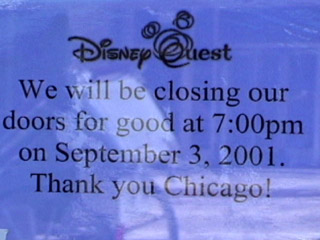
The Chicago location permanently closed on September 3, 2001, after 2 years and 3 months of operating due to low visitor numbers as well as other, broader issues. While the location was generating income, it was not enough for Disney.[3]

After the failure of DisneyQuest Chicago, the DisneyQuest project was officially brought to an end. Construction that had begun for DisneyQuest Philadelphia was scrapped in April 2000[8], leaving a giant hole in its place for several years; the hole has since been filled and the space later became a parking lot.[9] A DisneyQuest at the Disneyland Resort in California never proceeded past the planning stage. After the closure of the Chicago location, Disney Regional Entertainment turned over control of the remaining location to Walt Disney World operations.[5]

On June 30, 2015, Disney officials announced that the Walt Disney World location would close in 2016 as part of the continued redevelopment of Downtown Disney into Disney Springs.[10] A spokesperson for the labor unions that represent Disney employees who work at DisneyQuest stated that displaced workers will be relocated to other positions. The property was set to be redeveloped into a new attraction themed to the NBA after they left their previous location at Universal CityWalk.[11] In November 2016, Disney officials announced that DisneyQuest would remain open for the remainder of the year and into 2017, with no definitive closing date. They further stated that they had no update on the status of the NBA attraction other than it was still planned for the site.[11] On January 30, 2017, the Disney Parks announced that DisneyQuest would close after July 2, 2017, so work on the NBA Experience attraction could begin.[12] DisneyQuest's final day of operation was on July 2, 2017, and was demolished a few months later.[4]

Its replacement, the NBA Experience, officially opened on August 12, 2019. However, due to the COVID-19 pandemic, the venue closed in March 2020, and all guest actors were laid off in October the same year. On August 16, 2021, Disney announced that the venue would not reopen.[13] On February 19, 2025, it was reported that Level99, an escape room attraction, would replace the NBA Experience.[14]

Former attractions

[edit]
Name Opened Closed Description
Aladdin's Magic Carpet Ride 1998 2017 A VR attraction where attendees wear a head-mounted display that simulates a magic carpet through Agrabah. Players collect gems to find The Genie, who has been hidden away in the Cave of Wonders.
The attraction was previously featured at Innoventions West at Epcot between 1994 and 1997, initially as part of the Walt Disney Imagineering Labs exhibit.
Animation Academy 1998 2017 Regular sessions throughout the day teach how to draw Disney characters, step by step. In this version of the attraction, attendees draw characters on computer screens using lightpens, and can purchase a printout of their creation afterward.
Buzz Lightyear's AstroBlaster 1998 2017 Modified Bumper Car attraction, similar to that of Sega's "Mad Bazooka" ride system. Attendees board bumper cars and attempt to navigate over foam balls, called asteroids on the floor. By doing so, the asteroids will be sucked up into the cabin where players can then load them into a cannon and shoot at the other cars. If hit in the correct spot, one's car may spin around uncontrollably for ten seconds. Usually, there are two players in a car; however, it is possible for one person can pilot and shoot at the same time.
CyberSpace Mountain 1998 2017 Attendees design a roller coaster on a design kiosk, and then they sit in the pitch-and-roll motion simulators and ride it. Guests may also ride pre-built coasters. It is hosted by Bill Nye the Science Guy, who instead refers to himself as "Bill Nye the Coaster Guy". This attraction is based on the ride Space Mountain.
Invasion! An ExtraTERRORestrial Alien Encounter 1998 2017 A 3D shooting attraction based on the former Magic Kingdom attraction, ExtraTERRORestrial Alien Encounter; with actor Jeffrey Jones reprised his role as Chairman Clench. In the attraction, attendees ride inside a rescue vehicle to save astronauts: one player drives, and the other three shoot enemy aliens.
Living Easels 1998 2017 An interactive touch screen program where guests can place various images onto several selectable backgrounds. A full-color printout of a guest's design may be purchased.
Mighty Ducks Pinball Slam 1998 2017 A virtual projected pinball-type game where the attendees become the pinball.[15] by rocking their "duck" back and forth, up to twelve players at a time control their corresponding pinball on the screen, attempting to collect the most points.
Pirates of the Caribbean: Battle for Buccaneer Gold 2000 2017 Arcade shooter attraction with 3D projections where attendees man a pirate ship and destroy other ships, sea monsters, and fortresses to collect gold. One player captains the ship by steering and controlling the throttle, while up to four gunners control the cannons to destroy other ships.
Radio Disney Song Maker 1998 2017 Guests can create their own song and buy it on a CD later during their visit.
Sid's Create-a-Toy 1998 2017 A program featuring the antagonist from Toy Story that allows one to custom design a toy out of parts of other toys, later making it available for purchase.
Virtual Jungle Cruise 1998 2017 Guests paddle an inflatable raft (with real paddles) as they make their way down a prehistoric river, avoiding dinosaurs and occasionally getting sprayed with water. It is based on the ride Jungle Cruise.

Prior to final closure

[edit]
Name Opened Closed Description
Cave of Wonders Slide 1998 1999 A 150-foot (46m) long spiral slide that took guests from the third floor to the first. It was closed in DisneyQuest's first year of operation.
Hercules in the Underworld 1998 2000 Six guests would each control their own character from Disney's Hercules with a joystick. The object of the game was to collect lightning bolts and defeat Hades. This attraction was replaced with "Pirates of the Caribbean: Battle for Buccaneer Gold".
Magic Mirrors 1998 2005 Guests could take a picture of themselves and then edit their faces to appear like cartoons. The attraction closed in 2005 and was later converted to seating.
Ride the Comix 1998 2014 VR attraction where guests board a spaceship, wear a VR headset, and "enter the comic book world" where they battle with supervillains by using a laser sword. The art for the game was designed by Wildstorm artist Travis Charest. Up to six players can be on a team at a time. The attraction appeared on both the fourth and fifth floors, with two ships each. Beginning in early 2011, Ride the Comix 4 was "overtaken by villains" and in service only on days when the building was near capacity. However, guests were still able to play this game on the fifth floor directly above. On September 7, 2014, the attraction closed to make way for additional seating at the FoodQuest quick-service restaurant.
Treasure of the Incas 1998 2007 Players drive small remote-controlled toy trucks through a maze in search of treasure. Along a wall were stations with a steering wheel and a video screen by which to drive the truck; the floor of the room was clear plastic through which friends could see the trucks driving around so that they could shout directions to the driver. This attraction was plagued by interference from emerging technologies such as cell phones and was finally closed after one of the vehicles caught fire. The clear flooring and mazes could still be seen near the Virtual Jungle Cruise area, adjacent to the Safari hunting games until 2007 when the floor was recovered and new games moved to the area. This area was now entirely jungle-themed and is home to several Let's Go Jungle!: Lost on the Island of Spice arcade machines.
Virtual Pirates of the Caribbean 1998 2000 Projection screen-focused shooter attraction. After closure, the ride concept was reused for "Battle for Buccanner Gold".

All the redemption games were removed from the facility in January 2015 as a cautionary measure, in response to a state law that Disney believed made the games illegal under certain circumstances.[16]

When DisneyQuest closed on July 2, 2017, the remaining arcade games (including the Fix-It Felix Jr. arcade games from Wreck-It Ralph) were removed, and most of them were sold or put into storage.[citation needed]

See also

[edit]

References

[edit]

Further reading

[edit]
Revisions and contributorsEdit on WikipediaRead on Wikipedia
from Grokipedia
DisneyQuest was a chain of indoor interactive theme parks operated by through its Disney Regional Entertainment division, specializing in simulations, immersive video games, and creative digital experiences designed to blend Disney storytelling with cutting-edge technology of the late . The flagship location, a five-story, 100,000-square-foot facility, opened on June 19, 1998, in the West Side of (later rebranded as ) at Resort in , as part of an expansion to attract urban-style entertainment to the resort area. It was structured around four themed zones—Explore, Score, Create, and Replay—connected by a central "Ventureport" hub, where visitors purchased electronic cards loaded with "play credits" to access attractions without traditional tokens. The Explore Zone focused on adventurous virtual simulations, including : Battle for Buccaneer Gold, a multiplayer boat ride where groups navigated treacherous seas using laser cannons to battle enemies, and , a raft-based shooter set in a prehistoric river. The Score Zone emphasized competitive gaming with oversized arcade setups like Pinball Slam, a pinball machine where players physically bumped goals, alongside contemporary video games. In the Create Zone, guests engaged in artistic and design activities, such as the for drawing Disney characters or CyberSpace Mountain, where users built custom roller coasters on computers and then "rode" them in motion simulators with adjustable intensity levels. The Replay Zone offered nostalgic and playful elements, highlighted by Buzz Lightyear's AstroBlaster, equipped with projectile launchers for space-themed battles. Additional amenities included dining options like the FoodQuest cafe, serving themed meals, and an elevator narrated by a character for thematic transport between floors. Admission prices started at around $40 per person in 1998, with credits allowing multiple plays, though the venue required ongoing maintenance for its pioneering VR and projection systems. A second DisneyQuest opened on June 16, 1999, at 55 E. Ohio Street in Chicago, Illinois, replicating the Orlando model to test urban expansion, but it closed on September 4, 2001, after just over two years due to low attendance amid economic challenges. Plans for additional sites in cities like and were canceled, leaving the Orlando venue as the sole survivor, which ran for nearly 19 years until its announced closure on January 30, 2017, effective July 2, 2017, to accommodate the NBA Experience (which operated 2019–2020 before closing; as of 2025, the site is being redeveloped into Level99, an interactive gaming venue). The park's legacy lies in its early adoption of interactive tech, such as and motion platforms, which foreshadowed modern VR but became outdated as home gaming advanced, leading to high operational costs and frequent repairs. Despite criticisms of cheesiness in later years, it drew millions for its innovative fusion of and digital play.

History and Development

Conception and Planning

In the mid-1990s, Disney Regional Entertainment (DRE), a division of established in 1996, spearheaded the development of innovative, urban-oriented entertainment experiences aimed at broadening the reach of Disney's brand beyond traditional theme park destinations. DRE sought to capitalize on the growing popularity of interactive, -driven leisure options in city centers, where families and younger demographics could access Disney-themed activities without extensive travel. This initiative reflected Disney's strategic pivot toward regional entertainment concepts, including play centers and high-tech arcades, to tap into untapped markets in major metropolitan areas. DisneyQuest emerged from this vision as a groundbreaking "virtual theme park," designed to immerse visitors in interactive experiences blending (VR), digital gaming, and beloved Disney intellectual properties (IP) like characters from Peter Pan and . The concept emphasized hands-on interactivity to appeal to non-traditional theme park audiences, such as urban teens and tech-savvy families, by simulating adventures like virtual battles against or custom designs within a multi-story indoor environment. Key figures from , including computer science experts like , played pivotal roles in conceptualizing and prototyping these attractions. Planning for DisneyQuest envisioned a network of locations across the , with Orlando selected as the inaugural flagship to anchor the project within the expanding district (later rebranded as ). Site selection in this high-traffic entertainment zone was strategic, leveraging proximity to Resort to test the concept while drawing local and tourist visitors. Technologically, the project laid foundations through collaborations with leading firms, including , which provided high-performance hardware like Onyx2 machines to power VR simulations starting in 1997 and 1998. These partnerships enabled the integration of cutting-edge VR software and hardware, positioning DisneyQuest as a pioneer in location-based entertainment.

Openings and Initial Operations

DisneyQuest's Orlando location debuted on June 19, 1998, as the flagship of Disney's ambitious indoor theme park initiative within the expanding entertainment district. The five-story, windowless structure spanned 100,000 square feet and was positioned as a cutting-edge destination for and interactive entertainment. The opening aligned with Disney's broader strategy to diversify beyond traditional outdoor parks, drawing immediate attention from local media and guests eager to explore the novel high-tech offerings. Initial admission pricing for the Orlando site was set at $32 for adults and $26 for children aged 3 to 9, granting unlimited access to all throughout the day. Daily operations commenced at 11:30 a.m. and extended until 11 p.m. on weekdays, with extended hours to midnight on weekends, accommodating peak evening crowds. Capacity was strictly managed to around 3,800 guests at any time within the facility to maintain smooth flow and prevent overcrowding at interactive stations. Staff underwent specialized training to guide visitors through the complex systems and multiplayer games, ensuring safe and engaging experiences. Marketing efforts leveraged Disney's extensive promotional channels, including television spots and print ads, to build buzz and drive early visitation. The location followed on June 16, 1999, marking the first DisneyQuest outside a property and located in a renovated 19th-century building at 55 E. Street, at the corner of and Rush Streets. The featured a festive spectacle, complete with displays and dramatic zipline entrances by Disney characters such as , underscoring the venue's emphasis on immersive, adventurous fun. Admission pricing mirrored the Orlando model at $32 for adults and $26 for children, with multi-attraction passes available for extended play. Like its counterpart, the Chicago facility covered 100,000 square feet and adhered to similar operational hours from 11:30 a.m. to 11 p.m., with capacity controls and staff trained on the interactive technologies to facilitate guest navigation. From 1998 until the Chicago site's closure in 2001, both locations fell under the management of Disney Regional Entertainment, a subsidiary focused on developing non-resort entertainment ventures, which handled daily operations, maintenance of the high-tech infrastructure, and promotional activities. Following the Chicago closure, the Orlando site continued under DRE until the division's dissolution in 2010, at which point operational responsibility shifted to Walt Disney Parks and Resorts, integrating it more closely with the broader ecosystem.

Expansion Attempts and Challenges

Following the successful launch of the Orlando location, Disney pursued expansion to establish DisneyQuest as a national chain of urban entertainment venues. In December 1998, the company announced plans for a DisneyQuest site in downtown , near historic landmarks like the , as part of a broader strategy to open 20 to 30 centers domestically and internationally. By 1999, Disney revealed intentions for additional sites, including one in slated for 2001, supported by feasibility assessments and conceptual architectural designs. The venue, opened in June 1999 within the North Bridge development, functioned as an early testbed for adapting the concept to dense urban settings outside resort areas. These efforts reflected initial optimism from the project's conception, aiming to extend Disney's theme park experiences to non-vacation markets. However, the failure of the location due to low attendance led DRE to scale back the expansion, officially ending the DisneyQuest chain concept by 2001 and canceling further sites. However, expansion faced mounting operational hurdles that undermined viability. High maintenance expenses for virtual reality hardware, with individual systems costing hundreds of thousands of dollars, strained budgets due to the technology's complexity and need for constant upkeep. Frequent equipment malfunctions further exacerbated costs, as the cutting-edge VR setups from the late proved unreliable under heavy public use. Intensifying competition from affordable home gaming consoles, such as the PlayStation, diminished the appeal of on-site experiences, as consumers increasingly accessed advanced and multiplayer features at home. To counter these issues, implemented software refreshes in the early and integrated promotional elements tied to recent Disney films, aiming to refresh content and boost attendance. Despite these measures, the core novelty of the VR attractions waned by the mid-, as rapid technological evolution outpaced updates and shifted entertainment preferences toward portable and digital alternatives. Financial disparities highlighted the challenges: while the Orlando site sustained profitability through high tourist traffic, the Chicago location reported poor results, accruing significant annual losses that prompted its closure in 2001. These outcomes stalled further rollouts, limiting the chain to just two operational venues.

Locations and Facilities

Chicago Location

DisneyQuest Chicago, the first urban outpost of the interactive theme park concept, opened on June 16, 1999, at 55 E. Ohio Street in the North Bridge development near Rush Street in downtown . The facility spanned 90,000 square feet across five stories, featuring interactive zones with rides, motion simulators, and creative stations designed to immerse visitors in Disney-themed experiences. Unlike the resort-integrated Orlando location, Chicago's DisneyQuest was built to blend into the , emphasizing walk-in accessibility for local residents and conventioneers rather than relying on vacation traffic. The venue targeted Chicago's 40 million annual travelers and urban population, adapting the original concept for a non-tourist setting with easy public transit access and promotions aimed at city dwellers. It operated for just over two years, closing on September 4, 2001, due to low attendance and poor financial performance that failed to justify ongoing technology investments. In contrast to the Orlando site's nearly two-decade run, Chicago's outpost struggled to draw sufficient crowds in its competitive downtown environment. Following closure, the building was repurposed for retail and office space, with much of the former DisneyQuest area converted into a furniture store by Room & Board, retaining no original Disney elements or attractions. The site now forms part of the ongoing North Bridge shopping and entertainment complex.

Orlando Location

The Orlando DisneyQuest facility served as the flagship location for the interactive theme park concept, housed in a five-story, 100,000-square-foot windowless building in the West Side district of Downtown Disney—later rebranded as Disney Springs—at Walt Disney World Resort in Lake Buena Vista, Florida. This structure was designed to blend seamlessly into the broader Walt Disney World entertainment complex, enhancing the district's appeal as a hub for shopping, dining, and live performances. The entrance featured distinctive theming as a virtual "portal" called Ventureport, where guests entered a lobby on the ground floor and were elevated to the third-floor atrium to begin their experience, evoking a sense of stepping into a digital realm. Positioned in close proximity to the theater, which hosted the resident show during DisneyQuest's run, the site contributed to the West Side's vibrant, performance-oriented atmosphere within the overall entertainment district. Inside, the multi-level layout spanned five floors organized around themed zones—Explore for adventure simulations, Score for competitive challenges, Create for artistic builds, and Replay for classic arcade games—with the ground floor primarily handling ticketing, entry, and introductory interactive stations to manage guest flow efficiently. This design allowed for vertical exploration via stairs and elevators, accommodating varying crowd levels in a resort-integrated environment that contrasted with the more urban, standalone model of the site. Operational from its opening on June 19, 1998, until its final day on July 2, 2017, the facility ran for 19 years, drawing consistent visitors as part of the ecosystem. Unique on-site amenities included the fifth-floor FoodQuest quick-service dining area, offering casual meals like pizzas and salads in a themed setting, alongside merchandise shops stocked with attraction-inspired souvenirs such as accessories and branded apparel. Following the 2017 closure, the building was repurposed as the NBA Experience, which operated from August 2019 to March 2020 before closing due to the and low attendance. The site remained vacant until 2025, when announced its transformation into a Level99 entertainment venue featuring multi-level challenge rooms for team-based games. As of November 2025, construction is underway, with the attraction expected to open in the near future.

Attractions and Experiences

Virtual Reality Rides

DisneyQuest featured several pioneering rides that immersed guests in simulated environments using head-mounted displays (HMDs), motion platforms, and interactive controls, marking some of the earliest large-scale applications of VR in theme park . These attractions, developed by Walt Disney Imagineering's VR Studio, combined physical sensations with digital visuals to create dynamic experiences, often accommodating multiple participants in shared or competitive . The rides emphasized exploration, adventure, and skill-based challenges, drawing from Disney's intellectual properties while pushing the boundaries of technology. Aladdin’s Ride allowed guests to pilot a virtual through the streets of Agrabah and into the of Wonders, collecting glowing gems to free the from captivity. Participants sat on a stationary platform resembling a carpet, gripping handlebars for steering, while wearing bulky HMDs that delivered a first-person perspective at 60 frames per second. The experience incorporated motion simulation to mimic , including banking turns and dives, and was originally prototyped in as part of Disney's early VR experiments before its full integration into DisneyQuest in 1998. CyberSpace Mountain enabled riders to customize their own roller coasters using touch-screen kiosks, selecting track layouts, speeds, and themes with guidance from host . Once designed, groups of up to four boarded pitch-and-roll motion simulators, donning HMDs to experience the virtual coaster with simulated G-forces and immersive 3D visuals of loops, drops, and inversions. Introduced in 1998, the ride highlighted in VR, though options were limited to predefined elements to ensure safe simulation parameters. Pirates of the Caribbean: Battle for Buccaneer Gold transformed guests into buccaneers navigating treacherous seas in a shared , battling enemy ships for . Up to five players crewed a physical with a steering wheel and four functional cannons, wearing HMDs to view a 360-degree seascape projected in real-time based on collective actions; one participant steered while others aimed and fired, scoring points for defeated foes and collected gold. Launched in 2000, it was praised for its seamless blend of physical and virtual elements, earning acclaim as one of the most effective VR entertainment applications of its era. Virtual Jungle Cruise offered a group paddling adventure down a prehistoric river teeming with CGI dinosaurs and hazards, inspired by the classic attraction. Teams of up to eight guests maneuvered an inflatable raft on a motion platform using real oars that registered steering inputs, facing projected threats like charging raptors and erupting geysers on a large forward-facing screen enhanced by water effects and vibrations. Debuting in , the ride emphasized navigation in a simulated environment, though it relied more on than individual HMDs for its immersive quality. The VR rides at DisneyQuest utilized cutting-edge hardware from the mid-1990s, including heavy HMDs suspended from ceilings to counter their weight—often exceeding several pounds—and powered by high-end (SGI) computers for rendering complex 3D graphics in real-time. Motion platforms from vendors like Kinetix provided multi-axis , while audio cues via integrated enhanced spatial awareness; systems were sporadically upgraded through the 2000s, but core tech dated to prototypes like the 1993 DisneyVision headset. These setups, though innovative, faced challenges like user discomfort from prolonged wear and high maintenance costs, reflecting the nascent state of consumer VR at the time.

Interactive Games and Creative Stations

The Interactive Games and Creative Stations at DisneyQuest provided guests with hands-on, participatory experiences that emphasized physical interaction and artistic expression, distinct from more immersive virtual simulations. These were housed primarily in the Replay Zone and Create Zone on the lower floors, encouraging collaborative play and creativity through Disney-themed mechanics. One of the most popular interactive games was Buzz Lightyear’s AstroBlaster, a Toy Story-themed bumper car arena where participants piloted spaceship vehicles equipped with cannons that fired foam balls at opponents. Riders could score points by hitting targets while maneuvering to avoid incoming projectiles, causing rival cars to spin out of control; the attraction required participants to be at least 51 inches tall to drive, with shorter guests able to ride as passengers. Invasion! An ExtraTERRORestrial Alien Encounter offered a team-based 3D shooting game where up to four crew members used mounted guns to battle aliens and stranded colonists on a distant , projected across 360-degree screens for an encompassing experience. Players assumed roles such as or gunner, coordinating shots to fend off waves of extraterrestrial threats in a high-stakes mission format. Mighty Ducks Pinball Slam transformed the classic concept into a full-body activity for up to 12 players, who stood on oversized movable platforms functioning as joysticks to control virtual pucks on a massive 25-foot screen. Participants used hip checks and body movements to bounce their puck through obstacles, score goals, and collide with others in a hockey-infused arena, with a 48-inch height minimum for participation. Shifting to creative stations, the Animation Academy featured computer-equipped desks where guests followed step-by-step lessons from trained Disney animators to draw iconic characters like , with sessions lasting about 25 minutes and offered every half-hour based on visitor requests. Completed drawings could be scanned and purchased as keepsakes, fostering an educational introduction to Disney's animation process. Living Easels allowed visitors to engage in digital painting on interactive screens, creating original artworks inspired by Disney themes that could be printed or saved for purchase, emphasizing free-form artistic exploration in a communal setup. Complementing this, Sid’s Create-a-Toy, drawn from the mischievous inventor in , provided 3D design stations where users assembled hybrid toys from scanned body parts and fantastical components, with the option to fabricate and buy physical versions on-site. Finally, Radio Disney Song Maker enabled guests to compose personalized tracks in soundproof booths by selecting from pre-written lyrics, musical styles, and vocal options tied to Disney songs, culminating in the ability to burn a custom CD for an additional fee of around $12. This attraction highlighted user-generated music without requiring recording of original vocals, making it accessible for all ages to produce radio-style hits.

Closure and Legacy

Reasons for Closure

The Chicago DisneyQuest location closed on September 4, 2001, after operating for just over two years, primarily due to persistently low attendance amid stiff competition from local urban arcades like and , as well as nearby malls offering similar family entertainment options. The venue struggled to attract sufficient crowds in a non-tourist-heavy market, with admission prices lowered from $34 to $26 for adults in an attempt to boost visits, but it failed to meet financial expectations. Compounding these issues, the September 11, 2001, terrorist attacks led to a sharp decline in regional and theme park visitation, further eroding viability in the ensuing economic downturn. Disney announced the Orlando location's closure on January 30, 2017, with operations ending on July 2, 2017, to facilitate the ongoing redevelopment of the surrounding area into , a more expansive retail, dining, and district. The decision prioritized investments in hotels, shops, and new attractions like the NBA Experience over maintaining the aging indoor venue, aligning with broader efforts to enhance the site's appeal to shoppers and casual visitors rather than dedicated interactive experiences. By this point, the facility's technology had become outdated, reducing its draw compared to evolving options. Broader factors contributing to both closures included rapid technological obsolescence, as the venue's and interactive systems from the late were not significantly updated, leaving them surpassed by affordable home VR devices such as the released in 2016. High operational costs for maintaining complex, custom-built attractions strained profitability, while Disney's strategic pivot away from its Regional Entertainment division—responsible for the DisneyQuest concept—halted further expansion and support after the failure, redirecting focus to core theme park and resort operations.

Cultural Impact and Successors

DisneyQuest's innovative use of and interactive technologies in the late 1990s positioned it as a pioneer in blending digital entertainment with Disney's thematic storytelling, serving as an early testbed for immersive experiences that influenced subsequent developments in theme park attractions. This approach foreshadowed modern VR integrations at Disney parks, such as the interactive elements in Star Wars: Galaxy's Edge, where guests engage in simulated adventures akin to DisneyQuest's virtual rides. The venue garnered significant media attention post-closure, particularly through retrospective analyses of Disney's experimental ventures. A notable example is the 2018 Defunctland documentary episode, which detailed DisneyQuest's operational history and its role in the broader of arcade-style entertainment within the Disney ecosystem. Such coverage has contributed to ongoing discussions about the risks and rewards of technology-driven theme park innovations. Following the Orlando DisneyQuest's closure in 2017, the site at what is now underwent several repurposings, reflecting evolving entertainment strategies in the area. The site was transformed into the NBA Experience, an interactive basketball-themed attraction that opened on August 12, 2019, but shuttered permanently on August 16, 2021, after failing to recover from pandemic-related attendance declines. As of November 2025, construction is underway on the former NBA Experience space for the largest outpost of Level99, a chain of immersive, real-world gaming venues featuring over 60 challenge rooms and duels across a two-story, 45,000-square-foot area; construction walls were erected in October 2025. This addition echoes 's emphasis on collaborative, tech-enhanced gameplay and is expected to open in 2026. DisneyQuest's broader legacy underscores key lessons in integrating with traditional theme park models, highlighting the challenges of scaling virtual experiences amid shifting consumer preferences and economic factors. These insights have informed Disney's more cautious adoption of digital interactivity in subsequent projects, ensuring enhances immersion without overshadowing physical attractions.

References

Add your contribution
Related Hubs
User Avatar
No comments yet.