


Community hub
Recent from talks
Contribute something
Nothing was collected or created yet.
Captain Hook
View on Wikipedia
| Captain James Hook | |
|---|---|
| Peter Pan character | |
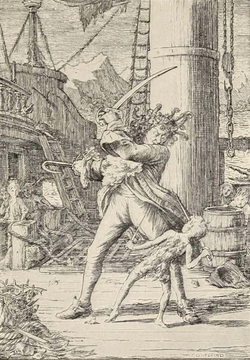
 1912 illustration by Francis Donkin Bedford | |
| First appearance | Peter Pan (1904) |
| Created by | J. M. Barrie |
| Portrayed by | Gerald du Maurier (1904 first stage production) |
| In-universe information | |
| Title | Captain |
| Occupation | Pirate |
| Nationality | English |
Captain James Hook is the main antagonist of J. M. Barrie's 1904 play Peter Pan; or, The Boy Who Wouldn't Grow Up and its various adaptations, in which he is Peter Pan's archenemy. The character is a pirate captain of the brig Jolly Roger. His two principal fears are the sight of his own blood (supposedly an unnatural colour) and the crocodile who pursues him after having previously eaten Captain Hook's hand cut off by Pan. An iron hook that replaced his severed hand has given the pirate his name.
Creation of the character
[edit]Hook did not appear in early drafts of the play, wherein the capricious and coercive Peter Pan was closest to a "villain", but was created for a front-cloth scene (a cloth flown well downstage in front of which short scenes are played while big scene changes are "silently" carried out upstage[1]) depicting the children's journey home. Later, Barrie expanded the scene, on the premise that children were fascinated by pirates, and expanded the role of the captain as the play developed. The character was originally cast to be played by Dorothea Baird, the actress playing Mary Darling, but Gerald du Maurier, already playing George Darling (and the brother of Sylvia Llewelyn Davies), persuaded Barrie to let him take the additional role instead,[2] a casting tradition since replicated in many stage and film productions of the Peter Pan story.
According to A. N. Wilson, Barrie "openly acknowledged Hook and his obsession with the crocodile was an English version of Ahab",[3] and there are other borrowings from Melville.[4]
Biography of the character
[edit]Barrie states in the novel: "Hook was not his true name. To reveal who he really was would even at this date set the country in a blaze." He is said to be "Blackbeard's bo'sun" and "the only man of whom Barbecue was afraid".[5] (In Robert Louis Stevenson's Treasure Island, one of the names Long John Silver goes by is Barbecue.)[6]
In the play, it is implied that Hook attended Eton College and Balliol College, Oxford,[7][8] and his final words are "Floreat Etona", Eton's motto. In the novel, Hook's last words are a similarly upper-class "bad form", in disapproval of the way Peter Pan beats him by throwing him overboard. He also has a yellow blood disorder.
The book relates that Peter Pan began the ongoing rivalry between them by feeding the pirate's hand to a crocodile. After getting a taste of Hook, the crocodile pursues him relentlessly, but the ticking clock it has also swallowed warns Hook of its presence.[9]
Appearances
[edit]Peter Pan (play) and Peter and Wendy (novel)
[edit].jpg)
Hook is described as "cadaverous" and "blackavised", with "eyes which were of the blue of the forget-me-not" ("save when he was plunging his hook into you, at which time two red spots appeared in them and lit them up horribly") and long dark curls resembling "black candles". He is a very skilled swordsman. In many pantomime performances of Peter Pan, Hook's hair is a wig and is accompanied by thick bushy eyebrows and moustache. The hook is fixed to his right hand (often changed to the left hand in film adaptations) and is used as a weapon. He is also described as having a "handsome countenance" and an "elegance of ... diction" – "even when he [is] swearing". Barrie describes "an attire associated with the name of Charles II, having heard it said in some earlier period of his career that he bore a strange resemblance to the ill-fated Stuarts". Hook's cigar holder enables him to smoke two cigars at once. Barrie also stated in "Captain Hook at Eton" that he was, "in a word, the handsomest man I have ever seen, though, at the same time, perhaps slightly disgusting". Although Hook is callous and bloodthirsty, it makes it clear that these qualities make him a magnificent pirate and "not wholly unheroic".
Disney version
[edit]| Captain James Hook | |
|---|---|
.png) Captain Hook as he appears in the Walt Disney version of Peter Pan | |
| First appearance | Peter Pan (1953) |
| Created by | Walt Disney Animation Studios |
| In-universe information | |
| Occupation | Pirate |
| Affiliation | Disney Villains |
| Children | Harriet Hook (daughter; Descendants only) CJ Hook (daughter; Descendants only) Harry Hook (son; Descendants only) Hazel Hook (daughter; Descendants only) |
| Voiced by |
|
| Portrayed by | Jude Law (Peter Pan & Wendy) Joshua Colley (Descendants: The Rise of Red) |
In the animated film Peter Pan (1953), Captain Hook is a far more comical villain than the original character: he is seen as a vain and dastardly coward with a childish temper who is prone to crying out in terror. During the film's early development, the story department analysed Hook's character as "a fop... Yet very mean, to the point of being murderous. This combination of traits should cause plenty of amusement whenever he talks or acts".[10]
Frank Thomas was the directing animator of Hook.[11][12] According to Disney's Platinum release bonus features, Hook was modeled after Charles II of England.[13][14][15][16] One director insisted that Hook should be a darker villain with no comedic traits; but this was refused for fear of frightening a juvenile audience, and Hook became a comical villain, equally matched with Peter Pan.[10]
Actor Hans Conried set the tone for Disney's interpretation of Hook, as he was the original voice for the Captain, as well as, in the tradition of the stage play, Mr. Darling, and performed live-action reference for the two characters.[17] In subsequent Disney animation, Hook is voiced by Corey Burton.[18]
Hook seeks revenge on Peter Pan for having fed the crocodile his left hand and refuses to leave Neverland prior to this revenge.[17] Throughout the film, Hook is supported by Mr. Smee. After promising Tinker Bell not to lay a finger (or a hook) on Peter Pan, he plants a bomb in Peter's hideout (instead of Barrie's vial of poison). At the conclusion of the film, Hook is chased by the crocodile into the distance, with the rest of the crew trying to save Hook. Walt Disney insisted on keeping Hook alive, as he said: "The audience will get to liking Hook, and they don't want to see him killed."[10]
Other film appearances
[edit]In the sequel Return to Never Land (2002), Hook mistakes Wendy's daughter Jane for Wendy and uses her as bait to lure Peter Pan to his death. After this fails, he promises to take Jane home if she will help him find the island's treasure, and "not to harm a single hair on Peter Pan's head". This last promise is kept when he pulls a single hair from Peter's head, declaring "the rest of him is mine". At the end of the film, he and the crew are pursued into the distance by a giant octopus.
Captain Hook is one of the Disney Villains who have a main focus in the direct-to-video anthology film Once Upon a Halloween.
Captain Hook's origins are explored in the Disney Fairies film The Pirate Fairy, in which he is voiced by Tom Hiddleston.[19][18] In the story, a young James years before he lost his hand, pretended to be a pirate ship's cabin boy and befriended the rebellious fairy Zarina, who had left Pixie Hollow after being dismissed as a dust-keeper when her unauthorised experiments with pixie dust led to a disaster. James foresaw the great potential of the pixie dust and let Zarina think she had the authority over pirates.
In The Simpsons short film Welcome to the Club, Captain Hook (voiced by Kevin Michael Richardson) appears along with other Disney Villains trying to convince Lisa Simpson how fun it is to be a villain.[20] He also appears in the short film The Most Wonderful Time of the Year.
Jude Law portrays Captain Hook in the live-action film Peter Pan & Wendy, which adapts material from the 1953 animated film.[21][22] Unlike the animated version, his hook is his right arm. Unlike Barrie's original play and later Peter Pan adaptations, in which the same actor play Hook and Mr. Darling, the latter's role is performed by a different actor, Alan Tudyk.[23] In this version, Hook is revealed to be an old friend of Peter's and the first Lost Boy, but he left Neverland because he missed his mother. Years later, he returned to Neverland as a pirate, being rejected by Peter because he had grown up.[24]
Joshua Colley plays a teen Hook in the live-action film Descendants: The Rise of Red, from the Descendants franchise.[25] His teenage son Harry (portrayed by Thomas Doherty) appears in the previous films of the franchise Descendants 2 and Descendants 3, Captain Hook being only mentioned.
Television series
[edit]Captain Hook made a special guest cameo on Raw Toonage in the episode hosted by Don Karnage (air pirate of TaleSpin), wherein he challenged Karnage to a sword fight for a treasure chest and won.[26]
Hook also appeared frequently on House of Mouse, and its two direct-to-video films Mickey's Magical Christmas: Snowed in at the House of Mouse and Mickey's House of Villains, acting as a major antagonist in the latter.[18]
In the Disney Junior series Jake and the Never Land Pirates, Hook serves as the main antagonist, with his mother, Mama Hook, herself exclusive to the Disney Junior series, keeping him "honest" if he gets tempted.[18]
Video games
[edit]Kingdom Hearts series
[edit]Captain Hook (フック船長, Fukku Senchō) appears in the video game series Kingdom Hearts. He is voiced in Japanese by Chikao Ohtsuka until Birth by Sleep, after which he is voiced by Naoya Uchida. His English voice actor is Corey Burton.[18]
- In the first game, Hook takes Riku with him where Kairi is being held. Hook does not like Riku's bossiness and regrets taking him along. Nonetheless, he follows his orders, as Riku has control over the Heartless and will likely unleash them on him should he disobey. When Sora, Donald, and Goofy arrive in Neverland, Riku throws them in the hold, where they meet and escape with Peter Pan. He is searching for Wendy, who Hook kidnapped due to believing that she was a Princess of Heart. Riku tells Hook that Wendy is not a Princess of Heart, irritating him. After defeating the Heartless, Sora fights a copy of himself summoned by Riku. After confronting Hook and learning that Riku took Kairi to Hollow Bastion, Sora and company are forced to surrender when Hook holds Tinker Bell hostage. When the crocodile appears, Hook flees while telling Smee to have their prisoners walk the plank. Peter returns to save Sora before imitating Smee to lure Hook to the deck, resulting in him being thrown overboard and chased away by the crocodile.[27]
- In Kingdom Hearts: Chain of Memories, Hook appears as a figment of Sora's memories.[28]
- In Kingdom Hearts 358/2 Days, Pete manipulates Hook into creating the Ruler of the Sky, a bird-like Heartless that Roxas defeats.[29]
- Hook appears in the prequel Kingdom Hearts Birth by Sleep, where he tricks Terra into attempting to kill Peter Pan for him. He kidnaps Tinker Bell and takes Mickey Mouse's Star Shard, but is defeated by Ventus and thrown into the water, where the crocodile chases him off.[30]
Epic Mickey
[edit]An animatronic version of Captain Hook appears in Epic Mickey, wherein he has been converting his crew into animatronic, cyborg version of themselves (referred to in the game as Beetleworx) and is waging an attack against the non-converted pirates. Smee requests that Mickey Mouse find a way to save Hook and stop this machine that is turning pirates into Beetleworx. Players can either fight Hook by themselves and earn a thinner upgrade (and a "bad ending") or free the Sprite and have Pete Pan (a version of Pete dressed as Peter Pan) defeat him and earn a paint upgrade (and a "good ending" showing Pete Pan and Captain Hook in a duel). In Epic Mickey 2: The Power of Two, Hook has disappeared entirely, leaving his crew leaderless and having been run out of Tortooga by Blackbeard and Pete Pan having joined up with the Mad Doctor after losing his purpose. Some of Hook's clothes and items have been left behind in Ventureland, which the crew members seek to assert their authority to take over leadership of the other pirates and lead them to take back their home.
The Cartoon World's version of Hook appears in Epic Mickey: Power of Illusion as the first boss, having fallen under the control of Mizrabel to fight Mickey. Upon his defeat, he comes to his senses and offers his help to Mickey's quest to bring the toons back to the Cartoon World.
Other games
[edit]- Captain Hook appears as a boss in the Japanese version of Mickey Mousecapade, with Pete replacing him in the English version.
- Captain Hook is one of the main antagonists in Disney's Villains' Revenge, voiced by Corey Burton.[18]
- Captain Hook appears as an unlockable playable character in Disney Magic Kingdoms.[31]
- Captain Hook appears as a playable character in Disney Heroes: Battle Mode.[32]
- An alternate universe version of Captain Hook appears as a playable character in Disney Mirrorverse.[33]
- Captain Hook appears as a playable character in Fortnite.[34][35]
Attractions and live events
[edit]
Captain Hook appears at the Walt Disney Parks and Resorts as a meetable character along with Mr. Smee alternating between Fantasyland and Adventureland. He also appears as a figure during the dark ride Peter Pan's Flight.
In Fantasmic! at Disneyland, there is a scene in which we see Captain Hook and Peter Pan duelling aboard the Jolly Roger (portrayed by the Sailing Ship Columbia). This is replaced by a short re-enactment of Disney's Pocahontas at Disney's Hollywood Studios.
At Disney World's Dream-Along with Mickey show, Hook, along with Smee, is one of the villains that crashes Mickey's party. This happens when Peter and Wendy appear to make Goofy's dream for some adventure come true and play a game of "Pretend to Be Pirates" with Donald Duck, who pretends to be the captain until the real Hook appears and challenges Peter to a duel. At first, Hook's appearance seems to take place for no reason other than to add some action to the show but is revealed to actually be working for Maleficent, who is insulted after not being invited to the party. He is defeated by Mickey Mouse, who leads the audience in a chant of "Dreams come true!", and scares off the villains.
At the Disney Villains Mix and Mingle Halloween Dance Party at Mickey's Not-So-Scary Halloween Party, Hook is summoned up by Maleficent along with the other villains, and co-hosts along with her, revealed by him being the only one of the villains besides her to sing and also being the villain that dances with her.
Captain Hook was also featured in the Disney on Ice 2013 show 'Let's Party' as part of the Halloween celebration section, which takes the format of a party hosted by Jack Skellington where all the 'main' Disney villains attend (the Evil Queen and Jafar being two other notable villains in the scene) and they plan to capture Mickey Mouse to plunge everyone into unhappiness.
Printed media
[edit]Occasionally, Hook appears in the Scrooge McDuck universe of comic books as the nemesis of Moby Duck, a whaler cousin of Donald Duck.[36]
In the Kingdom Keepers series book Disney at Dawn (2008), Captain Hook was snooping around Ariel's Grotto, having been sent by the Overtakers in investigate the meaning in Jess playing songs over the park speakers.
In the Descendants franchise novels Isle of the Lost (2015) and its sequel Rise of the Isle of the Lost (2017), Captain Hook appears as one of the villains who live imprisoned on the titular island. He is also the father of Harriet (eldest daughter), Harry (middle son), and CJ (youngest daughter).
In the Pirates of the Caribbean novel Pirates of the Caribbean: The Price of Freedom by A. C. Crispin, Captain Hook is mentioned as "James" in conversation, confirmed by Crispin to be a Disney "in" joke.[37][38][39][40]
In film
[edit]Peter Pan (1924 film)
[edit]Captain Hook appears in Peter Pan (1924), portrayed by Ernest Torrence.
Hook (1991 film)
[edit]| Captain James Hook | |
|---|---|
| Created by | Steven Spielberg |
| Portrayed by | Dustin Hoffman |
| In-universe information | |
| Nickname | Hook |
| Gender | Male |
| Occupation | Pirate |
Captain Hook appears in Hook, portrayed by Dustin Hoffman.[41] Looking for purpose in his own life Hook kidnaps the children of the adult Peter to lure his arch-enemy back to Neverland and gives the middle-aged man three days to rekindle his spirit. Hook has been left feeling depressed and suicidal since Peter Pan forfeited his eternal youth and left Neverland to start a family with Wendy's granddaughter Moira and took on the new identity of Peter Banning (Robin Williams). After his initial arrival in Neverland, Banning make an unsuccessful first attempt to get Hook to release his children by offering money but Hook refuses, shooting Peter's checkbook. Hook worries he has nothing left to accomplish; he has long since killed the crocodile and made a quiet clock tower out of its corpse. Despite killing the crocodile, he remains terrified of the sound of ticking clocks and has become increasingly paranoid of the crocodile coming back, often destroying clocks to cope. At Smee's suggestion, Hook attempts to persuade Peter's children that their father never loved them, in order to coerce them to stay in Neverland. He is successful with Jack, Peter's son, who soon sees Hook as the attentive father figure that Peter has never been, and Hook eventually sees Jack as a potential heir. Peter's daughter, Maggie, mistrusts Hook immediately and refuses to be swayed, reminding Hook of her father's past defiances. Hook decides to hold Maggie hostage until Peter's failure to rescue her ruins her faith in him. This backfires when Peter and the Lost Boys rescue her immediately. Jack sees Hook stab Rufio to death in a duel and realises how much his father cares for the Lost Boys, rejecting the murderous Hook and embracing Peter once again. As Peter leaves the ship with his children and the Lost Boys, Hook orders him to come back. Maggie tells him off, stating Hook needs a mother to straighten his bad attitude. After Hook vows to kidnap future generations of children in Peter's family, Peter and Hook engage in a final duel amidst a circle of Lost Boys, Peter taunting Hook about the idea that the ticking clocks he fears are not reminders of the crocodile, but a reminder of time ticking away. After a close call where Tinker Bell deflects an attack with the hook, the crocodile clock tower seemingly comes to "life" and eats Hook when it falls on top of him.
Hook's missing hand is his left and his stump takes other attachments, including a baseball mitt and a pointer. He dresses very elegantly in a gold-trimmed red coat, matching hat, and a wig that hides his balding head. He wears a ceremonial captain's sword at his side, but uses a proper duelling sword when fighting Rufio and Peter. Hook's physical appearance in the film is heavily influenced by Disney's portrayal, though with more elaborate clothing trim and his moustache is curled, shaped like a hook. He is closer to Barrie's characterisation as a gentleman pirate than in Disney's version; for instance, he frequently describes certain behaviours as "good form" or "bad form" (although he is willing to violate these rules when it suits him, such as trying to stab Peter in the back during their climatic duel). Hoffman claimed to have based the character's voice and mannerisms on conservative columnist William F. Buckley Jr.
In addition to playing the titular character, Hoffman also provided the airline pilot's announcement in the scene where the Bannings fly from San Francisco to London for Christmas, as a reference to the traditional element of casting one actor in a dual-role of Captain Hook and George Darling in the original play
Peter Pan (2003 film)
[edit]| Captain James Hook | |
|---|---|
| Created by | P.J. Hogan |
| Portrayed by | Jason Isaacs |
| In-universe information | |
| Nickname | Hook |
| Gender | Male |
| Occupation | Pirate |
Captain Hook appears in Peter Pan (2003), portrayed by Jason Isaacs. In the climactic duel, he learns to fly, almost defeating Peter Pan, but the Lost Boys' taunts weaken the enthusiasm needed to fly, and he falls into the crocodile's mouth, accepting his fate.
Shrek film series
[edit]Captain Hook appears in the Shrek franchise. In Shrek 2, he plays piano in the Poison Apple Tavern, singing "Little Drop of Poison" by Tom Waits and "People Ain't No Good" by Nick Cave. In Shrek the Third., he appears as a secondary antagonist voiced by Ian McShane.
Pan (2015 film)
[edit]Captain Hook appears in Pan, portrayed by Garrett Hedlund. He works with Peter Pan to escape from Blackbeard's mines in Neverland and joins forces with the native tribe. Although initially only interested in leaving Neverland, Hook is attracted to Tiger Lily (Rooney Mara) and assists her and Peter in personally dueling Boatswain Bishop as Tiger Lily fights Blackbeard during the final confrontation in the fairy kingdom. At the film's conclusion, he joins Peter and Tiger Lily in rescuing other children including Peter's confidant Nibs from Peter's old orphanage back in London. Hook in this film is different from the original character, and is portrayed as a pioneer-era American without any connection with Eton, Blackbeard, or piracy in general.
Come Away
[edit]Captain Hook appears in Come Away, portrayed by David Gyasi. This version is a ruthless pawnbroker and lower crime lord who is the son of the Mad Hatter, the paternal grandfather of Alice and Peter Pan, making CJ their paternal uncle and the paternal great-uncle of the Darling children, Wendy, Michael and John. CJ takes care of his father who is showing senility and thus only recognizes Jack; Alice and Peter's father as his son who CJ has always resented having grown up in his older brother's shadow. He also seems to blame Jack for the death of David who CJ seemed to view as his favorite nephew, so when Jack comes to his brother to help call off various debt collectors, CJ showing loyalty to his crime lord superiors crushes Jack's right hand leaving it to be amputated. Peter in response seeks out a group of street urchins to then rob his uncle of the gold coins he's safe guarding for the various criminal underworld factions before cutting off CJ's left hand in a sword duel (when CJ catches them in the act) before fleeing to parts unknown pursued by CJ and his cohorts.
Wendy
[edit]Captain Hook appears in Wendy, portrayed by Kevin Pugh, with Gavin Naquin portraying his younger self. Wendy here is the youngest to two twin older brothers James and Douglas, who are taken to Neverland by Peter, who here is made ageless after a deity saved him from a disaster that killed his family by sharing her powers with him making him untouched by time. This deity who is known as "mother" stops the kids who dwell there from growing up provided they retain faith in her otherwise she lets them rapidly ages into middle age adults. When Douglas seems to drown James starts losing faith, finding his right hand start to age prematurely prompting Peter to amputate it, but despite this James continues to grow old and rallies the other adults to kill and consume "mother" in an effort to retain their lost youth with a restored fishing boat. When Wendy discovers Douglas survived from seemingly drowning both help Peter revive "mother" after she is harpooned and temporary dies. James now with a makeshift hook in place of his right hand can no longer return home with his siblings and their friends, so stays to play with Peter as his new "enemy" Captain Hook, thereby allowing him to live out the rest of his days with the spirit of a child.
Lost Girls
[edit]Iain Glen plays Hook in the 2022 film The Lost Girls.[42]
Peter Pan's Neverland Nightmare
[edit]Captain Hook appears in Peter Pan's Neverland Nightmare, portrayed by Charity Kase. In the film, he was abducted by Peter 15 years ago, and is depicted as a heavily mutilated individual, chained and his hand replaced with a hook.[43]
In television
[edit]Peter Pan (1976 musical)
[edit]Captain Hook appears in Peter Pan (1976), portrayed by Danny Kaye.
Peter Pan – The Animated Series (no boken)
[edit]Captain Hook appears in Peter Pan: The Animated Series, voiced by Chikao Ohtsuka. This version's personality is far closer to the original character from Barrie's novel. Apart from wanting to destroy Pan, he is also eager to become Neverland's first king. Hook has a second hook-hand which resembles a crab claw.
Peter Pan and the Pirates
[edit]Captain Hook appears in Peter Pan and the Pirates, voiced by Tim Curry.[18] This version harkens closer to the original depiction of the character, being ruthless and cunning.
Funky Fables
[edit]Captain Hook appears in Funky Fables, voiced by Garry Chalk.[18]
The Children's Party at the Palace
[edit]Captain Hook appears in Children's Party at the Palace, portrayed by Anthony Head.
Once Upon a Time
[edit]Captain Hook appears in Once Upon a Time, portrayed by Colin O'Donoghue.[44]
Hook is born Killian Jones, who becomes captain of the Jolly Roger after his brother's death. His hand is cut off by the dark trickster Rumpelstiltskin as revenge for Hook running away with his wife. In order to find a way to kill Rumplestiltskin, Hook travels to Neverland, where he spends over 100 years before escaping back to the Enchanted Forest. Hook teams up with Cora, the Queen of Hearts, and they travel to the Land Without Magic after the curse is broken.
Neverland (TV miniseries)
[edit]Captain Hook appears in Neverland, portrayed by Rhys Ifans. He is introduced as "Jimmy", a fencing teacher and leader of a small group of juvenile pickpockets including Peter Pan with whom he has developed a father-son relationship (that over time shatters completely due to events in Neverland culminating in the demise of Peter's confidant). Jimmy is seeking a mysterious orb, which Peter and his gang have discovered unbeknownst to him. In the course of the miniseries, "Jimmy" in avertedly causes Peter's right hand boy to die, where it is then revealed that "Jimmy" actually killed Peter's father because he was in love with Peter's mother, with the watch that Hook owns having once belonged to Peter's father; the watch is lost with Hook's hand in their final confrontation when the crocodile swallows both.
Peter Pan Live! (2014 TV special)
[edit]Captain Hook appears in Peter Pan Live!, portrayed by Christopher Walken. Compared to the 1954 musical on which it was based, this show sought to "strengthen and deepen" the portrayal of Captain Hook.[45] Hook and his pirate crew perform songs from the original musical, such as "Hook's Tango", in addition to new songs such as "Vengeance" and "Only Pretend".[46]
Peter and Wendy (2015 TV film)
[edit]Captain Hook appears in Peter and Wendy, portrayed by Stanley Tucci. Hook is shown to be just as being somewhat equally naïve as Peter Pan; since this disliking of children is due to his own somewhat turbulent childhood; where he was sent away to Eton by an unloving family so therefore in some ways he needs Wendy as much as Peter. He even reads out aloud to crewmembers his recounts of his hated school days but still refuses to believe his family didn't love him. He is shown to punish his crew for the slightest infractions killing one for accidentally spitting on his boots. Culminating in an ending similar to the book, only this time the crocodile drags him through an opening after bursting through the bottom hull to seize him, with said hook breaking off while James uses it to cling to the side of the hull.[47]
In literature
[edit]Peter Pan in Scarlet
[edit]Geraldine McCaughrean's authorized sequel to Peter Pan gives Peter a new nemesis, while bringing back the old favourite.
Ravello, a circus man in a constantly ragged woollen coat, volunteers to become Peter's valet in the search for the treasure. Ravello provides a red coat (that formerly belonged to Hook) and a bad influence, influencing Peter increasingly to become more and more like Captain Hook. He sees himself not as a living person; he never sleeps and eats only eggs. He is revealed in the middle of the book to be the old James Hook, who escaped the crocodile when the animal's stomach contractions broke the vial of poison Hook kept with him at all times. The poison killed the crocodile, and Hook used his hook to claw his way out, but he was mutated by the stomach acid into an uglier man with a scarred visage—vastly different in appearance from the noble pirate. He then assumed a new identity of Ravello, owner of a travelling circus, complete with lions, tigers, and bears.
A clue to Ravello's true identity is given when one of the Lost Boys asks Ravello his name: he thinks for a while as if trying to remember, and finally says the name his mother gave him was Crichton, but that names given by mothers don't mean anything.
Capt. Hook: The Adventures of a Notorious Youth
[edit]According to the 2007 novel Capt. Hook: The Adventures of a Notorious Youth, Captain Hook was the illegitimate son of a nobleman, "Lord B", and an unnamed woman Hook has never met (implied to be the Queen). Disowned by Lord B., James Matthew is reared by a Shakespearean actress he calls Aunt Emily, and unwillingly attends Eton College as an Oppidan scholar, where he is an avid reader of Shakespeare and Shelley, and his motto is "Knowledge is Power". He describes many things as first-rate – "Topping Swank", and punctuates his sentences with "The End". He is very interested in the French Revolution.
In the novel, James has only a few friends including Roger Peter Davies, whom he nicknames "Jolly Roger" (the name of his ship in later life), and the spider "Electra". A seventeen-year-old Colleger, Arthur Darling (named after Arthur Llewelyn Davies) is his rival in studies, fencing, sports, and the attentions of the visiting Ottoman Sultana Ananova Ariadne. When James successfully woos Ananova, their affection sets off political outrage that affects the noble position of Lord B., who arranges for James to leave Eton on his trading ship, the Sea Witch. Upon leaving, James defeats Arthur in a final duel and burns his own school records to leave no traces of his behaviour. On the Sea Witch, he befriends boatswain Bartholomew Quigley Smeethington, generally called Smee, frees the slaves aboard ship, overthrows the ship's captain (killed by Electra), and murders the quartermaster with a metal hook.
Throughout Capt. Hook, author J.V. Hart relates events in James Matthew Barrie's life and the lives of the Llewellyn Davies children. The narrative expands upon details of Barrie's original play and novel but ascribes James's unusual colouring and yellow blood to a blood disorder, makes James's long dark hair natural, rather than the usual wig, and has James titled "Hook" after murdering the quartermaster of the Sea Witch, rather than in reference to his prosthetic hand.
Peter and the Starcatchers
[edit]In the novel Peter and the Starcatchers by Dave Barry and Ridley Pearson, Captain Hook is distinguished by halitosis, beady black eyes, a pock-marked face, and perpetual filth of his person and surroundings contrasting strongly with J. M. Barrie's Etonian gentleman. The novel, which takes place before the Captain meets Peter Pan, calls Hook "Black Stache" for his prominent moustache, and his ship is called the Sea Devil; he captures the Jolly Roger, originally a British ship called the Wasp, later. Black Stache is renamed "Captain Hook" in the second instalment, Peter and the Shadow Thieves. In Barry and Pearson's book, his left hand is accidentally cut off by Peter.
In Rick Ellis' theatrical adaptation of the Barry-Pearson novel, Black Stache (portrayed in the original production by Christian Borle, who won a Tony Award for the role) is a witty, poetical, but psychotic pirate prone to malapropisms and the occasional pratfall. Similar to the Disney film character, Black Stache resembles both a dangerous villain and a comic buffoon. The last of a line of villains, he seeks to become a great villain by fighting a great hero, and finds one in Peter. His hand is cut off not by Peter, but accidentally severed when he slams the lid of a trunk in a fit of rage.
Pirates of the Caribbean
[edit]One of conceptual consultant James Ward Byrkit's concept art for the 2007 film Pirates of the Caribbean: At World's End showed a pirate similar to Captain Hook as one of the Pirate Lords of the Brethren Court.
In A. C. Crispin's 2011 novel Pirates of the Caribbean: The Price of Freedom, during a conversation between Captain Teague and Pirate Lord Don Rafael: "You'll never guess who I encountered at Oporto a few months ago. [...] James. [...] He's lost a hand. [...] he said it wasn't so bad, the hook was as good as a dagger in a fight. [...] He didn't look a day older, not a day. [...] James was a lot more...subdued. [...] The taberna keeper's little lad came round to collect our plates, and when he turned and saw he, for just a second he looked—scared. No, worse than that. Terrified. [...] Can you imagine that? Afraid! Of a young boy!"[39][40] It was confirmed by the author Crispin that "James" is indeed Captain Hook from J.M. Barrie's Peter Pan. Crispin figured that since the Pirates franchise had a couple Disney "in" jokes (such as Gillette's comment about "a little mermaid" in Pirates of the Caribbean: The Curse of the Black Pearl), that she'd include the mention of "James" as a joke.[37][38]
In theatre
[edit]Peter Pan (1950 musical)
[edit]In Leonard Bernstein's musical version, Boris Karloff starred as Mr. Darling/Captain Hook and Jean Arthur played Peter.
Most notably, Cyril Ritchard played Captain Hook in the 1954 musical adaptation which starred Mary Martin as Peter Pan. George Rose played the role in the 1977 revival which featured Sandy Duncan as Pan.
The role of Captain Hook in the musical adaptation of Finding Neverland is played by the same actor playing Charles Frohman. The role was originated in Leicester by Oliver Boot. In the American Repertory Theater try out the role was played by Michael McGrath. Kelsey Grammer originated the role in the Broadway cast and replacements for the role in the production include Anthony Warlow, Terrence Mann, and Marc Kudisch. Tom Hewitt played the role in the first US national tour.
Other
[edit]2012 Summer Olympics opening ceremony
[edit]Alongside other inflatable villains such as Lord Voldemort, the Queen of Hearts, Cruella de Vil, and The Child Catcher, Captain Hook made an appearance during the opening ceremony of the XXX Olympiad in London, representing one of the villains of British children's literature.
See also
[edit]References
[edit]- ^ "Theatrecrafts.com". www.theatrecrafts.com.
- ^ "Jmbarrie.co.uk – introduction to the yale edition (2003)". Archived from the original on 2 January 2008. Retrieved 2007-12-08.
- ^ A.N. Wilson. "Moby-Dick – a modern tragedy." The Telegraph, 27 October 2008. Retrieved 25 March 2014.
- ^ Williams, David Park (1965). "Hook and Ahab: Barrie's Strange Satire on Melville". PMLA. 80 (5): 483–488. doi:10.2307/460839. JSTOR 460839. S2CID 163344199.
- ^ Barrie, J. M. Peter and Wendy, Chapter 4. Hodder & Stoughton (1911).
- ^ Tatar, M. The Annotated Peter Pan. W.W. Norton & Co. (2011).
- ^ McConnachie and JMB, Captain Hook at Eton – Speeches by JM Barrie, Peter Davies Publishing. 1938.
- ^ "Captain Hook at Eton". Angelfire.
- ^ Barrie, J. M. Peter and Wendy. Hodder & Stoughton (1911).
- ^ a b c Thomas, Frank & Johnston, Ollie (1993) Disney Villain "Chapter 4: Nine Old Men," section: "Peter Pan", pp. 109–113. ISBN 978 1562827922
- ^ "Feature Films: Peter Pan". Frank & Ollie's Official Site.
- ^ "Frank Thomas Obituary". The Free Library. Archived from the original on 12 March 2017. Retrieved 1 August 2009.
- ^ "Captain Hook's Hook: Its Most Likely Inspiration–And His Nemesis Crocodile's Too!". 10 April 2020.
- ^ "The Astonishing Evolution of Captain Hook: The Most Sensational Pirate". August 2023.
- ^ "Penguin Monarchs: Charles II". 23 July 2021.
- ^ "The costume evolution of Captain Hook: From grisly to suave".
- ^ a b "Captain Hook: Character History". Disney Archives. Archived from the original on 8 August 2009. Retrieved 1 August 2009.
- ^ a b c d e f g h "Captain Hook Voices (Peter Pan)". Behind The Voice Actors. Retrieved 5 May 2025. A green check mark indicates that a role has been confirmed using a screenshot (or collage of screenshots) of a title's list of voice actors and their respective characters found in its credits or other reliable sources of information.
- ^ Taylor, Amanda (9 August 2013). "'The Pirate Fairy': Christina Hendricks and Tom Hiddleston join newest Tinkerbell movie". Entertainment Weekly. Archived from the original on 10 September 2015.
- ^ Reif, Alex (8 September 2022). "TV Recap: "The Simpsons: Welcome to the Club" Brings Disney Villains to Springfield". LaughingPlace.com. Retrieved 9 September 2022.
- ^ Kroll, Justin (7 July 2020). "Jude Law to Play Captain Hook in Disney's Live-Action 'Peter Pan' (EXCLUSIVE)". Variety. Retrieved 7 July 2020.
- ^ Kroll, Justin (25 September 2020). "Yara Shahidi to Play Tinkerbell in Disney's Live-Action 'Peter Pan'". The Hollywood Reporter. Retrieved 27 September 2020.
She will join Jude Law, who is set to play Captain Hook, and Alexander Molony and Ever Anderson, who will play Peter and Wendy, respectively.
- ^ Ibrahim, Samantha (1 March 2023). "Jude Law as Captain Hook in 'Peter Pan & Wendy' triggers backlash". nypost.com. New York Post. Retrieved 14 March 2023.
- ^ Michaelsen, Shannen (30 April 2023). "Peter Pan & Wendy's New Captain Hook Backstory Explained". Screen Rant. Retrieved 30 April 2023.
- ^ Petski, Denise (21 November 2022). "Brandy & Rita Ora Among 7 Cast In 'Descendants' Sequel 'The Pocketwatch' At Disney+". Deadline. Retrieved 21 November 2022.
- ^ "Sheerluck Bonkers / All Potato Network / The Puck Stops Here". Raw Toonage. Episode 2. 26 September 1992.
- ^ "Never Land Walthrough (KHIFM) – KHGuides". khguides.com. 27 February 2019.
- ^ "Walkthrough: Part Four - Kingdom Hearts: Chain of Memories Guide". IGN. 28 March 2012. Retrieved 5 May 2025.
- ^ "Days 301-304: Vacant Place - Kingdom Hearts 358/2 Days Guide". IGN. 14 February 2014. Retrieved 5 May 2025.
- ^ "Captain Hook – Kingdom Hearts Insider". Kingdom Hearts Insider. 5 October 2012.
- ^ Disney Magic Kingdoms (19 January 2018). "Update 17: Peter Pan | Livestream". YouTube.
- ^ "Update 1.13.2 Patch Notes". Disney Heroes: Battle Mode. 21 October 2019. Archived from the original on 25 January 2020. Retrieved 11 August 2024.
- ^ "Captain Hook – Disney Mirrorverse". Kabam. 2 July 2021.
- ^ "Fortnitemares 2024 Afflicts the Island in Battle Royale v31.40". Epic Games. 12 October 2024.
- ^ Maxon Faber (18 October 2024). "Just Released — Check Out Fortnite's Full Disney Villains Collection". Laughing Place.
- ^ "Captain Hook". I.N.D.U.C.K.S.
- ^ a b Keep To The Code forums
- ^ a b Goodreads
- ^ a b Crispin, Ann C. (17 May 2011). Pirates of the Caribbean: The Price of Freedom. Disney Editions. ISBN 978-1-4231-0704-0.
- ^ a b Crispin, A. C. (2011). Price of Freedom (PDF). Disney Editions. ISBN 978-1-4231-0704-0.
- ^ Murphy, Ryan (5 January 1992). "Dustin Hoffman takes all roles seriously – Hook, too". The Baltimore Sun. Archived from the original on 28 December 2018. Retrieved 28 December 2019.
- ^ Kay, Jeremy (8 September 2020). "Myriad completes UK shoot on TIFF sales title 'The Lost Girls' (exclusive)". Screen Daily. Retrieved 11 December 2021.
- ^ Squires, John (30 August 2024). "'Peter Pan's Neverland Nightmare' Exclusive Trailer – 'Poohniverse' Movie Gets Extremely Bloody". Bloody Disgusting. Retrieved 31 August 2024.
- ^ "'Once Upon A Time' season 2 has Captain Hook?". ABC7 Los Angeles. Archived from the original on 15 December 2018. Retrieved 15 December 2018.
- ^ "NBC Hopes 'Peter Pan Live' Can Fly to New Heights". Variety. 26 November 2014. Retrieved 5 December 2014.
- ^ "All about the new songs in 'Peter Pan Live!' – and how the show's handling 'Ugg-a-Wugg'". Inside TV. Entertainment Weekly. 18 November 2014. Retrieved 18 November 2014.
- ^ Plunkett, John (14 May 2015). "Paloma Faith and Stanley Tucci to star in ITV's Peter Pan drama". theguardian.com. Guardian News & Media Limited. Retrieved 28 December 2019.
External links
[edit] Media related to Captain Hook at Wikimedia Commons

| |||||||||||||||||||||||||||||||||||||||||
| |||||||||||||||||||||||||||||||||||||||||


| International | |
|---|---|
| National | |
| Artists | |
| People | |
| Other | |

Captain Hook
View on GrokipediaCreation and conception
Development by J.M. Barrie
J.M. Barrie conceived Captain Hook as the primary antagonist during the development of his 1904 play Peter Pan; or, The Boy Who Wouldn't Grow Up, drawing from earlier improvisational games with the Llewelyn Davies boys where he portrayed a pirate figure known as Captain Swarthy.[3] In initial drafts of the play, begun in November 1903 under the working title Anon: A Play, Peter Pan served as the sole source of cruelty and villainy, with no defined pirate captain; Hook was introduced later as a distinct adversary to balance the narrative and facilitate scene transitions by distracting audiences during set changes.[4] This evolution transformed the story from a darker tale centered on Peter's abduction of children into a more structured conflict between eternal youth and adult menace.[5] Barrie's collaboration with American producer Charles Frohman played a pivotal role in refining the character for the stage, as Frohman championed the play's production despite initial skepticism from other theater figures like Herbert Beerbohm Tree, for whom Barrie had partially envisioned Hook's role.[5] Frohman's support led to the play's premiere on December 27, 1904, at the Duke of York's Theatre in London, where Hook debuted as a theatrical foil to Peter, embodied by actor Gerald du Maurier in a dual role with Mr. Darling to emphasize thematic parallels.[6] During the initial run, Barrie continued nightly revisions to enhance dramatic tension, incorporating elements like the pursuing crocodile—already present in the premiere script as a ticking symbol of Hook's mortality—to heighten the pirate's vulnerability and the play's whimsical peril.[4] In the 1911 novelization Peter and Wendy, Barrie formalized Hook's identity as Captain James Hook, describing him as "Jas. Hook" in official correspondence and attributing to him an elite education implied through nostalgic reflections on Eton traditions during his final moments, such as the wall game and playing fields.[7] This expansion deepened Hook's backstory beyond the play's outlines, portraying him as a formerly refined gentleman turned pirate, while retaining the crocodile as a relentless nemesis that had devoured his hand.[7] Subsequent revisions, including a 1905 revival adding scenes like the Marooners' Rock encounter, further integrated Hook into Neverland's ecosystem, solidifying his role as Peter's dark mirror.[8]Influences and early inspirations
Captain Hook's creation draws from historical pirate figures known for their flamboyant attire and vengeful personas, popularized in 18th- and 19th-century accounts, contributing to the character's exaggerated sense of honor and dread of defeat. Literary precedents, particularly Robert Louis Stevenson's Treasure Island (1883), significantly shaped Hook's persona as an educated, aristocratic pirate. Barrie explicitly linked Hook to Stevenson's Long John Silver, describing him as "the only man of whom Barbecue [Silver's alias] was afraid," establishing Hook within a tradition of sophisticated buccaneers who blend charm with treachery. This influence extends to the character's physical disability, echoing Silver's crutch and earlier tropes like Charles Dickens's hook-handed Captain Cuttle in Dombey and Son (1846–1848), which reinforced the association of prosthetics with villainous cunning in Victorian literature.[9] Barrie's personal experiences profoundly impacted Hook's role as a symbol of adult vulnerability contrasting eternal youth. The 1867 death of his older brother David in a skating accident, just before turning 14, left a lasting imprint; Barrie's mother found solace in viewing David as forever young, a notion that inspired the theme of perpetual boyhood in Peter Pan while positioning Hook as the embodiment of grown-up fears like time's inexorable passage and mortality, exemplified by his terror of the ticking crocodile.[10] This personal tragedy underscored Hook's vengeful fixation on Peter, representing the clash between unchanging childhood innocence and the burdens of maturity. Contemporary Edwardian theatrical trends, particularly the popularity of pirate melodramas, further molded Hook's dramatic flair and stage presence. These sensational plays, blending adventure, villainy, and spectacle in venues like London's Drury Lane, emphasized physical deformities and bombastic evil in antagonists, a convention Barrie adapted to heighten Hook's monstrous yet elegant menace for live performance.[9]Original character portrayal
Description in Peter Pan play and novel
Captain James Hook, as depicted in J.M. Barrie's 1904 play Peter Pan; or, the Boy Who Wouldn't Grow Up and the 1911 novel Peter and Wendy, is a one-handed pirate captain whose right hand has been replaced by an iron hook prosthesis, severed by Peter Pan in a prior encounter.[11][2] He is described as cadaverous and blackavised, with a swarthy, evil face, long black curls resembling candles, and forget-me-not blue eyes that develop a red spot when he uses his hook aggressively.[11][2] His attire reflects a dandiacal style reminiscent of the Charles II era, featuring an elaborate pirate ensemble with a large feathered hat, a red coat, lace cuffs, and a soiled ruff, often complemented by smoking two cigars simultaneously in a custom holder.[11][2] Despite his handsome features and indomitable courage in battle, Hook exhibits underlying cowardice, particularly in flinching at the sight of his own unusually colored blood.[11][2] Hook's behavioral traits portray him as an Eton-educated dandy obsessed with "good form," a code of refined conduct that he contrasts with the "bad form" of common behaviors and vulgarity, including his disdain for children and their chaotic ways.[11][2] He speaks with sinister politeness and elegant diction, even when issuing threats or swearing, setting him apart from his rough crew, whom he treats like dogs and disciplines with his hook.[11][2] His greatest fear is a crocodile that swallowed his hand along with an alarm clock, whose ticking relentlessly pursues him across seas and lands, causing him to cower and crawl in terror at its approach.[11][2] This phobia underscores his melancholic and reflective nature, often leading to solitary dejection despite his villainous triumphs, as he ponders his unlovable status among children.[11][2] In the narrative, Hook serves as the primary antagonist and captain of the pirate ship Jolly Roger, commanding a crew that includes the bumbling boatswain Mr. Smee and other "scugs" in relentless schemes to capture Peter Pan and the Lost Boys.[11][2] Driven by a personal vendetta against Peter for the loss of his hand, he leads ambushes, poisons Peter's medicine, and forces captives to walk the plank, all while plotting to eliminate the children of Neverland, such as offering a booby-trapped cake to the Lost Boys.[11][2] His role culminates in a dramatic duel with Peter aboard the Jolly Roger, where his strategic cunning and ruthless authority are ultimately defeated, leading to his demise in the crocodile's jaws.[11][2] Barrie provides vivid insight into Hook's psyche through soliloquies that reveal his fixation on propriety and fame, such as his reflection on "good form" while sparing Smee: "To claw a man because he is good form, what would that be? Bad form!"[11][2] In another, he expresses disdain for children during a moment of triumph: "Compare with them the children on this boat about to walk the plank. Split my infinitives, but 'tis my hour of triumph!"[11] His fear of the crocodile is articulated confidentially to Smee: "It liked my arm so much, Smee, that it has followed me ever since, from sea to sea and from land to land, licking its lips for the rest of me."[11][2] These lines highlight Hook's blend of aristocratic pretensions and primal vulnerabilities.[11][2]Initial theatrical performances
The premiere of J.M. Barrie's Peter Pan, or The Boy Who Wouldn't Grow Up occurred on December 27, 1904, at the Duke of York's Theatre in London, where Gerald du Maurier originated the dual role of Mr. George Darling and Captain James Hook.[12] This casting choice, initially unintended as the role of Hook was offered to actress Dorothea Baird, underscored a thematic duality between the domestic father and the piratical antagonist, enhancing the play's exploration of maturity and regression.[13] Du Maurier's performance as Hook emphasized the character's refined education and isolation, portraying him as a cultured dandy amid rough pirates, which deepened the villain's tragic appeal.[13] Du Maurier's interpretation infused Hook with elegance and pathos, presenting him as a tormented genius haunted by his own imagination and fear of Peter Pan, whom he viewed as an embodiment of eternal youth.[13] Physically, Hook was staged with an ashen face, blood-red lips, long greasy curls, and a diabolical smile, his iron hook prominently featured in gestures that blended menace with sardonic charm, often accompanied by a chilling laugh.[13] The sword fight with Peter, a climactic duel on the deck of the Jolly Roger, highlighted Hook's agile yet desperate swordsmanship, with the hook serving as both a weapon and a symbol of his maimed vulnerability, staged to evoke audience sympathy amid the spectacle. Costume designs by William Nicholson reinforced this visual identity, depicting Hook in a formal frock coat and tricorne hat, evoking 18th-century aristocracy twisted into piracy.[14] The 1904 London production toured extensively in the UK during its initial run, with du Maurier reprising the role of Hook to sustain the play's momentum through regional performances that adapted the staging for varied theaters.[15] A Broadway adaptation opened on November 6, 1905, at the Empire Theatre in New York, produced by Charles Frohman, where Ian Maclaren assumed the dual role of Mr. Darling and Hook, maintaining the character's elegant antagonism while introducing American audiences to the production's innovative elements like flying apparatus.[16] Early 20th-century pantomime versions in Britain, emerging around 1906, stylized Hook further for holiday seasons, often amplifying his theatrical flair with exaggerated props and costumes inspired by Nicholson's designs, though retaining du Maurier's foundational blend of sophistication and pathos.[17]Character biography and analysis
Backstory and motivations in original works
In J.M. Barrie's original play Peter Pan; or, the Boy Who Wouldn't Grow Up (1904) and the novelization Peter and Wendy (1911), Captain James Hook is introduced as a seasoned pirate captain of the ship Jolly Roger, formerly serving as boatswain under the infamous Blackbeard, where he earned a fearsome reputation as the most bloodthirsty of buccaneers.[7] Hook's refined demeanor stems from a classical education, as evidenced by his occasional use of Latin phrases like "mea culpa" and his adherence to a code of "good form" derived from his attendance at a prestigious public school.[7] Barrie later elaborated on this background in his 1927 speech "Captain Hook at Eton," revealing Hook's true identity as an alumnus of Eton College, where he was a "dry bob" who excelled in school activities, winning multiple colors in sports and contributing to the ephemeral magazine with an essay on roast pig, before briefly studying at Balliol College, Oxford, from which he departed suddenly after a few terms.[18] This elite upbringing, implying a son of considerable wealth, contrasts sharply with his piratical turn, which Barrie attributes to an unspecified "daring and singular" career path leading him to the Spanish Main as a pirate.[18] Hook's primary motivation is a deep-seated vendetta against Peter Pan, whom he despises for severing his right hand in a prior encounter and feeding it to a crocodile that now perpetually pursues him, having also swallowed an alarm clock that ticks ominously.[7] This loss, replaced by an iron hook, fuels Hook's obsessive quest for revenge, as he declares his longing to capture and eliminate Peter above all else, viewing the boy as a mocking symbol of eternal youth that undermines his own aging authority.[7] Beyond this personal grudge, Hook harbors a broader antipathy toward children and youthful defiance, seeing Peter's carefree rebellion against maturity as a direct affront to the structured "good form" he clings to, which masks his underlying fears of obsolescence and the relentless crocodile's reminder of mortality.[7] Central to Hook's schemes in the original works are several key antagonistic actions against Peter and his allies. He orchestrates the abduction of the Native American princess Tiger Lily, intending to strand her on the tide-risen Marooners' Rock to drown, though Peter thwarts this by eavesdropping and mimicking voices to secure her release.[7] In a subtler ploy, Hook poisons the medicine left for Peter by his fairy companion Tinker Bell, endangering the boy indirectly until Tinker Bell sacrifices herself by drinking it instead.[7] These efforts culminate in a climactic duel aboard the Jolly Roger, where Hook engages Peter in swordplay but ultimately meets his end by being thrown overboard to the waiting crocodile, his final utterance a lament over Peter's perceived lack of "good form."[7] Throughout, Hook's fixation on propriety—demanding politeness even in villainy—reveals a psychological tension between his cultured past and piratical present, underscoring his drive to reclaim dignity amid personal humiliations.[18]Personality traits and symbolic interpretations
Captain Hook is portrayed as a complex antagonist blending cowardice with theatrical grandeur, intellectual pretensions, and deep-seated superstitions. Despite his fearsome reputation as a pirate captain, Hook exhibits profound cowardice, particularly in his terror of the crocodile that relentlessly pursues him, symbolizing his vulnerability beneath a veneer of menace. This fear underscores his superstitious nature, as he attributes almost supernatural inevitability to the beast's pursuit. His theatricality shines through in his dramatic gestures and speeches, where he revels in the spotlight of villainy, often prioritizing "good form"—a code of gentlemanly conduct—over practical ruthlessness. Yet, this is tempered by intellectual snobbery; Hook prides himself on his Eton education and refined tastes, such as his appreciation for poetry and music, viewing himself as superior to the "barbarian" inhabitants of Neverland. His loyalty to his crew is genuine but conditional, marked by a paternalistic affection that coexists with ruthless pragmatism, as he unhesitatingly sacrifices underlings to achieve his ends.[5][19] Symbolically, Hook embodies the encroaching shadows of adulthood, time, and mortality in stark contrast to Peter Pan's perpetual childhood. The crocodile, with its swallowed clock, serves as an auditory reminder of time's inexorable march, haunting Hook and representing the adult dread of aging and death that Peter evades through eternal youth. Hook's character also critiques British imperialism and class rigidity, portraying him as a narcissistic figure whose gentlemanly airs mask a violent, solipsistic pursuit of dominance, reflective of Edwardian-era anxieties about masculine authority and colonial control. His obsession with hierarchy and "good form" reinforces rigid social structures, positioning him as the antithesis to Neverland's anarchic freedom.[20][21] Psychoanalytic interpretations often cast Hook as a father figure and Oedipal rival to Peter, embodying the superego's repressive demands against Peter's id-driven boyhood. In this reading, their conflict symbolizes the son's desire to overthrow paternal authority, with Peter's severing of Hook's hand evoking castration anxiety and the triumph over the father. Hook's allure as a mature, seductive adult further highlights Peter's refusal to grow, positioning the pirate as the ego's bridge to reality that Peter rejects.[22][23] In Barrie's revisions, particularly from the 1904 play to the 1911 novel Peter and Wendy, Hook's vanity was amplified for dramatic effect, enhancing his tragic depth. Early drafts emphasized his gentlemanly poise, but later versions intensified his pride in Etonian heritage and personal elegance—such as comparisons to King Charles II in attire and his harpsichord-playing—to heighten the irony of his downfall. This evolution transformed Hook from a straightforward villain into a melancholic dandy, whose self-absorption underscores themes of lost dignity and the futility of adult pretensions, culminating in poignant final lines like "Floreat Etona" in the 1928 scenario.Adaptations in film
Disney animated and related productions
In Disney's 1953 animated feature film Peter Pan, Captain Hook is introduced as the primary antagonist, voiced by Hans Conried in a performance that also covers the role of Mr. Darling.[24] The character is depicted as an elegant yet comically inept pirate captain, marked by exaggerated cowardice and theatrical bluster, particularly in his obsessive fear of the crocodile that swallowed a clock and now stalks him relentlessly.[25] This portrayal emphasizes Hook's bumbling nature through humorous sequences, such as the "Tick-Tock" chase where the ticking sound drives him to panic, contrasting his self-proclaimed sophistication with slapstick failures against Peter Pan and the Lost Boys. Hook's role expands in Disney's direct-to-video sequels within the Peter Pan franchise. In Return to Never Land (2002), voiced by Corey Burton, he kidnaps Wendy's daughter Jane during World War II, reigniting his feud with Peter Pan (voiced by Blayne Weaver) and highlighting his unyielding persistence in seeking revenge, even as he schemes with his pirate crew aboard the Jolly Roger.[26][27] A younger version of Hook appears as an antagonist in the Disney Fairies spin-off film Tinker Bell and the Pirate Fairy (2014), where he, voiced by Tom Hiddleston, clashes with Tinker Bell and her friends over stolen pixie dust, portraying him as a cunning but opportunistic young pirate before his full transformation into the iconic villain.[28][29] The character features prominently in Disney's animated television productions aimed at younger audiences. In the series Jake and the Never Land Pirates (2011–2016), Hook, again voiced by Corey Burton, serves as a recurring comedic foe to the young pirate Jake and his crew in lighthearted, educational adventures across Never Land, often thwarted in schemes involving treasure hunts or magical artifacts while retaining his signature temper and crocodile phobia.[30][31] A more recent Disney adaptation reimagines Hook in live-action. In Peter Pan & Wendy (2023), directed by David Lowery, Jude Law embodies the pirate captain as a tragic and authoritative figure, infusing the role with nuanced motivations rooted in regret and lost youth, which adds emotional depth to his rivalry with Peter Pan beyond the original's comedic tone.[32][33] Disney has also extended Hook's presence through printed tie-in media with original narratives. The 1953 Dell Comics one-shot Walt Disney's Captain Hook and Peter Pan presents an exclusive story focused on Hook's pirate crew hunting treasure, with Peter and the children as interlopers.[34] Later examples include "Captain Hook and the Buried Treasure" in the October 1971 issue of Walt Disney Comics Digest, where Hook leads a misguided expedition for hidden riches, blending adventure with his characteristic mishaps.[34] These publications often explore standalone escapades in Never Land, reinforcing Hook's role as a persistent, scheming adversary in the Disney canon.[34]Non-Disney live-action and animated films
The earliest non-Disney adaptation of Peter Pan in film was the 1924 silent version directed by Herbert Brenon, where Ernest Torrence portrayed Captain Hook as a formidable and menacing antagonist, emphasizing his ruthless pursuit of Peter and the children through exaggerated physicality suited to the era's visual storytelling.[35] Torrence's performance balanced comic menace with a grandfatherly demeanor, making Hook a paradoxically gentlemanly villain who comically threatens the Lost Boys while maintaining an air of refined piracy.[36] In the 20th century, Steven Spielberg's 1991 fantasy adventure Hook reimagined the character through Dustin Hoffman's portrayal of an adult Captain Hook in a sequel-like narrative, where the pirate kidnaps the grown Peter's children to lure him back to Neverland, blending theatrical flair with emotional depth to depict Hook as a flamboyant yet vengeful schemer haunted by his eternal rivalry.[37] Hoffman's Hook is characterized by elaborate costumes, witty dialogue, and a mix of bombast and pathos, highlighting his obsession with revenge against Peter while commanding a ragtag crew aboard the Jolly Roger.[38] Later that decade, P.J. Hogan's 2003 live-action Peter Pan featured Jason Isaacs in the dual role of Mr. Darling and Captain Hook, infusing the villain with pathos through a more vulnerable interpretation that underscores his fear of the ticking crocodile and his aristocratic disdain for Peter's youthful chaos.[39] Isaacs's performance draws on the original play's tradition of one actor playing both roles, portraying Hook as a cunning swordsman with a refined English accent, whose threats carry an undercurrent of personal insecurity and longing for respect.[40] The 21st century brought revisionist takes on Hook in non-Disney productions. Joe Wright's 2015 prequel Pan cast Garrett Hedlund as a young, hookless James Hook, depicted as a heroic rogue and reluctant ally to Peter in their shared captivity under Blackbeard, exploring his pre-villainous origins as a swashbuckling adventurer driven by survival and camaraderie rather than outright malice.[41] Hedlund's Hook is rugged and charismatic, sporting a leather jacket and aviator goggles in a steampunk-inspired Neverland, with his arc hinting at future antagonism through subtle tensions with Peter.[42] Brenda Chapman's 2020 fantasy drama Come Away integrated Hook into a grounded, non-fantasy family story blending Peter Pan and Alice in Wonderland, with David Gyasi playing Captain James (Hook) as a shadowy pirate figure who confronts young Peter in a hallucinatory sequence symbolizing loss and escapism amid the children's grief over their brother's death.[43] Gyasi's restrained portrayal positions Hook as a metaphorical embodiment of danger and temptation, appearing briefly in a dreamlike duel that ties into the protagonists' emotional journey without fully immersing in supernatural elements.[44] Benh Zeitlin's 2020 reimagining Wendy (filmed in 2019) further deconstructs the character, with Kevin Pugh as a enigmatic, aging pirate leader on a mysterious island, transforming Hook into a weary, almost paternal antagonist who lures children into eternal youth, emphasizing themes of time, labor, and lost innocence over traditional swashbuckling villainy. Recent independent films have leaned into horror-infused interpretations of Hook. Scott Chambers's 2025 low-budget horror Peter Pan's Neverland Nightmare, part of the Twisted Childhood Universe, features Charity Kase as a slasher-style Captain Hook, reimagined as a drug-addicted, mutilated killer who abducts Wendy and her brothers in a dark alternate Neverland overrun by decayed fairy-tale horrors, driven by addiction and rage against Peter.[45] Kase's visceral, gore-heavy performance amplifies Hook's physical deformity and sadism, turning him into a relentless pursuer in a slasher narrative that subverts the source material's whimsy.[46] Lars Janssen's 2025 action-horror Captain Hook: The Cursed Tides stars Richard Rowden as a vengeful, undead-infused pirate seeking revenge after a defeat by Admiral Smee, allying with a local in a coastal town to reclaim his power through cursed artifacts and brutal confrontations.[47] Rowden's Hook is brooding and supernatural, marked by pale skin and tattered attire, embodying a horror pirate archetype fueled by betrayal and supernatural tides that grant him eerie abilities.[48] In animated parodies, the DreamWorks Shrek series includes brief cameos of Captain Hook as a minor fairy-tale villain. Voiced by Ian McShane in Shrek the Third (2007), he appears as a henchman in Prince Charming's troupe, participating in a theatrical invasion with exaggerated pirate mannerisms and a comically oversized hook. Earlier, in Shrek 2 (2004), an unvoiced Hook plays piano in the Poison Apple tavern, crooning a villainous tune amid other storybook rogues, reinforcing his status as a hapless, parodic buccaneer in the franchise's satirical world.[49]Adaptations in television
Animated series and specials
In the animated series Peter Pan and the Pirates (1990–1991), Captain Hook is portrayed as the primary antagonist, commanding his pirate crew in serialized adventures against Peter Pan and the Lost Boys in Neverland.[50] Voiced by Tim Curry, Hook exhibits a sophisticated and scheming demeanor, often employing elaborate plots and verbal wit in his schemes, which earned the series a Daytime Emmy for Outstanding Animated Program in 1991. The show aired for 65 episodes on Fox Kids, emphasizing dramatic storytelling with darker tones drawn from J.M. Barrie's original works.[50] The Japanese anime Peter Pan no Bōken (also known as Peter Pan: The Animated Series, 1989), produced by Nippon Animation, features Captain Hook as a formidable and militaristic pirate captain leading assaults on Peter Pan's allies.[51] Voiced by Chikao Ōtsuka, Hook's character drives much of the 41-episode conflict, blending adventure with elements of fantasy and moral lessons in a style typical of World Masterpiece Theater adaptations. The series follows the Darling children joining Peter in Neverland to battle Hook's crew and an overarching darker threat.[52] Captain Hook makes comedic appearances in the Disney anthology series Raw Toonage (1992), a collection of short animated segments featuring various Disney characters.[53] Voiced by Corey Burton, Hook participates in humorous vignettes, such as teaming up with other villains or engaging in slapstick scenarios aboard the Jolly Roger, contrasting his usual menacing role with lighthearted parody.[54] The series ran for one season on CBS, comprising 39 shorts that highlighted experimental animation styles.[53] In the crossover animated series House of Mouse (2001–2003), Captain Hook appears in brief, recurring cameos as a guest at Mickey Mouse's nightclub, often interacting with other Disney villains in comedic crowd scenes.[55] Voiced again by Corey Burton, his portrayals emphasize his cowardly traits, such as fleeing from threats or bickering with peers, within the show's variety format of 52 episodes aired on Disney Channel.[55] The Disney Junior series Jake and the Never Land Pirates (2011–2016) features Captain Hook as the main antagonist in adventures centered on young pirate Jake and his crew seeking treasure in Neverland while thwarting Hook's schemes.[31] Voiced by Jeff Bennett, Hook is depicted as a comically inept and hot-tempered pirate, often foiled by his own crew or the protagonists, across 128 episodes that promote themes of teamwork and problem-solving for preschool audiences.[30] Hook features in the stylized retelling of Peter Pan within the Funky Fables animated video series (circa 1991), a collection of fairy tale adaptations produced by Saban Entertainment.[56] In this brief, humorous episode, Hook is depicted as a comically inept pirate antagonist, simplifying the original narrative for younger audiences through exaggerated antics and vibrant, low-budget animation.[56]Live-action miniseries and specials
The NBC live television production Peter Pan (1955), an adaptation of the 1954 Broadway musical, stars Cyril Ritchard as Captain Hook in a pioneering broadcast that brought the story to millions of homes.[57] Ritchard's flamboyant and theatrical performance, also portraying Mr. Darling, emphasizes Hook's aristocratic flair and comedic villainy through songs like "Oh, We Pirates" and interactions with the pirates, setting a benchmark for future TV interpretations. The special was rebroadcast in color in 1960 with the same cast, updating the presentation while retaining the original charm.[57] In the 2011 Syfy miniseries Neverland, a prequel exploring the origins of Peter Pan and his adversaries, Rhys Ifans portrays James "Jimmy" Hook as a cunning, street-smart mentor to a gang of orphaned pickpockets in Victorian London, who recruits them to steal a magical orb that transports them to Neverland, where Hook emerges as the primary antagonist driven by ambition and betrayal.[58][59] The ABC fantasy series Once Upon a Time (2011–2018) features Colin O'Donoghue as Captain Killian "Hook" Jones, a romanticized pirate with a complex redemption arc, initially introduced in season 2 as a vengeful suitor entangled in the Enchanted Forest's curses and modern-day Storybrooke, evolving from a self-serving villain to a heroic ally through his relationship with Emma Swan, which includes dating, marriage, and having a child together as part of his redemption from villain to hero.[60][61] NBC's 2014 live television production Peter Pan Live!, a musical adaptation of J.M. Barrie's play, casts Christopher Walken as an eccentric Captain Hook, delivering a quirky, deadpan performance marked by rhythmic speech patterns and improvisational flair during songs like "Vengeance" and "Hook's Waltz," emphasizing the character's theatrical menace in a broadcast format.[62][63] The 2015 British television film Peter and Wendy, directed by Diarmuid Lawrence and aired on ITV, presents Stanley Tucci as Captain Hook in a faithful yet contemporary adaptation that interweaves Barrie's story with a modern narrative of a hospitalized girl imagining the adventure, portraying Hook as a dapper, aristocratic pirate whose dual role as Mr. Darling underscores themes of paternal authority and escapism.[64] Earlier live-action specials include the 1976 Hallmark Hall of Fame musical Peter Pan, where Danny Kaye embodies both the bumbling yet tyrannical Captain Hook and the kindly Mr. Darling, infusing the role with vaudevillian charm and physical comedy in a family-oriented production narrated by Sir John Gielgud.[65] In the 2006 BBC special The Children's Party at the Palace, a celebratory event for Queen Elizabeth II's 80th birthday featuring characters from British literature, Anthony Head makes a brief cameo as Captain Hook, participating in a chaotic, ensemble sequence involving pirate antics and interactions with other iconic figures like Peter Pan.[66]Adaptations in literature
Official sequels and prequels
The official sequels and prequels to J.M. Barrie's Peter Pan featuring Captain Hook consist of authorized literary extensions that build directly on the original narrative, often commissioned or published by entities holding rights to the story, such as Great Ormond Street Hospital or Disney. These works explore Hook's origins, resurrection, or alternate backstories while maintaining canonical ties to Barrie's universe. They include a single official sequel and several prequel series, each providing deeper insight into Hook's character as a complex antagonist driven by revenge, ambition, or longing. Peter Pan in Scarlet (2006), written by Geraldine McCaughrean, serves as the sole official sequel to Barrie's Peter Pan, commissioned through a competition by the trustees of Great Ormond Street Hospital, which holds perpetual rights to the story in the United Kingdom.[67] Set years after the original events, the novel follows a grown-up Peter Pan and the Darling children as they return to a dream-haunted Neverland to confront a mysterious illness affecting its inhabitants. Having survived being swallowed by the crocodile, Captain Hook returns in disguise as Ravello, the circus master, joining the group and seeking revenge on Peter while temporarily allying against greater threats like shadowy dream-weavers.[68] The book, illustrated by Scott M. Fischer, emphasizes themes of maturity and loss, with all proceeds benefiting the hospital.[67] In the prequel Capt. Hook: The Adventures of a Notorious Youth (2004) by James V. Hart, the narrative traces the early life of James Matthew, the boy destined to become Captain Hook, reimagining elements inspired by Barrie's own biography.[69] As a rebellious student at Eton College in the 19th century, young James—nicknamed "King Jas."—engages in sword fighting, budding romances, and pranks that mark his path toward piracy, including his first encounters with the sea and betrayal by mentors. Illustrated by Brett Helquist and published by HarperCollins, the novel culminates in James's transformation into a pirate after a pivotal voyage, establishing his signature cunning and hatred for eternal youth long before meeting Peter Pan.[69] Hart, known for screenwriting Hook (1991), drew from historical details of Eton to humanize Hook's aristocratic origins and motivations rooted in class rebellion and personal loss. The Peter and the Starcatchers series (2004–2011), co-authored by Dave Barry and Ridley Pearson and published by Disney Hyperion, comprises five official prequel novels that reimagine the Peter Pan universe as a swashbuckling origin story, with Hook appearing as the pirate "Black Stache."[70] Beginning with Peter and the Starcatchers (2004), illustrated by Greg Call, the series follows orphan Peter and girl Molly Aster as they protect magical "starstuff" from Black Stache, a bumbling yet ruthless buccaneer with a thick mustache and theatrical flair, aboard the ship Never Land. Black Stache evolves across volumes like Peter and the Shadow Thieves (2006) and Peter and the Secret of Rundoon (2007) into a more formidable villain, losing his right hand to Peter in a climactic battle with a crocodile—directly leading to his alias as Captain Hook.[71] The final book, Peter and the Sword of Mercy (2009), solidifies his rivalry with Peter while introducing elements like Tinker Bell's origins and Neverland's creation, blending adventure with humor to portray Black Stache/Hook as an aspiring "great villain" thwarted by incompetence and fate.[70] Disney's Never Never: A Tale of Captain Hook (2022) by Serena Valentino, part of the official Villains series published by Disney Books, expands Hook's backstory through tie-in novels connected to the Neverland lore from Disney's animated Peter Pan (1953).[72] Narrated from Hook's perspective as James Bartholomew, the story depicts his infancy in Victorian London, where he is briefly kidnapped to Neverland as a baby, spending nearly seven days there before rescue—instilling a lifelong obsession with returning to the island's magic. Growing up privileged yet haunted by dreams of Lost Boys and pixie dust, James rejects his aristocratic life for piracy, adopting the hook after a crocodile attack and clashing with Peter, whom he views as a thief of his eternal youth. Illustrated by Arielle Jovellanos, the novel humanizes Hook as a tragic figure driven by nostalgia and resentment, aligning with Disney's broader villain origin explorations while tying into Neverland's canonical elements like the crocodile and Jolly Roger.[73]Other novels and short stories
In addition to official sequels, Captain Hook has been reimagined in various unofficial novels that explore his backstory, motivations, and humanity through creative reinterpretations. One prominent example is Lost Boy: The True Story of Captain Hook (2017) by Christina Henry, which presents Hook—originally named James—as a former Lost Boy betrayed by Peter Pan, delving into themes of lost innocence and vengeance in a dark fantasy setting. Similarly, Hook's Tale: Being the Account of an Unjustly Villainized Pirate Written by Himself (2017) by John Leonard Pielmeier portrays Hook as a memoirist recounting his aristocratic youth, naval service, and transformation into a pirate, emphasizing psychological depth and historical parallels to real explorers like Captain James Cook.[74] These works contrast with Barrie's original by humanizing Hook as a tragic figure rather than a mere villain. Young adult novels have also featured Hook in romantic and adventurous contexts. Never Never (2015) by Brianna R. Shrum reimagines Hook's origin as a boy eager to grow up who encounters Peter Pan, evolving into a quest-driven narrative with romantic elements amid Neverland's magic, highlighting themes of maturity and obsession. Another is Hooked (2021) by A.C. Wise, a horror-infused retelling that follows Hook after escaping Neverland, grappling with trauma and supernatural consequences in a post-Neverland world. Graphic novels offer visual reinterpretations, such as Straight On Till Morning: A Twisted Tale Graphic Novel (2024), adapted by Stephanie Kate Strohm from Liz Braswell's 2020 novel, illustrated by Noor Sofi, where Wendy Darling joins Captain Hook on a journey to Neverland, uncovering his complexities and challenging the island's enchantments in a dystopian twist.[75] Hook appears in short stories and anthologies focused on pirate lore and modern retellings. The Lady's Captain (2017) by Alex Page is an anthology of five interconnected stories exploring Hook's evolving relationship with Wendy, blending romance and adventure while emphasizing his vulnerability. Other appearances include pirate-themed collections, with crossovers integrating Hook into broader franchises, such as in the Pirates of the Caribbean novelization The Price of Freedom (2011) by A.C. Crispin, where he is referenced as "James," a notorious pirate ally to Jack Sparrow, linking Neverland's lore to Caribbean seas in a subtle, non-canonical nod. Devourer of Men (2024) by Zoraida Córdova presents a gothic horror reimagining where a grown Wendy confronts the returning Captain Hook and the Crocodile, forced to choose between her heart and survival in a tale of dark magic and vengeance.[76] Additionally, Son of Neverland and the Kingdom of Time (2025) by Cal R. Barnes, sequel to the 2021 prequel, is set in a Neverland long after Hook's defeat, exploring ongoing conflicts tied to his legacy and the island's enduring curse.[77]Adaptations in theatre and music
Musical productions
The first musical adaptation of J.M. Barrie's Peter Pan emerged in 1950 as an incidental score by Leonard Bernstein for a Broadway production starring Jean Arthur as Peter Pan and Boris Karloff as Captain Hook, marking an evolution from the original 1904 non-musical play by incorporating songs like "Who Am I?" and "Peter's a Good Swordsman" to enhance the dramatic tension around Hook's villainous schemes.[78] For a subsequent national tour featuring Lawrence Tibbett as Hook, Bernstein added the song "Captain Hook's Soliloquy," which delved into the character's introspective menace, though the tour was cut short due to financial issues.[78] This groundwork led to the full-fledged 1954 Broadway musical Peter Pan, where Cyril Ritchard originated the dual role of Captain Hook and Mr. Darling, delivering an iconic, campy portrayal of Hook as a flamboyantly theatrical pirate through songs such as "Captain Hook's Waltz" and "Hook's Tango," which highlighted his elegant yet comically inept villainy and earned him a Tony Award for Best Featured Actor in a Musical.[79] Ritchard's performance, reprised in a 1955 NBC television broadcast, emphasized Hook's dandyish mannerisms and fear of the crocodile, solidifying the character's stage legacy as a blend of menace and farce. In the 2014 musical Finding Neverland, inspired by the film about Barrie's life, Captain Hook appears as a hallucinatory figure modeled after theater producer Charles Frohman, portrayed by Kelsey Grammer in the Broadway premiere; the role fuses biographical elements with Hook's piratical traits in songs like "Live by the Hook," portraying him as a catalyst for Barrie's creative struggles and the birth of Peter Pan.[80] Subsequent replacements, including Terrence Mann and Marc Kudisch, maintained this dual casting to underscore Hook's symbolic role in exploring imagination versus adulthood.[81] Revivals of the 1954 Peter Pan musical in the 1990s and 2010s adapted Hook for modern audiences, often with gender-fluid casting to refresh the character's theatricality; for instance, in the 1990 Broadway revival at the Lunt-Fontanne Theatre starring Cathy Rigby as Peter Pan, Stephen Hanan played Hook, bringing a heightened comedic edge to the pirate's antics during tours that emphasized aerial stunts and family-friendly spectacle.[82] National tours in the 2010s continued to highlight Hook's songs to engage contemporary viewers with themes of eternal youth.Non-musical stage adaptations
Non-musical stage adaptations of Peter Pan have explored Captain Hook in varied theatrical contexts, emphasizing dialogue, physicality, and interpretive depth over song and dance. These productions often highlight Hook's villainy through stylized performance, psychological nuance, or comedic exaggeration, drawing from J.M. Barrie's original 1904 play while adapting it for contemporary audiences.[83] In the United Kingdom, Peter Pan has become a staple of the annual Christmas pantomime tradition, where Hook is portrayed as a boisterous, audience-baiting antagonist in family-oriented holiday spectacles. These productions feature interactive elements, such as audiences booing Hook on cue and shouting warnings to the characters, transforming the pirate captain into a comically inept yet menacing figure who engages directly with viewers. For instance, in a 2009 Liverpool pantomime, Henry Winkler played Hook as a slapstick villain in a tradition dating back centuries, blending physical comedy with ad-libbed banter to emphasize his theatrical flair over subtle menace.[84][85] A notable cameo appearance of Hook occurred during the opening ceremony of the 2012 Summer Olympics in London, as part of a segment celebrating British children's literature. A giant puppet depicting the pirate captain emerged amid other iconic villains like Cruella de Vil and the Child Catcher, symbolizing the whimsical yet dark elements of national storytelling in a non-narrative, ceremonial tribute directed by Danny Boyle. This brief, visually striking portrayal underscored Hook's enduring cultural presence without advancing a full plot.[86] Modern straight-play adaptations have reimagined Hook with a gritty or psychological edge, focusing on his internal conflicts and the story's darker themes. The 2016 National Theatre production in London, directed by Sally Cookson, presented Hook (played by Anna Francolini) as a terrifying, psychologically complex figure whose enmity with Peter Pan was reconfigured to explore themes of maturity and loss, using inventive staging like aerial work and raw physicality to delve into his psyche. Similarly, the 2023-2024 production Wasteland: Peter Pan at Berlin's Deutsches Theater offered an experimental take, transforming Neverland into a post-apocalyptic dystopia where survival struggles highlight the story's dark themes of authoritarian control and eternal youth, with Hook as part of the piratical ensemble in this nightmarish reimagining.[87][88][89] International non-musical adaptations have incorporated cultural performance styles to stylize Hook's combat and persona. In European experimental theatre, productions like the Deutsches Theater's version prioritize the story's psyche through surreal, immersive environments that blur reality and fantasy, portraying oppressive elements of adulthood in ensemble-driven narratives. These approaches contrast with more traditional UK pantomimes by foregrounding thematic depth over lighthearted villainy. In 2025, the Royal Shakespeare Company's Wendy & Peter Pan at London's Barbican Theatre continued this tradition, staging Hook in a production exploring maturity and imagination.[90]Other media appearances
Video games and interactive media
Captain Hook has appeared in numerous video games and interactive media, often as a primary antagonist in adaptations of the Peter Pan story, where players engage in sword fights, treasure hunts, and pursuits across Neverland. These portrayals typically emphasize his cowardly yet cunning personality, with gameplay mechanics revolving around naval battles, boss encounters, and evasion from his pursuing crocodile.[91][92] In Disney's Peter Pan: Return to Never Land (2002, released for Game Boy Advance and PlayStation 2), Hook serves as the final boss, scheming to claim a hidden treasure map while the player, controlling Peter Pan and Tinker Bell, navigates platforming levels to thwart his plans through combat and puzzle-solving. The game culminates in a duel on Hook's ship, where players use Peter Pan's sword and flight abilities to defeat him.[91][93] The Kingdom Hearts series, developed by Square Enix in collaboration with Disney, features Hook prominently across multiple installments from Kingdom Hearts (2002) to Kingdom Hearts III (2019). Influenced by the Heartless, Hook captures various characters on his ship, serving as a boss enemy in the Neverland world; players battle him using keyblade attacks, exploiting his fear of the crocodile by luring him into water for environmental damage. He is voiced by Corey Burton throughout the series, delivering lines that highlight his bombastic threats and trepidation toward ticking clocks.[92][94] Outside Disney properties, the 1991 adventure film Hook inspired several tie-in games, including the arcade beat 'em up by Irem, where up to four players control Peter Pan or the Lost Boys to rescue kidnapped children from Hook's pirates across six stages of side-scrolling combat. Hook appears as the final boss, armed with pistols and commanding minions on the Jolly Roger, with players using spears and special attacks to overcome him. Ports for NES and other platforms followed similar mechanics.[95] In Disney's Villains' Revenge (1999, Microsoft Windows and Macintosh), a point-and-click puzzle adventure, Hook is one of four main villains who hijack classic Disney stories; in the Peter Pan segment, he turns Peter into an old man, and players duel Hook with a sword to restore the tale, emphasizing his swashbuckling antagonism.[96] In Disney Epic Mickey (2010, Wii), Hook is reimagined as an animatronic villain in the Pirates of the Wasteland area, corrupted by thinner ink; players wield Mickey's magic paintbrush to either battle him directly on deck—dodging his thinner shots and bombs—or pursue alternative paths involving allies like Pete for a restorative outcome. This encounter underscores themes of redemption in the game's Wasteland setting.[97] Mobile games tied to the Jake and the Never Land Pirates series, such as Jake's Never Land Pirate School (2012, iOS/Android), position Hook as a recurring foe in educational mini-games focused on shapes, numbers, and navigation. Players guide Jake's crew to outmaneuver Hook's schemes, like tracing paths to evade his cutouts or popping bubbles to protect treasure from his grasp, blending adventure with learning elements. More recent interactive experiences include Peter Pan: Saving Tinkerbell (2019 VR attraction by Red Raion), an immersive ride where participants aid Peter Pan in pursuing Hook, who has abducted Tinker Bell; the sequence features aerial duels and chases through Neverland's skies, culminating in a confrontation emphasizing Hook's hook as a slashing weapon.[98] Common gameplay features across these titles include Hook wielding his signature hook as a melee weapon for combos and grapples, often paired with a sword, and mini-games involving crocodile chases where players knock him into water to trigger pursuits that drain his health or advance objectives.[92][95]Theme park attractions and live events
Captain Hook has been a prominent figure in Disney theme park attractions since the mid-20th century, particularly in rides and spectacles that draw from the 1953 animated film Peter Pan. One of the earliest and most enduring examples is the Peter Pan's Flight dark ride, which debuted at Disneyland in 1955 and features an audio-animatronic Captain Hook in a climactic scene aboard his pirate ship, where he duels Peter Pan while evading the pursuing crocodile Tick-Tock.[99] This attraction, replicated in other Disney parks including Magic Kingdom at Walt Disney World, Tokyo Disneyland, Disneyland Paris, and Shanghai Disneyland, immerses guests in a suspended flight over London and Neverland, with Hook's villainous presence heightening the adventure in the final pirate ship sequence.[100] In nighttime entertainment, Hook plays a key antagonistic role in the Fantasmic! spectacular, which premiered at Disneyland in 1992 as a water-and-fireworks show celebrating Disney heroes battling villains. During the production, Hook commands the Sailing Ship Columbia, reimagined as the Jolly Roger, leading to an epic sword fight with Peter Pan and the Lost Boys amid pyrotechnics and projections; the show was enhanced in 2009 with updated effects including a new crocodile figure.[101] A similar version appears at Disney's Hollywood Studios in Walt Disney World, where Hook's battle sequence remains a highlight of the villain-led assault on Mickey Mouse's imagination.[102] In 2025, Hook features in the new stage show Disney Villains: Unfairly Ever After at Disney's Hollywood Studios, which premiered on May 27; the production has villains including Hook, Cruella de Vil, and Maleficent compete via the Magic Mirror to be crowned the most misunderstood, with Hook performing musical numbers and interactive elements tied to his Peter Pan rivalry.[103] Beyond rides and shows, Captain Hook engages guests through live events and character interactions across Disney properties. Meet-and-greet opportunities with costumed performers portraying Hook occur sporadically at parks like Disneyland and Magic Kingdom, often in Fantasyland or near Pirates of the Caribbean during special events such as Pirate Night or holiday seasons, allowing for photo opportunities and playful banter.[104] On Disney Cruise Line ships, Hook features in immersive live experiences, including surprise appearances and games during themed Pirate Nights, where he interacts with passengers alongside characters like Peter Pan and Mr. Smee to recreate Neverland skirmishes.[105] Additionally, the Disney Treasure cruise ship incorporates Hook and Peter Pan as decorative stern sculptures, symbolizing the line's adventure motif and tying into onboard pirate-themed entertainment.[106]References
- https://en.wikisource.org/wiki/Captain_Hook_at_Eton