Hubbry Logo
Dobby loomDobby loomMain
Open search
Dobby loom
Community hub
Dobby loom
logo
8 pages, 0 posts
0 subscribers
Be the first to start a discussion here.
Dobby loom
Dobby loom
from Wikipedia
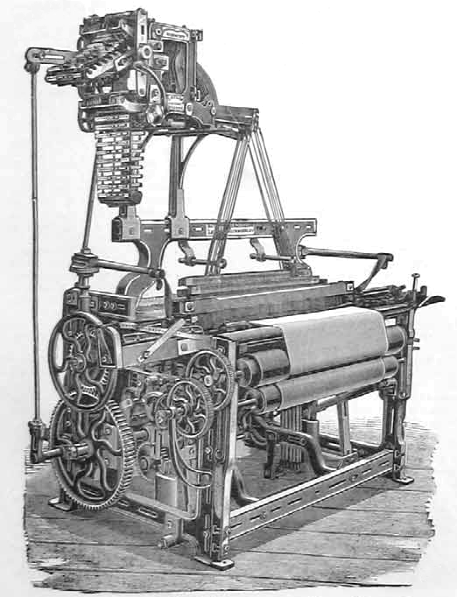
A loom from the 1890s with a dobby head

A dobby loom, or dobbie loom,[1] is a type of floor loom that controls all the warp threads using a device called a dobby.[2]

Dobbies can produce more complex fabric designs than tappet looms[2] but are limited in comparison to Jacquard looms. Dobby looms first appeared around 1843, roughly 40 years after Joseph Marie Jacquard invented the Jacquard device that can be mounted atop a loom to lift the individual heddles and warp threads.

The word dobby is a corruption of "draw boy," which refers to the weaver's helpers who used to control the warp thread by pulling on draw threads. A dobby loom is an alternative to a treadle loom. Both are floor looms in which every warp thread on the loom is attached to a single shaft using a device called a heddle. A shaft is sometimes known as a harness. Each shaft controls a set of threads. Raising or lowering several shafts at the same time gives a huge variety of possible sheds (gaps) through which the shuttle containing the weft thread can be thrown.

Control

[edit]
Dobby-loom control mechanism. The pegs driven into the bars (hung in a loop on the left) each lift one "treadle" in a pre-determined pattern, like lifting the teeth of a music box. Hooghly District, West Bengal, 2019
Steam-powered 1894 dobby loom, Queen Street Mill Museum
The successor punched-card control mechanism of a Jacquard loom in use in 2009, Varanasi, Uttar Pradesh, India

A manual dobby uses a chain of bars or lags each of which has pegs inserted to select the shafts to be moved. A computer-assisted dobby loom uses a set of solenoids or other electric devices to select the shafts. Activation of these solenoids is under the control of a computer program. In either case the selected shafts are raised or lowered by either leg power on a dobby pedal or electric or other power sources.

Manual

[edit]

On a treadle loom, each foot-operated treadle is connected by a linkage called a tie-up to one or more shafts. More than one treadle can operate a single shaft. The tie-up consists of cords or similar mechanical linkages tying the treadles to the lams that actually lift or lower the shaft.

On treadle operated looms, the number of sheds is limited by the number of treadles available. An eight-shaft loom can create 254 different sheds. There are actually 256 possibilities, which is 2 to the eighth power, but having all threads up or all threads down is not very useful. Most eight-shaft floor looms have only ten to twelve treadles due to space limitations. This limits the weaver to ten to twelve distinct sheds. It is possible to use both feet to get more sheds, but this is rarely done in practice. It is even possible to change tie-ups in the middle of weaving a cloth but this is a tedious process, so this too is rarely done.

With a dobby loom, all 254 possibilities are available at any time. This vastly increases the number of cloth designs available to the weaver. The advantage of a dobby loom becomes even more pronounced on looms with 12 shafts (4094 possible sheds), 16 shafts (65,534 possible sheds), or more. It reaches its peak on a Jacquard loom in which each thread is individually controlled.

Another advantage to a dobby loom is the ability to handle much longer sequences in the pattern. A weaver working on a treadle loom must remember the entire sequence of treadlings that make up the pattern, and must keep track of where they are in the sequence at all times. Getting lost or making a mistake can ruin the cloth being woven. On a manual dobby the sequence that makes up the pattern is represented by the chain of dobby bars. The length of the sequence is limited by the length of the dobby chain. This can easily be several hundred dobby bars, although an average dobby chain will have approximately fifty bars.

Computer

[edit]

A computer-controlled dobby loom takes this one step further by replacing the mechanical dobby chain with computer-controlled shaft selection. In addition to being able to handle sequences that are virtually unlimited, the construction of the shaft sequences is done on the computer screen rather than by building a mechanical dobby chain. This allows the weaver to load and switch weave drafts in seconds without even getting up from the loom. In addition, the design process performed on the computer provides the weaver with a more intuitive way to design fabric; seeing the pattern on a computer screen is easier than trying to visualize it by looking at the dobby chain.

Dobby looms expand a weaver's capabilities and remove some of the tedious work involved in designing and producing fabric. Many newer cloth design techniques such as network drafting can only reach their full potential on a dobby loom.

See also

[edit]

References

[edit]
Revisions and contributorsEdit on WikipediaRead on Wikipedia
from Grokipedia
A dobby loom is a type of loom equipped with a dobby mechanism, a shedding device that selectively controls the lifting of 12 to 40 heald shafts to interlace yarns, enabling the production of small, repeating geometric patterns such as stripes, checks, or motifs in fabrics. The term 'dobby' originates from 'draw-boy,' the name for the assistant who manually controlled the warp threads on earlier drawlooms. Unlike looms limited to basic weaves, the dobby loom facilitates more intricate designs without requiring the complexity of a Jacquard attachment, making it suitable for both hand and power operations. The emerged in the early as an innovation in textile machinery, with American inventor William Crompton patenting a featuring a dobby head and in , building on earlier cam-controlled systems to allow greater pattern flexibility. This development, inspired by European fancy weaves like diamond-patterned cassimere, revolutionized fabric production by enabling mills to create patterned woolens and cottons more efficiently and affordably than with labor-intensive drawlooms or costly Jacquard mechanisms. By the mid-1800s, dobby-equipped looms had boosted U.S. cassimere output dramatically, from about 2.5 million yards in 1845 to over 15 million yards by 1865, supporting industries like men's and uniforms during the Civil War. In operation, the dobby mechanism uses a series of hooks, knives, and levers—often driven by the loom's —to raise specific harness combinations per pick, with designs programmed via a chain of lags with pegs or modern electronic interfaces for precision. Common types include negative and positive dobbies for shaft control, single- or double-lift models for speed variations, and electronic versions integrating CAD software and IoT sensors for real-time monitoring and customization. Today, dobby looms remain vital in studios and industrial settings for producing , apparel, and decorative textiles, with advancements focusing on energy efficiency, , and modular designs to meet global demands.

History

Early Developments

The origins of the dobby loom trace back to the drawloom, a complex weaving device used for creating intricate patterns by lifting groups of warp threads via harnesses. Prior to , this process relied on "draw boys"—young assistants who manually selected and raised specific harness cords to form the desired for each of the weft, a labor-intensive role that limited production speed and efficiency. The term "dobby" is a corruption of "draw boy," reflecting the mechanism's purpose in automating this helper's function. Early efforts to mechanize harness selection emerged in 18th-century , building on the drawloom's limitations compared to simple treadle-operated looms. In 1725, Basile Bouchon, a worker from , invented the first semi-automated system by adapting perforated paper tape—originally used in organ mechanisms—to control the lifting of harness cords on a drawloom, allowing for programmed pattern selection without constant manual intervention. This innovation marked the initial step toward replacing the draw boy with a mechanical selector. Bouchon's system was refined shortly thereafter; in 1728, his assistant Jean-Baptiste Falcon introduced a chain of punched cards, which provided greater flexibility for complex patterns by linking multiple cards in sequence to guide needle-like selectors for the harnesses. Further experimentation continued with Jacques de Vaucanson's 1745 fully automated loom, which employed a rotating barrel with pins to mimic the draw boy's actions more reliably, though it remained limited to repetitive designs. These 18th-century inventions focused on automating group thread control beyond basic treadling, establishing the conceptual foundation for dobby mechanisms. These early developments paved the way for 19th-century refinements, spurred by the Jacquard loom's 1801 debut, which enabled individual thread control and highlighted the need for simpler harness-based automation.

19th-Century Advancements

The dobby loom emerged in the 1830s, when American inventor William Crompton developed a featuring a dobby mechanism in 1836, which he patented in 1837, building on the Jacquard loom's 1801 debut as a simpler shaft-based alternative for controlling groups of warp threads rather than individual ones. This development represented an evolutionary step from 18th-century punched-card concepts, adapting mechanical selection for broader industrial application. A key innovation in these early dobby looms was the pegged-bar system, which used inserted pegs on rotating or sliding bars to select and lift multiple harnesses simultaneously. This mechanism enabled the creation of longer and more varied sequences compared to traditional looms, which were limited by the number of foot-operated and their physical constraints. By the mid-19th century, dobby looms saw initial adoption in industrial textile mills for weaving semi-complex fabrics such as decorative silks and patterned cottons, where efficiency and pattern versatility were essential. Examples of early dobby-equipped floor looms demonstrated capacity for up to 20 harnesses, allowing weavers to produce intricate designs that balanced complexity with production speed in factory settings.

Design and Mechanism

Core Components

The core components of a dobby loom form the foundation for its selective shedding capability, enabling precise control over warp threads to create patterned fabrics. These include the harnesses equipped with heddles, the dobby mechanism with its levers, pegs, and bars, and the integration points with the loom's primary frame elements. Harnesses, also known as heald shafts, consist of rigid frames that support multiple heddles and are suspended within the structure to group and manipulate warp threads. Each harness typically holds a set of parallel heddles—thin wires or flat metal strips with an eye or loop in the center through which individual warp ends pass—allowing for organized lifting or lowering of thread groups to form the . Standard dobby looms accommodate 12 to 24 harnesses, though configurations up to 36 or 48 are possible depending on the fabric complexity and . The dobby mechanism itself is a mechanical assembly mounted atop the , comprising levers, pegs, and bars that translate instructions into harness movements. Levers, including L-levers, T-levers, jack levers, and bulk levers, interconnect to form a linkage where jacks and connectors attach to the harnesses via cords or wires, providing the lifting force. Pegs are inserted into wooden lags or bars arranged in a or , with each peg corresponding to a specific harness; blanks or absences indicate non-lifting positions, based on 19th-century pegged designs. Additional elements like hooks, draw knives, and retaining bars support the levers, ensuring stable engagement during operation. This mechanism links directly to the loom's through a bottom shaft, upright shaft, or via spur wheels and bevel gears, synchronizing harness lifts with the loom's reciprocating motions at a rate matching the speed. Returning springs attached to the harnesses and levers facilitate reset after each cycle, maintaining motion to minimize strain on components. Integration with the overall loom frame occurs primarily through the dobby head mounted on the upper frame, where harnesses suspend from overhead supports and connect to the warp beam at the rear for tensioned thread supply. The reed, held within the beater (or slay) assembly at the front, aligns with the formed by the harnesses to guide weft insertion, while the beater's swinging motion beats the weft into place in coordination with dobby-timed lifts; this attachment enables selective raising of individual or grouped harnesses without interfering with the warp beam's let-off or the beater's path.

Shedding Operation

The shedding operation in a dobby loom begins with the rotation of the , which powers the dobby's selection mechanism to identify and engage specific harnesses based on the desired . As the shaft turns, it drives oscillating knives or levers that interact with hooks connected to jacks; selected hooks onto the knives, lifting the corresponding heald shafts and raising the attached warp threads to form the —an opening through which the weft can pass. In negative dobby systems, unselected harnesses remain lowered by spring tension, while positive systems actively control both raising and lowering motions for greater precision. Once the is formed, the shuttle inserts the weft through the opening during the loom's picking phase, after which the continues its cycle to disengage the hooks, allowing the lifted harnesses to lower and close the . This sequence repeats synchronously with the overall cycle, driven by the bottom shaft or , ensuring the shedding aligns precisely with beating-up and other motions. The operation includes a dwell period—typically 60 to 120 degrees of shaft rotation—during which the remains stable to facilitate reliable weft insertion and minimize vibrations that could arise from rapid changes, offering smoother performance than the quicker oscillations in systems despite the dobby's relatively slower speed. The dobby's capacity for pattern complexity stems from its ability to produce up to 2n2^n unique shed configurations, where nn is the number of harnesses; for instance, with 8 harnesses, it enables 256 distinct s (28=2562^8 = 256), supporting weave repeats that extend far beyond the limitations of manual treadling on simpler looms. This combinatorial potential allows for intricate designs without the need for individual thread control, though practical setups commonly use 12 to 24 harnesses for balanced operation.

Control Methods

Manual Systems

Manual dobby looms rely on a mechanical system of pegged wooden or metal bars, often referred to as lags, that are linked together to form a continuous . These bars feature rows of holes into which short metal pegs are inserted to select specific harnesses for lifting during each of the weft. The placement of pegs on a bar determines which heald shafts rise to form the , allowing for patterned without the need for multiple tie-ups. The length of the chain imposes a practical limit on the and repeat of the weave , as each bar corresponds to one . Typical configurations use 20 to 48 bars, with common setups featuring 16, 24, or 36 bars to accommodate up to 48 harnesses, though smaller chains of 8 to 12 lags are employed for simpler designs. Beyond this length, extending the chain becomes cumbersome, restricting patterns to repeats that fit within the chain's capacity. In operation, the weaver plays a central role by assembling the chain according to a pre-planned , inserting pegs manually to encode the desired . During , the weaver advances the chain by operating treadles or levers, which rotate the chain to position the next bar, requiring ongoing physical effort to maintain tension and alignment. Complex designs demand heightened vigilance and labor, as frequent adjustments to the pegs or chain can strain the mechanism and the operator, particularly in handloom setups where power is provided solely by manual force. Historically, manual dobby systems found extensive use in small-scale handloom for producing intricate dobby patterns in and fabrics, such as check dress goods, tartans, coatings, and trouserings. These looms enabled artisans to create figured textiles like saree borders or lightweight weaves without the expense of larger machinery, thriving in industries and regional workshops from the late onward. The basic shedding process is triggered by the pegs engaging levers or vibrators to lift the selected harnesses, forming the for the shuttle's passage.

Electronic Systems

Electronic dobby looms employ actuators to replace traditional mechanical pegs, enabling precise control over harness movements through electrical signals rather than physical linkages. These actuators, typically electromagnets operating at voltages like 24 V DC, extend or retract to lift or lower heddle frames, sequenced by programs that interpret patterns in real time. For instance, in systems like the Compu-Dobby II, solenoids in a dedicated box push cables into dobby arm slots to select harness lifts, with the microprocessor handling diagnostics and motion timing to ensure synchronization with the loom's picking cycle. This electronic setup allows for unlimited length, as designs are stored and executed via software rather than fixed mechanical chains, overcoming the constraints of physical components. Microcontrollers, such as the ATmega128, manage data from chips, converting it into commands through serial shift outputs and power amplification circuits like ULN2803 drivers. Patterns can be dynamically altered during operation, supporting complex weaves without hardware reconfiguration, as demonstrated in rotary electronic dobbies integrated with rapier looms. The design process for electronic dobby systems involves pattern drafting on computer screens using specialized weaving software, followed by simulation to preview fabric outcomes before direct loading onto the loom's control unit. Features like or interfaces enable network connectivity, allowing shared designs across multiple machines or remote uploads from human-machine interfaces (HMIs). This streamlines production in industrial settings, where operators can edit and manage patterns efficiently without interrupting weaving. Since the late , electronic dobby systems have seen widespread adoption in mills, evolving from early integrations in the to become standard in high-speed . Energy-efficient models, incorporating servo motors and optimized control algorithms, reduce power consumption by up to 25% compared to mechanical predecessors and minimize through predictive diagnostics and automated fault detection. These advancements have enhanced scalability in industrial applications, particularly for and air-jet looms producing intricate fabrics. As of 2025, electronic dobby systems increasingly incorporate AI for optimization and sustainable materials processing, enhancing efficiency in global production.

Advantages and Limitations

Primary Benefits

The excels in producing intricate patterns, such as geometric motifs or simple florals, by utilizing a dobby mechanism that controls multiple harnesses independently, allowing for a large number of unique combinations through binary selection of lifts with multiple shafts. This capability minimizes the weaver's manual intervention during operation, as the dobby automates shed formation for each pick, enabling precise execution of complex designs without constant adjustments. Compared to traditional systems, dobby looms significantly reduce setup time by eliminating the need for extensive tie-up configurations under the loom, streamlining preparation for changes and allowing to focus on production rather than mechanical adjustments. In electronic dobby variants, lower power consumption supports high-speed operations while maintaining efficiency, as the computerized controls optimize energy use for sustained performance. Recent applications as of 2024 include multi-layer weaves for , expanding versatility in smart and sustainable fabric production. Dobby looms demonstrate remarkable versatility, adapting seamlessly to both handweaving in artisanal settings and industrial-scale production, where they facilitate the creation of textured fabrics suitable for or apparel applications. Electronic controls in these systems further enhance this flexibility by enabling quick design modifications through digital interfaces.

Key Drawbacks

Dobby looms, particularly in their mechanical configurations, incur higher initial costs compared to simpler looms due to the intricate components required for selection, such as lags, pegs, and chains. Setup is a significant drawback, especially for manual versions, where designing s involves time-consuming manual placement of pegs into wooden lags or chains, and long repeats demand numerous lags that can be physically strenuous to handle and lift. Mechanical dobby mechanisms also exhibit greater power consumption than tappet systems, as the additional levers, hooks, and drives necessitate more energy for operation. This elevated power use contributes to increased , particularly at higher speeds, which limits operational efficiency and can accelerate wear on components. A fundamental constraint of dobby looms lies in their reliance on heald shafts to control groups of warp threads simultaneously, making them unsuitable for highly irregular or highly detailed that require individual thread manipulation, as each shaft typically handles multiple ends rather than single yarns. Electronic dobby systems can mitigate some maintenance challenges associated with mechanical wear through reduced costs, but core limitations in cost, power, and persist across variants; additionally, they require skilled workforce training and face integration challenges with legacy systems.

Comparisons

With Tappet Looms

Dobby looms differ from looms primarily in their capacity for pattern complexity, as dobby mechanisms enable arbitrary sequences of heald shaft lifts, allowing for longer repeats exceeding 12 picks and intricate motifs across up to 48 shafts, whereas looms rely on fixed cam-driven cycles limited to simple weaves with repeats typically confined to 2–12 picks and a maximum of 8–14 heald shafts. This flexibility in dobby systems arises from programmable chains or lags, which support virtually unlimited pick repeats for varied designs, in contrast to the rigid, repetitive patterns of cams suited only for basic structures like or weaves. Operationally, tappet looms achieve higher speeds with reduced vibration and power consumption due to their simpler mechanical , making them ideal for efficient production of uniform basic fabrics, while dobby looms operate at somewhat lower speeds owing to increased friction and complexity in coordinating multiple shafts for diverse motifs. Dobby's shedding mechanism, governed by combinatorial selections of shaft combinations, thus permits exponentially more pattern variations than the limited configurations of tappet systems. Historically, looms dominated prior to the and into its early years, serving the industrial production of plain , low woolens, and simple twills where minimal pattern variation sufficed. The advent of dobby mechanisms in the early , with notable developments like the dobby by around 1843, marked a shift toward addressing growing demands for complex fancy fabrics in woolens and worsteds, gradually supplanting looms for applications requiring greater design versatility.

With Jacquard Looms

The dobby loom and the Jacquard loom both facilitate complex shedding mechanisms in , but they differ fundamentally in their approach to controlling warp threads. The dobby loom operates by lifting groups of warp yarns through a limited number of heald frames or shafts, typically ranging from 16 to 48, which allows for moderately intricate patterns such as stripes, checks, and small motifs in fabrics like coatings and dress goods. In contrast, the Jacquard loom controls each individual warp thread independently using a system of hooks and harness cords, enabling unlimited complexity without shaft limitations, making it ideal for elaborate ornamental fabrics like tapestries and brocades. Operationally, the dobby mechanism relies on pattern chains, pegs, or modern electronic controls to selectively raise or lower heald frames, producing open or center-closed sheds that are mechanically timed for efficiency. This grouped control limits resolution to about 24 independent ends for fine details, restricting it to patterns that do not require pixel-level precision across wide widths. The Jacquard system, however, uses punched cards or electronic equivalents to actuate hundreds to thousands of hooks (up to 12,288 in advanced setups), allowing each warp end to move autonomously and form highly detailed, multi-color designs with no such grouping constraints. As a result, dobby looms occupy a middle ground between simpler tappet systems and the Jacquard's advanced figuring capacity, offering versatility for basic fancy weaves but falling short for designs demanding individual thread manipulation. In terms of advantages, dobby looms are generally simpler, faster, and more cost-effective than Jacquard looms, with lower maintenance needs due to fewer moving parts and the ability to handle up to 48 shafts for a wide range of fabrics without excessive complexity. They also support positive box motions and easing mechanisms that reduce strain during operation, making them suitable for high-speed production of moderately patterned textiles. Jacquard looms, while excelling in design flexibility and enabling intricate, large-scale patterns, are more expensive—often twice the cost of a comparable dobby setup—and slower due to their delicate, card-driven precision, which requires frequent tuning. Limitations of the dobby include its inability to produce very complex motifs beyond 48 shafts, potentially leading to defective shedding in overly ambitious designs, whereas Jacquard's individual control avoids such restrictions but at the expense of operational delicacy. Overall, the choice between dobby and Jacquard looms depends on pattern intricacy: dobby suits economical production of semi-complex weaves, while Jacquard is preferred for high-end, detailed artistry where resolution trumps speed and cost.

References

Add your contribution
Related Hubs
User Avatar
No comments yet.