Hubbry Logo
Domino tilingDomino tilingMain
Open search
Domino tiling
Community hub
Domino tiling
logo
8 pages, 0 posts
0 subscribers
Be the first to start a discussion here.
Domino tiling
Domino tiling
from Wikipedia
A domino tiling of an 8×8 square

In geometry, a domino tiling of a region in the Euclidean plane is a tessellation of the region by dominoes, shapes formed by the union of two unit squares meeting edge-to-edge. Equivalently, it is a perfect matching in the grid graph formed by placing a vertex at the center of each square of the region and connecting two vertices when they correspond to adjacent squares.

Height functions

[edit]

For some classes of tilings on a regular grid in two dimensions, it is possible to define a height function associating an integer to the vertices of the grid. For instance, draw a chessboard, fix a node with height 0, then for any node there is a path from to it. On this path define the height of each node (i.e. corners of the squares) to be the height of the previous node plus one if the square on the right of the path from to is black, and minus one otherwise.

More details can be found in Kenyon & Okounkov (2005).

Thurston's height condition

[edit]

William Thurston (1990) describes a test for determining whether a simply-connected region, formed as the union of unit squares in the plane, has a domino tiling. He forms an undirected graph that has as its vertices the points (x,y,z) in the three-dimensional integer lattice, where each such point is connected to four neighbors: if x + y is even, then (x,y,z) is connected to (x + 1,y,z + 1), (x − 1,y,z + 1), (x,y + 1,z − 1), and (x,y − 1,z − 1), while if x + y is odd, then (x,y,z) is connected to (x + 1,y,z − 1), (x − 1,y,z − 1), (x,y + 1,z + 1), and (x,y − 1,z + 1). The boundary of the region, viewed as a sequence of integer points in the (x,y) plane, lifts uniquely (once a starting height is chosen) to a path in this three-dimensional graph. A necessary condition for this region to be tileable is that this path must close up to form a simple closed curve in three dimensions, however, this condition is not sufficient. Using more careful analysis of the boundary path, Thurston gave a criterion for tileability of a region that was sufficient as well as necessary.

Counting tilings of regions

[edit]
A domino tiling of an 8×8 square using the minimum number of long-edge-to-long-edge pairs (1 pair in the center). This arrangement is also a valid Tatami tiling of an 8x8 square, with no four dominoes touching at an internal point.

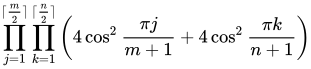
The number of ways to cover an rectangle with dominoes, calculated independently by Temperley & Fisher (1961) and Kasteleyn (1961), is given by (sequence A099390 in the OEIS).

When both m and n are odd, the formula correctly reduces to zero possible domino tilings.

A special case occurs when tiling the rectangle with n dominoes: the sequence reduces to the Fibonacci sequence.[1]

Another special case happens for squares with m = n = 0, 2, 4, 6, 8, 10, 12, ... is

1, 2, 36, 6728, 12988816, 258584046368, 53060477521960000, ... (sequence A004003 in the OEIS).

These numbers can be found by writing them as the Pfaffian of an skew-symmetric matrix whose eigenvalues can be found explicitly. This technique may be applied in many mathematics-related subjects, for example, in the classical, 2-dimensional computation of the dimer-dimer correlator function in statistical mechanics.

The number of tilings of a region is very sensitive to boundary conditions, and can change dramatically with apparently insignificant changes in the shape of the region. This is illustrated by the number of tilings of an Aztec diamond of order n, where the number of tilings is 2(n + 1)n/2. If this is replaced by the "augmented Aztec diamond" of order n with 3 long rows in the middle rather than 2, the number of tilings drops to the much smaller number D(n,n), a Delannoy number, which has only exponential rather than super-exponential growth in n. For the "reduced Aztec diamond" of order n with only one long middle row, there is only one tiling.

Tatami

[edit]

Tatami are Japanese floor mats in the shape of a domino (1x2 rectangle). They are used to tile rooms, but with additional rules about how they may be placed. In particular, typically, junctions where three tatami meet are considered auspicious, while junctions where four meet are inauspicious, so a proper tatami tiling is one where only three tatami meet at any corner.[2] The problem of tiling an irregular room by tatami that meet three to a corner is NP-complete.[3]

Applications in statistical physics

[edit]

There is a one-to-one correspondence between a periodic domino tiling and a ground state configuration of the fully-frustrated Ising model on a two-dimensional periodic lattice.[4] At the ground state, each plaquette of the spin model must contain exactly one frustrated interaction. Therefore, viewing from the dual lattice, each frustrated edge must be "covered" by a 1x2 rectangle, such that the rectangles span the entire lattice and do not overlap, or a domino tiling of the dual lattice.

See also

[edit]

Notes

[edit]

References

[edit]

Further reading

[edit]
Revisions and contributorsEdit on WikipediaRead on Wikipedia
from Grokipedia
Domino tiling refers to the covering of a finite region in the plane, typically composed of unit squares such as a rectangular m × n grid, using dominoes—each a 1 × 2 or 2 × 1 rectangle formed by two adjacent unit squares—such that every square is covered exactly once without overlaps or gaps. Such tilings exist for an m × n grid the total number of squares mn is even, ensuring the region can be bipartitioned into equal sets of black and white squares under a checkerboard coloring. The study of domino tilings originated as a combinatorial puzzle in the early , but gained prominence in 1961 through independent solutions by Percy Kasteleyn and by Harold Temperley and , who connected it to the dimer model in for calculating partition functions of lattice gases. In terms, a domino tiling corresponds to a perfect in the dual of the region, where vertices represent squares and edges connect adjacent pairs, allowing the number of tilings to be computed via the permanent or of the . For the specific case of a 2 × n grid, the number of distinct tilings is given by the (n + 1)th number, where the is defined as F_1 = 1, F_2 = 1, and F_k = F_{k-1} + F_{k-2} for k > 2, reflecting the recursive nature of placements. More generally, for an m × n grid with m even, Kasteleyn's method yields an exact closed-form formula involving a double product over cosines: T(m,n)=j=1m/2k=1n(4cos2πjm+1+4cos2πkn+1)1/2T(m, n) = \prod_{j=1}^{m/2} \prod_{k=1}^n \left( 4 \cos^2 \frac{\pi j}{m+1} + 4 \cos^2 \frac{\pi k}{n+1} \right)^{1/2}, enabling efficient computation via determinants. Beyond rectangles, domino tilings extend to arbitrary regions that have an even number of squares and equal numbers of black and white squares under a coloring; stronger necessary conditions for tileability, using combinatorial , were established by John Conway and in 1990. For simply connected regions, the space of tilings is connected under local flips. Applications span statistical physics, where tilings model dimer coverings to compute free energies and phase transitions in two-dimensional systems, and , where counting tilings is polynomial-time solvable for planar graphs but NP-hard for generalized variants on non-planar surfaces. These connections highlight domino tilings as a foundational problem in , bridging with physical models.

Fundamentals

Definition and Basic Properties

A domino tiling of a finite in the plane, typically a or a portion of the square grid, is a covering of that using 1×2 or 2×1 rectangles known as , such that the dominoes have disjoint interiors, do not overlap, and their union exactly fills the without gaps. Each covers precisely two adjacent unit squares, either horizontally or vertically. A fundamental property of any region admitting a domino tiling is that its total area must be even, as each domino contributes an area of 2, ensuring the parity condition for complete coverage. Moreover, the square grid underlying the region is bipartite, allowing a black-white coloring of the squares such that adjacent squares receive different colors; in any valid tiling, each domino covers exactly one black square and one white square, so the region must contain an equal number of black and white squares. This colorability argument provides a necessary condition for tilability and can demonstrate impossibility in certain cases. For example, a can always be tiled with when n is a positive , as illustrated by the simplest case of a 2×2 grid, which admits two tilings: either two horizontal dominoes stacked vertically or two vertical dominoes side by side. A 4×4 grid expands this to more configurations, such as all vertical dominoes in columns, all horizontal in rows, or mixed arrangements like a central 2×2 block of verticals surrounded by horizontals, highlighting the combinatorial variety while maintaining the even-area and balanced-coloring properties. The number of such tilings for the 2×n case follows the , offering an initial glimpse into enumeration patterns. A classic illustration of the coloring condition's power is the mutilated 8×8 , where two opposite corners (both the same color, say white) are removed, leaving 30 white squares and 32 black squares; since no domino can cover two squares of the same color, a tiling is impossible despite the even total area of 62. Such examples underscore the interplay between geometric structure and graph-theoretic bipartiteness in determining tilability.

Historical Development

The , a classic involving , was first formally proposed by philosopher Max Black in his 1946 book , where he posed the question of whether a standard 8×8 with two opposite corners removed could be covered by 31 , each covering two adjacent squares. This puzzle, which demonstrates impossibility through a simple coloring argument (removing two squares of the same color leaves an imbalance), gained popularity in and highlighted early interest in tiling constraints, though themselves trace back to ancient Chinese tile games from around 1120 CE, with European adoption by the . Early enumerative efforts, such as Percy MacMahon's work on rectangular tilings in 1916, laid groundwork for formal study. In the mid-20th century, domino tiling transitioned from puzzles to rigorous mathematical study, particularly through connections to . In 1961, physicist Pieter W. Kasteleyn developed the Pfaffian method to count the exact number of domino tilings of planar regions, expressing it as the square root of a of a specially oriented , a breakthrough motivated by dimer models in physics. Independently that same year, H. N. V. Temperley and Michael E. Fisher arrived at a similar result using techniques for lattice coverings, establishing the foundations for enumerating perfect matchings in bipartite graphs and linking tilings to partition functions in two-dimensional systems. These works formalized domino tilings as a model for solving broader problems in and physics during the 1960s. Further advancements in the and deepened the theoretical framework. William introduced height functions in 1990 to characterize valid domino tilings of simply connected regions, assigning integer heights to vertices such that adjacent heights differ by ±1 or ±3, providing a criterion for tileability without explicit construction. A key milestone came in 1992 with the introduction of the Aztec diamond by Noam , Greg Kuperberg, Michael Larsen, and James Propp, a centered square region whose tilings exhibit phenomena in random configurations, connecting to probabilistic limits. Influential figures shaped the field's evolution. Solomon Golomb (1932–2016), a pioneering combinatorialist, coined the term "polyominoes" in 1953 while studying connected unions of squares, including as the simplest case, and explored their tiling properties in his seminal 1965 book Polyominoes: Puzzles, Patterns, Problems, and Packings. Richard Stanley, a leading enumerative combinatorialist, applied theory to count domino tilings of regions like rectangles and Aztec diamonds, linking them to plane partitions and alternating-sign matrices in works from the 1980s onward. James Propp, a mathematician at the , popularized domino tilings through puzzles, research groups, and expository articles in the , notably advancing enumeration techniques and random tiling statistics via the Aztec diamond. These contributions have influenced modern applications in , where dimer models simulate phase transitions and critical phenomena.

Representational Frameworks

Height Functions

Height functions offer a bijective correspondence between domino tilings of a simply connected planar and certain integer-valued functions on the vertices of the . A height function assigns an integer height to each vertex in the such that the in heights between two adjacent vertices connected by a grid edge is either 1 or 3. Specifically, if the connecting edge is not crossed by a (i.e., separates squares covered by different or is on the boundary), the heights differ by ±1; if the edge is crossed by a (i.e., is the internal shared boundary between the two squares of a ), the difference is ±3. The sign of the difference depends on the orientation of the traversal relative to a fixed coloring of the squares, where black and white squares alternate. This setup interprets the tiling as a stepped surface in three dimensions, with representing height steps of 3 units and uncrossed edges as 1-unit changes. To construct a height function from a given domino tiling, assign height 0 to one base vertex and propagate heights to adjacent vertices according to the difference rules: traversing an edge crossed by a horizontal domino increases or decreases the height by 3 depending on whether the traversal goes from the "lower" to "higher" side or vice versa (with sign determined by the coloring), while edges crossed by vertical dominoes follow analogous rules rotated by 90 degrees; uncrossed edges change height by 1 in the appropriate direction. The resulting heights are path-independent due to a net change of 4 around each unit square plaquette and are defined up to an additive constant; they are considered modulo 4, reflecting the four possible local configurations around a plaquette due to the bipartite nature of the grid. Distinct tilings correspond precisely to distinct equivalence classes of such height functions with fixed boundary values, establishing the bijection. These height functions possess notable properties, including , where the heights along any path from boundary to interior exhibit a single peak, and convexity, meaning the function lies below its tangent planes in a discrete sense, facilitating analysis of the tiling space as a distributive lattice under local flips. Moreover, height functions relate directly to perfect matchings in the of the region, where vertices represent squares, edges connect adjacent squares, and the matching encodes the domino placements via the ±3 differences across the crossed edges. As an illustrative example, consider a 2×4 , a simply connected region with even area. Fix boundary conditions by setting the bottom-left vertex to height 0 and propagating along the boundary: the bottom row vertices might have heights 0, 1, 2, 3, with upper rows adjusted accordingly based on the tiling. For the all-horizontal tiling (horizontal in each row), the heights form a flat stepped surface with differences of 3 across the vertical internal edges of each and 1 along horizontal edges. An alternative all-vertical tiling shifts the heights, creating a different 4, while maintaining fixed boundary values that ensure compatibility with the region's parity.

Thurston's Height Condition

In 1990, established a precise criterion for determining whether a given on the vertices of a simply connected corresponds to an actual domino tiling, leveraging the structure of Conway's tiling groups to encode tiling configurations via integer-valued heights. This theorem provides both a necessary and sufficient condition for realizability, enabling efficient algorithmic checks for tileability. The formal statement of Thurston's theorem is as follows: Let RZ2R \subset \mathbb{Z}^2 be a simply connected polyomino with vertex set V(R)V(R), and let h:V(R)Zh: V(R) \to \mathbb{Z} be an integer-valued function with h(0,0)=0h(0,0) = 0. Then hh is the height function of a domino tiling of RR if and only if it satisfies the following slope conditions:
(i) For any two vertices x=(a1,b1),y=(a2,b2)V(R)x = (a_1, b_1), y = (a_2, b_2) \in V(R) with a1a2(mod2)a_1 \equiv a_2 \pmod{2} and b1b2(mod2)b_1 \equiv b_2 \pmod{2}, h(x)h(y)0(mod4)h(x) - h(y) \equiv 0 \pmod{4}.
(ii) For every boundary edge (x,y)(x, y) in R\partial R, oriented such that the interior white square (in the chessboard coloring) lies to the left, h(x)h(y)=1h(x) - h(y) = 1.
(iii) For every internal edge (x,y)E(R)(x, y) \in E(R), h(x)h(y)3|h(x) - h(y)| \leq 3.
These conditions ensure that height changes across edges are "balanced," forming consistent paths around each face with a net increase of 4 in the counterclockwise direction (reflecting the four unit steps around an untiled square face, adjusted for domino placements that effectively reroute the path with a +3/-1 pair across the domino). Forbidden configurations include height drops exceeding 3 on any edge (violating the Lipschitz-like bound) or parity mismatches that prevent reconstruction of tiles. The proof relies on topological arguments within the of the tiling group, where the arises as a to Z\mathbb{Z} (the abelianization capturing net displacements). To show sufficiency, one constructs the maximal by iteratively placing at boundary-determined local maxima, ensuring no interior violations; this process terminates with a tiling if the conditions hold, as lifts to cover avoid intersections akin to train tracks in the plane. Equivalence to non-intersecting lattice paths follows by mapping the height gradients to path elevations, where valid heights correspond to non-crossing configurations in the . Necessity is verified by direct integration along tiling boundaries, confirming the local rules. For illustration, consider a 4×4 grid region with 8 black and 8 white squares. A valid for the all-horizontal tiling might assign heights starting at 0 on the bottom-left vertex, increasing by 1 along horizontal edges and by 3 vertically across each horizontal domino pair (e.g., row vertices: 0,1; next row: 2,3; and so on, satisfying parity and bounds). An invalid function, such as one with a +4 jump on an internal horizontal edge, violates condition (iii), corresponding to an impossible "overhang" that cannot be resolved by any domino placement, as it implies a disconnected or overlapping .

Enumeration Techniques

Counting Tilings of General Regions

The enumeration of domino tilings for general planar regions corresponds to counting the number of perfect matchings in the of the region, where each vertex represents a and edges connect adjacent squares. A seminal approach, developed by Kasteleyn in 1961, involves orienting the edges of the to create a skew-symmetric whose equals the of the , yielding the exact number of perfect matchings as the absolute value of this . Specifically, for a graph GG with KK under such an orientation, the number of tilings is detK\sqrt{|\det K|}
Add your contribution
Related Hubs
User Avatar
No comments yet.