Hubbry Logo
Doti DistrictDoti DistrictMain
Open search
Doti District
Community hub
Doti District
logo
8 pages, 0 posts
0 subscribers
Be the first to start a discussion here.
Doti District
Doti District
from Wikipedia

Doti District (Nepali: डोटी जिल्ला pronounced [ɖoʈi] ), part of Sudurpashchim Province, is one of the seventy-seven districts of Nepal. This district, with Silgadhi as its headquarters, covers an area of 2,025 square kilometres (782 sq mi) with a population of 207,066 in 2001 and increasing marginally to 211,746 in 2011.[1]

Key Information

History

[edit]

Doti was a medieval kingdom of Kumaon. It was founded by Niranjan Malla Dev, the last son of the Katyuri dynasty and younger brother of Abhay Pal of Askot. Previously, the area between Ramganga in the west and the Karnali River in the east was under the control of the Raikas (rulers of the Doti kingdom, alternately Kumaun or Rainka Maharaj).[2]

Ancient Doti was a part of Kumaon Kingdom, Now remaining Kumaon region is part of Uttrakhand a state in modern-day india, Nepal's neighboring country. Kingdom of Kumaon lost Doti during the expansion of Nepal Kingdom in 1790. It was formed after the Katyuri Kingdom's disintegration during the 13th century.[3] Doti was one of eight different princely states formed after the disintegration, and all claim Katyuri heritage.[4] The seven other known states are:

  • Baijnath-Katyuri
  • Dwarahat
  • Baramandal
  • Askot
  • Sira
  • Sora
  • Sui (Kali Kumaon)

The Katyuri Kingdom's dissolution is attributed to the invasion of Khas Kings Ashoka Challa and Krachalla, from the Karnali zone (Dullu) in 1191 and 1223 respectively.[5] Later, the whole land between Ramganga in the west (Uttarakhand) and the Karnali in the east (which divides the far western region from other parts of Nepal), came under the Raikas' rule — after the establishment of the Katyuri's dynastic Raikas Doti. Brahma Dev Mandi at Kanchanpur; a district within Mahakali, was established by Katyuri King Brahma Dev.

Raikas of Doti and their lineage

[edit]

Historical evidence [6] of the following raikas has been discovered:

  • Niranjan Malla Dev (founder of Doti Kingdom beginning of the 13th century)
  • Nagi Malla (1238)
  • Ripu Malla (1279)
  • Nirai Pal (1353) may be from Askot as historical evidence from 1354 AD relating to him has been found in Almora.[7]
  • Nag Malla (1384)
  • Dhir Malla (1400)
  • Ripu Malla (1410)
  • Anand Malla (1430)
  • Balinarayan Malla (1400)[8]
  • Sansar Malla (1442)
  • Kalyan Malla (1443)
  • Suratan Malla (1478)
  • Kriti Malla (1482)
  • Prithivi Malla (1488)
  • Medini Jay Malla (1512)
  • Ashok Malla (1517)
  • Raj Malla (1539)
  • Arjun Malla/Shahi (1500 [8])
  • Bhupati Malla/Shahi (1558)
  • Sagaram Shahi (1567)
  • Hari Malla/Shahi (1581; last Raika of Sira, and the adjoining part of Nepal[8][9])
  • Rudra Shahi (1630)
  • Vikram Shahi (1642)
  • Mandhata Shahi (1671)
  • Raghunath Shahi (1690)
  • Hari Shahi (1720)
  • Krishna Shahi (1760)
  • Deep Shahi (1785)
  • Prithivi Pati Shahi (1790; He had fought against the Nepali army and also with the British in 1814 AD)[10][11]

Conflict with Kingdom Of Nepal

[edit]

The historic place of war between the Doti Kingdom and Nepal kingdom during the period of Expanding Kingdom of Nepal in 1790, is Nari-Dang which lies on the bank of the Seti River and Dumrakot was the base of the Doti Kingdom during the fighting against the Gorkhalis.[12]

Doti was captured by Nepali/Gorkhali forces, and the Nepali rulers went on to destroy several historical sites in Doti — attempting to cover its legendary bravery and tenacity.[12] The Dotyali people were also subject to ethnic prejudice, and were frequently excluded from government jobs and offices of state.[12] Somehow in 1950, a few Dotyalis established their identities as national heroes based solely on their courage, daring, and contribution to their country.[12] Noted among them are Martyr Dashrath Chand Ministry of Home Affairs, Martyr Bhim Dutta Pant Ministry of Home Affairs, and K.I. Singh,[13][14] a revolutionary leader who later became prime minister.

Geography and climate

[edit]
Climate Zone[15] Elevation Range % of Area
Lower Tropical below 300 meters (1,000 ft)  0.1%
Upper Tropical 300 to 1,000 meters
1,000 to 3,300 ft.
22.2%
Subtropical 1,000 to 2,000 meters
3,300 to 6,600 ft.
58.8%
Temperate 2,000 to 3,000 meters
6,400 to 9,800 ft.
17.6%
Subalpine 3,000 to 4,000 meters
9,800 to 13,100 ft.
 1.2%

Demographics

[edit]
Historical population
Census yearPop.±% p.a.
1981 153,135—    
1991 167,168+0.88%
2001 207,066+2.16%
2011 211,746+0.22%
2021 205,683−0.29%
Source: Citypopulation[16]

At the time of the 2021 Nepal census, Doti District had a population of 204,831. 10.79% of the population is under 5 years of age. It has a literacy rate of 70.74% and a sex ratio of 1188 females per 1000 males. 64,367 (31.42%) lived in municipalities.[17]

Castes/ethnic groups in Doti district (2021)[18]
  1. Chhetri (59.9%)
  2. Kami (11.7%)
  3. Damai (7.07%)
  4. Bahun (6.75%)
  5. Sarki (5.37%)
  6. Magar (3.55%)
  7. Thakuri (3.50%)
  8. Others (2.16%)

Khas people make up a majority of the population with 95% of the population. Chhetris make up 60% of the population, while Khas Dalits make up 24% of the population. Hill Janjatis, mainly Magars, are 4% of the population.[18]

Languages of Doti district (2021)[19]
  1. Doteli (89.1%)
  2. Nepali (7.30%)
  3. Magar Kham (1.35%)
  4. Magar Dhut (1.00%)
  5. Others (1.26%)

At the time of the 2021 census, 89.09% of the population spoke Doteli, 7.30% Nepali, 1.35% Magar Kham and 1.00% Magar Dhut as their first language.[19] In 2011, 6.8% of the population spoke Nepali as their first language.[20]

Religion in Doti District (2021)[21]
Religion Percent
Hinduism
98.97%
Buddhism
0.67%
Other or not stated
0.36%

Administration

[edit]

The district consists of nine municipalities, out of which two are urban municipalities and seven are rural municipalities. These are as follows:[22]

Former Village Development Committees

[edit]

Prior to the restructuring of the district, Doti District consisted of the following Village development committees:

Map of the VDCs in Doti District

See also

[edit]

References

[edit]
Revisions and contributorsEdit on WikipediaRead on Wikipedia
from Grokipedia
Doti District is an administrative district in , far-western , encompassing hilly terrain between the to the west, bordering , and the Karnali River to the east. Covering an area of 2,025 square kilometers, it had a population of 204,831 according to 's 2021 census. The district headquarters is Dipayal Silgadhi, and its economy relies predominantly on , including crops such as , , , and millet, supplemented by rearing and remittances from migrant labor. Historically, served as the core of the medieval Doti Kingdom, established in the 13th century by Niranjan Malla Dev following the decline of the Katyuri dynasty, and it maintained independence until its annexation by the Gorkha Kingdom in 1790 during Nepal's unification wars. The region retains cultural significance through sites like the Saileswori Temple, a key Hindu pilgrimage center, reflecting its blend of ancient traditions and rural Himalayan life. Despite its natural beauty and historical legacy, faces challenges including low agricultural productivity, limited , and high out-migration, contributing to its relative to Nepal's central regions.

History

Origins and the Raika Kingdom

The region encompassing modern emerged as a distinct following the collapse of the Katyuri Kingdom in the Kumaon region during the early 13th century, precipitated by invasions from Khas kings, including Ashoka Challa in 1191 and Krachalla in 1223. This fragmentation allowed for the formation of smaller principalities from former Katyuri territories, with establishing itself as one such entity in the far-western Himalayan foothills, spanning areas between the Kali River and adjacent river valleys. The of "Doti" likely derives from "Dovati," denoting land situated between two rivers, reflecting its geographical positioning amid riverine terrain conducive to early settlement and agriculture. Niranjan Malla Dev, described in historical accounts as the son of the last Katyuri ruler and younger brother of Abhay Pal (ruler of Askot), is credited with founding the Doti kingdom around the mid-13th century. His establishment of the polity marked a shift from the broader Katyuri domain to localized Khas-influenced governance, leveraging the power vacuum to assert control over fertile valleys and trade routes in what is now far-western . The Raika dynasty, with rulers titled Raikas (or Rainka Maharaj), governed Doti as a semi-autonomous kingdom characterized by feudal structures adapted from Katyuri and Khas traditions. Early Raikas expanded their domain by subduing the Khas Malla rulers of the neighboring Karnali Zone, thereby securing and economic resources such as timber, herbs, and pastoral lands essential for sustaining a warrior . This consolidation fostered a stable medieval polity reliant on agrarian surplus and intermittent warfare, with administrative centers like Ajemeru serving as early capitals, though precise boundaries fluctuated amid regional power struggles. Historical records of the era remain fragmentary, drawn primarily from local chronicles and inscriptions, underscoring the kingdom's role as a between emerging powers in Kumaon and the Nepalese hills.

Lineage of Raikas and Medieval Governance

The Raika dynasty emerged in the 13th century following the disintegration of the Katyuri Kingdom, with Niranjan Malla Dev establishing as an independent realm. As the son of the last Katyuri ruler and younger brother of Abhay Pal (ruler of Askot), Niranjan Malla Dev founded the kingdom amid the fragmentation of Katyuri territories into multiple principalities. The Raikas, as the rulers were titled (also rendered as Rainka Maharaj), traced their legitimacy to this Katyuri heritage while adopting Shahi surnames in later generations. Successive Raikas expanded Doti's domain through military campaigns, notably defeating the Khas Malla rulers of the Karnali region to secure control over far-western territories stretching from the River in the west to the Karnali in the east. Inscriptions provide evidence of key figures: Niraya Pal asserted sovereignty around 1352 CE, while Naga Malla subsequently consolidated authority over the broader Karnali area. By the late medieval period, Raika Mandhata Shahi issued a copper-plate grant in Saka Era 1612 (approximately 1690 CE), documenting land endowments in the Khas language using script, indicative of ongoing administrative practices. Medieval governance under the Raikas operated as a within the confederation of western hill states, with the Raika exercising centralized authority supported by regional chieftains and feudal obligations. Administration relied on copper-plate inscriptions for recording grants, collection, and judicial decisions, mirroring systems in contemporaneous Kumaon and Karnali polities. Defensive fortifications, such as those at Ajemeru, underscored the kingdom's focus on security against incursions, including a 16th-century Mughal expedition led by Hussain Khan. This structure sustained Doti's autonomy until the Gorkha expansions of the late .

Conflicts and Integration with the Kingdom of Nepal

The Kingdom of Doti, ruled by the Raika dynasty as one of the principalities in western Nepal, faced military pressure from the expanding Gorkha Kingdom following the death of in 1775. Under his successors, particularly during the reign of , Gorkha forces targeted the far-western kingdoms to consolidate control over fragmented hill states. Doti's rulers mounted resistance against these incursions, leveraging the rugged terrain and alliances with neighboring Kumaon to defend their sovereignty. Key conflicts erupted in the late , with a pivotal battle occurring at Nari-Dang on the banks of the in , marking a historic clash between forces and Gorkha troops during the broader unification campaigns. This engagement highlighted Doti's defensive efforts, but Gorkha military superiority, bolstered by disciplined and , prevailed in subsequent confrontations, including a fierce battle at Dumrakot. Raika Pad Shahi, the last independent king of , was forced into exile following these defeats, signifying the collapse of Doti's . Annexation of Doti into the Kingdom of Nepal occurred around 1790, integrating its territories administratively under Gorkha governance and ending the Raika lineage's rule. While some local accounts suggest lingering semi-autonomy until 1847, when final merger and deposition of residual royal claims took place, the primary conquest aligned with Gorkha's western expansion phase. This incorporation subjected Doti to central taxation, military conscription, and land reforms typical of Gorkha administration, though local customs persisted under appointed governors. The region's retention by Nepal after the (1814–1816), unlike territories west of the Kali River ceded to British India via the , solidified its place within the unified kingdom.

Geography

Location and Topography

Doti District is located in in the far-western region of , with its administrative at Dipayal Silgadhi. Centered at approximately 29°15′N 80°55′E, the district spans 2,025 square kilometers and shares borders with Baitadi and Dadeldhura districts to the west, Bajhang and Achham to the north, Kailali to the south, and Surkhet to the east. The topography of Doti is predominantly hilly, forming part of Nepal's mid-hills region, with rolling hills, deep river valleys carved by waterways like the , and pockets of fertile plains suitable for . Elevations vary significantly, starting from around 600 meters in lower valleys to exceeding 3,280 meters at the district's high points, with an average of 1,451 meters across the terrain.

Climate and Natural Resources

Doti District experiences a temperate highland tropical characterized by dry winters, with annual mean temperatures averaging 22.84°C. totals approximately 1145 mm annually, with the majority—around 802 mm—occurring during the season from to . Climatic conditions vary by , ranging from subtropical in lower valleys to temperate in higher hills, where the district's average reaches about 1451 meters, though the headquarters at Dipayal Silgadhi sits at 563 meters. The district's natural resources are dominated by extensive forests, which cover approximately 71.3% of the land area, supporting and providing timber, fuelwood, and non-timber products essential for local livelihoods. Water resources include rivers such as the Seti and Sailigad, which facilitate , traditional water mills for grain processing, and potential development, though spring sources have shown declining discharge amid broader Himalayan trends. Agricultural land supports subsistence farming of crops including , , , millet, potatoes, and cash crops like (produced on 313 hectares yielding 3,000 metric tonnes in recent years) and kiwi (64.96 tonnes from 28 hectares). Mineral deposits, primarily with potential for base metals and , occur in limited quantities and have historically supported small-scale . Despite these assets, resource dependency contributes to low , exacerbated by land abandonment and conversion of arable areas to pastures.

Environmental Features and Hazards

Doti District exhibits a predominantly hilly characterized by rolling hills, deep river valleys, and pockets of fertile plains, which support agricultural activities amid scenic landscapes. Forests cover approximately 71.3% of the district's total land area, primarily consisting of mid-hill vegetation types that harbor local and serve as vital resources for livelihoods. The region's , marked by monsoon-influenced wet summers and drier winters, fosters diverse ecosystems but also amplifies susceptibility to seasonal environmental disruptions. Natural hazards in Doti are exacerbated by its steep slopes, fragile , and heavy rainfall, making landslides and floods recurrent threats. For instance, landslides in October 2021 claimed four lives in the district, highlighting the risks to remote settlements. Seismic activity poses another major danger, as evidenced by the 6.6 magnitude on November 9, 2022, centered near Doti, which killed at least six people, injured seven, and damaged over two dozen houses across affected wards. fires, driven by dry conditions and human activities, frequently occur in the extensive wooded areas, threatening vegetation cover and exacerbating . The district's high social vulnerability stems from , limited , and resource dependency, intensifying impacts from these events.

Demographics

According to the National Population and Housing Census conducted by Nepal's Central Bureau of Statistics, Doti District had a population of 204,831 in 2021, down from 211,746 in 2011. This represents a net decline of approximately 6,915 residents over the decade, or an average annual growth rate of -0.32%. Historical census data indicate slower growth prior to 2011. The 2001 census recorded 207,066 inhabitants, reflecting a modest increase of about 2.2% over the subsequent decade to 2011. These figures, derived from Nepal's decennial enumerations, highlight a pattern of initial expansion followed by stagnation or reversal in the district's far-western location, potentially linked to broader national trends of rural-to-urban migration and international labor outflows, though district-specific emigration data remain limited in official releases.
Census YearPopulationChange from Previous Census
2001207,066-
2011211,746+4,680 (+2.3%)
2021204,831-6,915 (-3.3%)
The 2021 stood at 101.2 persons per square kilometer across Doti's 2,025 km² area, underscoring its predominantly rural character with sparse settlement patterns influenced by hilly terrain. Literacy rates and age distributions from the same show 10.79% of the under age 5, but detailed breakdowns for trends require cross-referencing with prior volumes, as annual updates are not systematically published for subnational units.

Ethnic and Religious Composition

Doti District is predominantly inhabited by Khas-Arya ethnic groups, with forming the largest segment of the population, alongside Hill Brahmins (), Thakuri, and communities including , Sarki, and . Smaller proportions consist of indigenous Janajati groups such as Magar. These groups reflect the historical Khas dominance in the far-western hills of , where caste hierarchies and endogamous practices persist. Religiously, the district is overwhelmingly Hindu, aligning with the Khas ethnic majority's adherence to Hinduism. The 2021 National Population and Housing Census recorded a total population of 204,831, with the following distribution:
ReligionPopulationPercentage
Hinduism202,71798.97%
Buddhism1,3800.67%
Prakriti3050.15%
Christianity2950.14%
Islam1140.06%
Kirat13<0.01%
Other7<0.01%
This composition underscores 's deep-rooted prevalence, with minority faiths represented in trace numbers, consistent with broader patterns in Nepal's hill districts where exceeds 90% adherence.

Migration Patterns and Urbanization

Doti District experiences significant out-migration, both internal and international, contributing to a negative rate of -2.2% between the 2011 and 2021 censuses. Lifetime out-migration affects 37.9% of the native-born population (77,421 individuals), far exceeding in-migration at 5.8% (11,927 individuals), resulting in a net migration loss of -32.1%. Recent migration (within five years prior to 2021) shows 7.3% out-migration (14,641 individuals) against 1.7% in-migration (3,398 individuals), with a net loss of -5.6%. Rural-to-urban streams dominate internal patterns, driven by economic opportunities, , and , though district-specific rural-urban data indicate outflows from rural hills to provincial urban centers. International migration is male-dominated, with absentees totaling 28,574 (14% of the district population), including 25.4% of males and 4.3% of females. Of these, 95.8% (27,368 individuals) head to , reflecting historical seasonal and labor flows from the far-western hills, while only 604 migrate to the . Approximately 39% of households have international absentees, higher than the Sudurpashchim provincial average of 29.8%, with 69.8% of households reporting at least one migrant in the past five years. Primary drivers include wage labor, exacerbating workforce shortages in and local economies. Urbanization remains limited in Doti, a predominantly rural with a 2021 population of 204,831 spread over 2,025 km². The main urban center, Dipayal Silgadhi Municipality, accounts for about 16.6% of the 's (), but includes mixed rural-urban wards under Nepal's expanded urban criteria post-2017. High out-migration sustains low , with net migration at -13.7%, hindering growth in secondary towns and reinforcing rural depopulation. Provincial trends in Sudurpashchim show urban shares rising to around 44% by 2016, yet lags due to geographic isolation and migration-induced labor deficits.

Culture and Society

Dotyali Language and Dialects

Dotyali, also referred to as Doteli or Dotali, is an of the Khas subgroup spoken predominantly in Nepal's Far Western Region, with Doti District as its historical and linguistic core. It was reclassified by in 2012 as a distinct separate from Nepali, previously treated as a western dialect thereof, and assigned the code dty. The employs the script for writing and exhibits features typical of , including variations in , , and influenced by regional geography. In Doti District, Dotyali functions as the primary mother tongue, reflecting the area's ethnic and cultural identity amid broader Nepali dominance in official domains. Sociolinguistic surveys indicate approximately 250,000 speakers of Dotyali across as of 2012, concentrated in districts including , with stable usage in home and community settings despite Nepali's role as a . Comprehension testing reveals high among varieties, supporting speakers' self-perception as a unified linguistic community. Dialect mapping in and adjacent areas confirms above 80% between core Dotyali forms and neighboring speech, with attitudes favoring leveling toward Doti-centric norms for prestige and unity. The language features at least four principal dialect clusters: the core of , Baitadeli (prevalent in Baitadi and extending to parts of Kanchanpur and Kailali), Darchuleli (in Darchula), and influences from Bajhang and Achham varieties sometimes grouped under broader Dotyali. These exhibit geographical variation, such as distinct pronunciations (e.g., sonority sequencing in clusters) and lexical items tied to local , yet retain shared grammatical structures like pronominal systems differing from standard Nepali. In specifically, the eponymous prevails, characterized by conservative Khas elements and minimal external admixture, though with Nepali and English occurs in urbanizing areas like Dipayal. Efforts to document , such as Shridhar Pant's 2009 Dotyali Byakaran, highlight pluralization and other morphological traits unique to these forms.

Traditional Practices, Festivals, and Social Structure

The social structure of Doti District adheres to the traditional Khas caste system, characterized by hierarchical divisions among (priests and scholars), (warriors and administrators, the dominant group), (historical rulers), and lower castes including Dalits, with endogamous marriages reinforcing these boundaries. is patrilineal, with extended joint families common in rural areas, where authority rests with senior males and inheritance passes through male lines. Inter-caste interactions are governed by notions of purity and pollution, limiting commensality and ritual participation between upper and lower groups, though economic necessities foster pragmatic alliances. A distinctive practice is the miteri system, a ritualized form of fictive kinship established through ceremonies like blood-sharing or symbolic exchanges during weddings or festivals, which obligates mutual aid in labor, hospitality, and lifecycle events to reproduce social ties and mitigate resource scarcity in agrarian communities. This reciprocity extends to agricultural tasks, such as cooperative harvesting, and funeral rites, where miteri partners provide support irrespective of caste, though upper castes often initiate such bonds. Other customs include menstrual seclusion (chhaupadi), historically practiced by some Hindu women in isolation during periods, tied to purity beliefs but increasingly criticized and restricted by law since 2005. Festivals center on Hindu agrarian and familial cycles, with (September-October) featuring 15 days of rituals culminating in tika blessings from elders, animal sacrifices to , and family feasts symbolizing good's triumph over evil, drawing communities to temples like Saileswori for offerings. Tihar (October-November), the five-day Festival of Lights, honors siblings, crows, dogs, cows, and through oil lamps, patterns, and sweets, emphasizing prosperity and nature reverence. (mid-January) marks winter's end with baths in sacred rivers, consumption of sesame laddus and molasses for warmth and vitality, and communal gatherings reflecting seasonal renewal. Local expressions include Deuda performances, a and antiphonal singing tradition by Khas groups during weddings, harvests, or festivals like Gaura Parva, where participants link arms, sway rhythmically, and improvise verses on love, labor, or satire to strengthen community bonds and transmit oral histories. These events, prevalent in Dipayal and rural wards, integrate with broader rituals, underscoring Doti's Khas cultural continuity amid modernization pressures.

Cultural Heritage Sites and Preservation

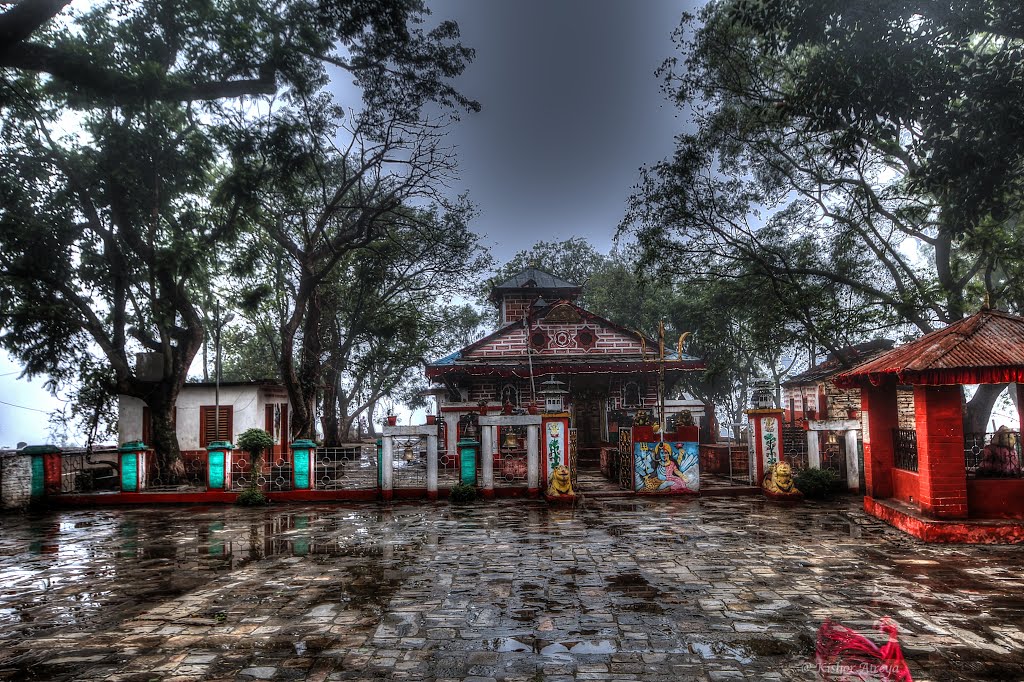
The Shaileshwari Temple, situated in Silgadhi Bazaar of Doti District, stands as the district's premier cultural heritage site, dedicated to Goddess Shaileshwari, a form of revered in Hindu tradition. Established as one of Nepal's most prominent shrines in the western hills, it draws pilgrims particularly during and other festivals, with its architecture and rituals rooted in ancient practices referenced in texts like the . Additional religious landmarks include the Nateshwar Temple and Ugratara Temple, both significant for their historical and spiritual value, attracting devotees from across and contributing to the preservation of local Shaivite and Shakta traditions. Secular heritage encompasses structures like Doti Fort (Silgadhi Fort) and Ganairagauda Durbar, remnants of the medieval Doti Kingdom's royal architecture dating to the or earlier, which reflect the region's pre-Gorkha political history. Preservation efforts in Doti remain limited and under-resourced, with sites like Ganairagauda Durbar reported in a state of dilapidation as of August 2019, lacking systematic repairs despite their archaeological importance under Nepal's Ancient Monuments Preservation Act of 1956. Community and temple-led initiatives at Shaileshwari Temple help sustain rituals and minor upkeep, promoting cultural continuity amid tourism interest, though broader governmental intervention for structural restoration is sparse. No major funded conservation projects specific to Doti's heritage were documented post-2019, highlighting ongoing risks from and decay in this remote far-western district.

Economy and Livelihoods

Agriculture, Trade, and Primary Industries

Agriculture constitutes the primary economic activity in Doti District, employing over 80% of the population in subsistence and semi-commercial farming on terraced hillsides with limited irrigation infrastructure. Major cereal crops include paddy, covering 8,435 hectares with a production of 19,738 metric tons (MT) and a yield of 2.34 MT per hectare; maize, on 3,650 hectares yielding 10,200 MT at 2.79 MT/ha; and wheat, spanning 10,290 hectares for 17,209 MT at 1.67 MT/ha, all figures from fiscal year 2079/80 (2022/23). Millet occupies 3,250 hectares, producing 3,938 MT at 1.21 MT/ha, supporting food security in rain-fed areas. Cash crops drive commercial potential, particularly ginger, cultivated on 785 hectares yielding 10,030 MT at 12.78 MT/ha, with average farm-level productivity reaching 18.18 MT/ha and net returns of 19,200 per ropani after costs of 30,670. Potatoes cover 1,433 hectares, producing 23,501 MT at a high yield of 16.40 MT/ha, while total 1,683 hectares for 18,337 MT at 10.90 MT/ha, including (3,850 MT) and (1,815 MT). Fruit production features on 642 productive hectares yielding 6,122 MT at 9.53 MT/ha. Livestock rearing complements crop farming, with goat populations at 149,614 heads, cattle at 35,614, and buffaloes at 31,135, contributing to output of 1,550 MT annually (including 645 MT chevon and 389 MT buff meat). production totals 17,693 MT, from 17,080 milking cows (11,583 MT) and 4,281 milking buffaloes (6,110 MT), alongside 345,000 eggs from . Fisheries remain negligible, with only 2 MT from 1.5 hectares of ponds. Trade in primary products occurs primarily through local haat bazaars and roads to nearby urban centers like Silgadhi or , with surpluses of ginger and off-season sold to national or Indian markets; ginger's benefit-cost ratio of 1.63 supports its role as a key export-oriented crop, though constraints limit volumes. Overall, the sector faces challenges from low and climate variability, yet provides essential livelihoods amid reliance on remittances for inputs.

Tourism Development and Potential

Tourism in Doti District remains underdeveloped, primarily centered on religious pilgrimage and nascent eco-tourism activities, with limited visitor infrastructure and promotion compared to Nepal's more prominent destinations. Key attractions include the Shaileshwari Temple in Silgadhi, a renowned dedicated to deities such as , Ganesh, and , as described in the , which draws devotees particularly during the festival for special pujas and melas. The temple's hilltop location on Mountain provides panoramic views of valleys and hills, enhancing its appeal for spiritual and scenic tourism. Natural sites contribute to the district's tourism base, including the eastern portion of , established in 1984, which supports trekking, , and visits to the Khaptad Baba Ashram amid mid-mountain biodiversity. Other features encompass the Budar Waterfall for its cascading beauty and the for potential white-water rafting, alongside historical remnants like Silgadhi Fort, offering insights into the region's past. Accessibility has improved via motorable roads from and air links to Dipayal, though remote trails to sites like the temple require through villages and forests. Development initiatives are guided by the Sudurpaschim Province Tourism Master Plan (2018-2028), which envisions sustainable growth through enhancements and promotion of cultural and natural assets to foster socio-economic opportunities, including for vulnerable groups. Despite this framework, challenges persist, such as inadequate facilities, poor connectivity, and underutilization of potentials, as noted in provincial assessments, hindering broader visitor influx. The district's tourism potential lies in rural and community-based models, leveraging ethnic diversity, traditional villages, and untapped eco-tourism in hills and rivers to generate local and preserve heritage, with opportunities for integration into broader provincial circuits focused on and . Studies highlight prospects for economic diversification beyond through targeted investments in promotion and homestays, potentially elevating Doti's role in Nepal's far-western amid growing interest in off-beat destinations.

Economic Challenges and Informal Sector

Doti District faces persistent economic challenges rooted in its remote geography and limited infrastructure, contributing to high rates and underemployment. , which includes , records Nepal's highest multidimensional rate at 34.2%, driven by factors such as inadequate access to markets, low , and vulnerability to natural disasters. Subsistence agriculture dominates the local economy, with crops like , , and mustard supporting most households, yet yields remain low due to outdated farming techniques, insufficient , and degradation. High exacerbates these issues, prompting widespread seasonal out-migration to and other regions, where residents engage in low-skilled labor, leaving behind dependency on remittances that, while providing short-term relief, fail to foster sustainable local growth. The informal sector constitutes a critical yet precarious component of Doti's economy, absorbing the majority of the workforce amid formal job scarcity. In broadly, informal activities account for approximately 38.6% of GDP and employ over 96% of the economically active population, a pattern amplified in rural districts like where unregistered small-scale trade, artisanal crafts, and agricultural prevail without legal protections or social security. Local initiatives, such as workshops addressing women workers' rights in informal sectors across Sudurpashchim's districts, highlight vulnerabilities including exclusion from benefits under laws like the Social Security Act 2017, despite their contributions to household incomes through activities like petty trading in Dipayal Silgadhi. This sector's dominance underscores structural barriers to formalization, including limited credit access, weak enforcement of labor regulations, and a small market size constrained by poor connectivity, perpetuating cycles of low productivity and economic informality.

Administration and Governance

Local Government Structure

Doti District operates under Nepal's federal system of local governance, established following the 2015 Constitution and the Local Level Restructuring Commission recommendations, which reorganized former Village Development Committees and municipalities into autonomous units. The district encompasses nine such local levels: two urban municipalities—Dipayal Silgadhi (9 wards), the district headquarters, and Shikhar (11 wards)—and seven rural municipalities—Aadarsha (7 wards), Badikedar (7 wards), Bogatan-Phudsil (7 wards), Jorayal (9 wards), K.I. Singh (7 wards), Purbichauki (7 wards), and Sayal (9 wards)—collectively comprising 65 wards. Each local unit functions as an independent corporate body with elected leadership, including a chairperson for rural municipalities or for urban ones, a deputy counterpart, and ward chairs with committees handling administration. These bodies manage devolved functions such as local taxation, , basic (roads, ), primary education, health services, and , with fiscal transfers from federal and provincial governments supplementing local revenue. Coordination across units occurs through the District Coordination Committee, chaired by the District Chief, which facilitates inter-local planning without executive authority over individual units. Elections for these positions occur every five years via first-past-the-post and systems, with the most recent held on May 13, 2022 (2079 BS), determining current officeholders responsible for implementing annual plans and budgets aligned with national priorities like . Local units report to the provincial Ministry of Industry, Tourism, Forests and Environment in , while oversight and capacity-building support come from the federal Ministry of Federal Affairs and General Administration.

Administrative Divisions and Reforms

Doti District is subdivided into nine units as per Nepal's federal administrative framework: two municipalities (nagarpalikas) and seven rural municipalities (gaunpalikas). The municipalities are Dipayal Silgadhi Municipality, serving as the district headquarters with nine wards, and Shikhar Municipality with eleven wards. The rural municipalities comprise Aadarsha (seven wards), Badikedar, Bogatan Phudsil (seven wards), Jorayal, K.I. Singh, Purbichauki (seven wards), and Sayal. These divisions resulted from nationwide administrative reforms enacted after the adoption of Nepal's 2015 Constitution, which established a federal system, and implemented via the Local Government Operation Act of 2017 (2074 BS). Prior to this restructuring, Doti operated under the unitary system with 50 village development committees (VDCs) and one municipality, a structure dating back to the Local Self-Governance Act of 1999 that emphasized deconcentration rather than full devolution. The 2017 reforms consolidated these into the current local levels to promote fiscal federalism, enhance service delivery, and empower subnational governance, reducing the total number of local units nationally from over 4,000 to 753 while increasing autonomy in areas like taxation and planning. In Doti, this shift integrated former VDCs into larger rural municipalities, aiming to address inefficiencies in rural administration amid the district's challenging terrain and sparse population distribution.

Infrastructure and Public Services

Doti District has experienced gradual expansion of its network, with local governments prioritizing rural construction and allocating significant budgets to connect remote villages to markets and services, though this has sometimes diverted resources from other sectors like . As of 2019, certain projects spanning 108 kilometers had only completed portions, with 43 kilometers still pending opening due to ongoing challenges in track development. Electrification coverage in the district reached 88.04 percent as of 2024, reflecting national efforts to extend grid and decentralized access to rural hill areas, including through micro-hydropower initiatives in districts like . Access to improved drinking water remains limited in many parts of , with district-level data from surveys indicating coverage as low as 41.7 percent in some assessments, below the national average, due to reliance on shared taps (affecting nearly 97 percent of households in studied rural areas) and challenges in maintaining supply in hilly terrain. Sanitation infrastructure has improved in urban centers, such as Dipayal Silgadhi , where basic coverage stands at 98.07 percent, supported by national campaigns toward open-defecation-free status, though rural areas lag with persisting among households without private facilities. Public services delivery, including and , is constrained by inadequate in remote wards, with limited facilities exacerbating access issues despite targeted projects like health system improvements in areas such as Bogtan Phudsil .

Development and Recent Events

Education and Health Indicators

The literacy rate among the population aged 5 years and above in Doti District stood at approximately 71.6% in the 2021 National Population and Housing , lower than the national figure of 76.2%. This encompasses 129,257 fully literate individuals and 1,530 who could read only, out of a total of 182,657 persons in that age group, with 51,870 recorded as illiterate. Gender disparities persist, consistent with broader patterns in rural Nepali districts where female lags due to cultural and access barriers, though specific breakdowns for Doti were not detailed in census aggregates. Enrollment and school infrastructure in Doti reflect challenges typical of remote hill districts, with community schools relying on local government support for teacher recruitment; for instance, Adarsha Rural Municipality allocated positions for 55 teachers across its schools in 2023 to address shortages. Secondary education completion rates remain modest, with historical data indicating around 19.6% of the district's population having passed the School Leaving Certificate examination as of the mid-2010s, amid resource constraints and high dropout risks in higher grades. Primary net enrollment aligns closely with national highs near 97%, but transitions to secondary levels drop, exacerbated by geographic isolation and economic pressures on families. Health services in Doti are anchored by the district hospital in Dipayal Silgadhi, which handles referrals for newborn and maternal care, though out-of-pocket costs for specialized treatment like sick newborn management averaged significant burdens in regional studies including the facility. The district's maternal health outcomes have prompted targeted interventions, given its classification among areas with relatively poor indicators in the Far-Western region, including elevated risks from limited access to skilled birth attendants. Immunization coverage benefits from national Expanded Programme on Immunization efforts, with routine services extended via Female Community Health Volunteers active in Doti, though remote terrain hinders full equity compared to urban provinces. Infant and under-five mortality rates, while improved nationally to 28.2 per 1,000 live births by 2020, likely exceed averages in Doti due to socioeconomic factors, underscoring ongoing needs for infrastructure upgrades.

Major Projects and Reconstruction Efforts

The West Seti Hydropower Project, a 750 MW storage-type initiative on the , represents a effort in Doti District and surrounding areas of , aimed at addressing Nepal's deficits through a 25 km reservoir and annual generation capacity supporting national grids. Government officials and experts conducted on-site studies in Doti in early 2025 to advance feasibility and environmental assessments, with the project positioned as a priority for long-term power storage amid Nepal's hydropower expansion goals. In education infrastructure, the funded the construction of the Shree Kedar Jyotipunja Multiple Campus school building in Badikedar , with a budget of 28.9 million under its High Impact Community Development Projects framework; the foundation stone was laid on March 11, 2024, to enhance local access to in underserved rural areas. Reconstruction efforts intensified following earthquakes in western Nepal, including Doti, which damaged structures across districts like Jajarkot, Bajhang, and Doti, with total estimated costs exceeding 63.58 billion for retrofitting, rebuilding, and resettlement. The Detailed Damage Assessment for Doti was completed by 2025, enabling private housing reconstruction to commence on January 15, 2025, under the National Reconstruction Authority's oversight. The program was officially inaugurated by Nepal's Home Minister in April 2025, focusing on resilient housing recovery through platforms like the National Housing and Settlements Resilience Platform, prioritizing rural areas where 85% of damages occurred.

Social Issues and Human Rights Concerns

Doti District, located in Nepal's far-western , grapples with entrenched social issues rooted in poverty, cultural norms, and historical inequalities, including caste-based discrimination, gender-based violence, , and . communities, comprising a significant portion of the population, face systemic discrimination, particularly in urban areas like the district headquarters, where even educated youths and rights activists report , , and barriers to inter-caste interactions such as shared meals or temple entry. This persists despite legal prohibitions under Nepal's , exacerbating economic marginalization and limiting access to public services. Remnants of the Haliya bonded labor system, formally abolished in 2008, continue to affect families in , where former Haliyas endure , unequal wages, and , with surveys indicating 35 percent of Haliya women experiencing spousal abuse. Freed Haliyas often revert to exploitative arrangements due to landlessness and lack of rehabilitation support, as evidenced by post-abolition studies showing minimal improvements in livelihoods or social status in western districts like . These practices violate international labor standards and Nepal's anti-discrimination laws, perpetuating cycles of and rights abuses. Child marriage remains prevalent, driven by economic pressures and patriarchal traditions, with 163 documented cases in Silgadhi Municipality Ward 8 (Ladagada) alone over three years as of recent local data. Police interventions have annulled specific underage unions, such as a 2023 case involving a 17-year-old girl, while community campaigns, including youth-led dramas and UNFPA-supported sessions, aim to challenge norms in areas like Dipayal and Silgadi. Despite national legal minimums of 20 years for marriage, enforcement is weak in rural Doti, correlating with higher risks of domestic violence and school dropout for girls. Human trafficking cases have risen, often targeting vulnerable girls for labor or sexual exploitation across the border, with a 2016 incident involving a church pastor attempting to traffic minors prompting increased police vigilance. District-wide awareness campaigns, such as a 2019 weeklong initiative led by the Chief District Officer, highlight ongoing risks fueled by and deceptive job promises. Gender-based violence, including domestic abuse and in-law mistreatment, disproportionately affects women in , compounded by limited decision-making autonomy in household matters. programs from 2012 to 2016 targeted violence prevention in alongside neighboring districts, yet cultural barriers persist, with women facing stigma when reporting incidents. These concerns intersect with broader challenges, where weak local and remote terrain hinder access to justice and support services.

References

Add your contribution
Related Hubs
User Avatar
No comments yet.