


Community hub
Recent from talks
Contribute something
Nothing was collected or created yet.
Dragon Challenge
View on Wikipedia
| Dragon Challenge | |||
|---|---|---|---|
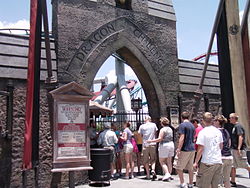
 Entrance to Dragon Challenge | |||
| Previously known as Dueling Dragons (1999–2010) | |||
| Universal Islands of Adventure | |||
| Park section | The Wizarding World of Harry Potter (2010-2017) - Hogsmeade | ||
| Coordinates | 28°28′25″N 81°28′24″W / 28.47361°N 81.47333°W | ||
| Status | Removed | ||
| Opening date | May 28, 1999 | ||
| Closing date | September 4, 2017 | ||
| Replaced by | Hagrid's Magical Creatures Motorbike Adventure[1] | ||
| General statistics | |||
| Type | Steel – Inverted – Dueling | ||
| Manufacturer | Bolliger & Mabillard | ||
| Designer | Werner Stengel | ||
| Model | Inverted Coaster | ||
| Lift/launch system | Chain lift hill | ||
| Chinese Fireball | Hungarian Horntail | ||
| Height | 125 ft (38.1 m) | 125 ft (38.1 m) | |
| Drop | 115 ft (35.1 m) | 95 ft (29.0 m) | |
| Length | 3,200 ft (975.4 m) | 3,200 ft (975.4 m) | |
| Speed | 60 mph (96.6 km/h) | 55 mph (88.5 km/h) | |
| Inversions | 5 | 5 | |
| Duration | 2:25 | 2:25 | |
| Height restriction | 54 in (137 cm) | ||
| Trains | 8 cars. Riders are arranged 4 across in a single row for a total of 32 riders per train. | ||
|
Dragon Challenge at RCDB Pictures of Dragon Challenge at RCDB | |||
Dragon Challenge, formerly named Dueling Dragons (1999–2010), was a pair of intertwined inverted roller coasters in the Wizarding World of Harry Potter area of Islands of Adventure in Orlando, Florida, United States. Designed by Bolliger & Mabillard of Switzerland, the ride was a dueling roller coaster featuring two tracks – one side was called Chinese Fireball and the other Hungarian Horntail – that were themed as two chasing dragons. Its layout involved two trains sharing adjacent lift hills, with each traversing unique courses. Trains on the Chinese Fireball track reached a maximum speed of 60 mph (97 km/h), while trains on the Hungarian Horntail reached 55 mph (89 km/h). Both tracks featured five inversions and an identical ride duration of 2 minutes and 25 seconds.
The ride debuted as Dueling Dragons during the grand opening of Islands of Adventure on May 28, 1999. It was located in The Lost Continent area, and the dueling trains were named Fire and Ice. After a renovation period, the attraction reopened in March 2010. It was renamed Dragon Challenge for The Wizarding World of Harry Potter grand opening on June 18, 2010.
During much of the ride's history, the trains were dispatched simultaneously, creating three near-miss encounters along the courses. Multiple incidents in 2011 involving injuries to riders, who were hit with loose objects, resulted in an operational change to dispatch trains separately to avoid close encounters. Universal Orlando officials, citing that the ride had reached the end of its service life, made the decision to close Dragon Challenge permanently on September 4, 2017. Hagrid's Magical Creatures Motorbike Adventure opened in its place in 2019, leaving The Incredible Hulk Coaster as the only remaining Bolliger and Mabillard roller coaster at Islands of Adventure.
History
[edit]Dueling Dragons (1999–2010)
[edit]
In 1997, it was announced that Dueling Dragons would be a part of a new second theme park at the Universal Orlando Resort, Islands of Adventure. The new ride would be a unique dueling inverted roller coaster by Bolliger & Mabillard. It would be placed in a fairy tale-themed land known as the Lost Continent. The coaster would be situated in the Merlinwood area.[2] Dueling Dragons was completed on time, debuting with the premiere of Islands of Adventure on May 28, 1999. At the time, it was the only fully inverted dueling roller coaster in the world.[3] The ride was themed to two dueling dragons. The queue was decorated as a ruined castle that the two dragons destroyed. Once the riders arrived at the station, they chose which of the two coasters they would like to experience, the Fire dragon or the Ice dragon.[4] The original name for Dueling Dragons was going to be "Merlin's Duelling Dragons," and the dragons both had names; Blizzrock for the blue dragon, and Pyrock for the red dragon.[5]
Dragon Challenge (2010–2017)
[edit]On May 31, 2007, Universal announced plans to construct The Wizarding World of Harry Potter, a new section devoted to the popular Harry Potter book and film series.[6][7][8] Dueling Dragons, as well as the adjacent roller coaster Flying Unicorn (later renamed Flight of the Hippogriff), were shown to be included in the new section.[9] Universal later announced that Dueling Dragons would be renamed Dragon Challenge upon the re-opening of the attraction and that its two coasters would be renamed Hungarian Horntail and Chinese Fireball.[10][11]
Construction on re-theming the queue began in the third quarter of 2009.[12] In the first quarter of 2010, the ride closed in order to refurbish the attraction to incorporate the Harry Potter theme.[13][14][15] In mid-March 2010, the roller coasters reopened to the public.[14][16][17] On June 18, 2010, with the opening of the entire The Wizarding World of Harry Potter section, the ride officially became Dragon Challenge.[11]
During the summer of 2011, there were two accidents (one serious) caused by what is believed to be loose objects hitting riders while riding the roller coaster. The most serious accident involved a rider being struck in the eye by an object, causing injuries which required the removal of the eye. On the same day of the incident, Universal Studios announced that the coasters would not duel until an investigation was completed. For two months the coasters were dispatched separately and in mid-October 2011, Universal made the decision to turn off the dueling aspect of the ride permanently without any explanation to what caused the injuries.[18][19] No further injuries were reported.
Dragon Challenge was becoming obsolete due to the lack of its dueling feature.[20] In early 2017, rumors were starting to spread that it was to be removed for a new attraction based on the Harry Potter spin-off film Fantastic Beasts and Where to Find Them.[21] It was then confirmed that Universal announced on July 24, 2017, that a new roller coaster was scheduled to debut in 2019, meaning that Dragon Challenge would be officially shut down on September 4, 2017.[22][23][24] By late September 2017, Dragon Challenge was being removed and sent to the scrapyard.[25] The ride's replacement, Hagrid's Magical Creatures Motorbike Adventure, opened on June 13, 2019.[26]
Legacy
[edit]A tribute to Dragon Challenge can be found in the queue line. Upon exiting the room with cages on the ceiling, guests can find a mural on the left wall. The mural features fire and ice dragons and a message saying Dueling Club.[27]
Universal's Halloween Horror Nights in 2023 featured a haunted house based on the original Dueling Dragons concept called "Dueling Dragons: Choose Thy Fate". The house's story takes place after the events of the original ride where guests choose a path and a victor.[28]
Ride experience
[edit]

Queue
[edit]Before the Harry Potter refurbishment, the queue was themed as a ruined castle where the Fire and Ice dragons lived. The queue passed through dungeons with human skeletons, torches and cobwebs. To ride Fire, guests would go left, while riders wanting to ride Ice would go right at the intersection point.[29]
After the Harry Potter re-theming of the queue, guests were taken past a number of banners for the Triwizard Tournament showing support for the tournament's four contestants. After passing the Weasleys' crashed flying Ford Anglia, they entered the Champions' Tent. From there, guests passed a large pedestal with the Triwizard Cup glowing at the top, and several dark "tunnels" which led to both coaster's stations. Just before entering the station, guests had to choose which coaster they wanted to ride: the Chinese Fireball to the left or the Hungarian Horntail to the right. Once in the station, there was a projection of the dragons on the ceiling.[30]
In April 2015, metal detectors were installed as a permanent fixture to the entrance, and security officers with metal-detecting wands were employed.[31] The attraction enacted a zero tolerance policy for cell phones, wallets, coins, watches, cameras, or other loose objects; all riders were required to completely empty their pockets before boarding. Persons in violation would be sent to the lockers or possibly ejected from the park without a refund.[32]
Track layout
[edit]
Chinese Fireball
[edit]After departing from the station, the train made a slight left turn leading into the transfer track section before beginning to climb the 125-foot (38 m) lift hill. Once at the top and after going through a pre-drop, the train made a sharp 115-foot (35 m) left-hand drop back to the ground. Then, the train went back up, through an Immelmann followed by a slight air-time downward right turn before entering an air-time hill (this was the first of three near-miss points with the Hungarian Horntail train when the roller coasters duelled). Next, the train dropped back down turning left slightly, leading into a second Immelmann. After a downward right helix and a short section of straight track, the train went through the second former near-miss point with the other train, a vertical loop. After the loop and another section of straight track, the train made a right turn leading into the third and final former near-miss element, which was a corkscrew. Then, the train made a left turn followed by a small drop leading into another section of straight track before entering the final element in the coaster layout, another corkscrew. The train then made a left turn into the final brake run. Following a left turn, the train returned to the station where the riders unloaded and the next riders loaded.[4][33]
Hungarian Horntail
[edit]After departing from the station, the train made a slight right turn leading into the transfer track section before beginning to climb the 125-foot (38 m) lift hill. Once at the top and after going through a pre-drop, the train made a sharp 95-foot (29 m) right-hand drop back to the ground. Then, the train went through a 270-degree left overbanked turn before entering a Zero-gravity roll, which was the first of three former near-miss points with the Chinese Fireball train. Then, the train made a slight right turn heading straight into a wall before entering a cobra roll. After a straight section of track, the train entered the second former near-miss point with the other train, a vertical loop. The train then made a right turn into the final former near-miss point, a corkscrew. Next, the train made a right turn, followed by a left turn leading into the final brake run. Following a right turn, the train returned to the station where the riders unloaded and the next riders loaded.[4][34]
Track
[edit]The steel track was approximately 3,200 feet (980 m) in length and the height of the lift was approximately 125 feet (38 m) for both roller coasters. The first drop for Chinese Fireball was 115 feet (35 m) while Hungarian Horntail was 95 feet (29 m). Chinese Fireball's track was red, Hungarian Horntail's was blue, and both coasters' supports were white.[4][35]
Trains
[edit]Dragon Challenge operated with several steel and fiberglass trains. Each train had eight cars with four seats for a total of 32 riders per train. The trains' front seat resembled a mouth, while the rest bore a resemblance to hands. The Hungarian Horntail trains resembled a blue ice dragon while the Chinese Fireball trains resembled a red fire dragon.[36]

When the coaster cars duelled, in order to make the trains meet at each of the three near-miss points along the layout, the trains would be weighed once they were loaded at the station to adjust the dispatch times. (For example, if the Chinese Fireball train weighed more than the Hungarian Horntail train, the Fireball would be dispatched after the Horntail.)[19]
Reception
[edit]Dragon Challenge was generally well received from its opening in 1999 until its closing in 2017. In Amusement Today's annual Golden Ticket Awards for the Top Steel Roller Coasters, Dragon Challenge ranked in the top 50 every year between 2000 and 2012. It peaked at position 11 in 2002.[37]
| Year | 1998 | 1999 | ||||||||
|---|---|---|---|---|---|---|---|---|---|---|
| Ranking | – | –[38] | ||||||||
| Year | 2000 | 2001 | 2002 | 2003 | 2004 | 2005 | 2006 | 2007 | 2008 | 2009 |
| Ranking | 13[39] | 12[40] | 11[37] | 14[41] | 16[42] | 15[43] | 18[44] | 23[45] | 14[46] | 17[47] |
| Year | 2010 | 2011 | 2012 | 2013 | 2014 | 2015 | 2016 | 2017 | 2018 | 2019 |
| Ranking | 31[48] | 28[49] | 35[50] | –[51] | – | – | – | – | – | – |
| Year | 2020 | 2021 | 2022 | 2023 | 2024 | 2025 | ||||
| Ranking | N/A | – | – | – | – | – |
Incidents
[edit]- On July 1, 2009, an employee was walking underneath the coaster in a restricted area when he was hit by a train during a test run. The victim suffered multiple head injuries and was taken to nearby Orlando Regional Medical Center.[52]
- On July 31, 2011, a tourist was injured when an unidentified object hit him in the eye while riding Dragon Challenge. Prior to the incident, the guest had only one good eye, therefore the incident resulted in the guest completely losing his sight. Dragon Challenge remained shut for less than 24 hours after the incident with Universal concluding that the ride was safe.[53][54][55]
- On August 10, 2011, a rider was struck by an object while riding the attraction, injuring his face and leg. As a result of this and the aforementioned incident in which a rider lost sight in one eye, Universal officials announced that the two roller coasters would no longer operate simultaneously, pending an investigation into both incidents.[56] In October 2011, officials suspended the dueling aspect of the ride permanently.[57]
See also
[edit]References
[edit]- ^ "Dragon Challenge closing for a new Harry Potter ride". Orlando Informer. July 24, 2017.
- ^ "DUELING DRAGONS WILL TAKE UNIVERSAL VISITORS FOR A THRILL RIDE".
- ^ "Dragon Challenge in The Wizarding World of Harry Potter closes forever at Universal's Islands of Adventure". Attractions Magazine. September 5, 2017. Retrieved September 3, 2021.
- ^ a b c d Marden, Duane. "Dragon Challenge (Universal Studios Islands of Adventure)". Roller Coaster DataBase.
- ^ "Dueling Dragons". Parkpedia. July 27, 2012. Retrieved September 3, 2021.
- ^ "Harry Potter theme park planned". BBC News. May 31, 2007. Archived from the original on May 12, 2014. Retrieved December 29, 2012.
- ^ Sturcke, James (May 31, 2007). "Harry Potter theme park to open in Florida". The Guardian. Archived from the original on August 31, 2013. Retrieved December 29, 2012.
- ^ Powers, Scott (May 31, 2007). "Wizarding World of Harry Potter coming to Universal Orlando's Islands of Adventure". Orlando Sentinel. Archived from the original on January 12, 2012. Retrieved January 1, 2013.
- ^ Sciretta, Peter (September 15, 2009). "The Wizarding World of Harry Potter Details, Concept Art, Videos Revealed". Slash Film. Archived from the original on June 6, 2014. Retrieved December 29, 2012.
- ^ Dewayne Bevil (September 15, 2009). "Wizarding World of Harry Potter will open in spring 2010 at Universal Orlando". Orlando Sentinel. Archived from the original on November 16, 2009. Retrieved September 16, 2009.
- ^ a b Bevil, Dewayne (June 18, 2010). "Fans stream into Harry Potter theme park for grand opening". Orlando Sentinel. Archived from the original on October 18, 2012. Retrieved December 29, 2012.
- ^ Sim, Nick (October 14, 2009). "Dueling Dragons queue changes, but no closure date yet". Theme Park Tourist. Archived from the original on September 15, 2014. Retrieved January 2, 2013.
- ^ Sim, Nick (March 1, 2010). "Dueling Dragons closes at Islands of Adventure to undergo Dragon Challenge transformation". Theme Park Tourist. Archived from the original on September 15, 2014. Retrieved January 2, 2013.
- ^ a b Niles, Robert (February 19, 2010). "Vote of the week: When will the Wizarding World of Harry Potter open?". Theme Park Insider. Archived from the original on September 15, 2014. Retrieved September 14, 2014.
- ^ "Dueling Dragons closes today". Orlando Theme Park News. February 27, 2010. Archived from the original on September 15, 2014. Retrieved September 14, 2014.
- ^ Sim, Nick (March 15, 2010). "Dueling Dragons set to reopen on March 18 at Universal's Islands of Adventure". Theme Park Tourist. Archived from the original on September 15, 2014. Retrieved January 2, 2013.
- ^ "Progress in the Wizarding World – Butterbeer cart, moving owl, sneak peek at new ride". Orlando Attractions Magazine. March 18, 2010. Archived from the original on September 15, 2014. Retrieved September 14, 2014.
- ^ "Universal Announces Changes To Coaster". wesh.com. August 17, 2011. Archived from the original on November 6, 2013. Retrieved December 28, 2012.
- ^ a b Garcia, Jason (October 19, 2011). "Universal Orlando's twin dragon coasters will never 'duel' again". Orlando Sentinel. Retrieved January 9, 2020.
- ^ "Dragon Challenge is Closing Forever at Universal. Here's What is Replacing It". Archived from the original on November 11, 2019. Retrieved November 21, 2020.
- ^ "New Harry Potter Rides Coming To Universal? These Patents May Give Us A Glimpse". March 22, 2017.
- ^ Bevil, Dewayne (July 24, 2017). "Universal: Dragon Challenge to be replaced with new Harry Potter ride". Orlando Sentinel. Retrieved July 27, 2017.
- ^ Kubersky, Seth (July 24, 2017). "Universal Orlando announces new Harry Potter coaster replacing Dragon Challenge". Attractions Magazine. Retrieved July 27, 2017.
- ^ James, Kristin (July 24, 2017). "Universal will replace Dragon Challenge with new Harry Potter coaster". Orlando Weekly. Archived from the original on March 13, 2021. Retrieved July 27, 2017.
- ^ White, Tharin (September 24, 2017). "Photo Update: Disney and Universal construction from above". Attractions Magazine. Retrieved November 9, 2017.
- ^ Hume, Jerry (June 13, 2019). "Fans Wait 10 Hours for Universal's New Hagrid Coaster". News 13. Retrieved July 28, 2019.
- ^ "Everything you need to know about Hagrid's Motorbike Adventure at Universal Studios". Entertainment Weekly.
- ^ Niles, Robert (July 28, 2023). "Dueling Dragons are back, for Universal's Halloween Horror Nights". Theme Park Insider. Retrieved August 5, 2023.
- ^ "Dueling Dragon, Ice, Fire, Preshow, and Que-line". THEMEPARKGEEK63 (YouTube). December 30, 2007. Archived from the original on April 19, 2016. Retrieved December 28, 2012.
- ^ "Dragon Challenge roller coaster queue at the Wizarding World of Harry Potter". InsideTheMagic (YouTube). May 29, 2010. Archived from the original on October 30, 2014. Retrieved December 28, 2012.
- ^ "Metal detectors become permanent at 3 Universal rides". April 22, 2015.
- ^ "Using Metal Detectors To Screen Riders On Roller Coasters: Why It's Good & How It Will Keep You Safer At Theme Parks | The Travel Guide". Travel Guide. May 1, 2015. Archived from the original on September 23, 2016. Retrieved May 21, 2016.
- ^ Dragon Challenge: Chinese Fireball Front Seat on-ride HD POV Universal Studios Islands of Adventure (YouTube). COASTERFORCE. November 15, 2012. Retrieved December 27, 2012.
- ^ Dragon Challenge: Hungarian Horntail Front Seat on-ride HD POV Universal Islands of Adventure (YouTube). COASTERFORCE. November 15, 2012. Retrieved December 27, 2012.
- ^ Marden, Duane. "Dragon Challenge Layout Photo (Universal Studios Islands of Adventure)". Roller Coaster DataBase.
- ^ Marden, Duane. "Dragon Challenge Hungarian Horntain Car Photo (Universal Studios Islands of Adventure)". Roller Coaster DataBase.
- ^ a b "Top 25 steel Roller Coasters" (PDF). Amusement Today: 7B. September 2002. Archived from the original (PDF) on October 19, 2013.
- ^ "Top 25 steel Roller Coasters" (PDF). Amusement Today: 7B. August 1999.
- ^ "Top 25 steel Roller Coasters" (PDF). Amusement Today. August 2000.
- ^ "Top 25 steel Roller Coasters" (PDF). Amusement Today: 7B. August 2001. Archived from the original (PDF) on October 19, 2013.
- ^ "Top 50 steel Roller Coasters" (PDF). Amusement Today: 14–15B. September 2003. Archived from the original (PDF) on October 19, 2013.
- ^ "Top 50 steel Roller Coasters" (PDF). Amusement Today: 18–19B. September 2004. Archived from the original (PDF) on April 3, 2007.
- ^ "Top 50 steel Roller Coasters" (PDF). Amusement Today: 26–27B. September 2005. Archived from the original (PDF) on October 19, 2013.
- ^ "Top 50 steel Roller Coasters" (PDF). Amusement Today: 26–27B. September 2006. Archived from the original (PDF) on October 19, 2013.
- ^ "Top 50 steel Roller Coasters" (PDF). Amusement Today. 11 (6.2): 36–37. September 2007. Archived from the original (PDF) on October 19, 2013.
- ^ "Top 50 steel Roller Coasters" (PDF). Amusement Today. 12 (6.2): 36–37. September 2008. Archived from the original (PDF) on October 19, 2013.
- ^ "Top 50 steel Roller Coasters" (PDF). Amusement Today. 13 (6.2): 32–33. September 2009. Archived from the original (PDF) on October 19, 2013.
- ^ "Top 50 steel Roller Coasters" (PDF). Amusement Today. 14 (6.2): 34–35. September 2010. Archived from the original (PDF) on October 19, 2013.
- ^ "Top 50 steel Roller Coasters" (PDF). Amusement Today. 15 (6.2): 38–39. September 2011. Archived from the original (PDF) on October 19, 2013.
- ^ "Top 50 steel Roller Coasters" (PDF). Amusement Today. 16 (6.2): 36–37. September 2012.
- ^ "2013 Top 50 steel Roller Coasters" (PDF). Amusement Today. 17 (6.2): 34–35. September 2013. Archived from the original (PDF) on October 19, 2013.
- ^ "Universal Worker Seriously Injured By Coaster". WFTV. July 1, 2009. Archived from the original on July 4, 2009. Retrieved July 5, 2009.
- ^ "Man Loses Sight While Riding Universal Roller Coaster". WFTV. August 2, 2011. Archived from the original on September 13, 2011. Retrieved August 14, 2011.
- ^ "Man Loses Sight After Roller Coaster Ride". Wesh Orlando. August 3, 2011. Retrieved August 14, 2011.[permanent dead link]
- ^ "Man Injured On Harry Potter Roller Coaster". Click Orlando. August 2, 2011. Archived from the original on October 6, 2011. Retrieved August 14, 2011.
- ^ "Universal Announces Changes To Coaster". wesh.com. August 17, 2011. Archived from the original on September 18, 2011. Retrieved August 17, 2011.
- ^ Garcia, Jason (October 19, 2011). "Universal Orlando's twin dragon coasters will never 'duel'". Orlando Sentinel. Tribune Newspapers. Archived from the original on September 6, 2012. Retrieved October 21, 2011.
External links
[edit]- Dragon Challenge at Universal Orlando Resort
 Media related to Dragon Challenge at Wikimedia Commons


Dragon Challenge
View on GrokipediaOverview
Location and Design
Dragon Challenge was located in the Wizarding World of Harry Potter – Hogsmeade section of Universal's Islands of Adventure theme park in Orlando, Florida.[8] The attraction originally opened to the public on May 28, 1999, as Dueling Dragons, and was rethemed and renamed Dragon Challenge, opening on June 18, 2010. It featured a minimum height requirement of 54 inches (137 cm) for riders.[8] The attraction consisted of a pair of dueling inverted roller coasters, each with independent tracks that intertwined multiple times without colliding.[9] Manufactured by Bolliger & Mabillard, a Swiss engineering firm specializing in steel coasters, the design emphasized intense airtime and inversions while simulating a fierce aerial battle between mythical dragons.[9] Following a 2010 retheming tied to Harry Potter and the Goblet of Fire, the tracks were renamed after specific dragons from the series: the Chinese Fireball and the Hungarian Horntail, enhancing the immersive narrative of champion versus beast in the Triwizard Tournament.[8] This core concept drew inspiration from legendary dragon lore, portraying the coasters as rival creatures locked in combat, with riders suspended beneath the tracks for a suspended flight-like perspective.[10] The dueling mechanism relied on synchronized dispatches to create the illusion of near-misses at key intersection points, heightening the thrill without actual contact between trains.[9]Key Specifications
Dragon Challenge consisted of two independent inverted roller coaster tracks built by Bolliger & Mabillard, each sharing a common station but operating separately after 2011 modifications ceased dueling operations. Both tracks ascended a 125-foot (38 m) chain lift hill and featured five inversions, including a vertical loop, zero-g roll (on one track), cobra roll, and corkscrew elements. The ride duration was 2 minutes and 25 seconds, with a theoretical capacity of approximately 3,000 riders per hour across both tracks.[2][11]| Specification | Chinese Fireball Track | Hungarian Horntail Track |
|---|---|---|
| Track Length | 3,200 feet (980 m) | 3,200 feet (980 m) |
| First Drop | 115 feet (35 m) | 95 feet (29 m) |
| Top Speed | 60 mph (97 km/h) | 55 mph (89 km/h) |
| Inversions | 5 (two Immelmann loops, vertical loop, two corkscrews) | 5 (zero-g roll, cobra roll, vertical loop, corkscrew) |
| Height Requirement | 54 inches (137 cm) | 54 inches (137 cm) |