


Community hub
Recent from talks
Contribute something
Nothing was collected or created yet.
Drava Statistical Region
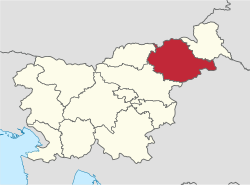
View on WikipediaThe Drava Statistical Region[3][4][5] (Slovene: podravska statistična regija) is a statistical region in Slovenia. The largest city in the region is Maribor. The region's name comes from the Drava River and includes land on both banks along its course through Slovenia as well as the Pohorje mountains in the northeast of the region. The Drava is used for the production of hydroelectricity and the fertile land around it is used for agriculture. The share of job vacancies in all available jobs is among the highest in Slovenia and the region has a positive net migration rate but a very high natural decrease, which means an overall decrease in the population.
Key Information


Cities and towns
[edit]The Drava Statistical Region includes six cities and towns, the largest of which is Maribor.[6]
| Rank | Name | Population (2025)[7] |
|---|---|---|
1
|
Maribor | 97,522
|
2
|
Ptuj | 18,291
|
3
|
Slovenska Bistrica | 8,362
|
4
|
Ruše | 4,217
|
5
|
Lenart v Slovenskih Goricah | 3,498
|
6
|
Ormož | 1,939
|
Administrative divisions
[edit]The Drava Statistical Region comprises the following 41 municipalities:
- Benedikt
- Cerkvenjak
- Cirkulane
- Destrnik
- Dornava
- Duplek
- Gorišnica
- Hajdina
- Hoče–Slivnica
- Juršinci
- Kidričevo
- Kungota
- Lenart
- Lovrenc na Pohorju
- Majšperk
- Makole
- Maribor
- Markovci
- Miklavž na Dravskem Polju
- Oplotnica
- Ormož
- Pesnica
- Podlehnik
- Poljčane
- Ptuj
- Rače–Fram
- Ruše
- Selnica ob Dravi
- Šentilj
- Slovenska Bistrica
- Središče ob Dravi
- Starše
- Sveta Ana
- Sveta Trojica v Slovenskih Goricah
- Sveti Andraž v Slovenskih Goricah
- Sveti Jurij v Slovenskih Goricah
- Sveti Tomaž
- Trnovska Vas
- Videm
- Zavrč
- Žetale
Demographics
[edit]The population in 2025 was 331,504. It has a total area of 2,170 km².
Economy
[edit]Employment structure: 63.4% services, 35.8% industry, 0.8% agriculture.
Tourism
[edit]It attracts only 3.2% of the total number of tourists in Slovenia, most being from foreign countries (68.9%).
Transportation
[edit]- Length of motorways: 132.7 km
- Length of other roads: 6,422.9 km
Sources
[edit]- ^ "Prebivalstvo po starosti in spolu, statistične regije, Slovenija, polletno" [Population by age and sex, statistical regions, Slovenia, semi-annual]. stat.si (in Slovenian). Retrieved 5 February 2026.
- ^ "Sub-national HDI - Area Database - Global Data Lab". hdi.globaldatalab.org. Retrieved 2021-07-20.
- ^ OECD. 2012. OECD Environmental Performance Reviews: Slovenia 2012. OECD Publishing, p. 325.
- ^ Lapuh, Lucija. 2016. Measuring the Impact of the Recession on Slovenian Statistical Regions and their Ability to Recover. Acta Geographica Slovenica 56(2): 247–256, pp. 252ff.
- ^ Boršič, Darja, & Alenka Kavkler. 2009. Modeling Unemployment Duration in Slovenia Using Cox Regression Models. Transition Studies Review 54(1): 145–156, p. 148.
- ^ "Mesta in urbana območja v Sloveniji". Archived from the original on 2020-05-13.
- ^ "Prebivalstvo, mestna naselja, Slovenija, letno". Archived from the original on 2022-01-10.
 |  | ||
Drava Statistical Region
View on GrokipediaGeography
Location and Borders
The Drava Statistical Region, known in Slovene as Podravska statistična regija, is one of Slovenia's 12 statistical regions, established by the Statistical Office of the Republic of Slovenia (SURS) in 1995 as part of a regional breakdown for statistical and planning purposes, and formalized under the Decree on the Standard Classification of Territorial Units in 2000.[5] This classification divides the country into functional areas based on earlier 1970s research, adjusted to align with municipal boundaries post-1994 administrative reforms.[5] Situated in northeastern Slovenia, the region borders Austria to the north along a segment of the international frontier, Croatia to the south and east, and other Slovenian statistical regions including the Styria Region (Štajerska) to the west and the Savinja Region to the southwest, with some boundary adjustments noted for municipalities like Zreče.[5] The Drava River serves as the region's defining geographical feature, lending its name to the area (Podravje meaning "along the Drava") and flowing westward to eastward through its territory, encompassing land on both riverbanks.[6][7] Covering a total area of 2,170 square kilometers, the Drava Statistical Region accounts for approximately 10.7% of Slovenia's overall land area of 20,273 square kilometers.[2][8]Physical Features and Climate
The Drava Statistical Region features a diverse topography shaped by the Drava River valley, which forms the central Dravsko-Ptujsko polje, a broad fertile plain, flanked by rolling hills in the northeast and subalpine wooded mountains in the west, including the Pohorje massif. The Pohorje, a prominent mountain range, reaches its highest point at Črni vrh with an elevation of 1,543 meters, providing a mix of forested slopes and open highlands suitable for agriculture on the lower elevations. These hills and mountains create a varied landscape that supports both intensive farming in the valleys and extensive forestry higher up.[9] Hydrologically, the Drava River serves as the region's primary waterway, flowing through the valley and enabling a chain of hydroelectric power plants that generate significant electricity while also providing irrigation for the surrounding plains. The river is joined by several key tributaries such as the Dravinja and Pesnica, contributing to the hydrological network and enhancing water availability for agricultural and ecological purposes. This river system not only defines the region's physical boundaries but also influences sediment deposition and floodplain formation.[9] The region experiences a continental climate characterized by warm summers and cold winters, with average July temperatures ranging from 20 to 22°C in the lowlands and average January temperatures between -2 and 0°C. Annual precipitation varies from 800 to 1,200 mm, with higher amounts in the mountainous areas like Pohorje due to orographic effects, supporting a cycle of seasonal rains and snowmelt. These climatic conditions foster a landscape conducive to diverse vegetation and agricultural activities.[10][11] Biodiversity in the Drava Statistical Region is highlighted by its fertile plains, ideal for viticulture, extensive forests covering approximately 30% of the area, and protected ecological zones. The forests, predominantly in the Pohorje and hills, host a variety of deciduous and coniferous species, contributing to habitat diversity. The Drava River ecological corridor, part of the transboundary Mura-Drava-Danube Biosphere Reserve, preserves riparian habitats essential for migratory fish, birds, and wetland flora, promoting regional ecological connectivity.[12][13]Administration
Municipalities
The Drava Statistical Region, known in Slovenian as the Podravska statistična regija, is administratively divided into 41 municipalities that form the foundational units of local self-government in Slovenia.[3] These municipalities are responsible for key functions including local spatial planning, provision of public services, budget management, and coordination with national statistical authorities for data reporting on regional development.[14] Under Slovenia's Local Self-Government Act, they operate with autonomy in addressing community needs while adhering to national frameworks for administration and inter-municipal cooperation.[15] Of the 41 municipalities, two hold urban status as city municipalities—Maribor and Ptuj—which possess expanded competencies in areas such as urban transport, housing policy, and economic development compared to standard municipalities.[16] The remaining 39 are classified as rural or mixed municipalities, focusing primarily on agricultural support, environmental management, and smaller-scale infrastructure. The current structure reflects evolutionary subdivisions since the statistical regions' establishment in 2000, when Slovenia's total municipalities numbered around 193, leading to the present configuration of 212 nationwide without significant post-2010 mergers in this region.[5] The municipalities are geographically distributed across sub-regions, including the densely populated Maribor urban area, the Ptuj and Ormož valleys along the Drava River, and the hilly Slovenske Gorice plateau, facilitating localized governance tailored to urban, riverine, and rural contexts. The full list of municipalities is as follows:| Sub-region Grouping | Municipalities |
|---|---|
| Maribor Urban Area and Surroundings | Hoče–Slivnica, Kungota, Maribor, Pesnica, Ruše, Selnica ob Dravi, Šentilj, Starše |
| Ptuj and Drava Valley Hinterland | Cirkulane, Destrnik, Dornava, Hajdina, Kidričevo, Miklavž na Dravskem polju, Ptuj, Rače–Fram |
| Ormož and Lower Drava Area | Markovci, Ormož, Podlehnik, Poljčane, Središče ob Dravi, Sveti Tomaž, Trnovska vas, Videm, Zavrč |
| Slovenske Gorice and Rural Uplands | Benedikt, Cerkvenjak, Duplek, Gorišnica, Juršinci, Lenart, Lovrenc na Pohorju, Majšperk, Makole, Oplotnica, Slovenska Bistrica, Sveta Ana, Sveta Trojica v Slovenskih goricah, Sveti Andraž v Slovenskih goricah, Sveti Jurij v Slovenskih goricah, Žetale |
Cities and Towns
The Drava Statistical Region encompasses three primary urban centers—Maribor, Ptuj, and Slovenska Bistrica—which anchor the area's urban development and distinguish them from smaller towns. These centers represent the region's core urban hubs, each contributing uniquely to its identity through historical, educational, and economic functions. According to Slovenian statistical definitions, urban settlements qualifying as such exhibit dense built environments, fostering a balanced distribution of urban and rural elements across the 41 municipalities.[18] By population in 2022, Maribor ranks first with 96,302 residents, followed by Ptuj at 17,880, and Slovenska Bistrica at 8,181. Maribor, Slovenia's second-largest city, functions as the regional capital and features a robust university and industrial base, with the University of Maribor educating over 14,000 students across 17 faculties and a legacy in sectors like automotive and metal processing that positioned it as a key economic driver in former Yugoslavia.[3][19][20] Ptuj stands out as the oldest town in Slovenia, tracing its origins to Roman Poetovio with preserved archaeological sites including fortifications and artifacts that highlight its ancient heritage dating back to the 1st century AD.[21] Slovenska Bistrica serves as a mid-sized urban center, supporting regional connectivity through its location along transport routes and contributing to local commerce and services. Urban development in the region shows steady expansion, particularly in the Maribor metropolitan area, where suburbs like Hoče-Slivnica have recorded positive population growth driven by net migration rates of 11.5 per 1,000 residents and a total increase of 7.4 per 1,000 between 2015 and 2023, reflecting broader suburbanization trends as residents seek proximity to the capital's amenities while avoiding central density.[22] This growth underscores the region's evolving urban fabric, with the Maribor area integrating surrounding municipalities to form a cohesive economic and residential corridor along the Drava River.Demographics
Population Statistics
The Drava Statistical Region recorded a total population of 328,469 in the 2021 register-based census conducted by the Statistical Office of the Republic of Slovenia (SURS).[3] As of 1 July 2023, the estimated population stood at 329,753, reflecting a modest increase driven by net migration despite an aging demographic profile that projects gradual long-term decline without sustained inflows.[23] By mid-2025, estimates suggest the population is approximately 331,800, consistent with national trends of slight growth amid low natural increase rates of –3.8 per 1,000 population.[24] The region's population density averages 152 inhabitants per square kilometer across its 2,170 km² area, positioning it above the national average but marked by significant urban-rural disparities.[23] Urban concentrations, particularly in the Maribor area, exceed 1,000 inhabitants per km², supporting economic hubs and infrastructure, while rural zones in the Pohorje hills register densities below 50 inhabitants per km², highlighting challenges in service provision and connectivity.[3] Household data from the 2021 census indicate 133,789 private households in the region, with an average size of 2.4 persons per household, slightly below the national figure and reflective of smaller family units amid urbanization and aging.[3] The Human Development Index for the Drava Statistical Region reached 0.898 in 2022, categorizing it as very high and placing it 7th among Slovenia's 12 statistical regions.[25]Composition and Trends
The Drava Statistical Region features a predominantly ethnic Slovene population, reflecting broader national patterns in this northeastern area of Slovenia. According to the 2002 census conducted by the Statistical Office of the Republic of Slovenia (SURS), 96.2% of residents who declared an ethnic affiliation identified as Slovenes, totaling 267,536 individuals out of 278,070 declarations in the region.[26] Minorities are limited, with Croats comprising 1.4% (4,012 people), primarily near the Croatian border, followed by Serbs at 0.9% (2,524 people) and Roma at 0.3% (712 people), often concentrated in peri-urban and border communities around Maribor.[26] No significant Hungarian minority is present, as that group is more associated with the adjacent Mura Statistical Region; ethnic data has not been comprehensively updated at the regional level since 2002 due to the register-based nature of subsequent censuses.[27] The region's age structure underscores a pronounced aging trend, consistent with national demographics but slightly more acute due to lower fertility and out-migration of younger cohorts. As of the 2021 census, 23.0% of the population—approximately 75,664 individuals—was aged 65 or older, exceeding the national average of around 20%.[24] The mean age reached 44.8 years in 2023, higher than Slovenia's overall 44.1 years, with an aging index of 162.5 elderly persons per 100 individuals under 15—indicating accelerated demographic shift compared to more urbanized regions.[2] The proportion of youth aged 0–14 stood at 13.7% in 2023, the second-lowest among Slovenia's 12 statistical regions, while the working-age group (15–64) accounted for about 60.8%.[2][24] This structure stems from a persistently low birth rate of around 7.9 live births per 1,000 population nationally, translating to a natural decrease of –3.8 per 1,000 inhabitants in the region annually, driven by fewer than 4,000 births yearly against higher mortality.[2][28] Migration patterns provide a counterbalance to the natural decline, resulting in modest overall population growth. Net migration was positive at +8.5 per 1,000 population in 2023, equating to roughly 2,800 net inflows for the region's approximately 330,000 residents—higher than the national rate of +5.4 per 1,000.[2] Internal migration dominates, with inflows to urban hubs like Maribor attracting workers and families from rural municipalities and other regions, supported by employment opportunities in industry and services.[2] However, this is offset by significant youth emigration, particularly among those aged 18–34, who often relocate to the capital Ljubljana or abroad (e.g., to Austria or Germany) for education and better job prospects, contributing to a brain drain in peripheral areas.[29] International migration adds modestly, with non-EU citizens (e.g., from the Balkans) comprising about 10% of inflows, though the region sees lower volumes than central Slovenia.[30] The urban-rural divide shapes demographic trends, with urban areas absorbing growth while rural zones depopulate. Approximately 60% of the population resides in urban clusters, defined by SURS and Eurostat as areas with densities over 300 inhabitants per km² and at least 5,000 residents, centered on Maribor (over 95,000 inhabitants) and secondary towns like Ptuj and Slovenska Bistrica.[31] Rural municipalities, especially in the eastern Drava valley and hilly peripheries, experience accelerated depopulation—rates up to 1–2% annually—due to aging, low births, and out-migration to urban jobs, leaving some villages with densities below 50 per km² and aging indices over 200.[31] This polarization exacerbates service provision challenges in rural east, where over 25% of residents are 65+, compared to under 20% in Maribor's urban core.[2]Economy
Economic Indicators
The Drava Statistical Region, also known as Podravska, recorded a gross domestic product (GDP) of €8,086 million in 2023, representing 12.6% of Slovenia's total GDP.[32] This marked a nominal increase aligned with the national growth of 12.4%, though volume growth for the region followed the country's 2.1% expansion.[32] GDP per capita stood at €24,527, equivalent to 81.3% of the national average of €30,158, positioning it below the Slovenia-wide figure but above several other peripheral regions.[32] Prior to 2020, the region's economy exhibited steady annual GDP growth of approximately 2-3%, driven by manufacturing and trade, though this was interrupted by the COVID-19 pandemic, which contributed to a national contraction of 4.3% in 2020 and similar impacts regionally.[33] Recovery has been supported by European Union funds, including the Recovery and Resilience Facility, aiding infrastructure and digitalization initiatives that bolstered rebound growth of around 8% in 2021 and stabilization thereafter. The region's export-oriented industries, such as those in machinery and food processing, have been key to this resilience, contributing disproportionately to Slovenia's trade surplus. Unemployment in the Drava Statistical Region averaged 4.3% in 2023 according to the Labour Force Survey, the third highest among Slovenia's regions, reflecting a tightening labor market amid national rates below 4%.[2] This rate declined from 6.2% in 2022, indicating post-pandemic improvement, though high job vacancies persist in skilled sectors like engineering and IT, with regional employment rates at 64.5%.[2] Overall, the region's economic performance underscores its role as a secondary hub after the Central Slovenia region, with aggregate indicators signaling moderate but stable contributions to national output.[32]| Key Economic Indicator | Value (2023) | National Comparison |
|---|---|---|
| GDP (million €) | 8,086 | 12.6% of total |
| GDP per capita (€) | 24,527 | 81.3% of average |
| Unemployment rate (%) | 4.3 | Above national (3.7%) |
| Contribution to GDP (%) | 12.6 | Focused on exports |