


Community hub
Recent from talks
Contribute something
Nothing was collected or created yet.
Drayton Hall
View on Wikipedia
Drayton Hall | |
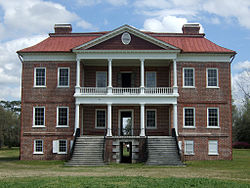
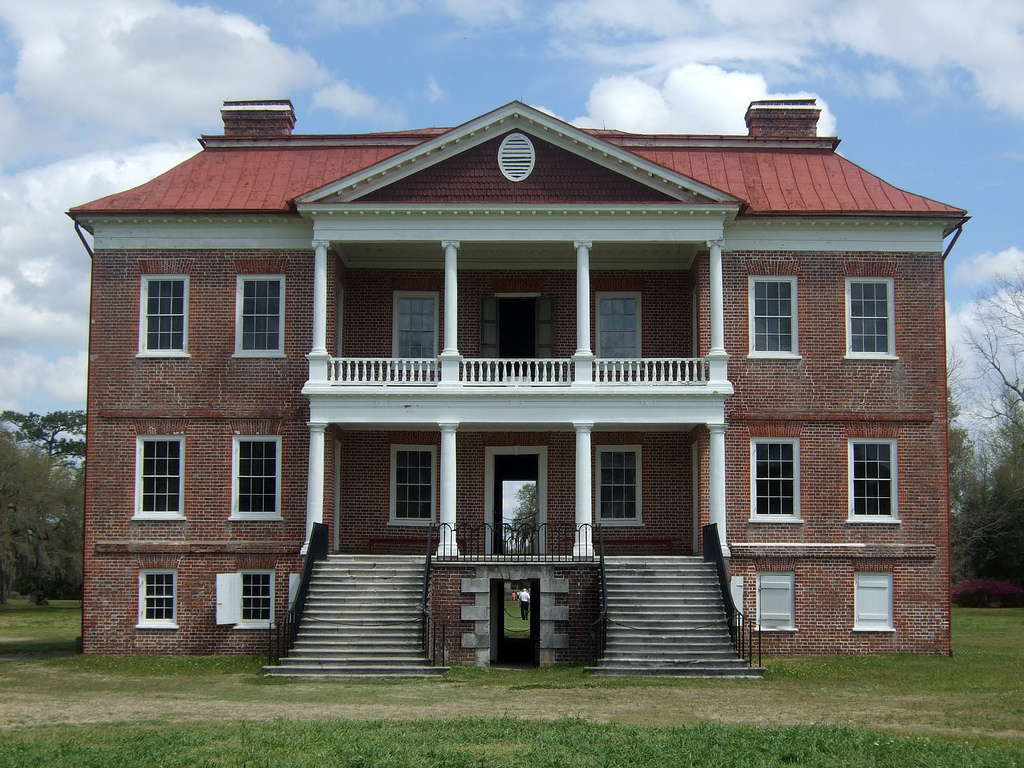
 Drayton Hall (front) | |
| Nearest city | Charleston, South Carolina and North Charleston, South Carolina |
|---|---|
| Coordinates | 32°52′15.24″N 80°4′34.68″W / 32.8709000°N 80.0763000°W |
| Built | 1747–1752 |
| Architectural style | Palladian |
| NRHP reference No. | 66000701 |
| Significant dates | |
| Added to NRHP | October 15, 1966[1] |
| Designated NHL | October 9, 1960[2] |
Drayton Hall is an 18th-century plantation house located on the Ashley River about 15 miles (24 km) northwest of Charleston, South Carolina, and directly across the Ashley River from North Charleston, west of the Ashley in the Lowcountry. An example of Palladian architecture in North America and the only plantation house on the Ashley River to survive intact through both the Revolutionary and Civil wars, it is a National Historic Landmark.
Description
[edit]The house has a double projecting portico on the west facade, which faces away from the river and toward the land side approach from Ashley River Road. The portico resembles a similar feature at the Villa Cornaro near Venice, Italy, designed by Renaissance architect Andrea Palladio in 1551. The floor plan of Drayton Hall is Palladian-inspired as well, perhaps derived from Plate 38 of James Gibbs' A Book of Architecture,[3] the influential pattern-book published in London in 1728.[4] A large central entrance stair hall with a symmetrical divided staircase is backed by a large salon, flanked by square and rectangular chambers.[5] Pedimented chimney-pieces in the house echo designs of Inigo Jones.[6]
History
[edit]
The mansion was built for the grandfather of John Drayton, John Drayton Sr. (c. 1715–1779; son of Thomas and Ann Drayton) after he bought the property in 1738.[7]
For many decades, the house was thought to have been begun in 1738 and completed in 1752. In 2014, an examination of wood cores showed that the attic timbers were cut from trees felled in the winter of 1747–48. Because the attic framing would have to have been in place well before the completion of the interior finishes, the house is now thought to have been occupied by the early 1750s.[8] The seven-bay, double-pile plantation house is within a 630-acre (2.5 km2) site that is part of the plantation based on indigo and rice and the former site of 13 slave cabins believed to have housed approximately 78 slaves. Seven generations of Drayton heirs preserved the house, though the flanking outbuildings have not survived: an earthquake destroyed the laundry house in 1886, and a hurricane destroyed the kitchen in 1893.[9]
The house is located in the Ashley River Historic District, it was declared a National Historic Landmark in 1960.[10]
Gallery
[edit]-
 When photographed by George LaGrange Cook in about 1890, Drayton Hall's two flanker buildings were still extant.
 -
 Drayton Hall plantation house viewed from behind one of several live oaks.
 -
 Drayton Hall plantation house by Carol M. Highsmith.
 -
 The Ashley river, just behind Drayton Hall
 -
 Rear view of Drayton Hall
 -
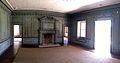 Main living space at Drayton Hall
 -
 Drayton Hall staircase


See also
[edit]References
[edit]- ^ "National Register Information System". National Register of Historic Places. National Park Service. January 23, 2007.
- ^ "Drayton Hall". National Historic Landmark summary listing. National Park Service. Archived from the original on October 23, 2007. Retrieved March 21, 2008.
- ^ James Gibbs, A Book of Architecture, containing designs of buildings and ornaments (London, 1728; repr. New York, 2008), ISBN 0-486-46601-9.
- ^ Carl I. Gable, "Searching for Sources: What are Drayton Hall's Palladian Roots?" Palladiana: Journal of the Center for Palladian Studies in America, Inc., vol. 4, no. 1 (Fall 2009), p. 5.
- ^ Drayton Hall
- ^ "Drayton Hall". blogs.cofc.edu. Retrieved April 29, 2022.
- ^ "Seven Generations of the Drayton Family: From the Colonial Period to Modern Day" Archived March 3, 2011, at the Wayback Machine, Drayton Hall website
- ^ Behre, Robert (May 10, 2014). "How old is your house? The wood would know..." Post & Courier. Charleston, South Carolina. Archived from the original on May 13, 2014. Retrieved May 10, 2014.
- ^ "Drayton Hall", South Carolina Plantations, SCIway
- ^ James Dillon (August 1976). "National Register of Historic Places Inventory-Nomination" (pdf). National Park Service.
{{cite journal}}: Cite journal requires|journal=(help) and Accompanying five photos, exterior, from 1975 (32 KB)
External links
[edit]
- Drayton Hall homepage
- The Center for Palladian Studies in America, Inc.
- Drayton Hall, Charleston County (S.C. Hwy. 61, Charleston vicinity) (with 37 photographs), at South Carolina Department of Archives and History
- Great Buildings on-line: Drayton Hall
- Historic American Buildings Survey (HABS) No. SC-377, "Drayton Hall, Ashley River Road (State Route 61), Charleston, Charleston County, SC", 12 photos, 14 measured drawings, 19 data pages, 1 photo caption page
- South Carolina Plantations: Drayton Hall
| Topics |   | |
|---|---|---|
| Lists by county |
| |
| Lists by city | ||
| Other lists | ||
Drayton Hall
View on GrokipediaArchitectural Description
Exterior and Grounds
Drayton Hall presents a monumental brick edifice of two stories raised over a high basement, built between 1738 and 1742 as the earliest fully realized example of Palladian architecture in North America.[8] The structure's south facade is defined by its innovative two-story double portico, which uniquely projects forward and recedes into the wall plane, supporting a pediment with Doric entablature derived from classical precedents.[9] [10] The portico's ground-level columns, replaced in the early 19th century, are fashioned from limestone.[11] Capping the building is a double-hipped roof, contributing to its symmetrical Georgian Palladian profile.[12] The grounds of Drayton Hall embody an 18th-century gentleman's country seat, conceived concurrently with the house's construction under John Drayton, in a picturesque style leveraging existing native vegetation.[13] Key landscape elements include centuries-old live oaks, some exceeding 300 years in age, framing views and allees that enhance the estate's formal approach.[14] The property fronts the Ashley River, integrating natural riverine features with designed earthen works from the period.[12] Complementary to the historic landscape, the Lenhardt Courtyard Garden at the visitor center replicates semi-formal plantings drawn from Drayton family records spanning 1784 to 1820, incorporating both indigenous and exotic species suited to the regional climate.[13] These elements preserve the estate's original spatial organization and botanical interests, distinct from later modifications.[13]
Interior Layout and Features
The interior of Drayton Hall exemplifies early Georgian Palladian design, featuring a symmetrical layout centered on a monumental two-story stair hall with 27-foot ceilings that functions as both entry and circulation space.[2] This central hall is flanked by spacious rooms on both sides, with two interior chimneys positioned west of center to accommodate larger chambers on the eastern facade.[4] Most rooms are fully paneled in pine, often painted in seafoam green tones, accented by delicate carvings, elegant mantelpieces of high-quality marble or wood, and classical cornices.[2] [15] The double staircase in the stair hall is a richly carved highlight, featuring mahogany wainscoting, balusters with lotus and squash blossom motifs, S-scrolls, rosettes, and Corinthian pilasters framing the doorway surround with entablature, modillions, and acanthus leaves.[15] Floors throughout are dark-stained pine, with windows equipped with shutters and window seats concealing storage.[15] Ceilings display rich plasterwork, including the drawing room's original hand-carved ornamentation—believed to be the oldest surviving example in North America—with modillions, swan's neck pediments, and mahogany swags.[16] [15] Key ground-floor spaces include the great hall (29 feet by 24 feet), featuring a central plaster medallion depicting local vegetation and stars, and the dining room with a fireplace under a swan's neck pediment supported by fluted colonnettes.[15] The library and chambers exhibit Georgian mantelpieces with broken pediments, dentil molding, shells, and egg-and-dart motifs.[15] Upstairs, the upper great hall mirrors the lower but with higher ceilings and Corinthian detailing, including a late-19th-century mantel bearing the Drayton family coat of arms.[15] The cellar level served utilitarian purposes as kitchen, office, storage, and servants' hall, constructed with English bond brick arches.[15] The house's preservation without restoration reveals layered historical modifications, such as 1860s ceiling updates, while maintaining original paneling and ornamentation that underscore its status as a prime example of colonial elite residential architecture.[8][2]Historical Timeline
Construction and Early Ownership (1738–1742)
John Drayton, a member of South Carolina's Commons House of Assembly and later appointed to the King's Council, acquired the 350-acre tract along the Ashley River in St. Andrew's Parish in 1738, on which he initiated construction of Drayton Hall that same year.[17][4] The site, part of a larger Drayton family landholding developed for rice cultivation, was selected for its elevated position overlooking the river, providing strategic access for plantation operations.[18] Construction of the two-story brick mansion, executed in a Palladian style with symmetrical wings and a pedimented portico, proceeded under Drayton's direction, though the architect and primary builders remain unidentified in surviving records.[17] The structure employed local materials, including handmade bricks fired on-site, and incorporated double brick walls for insulation against the humid climate, reflecting Drayton's status as a prosperous planter seeking a grand residence befitting his rising social position.[4] By 1742, the house was sufficiently complete to serve as the family seat, as evidenced by the birth there of Drayton's son, William Henry Drayton, on October 26 of that year.[4] Ownership remained with John Drayton during this period, who occupied the property as his primary residence while managing adjacent estates; no transfers or disputes over title are documented prior to his death in 1779.[17] The early years under Drayton's stewardship focused on integrating the house with emerging plantation infrastructure, including dependencies for enslaved laborers essential to rice production.[19]Expansion and Operations (1740s–1860s)
The core estate of Drayton Hall, initially comprising 350 acres purchased by John Drayton in 1738, supported the construction of flanker buildings integral to the original Palladian design shortly after the main house's completion around 1750. These dependencies, connected by curved colonnades, served functional purposes such as storage and possibly oversight of operations. Under subsequent owner Charles Drayton (1743–1820), who took residence in 1784, diaries record the construction and repair of various service outbuildings, including a servants' hall and structures for agricultural support, reflecting adaptations to intensify plantation activities.[20][21][22] Agricultural operations at Drayton Hall primarily involved rice and indigo as cash crops during the 18th century, leveraging the fertile lowcountry soils and proximity to the Ashley River for tidal irrigation essential to rice cultivation. Enslaved laborers managed indigo vats and fields, contributing to the Drayton family's broader network of over 76,000 acres across multiple plantations focused on these staples alongside cattle rearing. By the early 19th century, experimentation with cotton emerged, as noted in records of crop diversification amid fluctuating markets.[23][24][21] The scale of operations expanded significantly under Charles Drayton, with the enslaved population at Drayton Hall growing from 41 in 1790 to a peak of 181 in 1810, enabling intensified production before declining to 44 by 1860, possibly due to shifts in crop viability and management across family holdings. Charles's detailed diaries document daily oversight, including planting schedules and labor allocation, underscoring the reliance on coerced African labor for economic output. This period solidified Drayton Hall's role within South Carolina's plantation economy, driven by export-oriented agriculture until the Civil War's onset.[23][25][26]Civil War Survival and Postwar Changes (1860s–1900s)
During the American Civil War, Drayton Hall served as the residence of Dr. John S. Drayton, a Confederate surgeon who treated patients there amid the conflict.[27] The Drayton family, including John's brothers James (in South Carolina artillery) and Thomas (in cavalry), supported secession, with family members actively serving the Confederacy.[27] As Union forces advanced and occupied Charleston in February 1865, John Drayton evacuated the property out of fear, leaving it vulnerable.[27] Remarkably, the house survived intact while nearly all other plantation structures along the Ashley River were burned by Federal troops, likely due to quarantine flags signaling a smallpox hospital—leveraging John's medical role and the era's dread of the disease, which deterred occupation or destruction.[27][28] Postwar, the Civil War inflicted severe financial and emotional ruin on the Drayton family, ending the plantation's rice-based economy and forcing adaptation. Dr. John Drayton and his nephew Charles began leasing phosphate mining rights on the property as early as 1866, capitalizing on the post-emancipation demand for fertilizer in depleted Southern soils. This industry, peaking in the 1870s–1880s, involved excavating riverine deposits with labor primarily from freed African Americans who remained in the Lowcountry, often under harsh conditions in open-pit operations employing dozens to hundreds seasonally.[29] Phosphate revenues from leases sustained the estate through the late 19th century, preventing sale or demolition despite ongoing economic pressures, with mining activities continuing intermittently until around 1910.[5] The main house underwent no significant structural alterations, retaining its 18th-century form without modern utilities, while outbuildings adapted for mining storage and processing.[27] A post-Civil War African American tenant house survives as evidence of the shifted labor and tenancy systems on the grounds.[3] By the early 1900s, declining phosphate markets and family attrition marked the transition to stewardship challenges, with the property passing to seventh-generation kin.[27]Decline and Early 20th-Century Stewardship (1900s–1970s)
Following the cessation of phosphate mining operations on the estate around 1910, Drayton Hall experienced a period of diminished economic viability and reduced active use, as the plantation's traditional agricultural foundations had long eroded after the Civil War.[30] The main house transitioned to occasional family occupancy, with grounds and outbuildings maintained primarily by longtime African American resident caretakers descended from the site's enslaved population, who tended gardens, repaired structures, and farmed small plots until the early 1960s.[18] This tenant-based stewardship, exemplified by the Bowens family, prevented outright abandonment but allowed gradual deterioration, including weathering of exteriors and deferred maintenance on interiors, amid the broader challenges facing unmodernized rural estates in the South.[31] Charlotta Drayton (1884–1969), a sixth-generation descendant and the last family member to reside significantly at the property, oversaw its care from Charleston while dividing time between the hall and urban family holdings; her invalid status limited on-site presence, but she upheld a policy against modernization, preserving the site's 18th-century character.[32] Upon her death in 1969, ownership passed to her nephews, brothers Charles H. Drayton III (seventh-generation stewards) and Frank B. Drayton Jr. (1923–1979), who inherited with explicit instructions to avoid alterations like electricity or plumbing installations.[33] Their tenure emphasized minimal intervention, relying on oral histories from caretakers like Richmond Bowens (1908–1998), a descendant of enslaved laborers who served as gatekeeper and shared knowledge of 20th-century site life, including maintenance routines that sustained the landscape.[34] In 1960, Drayton Hall received National Historic Landmark designation, underscoring its architectural integrity despite episodic neglect, such as unfurnished interiors and reliance on natural aging processes.[35] Facing escalating preservation costs and the absence of resident families after tenant departures, the Drayton brothers sold the house and 125 acres to the National Trust for Historic Preservation in 1974, retaining adjacent lands while stipulating its treatment as an unaltered relic to avert further decline.[36] This transfer marked the end of private family oversight, with keys formally handed over on April 22, 1975, enabling systematic conservation that built on the brothers' restraint against adaptive reuse.[37]Economic Foundations
Agricultural Production and Innovations
Drayton Hall functioned as the administrative and commercial hub for John Drayton's plantation empire, encompassing approximately 76,000 acres across numerous properties, with rice as the dominant cash crop driving 18th-century prosperity.[5][38] Rice, dubbed "Carolina Gold" for its economic value, was cultivated extensively on lowcountry fields irrigated by tidal methods from the adjacent Ashley River.[38][39] Tidal rice cultivation, a key 18th-century advancement in the region, utilized natural river tides to flood fields for irrigation and drain them for harvesting, supported by infrastructure including dikes, ditches, and wooden sluices known as rice trunks.[21][23][40] A 1790s sketch by Charles Drayton illustrates the estate's extensive field systems, dikes, and waterways designed for this purpose.[21] This hydraulic approach enhanced yields compared to earlier inland methods by minimizing labor-intensive pumping, though it required precise management of tidal flows twice daily.[41][42] Indigo complemented rice as a secondary cash crop, processed for export as a blue dye and ranking second in South Carolina's agricultural output from the late 1740s onward.[5][43] Cattle raising formed an early economic base before row crops dominated, providing provisions and hides amid initial land settlement focused on ranching.[44] Rice processing at Drayton Hall involved threshing and winnowing, incorporating techniques like fanner baskets for separating grain, which drew from West African agricultural knowledge adapted to local conditions.[45][46] The estate served as a central point for weighing, milling, and shipping produce, underscoring its role in the transatlantic trade network.[46]