Hubbry Logo
Driving simulatorDriving simulatorMain
Open search
Driving simulator
Community hub
Driving simulator
logo
8 pages, 0 posts
0 subscribers
Be the first to start a discussion here.
Driving simulator
Driving simulator
from Wikipedia
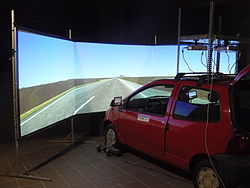
Driving simulator developed by University of Valencia in Spain, used in evaluation of drivers, roads, in-vehicle information system devices and other areas
Portable in-vehicle simulator based on a real car and virtual reality glasses (2017)

Driving simulators are used for entertainment as well as in training of driver's education courses taught in educational institutions and private businesses. They are also used for research purposes in the area of human factors and medical research, to monitor driver behavior, performance, and attention and in the car industry to design and evaluate new vehicles or new advanced driver assistance systems.

Training

[edit]

Driving simulators are being increasingly used for training drivers. Versions exist for cars, trucks, buses, etc.

Uses

[edit]
  • Novice driver training and testing
  • Professional driver training and testing
  • Training in critical driving conditions
  • Testing the effects of impairment on driver performance
  • Analysis of the driver behaviours
  • Analysis of driver responses
  • Evaluating user performances in different conditions (handling of controls)
  • Assessing fitness to drive for aging drivers
  • Testing future in-vehicle technologies on drivers or passengers (Human -Machine Interface)
  • entertainment and fun

Types

[edit]
  • Ambulance simulator: Used to train and assess ambulance drivers in basic and advanced vehicle control skills as well as how to respond to emergencies and interact with other emergency responders.
  • Car simulator: Used to train and test novice drivers in all the skills required to pass a driver's license road test as well as hazard perception and crash risk mitigation.
  • Modular-design simulator: Interchangeable vehicle cabins or cockpits can be configured for use as tractor/trailer trucks, dump trucks and other construction vehicles, airport-operated vehicles, emergency response and police pursuit vehicles, buses, subway trains, passenger vehicles, and heavy equipment such as cranes.
  • Multi-station driving simulator: This type of simulator enables one instructor to train more drivers at the same time thus saving time and reducing costs... These systems are equipped with instructor stations connected to control several driving simulators.
  • Truck simulator: Used to train and assess novice and experienced truck drivers in skills ranging from basic control maneuvers, e.g. shifting and backing, to advanced skills, e.g. fuel efficiency, rollover prevention, defensive driving.
  • Bus simulator: is used to train bus drivers on route familiarisation, safe driving techniques, fuel efficiency techniques. It can be used for training drivers on a variety of bus models and on different types of gear transmissions.
  • Physical simulator: Large scale simulators employ Stewart platforms and xy tables to physically move the driver around in 6-axis space, simulating acceleration, braking and centripetal forces, similar to physical flight simulators.

Entertainment

[edit]

In the 1980s, it became a trend for arcade racing games to use hydraulic motion simulator arcade cabinets.[1][2] The trend was sparked by Sega's "taikan" games, with "taikan" meaning "body sensation" in Japanese.[2] The "taikan" trend began when Yu Suzuki's team at Sega (later known as Sega AM2) developed Hang-On (1985), a racing video game where the player sits on and moves a motorbike replica to control the in-game actions.[3] Suzuki's team at Sega followed it with hydraulic motion simulator cockpit cabinets for later racing games such as Out Run (1986). Sega have since continued to manufacture motion simulator cabinets for arcade racing games through to the 2010s.[1]

In 1991, Namco released the arcade game Mitsubishi Driving Simulator, co-developed with Mitsubishi. It was a serious educational street driving simulator that used 3D polygon technology and a sit-down arcade cabinet to simulate realistic driving, including basics such as ensuring the car is in neutral or parking position, starting the engine, placing the car into gear, releasing the hand-brake, and then driving. The player can choose from three routes while following instructions, avoiding collisions with other vehicles or pedestrians, and waiting at traffic lights; the brakes are accurately simulated, with the car creeping forward after taking the foot off the brake until the hand-brake is applied. Leisure Line magazine considered it the "hit of the show" upon its debut at the 1991 JAMMA show. It was designed for use by Japanese driving schools, with a very expensive cost of AU$150,000 or US$117,000 (equivalent to $282,000 in 2024) per unit.[4]

Advances in processing power have led to more realistic simulators known as sim racing games on home systems, beginning with Papyrus Design Group's groundbreaking IndyCar Racing (1993) and Grand Prix Legends (1998) for PC and Gran Turismo (1997) for home consoles.

Occasionally, a racing game or driving simulator will also include an attachable steering wheel that can be used to play the game in place of a controller. The wheel, which is usually plastic, may also include pedals to add to the game's reality. These wheels are usually used only for arcade and computer games.

In addition to the myriad commercial releases there is a bustling community of amateur coders working on closed and open source free simulators. Some of the major features popular with fans of the genre are online racing, realism and diversity of cars and tracks.

Research

[edit]

Driving simulators are used at research facilities for many purposes. Many vehicle manufacturers operate driving simulators, e.g. BMW, Ford, Renault. Many universities also operate simulators for research. Driving simulators allow researchers to study driver training issues and driver behavior under conditions in which it would be illegal and/or unethical to place drivers. For instance, studies of driver distraction would be dangerous and unethical (because of the inability to obtain informed consent from other drivers) to do on the road.

With the increasing use of various in-vehicle information systems (IVIS) such as satellite navigation systems, cell phones, DVD players and e-mail systems, simulators are playing an important rule in assessing the safety and utility of such devices.

Fidelity

[edit]

There exists a number of types research driving simulators, with a wide range of capabilities. The most complex, like the National Advanced Driving Simulator, have a full-sized vehicle body, with six-axis movement and 360-degree visual displays. On the other end of the range are simple desktop simulators that are often implemented using a computer monitor for the visual display and a videogame-type steering wheel and pedal input devices. These low cost simulators are used readily in the evaluation of basic and clinically oriented scientific questions.[5][6][7][8][9][10] The issue is complicated by political and economic factors, as facilities with low-fidelity simulators claim their systems are "good enough" for the job, while the high-fidelity simulator groups insist that their (considerably more expensive) systems are necessary. Research into motion fidelity indicates that, while some motion is necessary in a research driving simulator, it does not need to have enough range to match real-world forces.[11] Recent research has also considered the use of the real-time photo-realistic video content that reacts dynamically to driver behaviour in the environment.[12]

Validity

[edit]

There is a question of validity—whether results obtained in the simulator are applicable to real-world driving. One review of research studies found that driver behavior on a driving simulator approximates (relative validity) but does not exactly replicate (absolute validity) on-road driving behavior.[13] Another study found absolute validity for the types and number of driver errors committed on a simulator and on the road.[14] Yet another study found that drivers who reported impaired performance on a low fidelity driving simulator were significantly more likely to take part in an accident in which the driver was at least partially at fault, within five years after the simulator session.[15] Some research teams are using automated vehicles to recreate simulator studies on a test track, enabling a more direct comparison between the simulator study and the real world.[16] As computers have grown faster and simulation is more widespread in the automotive industry, commercial vehicle math models that have been validated by manufacturers are seeing use in simulators.

See also

[edit]

References

[edit]
Revisions and contributorsEdit on WikipediaRead on Wikipedia
from Grokipedia
A driving simulator is a computer-based system that replicates the experience of operating a in a controlled, , utilizing mathematical models of , motion platforms, and immersive visual, auditory, and haptic feedback to mimic real-world driving conditions for purposes such as , , testing, and . The development of driving simulators traces back to the 1920s, with early prototypes emerging from flight simulation technologies and initial automotive applications in the 1950s by manufacturers like , , and Ford for training and stability . By the 1970s, these systems evolved into more sophisticated setups with three degrees of freedom (DOF) motion platforms and single-screen visuals, while the 1980s saw high-fidelity advancements, such as Daimler-Benz's simulator, paving the way for modern facilities like the National Advanced Driving Simulator (NADS) at the , established in 1999 with 13-DOF capabilities funded by the (NHTSA). Key components include the model, which simulates physics like suspension and using up to 30 DOF; motion systems ranging from simple 2-DOF seats to complex hexapod or hybrid platforms for acceleration and tilt cues; and virtual environments generated via software like , incorporating traffic, weather, and 360-degree projections for realism. Driving simulators are widely applied in driver behavior studies, such as evaluating distractions, , or impairment effects; novice and professional drivers, including ; validating advanced driver assistance systems (ADAS) and autonomous vehicle technologies in scenarios like car-following or emergency braking; and through arcade machines and consumer video games. They offer advantages like safety, repeatability, and cost-efficiency over on-road testing, though challenges include , high setup costs, and ensuring validity through comparisons of simulated versus real-world data, where relative validity (similar behavioral trends) is often confirmed but absolute validity (exact matches) varies. Notable examples include university-based systems like NADS for traffic safety research and industry tools from VI-grade for chassis design optimization.

History

Early Developments

Initial automotive applications of driving simulators emerged in the 1950s, with manufacturers such as , , and Ford developing early prototypes for driver training and vehicle stability research. The development of driving simulators in the mid-20th century was heavily influenced by crossovers from and training technologies, particularly hydraulic motion systems originally designed for flight simulators in the 1940s and 1950s. These systems, which used hydraulic actuators to replicate forces and movements, were adapted for ground vehicle simulations during the 1950s and 1960s to provide physical feedback in controlled settings, enabling safer exploration of vehicle handling and driver responses without real-world hazards. Early applications focused on research into driver behavior and vehicle design, drawing on aviation's emphasis on repeatable, risk-free training environments. In the , motorsport innovation advanced simulator technology through ' efforts, where founder spearheaded the creation of one of the earliest dedicated simulators in 1966. This device employed analog computers to simulate , paired with a physical of race tracks like , captured by a camera and projected via mirrors onto a screen for visual immersion. Primarily used for driver training in Formula 1 and marketed as an arcade attraction, it represented a foundational step in integrating computational modeling with interactive feedback for performance optimization. Research-oriented driving simulators emerged in the late , with the Laboratory of Japan's Agency of Industrial Science and Technology (AIST) developing a notable example in 1976 to study automated driving simulations and human-vehicle interactions. This simulator incorporated basic motion and visual elements to model driver responses in controlled scenarios, addressing growing concerns over traffic safety amid rapid motorization. Such systems prioritized conceptual validation of automated controls and behavioral analysis, setting precedents for academic and industrial applications. By the mid-1970s, arcade-style games served as precursors to more interactive driving simulations, exemplified by Atari's Night Driver released in 1976. This vector-graphics-based game provided a first-person perspective of steering through a darkened , introducing real-time visual cues and control inputs to a broad audience and influencing future entertainment and training designs. Throughout this era, key challenges hindered progress, including severely limited computing power that impeded accurate real-time modeling and rudimentary visual displays reliant on or film strips, which offered low resolution and poor environmental . These constraints caused a temporary decline in simulator adoption around the mid-1960s, only revitalized by computational improvements from NASA's space program in the late 1960s.

Modern Evolution

The 1980s marked the commercialization of driving simulators through arcade games, which popularized interactive racing experiences and introduced motion elements to enhance realism. Pole Position, released by Namco in 1982 and distributed by Atari in the West, revolutionized arcade racing with its third-person perspective, realistic track layouts inspired by real circuits, and a qualifying lap system that set new standards for the genre. Sega's Hang-On, launched in 1985, further advanced this trend by featuring a motorcycle-shaped cabinet with motion controls that tilted to simulate leaning into curves, mimicking centrifugal forces for immersive gameplay. In the , driving simulators shifted toward higher fidelity and educational applications, bridging entertainment and research. Namco's Driving Simulator, co-developed with and released in 1991, represented a serious street-driving tool aimed at training, utilizing advanced graphics and controls for realistic urban scenarios. This era also saw the emergence of sophisticated research facilities, exemplified by the National Advanced Driving Simulator (NADS) at the , developed in the late 1990s and operational in 2001, which provided high-fidelity environments for studying driver-vehicle interactions with precise motion and visual systems. The 2000s witnessed the rise of PC-based sim racing, fueled by influential titles and hardware innovations that democratized access to realistic simulations. Gran Turismo, debuted in 1997 on PlayStation but profoundly influencing PC platforms through its emphasis on accurate physics and vehicle handling, paved the way for a surge in dedicated communities during the decade. Concurrently, the integration of force feedback wheels—such as those from and —became widespread, providing haptic responses to road conditions and that elevated immersion beyond visual and auditory cues alone. From the to the , the driving simulator market expanded rapidly due to digital integration, cost reductions in computing power, and growing demand across , , and sectors. The global market was valued at USD 2.1 billion in 2023, projected to reach USD 4.2 billion by 2033 at a of 7.3%. A key milestone in this period is Renault Group's progression through five generations of simulators, starting with the 1998 for lighting validation and culminating in the 2023 ROADS system—a full-immersion dome with 360-degree projection, 1G capabilities, and a 25m x 25m rail platform for unprecedented realism in ADAS and handling evaluations.

Technology

Hardware Components

Driving simulators rely on a variety of hardware components to replicate the physical sensations and interactions of real-world , enhancing user immersion and realism. These elements include motion platforms, visual display systems, control interfaces, and sensory feedback mechanisms such as audio and environmental simulators. The integration of these components varies by simulator type, from fixed-base setups for basic training to high-fidelity systems for , with design priorities focusing on , cost, and perceptual . Motion systems in driving simulators primarily utilize Stewart platforms, also known as 6-degree-of-freedom (6DoF) hexapods, to simulate accelerations, braking, and turns by providing coordinated movements in surge, sway, heave, pitch, roll, and yaw. These platforms consist of a top plate connected to a base via six extensible legs, typically hydraulic or electric actuators, allowing precise control over cues that are critical for maintaining driver orientation. Originating from flight simulation applications in the , where D. Stewart proposed the mechanism for reproducing aircraft motion in 1965, Stewart platforms have been adapted for driving simulators to deliver realistic vestibular feedback without the risks of on-road testing. For instance, a Stewart platform-based motion system in a driving simulator can achieve accelerations up to in multiple axes, though workspace limitations often require motion cueing algorithms to extend perceived motion beyond physical constraints. Visual displays form the core of environmental rendering in driving simulators, employing configurations that provide wide fields of view to mimic and . Common setups include multi-screen arrays, such as three to seven curved or flat monitors offering 180-220° horizontal fields of view, or dome projections that encircle the driver for 360° immersion using rear-projection screens and multiple projectors. High-end examples, like the National Advanced Driving Simulator's 24-foot (7.3-meter) dome, integrate seamless edge-blending for distortion-free visuals across a full surround. Since the mid-2010s, head-mounted displays (HMDs) such as the have been integrated into driving simulators, enabling personalizable 360° views with head-tracking for enhanced spatial awareness, though they may introduce cybersickness if latency exceeds 20ms. These systems typically render at resolutions up to 4K per eye, prioritizing low-latency graphics to align visual cues with motion feedback. Control interfaces replicate vehicle inputs through force-feedback mechanisms that provide tactile resistance and vibration to convey road conditions and efforts. Steering wheels, such as those from , feature direct-drive or belt-driven motors delivering torque up to 10 Nm, as in models like the T818, with rotation ranges adjustable from 270° to 4500° to match real-vehicle lock-to-lock turns, enhancing precision in simulated scenarios. Pedals incorporate load cells—strain-gauge sensors measuring applied force up to 200kg for braking—to simulate progressive resistance akin to hydraulic systems, improving modulation accuracy over potentiometer-based alternatives. Haptic seats and transducers, like ButtKicker units mounted under the seat, add vibrotactile cues for tire grip loss or road texture, using frequencies from 10-300Hz to convey low-frequency forces without full motion platforms. These interfaces connect via USB or for real-time synchronization with . Audio and environmental systems augment multisensory immersion by simulating auditory and tactile externalities. Surround sound setups, often 5.1 or 7.1 configurations integrated into the vehicle cabin, render spatialized engine noise, tire squeals, and wind rush using ambisonic processing to localize sources relative to the driver's viewpoint. For instance, the VIRTTEX driving simulator employs a 3D audio engine to generate realistic in-vehicle acoustics from parameterized sources like RPM-dependent engine tones and velocity-scaled wind noise. Environmental enhancers include wind simulators—high-velocity fans modulated by simulated speed to produce airflow up to 50km/h—and seats, which use pneumatic bladders or linear actuators to apply lateral and longitudinal pressures mimicking cornering or acceleration loads up to 1.5g. These elements, while secondary to visuals and motion, significantly reduce perceptual gaps in fixed-base simulators. Mid-range driving simulators exemplify hardware integration by combining cost-effective components for balanced fidelity. The University of Skövde's simulator, for example, features a complete vehicle chassis with authentic force-feedback steering and load-cell pedals, surrounded by seven LCD-projected screens for a 220° forward , augmented by ButtKicker haptic transducers in the seat for vibration feedback and a speed-controlled fan for wind simulation, all without a full motion platform to maintain affordability. This setup demonstrates how modular hardware—real controls paired with projected visuals and basic sensory add-ons—can achieve effective immersion for educational and research purposes.

Software and Simulation

Software in driving simulators encompasses the algorithms and computational frameworks that replicate real-world driving physics, visuals, and environmental interactions, enabling immersive and realistic experiences. These systems integrate physics engines to model vehicle behavior, graphics pipelines for rendering dynamic scenes, and scenario generation tools to simulate varied conditions, all while ensuring seamless compatibility with hardware inputs and outputs. High-fidelity simulations rely on established models like the Pacejka Magic Formula for dynamics, which has become a standard for predicting forces under slip conditions in vehicle simulations. Physics modeling forms the core of driving simulator software, focusing on through mathematical representations of s and motions. A key component is tire modeling, where the Pacejka Magic Formula provides an empirical approach to compute lateral and longitudinal s based on slip angles and ratios. This model, widely adopted for its accuracy in steady-state conditions on flat surfaces, uses parameters such as peak factor (D), shape factor (C), stiffness factor (B), and curvature factor (E) to describe tire-road interactions. The lateral FyF_y is calculated as: Fy=Dsin(Carctan(BαE(Bαarctan(Bα))))F_y = D \sin\left( C \arctan\left( B \alpha - E (B \alpha - \arctan(B \alpha)) \right) \right) where α\alpha is the slip angle. This formulation allows simulators to accurately replicate handling characteristics like understeer and oversteer, essential for training and research applications. Graphics engines handle real-time rendering to create visually convincing environments, with Unity and Unreal Engine being prominent choices for driving simulators due to their robust support for high-fidelity visuals. Unity excels in flexible 3D rendering and seamless integration for multi-channel displays, as seen in professional setups enhancing realism and performance. Unreal Engine, leveraging its advanced deferred rendering pipeline, delivers photorealistic scenes suitable for vehicle simulations, including support for virtual reality headsets. Post-2018 advancements in ray-tracing, introduced with hardware like NVIDIA RTX, enable realistic lighting, shadows, and reflections in these engines, significantly improving scene fidelity without compromising frame rates in optimized implementations. Scenario builders facilitate the creation of diverse driving environments by allowing users to configure patterns, effects, and conditions, often incorporating AI-driven non-player characters (NPCs) for realistic interactions. Tools like ScenarioRunner in the CARLA simulator enable modular definition and execution of scenarios, including dynamic behaviors for vehicles and pedestrians to mimic urban congestion or highway flows. These systems support variations in —such as or —through , ensuring scenarios test adaptive responses in autonomous or human-driven contexts. AI NPCs, powered by behavior trees or , add variability by simulating rule-following or erratic drivers, enhancing the of simulations. Integration layers bridge software with hardware via APIs, ensuring synchronized data exchange such as translating physics outputs into force feedback for steering wheels. Platforms like provide flexible APIs for connecting simulation engines to input devices, controllers, and motion systems, supporting real-time updates for immersive feedback. These interfaces handle latency-critical tasks, like mapping tire slip calculations to haptic responses, while maintaining compatibility across diverse hardware ecosystems. Open-source examples, such as (The Open Racing Car Simulator), exemplify customizable software with modular physics and graphics, allowing researchers to tweak vehicle parameters for tailored experiments.

Training Applications

Uses

Driving simulators play a crucial role in novice driver education by allowing learners to hazardous scenarios, such as skids, intersections, and sudden obstacles, in a controlled environment free from real-world risks. This approach enables repeated exposure to high-risk situations that would be dangerous or impractical during on-road training, fostering safer decision-making and hazard anticipation skills. For instance, research indicates that simulator interventions improve hazard perception and overall performance, contributing to lower rates in early driving years. In contexts, driving simulators are extensively used for operators of trucks, buses, and vehicles, where they simulate complex maneuvers like tight turns, adverse weather, and high-speed pursuits. These systems allow for the safe replication of impairment effects, such as those from alcohol, through mechanisms like delayed and pedal inputs that mimic reduced reaction times and coordination loss. This is particularly valuable for responders, enabling practice of evasive actions and siren navigation without endangering public safety. Simulator for drivers has been shown to decrease crash incidents by up to 22% compared to traditional methods, enhancing operational readiness across fleets. Beyond direct skill-building, driving simulators facilitate the evaluation of emerging in-vehicle information systems (IVIS), such as , by testing driver interactions in simulated traffic flows before real-world implementation. This pre-deployment assessment identifies potential distractions or usability issues, ensuring technologies integrate seamlessly with . For example, simulator studies have evaluated how affects speed maintenance and headway, informing design improvements to minimize driver workload. Globally, driving simulators have gained adoption in standardized training programs, notably through the European Union's Directive 2018/645, which since the late permits simulators to substitute portions of practical lessons for professional drivers, promoting safer and more efficient . To enhance accessibility, portable (VR) systems offer low-cost alternatives, enabling simulator training in resource-limited settings without the need for fixed installations. These compact VR setups democratize access to immersive practice, particularly in developing regions or small training centers. The primary benefits of driving simulators in training include substantial cost savings and scalability, as they eliminate expenses associated with fuel, vehicle maintenance, and damage from real-world errors—potentially avoiding thousands of dollars per incident in repairs or liability. For fleet operators, this translates to efficient, repeatable sessions that can train multiple drivers simultaneously, reducing downtime and accelerating proficiency without compromising safety. Overall, these advantages make simulators a scalable solution for both individual and organizational driver development.

Types

Driving simulators for training are categorized by their setup, vehicle specificity, and fidelity levels to address diverse instructional needs, such as skill development in hazard avoidance. Fixed-base simulators, which lack physical motion and rely on visual and auditory cues, are commonly used for basic skills training like and speed control in controlled environments. In contrast, motion-based simulators incorporate platforms like hexapods to replicate accelerations and vibrations, enabling advanced maneuver practice such as emergency braking or evasive actions. These motion systems typically offer 3 to 6 (DOF), enhancing realism for complex scenarios. Vehicle-specific simulators tailor training to operational contexts, with car models supporting general licensing and road rule adherence for novice drivers. Truck and bus simulators focus on commercial applications, often featuring modular multi-station setups for fleet operations to simulate long-haul routes and cargo handling. Ambulance simulators, equipped with sirens, lights, and emergency controls, prepare responders for high-stakes urban navigation and patient transport. Fidelity levels range from low-cost portable units, such as VR headsets priced under $500, which provide accessible on-the-go training for reaction times and spatial awareness, to high-end institutional systems with 6-DOF platforms for precise motion cueing in research-grade evaluations. For instance, Carnetsoft software integrates with simulators for fitness-to-drive assessments, measuring lateral control, braking response, and attention via real-time to evaluate post-injury or age-related capabilities. Post-2020 innovations include AI-enhanced simulators that adapt training paths in real-time, personalizing scenarios based on learner to improve retention and outcomes. These systems, such as those incorporating AI traffic modeling, have been deployed in driver education to simulate dynamic interactions more effectively than traditional methods. As of 2025, advancements in AI and VR continue to expand, with gamified learning and adaptive scenarios enhancing engagement and outcomes in novice and professional training programs.

Entertainment Applications

Arcade Simulators

Arcade simulators emerged in the as commercial entertainment devices designed for public venues, prioritizing thrilling experiences over realistic training. Sega's (1986), developed by , marked a pivotal origin, utilizing innovative "Super Scaler" hardware to create pseudo-3D visuals and branching routes that simulated open-road driving freedom. The game's deluxe sit-down cabinet featured a tilting mechanism where players physically leaned to steer, providing pseudo-motion feedback that heightened immersion without full hydraulic systems. By 1993, had sold over 30,000 cabinets worldwide, generating approximately $393 million in revenue, underscoring its role in boosting arcade profitability during the era. The represented a peak for arcade simulators, driven by advancements in 3D graphics and motion technology that amplified the fun of high-speed racing. Namco's (1993), running on the powerful System 22 hardware, exemplified this evolution with smooth drifting mechanics, vibrant tracks, and responsive controls that emphasized arcade-style excitement over simulation accuracy. While standard upright cabinets were common, deluxe versions like the full-scale "" model enclosed players in a real body with multi-screen projections, creating an enveloping environment for competitive play. These setups often incorporated motion elements, such as subtle platform feedback, to mimic acceleration and turns, further distinguishing them from home systems. Typical design features of arcade simulators included coin-operated enclosed cabins with large, curved screens or arrays for panoramic views, wheels, pedals, and gear shifters calibrated for intuitive, penalty-free . Unlike or variants, these focused on rapid, accessible —allowing endless retries without real-world consequences—to maximize player turnover and revenue in busy locations like malls and amusement parks. The emphasis on visual spectacle and , such as revving engines and upbeat soundtracks, catered to short sessions that encouraged repeat plays. These simulators had a profound cultural impact, popularizing the sim racing genre and turning arcades into social hubs for gaming enthusiasts. Installations proliferated in malls, trade expos, and theme parks, with high-end models like Namco's co-developed Driving Simulator (1991) showcasing advanced 3D graphics in promotional settings, drawing crowds to experience futuristic driving. Such units helped bridge arcade entertainment with automotive branding, influencing the broader perception of video games as mainstream leisure. Following the , arcade simulators experienced a decline due to the rise of affordable home consoles and , which shifted revenue streams away from physical coin-ops toward online and VR experiences. Traditional cabinets became rarer in dedicated arcades, replaced by stripped-down ports of console titles. However, elements of arcade simulators persisted in revival forms, particularly at motorsport events where motion-enabled setups provide interactive fan experiences, blending with modern technology to engage audiences at races and exhibitions.

Home and Consumer Simulators

Home and consumer driving simulators have evolved into accessible platforms for personal entertainment, allowing individuals to experience realistic vehicle handling without leaving their living rooms. These systems range from console-based titles to customizable personal rigs, emphasizing leisure and skill-building through immersive gameplay. Unlike public arcade setups, home versions prioritize affordability, modifiability, and integration with everyday gaming hardware, fostering a hobbyist culture among enthusiasts. The Gran Turismo series, launched in 1997 on the original PlayStation, marked a pivotal evolution in console driving simulators by introducing photorealistic graphics, detailed physics, and a vast car collection that appealed to casual and dedicated players alike. By 2016, with the release of Gran Turismo Sport, the franchise integrated PlayStation VR support, enabling 360-degree immersive racing experiences that enhanced spatial awareness and realism. As of June 2025, the series has sold over 100 million units worldwide, underscoring its enduring popularity and influence on consumer sim racing. Enthusiasts often build do-it-yourself (DIY) rigs to elevate the home experience, combining off-the-shelf components like Fanatec direct-drive wheel bases and pedals with custom or triple-monitor displays for a more authentic cockpit feel. These setups typically cost between $1,000 and $5,000, depending on features such as force feedback intensity and seating , making them viable for hobbyists seeking professional-grade without institutional budgets. Fanatec's CSL DD series, for instance, offers entry-level direct drive at around $429 for the base, scalable for various budgets. Advancements post-2020 have further blurred lines between gaming and simulation through (VR) and (AR) integrations, with titles like supporting Oculus Quest 2 headsets as early as 2021 for wireless, high-fidelity immersion, and ongoing updates in November 2025 including new UI and physics enhancements. This era also saw the rise of esports leagues tailored to consumer platforms, such as the Accelerate series launched in 2021, where amateur and pro sim racers compete in official virtual championships using accessible software like rFactor 2. These developments have democratized competitive racing, drawing in players via standard PCs and consoles. Affordable PC and mobile options expand accessibility for budget-conscious users, with PC titles like City Car Driving offering realistic urban navigation and traffic scenarios through purchasable versions that simulate diverse weather and road conditions. On smartphones, free apps such as Real Driving Simulator employ tilt controls for intuitive steering, mimicking real-world physics in open-world environments and supporting for deeper engagement. These platforms lower , allowing quick sessions on the go without specialized hardware. Vibrant communities drive innovation in home simulators through modding scenes, where users create custom tracks, vehicles, and liveries for games like , enhancing replayability and personalization. Virtual racing events surged during the 2020 , as real-world motorsports halted, prompting organized online leagues and celebrity participations that boosted participation by substituting live events with accessible digital alternatives. This community momentum continues to sustain growth, with forums and servers facilitating shared builds and tournaments.

Research Applications

Methodologies

Driving simulators enable controlled experimental environments to investigate driver behavior and vehicle systems, allowing researchers to manipulate variables such as traffic conditions and distractions while measuring physiological and performance outcomes. These methodologies typically involve high-fidelity setups that replicate real-world driving dynamics, facilitating the collection of data on reaction times, patterns, and vehicle control metrics without safety risks. In behavioral studies, simulators are used to analyze distractions through scripted scenarios, such as sudden crossings or encroachments, where participants respond to s under varying cognitive loads. For instance, use has been shown to impair detection, with hand-held calling increasing reaction time by approximately 0.3 seconds from a baseline of 0.6 seconds, and texting tasks nearly doubling it to over 1 second. Complex texting can elevate reaction times by up to 204% in events, highlighting the severity of visual-manual distractions in controlled simulations. Human factors research employs driving simulators to evaluate in-vehicle information systems (IVIS), such as interfaces, by integrating secondary tasks like text entry or into baseline driving routes. Key metrics include glance duration, where eyes-off-road times exceed 2 seconds during prolonged IVIS interactions, leading to degraded , and deviation, measured as standard deviation of position (SDLP), which correlates with visual occlusion time (r=0.891). These studies often use medium-fidelity simulators with 270-degree visual fields to assess adaptive behaviors, revealing that high-risk drivers exhibit longer mean glance durations over repeated sessions. For autonomous vehicle testing, simulators facilitate the simulation of edge cases, such as unexpected interactions at crosswalks, to validate and algorithms in safe, repeatable conditions. Prior to 2020, approaches focused on generative methods in tools like CARLA to reconstruct rare scenarios, emphasizing trajectory safety metrics like time-to-collision. By 2023, methodologies expanded to AI validation through hybrid simulations integrating multi-modal data and knowledge-driven ontologies, improving detection of anomalies like erratic movements with metrics such as true positive rates and F1-scores. enhancements in these tests, using 360-degree environments, have supported studies on multi-pedestrian dynamics since around 2020. In 2025, advancements include co-simulation platforms that integrate driving simulators with vehicle-in-the-loop testing for more accurate evaluation of automated driving systems. Participant protocols in simulator experiments standardize recruitment to ensure demographic diversity, often targeting ages 18-30 with exclusion for neurological conditions, and obtaining . Scenarios are designed with varying workloads—e.g., low for braking, high for lead vehicle following—and may involve sequential presentation to build complexity, though randomization counters order effects in some designs. integrates eye-tracking systems sampling at 1000 Hz to capture fixation durations and saccades, alongside like for assessment. A prominent example is the University of Iowa's National Advanced Driving Simulator (NADS), operational since 2001, which has supported forward collision warning system development through automated simulations of hazard events, building on initial work from 1994. This facility's high-fidelity motion and visual cues have enabled longitudinal testing of warning thresholds and driver responses in controlled crash-avoidance scenarios.

Fidelity and Validity

Fidelity in driving simulators refers to the degree of realism in replicating real-world sensory and physical cues, often categorized into absolute , which aims for exact physical replication of driving conditions such as precise and environmental interactions, and functional fidelity, which emphasizes behavioral equivalence sufficient for training outcomes without needing perfect duplication. High-fidelity systems like the National Advanced Driving Simulator (NADS) achieve motion cue accuracy where scaling cues by 90% or more becomes imperceptible to users, enabling effective simulation of sustained accelerations and maneuvers through its 13-degree-of-freedom motion base with low noise levels (e.g., 6-10 mG RMS) and moderate bandwidth responses. Validity assesses how well simulator data corresponds to real-world , distinguished as absolute validity, involving numerical matches in metrics like speed or between simulated and on-road performance, and relative validity, where trends and effects (e.g., increased reaction times to hazards) align directionally without exact equivalence. Transfer studies validate these by demonstrating 70-80% correlations in skills, such as corrections and time taken during tasks, where simulator-trained drivers achieve near-equivalent success rates (e.g., 73/75 points) in real vehicles compared to on-road trained groups, though with slightly more adjustments due to simulator sensitivity. Key measurements include cueing validity, which evaluates the alignment of visual and motion cues to produce realistic vestibular sensations—such as using tilt for low-frequency sustained forces (thresholds of 0.05-0.15 rad/s) and for high-frequency onsets—ensuring perceptual without overwhelming users, as scale-factors above 0.9 yield imperceptible differences. Transfer validity further confirms applicability by testing sim-trained skills in real vehicles, showing positive transfer in tasks like braking and lane-keeping, with correlations around 78% between simulator performance metrics and on-road outcomes. Challenges to fidelity and validity encompass , which induces , disorientation, and in 20-30% of users due to visual-vestibular mismatches during prolonged sessions, potentially results. Additionally, cost-benefit analyses highlight trade-offs, as low-fidelity PC-based simulators (under $50,000) provide sufficient relative validity and skill transfer for training, while high-fidelity systems (around $80 million) offer marginal gains in absolute metrics at higher expense, making lower options preferable for broad behavioral research. Post-2020 advancements in (VR) integration have addressed sickness through higher refresh rates of 90-120 Hz, which significantly reduce severity by minimizing rendering lags and improving visual-motion synchronization, with 120 Hz identified as a key threshold for perceptible symptom alleviation in head-mounted displays.

References

Add your contribution
Related Hubs
User Avatar
No comments yet.