Respect all members: no insults, harassment, or hate speech.
Be tolerant of different viewpoints, cultures, and beliefs. If you do not agree with others, just create separate note, article or collection.
Clearly distinguish between personal opinion and fact.
Verify facts before posting, especially when writing about history, science, or statistics.
Promotional content must be published on the “Related Services and Products” page—no more than one paragraph per service. You can also create subpages under the “Related Services and Products” page and publish longer promotional text there.
Do not post materials that infringe on copyright without permission.
Always credit sources when sharing information, quotes, or media.
Be respectful of the work of others when making changes.
Discuss major edits instead of removing others' contributions without reason.
If you notice rule-breaking, notify community about it in talks.
Do not share personal data of others without their consent.
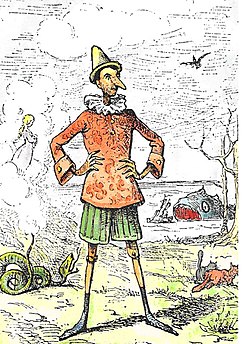
The fictional character Pinocchio is a common depiction of a liar.
A lie is an assertion that is believed to be false, typically used with the purpose of deceiving or misleading someone.[1][2][3] The practice of communicating lies is called lying. A person who communicates a lie may be termed a liar. Lies can be interpreted as deliberately false statements or misleading statements, though not all statements that are literally false are considered lies – metaphors, hyperboles, and other figurative rhetoric are not intended to mislead, while lies are explicitly meant for literal interpretation by their audience. Lies may also serve a variety of instrumental, interpersonal, or psychological functions for the individuals who use them.[4]
Generally, the term "lie" carries a negative connotation, and depending on the context a person who communicates a lie may be subject to social, legal, religious, or criminal sanctions; for instance, perjury, or the act of lying under oath, can result in criminal and civil charges being pressed against the perjurer.
Although people in many cultures believe that deception can be detected by observing nonverbal behaviors (e.g. not making eye contact, fidgeting, stuttering, smiling) research indicates that people overestimate both the significance of such cues and their ability to make accurate judgements about deception.[5][6] More generally, people's ability to make true judgments is affected by biases towards accepting incoming information and interpreting feelings as evidence of truth. People do not always check incoming assertions against their memory.[7]
A barefaced, bald-faced or bold-faced lie is an impudent, brazen, shameless, flagrant, or audacious lie that is sometimes but not always undisguised and that it is even then not always obvious to those hearing it.[8]
A big lie is one that attempts to trick the victim into believing something major, which will likely be contradicted by some information the victim already possesses, or by their common sense. When the lie is of sufficient magnitude it may succeed, due to the victim's reluctance to believe that an untruth on such a grand scale would indeed be concocted.[9]
A black lie is about simple and callous selfishness. They are usually told when others gain nothing, and the sole purpose is either to get oneself out of trouble (reducing harm against oneself), or to gain something one desires (increasing benefits for oneself).[10][better source needed]
A blue lie is a form of lying that is told purportedly to benefit a collective or "in the name of the collective good". The origin of the term "blue lie" is possibly from cases where police officers made false statements to protect the police force, or to ensure the success of a legal case against an accused.[11]
An April fool is a lie or hoax told/performed on April Fools' Day.
To bluff is to pretend to have a capability or intention one does not possess.[9] Bluffing is an act of deception that is rarely seen as immoral when it takes place in the context of a game, such as poker, where this kind of deception is consented to in advance by the players. For instance, gamblers who deceive other players into thinking they have different cards to those they really hold, or athletes who hint that they will move left and then dodge right are not considered to be lying (also known as a feint or juke). In these situations, deception is acceptable and is commonly expected as a tactic.[citation needed]
Bullshit (also B.S., bullcrap, bull) does not necessarily have to be a complete fabrication. While a lie is related by a speaker who believes what is said is false, bullshit is offered by a speaker who does not care whether what is said is true because the speaker is more concerned with giving the hearer some impression. Thus, bullshit may be either true or false, but demonstrates a lack of concern for the truth that is likely to lead to falsehoods.[12]
A motivational poster about lying declares "An ostrich only thinks he 'covers up'" A cover-up may be used to deny, defend, or obfuscate a lie, errors, embarrassing actions, or lifestyle, and/or lie(s) made previously.[9] One may deny a lie made on a previous occasion, or alternatively, one may claim that a previous lie was not as egregious as it was. For example, to claim that a premeditated lie was really "only" an emergency lie, or to claim that a self-serving lie was really "only" a white lie or noble lie. This should not be confused with confirmation bias in which the deceiver is deceiving themselves.[citation needed]
Defamation is the communication of a false statement that harms the reputation of an individual person, business, product, group, government, religion, or nation.[9]
To deflect is to avoid the subject that the lie is about, not giving attention to the lie. When attention is given to the subject the lie is based around, deflectors ignore or refuse to respond. Skillful deflectors are passive-aggressive, who when confronted with the subject choose to ignore and not respond.[13]
An exaggeration occurs when the most fundamental aspects of a statement are true, but only to a certain degree. It also is seen as "stretching the truth" or making something appear more powerful, meaningful, or real than it is. Saying that someone devoured most of something when they only ate half is considered an exaggeration. An exaggeration might be easily found to be a hyperbole where a person's statement (i.e. in informal speech, such as "He did this one million times already!") is meant not to be understood literally.[9]
A fib is a lie that is easy to forgive due to its subject being a trivial matter; for example, a child may tell a fib by claiming that the family dog broke a household vase, when the child was the one who broke it.[9]
Fraud refers to the act of inducing another person or people to believe a lie in order to secure material or financial gain for the liar. Depending on the context, fraud may subject the liar to civil or criminal penalties.[15]
A gray lie is told partly to help others and partly to help ourselves. It may vary in the shade of gray, depending on the balance of help and harm. Gray lies are, almost by definition, hard to clarify. For example you can lie to help a friend out of trouble but then gain the reciprocal benefit of them lying for you while those they have harmed in some way lose out.[10][better source needed]
A half-truth or partial truth is a deceptive statement that includes some element of truth. The statement might be partly true, the statement may be totally true, but only part of the whole truth, or it may employ some deceptive element, such as improper punctuation or double meaning, especially if the intent is to deceive, evade, blame, or misrepresent the truth.[16] Partial truths are characterized by malicious intent, and therefore, honest people should not excuse them as containing a "rational kernel."[17]
Confabulation (or honest lie) may be identified by verbal statements or actions that inaccurately describe the history, background, and present situations. There is generally no intent to misinform and the individual is unaware that their information is false. Because of this, it is not technically a lie at all since, by definition, there must be an intent to deceive for the statement to be considered a lie.[citation needed]
Jocose lies are lies meant in jest, intended to be understood as such by all present parties. Teasing and irony are examples. A more elaborate instance is seen in some storytelling traditions, where the storyteller's insistence that the story is the absolute truth, despite all evidence to the contrary (i.e., tall tale), is considered humorous. There is debate about whether these are "real" lies, and different philosophers hold different views. The Crick Crack Club in London arranges a yearly "Grand Lying Contest" with the winner being awarded the coveted "Hodja Cup" (named for the Mulla Nasreddin: "The truth is something I have never spoken."). The winner in 2010 was Hugh Lupton. In the United States, the Burlington Liars' Club awards an annual title to the "World Champion Liar."[18]
Lie-to-children is a phrase that describes a simplified explanation of technical or complex subjects as a teaching method for children and laypeople. While lies-to-children are useful in teaching complex subjects to people who are new to the concepts discussed, they can promote the creation of misconceptions among the people who listen to them. The phrase has been incorporated by academics within the fields of biology, evolution, bioinformatics, and the social sciences. Media use of the term has extended to publications including The Conversation and Forbes.[citation needed]
Lying by omission, also known as a continuing misrepresentation or quote mining, occurs when an important fact is left out in order to foster a misconception. Lying by omission includes the failure to correct pre-existing misconceptions. For example, when the seller of a car declares it has been serviced regularly, but does not mention that a fault was reported during the last service, the seller lies by omission. It may be compared to dissimulation. An omission is when a person tells most of the truth, but leaves out a few key facts that therefore, completely obscures the truth.[13]
Consumer protection laws often mandate the posting of notices, such as this one which appears in all automotive repair shops in California.Lying in trade occurs when the seller of a product or service may advertise untrue facts about the product or service in order to gain sales, especially by competitive advantage. Many countries and states have enacted consumer protection laws intended to combat such fraud.
A memory hole is a mechanism for the alteration or disappearance of inconvenient or embarrassing documents, photographs, transcripts, or other records, such as from a website or other archive, particularly as part of an attempt to give the impression that something never happened.[19][20]
Mutual deceit is a situation wherein lying is both accepted and expected[21] or that the parties mutually accept the deceit in question. This can be demonstrated in the case of a poker game wherein the strategies rely on deception and bluffing to win.[22]
Plato presented arguments to justify the use of noble lies in his Republic.[23] A noble lie, which also could be called a strategic untruth, is one that normally would cause discord if uncovered, but offers some benefit to the liar and assists in an orderly society, therefore, potentially being beneficial to others. It is often told to maintain law, order, and safety.
Paltering is the active use of selective truthful statements to mislead.[24]
Paternalistic deception is a lie told because it is believed (possibly incorrectly) that the deceived person will benefit.
In psychiatry, pathological lying (also called compulsive lying, pseudologia fantastica, and mythomania) is a behavior of habitual or compulsive lying.[25][26] It was first described in the medical literature in 1891 by Anton Delbrueck.[26] Although it is a controversial topic,[26] pathological lying has been defined as "falsification entirely disproportionate to any discernible end in view, may be extensive and very complicated, and may manifest over a period of years or even a lifetime".[25] The individual may be aware they are lying, or may believe they are telling the truth, being unaware that they are relating fantasies.[citation needed]
Perjury is the act of lying or making verifiably false statements on a material matter under oath or affirmation in court, or in any of various sworn statements in writing. Perjury is a crime, because the witness has sworn to tell the truth, and for the credibility of the court to remain intact, witness testimony must be relied on as truthful.[9]
A polite lie is a lie that a politeness standard requires, and that usually is known to be untrue by both parties. Whether such lies are acceptable is heavily dependent on culture. A common polite lie in international etiquette may be to decline invitations because of "scheduling difficulties", or due to "diplomatic illness". Similarly, the butler lie is a small lie that usually is sent electronically and is used to terminate conversations or to save face.[27]
Puffery is an exaggerated claim typically found in advertising and publicity announcements, such as "the highest quality at the lowest price", or "always votes in the best interest of all the people". Such statements are unlikely to be true – but cannot be proven false and so, do not violate trade laws, especially as the consumer is expected to be able to determine that it is not the absolute truth.[28]
A red lie is about spite and revenge. It is driven by the motive to harm others even at the expense of harming oneself, out of an angry desire for retribution.[10][better source needed]
The phrase "speaking with a forked tongue" means to deliberately say one thing and mean another or, to be hypocritical, or act in a duplicitous manner. This phrase was adopted by Americans around the time of the Revolution, and may be found in abundant references from the early nineteenth century – often reporting on American officers who sought to convince the Indigenous peoples of the Americas with whom they negotiated that they "spoke with a straight and not with a forked tongue" (as for example, President Andrew Jackson told members of the Creek Nation in 1829).[29] According to one 1859 account, the proverb that the "white man spoke with a forked tongue" originated in the 1690s, in the descriptions by the indigenous peoples of French colonials in America inviting members of the Iroquois Confederacy to attend a peace conference, but when the Iroquois arrived, the French had set an ambush and proceeded to slaughter and capture the Iroquois.[30]
A therapeutic fib is lying, or bending the truth, in order to avoid increased agitation from a person with dementia.[31] The intent is not to deceive the patient, but rather to help them feel safe and secure in facing an otherwise upsetting situation or fact.
Weasel word is an informal term[32] for words and phrases aimed at creating an impression that a specific or meaningful statement has been made, when in fact only a vague or ambiguous claim has been communicated, enabling the specific meaning to be denied if the statement is challenged. A more formal term is equivocation.[citation needed]
A white lie is a harmless or trivial lie, especially one told in order to be polite or to avoid hurting someone's feelings or stopping them from being upset by the truth.[33][34][35] A white lie also is considered a lie to be used for greater good (pro-social behavior). It sometimes is used to shield someone from a hurtful or emotionally-damaging truth, especially when not knowing the truth is deemed by the liar as completely harmless. However, white lies can still be harmful as they can foster distrust when used in inappropriate situations.[36]
Vranyo expresses white lies or half-lies in Russian culture, told without the intention of (maliciously) deceiving, but as a fantasy, suppressing unpleasant parts of the truth.[citation needed]
The potential consequences of lying are manifold; some in particular are worth considering. Typically lies aim to deceive, so the hearer may acquire a false belief (or at least something that the speaker believes to be false). When deception is unsuccessful, a lie may be discovered. The discovery of a lie may discredit other statements by the same speaker, thereby staining that speaker's reputation. In some circumstances, it may also negatively affect the social or legal standing of the speaker. Lying in a court of law, for instance, is a criminal offense (perjury).[37]
Hannah Arendt spoke about extraordinary cases in which an entire society is being lied to consistently. She said that the consequences of such lying are "not that you believe the lies, but rather that nobody believes anything any longer. This is because lies, by their very nature, have to be changed, and a lying government has constantly to rewrite its own history. On the receiving end you get not only one lie – a lie which you could go on for the rest of your days – but you get a great number of lies, depending on how the political wind blows."[38]
The question of whether lies can be detected reliably through nonverbal behavior has been the subject of frequent study. While people in many cultures believe that deception can be indicated by behaviors such as looking away, fidgeting, or stammering, this is not supported by research.[5][6] A 2019 review of research on deception and its detection through nonverbal behavior concludes that people tend to overestimate both the reliability of nonverbal behavior as an indicator of deception, and their ability to make accurate judgements about deception based on nonverbal behavior.[5][39]
Polygraph "lie detector" machines measure the physiological stress a subject endures in a number of measures while giving statements or answering questions. Spikes in stress indicators are purported to reveal lying. The accuracy of this method is widely disputed. In several well-known cases, application of the technique has been shown to have given incorrect results.[examples needed] Nonetheless, it remains in use in many areas, primarily as a method for eliciting confessions or employment screening. The unreliability of polygraph results is the basis of the exclusion of such evaluations as admissible evidence in many courts, and the technique is generally perceived to be an example of pseudoscience.[40]
A recent study found that composing a lie takes longer than telling the truth and thus, the time taken to answer a question may be used as a method of lie detection.[41] Instant answers with a lie may be proof of a prepared lie. A recommendation provided to resolve that contradiction is to try to surprise the subject and find a midway answer, not too quick, nor too long.[42]
Utilitarian philosophers have supported lies that achieve good outcomes – white lies.[43] In his 2008 book, How to Make Good Decisions and Be Right All the Time, Iain King suggested a credible rule on lying was possible, and he defined it as: "Deceive only if you can change behaviour in a way worth more than the trust you would lose, were the deception discovered (whether the deception actually is exposed or not)."[44]
Stanford law professor Deborah L. Rhode articulated three rules she says ethicists generally agree distinguish "white lies" from harmful lies or cheating:[45]
A disinterested observer would conclude that the benefits outweigh the harms
There is no alternative
If everyone in similar circumstances acted similarly, society would be no worse off
Aristotle believed no general rule on lying was possible, because anyone who advocated lying could never be believed, he said.[46] The philosophersSt. Augustine, St. Thomas Aquinas, and Immanuel Kant, condemned all lying.[43] According to all three, there are no circumstances in which, ethically, one may lie. Even if the only way to protect oneself is to lie, it is never ethically permissible to lie even in the face of murder, torture, or any other hardship. Each of these philosophers gave several arguments for the ethical basis against lying, all compatible with each other. Among the more important arguments are:
Lying is a perversion of the natural faculty of speech, the natural end of which is to communicate the thoughts of the speaker.
In Lying, neuroscientist Sam Harris argues that lying is negative for the liar and the person who is being lied to. To tell lies is to deny others access to reality, and the harm of lying often cannot be anticipated. The ones lied to may fail to solve problems they could have solved only on a basis of good information. To lie also harms oneself, making the liar distrust the person who is being lied to.[47] Liars generally feel badly about their lies and sense a loss of sincerity, authenticity, and integrity. Harris asserts that honesty allows one to have deeper relationships and to bring all dysfunction in one's life to the surface.
In Human, All Too Human, philosopher Friedrich Nietzsche suggested that those who refrain from lying may do so only because of the difficulty involved in maintaining lies. This is consistent with his general philosophy that divides (or ranks) people according to strength and ability; thus, some people tell the truth only out of weakness.[citation needed]
A study was conducted by the University of Nottingham, released in 2016, which utilized a dice roll test where participants could easily lie to get a bigger payout. The study found that in countries with high prevalence of rule breaking, dishonesty in people in their early 20s was more prevalent.[48]
Possession of the capacity to lie among non-humans has been asserted during language studies with great apes. In one instance, the gorilla Koko, when asked who tore a sink from the wall, pointed to one of her handlers and then laughed.[49]
Deceptive body language, such as feints that mislead as to the intended direction of attack or flight, is observed in many species. A mother bird deceives when she pretends to have a broken wing to divert the attention of a perceived predator – including unwitting humans – from the eggs in her nest, instead to her, as she draws the predator away from the location of the nest, most notably a trait of the killdeer.[50]
Carlo Collodi's Pinocchio is a wooden puppet character often led into trouble by his propensity to lie; his nose grows with every one. Hence, long noses have become a caricature of liars.
The Boy Who Cried Wolf, a fable attributed to Aesop about a boy who continually lies that a wolf is coming. When a wolf does appear, nobody believes him anymore.
A famous anecdote by Parson Weems claims that George Washington once cut at a cherry tree with a hatchet when he was a small child. His father asked him who cut the cherry tree and Washington confessed his crime with the words: "I'm sorry, father, I cannot tell a lie."
To Tell the Truth was the originator of a genre of game shows with three contestants claiming to be a person only one of them is.
In the film Big Fat Liar, the story producer Marty Wolf (a notorious and proud liar) steals a story from student Jason Shepard, telling of a character whose lies become out of control to the point where each lie he tells causes him to grow in size.
In the film Liar Liar, the lawyer Fletcher Reede (Jim Carrey) cannot lie for 24 hours, due to a wish of his son that magically came true.
In the 1985 film Max Headroom, the title character comments that one can always tell when a politician lies because "their lips move". The joke has been widely repeated and rephrased.
Larry-Boy! And the Fib from Outer Space! is a VeggieTales story about a crime-fighting superhero with super-suction ears having to stop an alien calling himself "Fib" from destroying the town of Bumblyburg due to the lies that cause Fib to grow. Telling the truth is the moral of this story.
A similar premise can be found in The Powerpuff Girls episode "Lying Around the House", in which a monster wreaks havoc around the house and grows in size every time a lie is told.
Lie to Me is a television series based on behavior analysts who read lies through facial expressions and body language.
The Adventures of Baron Munchausen tell the story about an eighteenth-century baron who tells outrageous, unbelievable stories, all of which he claims are true.
In Grand Theft Auto IV and Grand Theft Auto V, there is an agency called FIB (a parody of the FBI) which is known to cover up stories, cooperate with criminals, and extract information by lying.
It is asserted that the capacity to lie is a talent human beings possess universally.[53]
The evolutionary theory proposed by Darwin states that only the fittest will survive and by lying, we aim to improve other's perception of our social image and status, capability, and desirability in general.[54] Studies have shown that humans begin lying at a mere age of six months, through crying and laughing, to gain attention.[55]
Scientific studies have shown differences in forms of lying across gender. Although men and women lie at equal frequencies, men are more likely to lie in order to please themselves while women are more likely to lie to please others.[56] The presumption is that humans are individuals living in a world of competition and strict social norms, where they are able to use lies and deception to enhance chances of survival and reproduction.
Stereotypically speaking, David Livingstone Smith asserts that men like to exaggerate about their sexual expertise, but shy away from topics that degrade them while women understate their sexual expertise to make themselves more respectable and loyal in the eyes of men and avoid being labelled as a 'scarlet woman'.[56]
Those with Parkinson's disease show difficulties in deceiving others, difficulties that link to prefrontal hypometabolism. This suggests a link between the capacity for dishonesty and integrity of prefrontal functioning.[57]
Pseudologia fantastica is a term applied by psychiatrists to the behavior of habitual or compulsive lying. Mythomania is the condition where there is an excessive or abnormal propensity for lying and exaggerating.[58]
A recent study found that composing a lie takes longer than telling the truth.[42] Or, as Chief Joseph succinctly put it, "It does not require many words to speak the truth."[59]
Some people who are not convincing liars truly believe they are.[60]
Various passages of the Bible feature exchanges that assert lying is immoral and wrong (Prov. 6:16–19; Ps. 5:6), (Lev. 19:11; Prov. 14:5; Prov. 30:6; Zeph. 3:13), (Isa. 28:15; Dan. 11:27), most famously, in the Ten Commandments: "Thou shalt not bear false witness" (Ex.20:2–17; Deut.5:6–21); Ex. 23:1; Matt. 19:18; Mark 10:19; Luke 18:20 a specific reference to perjury.
Other passages feature descriptive (not prescriptive) exchanges where lying was committed in extreme circumstances involving life and death. Most Christian philosophers might argue that lying is never acceptable, but that even those who are righteous in God's eyes sin sometimes. Old Testament accounts of lying include:[68]
The midwives lied about their inability to kill the Israelite children. (Ex. 1:15–21).
Rahab lied to the king of Jericho about hiding the Hebrew spies (Josh. 2:4–5) and was not killed with those who were disobedient because of her faith (Heb. 11:31).
Abraham instructed his wife, Sarah, to mislead the Egyptians and say that she is his sister (Gen. 12:10). Abraham's story was strictly true – Sarah was his half sister – but intentionally misleading because it was designed to lead the Egyptians to believe that Sarah was not Abraham's wife for Abraham feared that they would kill him in order to take her, for she was very beautiful.[69]
In the New Testament, Jesus refers to the Devil as the father of lies (John 8:44) and Paul commands Christians "Do not lie to one another" (Col. 3:9; cf. Lev. 19:11). In the Day of Judgement, unrepentant liars will be punished in the lake of fire. (Rev. 21:8; 21:27).
Augustine of Hippo wrote two books about lying: On Lying (De Mendacio) and Against Lying (Contra Mendacio).[70][71] He describes each book in his later work, Retractationes. Based on the location of De Mendacio in Retractationes, it appears to have been written about AD 395. The first work, On Lying, begins: "Magna quæstio est de Mendacio" ("There is a great question about Lying"). From his text, it can be derived that St. Augustine divided lies into eight categories, listed in order of descending severity:
Lies in religious teaching
Lies that harm others and help no one
Lies that harm others and help someone
Lies told for the pleasure of lying
Lies told to "please others in smooth discourse"
Lies that harm no one and that help someone materially
Lies that harm no one and that help someone spiritually
Lies that harm no one and that protect someone from "bodily defilement"
Despite distinguishing between lies according to their external severity, Augustine maintains in both treatises that all lies, defined precisely as the external communication of what one does not hold to be internally true, are categorically sinful and therefore, ethically impermissible.[72]
Augustine wrote that lies told in jest, or by someone who believes or opines the lie to be true are not, in fact, lies.[73]
The fourth of the five Buddhist precepts involves falsehood spoken or committed to by action.[74] Avoiding other forms of wrong speech are also considered part of this precept, consisting of malicious speech, harsh speech, and gossip.[75][76] A breach of the precept is considered more serious if the falsehood is motivated by an ulterior motive [74] (rather than, for example, "a small white lie").[77] The accompanying virtue is being honest and dependable,[78][79] and involves honesty in work, truthfulness to others, loyalty to superiors, and gratitude to benefactors.[80] In Buddhist texts, this precept is considered most important next to the first precept, because a lying person is regarded to have no shame, and therefore capable of many wrongs.[81] Lying is not only to be avoided because it harms others, but also because it goes against the Buddhist ideal of finding the truth.[77][82]
The fourth precept includes avoidance of lying and harmful speech.[83] Some modern Buddhist teachers such as Thich Nhat Hanh interpret this to include avoiding spreading false news and uncertain information.[81] Work that involves data manipulation, false advertising, or online scams can also be regarded as violations.[84] Anthropologist Barend Terwiel [de] reports that among Thai Buddhists, the fourth precept also is seen to be broken when people insinuate, exaggerate, or speak abusively or deceitfully.[85]
In Gestaþáttr, one of the sections within the Eddaic poemHávamál, Odin states that it is advisable, when dealing with "a false foe who lies", to tell lies also.[86]
Darius I, imagined by a Greek painter, fourth century BCE
Zoroaster teaches that there are two powers in the universe; Asha, which is truth, order, and that which is real, and Druj, which is "the Lie". Later on, the Lie became personified as Angra Mainyu, a figure similar to the Christian Devil, who was portrayed as the eternal opponent of Ahura Mazda (God).
Herodotus, in his mid-fifth-century BC account of Persian residents of the Pontus, reports that Persian youths, from their fifth year to their twentieth year, were instructed in three things – "to ride a horse, to draw a bow, and to speak the Truth".[87] He further notes that:[87] "The most disgraceful thing in the world [the Persians] think, is to tell a lie; the next worst, to owe a debt: because, among other reasons, the debtor is obliged to tell lies."
In Achaemenid Persia, the lie, drauga (in Avestan: druj), is considered to be a cardinal sin and it was punishable by death in some extreme cases. Tablets discovered by archaeologists in the 1930s [88] at the site of Persepolis give us adequate evidence about the love and veneration for the culture of truth during the Achaemenian period. These tablets contain the names of ordinary Persians, mainly traders and warehouse-keepers.[89] According to Stanley Insler of Yale University, as many as 72 names of officials and petty clerks found on these tablets contain the word truth.[90] Thus, says Insler, we have Artapana, protector of truth, Artakama, lover of truth, Artamanah, truth-minded, Artafarnah, possessing splendour of truth, Artazusta, delighting in truth, Artastuna, pillar of truth, Artafrida, prospering the truth, and Artahunara, having nobility of truth.
It was Darius the Great who laid down the "ordinance of good regulations" during his reign. Darius' testimony about his constant battle against the Lie is found in the Behistun Inscription. He testifies:[91] "I was not a lie-follower, I was not a doer of wrong ... According to righteousness I conducted myself. Neither to the weak or to the powerful did I do wrong. The man who cooperated with my house, him I rewarded well; who so did injury, him I punished well."
He asks Ahuramazda, God, to protect the country from "a (hostile) army, from famine, from the Lie".[92]
Darius had his hands full dealing with large-scale rebellion which broke out throughout the empire. After fighting successfully with nine traitors in a year, Darius records his battles against them for posterity and tells us how it was the Lie that made them rebel against the empire. At the Behistun inscription, Darius says: "I smote them and took prisoner nine kings. One was Gaumata by name, a Magian; he lied; thus he said: I am Smerdis, the son of Cyrus ... One, Acina by name, an Elamite; he lied; thus he said: I am king in Elam ... One, Nidintu-Bel by name, a Babylonian; he lied; thus he said: I am Nebuchadnezzar, the son of Nabonidus. ... The Lie made them rebellious, so that these men deceived the people."[93] Then advice to his son Xerxes, who is to succeed him as the great king: "Thou who shalt be king hereafter, protect yourself vigorously from the Lie; the man who shall be a lie-follower, him do thou punish well, if thus thou shall think. May my country be secure!"[citation needed]
^Mahon, James Edwin (2008). "Two Definitions of Lying". International Journal of Applied Philosophy. 22 (2): 211–230. doi:10.5840/ijap200822216. ISSN0739-098X.
^Ekman, P. (2009). Telling lies: Clues to deceit in the marketplace, politics, and marriage (revised edition). WW Norton & Company.
^Minkler, Alanson (2011). Integrity and Agreement: Economics When Principles Also Matter. Ann Arbor: University of Michigan Press. pp. 78, 128. ISBN978-0-472-11643-0.
^Arp, Robert (2013). Psych and Philosophy. Chicago: Open Court Publishing. p. 140. ISBN978-0-8126-9825-1.
^ abDike CC, Baranoski M, Griffith EE (2005). "Pathological lying revisited". The Journal of the American Academy of Psychiatry and the Law. 33 (3): 342–349. PMID16186198. Archived from the original on 13 January 2013. Retrieved 6 July 2014.
^ abRoy Britt, "Lies Take Longer Than Truths," LiveScience.com, 26 January 2009, found at [1]Archived 3 July 2012 at the Wayback Machine. Accessed 27 November 2011.
^ abArjuna, T. "To lead a life of lies". Can we talk? by T. Arjuna. Sunday Observer. Archived from the original on 11 February 2012. Retrieved 10 July 2012. | Sri Lanka's Sunday Observer article on lying, Feb 2012
^Hanley, Elizabeth (4 July 2004). "Listening to Koko"(PDF). Commonweal Magazine: 16. Archived(PDF) from the original on 14 July 2014. Retrieved 7 July 2014.
^Saint Augustine (2002). Deferrari, Roy J. (ed.). Treatises on various subjects. Translated by Mary Sarah Muldowney (1st pbk. reprint ed.). New York: Catholic University of America Press. ISBN978-0-8132-1320-0. Archived from the original on 3 February 2017. Retrieved 3 February 2016.
^Segall, Seth Robert (2003). "Psychotherapy Practice as Buddhist Practice". In Segall, Seth Robert (ed.). Encountering Buddhism: Western Psychology and Buddhist Teachings. State University of New York Press. p. 169. ISBN978-0-7914-8679-5.
^Dandamayev, Muhammad (2002). "Persepolis Elamite Tablets". Encyclopedia Iranica. Archived from the original on 21 January 2012. Retrieved 1 November 2013.
^DPd inscription, lines 12–24: "Darius the King says: May Ahuramazda bear me aid, with the gods of the royal house; and may Ahuramazda protect this country from a (hostile) army, from famine, from the Lie! Upon this country may there not come an army, nor famine, nor the Lie; this I pray as a boon from Ahuramazda together with the gods of the royal house. This boon may Ahuramazda together with the gods of the royal house give to me! "
^"Darius, Behishtan (DB), Column 1". Archived from the original on 19 July 2017. Retrieved 27 July 2015. From Kent, Roland G. (1953). Old Persian: Grammar, texts, lexicon. New Haven: American Oriental Society.
Chisholm, R.M.; Feehan, T.D. (1977). "The intent to deceive". Journal of Philosophy. 74 (3): 143–159. doi:10.2307/2025605. JSTOR2025605.
Davids, P.H.; Bruce, F.F.; Brauch, M.T. & W.C. Kaiser, Hard Sayings of the Bible (InterVarsity Press, 1996).
Denery, Dallas G. II. The Devil Wins: A History of Lying From the Garden of Eden to the Enlightenment (Princeton University Press; 2014) 352 pages; Uses religious, philosophical, literary and other sources in a study of lying from the perspectives of God, the Devil, theologians, courtiers, and women.
Frankfurt, H.G. "The Faintest Passion," in Necessity, Volition and Love (Cambridge: Cambridge University Press, 1999).
Hausman, Carl, "Lies We Live By," (New York: Routledge, 2000).
Kant, I. Groundwork of the Metaphysics of Morals, The Metaphysics of Morals and "On a supposed right to lie from philanthropy," in Immanuel Kant, Practical Philosophy, eds. Mary Gregor and Allen W. Wood (Cambridge: CUP, 1986).
Lakoff, George, Don't Think of an Elephant, (Chelsea Green Publishing, 2004).
Leslie I. Born Liars: Why We Can't Live Without Deceit (2011)
Siegler, F.A. "Lying," American Philosophical Quarterly, Vol. 3 (1966), 128–136.
Sorensen, Roy (2007). "Bald-Faced Lies! Lying Without the Intent to Deceive". Pacific Philosophical Quarterly. 88 (2): 251–264. doi:10.1111/j.1468-0114.2007.00290.x.
A lie is an assertion that the speaker believes to be false, made with the intention to deceive the recipient into believing it to be true.[1][2] This standard definition, articulated in philosophical and psychological literature, requires both awareness of falsity and deceptive intent, distinguishing lies from mistakes, exaggerations without belief in falsity, or mere omissions.[1][3] The English term "lie" originates from Old Englishlyge or lige, denoting an untruth or deliberate falsehood, with roots in Proto-Germanic forms related to deception.[4]Lying manifests in various forms, including direct falsehoods, half-truths, and lies of omission, though the latter are debated as true lies absent an assertive statement.[1] Psychologically, lies often serve self-protective or manipulative purposes, such as avoiding punishment, gaining advantage, or preserving relationships, and are cognitively demanding due to the need to suppress truth while fabricating alternatives.[5][6] Empirically, humans lie frequently—averaging one to two lies per day in social interactions—reflecting its role in navigating complex social dynamics, though habitual lying correlates with eroded trust and interpersonal harm.[3][7]Philosophically, lying has been condemned as intrinsically immoral by figures like St. Augustine, who classified it as duplicitous speech violating divine order regardless of outcome, and Immanuel Kant, who posited truthfulness as a categorical imperative never permitting exceptions, even to thwart harm, as deception undermines rational autonomy and universal moral law.[8][1] These absolutist views contrast with consequentialist perspectives allowing lies when benefits outweigh harms, highlighting ongoing debates over whether lying's wrongness stems from intent, effects, or violation of truth as a foundational epistemic good.[9][1] Detection relies on cues like inconsistencies or nonverbal signals, but remains imperfect, underscoring lying's evolutionary utility in deception-prone environments despite its societal costs in fostering suspicion and suboptimal decisions based on distorted information.[6]
Definition and Core Concepts
Etymology and Basic Definition
The English noun "lie," denoting a deliberate falsehood, originates from Old Englishlyge, meaning an untruth or deception, with the corresponding verb leogan (to lie, speak falsely) attested from at least the late 12th century. This stems from Proto-Germanic lugizōną (to lie or deceive), ultimately tracing to the Proto-Indo-European rootleugh-, associated with bending, twisting, or distorting—metaphorically reflecting the act of warping truth through words.[4] The term's evolution highlights a conceptual link between verbal deceit and physical contortion, distinct from the unrelated Old Englishlicgan (to recline), which shares no etymological connection despite homophony in modern English.[10]A lie constitutes an assertion that the speaker believes to be false, uttered with the deliberate intent to mislead or deceive the recipient, distinguishing it from mere errors, mistakes, or unintentional misrepresentations.[11] Philosophically and linguistically, this requires both subjective falsity (the speaker's belief in the statement's untruth) and assertive intent under norms of truthful communication, such that even accidentally true statements believed false qualify as lies, while true beliefs honestly conveyed do not.[12][13] This definition underscores lying as an act of epistemic betrayal, rooted in the causal mechanism of substituting known distortion for verifiable reality to manipulate belief.[14]
Distinctions from Truth-Telling and Related Deceptions
A lie is traditionally defined as an assertion that the speaker believes to be false, made with the intention that the recipient believe it to be true, thereby deceiving them about its content.[15] This contrasts with truth-telling, which entails sincerely communicating propositions the speaker believes accurate, aiming to inform rather than mislead. Empirical studies of folk intuitions align with this view, indicating that both belief in the falsity of the statement and intent to deceive are necessary conditions for an act to be classified as a lie by ordinary language speakers.Unlike errors or honest mistakes, which involve conveying falsehoods due to ignorance or misapprehension without deceptive purpose, lies require deliberate knowledge of the statement's falsity.[12] For instance, a witness providing incorrect testimony from faulty memory commits no lie absent intent to deceive, as the falsehood stems from cognitive limitation rather than volition.[18]Deception by omission, involving the intentional withholding of pertinent facts to induce false beliefs, constitutes a form of misleading but diverges from lying, which demands an affirmative false assertion rather than mere silence or selective disclosure.[19] Philosophers such as Immanuel Kant maintained that truth-telling obligates full disclosure in contexts of inquiry, yet distinguished strict lying as the propagation of known untruths, reserving omissions for separate ethical scrutiny.[20]Harry Frankfurt delineates bullshit from lying by the bullshitter's indifference to truth-values: the liar subverts reality by asserting known falsehoods, presupposing awareness of truth to oppose it, whereas bullshitters fabricate without concern for veracity, prioritizing impression over factual constraint.[21] This renders bullshit potentially more corrosive, as it undermines epistemic standards without engaging them.[22]Sissela Bok specifies lying as an intentionally deceptive statement, excluding broader deceptions like equivocation—where ambiguous phrasing induces misinterpretation without direct falsity—or non-assertoric ploys such as gestures or implicatures that mislead sans explicit untruth.[23] These related tactics deceive through indirection or implication but fail the criterion of asserting believed falsehoods, thus not qualifying as lies proper.[24]
Classifications and Types of Lies
Lies are classified along multiple dimensions, including their form, the deceiver's intent or beneficiary, and their perceived seriousness, based on empirical research in psychology and communication studies. These categorizations help elucidate the mechanisms and motivations underlying deception in everyday interactions.[25][26]One primary classification distinguishes lies by their form or method of execution:
Fabrication (lies of commission): Involves actively creating and uttering false information, such as fabricating events or attributes to mislead. This direct approach requires cognitive effort to construct and maintain consistency.[26]
Concealment (lies of omission): Entails withholding relevant true information without asserting falsehoods, allowing the deceiver to avoid disclosure while implying accuracy through silence.[26]
Equivocation: Features ambiguous or evasive statements that neither confirm nor deny truth, such as vague responses to sidestep commitment, often used to manage impressions without outright fabrication.[26]
These forms align with interpersonal deception theory, which posits that deceivers strategically adapt their communication to minimize detection risks, drawing from empirical observations of verbal and nonverbal cues in dyadic interactions.[26]A second dimension classifies lies by intent or beneficiary, reflecting whether deception primarily serves the liar, the target, or both:
Self-serving lies: Aimed at personal gain, such as avoiding embarrassment, punishment, or responsibility, or enhancing one's image or status. Diary studies of 147 participants (college students and community members) revealed self-serving justifications in 45% of college-reported lies and 57% of community lies, with content often involving actions, plans, or achievements.[25]
Prosocial (other-oriented) lies: Intended to benefit the recipient, typically by sparing feelings or maintaining harmony, such as white lies complimenting appearance. These accounted for 26% of college lies and 24% of community lies in the same studies, more common in interactions with acquaintances than close relations.[25]
Pareto lies: Benefit both the deceiver and the target, such as mutual flattery in negotiations, though less frequently isolated in everyday empirical data.[27]
Self-serving lies outnumbered prosocial ones across samples, with participants reporting an average of 1.96 lies per day (college) and 0.97 (community), mostly trivial but self-centered.[25]Lies are further differentiated by seriousness, contrasting everyday deceptions with grave ones:
Trivial or everyday lies: Short, spontaneous, and low-stakes, comprising the bulk of reported deceptions (e.g., about feelings or minor plans), often repeated without guilt as they protect the liar or mildly benefit others. In one-week diaries, such lies dominated, with fewer told to intimates.[25]
Serious lies: Involve high consequences, like infidelity (23% of serious college lies) or misdeeds (20-23%), requiring sustained effort and risking relational damage; these are less frequent but judged more deceptive by both parties.[25][28]
These categories overlap; for instance, a falsified alibi may be self-serving and serious. Empirical typologies emphasize that frequency and type vary by relationship closeness and personality traits like extraversion or Machiavellianism, which correlate with higher lying rates.[25]
Psychological Foundations
Motivations and Cognitive Processes
Individuals engage in deception primarily to avoid anticipated negative outcomes, such as punishment, judgment, or shame, or to secure personal advantages like material gain or social approval.[29] Empirical diary studies indicate that adults tell lies at a rate of approximately one to two per day, with college students averaging two lies daily and community members one; these lies are often self-centered in casual interactions but shift toward other-oriented motives, such as protecting relationships, in closer ties.[30] Motivations can be categorized into pro-self (e.g., evading personal harm or acquiring benefits) and pro-social subtypes (e.g., sparing others' feelings), though self-serving protective lies predominate in frequency.[31]Cognitively, lying imposes greater demands than truth-telling, as it requires simultaneous inhibition of the truthful response, fabrication of a plausible falsehood, and maintenance of consistency via working memory.[32] This elevated cognitive load manifests in prolonged response latencies and heightened activation in executive control regions, including the prefrontal cortex, during neuroimaging tasks comparing lies to truths.[33] Functional MRI evidence further reveals differential neural engagement for spontaneous versus instructed deception, with spontaneous lies recruiting broader conflict-monitoring and decision-making networks to weigh reputational risks against immediate gains.[34] Such processes underscore deception's reliance on inhibitory control and mental simulation, rendering it more effortful and error-prone under divided attention.[35]
Developmental Aspects and Frequency in Humans
Children begin to exhibit intentional deception around 2 to 3 years of age, coinciding with the emergence of basic theory of mind and executive function skills that enable them to misrepresent reality deliberately.[36] This initial lying is often rudimentary, such as denying a transgression after witnessing it, and reflects cognitive advances rather than moral intent.[37] By age 4, approximately 90% of children demonstrate the capacity for successful deception in experimental settings, marking a milestone in social-cognitive development where they understand others' false beliefs.[38]Lying proficiency and frequency increase through childhood and adolescence, driven by maturing inhibitory control, semantic leakage control (to avoid contradictory details), and socio-moral reasoning.[39] Preschoolers' lies are typically self-oriented and impulsive, while school-aged children (6-11 years) incorporate intentionality and prosocial elements, such as white lies for politeness.[40] Peak lying ability occurs in young adulthood, after which it may decline with advanced age due to reduced cognitive flexibility, though empirical data on late-life patterns remain limited.[39] Parental modeling influences trajectories; exposure to adult deception correlates with higher child dishonesty rates in longitudinal studies.[41]In adults, self-reported lying averages 1 to 2 instances per day, though distributions are highly skewed: most individuals (about 75%) report 0-2 lies daily, while a minority of prolific liars account for nearly 40% of total lies.[42] This pattern holds across surveys, including a 2010 U.S. national sample where 92% admitted lying at least once in a recent period, but average frequency remained low.[39] Approximately 18% of young adults report daily lying, associated with lower self-esteem and academic performance in correlational analyses.[43] Lies often serve prosocial functions (e.g., sparing feelings) or self-protection, comprising about 7% of daily communications.[44] Recent replications confirm these rates, with no significant upward trend despite digital communication proliferation.[45]
Individual and Pathological Variations
Individual differences in lying frequency and propensity are well-documented in psychological research, with the average person reporting 1 to 2 lies per day, though this varies substantially across individuals.[46] Studies indicate that a small subset of prolific liars accounts for the majority of lies told, consistent with Truth-Default Theory, which posits that most people default to assuming truthfulness while a minority engages in disproportionate deception.[47] For instance, approximately 18.1% of young adults report daily lying, correlating with lower grade point averages, reduced quality of life, and diminished self-esteem compared to non-daily liars.[43]Personality traits, particularly those comprising the Dark Triad—narcissism, Machiavellianism, and psychopathy—predict higher lying frequency and acceptance of deception in everyday scenarios.[48] Empirical data show positive associations between Dark Triad scores and self-reported weekly lies, with narcissism exhibiting the strongest link to increased dishonesty.[48] Individuals high in these traits tend to view lying as a strategic tool for self-advancement, displaying greater ease in fabricating stories across contexts like personal gain or social manipulation.[49] Measures such as the LYin Lying Tendency Scale further quantify variations in motivations, distinguishing selfish lies (for personal benefit), altruistic lies (to protect others), and social-acceptance lies (to maintain relationships).[50]Pathological lying, also termed pseudologia fantastica or mythomania, represents an extreme variation characterized by persistent, pervasive, and often compulsive fabrication of elaborate falsehoods without apparent external motive or benefit.[51] Unlike prosocial or self-serving lies, these deceptions are chronic, escalating from initial fabrications into complex narratives that impair social, occupational, or personal functioning, such as leading to professional ridicule or relational breakdowns.[52] It is not a standalone DSM diagnosis but manifests as a symptom within personality disorders, including antisocial, narcissistic, or histrionic types, where liars may exhibit no distress from their behavior yet cause significant harm to others.[53] Prevalence estimates from clinical samples range from 8% to 13%, with lies often grandiose or fantastical, persisting despite confrontation.[53]Empirical reviews support pathological lying as a distinct entity involving compulsive escalation, neurobiological underpinnings like prefrontal cortex dysregulation, and resistance to intervention due to lack of self-recognized impairment.[54] Treatment challenges arise from its integration with underlying disorders, with cognitive-behavioral approaches showing limited efficacy absent motivation for change, as liars rarely perceive their conduct as problematic.[55] In contrast to normal variations driven by situational incentives, pathological forms stem from internal dysregulations, underscoring causal distinctions in deceptive behavior.[54]
Detection and Countermeasures
Traditional and Empirical Detection Methods
Traditional detection methods for lies have historically relied on ordeals exploiting presumed physiological responses to guilt or fear. In ancient China around 1000 BCE, suspects chewed uncooked rice under questioning; dry rice upon spitting indicated deception, theorized to result from anxiety-induced xerostomia inhibiting salivation.[56] Comparable practices in medieval Europe included trial by hot iron, where unburned flesh or rapid healing purportedly signaled truth, reflecting causal assumptions that divine intervention or bodily integrity would spare the innocent.[57] These methods persisted into early modern eras, often intertwined with religious or superstitious rationales, but lacked empirical validation and frequently yielded arbitrary outcomes influenced by chance or suggestion.In non-ordeal traditions, detection emphasized behavioral observation during testimony or confrontation. Ancient texts, such as those from Babylon circa 3000 years ago, noted cues like toe-rubbing or downward gaze as guilt markers, while Greco-Roman interrogators probed for narrative inconsistencies or hesitations.[58] Modern analogs include intuitive assessments of nonverbal signals—fidgeting, averted eyes, or grooming gestures—and verbal slips, such as over-elaboration or evasion, commonly taught in law enforcement training. Psychologists like Paul Ekman have formalized aspects of this through microexpression analysis, positing fleeting facial flashes reveal suppressed emotions tied to deceit.[59]Empirical scrutiny undermines the reliability of these traditional cues. Meta-analyses of laboratory and field studies show human lie detectors, including trained professionals, achieve approximately 54% accuracy overall, detecting lies at 47% and truths at 61%—marginally above chance (50%) and invariant across experience levels.[60] Nonverbal behaviors exhibit no diagnostic specificity; gaze aversion or illustrators like shrugs occur equivalently in stressed truth-tellers and fabricators, confounding detection due to shared arousal responses rather than deception per se.[61] High-stakes contexts, such as criminal appeals, yield similar null results for isolated cues, with meta-analytic effect sizes near zero.[62]Verbal-centric empirical methods offer incremental gains by analyzing content quality over demeanor. Criteria-Based Content Analysis (CBCA) scores statements on 19 reality criteria—e.g., logical structure, contextual ties, unusual details—deriving from superior memory encoding in experienced events versus fabricated ones. Developed for child sexual abuse cases, CBCA discriminates truths from lies with moderate effect sizes (d ≈ 1.0–1.5) in meta-analyses of youth testimonies, but adult applications show weaker validity (d ≈ 0.5–0.8), vulnerable to coaching or cultural variance.[63][64]Reality monitoring, a related paradigm, leverages perceptual richness (sensory/perceptual details) absent in imagined deceits, yielding small-to-moderate accuracy uplifts (5–10% over baseline) in controlled paradigms.[65] These approaches outperform nonverbal judgment when judges focus on substantive inconsistencies rather than stereotypes, yet persist below 65% accuracy without corroborative evidence, highlighting humans' default truth bias and cue overreliance.[66]
Technological and Physiological Approaches
Polygraphs, also known as comparison question tests, measure physiological responses such as heart rate, blood pressure, respiration, and electrodermal activity to infer deception by comparing reactions to relevant versus control questions.[67] Developed by John Larson in 1921, these devices assume that lying provokes greater autonomic arousal due to emotional conflict or cognitive load.[57] Laboratory studies report accuracy rates of approximately 80-90% under controlled conditions, but field applications, particularly in screening contexts, yield lower reliability, with false positive rates up to 50% in some meta-analyses, leading the National Academy of Sciences to deem them scientifically inadequate for broad evidentiary use.[68][69]Functional magnetic resonance imaging (fMRI) attempts deception detection by observing brain activation patterns, positing that lying engages prefrontal and parietal regions associated with executive control and working memory more than truth-telling.[70] Early studies, such as those from the 2000s, claimed classification accuracies exceeding 90% in simple paradigms, but subsequent reviews highlight poor generalizability across individuals, contexts, and lie types, with reliability undermined by variability in neural responses and potential countermeasures like mental distraction.[71] A 2010 judicial review rejected fMRI evidence for lacking sufficient scientific validation, citing inconsistent replication and ethical concerns over false convictions.[72]Electroencephalography (EEG), particularly event-related potentials like the P300 component, detects lies by measuring brain responses to probe stimuli, where concealed knowledge elicits larger amplitudes due to orienting and memory retrieval.[73] Systematic reviews of studies from 2017-2024 indicate accuracies of 80-95% in laboratory concealed information tests, outperforming polygraphs in some paradigms by focusing on recognition rather than general arousal, though real-world applicability remains limited by stimulus specificity and susceptibility to habituation.[73]Voice stress analysis (VSA) technologies analyze vocal micro-tremors and frequency shifts, theorizing that deception induces laryngeal tension reflecting psychological stress.[74] Field evaluations, including a 2008 National Institute of Justice study, found VSA systems detecting only about 15-50% of deceptive statements on drug use, with no consistent advantage over chance, prompting critiques of pseudoscientific claims by manufacturers.[74][75]Emerging physiological methods, such as ocular-motor deception detection via eye-tracking, monitor pupil dilation, saccades, and fixations under cognitive load, achieving reported accuracies over 80% in controlled trials by exploiting asymmetries in scanning truthful versus deceptive visual stimuli.[76] These approaches, while promising for specific applications, face challenges in ecological validity and integration with broader multimodal systems.[77] Overall, physiological techniques hinge on indirect inference from stress or cognitive effort, inherently vulnerable to individual differences in baseline arousal and training effects, necessitating cautious interpretation.[78]
Reliability Challenges and False Positives
Human lie detection relies heavily on behavioral cues, yet meta-analyses of empirical studies reveal average accuracy rates of approximately 54% for distinguishing lies from truths, only marginally above chance levels, with truths correctly identified at 61% and lies at 47%.[79] This modest performance persists across professionals such as law enforcement officers and laypersons, attributed to overreliance on invalid stereotypes like gaze aversion or fidgeting, which do not reliably correlate with deception.[80] Nonverbal indicators, including purported microexpressions, fail to provide consistent diagnostic value; systematic reviews conclude that such fleeting facial movements do not enhance detection beyond baseline guessing and may mislead interpreters by conflating emotional leakage with deceit.[61][81]Polygraph testing exemplifies pronounced reliability deficits, particularly through elevated false positive rates where truthful individuals are erroneously classified as deceptive. Independent studies outside polygraph advocacy circles report false positive rates exceeding 50%, driven by physiological responses to anxiety or unfamiliarity mimicking deception signals such as elevated heart rate or skin conductance.[82] A comprehensive review by the National Research Council documented false positive incidences ranging from 2% to 50.7% across examinations, averaging 14.1%, with variability stemming from examiner subjectivity and test protocols that amplify innocent stress responses.[83] These errors have real-world consequences, including wrongful accusations in employment screenings and interrogations, where base rates of actual deception are low, inflating the proportion of false alarms under Bayes' theorem principles.[84]Broader challenges arise from cognitive biases and contextual factors that exacerbate false positives. Truth bias predisposes detectors to assume honesty, inadvertently boosting false negatives for lies but, in high-stakes scenarios, prompting compensatory scrutiny that flags benign nervousness as deceit.[85] Cultural differences in expressive norms and individual variations in autonomic reactivity further undermine universality, as cues deemed deceptive in one population may reflect normative behavior elsewhere. Empirical field studies highlight how these issues compound in asymmetric base-rate environments, such as security screenings, where rare deception events yield predominantly false positives even with tools achieving 80-90% controlled accuracy.[86] Technological aids like AI-driven analysis promise improvements but inherit similar pitfalls when trained on biased datasets, perpetuating erroneous classifications without addressing underlying causal ambiguities in deception signals.[87]
Consequences and Impacts
Interpersonal and Psychological Effects
Lying undermines interpersonal trust, as deception, once detected, often severs relational bonds and fosters suspicion in subsequent interactions. Empirical studies indicate that discovering falsehoods damages trust between parties, with prosocial lies sometimes temporarily boosting cooperation but ultimately reducing long-term social connection when revealed. In close relationships, frequent deception leads to relational distance, as lies accumulate and require defensive maintenance, cluttering communication and escalating conflicts. Victims of interpersonal lies commonly experience heightened anxiety, confusion, anger, and feelings of abandonment, which can perpetuate cycles of avoidance and resentment.[88][89]Psychologically, the act of lying imposes costs on the deceiver, including diminished self-esteem and elevated negative affect, irrespective of whether the lie serves self-interest or others. Research across multiple experiments demonstrates that even recalling past lies triggers psychological distress, with habitual liars exhibiting lower overall self-esteem, poorer quality of life, and reduced academic performance; for instance, young adults who lie daily report significantly worse grade point averages compared to infrequent liars. Pathological lying, characterized by compulsive deceit without apparent gain, correlates with impaired mental health, though it lacks formal diagnostic status in major classifications like the DSM-5, prompting calls for recognition as a distinct disorder due to its disruptive effects on the liar's functioning.[90][43][55]For those deceived, the psychological toll manifests as betrayal trauma, evoking intense emotions such as sadness, rage, and eroded self-worth, often initiating a prolonged grief-like process that challenges relational recovery. Individuals with prior trauma histories may face amplified effects, with lies reactivating hypervigilance and exacerbating conditions like complex PTSD through shattered expectations of safety. These impacts highlight deception's causal role in fostering emotional isolation, as victims internalize doubt about their judgment, potentially impairing future attachments.[91][92]
Societal and Institutional Ramifications
Lies and deception within institutions erode public trust, fostering social fragmentation and reduced cooperation. Empirical models demonstrate that antisocial lying in social networks leads to increasingly disconnected communities, as individuals withdraw from interactions perceived as unreliable, amplifying isolation over time.[93] This dynamic extends to broader society, where repeated institutional dishonesty correlates with declining interpersonal trust, evidenced by studies linking deception to heightened loneliness and weakened social bonds.[94] In democratic contexts, such erosion manifests as voter disillusionment, with misinformation campaigns deliberately undermining confidence in electoral processes and governance legitimacy.[95]In political institutions, deception contributes to policy failures and scandals that destabilize governance. For instance, political dishonesty, including disinformation spread via digital platforms, accelerates the rapid dissemination of falsehoods, resulting in polarized electorates and inefficient resource allocation based on fabricated premises.[96] Historical analyses of scandals reveal patterns where officials' deceit in constituent relations leads to moralambiguity around fraud, further entrenching cynicism toward leadership.[97]Public surveys indicate that awareness of such lies—often self-admitted by politicians through inconsistent narratives—intensifies perceptions of incompetence or malice, diminishing institutional efficacy.[98]Media institutions amplify these effects through selective reporting and failure to challenge falsehoods, perpetuating a "culture of lying" that distorts public discourse.[99] Low trust in news outlets, which has reached historic lows since 1975 tracking began, stems partly from audiences perceiving bias, omission of facts, and equivalence between verifiable truths and partisan claims, as critiqued in audience studies.[100] This institutional corruption, driven by dynamics like insider deceptions and agenda-pushing, fragments information ecosystems, hindering informed civic participation.[101]Economically, deception imposes substantial costs via fraud and misrepresentation, diverting resources from productive uses. In the United States, consumer-reported fraud losses reached $12.5 billion in 2024, a 25% increase from the prior year, encompassing scams reliant on deceitful promises.[102] Federal estimates peg annual government-wide fraud at $233 billion to $521 billion, reflecting systemic vulnerabilities in oversight and verification.[103] Globally, disinformation alone exacts $78 billion yearly in market disruptions and reputational damage to corporations, underscoring how institutional lies cascade into broader fiscal inefficiencies.[104] These burdens, often underreported, equate to nearly 8-10% of revenues for affected businesses, compounding through lost productivity and heightened defensive expenditures.[105]
Long-Term Cultural and Economic Costs
Widespread deception in society contributes to diminished social trust, which empirical studies link to reduced economic productivity and growth. Low-trust environments necessitate extensive formal contracts, legal oversight, and hierarchical structures to mitigate opportunism, elevating transaction costs and constraining the formation of efficient, large-scale enterprises beyond familial networks.[106] In high-trust societies, such as post-war Japan and Germany, spontaneous cooperation enables flexible networks and innovation, fostering prosperity; conversely, low-trust societies like those in southern Italy exhibit pervasive corruption and inefficient governance, perpetuating economic stagnation.[106] Cross-national analyses confirm that higher generalized trust correlates with greater GDP per capita growth, as trust facilitates investments in physical and human capital while boosting productivity through reduced monitoring needs.[107][108]Deception's erosion of trust imposes long-term economic burdens, including misallocation of resources via fraud and corruption, with U.S. healthcare dishonesty alone estimated at up to $272 billion annually in the early 2010s, diverting funds from productive uses and inflating systemic inefficiencies.[109] Persistent dishonesty reinforces behavioral norms favoring opportunism, as individuals observing widespread lying rationalize their own deceit, creating feedback loops that hinder institutional reforms and sustain low growth trajectories. In low-trust settings, economic activity remains confined to small, insular groups, limiting scalability and technological diffusion, as evidenced by comparative studies of familistic versus associative cultures.[106]Culturally, chronic lying fragments social networks and undermines cohesion, as deceptive practices deviate from normative expectations, fostering isolation and relativism over shared truths.[93] This leads to declining civic engagement and weakened civil society, with low social capital correlating to fragmented communities unable to sustain voluntary cooperation or collective problem-solving.[106] Over generations, such environments prioritize short-term self-interest, eroding virtues like reciprocity and accountability, which are foundational to cultural resilience; rebuilding trust proves arduous, as deception more readily destroys established norms than it constructs new ones.[110] In extreme cases, systemic lies propagate ideological echo chambers, polarizing discourse and impeding consensus on empirical realities essential for cultural progress.[111]
Ethical and Philosophical Analysis
Moral Justifications and Prohibitions
![St. Augustine]float-right
Major religious traditions impose strict prohibitions against lying, viewing it as a fundamental violation of divine command and human integrity. In Judaism and Christianity, the Eighth Commandment—"Thou shalt not bear false witness against thy neighbor"—explicitly forbids false testimony, extending to broader deceptions that undermine truth and justice.[112]Islam similarly condemns lying as a major sin, with the Quran stating that liars will face severe punishment unless they repent, emphasizing truthfulness as a pillar of faith.[113]Early Christian thinkers reinforced these bans without exception. St. Augustine, in his treatise On Lying (c. 395 AD), argued that any deliberate falsehood uttered with intent to deceive constitutes a lie, which corrupts the soul regardless of motive, as it opposes the divine nature of truth. He classified lies into categories like those harmful to others or self-deceptive but deemed all morally culpable, rejecting even lies to protect life as they violate the categorical duty to veracity.[114] Augustine's position influenced Catholic doctrine, which upholds the Eighth Commandment as absolute, permitting no intentional deception even in dire circumstances.[115]Deontological ethics in philosophy echoes these absolutes. Immanuel Kant, in his 1797 essay On a Supposed Right to Lie from Philanthropy, maintained that lying is inherently wrong because it treats others as means rather than ends, violating the categorical imperative to act only on maxims universalizable as rational law. Even lying to a murderer at the door to save a friend remains impermissible, as truthfulness preserves human autonomy and public trust; consequences cannot override this duty.[116][117]Consequentialist frameworks, such as utilitarianism, offer justifications for lying when it maximizes overall welfare. Act-utilitarians permit deception if no better alternative exists and net utility increases, as in wartime intelligence or shielding innocents from harm, arguing that rigid prohibitions ignore context-specific harms of truth.[118] Some religious traditions allow exceptions, like Judaism permitting lies to preserve life (pikuach nefesh), prioritizing survival over strict veracity in extremis. However, critics contend such justifications erode foundational trust, fostering a slippery slope where subjective "greater goods" rationalize habitual deceit, as empirical studies show repeated lying diminishes societal cooperation and personal credibility over time.[116]
First-Principles Reasoning on Deception
Deception entails the intentional assertion of a proposition known to be false by the speaker, with the aim of inducing a corresponding false belief in the recipient. This act exploits the presupposition inherent in communication that signals reliably map to reality, enabling coordination among rational agents who depend on accurate information for predictive decision-making. Without this default veracity, discourse collapses into unverifiable noise, as each reception would require exhaustive independent verification, negating the efficiency of language as a causal mechanism for shared knowledge and action.[1][116]From a deontological standpoint grounded in the logic of rational agency, deception contradicts the universalizability of truth-telling as a maxim. Immanuel Kant, in his 1797 essay "On a Supposed Right to Lie from Philanthropy," contends that speech exists to convey truth, and any lie undermines this telos by treating the listener's rational capacity instrumentally rather than as an end in itself. Were deception willed as a universal law, it would erode the trust presupposed in all communicative acts, rendering promises, inquiries, and declarations meaningless—since no assertion could be relied upon, the very framework for moral and practical reasoning dissolves. This self-defeating nature arises causally: deception succeeds only against a backdrop of predominant honesty; its generalization incentivizes perpetual skepticism, escalating cognitive and social costs without reciprocal benefit.[119][120]Causally, deception severs the link between empirical reality and belief formation, leading agents to act on distorted models of the world. Rational choice presupposes veridical inputs; false beliefs propagate errors in subsequent inferences and behaviors, such as misallocated resources or failed cooperation in iterated interactions. In strategic settings, where outcomes depend on mutual expectations, initial deceptions may yield short-term gains but erode reputational equilibria, as Bayesian updating by recipients adjusts priors toward distrust, increasing the probability of defection in future exchanges. This dynamic mirrors the prisoner's dilemma extended over time: truth fosters verifiable reciprocity, while deception invites retaliation or withdrawal, diminishing overall welfare through heightened uncertainty. Empirical analogs in economics, such as adverse selection under asymmetric information, illustrate how unchecked misrepresentation collapses markets by incentivizing withdrawal of quality signals.[116][121]Philosophically, the wrongness of deception stems not merely from contingent harms but from its inherent subversion of epistemic autonomy. By supplying fabricated premises, the deceiver usurps the recipient's faculty for independent judgment, akin to poisoning the well of reason. Classical thinkers like Aristotle viewed habitual falsehood as a character flaw eroding phronesis (practical wisdom), as reliable self-knowledge and interpersonal signaling require alignment with facts. Sustained deception thus impairs the deceiver's own causal efficacy, fostering self-deception or habitual divergence from reality, which hampers adaptive responses in a world governed by objective constraints.[122]
Debates on "Noble Lies" and Utilitarian Trade-offs
![Plato bust][float-right]
In Plato's Republic (circa 375 BCE), the "noble lie" (Greek: gennaion pseudos, often translated as a "magnificent myth") is proposed in Book III as a foundational deception to instill acceptance of the ideal city's class structure. Socrates suggests telling citizens that they were born from the earth infused with metals—gold for rulers (guardians), silver for auxiliaries (warriors), and bronze or iron for producers (farmers and craftsmen)—with offspring inheriting parental metals to justify inherited roles and encourage vigilance against degeneration.[123] This lie aims to foster civic unity and willing subordination, benefiting the polis by aligning individual duties with collective harmony, though Plato acknowledges its implausibility and frames it as a necessary expedient for non-philosophers.[124]The concept resonates with consequentialist frameworks, predating but paralleling utilitarian trade-offs where deception is permissible if it maximizes overall welfare. Utilitarians assess lies by their net outcomes: a falsehood promoting greater happiness or stability for the many outweighs the harm of individual truth-denial. For instance, act utilitarians might endorse a leader concealing harsh realities to avert panic, as in wartime deceptions that save lives, provided the utility calculus—balancing pleasure, pain, and long-term effects—yields positive results.[116] Proponents, drawing from Plato, argue noble lies sustain fragile social orders, preventing chaos from unvarnished truths about inequality or human flaws that could incite revolt.[125]Opponents, particularly deontologists, reject such trade-offs as morally corrosive, insisting truthfulness is an absolute duty irrespective of consequences. Immanuel Kant (1724–1804) maintained that lying violates the categorical imperative by treating others as means to an end and erodes rational autonomy, famously arguing one must not lie even to a murderer inquiring after a hidden innocent, lest universalized deceit render communication impossible.[116] This absolutism critiques noble lies as paternalistic elitism, risking elite corruption and public disillusionment upon exposure, which historically amplifies distrust beyond initial harms—evident in philosophical warnings that fabricated myths undermine genuine virtue and consent.[126]Debates intensify over empirical viability: while theoretical models posit controlled deception for societal gain, real-world applications often falter, as sustained lies demand perpetual secrecy and invite escalation, per critics like those echoing Kant's concerns about slippery slopes to tyranny. Utilitarian responses invoke rule utilitarianism, advocating habitual truth-telling rules unless exceptions demonstrably enhance aggregate utility, but concede noble lies' rarity due to discovery risks eroding institutional legitimacy.[116] Philosophers like Leo Strauss (1899–1973) revived noble lies for esoteric political writing to shield truths from masses, yet this invites charges of intellectual hierarchy over egalitarian realism, highlighting tensions between short-term stability and long-term epistemic integrity.[127]
Evolutionary and Biological Dimensions
Deception in Non-Human Animals
Deception in non-human animals encompasses a range of behaviors where individuals transmit misleading signals to exploit others, often for foraging, mating, or evasion advantages. These include passive forms like camouflage and mimicry, as well as active tactical maneuvers that suggest cognitive flexibility. Empirical observations span taxa, from insects using aggressive mimicry to lure prey—such as Photuris fireflies imitating the luminescent signals of conspecifics to attract and consume them—to vertebrates employing feigned signals in social contexts.[128] In predator-prey dynamics, post-detection deception frequently involves erratic movements or injury simulation to divert pursuit, as seen in ground-nesting birds like killdeer that perform "broken-wing" displays to lead threats away from nests.[129]Among mammals, rodents demonstrate rudimentary tactical deception. A 2024 field study of free-living Algerian mice (Mus spretus) revealed flexible dodging behaviors during pursuits, where mice unpredictably altered trajectories to mislead predators, with success rates increasing when deception was employed over direct flight. This marks the first documented evidence of potential intentional tactical deception in mice, analyzed through high-speed video tracking of over 200 chases.[130]Primates exhibit more sophisticated instances, often involving manipulation of conspecific knowledge states. Chimpanzees (Pan troglodytes), for example, have been observed hiding food from dominant group members or feigning disinterest in mating opportunities to avoid competition, with behaviors varying based on the observer's visual access.[131]Systematic catalogs of primate deception, such as the 1990 database by Byrne and Whiten, documented over 250 cases across 42 species, including tactical concealment in wild olive baboons (Papio anubis) where subordinates hid affiliations from dominants to evade punishment.[132] In gelada monkeys (Theropithecus gelada), females actively conceal extra-pair copulations with subordinate males by suppressing vocalizations and repositioning during encounters with dominant males, reducing detection risk by up to 80% in observed instances from a 2013 Ethiopian highland study.[133] These patterns suggest deception evolves where social complexity or predation pressure favors misleading signals, though distinguishing instinct from intent remains challenging without direct mind-reading evidence. Peer-reviewed analyses emphasize that such behaviors correlate with relative brain size in primates, implying cognitive underpinnings akin to theory of mind precursors.[134]
Adaptive Role in Human Evolution
Deception, encompassing deliberate lying, conferred adaptive advantages in human evolution by enabling individuals to manipulate social interactions for resource acquisition, status enhancement, and reproductive success in competitive ancestral environments. In small hunter-gatherer groups, where cooperation was essential yet rife with conflicts of interest, deceivers could secure disproportionate shares of food or mates without incurring the risks of overt aggression, thereby increasing fitness when detection probabilities were low. Evolutionary models demonstrate that lying strategies, such as self-benefiting "black lies," can invade truthful populations and stabilize at high frequencies (around 90% among senders) when payoff benefits to the liar exceed costs to the deceived, particularly as receivers evolve skepticism in response.[135] This dynamic reflects a co-evolutionary arms race between deception and detection, with natural selection favoring traits that minimize cognitive costs of lying, such as reduced nervousness or hesitation cues.[136]Self-deception emerged as a key mechanism to bolster interpersonal deception, allowing individuals to internalize false beliefs and thereby deceive others more convincingly without betraying telltale signs of duplicity. By dissociating conscious attitudes from unconscious knowledge—through biased information processing, selective memory, or source confusion—self-deceivers project greater confidence and authenticity, enhancing persuasion in leadership, mating, or alliance formation. In ancestral settings, this facilitated overconfident displays that deterred rivals or attracted partners, with empirical links to improved immune function, reduced stress, and longevity via positive illusions. For instance, approximately 50% of daily human lies serve self-interested goals, underscoring persistent selective pressures from such adaptations.[136] Detection rates, though generally poor (improving to 72% only in high-stakes scenarios like interrogations), further rewarded self-deceivers who avoided scrutiny.[136]The evolution of language amplified deception's utility as a derived function, enabling abstract manipulation beyond primate-like tactical deceit, though its primary role remains social bonding with honesty to sustain trust. Prosocial lies, which mitigate conflicts or bolster group cohesion, increase developmentally (post-age 7 in children), suggesting innate modules calibrated for balanced use given deception's risks, such as reputational damage or retaliation. Overall, lying's rarity in daily life (fewer than 2 lies per day on average) indicates selection for restraint, where benefits accrue selectively in asymmetric power dynamics or when prosocial variants enhance inclusive fitness without eroding cooperative equilibria.[137]
Genetic and Neurobiological Bases
Twin studies indicate moderate to substantial heritability in attitudes toward everyday dishonesty and moral judgments of deceptive acts. A study of over 1,000 twin pairs found that genetic factors account for approximately 30-40% of variance in disapproval of dishonest behaviors, with shared environment playing a minimal role.[138] Similarly, broad heritability estimates for self-reported lying tendencies, as measured by scales like the Eysenck Personality Questionnaire's Lie subscale, range from 29% to 42% in large adult twin samples.[139] These findings suggest that predispositions to dishonesty arise partly from polygenic influences rather than single genes, though environmental interactions modulate expression. For pathological lying, characterized by compulsive fabrication, genetic contributions are implicated alongside neurodevelopmental factors, but no deterministic "lying gene" has been identified; instead, variants in genes like TPH2, involved in serotonin synthesis, correlate with dishonest choices in experimental paradigms such as the die-under-cup task, where participants underreport rolls for gain.[140][141]Neuroimaging research reveals that deception engages cognitive control networks, demanding greater neural resources than truth-telling due to the dual processes of suppressing veridical information and fabricating alternatives. Functional MRI (fMRI) studies consistently show heightened activation in the prefrontal cortex, particularly the dorsolateral prefrontal cortex (DLPFC) for working memory and executive planning, and the anterior cingulate cortex (ACC) for detecting cognitive conflict between truth and lie.[35][142] A meta-analysis of deception paradigms identifies a distributed network including ventrolateral prefrontal regions for response inhibition and parietal areas for attentional allocation, with no brain region reliably more active during honest disclosure than deception, underscoring lying's inherent inhibitory load.[143] These activations are modulated by context; strategic deception in social interactions recruits additional temporoparietal junction activity for theory-of-mind inferences about others' beliefs.[144] Pathological forms may involve prefrontal hypoactivation or white matter anomalies, reducing inhibitory control and facilitating unchecked falsehoods, as observed in pseudologia fantastica cases.[141] Overall, these bases highlight deception as an evolutionarily conserved override of default honesty circuits, reliant on intact executive function.
Historical and Cultural Contexts
Prominent Historical Examples of Systemic Lies
The Donation of Constantine was a forged imperial decree falsely attributed to Emperor Constantine I around 315 AD, claiming he had granted Pope Sylvester I supremacy over the Western Roman Empire, including vast territories and secular authority. Likely fabricated in the papal chancery between 750 and 850 AD to bolster the Church's claims amid conflicts with secular rulers like the Lombards and Franks, the document was systematically invoked in papal bulls and canon law for centuries to legitimize the temporal power of the Holy See. Its exposure as a linguistic and historical anachronism came in 1440 through the philological analysis of Italian humanist Lorenzo Valla, who demonstrated inconsistencies such as references to non-existent titles and Latin styles absent in the 4th century.[145][146]The Protocols of the Elders of Zion, a fabricated antisemitic tract alleging a Jewish-Masonic conspiracy for world domination through control of finance, media, and governments, originated as a plagiarism of earlier satirical works by Russian secret police (Okhrana) agents around 1897-1903. First serialized in a Russian newspaper in 1903 and published as a book in 1905, it was systematically promoted by Tsarist authorities to deflect blame for pogroms and revolutionary unrest, later adopted by Henry Ford's The International Jew in the U.S. (1920-1922) and Nazi propaganda, including citations in Mein Kampf (1925), contributing to widespread persecution culminating in the Holocaust. Exposed as a forgery in 1921 by The Times of London through side-by-side comparisons revealing direct lifts from Maurice Joly's 1864 anti-Napoleon satire and Hermann Goedsche's 1868 novel, its persistence despite debunking underscores institutional endorsement overriding evidence.[147][148]Lysenkoism in the Soviet Union exemplified state-enforced pseudoscience, where agronomist Trofim Lysenko, backed by Joseph Stalin from the mid-1930s, rejected Mendelian genetics in favor of Lamarckian inheritance claims that environmental changes could rapidly alter heredity in crops and livestock. Promoted through purges of geneticists like Nikolai Vavilov (imprisoned 1940, died 1943) and official decrees, including the 1948 ban on genetics research, Lysenko's methods—such as vernalization and close planting—were mandated nationwide, leading to agricultural failures that exacerbated famines like the 1932-1933 Holodomor (5-7 million deaths) and post-WWII shortages. The doctrine's collapse began after Stalin's death in 1953, with genetics rehabilitated by 1964 under Nikita Khrushchev, though Lysenko retained influence until 1965; retrospective analyses attribute millions of excess deaths to yield drops of up to 50% in key crops.[149][150]The Dreyfus Affair involved the French Army's 1894 framing of Jewish captain Alfred Dreyfus for treason via forged evidence and a secret dossier, despite exonerating ballistics showing Major Ferdinand Walsin Esterhazy as the bordereau's author. Systematically covered up by military intelligence under General Mercier to protect institutional honor and amid antisemitic sentiments, Dreyfus was court-martialed on October 19, 1894, degraded publicly on January 5, 1895, and exiled to Devil's Island; the conspiracy persisted through a 1899 retrial influenced by falsified documents until full exoneration on July 12, 1906, after Émile Zola's 1898 open letter J'Accuse...!. This episode, involving forgery of over 200 documents and perjury by officers like Hubert-Joseph Henry (who confessed and suicided in 1898), eroded public trust in the Third Republic and fueled Zionist movements.[151]
Representations in Literature, Art, and Folklore
In literature, Carlo Collodi's The Adventures of Pinocchio (1883) portrays lying through the protagonist's wooden nose, which elongates each time he utters a falsehood, visually embodying the accumulation of deceit and its inescapability.[152][153] This motif underscores the narrative's moral lesson on honesty, as Pinocchio's repeated lies lead to physical and consequential repercussions until he reforms.[152]Aesop's fable "The Boy Who Cried Wolf," dating to ancient Greece around the 6th century BCE, illustrates the perils of habitual lying: a shepherd boy falsely alerts villagers to a wolf attack for amusement, eroding their trust, so that when a real wolf appears, his cries go unheeded, resulting in loss of sheep.[154] The tale's moral, "Liars are not believed even when they speak the truth," has influenced Western proverbs and cautionary stories against deception.[154]In folklore, lying contests feature prominently, as in Type 1965 of the Aarne-Thompson-Uther folktale classification, where characters vie with increasingly absurd fabrications, such as a man claiming to lack eyes, legs, or arms, highlighting exaggeration as a form of competitive deceit found across European oral traditions.[155]Greek mythology abounds with deceptive figures, including Odysseus, whose lies to Polyphemus—claiming the name "Nobody"—enable escape, and gods like Zeus, who frequently employ guile, reflecting deception's role in survival and divine intrigue.[156][157]Artistic representations often allegorize deception through mythological scenes; Diego Velázquez's 17th-century paintings, such as Joseph's Bloody Coat Brought to Jacob (c. 1630), depict biblical deceit where brothers fabricate evidence of fratricide to conceal their betrayal, using dramatic lighting to emphasize moral ambiguity.[158] In Baroque illusionism, trompe-l'œil techniques simulate reality to deceive the eye, mirroring thematic lies in works like those of the Carracci brothers, though primarily technical rather than narrative.[159]
Cross-Cultural Attitudes Toward Lying
Attitudes toward lying vary significantly across cultures, often aligning with broader value systems such as individualism versus collectivism. In individualistic societies like those in the United States and Western Europe, lying is generally viewed more negatively, with a stronger emphasis on personal autonomy and objective truthfulness, leading to lower acceptability ratings for most forms of deception.[160] Conversely, collectivist cultures, including those in East Asia and Latin America, tend to show greater tolerance for prosocial lies that preserve social harmony, protect group interests, or avoid conflict, reflecting priorities of relational interdependence over absolute honesty.[161][162]Empirical studies on children's moral evaluations highlight these divergences early in development. For instance, research comparing Chinese and Canadian children found that while both groups disapproved of antisocial lies, Chinese participants rated prosocial lies—those intended to benefit the collective—as more acceptable and less morally culpable than their Canadian counterparts, attributing this to cultural norms favoring group harmony.[163] Similarly, Korean and American children exhibited differences in judging lies versus truths in collective-oriented scenarios, with East Asian children showing leniency toward deceptions that upheld social obligations.[161] These patterns persist into adulthood, as evidenced by a study of German and Chinese university students, where Chinese participants deemed lying in intergroup contexts more morally justifiable if it served relational or face-saving goals, whereas Germans prioritized truth as an intrinsic ethical duty.[164]Cross-cultural research on indirect deception further reveals nuanced attitudes. A comparison of U.S. and Russian participants indicated that Russians assigned lower "lie ratings" to indirect statements that conveyed falsehoods without explicit falsity, suggesting a cultural acceptance of implication over direct assertion in communication.[165] In prosocial contexts, Euro-Americans rated lies motivated by altruism as more acceptable than self-serving ones, but overall less so than Ecuadorians, who balanced individual benefit with communal welfare in their judgments.[160] Such findings underscore how cultural scripts—shaped by historical emphases on hierarchy, reciprocity, or autonomy—influence the perceived legitimacy of deception, with collectivist norms often framing certain lies as adaptive rather than immoral.[166]Anthropological evidence complements psychological data, showing that in some non-Western societies, deception is embedded in everyday pragmatics without stigma. For example, ethnographic accounts from China describe "face-saving" evasions as normative politeness rather than deceit, prioritizing indirectness to maintain social bonds over blunt truth-telling.[167] However, global surveys reveal potential trade-offs: stricter cultural prohibitions on dishonesty in high-trust societies correlate with lower reported cheating rates, while permissive attitudes toward "harmless" lies may erode broader civic honesty in diverse experimental paradigms.[168] These variations challenge universalist assumptions, emphasizing context-dependent evaluations grounded in empirical cross-national comparisons.
Religious and Theological Views
Abrahamic Traditions
In Judaism, the Ninth Commandment explicitly prohibits bearing false witness against one's neighbor, as stated in Exodus 20:16.[169] Talmudic literature upholds a high standard of truthfulness, deeming even minor deceptions rabbinically forbidden based on prophetic verses emphasizing integrity.[170] However, exceptions exist: lying is permitted to preserve human life, promote peace between individuals (shalom bayit), or uphold modesty, as derived from interpretations allowing deviation from strict truth when greater harm would otherwise occur.[169]Christian theology draws from the same Decalogue prohibition while reinforcing truth as a divine attribute, with Proverbs 12:22 declaring lying lips an abomination to the Lord and Ephesians 4:25 urging believers to eschew falsehood.[114] Early Church Father Augustine of Hippo, in his treatise On Lying (c. 395 CE), argued unequivocally against all lies, defining a lie as speech intended to deceive regardless of intent or outcome, even in cases like protecting innocents from persecutors, as truthfulness aligns with God's unchanging nature.[114][171] This absolutist position influenced later thinkers like Thomas Aquinas, who maintained that while evasion or silence might be preferable, deliberate falsehood remains intrinsically wrong.[114]In Islam, the Quran commands adherence to truth in justice (4:135) and condemns liars alongside disbelievers (9:107), while Hadith collections such as Sahih Bukhari report the Prophet Muhammad stating that truthfulness leads to righteousness and paradise, whereas lying leads to wickedness and hellfire (Bukhari 6094). A hadith further identifies lying as one of three definitive signs of hypocrisy (Bukhari 33). Exceptions are narrowly circumscribed: deception is allowable in warfare ("war is deceit," Bukhari 3029), reconciliation between disputants, or spousal relations to foster harmony, though taqiyya—primarily a Shia doctrine permitting concealment of faith under persecution—remains debated and not a general license for falsehood in Sunni jurisprudence. [172]
Eastern Philosophies and Religions
In Hinduism, truthfulness (satya) constitutes a core ethical principle within dharma, requiring adherents to refrain from lying, betraying promises, and suppressing truth, as deception disrupts cosmic order and personal virtue.[173][174] Scriptures classify lying as a sin of speech, often motivated by gain or harm, which binds the soul to negative karma and hinders spiritual progress.[175] While satya emphasizes speaking what is true, kind, and necessary, it integrates with ahimsa (non-violence), subordinating absolute truth to avoidance of harm in rare contexts, though outright falsehood remains condemned.[176]Buddhism's fourth precept mandates abstaining from musavada (false speech), encompassing lies, deceit, and misleading words intended to deceive, as such actions generate harmful karma and obstruct the path to enlightenment.[177] Right Speech (samma vaca), a component of the Noble Eightfold Path, prohibits not only deliberate falsehoods but also divisive, harsh, or idle talk that erodes trust and mindfulness.[178] The Buddha emphasized intention: speech believed true, even if erroneous, does not violate the precept absent deceitful motive, underscoring causal realism in ethical evaluation where outcomes stem from volition rather than mere words.[177]Jainism elevates satya (truthfulness) as one of the five main vows for laypersons and ascetics, demanding strict avoidance of lies, half-truths, or exaggerations to uphold ahimsa (non-violence), since verbal harm karmically binds the soul and perpetuates suffering across existences.[179][180] This principle aligns thoughts, words, and actions, viewing deception as a form of violence that confuses the mind and invites karmic influx, with no exceptions for "white lies" as even protective silence is preferred over falsehood to minimize harm.[181]Confucianism prioritizes xin (sincerity or trustworthiness) as a cardinal virtue, demanding alignment between inner intent and outward expression to foster social harmony and moral rectification, where habitual lying erodes personal integrity and societal order.[182] Confucius taught that honesty in thoughts, avoidance of bias, and frank self-assessment form the basis of proper conduct, with insincerity (bu cheng) leading to self-deception and relational breakdown.[183] However, texts like the Mencius permit deception in exceptional cases if it aligns with righteousness (yi), such as strategic misdirection for greater ethical ends, reflecting a pragmatic realism over rigid absolutism.[184]Taoism views truth as alignment with the Tao's natural flow, discouraging contrived deception in daily life as it disrupts effortless action (wu wei) and invites disharmony, though indirectness or paradox may serve strategic contexts like warfare without moral condemnation.[185] Lao Tzu's Tao Te Ching implies that excessive words, including false ones, obscure reality, prioritizing authentic simplicity over verbal manipulation to avoid karmic-like imbalances in the cosmic order.[186]
Indigenous and Polytheistic Perspectives
In polytheistic traditions, deception frequently manifests as a divine tool for innovation, survival, or cosmic balance, embodied by trickster deities whose lies challenge rigid order without universal condemnation. In ancient Greek mythology, Hermes exemplifies this as the inventor of lying; on the day of his birth in approximately the 8th century BCE Homeric Hymn accounts, he stole Apollo's cattle, concealed the theft with cunning tracks, and fabricated denials before inventing the lyre from a tortoise shell as recompense, establishing his patronage over thieves and eloquent falsehoods.[187] Likewise, Norse lore portrays Loki as the god of mischief and deception, whose shape-shifting lies alternately rescue the gods—such as retrieving Thor's hammer Mjölnir through disguise—and precipitate chaos, as in the binding of Fenrir where deceit ensures divine security, illustrating trickery's dual role in maintaining equilibrium.[188]Hindu scriptures uphold satya (truth) as a foundational dharma, yet permit calculated lies under exigency, reflecting causal trade-offs between veracity and harm prevention. The Mahabharata, composed around 400 BCE to 400 CE, specifies falsehood as allowable in five contexts: to save a life in peril, during marriage rites, against enemies in war, to preserve a secret, or for a brähmin's welfare, as articulated in Book 8, Verse 69, where such deceptions align with broader ethical utility rather than absolute prohibition.[189]Indigenous traditions often prioritize truth for relational and ecological harmony, equating lies with self-deception or communal rupture, though trickster archetypes pragmatically deploy deceit to expose folly or foster adaptation. Among Native American groups like the Haudenosaunee, 19th-century leaders such as Red Jacket in his 1805 address to U.S. officials defended indigenous truths against colonial fabrications, emphasizing honest discourse as resistance to imposed narratives.[190]Coyote, a recurrent trickster in tribes including the Navajo and Lakota, lies inventively for sustenance or fire acquisition in oral tales dating to pre-colonial eras, yet faces repercussions that teach boundaries, as in GVSU analyses of trickster motifs where deceit drives cultural lessons on excess.[191]African indigenous epistemologies similarly distinguish moral lying from factual error, valorizing truth as empirically verified conscience while acknowledging falsehood's pervasive rivalry. Yoruba philosophy defines ooto (truth) as perceptual evidence conjoined with inner testimony, rendering iro (lie) a deliberate ethical breach rather than neutral negation, per analyses in Barry and Sodipo's 1986 ethnographic work.[192] In West African-derived creation myths, such as those syncretized in African-Cuban lore with roots in Yoruba or related traditions, the creator fashions mighty Truth and frail Falsehood as foes, only for Falsehood to decapitate and swap heads with Truth, symbolizing their inextricable confusion in human affairs since antiquity.[193]
Contemporary Issues and Debunking Narratives
Deception in Politics and Media
Deception in politics frequently involves strategic misrepresentation to influence voter behavior and maintain power. Empirical analysis of public claims by U.S. politicians reveals patterns of false statements, with fact-checking data from PolitiFact documenting over 2,400 claims by 444 politicians, many rated as false or misleading.[194] Studies further indicate that politicians averse to lying exhibit lower reelection rates, implying that deception can yield electoral advantages by aligning with voter expectations or avoiding scrutiny.[195] For instance, experimental research shows voters struggle to detect lies in political statements, with accuracy rates often below chance, allowing deceivers to evade accountability.[196]Historical cases underscore systemic political deception. President Lyndon B. Johnson's administration exaggerated the Gulf of Tonkin incident in 1964, fabricating details of North Vietnamese attacks to justify escalated U.S. involvement in Vietnam, a deception later declassified and confirmed by naval historians.[197] Similarly, Richard Nixon's Watergate scandal involved coordinated lies to cover up a 1972 break-in at Democratic headquarters, leading to his 1974 resignation amid irrefutable evidence from tapes and testimony.[198] These events, verified through official investigations, illustrate how deception sustains policy agendas despite eventual exposure.In media, ideological bias shapes reporting, often amplifying political narratives. Quantitative measures of U.S. media outlets, based on citation patterns of think tanks, place networks like CNN and The New York Times left of the congressional median, indicating systematic slant in story selection and framing.[199] Such bias correlates with undercoverage of scandals unfavorable to aligned parties, as seen in empirical reviews of partisan coverage disparities.[200] Mainstream outlets, influenced by institutional left-leaning tendencies, have propagated unverified claims, such as initial dismissals of the COVID-19 lab-leak hypothesis in 2020, later deemed plausible by intelligence assessments.[201]Fake news propagation exacerbates media deception, spreading faster than factual reporting on platforms like Twitter, where false stories reach six times the audience of true ones due to novelty and emotional appeal.[202] Case studies of misinformation, including reconfigured COVID-19 falsehoods, show 59% derived from real events but distorted for virality, eroding public trust.[203] This dynamic enables political actors to leverage media echo chambers, where biased amplification reinforces deceptions, as evidenced by machine learning analyses of headline sentiment revealing growing polarization.[204] Overall, these patterns highlight causal links between institutional incentives and deceptive outputs, prioritizing narrative over veracity.
Role in Ideological Conflicts and Propaganda
Lies constitute a foundational element in propaganda during ideological conflicts, enabling actors to shape narratives that advance partisan agendas by distorting reality and eroding trust in opposing viewpoints. Propaganda, as a systematic effort to influence attitudes through selective truths or outright fabrications, relies on deception to foster group cohesion and delegitimize adversaries, often exploiting cognitive vulnerabilities like the illusory truth effect, where repeated falsehoods gain perceived validity regardless of evidence.[205] This tactic has been empirically linked to polarization, as high-volume dissemination overwhelms rational scrutiny, a pattern observed in both historical and modern regimes.[206]The "big lie" technique, articulated by Adolf Hitler in Mein Kampf (1925), posits that colossal falsehoods are more credible to the masses than minor ones, as people assume no entity would risk fabricating deceptions of such scale; Hitler argued this stemmed from the public's reluctance to attribute immense audacity to authorities.[207]Joseph Goebbels, as Nazi Propaganda Minister from 1933, operationalized it through state media, repeatedly asserting the "stab-in-the-back" myth that Jews and communists betrayed Germany in World War I, despite military records showing internal collapse due to resource shortages and Allied advances by November 1918.[208] This deception mobilized support for aggressive expansionism, contributing to policies that culminated in the Holocaust, where propaganda framed Jews as existential threats, deceiving the populace into accepting genocidal measures as defensive necessities.[209]Soviet propaganda similarly weaponized lies in ideological warfare, employing a "firehose of falsehood" model characterized by rapid, voluminous dissemination across channels to drown out counter-narratives, as analyzed in post-Cold War declassifications.[206] Notable examples include the denial of the Holodomor famine (1932–1933), which killed an estimated 3.9 million Ukrainians through engineered starvation, portrayed instead as a natural disaster or Western exaggeration to conceal Stalin's collectivization policies aimed at crushing peasant resistance to communism.[210] In contemporary conflicts, such as Russia's 2022 invasion of Ukraine, state outlets propagated claims of Ukrainian "Nazification" and fabricated evidence of bioweapons labs, inverting documented Russian atrocities like the Bucha massacres (March 2022), where over 400 civilians were killed, to justify aggression under anti-fascist ideology.[211] These patterns underscore how lies in propaganda not only sustain ideological dominance but also impede empirical accountability, with studies indicating that partisan media consumption prioritizes ideological alignment over factual accuracy, amplifying deception's reach.[212]
Empirical Evidence Against Normalized Deceptions
Habituated deception, including socially accepted forms such as white lies, correlates with neural adaptations that diminish the cognitive and emotional costs of dishonesty, facilitating escalation to more frequent or severe lies. Neuroimaging studies demonstrate that repeated acts of deception reduce activation in brain regions associated with conflict monitoring, such as the amygdala and prefrontal cortex, effectively habituating individuals to moral transgression and increasing the likelihood of habitual lying.[213] This adaptation undermines self-regulatory mechanisms, as dishonesty initially depletes cognitive resources but progressively becomes less effortful, leading to patterns of compulsive or pathological lying observed in clinical populations.[214][53]Interpersonal relationships suffer measurable erosion from normalized deceptions, with even minor falsehoods fostering distrust and emotional disconnection. Experimental and survey data indicate that white lies, intended to avoid discomfort, often generate suspicion upon detection, compounding over time to impair relational intimacy and stability.[215][216] In romantic partnerships, dishonesty—regardless of scale—destroys foundational trust, with qualitative analyses revealing patterns where small deceptions evolve into cycles of avoidance and resentment, ultimately heightening conflict and dissolution risk.[217] Longitudinal observations of parent-child dynamics further show that routine parental lying predicts poorer emotional adjustment and increased deceptive tendencies in offspring, perpetuating intergenerational harm.[218]At the societal level, pervasive deception correlates with diminished social cohesion and trust metrics, as empirical network analyses reveal that undetected lies fragment cooperative structures by inducing generalized suspicion among deceivers and targets alike.[93] Studies on deception frequency demonstrate reduced perceived social connection, with participants engaging in lies reporting heightened interpersonal distrust, which scales to broader community fragmentation.[219] This effect manifests in quantifiable outcomes, such as lower cooperation rates in experimental games where prior deception exposure lowers reciprocity, mirroring real-world declines in institutional trust amid normalized misinformation.[220] Overall, these findings underscore that normalizing deceptions incurs cumulative costs to psychological integrity, relational bonds, and collective welfare, contravening assumptions of harmlessness.[221]