Hubbry Logo
DunamaseDunamaseMain
Open search
Dunamase
Community hub
Dunamase
logo
8 pages, 0 posts
0 subscribers
Be the first to start a discussion here.
Dunamase
Dunamase
from Wikipedia

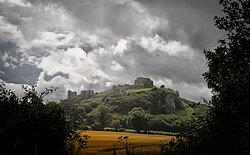
Dunamase or the Rock of Dunamase (Irish: Dún Másc[2] "fort of Másc") is a rocky outcrop in County Laois, Ireland.[2] Rising 46 metres (151 ft) above a plain, it has the ruins of Dunamase Castle, a defensive stronghold dating from the early Hiberno-Norman period with a view across to the Slieve Bloom Mountains. It is near the N80 road between the towns of Portlaoise and Stradbally.

Key Information

History

[edit]
Dunamase Castle at night
The castle ruins
Closeup of the castle ruins
Plan of how the castle originally looked

Dunamase was one of the landmarks shown on Ptolemy's map in the year 140.[3] Excavations in the 1990s demonstrated that the Rock was first settled in the 9th century when a hill fort or dún was constructed on the site. In 845 the Vikings of Dublin attacked the site and the abbot of Terryglass, Aed son of Dub dá Chrích, was killed there.[4] There is no clear evidence of 10th–11th century occupation.[citation needed]

The castle was built in the second half of the 12th century.[citation needed]

When the Normans arrived in Ireland in the late 12th century, Dunamase became the most important Hiberno-Norman fortification in Laois. It was Dunamase where Dermot Mac Morrough, King of Leinster, brought the wife of O'Rourke, the King of Breifne, after kidnapping her. Enlisting the help of the O'Connor clan, the O'Rourkes and O'Connors drove MacMurrough from Dunamase and he fled Ireland. MacMurrough gave Dunamase and his daughter Aoife in marriage to the Norman conqueror Strongbow in 1170 as part of a deal to enlist his help to regain his lands.[5] The Norman invasion of Ireland then followed when Strongbow accompanied MacMurrough, along with many men, to attack and regain MacMurrogh's lands.[citation needed]

Later, with the marriage of Strongbow and Aoife's daughter and heir, Isabel, the castle passed into the hands of the Marshal family. William Marshal, who later became Regent of England in the minority of Henry III, had five sons, all of whom succeeded him in turn and died without issue. So in 1247 the Marshal lands were divided among William's five daughters. Dunamase fell to Eva Marshal and then to her daughter, Maud, who was married to Roger Mortimer. The castle remained in Mortimer hands until 1330 when another Roger Mortimer was executed for treason. By the time the Mortimer family was rehabilitated the castle seems to have passed out of the area under Norman control. It seems to have become a ruinous shell by 1350.[citation needed]

From the 1400s and until the 16th century it was part of the land of the powerful O'More (now Moore or Ó Mórdha) family who ruled the county of County Laois for several hundreds of years until the 16th century when they faced great opposition from the English (see Plantations of Ireland). Rory O'More famously resisted the English. Hence, County Laois today is still nicknamed "The O'Moore County". The O'More's move from Laois to new lands is so memorialised in a 19th-century poem, Transplanted, by William O'Neill:

But vain I wait and listen for Rory Og is dead,
And in the halls of Dunamase a Saxon rules instead,
And o'er his fruitful acres the stranger now is lord
Where since the days of Cuchorb a proud O'Moore kept ward.

The castle was notably owned by, Rory O'More, Lord of Laois. The O'Mores left the castle and moved to Kildare, on land granted to them in 1574 by Rory O'More's cousin, Elizabeth I of England. The O'More family became the Moore family, although in 1751 an O'More married into the O'Ferrall family, who subsequently took on the surname More O'Ferrall. The family had been reduced from one of the most powerful Irish families to standard aristocrats, although the More O'Ferralls declined a peerage in the 17th century and later a baronetcy in the 19th (they still have the right to use their Irish title, Lord of Laois, and the head of the family is sometimes addressed as so). However, despite the change in status, the family has still played an important role in Irish history since their move. Their former castle played no part in the Cromwellian wars. It was slighted in 1650 to prevent it being used.[6] In the later 18th century Sir John Parnell started to build a banqueting hall within the ruins and this work incorporated medieval architectural details taken from other sites in the area.

References

[edit]

Notes

[edit]
[edit]
Revisions and contributorsEdit on WikipediaRead on Wikipedia
from Grokipedia
The Rock of Dunamase (Irish: Dún Másc), situated in , , is a prominent rising about 45 meters above the surrounding plain, featuring the ruins of a 12th-century Anglo-Norman that exemplifies medieval adapted to natural defenses. The site's strategic elevation provided commanding views over the landscape, making it a vital stronghold during Ireland's turbulent medieval period. Originally established as an early Christian fort known as Dún Másc, meaning "Fort of Másc," it served as a residence for the kings of Leinster's Laois territory before being plundered by Vikings in AD 842 or 844, an event recorded in Irish annals that highlights its early significance. Following the Anglo-Norman invasion in the late 12th century, the rock was granted by Diarmait Mac Murchadha, King of Leinster, as part of the dowry to his daughter Aoife's husband, Richard de Clare (Strongbow), leading to the construction of the castle's substantial stone fortifications, including a gatehouse, curtain walls, and a great hall. Dunamase flourished as a key Anglo-Norman bastion in the but saw decline after repeated attacks, including by Gaelic Irish forces, and was largely abandoned by the mid-14th century, with archaeological evidence from excavations confirming occupation ceased around the 1330s. Today, the site stands as a protected heritage managed by the Office of , valued for its dramatic ruins and insights into Ireland's layered history from prehistoric fortifications to .

Geography and Physical Description

Location and Topography

The Rock of Dunamase is a prominent situated in , , approximately 6.4 kilometers east of town. It lies along local roads branching off the N80 highway, rising sharply from the surrounding flat plain of the O'Moore valley in the South region. This geological feature elevates 46 meters above the adjacent lowlands, providing expansive panoramic views across the undulating countryside toward the horizon. The outcrop's jagged and isolated form, characterized by steep inclines and natural barriers, enhances its visual dominance over the landscape and inherent defensibility due to limited access points.

Architectural Features and Remains

The visible remains of Dunamase Castle represent early Hiberno-Norman military architecture adapted to the of a 46-meter , overlaying prehistoric fortifications. The primary defensive feature is a circuit of stone curtain wall enclosing the summit, constructed with local and incorporating cut elements around openings; this wall leverages sheer cliffs on three sides while fortifying the accessible fourth. Entry to the enclosure passes through a system, including an outer ditch and with surviving defensive mechanisms such as murder holes overhead for dropping projectiles and a slot for a . Beyond lies a lower ward ascending to an upper ward, with remnants of a gate-tower delineating internal divisions. Central to the upper ward stands the , its partial walls—reaching up to several meters in height—evidencing a rectangular structure of substantial scale typical for lordly residence and assembly in Norman strongholds. Adjacent features include a two-storey sallyport, a gate designed for surprise sorties, though much of its upper detail has collapsed. The ruins lack any intact roofs or vaults, exposing interiors to the elements, and show signs of weathering, partial collapse from historical bombardment, and overgrowth by ivy and scrub; however, post-2006 conservation has consolidated walls and cleared debris to preserve the layout and masonry details.

Pre-Norman History

Early Settlement and Fortification

The Rock of Dunamase was first settled in the 9th century with the construction of a hillfort, known as Dún Másc or Masc's Fort, on the prominent limestone outcrop overlooking the plains of County Laois. This early medieval fortification capitalized on the site's natural defensibility, featuring dry-stone walls that enclosed the summit area. The strategic elevation provided commanding views of the surrounding landscape, making it an ideal location for a regional stronghold. Archaeological excavations in the mid-1990s revealed evidence of this early settlement, including over 5,500 artifacts and settlement layers indicative of sustained occupation. Among the findings was a 9th-century silver penny, corroborating the timeline of initial fortification and use as a defended enclosure. These discoveries underscore the site's role in early medieval Irish society, prior to later modifications. As Dún Másc, the functioned as a power center for the kings of Laois, serving the Gaelic Irish rulers who controlled the territory. It represented a native Irish stronghold, associated with clans such as the O'Mores (Ó Mórdha), who held lordship over Laois and utilized such sites for defense and governance in the pre-Norman era. The fort's establishment reflects the emphasis on hilltop enclosures for political authority and protection in early medieval .

Viking Attacks

In 845 AD, Vikings plundered Dún Masc (the early name for the Rock of Dunamase), as detailed in the Annals of the Four Masters. The raiders, operating from their stronghold, targeted the site's Christian settlement and fortification, capturing Áed son of Dub dá Crích, abbot of Terryglass (Tír dá Glas) and Clonenagh, whom they transported to for martyrdom, while slaying the prior of Kildare and numerous others. This raid exemplifies the mid-9th-century Norse strategy of inland penetration beyond coastal monasteries, exploiting waterways like the River Barrow to strike fortified dúns amid broader campaigns that year, including assaults on other sites. The attack disrupted local ecclesiastical and secular control, with clerical casualties underscoring the targeted vulnerability of religious centers integrated into defensive structures. Archaeological traces of pre-Norman earthen defenses on the indicate that Dún Masc possessed inherent defensibility from its elevated, cliff-girt , which likely mitigated total abandonment post-raid. The site's continuity of occupation—evidenced by subsequent reuse without prolonged Norse settlement—demonstrates resilience against such hit-and-run incursions, preserving its strategic value for later Gaelic fortifications.

Anglo-Norman Era

Acquisition and Initial Construction

The Rock of Dunamase entered Anglo-Norman control in 1170 as part of the dowry granted by Diarmait Mac Murchadha, King of , to de Clare (Strongbow) upon his marriage to Diarmait's daughter, . This acquisition followed the initial Norman landings in Ireland in 1169, invited by Mac Murchadha to aid in regaining his throne, and positioned Dunamase as a strategic asset in the conquest of . Under Strongbow's lordship, the site transitioned from a Gaelic to an Anglo-Norman stronghold through the erection of initial stone fortifications in the late . These structures augmented or supplanted the earlier earthen dún, leveraging the rock's natural for enhanced defensibility while incorporating Norman engineering principles such as robust stone curtain walls and a defended gateway. The fortifications established Dunamase as one of the primary Anglo-Norman bastions in Laois, facilitating control over central amid ongoing conflicts with native Irish forces. This phase of construction reflected the ' adaptation of continental military architecture to Ireland's topography, prioritizing vertical rock defenses over traditional motte-and-bailey designs.

Strategic Role and Ownership Changes

Following the marriage of Isabel de Clare—daughter of Richard de Clare (Strongbow) and —to William , , in approximately 1189, Dunamase passed into the Marshal family's possession as part of the inheritance. The castle remained under Marshal control through William's five sons, who succeeded one another until the last, William Marshal the Younger, died without male heirs in 1231, leaving the family's Irish estates to be partitioned among co-heiresses. In 1247, as part of this division of the Marshal lordships, Dunamase was allocated to Eva Marshal, one of the five sisters, along with associated manors yielding an annual value of approximately £100. Eva, who married , passed the estate through her daughter , whose marriage to Roger Mortimer, 1st Baron Mortimer of Wigmore (died 1282), transferred ownership to the Mortimer family via female inheritance. Dunamase functioned as a primary Anglo-Norman stronghold in Laois during the 13th century, its elevated position commanding panoramic views over key routes linking counties Laois and Carlow, thereby facilitating surveillance and rapid response to threats. This strategic vantage supported its role as a defensive bulwark against Gaelic Irish resurgence, particularly incursions by the O'More of Laois, who contested Norman control of the region through persistent raids and territorial claims into the late medieval period. The site's tactical value is evidenced by episodes such as its temporary seizure by King John in the early amid tensions with William Marshal, after which a royal accounted for £53 in revenues from the manor in 1211, indicating active garrisoning and economic exploitation. Throughout the century, the anchored Norman efforts to secure the midlands, with reinforcements dispatched to counter local conflicts and maintain lordship amid ongoing resistance from Irish chieftains.

Later History and Decline

Medieval Decline and Abandonment

Historical records pertaining to Dunamase cease abruptly in the 1330s, coinciding with the forfeiture of the family's Irish estates to the English Crown following Roger Mortimer's execution in 1330. Shortly thereafter, the castle passed into the control of local Gaelic forces, including the O'Moore (Ó Mordha) sept, who seized it amid weakening Anglo-Norman authority in the Irish . This transition reflected broader Gaelic resurgence, as Anglo-Norman lordships fragmented under sustained pressure from indigenous clans, rendering upland strongholds like Dunamase strategically vulnerable and economically untenable. Archaeological excavations, including those directed by Brian Hodkinson in the 1990s, provide material evidence of disuse commencing in the mid-14th century, with post-1350 contexts revealing only ephemeral wicker structures and no sustained occupation or maintenance. , arriving in Ireland around 1348 and claiming approximately 40% of the population—disproportionately affecting urbanized Anglo-Norman communities—exacerbated this decline by decimating settler labor forces and eroding centralized control, further incentivizing a pivot to more defensible lowland manors. Without ongoing repairs, the site's fortifications succumbed to natural decay, transitioning from a functional to an uninhabited ruin by circa 1350, as power consolidated in Gaelic-held territories and emerging hybrid lordships favored accessible, agriculturally productive lowlands over isolated rock-top redoubts. This obsolescence underscored the ebbing viability of early Anglo-Norman models amid demographic collapse and shifting military priorities.

17th-Century Reuse and Destruction

During the (1641–1653), the ruins of Dunamase Castle were briefly reactivated in the 1640s as a defensive position amid the broader conflict between Irish Catholic Confederates, Royalists, and English Parliamentarian forces. This limited reuse capitalized on the site's elevated topography and residual fortifications, though specific garrisons or engagements at Dunamase during this period remain sparsely documented in primary accounts. The castle's final military episode occurred in 1650, when it was captured and deliberately slighted by Cromwellian Parliamentary forces as part of their campaign to suppress Irish and Confederate resistance. Slights involved systematic , likely using to breach walls and render the structure indefensible, aligning with Oliver Cromwell's policy of neutralizing potential rebel strongholds to consolidate English control over . Following this destruction, the site received no significant repairs or reoccupation, leading to progressive decay through natural weathering and abandonment that preserved its current dilapidated form.

Preservation and Modern Context

Archaeological Investigations

Archaeological excavations at the Rock of Dunamase, primarily conducted in the mid-1990s by of , uncovered stratified layers indicating initial settlement in the with the construction of a hill fort or dún on the outcrop. These digs, spanning multiple seasons including and , revealed defensive features such as a massive drystone wall associated with Early Christian phases, confirming pre-Norman occupation suspected from prior surveys. Over 5,500 artifacts were recovered across the site, including pottery sherds from sealed medieval contexts that evidenced transitions from Gaelic earth-and-timber structures to Anglo-Norman masonry. Key findings encompassed structural footings for the 12th-century and keep, alongside evidence of post-masonry earth and timber defences, suggesting adaptive strategies amid ownership shifts. Viking-era influences were inferred from artifacts linked to 9th-century attacks on the early dún, though direct Scandinavian material remained sparse compared to native Irish ceramics. These investigations delineated phases of continuous but punctuated occupation, with stratigraphic data highlighting a shift from indigenous ringfort-like enclosures to imported without evidence of seamless cultural fusion. The recovered assemblage, analyzed for chronology via associated datable finds like ware pottery, has informed broader reconstructions of Hiberno-Norman military adaptations in , emphasizing pragmatic Norman overlays on Gaelic precedents rather than hybridized traditions.

Conservation Projects

The Office of Public Works (OPW), responsible for the site's management as a , initiated conservation following mid-1990s archaeological excavations that exposed fragile structures. These excavations, directed by Brian Hodkinson, recovered over 5,500 artifacts and necessitated stabilization to counteract exposure-related decay on the limestone outcrop. A major project, funded under the National Development Plan 2000–2006 at a cost of €1.6 million, focused on consolidation for key elements including the gate tower and inner ward. Managed by architects Timothy Foley with contractors J. Rainey and Co. Ltd., the works prioritized structural reinforcement against weathering and erosion while adhering to principles of minimal intervention to preserve the ruins' historical authenticity. Completion occurred on 27 2006, incorporating measures for site integrity without reconstruction. Heritage Ireland, succeeding OPW in site care, continues routine preservation to address ongoing environmental threats like rockface erosion, emphasizing targeted stabilization over extensive alteration to sustain the monument for future generations.

Tourism and Public Access

The Rock of Dunamase is a state-owned National Monument managed by the Office of Public Works, offering free, unguided public access year-round during daylight hours. Limited free parking is available adjacent to the entrance gate, from which a short gravel path and initial steps provide access to the summit ruins via a steep but manageable incline. Exploration of the site typically requires less than an hour, with informal looped paths allowing visitors to traverse the motte and inspect the castle remnants while enjoying panoramic vistas over the surrounding Laois countryside. The site's dramatic elevated position and relative seclusion make it popular among heritage enthusiasts seeking a low-crowd experience without entry fees or timed restrictions. No on-site facilities, including toilets or interpretive centers, are provided, emphasizing its self-guided nature. Visitors should wear sturdy due to uneven, rocky and exercise caution on exposed edges, as the unstaffed site lacks safety barriers in some areas. In May 2025, local authorities announced development plans to enhance the site as a major attraction targeting 18,000 annual paying visitors, though as of October 2025, access remains free and unchanged.

References

Add your contribution
Related Hubs
User Avatar
No comments yet.