Hubbry Logo
Dutch colonial architectureDutch colonial architectureMain
Open search
Dutch colonial architecture
Community hub
Dutch colonial architecture
logo
8 pages, 0 posts
0 subscribers
Be the first to start a discussion here.
Dutch colonial architecture
from Wikipedia
Bogor Palace, in Bogor, was built in 1744 as a residence of the Dutch Governor-General.

Dutch colonial architecture refers to the various style of Dutch architecture built across the Dutch Empire. Though most of the buildings were designed by Dutch architects and dictated by Western architectural styles, even the most ardent style-purists among architects could not escape the forces of context and culture. Dutch colonial architecture often is a result of climatological adaptations or the use of local building materials - and more importantly, the rich and diverse cultural contexts. In this hybridity lies the quality of these buildings. Architecture shows that the strict racial taxonomy of a colonial system could not be maintained.[1]

Dutch colonial architecture is most visible in Indonesia (especially Java and Sumatra), the United States, South Asia, and South Africa. In Indonesia, formerly Dutch East Indies, colonial architecture was studied academically and had developed into a new tropical architecture form which emphasizes on conforming to the tropical climate of the Indies and not completely imitating the architectural language of the Dutch colonists.

In Indonesia

[edit]

Dutch colonial architecture in Indonesia were built across the archipelago that once was known as Dutch East Indies. Dutch colonial architecture in Indonesia is a unique cultural phenomenon. It is a mixture of Dutch colonial and Indonesian culture. It does not exist elsewhere, even in the other former colonized countries.[2] The uniqueness of these buildings can be seen in their colonial relics. As a result, there are large number of colonial buildings concentrated in its cities. Plenty of old VOC era forts and warehouses are also scattered throughout the archipelago, particularly around Maluku Islands and Sulawesi. There are three Dutch colonial architectural styles: Old Indies Style, Indies Empire style, and New Indies Style.

In Americas

[edit]

Suriname

[edit]

Suriname's capital, Paramaribo is a former Dutch colonial town from the 17th and 18th centuries planted on the northern coast of tropical South America. The original and highly characteristic street plan of the historic centre remains intact. Its buildings illustrate the gradual fusion of Dutch architectural influence with traditional local techniques and materials.[3]

United States

[edit]

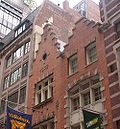
Developed from around 1630 with the arrival of Dutch colonists to New Amsterdam and the Hudson River Valley in what is now New York[4] and in Bergen in what is now New Jersey.[5][6] Initially the settlers built small, one room cottages with stone walls and steep roofs to allow a second floor loft. By 1670 or so, two-story gable-end homes were common in New Amsterdam.

Dutch Colonial Revival architecture

[edit]

Dutch Colonial is a style of domestic architecture, primarily characterized by gambrel roofs having curved eaves along the length of the house. Modern versions built in the early 20th century are more accurately referred to as "Dutch Colonial Revival", a subtype of the Colonial Revival style.

In South Asia

[edit]

India

[edit]

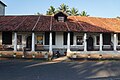
The Dutch came to India in the early 17th century and their influence and dominance is seen most in Kerala, though they occupied other parts of the country, such as, some areas along the southern Coromandel Coast and Gujarat. However, it is in Kerala, especially Cochin that Dutch architecture finds it existence. On the eastern coast, Pulicat was the first settlement of Dutch India and till date is home to the Dutch cemetery visited by tourists.[7]

Sri Lanka

[edit]

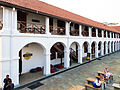
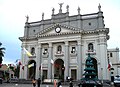
Many building from the Dutch Ceylon era could be found on the coastal parts of the island. For example, the old town of Galle and its fortifications built by the Dutch in the year 1663 make up a UNESCO World Heritage Site. Historic buildings, such as old churches, can be found in many Sri Lankan cities and towns.

In South Africa

[edit]

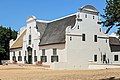
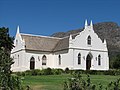
Dutch architecture are found mostly in the Western Cape of South Africa, but modern examples of the style have also been exported as far afield as Western Australia and New Zealand, typically on wine estates. The style was prominent in the early days (17th century) of the Cape Colony, and the name derives from the initial settlers of the Cape being primarily Dutch.

See also

[edit]

References

[edit]
Revisions and contributorsEdit on WikipediaRead on Wikipedia
from Grokipedia
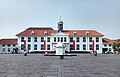
Dutch colonial architecture denotes the built environment created under Dutch imperial administration across overseas territories, most prominently in the (modern ), but also in and the , adapting European forms to subtropical and tropical conditions through features like expansive overhanging roofs, elevated structures on pillars, and extensive verandas for shade and airflow. This style arose from the 17th-century trading forts of the , evolving into administrative, residential, and ecclesiastical structures that prioritized functionality amid high humidity and heavy rainfall, often incorporating local materials and motifs while retaining neoclassical or rationalist proportions. The defining evolution culminated in the New Indies Style (Nieuwe Indische Bouwstijl) from the late 19th to mid-20th century, which fused emerging modern Western influences—such as and —with indigenous Javanese elements like roofs and open pavilions, yielding buildings with high ceilings, louvered windows, and cross-ventilation to mitigate equatorial heat without mechanical aids. Pioneering architects like Henri Maclaine Pont and C.P. Wolff Schoemaker engineered these adaptations, evident in landmarks such as Bandung's and Jakarta's Fatahillah Square edifices, which balanced imperial prestige with climatic pragmatism. In , the style manifested in wooden vernacular forms with stepped gables and elevated floors against flooding, reflecting regional variances in Dutch colonial . These structures not only facilitated colonial and but also represented pragmatic responses to environmental imperatives, outlasting the through their durable, context-specific designs, though many face preservation challenges from and neglect in post-independence contexts.

Origins and Characteristics

Historical Development

Dutch colonial architecture emerged in the early alongside the Dutch Republic's overseas expansion, driven primarily by the Vereenigde Oostindische Compagnie (VOC), established in 1602 to monopolize trade in . Initial constructions prioritized functionality for trade and defense, featuring robust stone forts and warehouses adapted from Dutch Renaissance designs but modified for tropical environments, such as elevated foundations to combat humidity and flooding. The founding of Batavia (modern ) in 1619 exemplified this phase, with its grid layout incorporating canals, drawbridges, and gabled buildings reminiscent of , serving as the VOC's Asian headquarters until the company's bankruptcy in 1799. In parallel, the VOC extended to other regions, including Formosa (Taiwan), where Fort Zeelandia was built between 1624 and 1634 as a polygonal bastion fort to secure trade routes, and Dejima in Japan, an artificial island trading post constructed in 1609 with wooden warehouses enclosed by walls. The Cape Colony, established in 1652 as a provisioning station, saw early fortifications like Fort de Goede Hoop, evolving into vernacular Cape Dutch homesteads with whitewashed walls, thatched roofs, and ornate gables by the late 17th century to suit the semi-arid climate. Suriname, acquired in 1667 through exchange with Britain, developed wooden plantation houses with wide verandas and steep roofs for heavy rainfall, reflecting pragmatic adaptations over strict Dutch replication. The marked a shift toward more permanent administrative and residential structures, influenced by Enlightenment ideals and growing colonial bureaucracies, though VOC priorities remained commercial, limiting lavish ornamentation. Following the VOC's dissolution, direct Crown rule from 1800 introduced neoclassical elements, notably under Governor-General (1808–1811), who promoted the Indies in the with symmetrical facades, columns, and to project authority amid Java's expansion. By the early , the New Indies Style emerged, integrating local motifs like Javanese pendopo pavilions with Dutch modernisms such as deep overhangs for shade and cross-ventilation, peaking in urban projects before Indonesian independence in 1949. This evolution reflected causal pressures of climate, resource scarcity, and imperial control, yielding hybrid forms distinct from metropolitan Dutch .

Core Architectural Features and Adaptations

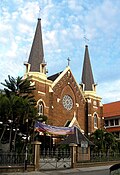
![Gereja Blenduk, Semarang][float-right] Dutch colonial architecture derived core features from 17th-century Dutch vernacular traditions, including robust brick or stone construction, symmetrical layouts, and prominent gabled facades often adorned with stepped or bell gables to evoke stability and grandeur. These elements symbolized the Dutch Republic's mercantile and were transported to colonies to assert cultural dominance. In practice, buildings emphasized functionality, with central hallways and multi-room plans suited for administrative and residential needs in trading posts and forts. Adaptations to colonial climates profoundly shaped designs, prioritizing and durability over strict adherence to European norms. In humid tropical settings like the , structures incorporated elevated floors on piers to elevate living spaces above flood-prone ground and promote underfloor ventilation, reducing moisture accumulation. High ceilings, typically exceeding 4 meters, allowed hot air to rise and escape, while wide overhanging and extensive verandas shielded interiors from direct sunlight and monsoon rains. Roof profiles shifted to steep, hipped forms covered in local tiles or thatch to swiftly shed heavy , contrasting the shallower pitches of Dutch homeland buildings designed for snow loads. Large, operable windows with jalousie shutters or transoms facilitated cross-breezes for natural ventilation, essential in equatorial heat where temperatures averaged 27-32°C year-round. Wall thicknesses, often 30-50 cm of or adobe-like mixes, provided to moderate indoor temperatures, though later New Indies Style iterations integrated modernist for enhanced resilience. In temperate colonies such as the , adaptations were subtler, retaining more gabled roofs and chimneys for fireplaces while using local stone for earthquake resistance, yet still widening porticos for shade. These modifications reflected causal necessities—material availability, seismic activity, and microclimates—driving empirical refinements over ideological purity, as evidenced by surviving structures like (built 1634, rebuilt 1667) with its thick walls and bastioned defenses adapted for defense amid tropical humidity.

Architecture in Asia

Dutch East Indies (Indonesia)

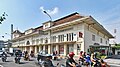
Dutch colonial architecture in the emerged with the establishment of trading posts by the (VOC) in the early 17th century, initially prioritizing functional forts and warehouses for commerce and defense. Batavia, founded in 1619 on the ruins of Jayakarta, served as the administrative center, featuring early structures like stone warehouses and gabled residences mimicking Dutch Renaissance styles but adapted with raised foundations to mitigate flooding and humidity. By the mid-18th century, rural landhuizen (country houses) began incorporating Indonesian elements such as open verandas and thatched roofs, marking a shift toward hybrid forms responsive to the tropical environment. Key adaptations addressed the humid-tropical climate, including high ceilings exceeding 4 meters to promote air circulation, wide voor- and achggalijen (front and rear verandas) for shading and ventilation, and steep tiled roofs with broad overhangs to deflect heavy rains while allowing hot air to escape. Elevated floors on pillars prevented ground ingress, and jalousie windows with adjustable slats facilitated cross-breezes without direct sun exposure. These features evolved from neoclassical Indies Empire Style—characterized by symmetrical facades, columns, and pediments suited to public offices—to the New Indies Style (Nieuwe Indische Bouwstijl) in the early , which fused Rationalist and principles with local motifs like expansive eaves and open plans. Prominent examples include in , constructed between 1904 and 1907 as the headquarters of the Railway Company, exemplifying New Indies Style with its extensive verandas, high ceilings, and influences for natural cooling. in , built from 1920 to 1924 as government offices, integrated Sundanese decorative elements like the sate skewer-inspired pinnacle with Western monumentalism, reflecting the Dutch plan to relocate the capital from Batavia amid growing urbanization. Villa Isola in , designed in 1933 by architect C.P. Wolff Schoemaker, showcased adaptations with curved forms, large windows for light diffusion, and elevated structures on a hillside for panoramic ventilation. These structures, concentrated in cities like , , , and , underscored the transition under the Ethical Policy (1901–1940s) toward more ambitious infrastructure, blending functionality with symbolic assertions of colonial permanence.

Taiwan (Formosa)

The Dutch East India Company (VOC) colonized southern Taiwan, referred to as Formosa, from 1624 to 1662, establishing fortified trading posts to facilitate commerce in silk, porcelain, and deer products with China and local indigenous groups. The primary surviving example of Dutch colonial architecture is Fort Zeelandia in Anping District, Tainan, constructed over a decade from 1624 to 1634 using imported bricks shipped from Batavia and Europe due to the scarcity of suitable local materials. Initially begun as a wooden palisade in 1622 on a coastal sandbar, the structure evolved into a robust brick fortress to withstand environmental erosion and potential attacks. Fort Zeelandia exemplified the Old Netherlands System of fortification, incorporating bastion principles with a square layout, projecting corner bastions for angled artillery fire, and thick walls designed for defensive efficiency rather than aesthetic ornamentation. Construction employed a simple running bond in , prioritizing functionality for military and administrative use, including warehouses, governor's quarters, and churches within the compound. Adaptations to Taiwan's subtropical and sandy included ongoing reinforcements against tidal shifts and typhoons, reflecting pragmatic engineering over elaborate colonial styles seen elsewhere. A secondary fort, Provintia, was erected nearby in 1653 following a rebellion by immigrants led by Guo Huaiyi, serving to consolidate Dutch authority with similar bastioned defenses but on a smaller scale. Limited civilian architecture, such as trading warehouses, existed but few traces remain due to subsequent reconstructions under Qing, Japanese, and modern influences. The forts' design emphasized strategic trade hub functionality, with minimal indigenous stylistic integration, underscoring the VOC's extractive commercial focus. After Zheng Chenggong () captured Fort Zeelandia in 1662 following a nine-month , much of the Dutch infrastructure was repurposed or dismantled, though remnants like the red-brick persist as heritage sites today. Preservation efforts highlight the forts' role in early European fortification in , with archaeological reconstructions aiding while debates persist over authentic versus interpretive rebuilding to balance historical accuracy and visitor access.

Japan (Dejima)

, an artificial fan-shaped island constructed in harbor between 1634 and 1636, served as the exclusive Dutch trading post in from 1641 until 1853, during the Tokugawa shogunate's isolation policy. Originally built to confine traders and limit Christian influence, the island measured approximately 0.13 square kilometers and was connected to the mainland by a guarded bridge, with surrounding canals and walls enforcing segregation. The (VOC) relocated its operations there after expulsion from Hirado, maintaining a small contingent of traders, interpreters, and staff who conducted annual trade in goods like , , and scientific knowledge exchange. The architecture of Dejima's trading factory reflected a pragmatic hybrid of Japanese construction techniques and limited Dutch modifications, constrained by shogunal regulations that prohibited extensive European-style building. Structures were primarily wooden, with dark cladding and whitewashed walls typical of Edo-period Japanese design, erected and maintained by local Japanese carpenters under Dutch oversight to ensure functionality for and residence. Key buildings included the Chief Factor's Quarters, completed in 1809 as the residence for the VOC director with incorporated Dutch interior layouts for administrative and living spaces; merchandise warehouses built in 1696 for storing imported and exported goods; and a western constructed in 1699 for ship access. Additional facilities encompassed clerks' quarters, a , and storage barns, often featuring flooring alongside European-influenced furnishings like desks and glass windows, fostering a distinct Western ambiance within Japanese structural norms. Dutch architectural influence remained subdued due to material restrictions and oversight by Japanese authorities, who rebuilt structures after fires—such as the 1664 blaze—with adherence to local seismic-resistant wooden framing and tiled roofs rather than stone or brick advocated by some Dutch residents. This resulted in no prominent gabled facades or symmetrical plans characteristic of Dutch colonial styles elsewhere, but rather functional adaptations that prioritized durability in Japan's humid, earthquake-prone environment. Interiors occasionally integrated Dutch elements, such as partitioned rooms for privacy and imported hardware, which subtly introduced Western spatial organization and contributed to cultural exchanges documented in (Dutch learning) studies. The site's layout, with segregated zones for officials, gardens, and livestock, underscored utilitarian design over aesthetic imposition. Today, reconstructed buildings based on 19th-century maps and records preserve this hybrid legacy, highlighting Dejima's role as a conduit for modest architectural cross-pollination amid Japan's closed borders. Preservation efforts since the have restored about 25 structures, emphasizing the original wooden with subtle Dutch traces, though original materials have largely perished due to urban encroachment and natural decay.

South Asia (India and Sri Lanka)

The (VOC) initiated its presence in during the early , establishing fortified trading posts along the to facilitate spice and textile commerce. In , the first major settlement north of modern , the VOC constructed Fort Geldria in 1613 as a brick stronghold with stepped gables and warehouses, incorporating local wood for doors and structural elements to withstand humidity and termites. Similarly, at , Fort Vijf Sinnen—named for its five-sensory bastions—featured defensive earthworks upgraded to stone ramparts by the mid-17th century, alongside administrative lodges and a reflecting austere Dutch functionalism blended with regional corbelled arches. These structures prioritized maritime defense and storage over ornamentation, with high ceilings and vented walls for tropical ventilation, though many fell into disrepair after the VOC ceded coastal holdings to the British by 1825, leaving scant preserved examples amid later colonial overlays. In (then Ceylon), Dutch architectural influence proved more enduring following the VOC's conquest of Portuguese coastal enclaves starting in 1658, administering the maritime provinces until 1796 and emphasizing fortified . , initially a 16th-century Portuguese bastion, underwent Dutch reconstruction with Vauban-inspired star-shaped fortifications, including 14 s, a clock tower gate emblazoned with the VOC coat of arms, and coral-rag walls up to 5 meters thick, designed for cannon emplacements against monsoon winds and naval threats. The Groote Kerk, or [Dutch Reformed Church](/page/Dutch_Reformed Church), within the fort—completed in 1755—exemplifies ecclesiastical design with its whitewashed gabled facade, wooden pulpit imported from the , and thick lime-plastered walls for thermal regulation, serving as the oldest Protestant church in . Colombo's surviving Dutch-era buildings further illustrate adaptive colonial vernacular: the Old Dutch Hospital, erected around 1680 and rebuilt after a 1684 fire, comprises arcaded verandas, terracotta-tiled roofs, and spacious interiors suited to equatorial heat, originally functioning as a medical facility before repurposing. Wolvendaal Church, consecrated in 1749, features a plan with octagonal and imported Dutch bells, constructed from kabook (cabook) stone for seismic resilience. Inland forts like Matara, fortified from 1640 with earthen ramparts later stone-clad, prioritized strategic bastions over residential elaboration, using and abundant locally. Overall, Dutch designs in Sri Lanka evolved from initial earthen prototypes to durable stone hybrids, prioritizing defensibility and climate mitigation—such as overhanging and cross-ventilation—while minimally altering indigenous building techniques, though British expansions from 1796 onward integrated and obscured some features.

Architecture in Africa

Cape Colony (South Africa)

The Cape Colony was established by the (VOC) in 1652 under as a refreshment station for ships traveling to , marking the beginning of permanent European settlement at the . Initial structures were utilitarian, constructed from local materials like wattle, daub, and timber frames, with rectangular layouts featuring thatched roofs to suit the of thick walls for thermal regulation and steeply pitched roofs to shed rainwater. These early farmhouses evolved into the distinctive style by the late 17th century, incorporating Dutch Renaissance elements such as symmetrical facades and ornate gables, adapted for practicality amid labor shortages and resource constraints that favored slave labor from and for construction. Core features of Cape Dutch architecture include whitewashed lime-plastered walls up to 60 cm thick for insulation against summer heat, multi-paned sash windows with green shutters, and central front doors flanked by smaller windows, often crowned by decorative gables in styles like the hollandsche (curved and scrolled) or later neoclassical wenkbrauw (eyebrow-like). Roofs were typically thatched with indigenous Restio reeds until the , supported by whitewashed gables that served both aesthetic and functional purposes, such as ventilating smoke from hearths. Interiors emphasized functionality with T-shaped or H-plan layouts, including a voorkamer (front ) for formal reception, bedrooms, and rear service wings for kitchens and storage, reflecting the agrarian lifestyle of free burghers who expanded from the initial VOC garden outpost. Prominent early examples include the , construction of which began in 1666 as a pentagonal fortress with bastions for defense against indigenous Khoikhoi and potential rivals, featuring Dutch and a utilitarian design that later incorporated elements like gabled additions. manor house, established around 1685 by Governor and expanded by his son Willem Adriaan in the 1690s, exemplifies the style with its double-gabled facade and vineyards, serving as a model for subsequent wine estates despite partial destruction by fire in 1925. estate, granted to van der Stel in 1700 and featuring four gables by 1710, demonstrated opulence through imported bricks and local stone, though it was demolished in 1796 under VOC orders amid corruption charges against van der Stel. By the 18th century, the style proliferated in the Winelands around and , with over 800 surviving examples by the 20th century, influenced by French Huguenot settlers arriving from 1688 who introduced and refined proportions, though core Dutch forms persisted under VOC oversight until British occupation in 1795. Architects like Louis Thibault (active 1780s–1810s) and sculptor Anton Anreith integrated neoclassical pediments and mythological motifs, as seen in the 1790s additions to , bridging Dutch vernacular with emerging European trends while prioritizing durability in a seismic and windy environment. This architecture symbolized VOC economic priorities—agriculture and trade—over urban grandeur, with adaptations like reinforced foundations against termites and floods underscoring pragmatic engineering amid isolation from metropolitan influences.

Architecture in the Americas

Suriname

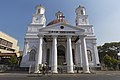
The Dutch colonial architecture in Suriname centers on Paramaribo, the capital, where the Historic Inner City exemplifies a fusion of 17th- and 18th-century Dutch urban planning with tropical adaptations. Established as a trading post after the Dutch acquired the territory in 1667 via the Treaty of Breda, the settlement featured Fort Zeelandia, constructed that year as a defensive stronghold with stone walls and bastions. The city's grid layout, planned from 1683, followed natural shell ridges for drainage over marshy terrain, incorporating Dutch engineering to extend settlement in the late 18th century. Predominantly wooden buildings dominate due to recurrent fires and earthquakes destroying earlier structures, with construction shifting to local hardwoods like greenheart for resistance and durability in humid conditions. Architectural hallmarks include symmetrical facades, steep overhanging roofs to shed heavy rainfall, elevated pilings to mitigate flooding, verandas for shade, and louvered jalousie shutters for cross-ventilation while deterring . This style integrates Dutch proportions and ornamentation—such as pediments and pilasters—with indigenous South American materials and craftsmanship, yielding a plain yet resilient vernacular absent in metropolitan . Prominent examples include the (1730), blending with stone in a neoclassical manner; the (1841), featuring a gabled facade; and the Reformed Church (1837), with its whitewashed wooden tower. The Roman Catholic Cathedral (1885), constructed in tropical hardwood without nails, exemplifies late-colonial hybridity with Gothic Revival elements adapted via local . Fort Zeelandia later housed colonial administration, its courtyard surrounded by whitewashed wooden barracks. Designated a in 2002 under criteria (ii) and (iv), Paramaribo's ensemble of over 291 monuments from 1680–1800 illustrates exceptional cultural interchange between Dutch colonizers and indigenous techniques, preserving an intact tropical colonial townscape unique in the . Preservation has emphasized structural reinforcement against and decay, countering post-independence neglect while avoiding over-restoration to maintain authenticity.

New Netherland (United States)

Dutch colonial architecture in , the Dutch West India Company's North American territory from 1621 to 1664 encompassing modern-day New York, , , and parts of and , emphasized practicality and adaptation to local resources like abundant timber, diverging from the brick-heavy styles of the . Early structures, such as those in (founded 1626) and Fort Orange (1624), relied on wooden frames with clapboard siding, featuring steep gabled roofs to shed heavy snowfall and rain, large central fireplaces for heating, and compact layouts with one or two ground-floor rooms plus a garret for storage. Urban settlements like featured narrow, canal-inspired street plans and tightly packed dwellings mimicking Amsterdam's townhouses but scaled down, with bent structural systems, high ceilings, and large windows where glass was available; brick was used sparingly for public buildings due to import costs, as in the 1642 Stadt Huys (city hall and tavern) at Pearl and Wall Streets, which incorporated Dutch ends. Rural farmhouses employed H-shaped for stability, extended eaves, and later roofs for additional attic space, reflecting agricultural needs in the Hudson and Mohawk Valleys. Fortifications exemplified defensive adaptations, beginning with wooden palisades and earthen walls; (constructed 1626 on Manhattan's southern tip) evolved from a simple to include stone elements under directors like Wouter van Twiller, measuring approximately 200 by 300 feet with bastions, while Fort Nassau (1623 on the ) featured a 58-foot-wide interior walled enclosure and an 18-foot . (1633 on the ) similarly used local earthworks and timber for trade post defense at Dutch Point. These forts prioritized functionality over ornament, with and gates suited to frontier threats from Indigenous groups and rivals like the English and . Few original 17th-century buildings survive due to fires (e.g., 1776 and 1835 in ), urban expansion, and material decay, leaving primarily archaeological remnants and period maps; Netherlandic traits persisted post-1664 English conquest, influencing later stone houses like those in the . Representations, such as the Dutch Chamber at Van Cortlandt House Museum, reconstruct these features using historical accounts of split doors, flared , and parged walls.

Legacy and Modern Interpretations

Revivals and Architectural Influence

In the United States, the Dutch Colonial Revival style emerged in the early as a subtype of the broader Colonial Revival movement, emphasizing roofs with curved, flared eaves drawn from 17th- and 18th-century Dutch settler homes in . This revival, peaking between 1905 and 1940, reflected national interest in reconnecting with early American heritage through practical, symmetrical brick or frame structures often featuring dormer windows and end chimneys. In , the Revival gained prominence around 1910 amid the , elevating the 17th- to 19th-century style—characterized by ornate gables, whitewashed walls, and hipped roofs—as a unifying for English and populations. Architects like adapted these elements for public and residential buildings, fostering a deliberate resurgence that integrated local materials such as thatch and while preserving climatological adaptations like deep verandas. Dutch colonial architecture has exerted lasting influence on post-colonial built environments, particularly through hybrid adaptations to local climates and materials. In , the Indische style's features—wide eaves for shade, elevated floors for airflow, and verandas—hybridized with Javanese elements, informing modern tropical designs as seen in structures like the 1920s in , where Indo-European acculturation in facades, columns, and motifs continues to shape and heritage-inspired developments. ![Gedung Sate, exemplifying Indische influence][center] In , Paramaribo's 17th- to 19th-century wooden townhouses, fusing Dutch gabled forms with tropical timber framing and jalousie shutters, have influenced contemporary residential and commercial architecture, maintaining a grid-based urban layout and material techniques recognized by in for their enduring blend of European symmetry and local resilience.

Preservation Efforts and Challenges

Preservation efforts for Dutch colonial architecture have primarily focused on key former colonies, with World Heritage designations playing a central role in sites like the Historic Inner City of in , inscribed in 2002 for its well-preserved 17th- and 18th-century wooden buildings exemplifying Dutch colonial urban planning. In , initiatives include strategies for Indisch-style buildings, such as those in , where studies emphasize maintaining historical fabric amid modern functions to sustain . Government-backed projects, like the Inter-American Development Bank's collaboration with since 2019 to rehabilitate 's site, involve structural reinforcements and tourism integration to fund upkeep. In South Africa's Cape region, the revival movement around 1910 promoted conservation of gabled homesteads and urban structures, evolving into modern heritage protections for areas like , where community-led restorations preserve multicultural colonial layers. Challenges persist due to in tropical climates, with humidity and poor maintenance accelerating decay in Indonesian wooden structures, often addressed reactively after visible damage. Urban development pressures threaten sites like Jakarta's Old Town, compounded by post-colonial sensitivities that complicate public appreciation and funding allocation. In , shortages of skilled conservators, mismatched funding, and limited compatible materials hinder comprehensive restorations, as seen in projects balancing authenticity with functionality. faces ownership dilemmas under heritage , where communal versus state claims delay interventions in Paramaribo's fragile timber . Broader issues include low and inadequate integration, particularly for industrial-era extensions, risking de-listing without sustained societal and governmental support. Recent revitalizations, such as Surabaya's efforts to repurpose Dutch-era buildings for tourism, highlight adaptive successes but underscore ongoing tensions between economic utility and historical integrity.

Impacts, Achievements, and Criticisms

Dutch colonial architecture achieved notable engineering feats through adaptations suited to tropical climates, such as wide verandas, high ceilings for ventilation, and elevated to combat humidity and flooding, enabling structures in places like and to endure for centuries despite earthquakes, monsoons, and wars. These innovations, drawing from 17th- and 18th-century Dutch techniques combined with local materials like wood and brick, facilitated the construction of forts, warehouses, and administrative buildings that supported the Dutch East India Company's (VOC) trade dominance, with examples like in demonstrating robust defensive designs that withstood sieges as early as 1669. The impacts extended to urban planning, where Dutch settlements imposed grid layouts and canal systems—evident in Batavia (modern Jakarta)—that formed the cores of postcolonial cities, blending European symmetry with indigenous elements and contributing to modern infrastructure resilience. Culturally, this architecture symbolized hierarchy, with grand gabled facades for European elites contrasting simpler local dwellings, yet it fostered hybrid styles like Indo-European that persist in contemporary . Economically, preserved sites now drive tourism; Paramaribo's wooden colonial core, a since 2002, attracts visitors and supports local economies through rehabilitation projects funded by international bodies. In , colonial-era buildings repurpose as museums and offices, yielding measurable heritage value despite initial extractive purposes. Criticisms center on the architecture's role in enforcing colonial control and inequality, as structures like Batavia's city walls and elite residences reinforced racial and class divisions through spatial segregation, built often amid exploitative labor systems that prioritized Dutch commercial interests over indigenous welfare. Post-independence narratives, particularly in academia influenced by ideologies, portray these edifices as emblems of , leading to debates over preservation versus demolition, as seen in where Dutch forts evoke contested histories of subjugation rather than neutral heritage. Historians like Pieter Emmer argue such views exaggerate negatives, noting empirical benefits like lasting urban frameworks that independent states have retained and adapted, countering claims of a wholly destructive legacy. Preservation challenges persist, including decay from neglect and ideological resistance, yet data from sites like show successful without erasing historical context.

References

Add your contribution
Related Hubs
User Avatar
No comments yet.