Hubbry Logo
ESIEE ParisESIEE ParisMain
Open search
ESIEE Paris
Community hub
ESIEE Paris
logo
8 pages, 0 posts
0 subscribers
Be the first to start a discussion here.
ESIEE Paris
ESIEE Paris
from Wikipedia

ESIEE Paris (French: École Supérieure d'Ingénieurs en Électrotechnique et Électronique, lit.'School of Engineering in Electrotechnics and Electronics') is a grande école of engineering located in Marne-la-Vallée. The school was established in 1904 and is part of the ESIEE network of graduate schools.[1]

Key Information

ESIEE Paris offers its students general engineering training with the aim of enabling them to design, produce and oversee complex industrial systems while meeting strict economic constraints and dealing with an international environment. To accomplish this, the school renders advanced scientific and technological training, which is frequently updated to keep pace with changes in the leading edge technologies and supplemented by its association with language, general culture, economics and humanities teaching.

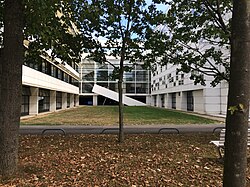
ESIEE Paris belongs to the Paris Île-de-France Regional Chamber of Commerce and Industry. The school is also a member of the Conférence des Grandes Écoles, and Université Gustave Eiffel. The 'modernist' school building located at Marne-la-Vallée has been designed and conceived by the famed French architect Dominique Perrault.

ESIEE Paris

History

[edit]

It was founded in 1904 and was known until the 1960s as the Breguet school. Created in 1904, under the patronage of a family whose three generations contributed to the progress of electricity in the nineteenth century, their descendants accepted that the new school be called Breguet School. The school, from its inception, is intended to constitute in the field of science and technology of electricity, the equivalent of what had been for a long time, the National Schools of Arts and Crafts for mechanics, and delivers an engineering degree.[2]

Recognized by the State by decree of January 3, 1922, the order of diploma is signed by the Minister of Supervision in 1926. Following the law of July 10, 1934, which specified the conditions of issue and the use of the title of qualified engineer, the Breguet School continues to appear on the list of establishments entitled to issue the title of engineer, after three years of consecutive studies at an entrance examination, aligned with the admission requirements of similar public schools.[citation needed]

At the very beginning, in 1904, it was not about electronics, let alone about computers and systems, but about electricity and mechanics. As the technical and technological evolution progressed, the School's teaching was adapted. Terrestrial television and radio courses appeared in the 30s and 40s and were replaced and strongly developed after the war under the general term of electronics. The scientific and technical education, supplemented by a broad general education allowed some 4 000 engineers from the 60 promotions, to adapt to all the circumstances of their professional life. Breguet is found in a wide range of industries, in its first place, obviously, in electrical or mechanical construction, electronics, aeronautics, but also in national services such as EDF, public works, transport, etc[citation needed].

In 1960, the Chamber of Commerce and Industry of Paris, anxious to add to its teaching work a training of engineers, chose Breguet School, which developed from then into a wide collaboration company-school. The last class of engineers from École Breguet was released in 1965. In 1968, the School became known as ESIEE - École Supérieure d'Ingénieurs en Électrotechnique et Électronique. However, the first engineers with the title of ESIEE engineers came out in 1966.[citation needed]

It is presently operated by the Paris Chamber of Commerce. Some of the students come directly from high school and graduate after five years while others, who follow the traditional path to the Grandes écoles, come from a preparatory classes and graduate in three years.[citation needed]

Since 2021, the engineering school is a member of Université Gustave Eiffel since the declaration of the French Prime Minister, Jean Castex. The school remains a school of the Chamber of Commerce and Industry (Décret n° 2020-1747 du 29 décembre 2020).[3]

Academics

[edit]

Approximately 400 of the 1,800 students in Paris graduate every year and 60% of them have spent at least three months studying or working outside France. Depending on their specialization, they can attend classes in its 650 m2 (7000 ft2) clean room. In 1991, it is known as the first engineering school to have students design and launch an artificial satellite, named SARA - Satellite Amateur de Radio Astronomie,[4] as part of extracurricular work in ESIEESPACE, a student club. During the last two years, students choose a specialization among the following subjects:

ESIEE launched several masters of science programs in nano-science, MEMS, electronic engineering and system on a chip, programs to which international students and 4th and 5th-year ESIEE students may participate.[5]

During the last two years at ESIEE Paris, students choose a specialization among the following subjects: Computer science, Signal processing and telecommunications, Network engineering, Electronics and microelectronics, Embedded systems, Manufacturing systems engineering etc.

Ranking

[edit]
  • L’Etudiant 2020 ranking list – ESIEE Paris is takes/holds 27th place in general ranking list and also makes part of schools in Group A.
  • 5th best higher education institution and joint-1st higher education institute of Ile-de-France
  • Joint-2nd based on company links
  • Joint-1st of higher education institutions of Ile-de-France based on academic excellence
  • Eduniversal ranking list of best higher education general engineering schools 2019-2020: no. 1 in Ile-de-France et 6th in general ranking
  • L'Usine Nouvelle 2020 ranking list: ESIEE Paris gains 9 places and rises to 23rd position out of 122 ranking schools
  • U-Multirank 2019 international ranking list: ESIEE Paris placed as 8th best French establishment in Science and Technology out of 236 globally-ranking universities
  • Happy At School® 2020 ranking list: 6th best engineering school in this brand-new ranking list based exclusively on student opinions

Partnership agreements with international institutions

[edit]

In addition to the European Erasmus Programme, two main exchange programs are offered to the students:

Hereafter is a list of some of the universities where students of ESIEE Paris have the opportunity to study:

Research

[edit]

ESIEE Paris is thoroughly invested in 5 primary research areas :

  • Informatics, Image Analysis, Signal Depiction
  • Sensors, Health, Energy and Environment
  • Electronics and Communications
  • Embedded Systems, Networks and Manufacturing
  • Management of Innovation Technologies
ESIEE Paris Library

Informatics, Image Analysis, Signal Depiction

[edit]

Having had many industrial collaborations, with the likes of General Electric, Siemens or Sagem, as well as with high-tech startup companies, the joint work of the Department of Computer Science with Siemens research (Princeton) has been rewarded by three thesis prizes. The department has several research activities including Architecture and parallelism for image processing and virtual reality, Discrete geometry, computational geometry, Mathematical morphology and image processing, Optimisation, modelling and machine learning & Signal processing etc.

Sensors, Health, Energy and Environment

[edit]

The research activity in this area is focused, primarily on the issues of sustainable cities and the well-being of the person. While considering the assortment of data that sensors can deliver, 'Examination Microsystems' is more intense than straightforward sensors. At the point when lessened to the 'Lab-on-chip' scaled down configuration, they turn out to be minimal effort and gain a critical place for supportable city instrumentation. The EquipEx ‘SenseCity' project is well-regarded in this context.

Notable alumni

[edit]
  • Marcel Dassault (Breguet 1912), founder of the Dassault Group [7]
  • Jacques Becker(Breguet 1920), French film director [8][9]
  • Charles Monier (Breguet, 1925), French aviator and part of Free French Air Forces [10]
  • Michel Lechevallier (1971), Director Purchasing, Supply Chain at Schneider Electric [11]
  • Gonzague de Blignières (1979), former co-chairman of Barclays Private Equity Europe and former president of Barclays Private Equity France in the Barclays group [12]
  • Yann LeCun (1983), Turing Award (known as the Nobel Prize in computer sciences), VP & Director of Artificial Intelligence Facebook [13]
  • Jean Michel Karam(1990), Franco-Lebanese engineer, inventor and entrepreneur, CEO of MEMSCAP and INTUISKIN/IOMA.[14]
  • Phillippe Carret (1991), Director, Transtechnology[15]
  • Michel Platnic(1994), French visual artist and electrical engineer [16]
  • Benjamin Bayart (1996), former president of French Data Network (FDN)[17]
  • Benoît Joly (1996), SVP Marketing and Smart Home at Technicolor [18]
  • Régis Lacote (1997), CEO of Paris Orly Airport [19]
  • Frédéric Lepied (1998), French computer scientist and CEO of Mandriva[20]
  • Alexis Bédeneau (2004), CIO Deputy at PWC France[21]
  • Camelia El Kord (2010), French fencer [21]
  • Sreyash Sarkar (2018), Indian poet and researcher [22][23]

References

[edit]
[edit]
Revisions and contributorsEdit on WikipediaRead on Wikipedia
from Grokipedia
ESIEE Paris is a French grande école of , founded in 1904 as the École Breguet and specializing in fields such as , informatics, embedded systems, and . Located in in the area, approximately 20 minutes from central , it serves as a key institution for higher education and focused on technological innovation, particularly in , energy transitions, and environmental . As a founding member of the Université , ESIEE Paris enrolls around 3,000 students and offers a range of five-year programs, including apprenticeships, with a strong emphasis on international mobility requiring at least four months abroad. In 2023, it merged with ESIPE to expand its offerings. The school's history traces back to its origins under the patronage of the Breguet family, renowned for advancements in and , evolving into a modern institution that integrates academic rigor with industry partnerships. Today, it is accredited by the Commission des Titres d'Ingénieur (CTI) and maintains close ties with the Paris Île-de-France Chamber of Commerce and Industry (CCI), fostering and practical training through 1,200 apprenticeships across 10 specialized courses. Its 27,000-square-meter campus, designed by architect , features futuristic and houses five technology platforms supporting in digital technologies, and environmental transitions, and health. ESIEE Paris stands out for its high , with 96% of 2023 graduates securing jobs within four months at an average starting salary of €43,400, often through pre-graduation contracts. The institution ranks among France's top schools, placing 8th overall in L'Usine Nouvelle's 2025 rankings out of 127 schools and 25th in L'Étudiant's 2025 assessment, while its affiliated university, , ranks 640th globally in the CWUR 2025. Notable include aviation pioneer , founder of , and AI researcher , a winner, underscoring the school's legacy in innovation. With 16,000 and ongoing contributions to sustainable cities and Industry 4.0, ESIEE Paris continues to shape future engineers for global challenges.

History

Founding and Early Development

The École Breguet was established in 1904 in as a graduate engineering school focused on practical training in and mechanics. The institution was initiated by three educators—Charles Schneider, Amans Falguières, and Marius Forgeron—with the aim of producing skilled engineers for the growing industrial needs in electrical technologies. Named after the renowned Breguet family, known for their contributions to precision instruments and early electrical devices, the school emphasized hands-on education to prepare students for professional roles in emerging fields. During , enrollment dropped significantly, and the school housed a for two years. The saw the school's practical, workshop-oriented approach build a reputation for producing adaptable engineers amid France's industrial modernization. This period marked steady enrollment and a focus on real-world applications in the electrical sector. The first female graduate was in 1921, and the school received state recognition in 1922. It was directed initially by Marius Forgeron, followed by his son until 1968. In the post-World War II era, École Breguet expanded its programs in , responding to the postwar boom in electrical and communication industries. By 1960, the school had joined the Chambre de Commerce et d'Industrie de (CCI Paris Île-de-France), which provided new resources for growth and integration into broader educational networks. This affiliation supported the development of advanced programs in . In 1968, to better reflect its evolving emphasis on and electrotechnics, the institution was renamed École Supérieure d'Ingénieurs en Électronique et Électrotechnique (ESIEE).

Modern Era and Institutional Affiliations

In the late 20th century, ESIEE Paris underwent significant institutional evolution, including its relocation from central to the Cité Descartes campus in in 1987, which facilitated expanded facilities and closer ties to emerging technological hubs in the region. The campus building, designed by architect , was constructed between 1984 and 1987. This move coincided with the school's growing emphasis on modern engineering disciplines and its integration into the newly formed Université Paris-Est in 2007 as a founding member, enabling enhanced collaborative research and educational synergies within a broader academic cluster focused on innovation and urban development. In 2012, ESIEE merged with ESIEE Management to form a unified under the name ESIEE Paris, enhancing its scope in and management. A pivotal administrative change occurred in 2021 through Décret n° 2020-1747 of December 29, 2020, which transferred ESIEE Paris's personnel and operations at its site to , marking the school's full incorporation into this multidisciplinary born from the merger of Université Paris-Est Marne and IFSTTAR. This affiliation, effective from January 1, 2021, has fostered interdisciplinary opportunities in fields like sustainable technologies and , aligning ESIEE Paris with a ranked among the top 3% globally. Further consolidating its structure, ESIEE Paris merged with ESIPE (École Supérieure d'Ingénieurs de Paris-Est) in late 2022, finalized on January 1, 2023, to form a unified under the ESIEE Paris name, broadening its programmatic scope while retaining its focus on technological innovation. By 2025, ESIEE Paris had grown its student body to approximately 3,000, including around 1,200 apprentices, reflecting its commitment to practical training in digital and sustainable technologies amid increasing demand for specialized engineers. Key milestones in this era include the 2004 centennial celebrations, which highlighted the school's century-long legacy in and , and the adoption of its futuristic campus design by architect to symbolize forward-thinking education in a 27,000 m² facility integrated into the expansive academic ecosystem.

Academics

Degree Programs and Curriculum

ESIEE Paris's flagship offering is the , a five-year degree accredited by the Commission des Titres d'Ingénieur (CTI), designed for post-baccalaureate entry via the competitive Puissance Alpha examination. This program trains generalist engineers with a focus on digital technologies, energy transitions, and , emphasizing practical skills for innovation in these domains. Approximately 480 engineers graduate annually from this program. The curriculum integrates foundational general engineering education in the first two years, covering mathematics, physics, , and managerial principles through and interdisciplinary courses. From the third year onward, students specialize in areas such as (algorithms, , and ), electronics (smart systems and ), and embedded systems (real-time programming and IoT). This structure fosters core competencies in problem-solving, , and sustainable technologies, with opportunities for research-oriented electives in emerging fields. Complementing the main degree, ESIEE Paris offers international Master's programs taught entirely in English, including the Master in and Cybersecurity and the M.Sc. Management of Technology - Information Systems (MOTIS). These 18- to 24-month programs, accessible after a , require a minimum of four months abroad through internships, exchanges, or double-degree arrangements to build global competencies.

Rankings and Reputation

In recent national rankings for 2025, ESIEE Paris has demonstrated strong performance among French engineering schools. According to L'Étudiant, the institution ranks 5th among post-baccalaureate engineering schools. L'Usine Nouvelle places it 8th overall out of 127 engineering schools and 1st among post-baccalaureate institutions, highlighting its excellence in , international outlook, and . Additionally, in the Speak & Act Best School Experience - Happiness Barometer 2025, based on student feedback, ESIEE Paris ranks 10th out of 125 engineering schools for overall student experience. In the Eduniversal 2025 ranking, it is positioned 7th among post-baccalaureate engineering schools. Historically, ESIEE Paris has shown a steady improvement in rankings, underscoring its growing reputation in . In L'Étudiant’s 2020 ranking, it placed 27th overall among French engineering schools. The 2019-2020 Eduniversal ranking positioned it 6th nationally for general programs and 1st in the region, reflecting strengths in academic excellence and industry relevance. The school's reputation is further bolstered by its high rates. For the 2023 graduating class, 96% of graduates secured employment within four months of graduation. The average annual gross starting salary for these graduates, both in and internationally, stands at approximately €43,400. Through its affiliation with Université Gustave Eiffel, ESIEE Paris benefits from the university's inclusion in the Center for World University Rankings (CWUR) 2025, where it ranks 640th globally out of over 21,000 institutions, placing it in the top 3% worldwide.

International Partnerships and Mobility

ESIEE Paris maintains an extensive network of over 120 partnerships with academic institutions across all continents, facilitating a range of international exchange and collaboration opportunities for its students. These agreements include 18 double-degree programs with universities in (such as and the ), (including ), and the (encompassing , the , , and ), allowing engineering students to earn credentials from both ESIEE Paris and partner institutions after completing additional coursework abroad. This global outreach supports diverse mobility options, from semester-long exchanges to year-long immersions, emphasizing cross-cultural . A core component of the curriculum at ESIEE Paris is mandatory international mobility, requiring all students to spend at least one —typically a minimum of three to four months—abroad during their studies. This requirement aligns with the school's emphasis on global competencies, with programs structured to integrate seamlessly into degree pathways. As part of the European Union's framework, ESIEE Paris enables tuition-free exchanges with partner universities across , supplemented by bilateral agreements for non-European destinations. As a constituent school of Université Gustave Eiffel since its formation, ESIEE Paris actively contributes to and benefits from the university's broader international initiatives, including the PIONEER European University Alliance, which promotes collaborative research and mobility among nine institutions focused on urban challenges. In 2025, these efforts include targeted mobility support such as application sessions for Erasmus+ and U.S.-focused programs like MICEFA, ensuring continued expansion of student access to global networks.

Research

Research Areas and Platforms

ESIEE Paris conducts research across three primary domains: , , and Innovation and Society, emphasizing interdisciplinary solutions that address societal challenges. These areas align with the institution's ethos by integrating advanced technologies such as sensors, , and embedded systems to foster and . As of 2025, the research portfolio includes 59 faculty members, 70 PhD students, and notable like one ERC Starting Grant, supporting experimental and industry-oriented projects. The area focuses on developing energy-efficient, resilient, and connected urban environments through engineering innovations in , risk mitigation, and digital integration. Key themes include sensor networks for flow optimization, building energy efficiency, and smart infrastructure, exemplified by projects utilizing the Sense-City facility for urban experimentation. This domain underscores ESIEE Paris's commitment to environmental sustainability, such as the Graphergia project, which develops graphene-based textiles for from and movement to power wearable sensors, launched in 2023 and advancing toward climate-neutral applications. In the Health domain, targets urban health challenges through advancements in , sensor instrumentation, and data analytics, often in collaboration with university hospitals. Core focuses encompass image processing algorithms developed at the LIGM laboratory and innovative microsensors from the ESYCOM laboratory, enabling precise diagnostics and monitoring systems like and nano-implants for health applications. This area leverages and AI to enhance sensor-based health technologies, promoting accessible and efficient medical solutions. The Innovation and Society domain explores the intersection of , social sciences, and , with an emphasis on , technological disruption, and new technology governance. It addresses themes such as applications, of tech adoption, and entrepreneurial frameworks, drawing on knowledge from , materials, and sciences to evaluate societal impacts. This research supports embedded systems and , aligning with ESIEE Paris's focus on managing digital transitions and AI-driven for broader economic and social benefits. Supporting these research domains are five specialized technology platforms that provide cutting-edge infrastructure for prototyping, testing, and analysis. The Clean Rooms platform enables the fabrication of miniature silicon-based sensors and micro-components, facilitating small-scale production for sectors like , environment, and . The Virtual Reality Room creates immersive 3D simulations using polarized projectors and 3D sensors, aiding research in visual and interactive technologies. The Embedded Systems Platform supports the design of real-time distributed systems with tools like and prototyping benches for applications in electric vehicles and , emphasizing innovation in connected devices. The Microwave Frequencies, , and Digital Communications Platform offers advanced and measurement capabilities, including network analyzers for RF, RFID, and wireless communications. Finally, the Innovation Database Analysis Platform analyzes patents and innovation trends through projects like RISIS, focusing on and economic modeling of . These platforms collectively enable high-impact in AI, , and sensor technologies, ensuring alignment with the school's engineering priorities.

Laboratories and Collaborations

ESIEE Paris hosts several key research laboratories as part of its affiliation with Université Gustave Eiffel, focusing on electronics, , and interdisciplinary innovation. The Laboratoire d'Informatique Gaspard-Monge (LIGM, UMR CNRS 8049) specializes in theoretical and applied , with teams dedicated to algorithms, , and image analysis, in collaboration with CNRS, (ENPC), and Université Gustave Eiffel. The Laboratoire d'Électronique et Systèmes de Communication Optique et Microsystèmes (ESYCOM, UMR CNRS 9007) advances work in communication systems, micro-sensors, and micro-energy sources, partnering with CNRS, Conservatoire National des Arts et Métiers (CNAM), and Université Gustave Eiffel. Additionally, the Laboratoire Interdisciplinaire Sciences, Innovations, Sociétés (LISIS, UMR CNRS 9003) examines innovations, knowledge production, and digital transformations, involving CNRS, INRAE, ENPC, and Université Gustave Eiffel. Centers for sensors and energy research, particularly within ESYCOM, support developments in micro/nano technologies aligned with themes at Université Gustave Eiffel. ESIEE Paris maintains collaborations with industry leaders for applied projects in electronics and . These efforts extend to broader industry ties through platforms that facilitate joint R&D in sustainable cities and applications. Research at ESIEE Paris benefits from university-level contributions, with Université Gustave Eiffel's 2024 research expenditure reaching €18.75 million, supplemented by grants from the (e.g., ERC Starting Grant for Neurodiam project on diamond-based neural implants), ANR, and H2020 programs. Outputs include patents in nano-sciences, such as EP3951354A1 (2022) for chip-based flow cytometers from ESYCOM and US Patent 11,491,465 (2022) for ZnO nanostructures, alongside joint publications in areas like and microsystems. As of 2025, these activities continue to yield high-impact contributions, with ongoing European supporting interdisciplinary outputs. Research integrates into teaching through PhD programs affiliated with Paris-Est Sup doctoral schools in mathematics, ICT, sciences, and engineering, hosting over 200 PhD students university-wide, including awardees from ESYCOM and LIGM in 2024. Innovation incubators and clean room facilities enable hands-on PhD training in nano-fabrication and AI applications, bridging lab with engineering curricula.

Campus and Facilities

Location and Architecture

ESIEE Paris is situated in the Cité Descartes area of , in , , approximately 20 minutes from central via the line at the nearby Noisy-Champs station. The campus forms part of the larger Université Gustave Eiffel ecosystem, established in 2020 through the merger of several institutions, and hosts nearly 17,000 students across various engineering and research programs. The school's primary building, designed by renowned French architect , was completed in 1987 and covers a built area of 27,000 m² on a 40,000 m² site. This futuristic structure features an innovative that functions as both facade and roof, a central incision creating the main entrance, and an interior street that links six modular volumes housing classrooms, laboratories, workshops, and a gymnasium. The design emphasizes fluidity and connectivity, with open spaces that integrate the building into its urban and natural context, including direct access to adjacent forest areas on the west side. As a founding member of Université , established in , the campus benefits from enhanced collaborative infrastructure while maintaining proximity to efficient links. The architecture aligns with the institution's focus on , as evidenced by Perrault's broader philosophy of environmentally responsive design and ESIEE Paris's programs in and energy efficiency.

Resources and Infrastructure

ESIEE Paris provides specialized infrastructure to support advanced education and research in engineering disciplines. The institution features cleanrooms dedicated to nano-fabrication and microtechnology, enabling the production of microelements that are 10 to 100 times smaller than the diameter of a human hair. These facilities, with over 30 years of operational experience, specialize in prototyping micro-electro-mechanical systems (MEMS)-type sensors, characterization, and small-to-medium series manufacturing, serving pedagogical activities, academic research, and industry partnerships in fields such as aeronautics, medicine, and environmental monitoring. Additionally, prototyping workshops include the Embedded Systems Platform, equipped with tools like MATLAB and DSP 28335 for real-time system design, as well as testing benches for electric vehicles and distributed systems in home automation. The campus also maintains robust computing resources, comprising 660 workstations across 40 labs, 30 servers, and access to over 200 software programs for pedagogical and scientific applications. The system at ESIEE Paris offers a dedicated spanning 695 m², designed for individual and group study with flexible workspaces and on-site consultation available Monday through Friday from 10:00 to 19:00. This facility includes the TI-Innovation Gateway, Europe's first 4.0 established in partnership with in 2018, which allows students to borrow electronic components for innovative projects and testing. Students have free access to extensive digital archives and resources, including remote learning platforms and tools. Furthermore, as part of Université Gustave Eiffel, ESIEE Paris students can utilize the university's broader collections across multiple campuses, focusing on areas like , , and . Additional amenities enhance the campus experience for students as of 2025. Gymnasiums include a fully equipped 2,000 m² sports hall, a , a weight-lifting gym, and a , supporting nearly 30 supervised sports disciplines led by trainers, with access to nearby stadiums and complexes. Student housing options encompass reserved accommodations in residences such as Ampère (300 meters from campus) and Arago, prioritizing ESIEE Paris students, along with 30 spots in the CROUS residence and 50 in the MA1SON program for scholarship recipients; additional nearby options are available in areas like Champs-sur-Marne and . Collaborative workspaces, including the 695 m² Vercors area in the former library space, provide modular co-working setups with adaptable furniture, open Monday to Friday from 8:00 to 19:00, and host events like job-dating sessions. Sustainability infrastructure at ESIEE Paris emphasizes energy efficiency and renewable technologies, aligning with the institution's focus on environmental transitions. The Health, Energy, and Sustainable Environment department conducts research on power generation systems, renewable energy, and building energy efficiency, including applications in solar energy and facility optimization. While specific on-campus installations like solar panels are integrated into research projects such as the Liv-Lib' initiative for building-integrated photovoltaics, the campus supports broader sustainability through these expertise areas and access to monitoring tools in prototyping facilities.

Student Life

Admissions and Enrollment

Admissions to ESIEE Paris for its primary program are primarily conducted post-baccalauréat through the competitive national Concours Puissance Alpha, accessible via the platform for French and European applicants. This concours evaluates candidates' aptitude in science, technology, , and (STEM) through written examinations in subjects such as and physics-chemistry, followed by oral interviews for shortlisted applicants. Preparatory classes (classes préparatoires aux grandes écoles, or CPGE) are optional, as the post-bac pathway allows direct entry into the first year of the three-year initial cycle leading to the full five-year . For international applicants, particularly non-European students, admissions rely on a selective process involving submission of an application file, an English proficiency test, a assessment, and a personal to gauge academic background and . Prerequisites include a or equivalent (at least four years of higher education for non-EU candidates), with emphasis placed on strong STEM foundations demonstrated through prior coursework and achievements. Entry is possible in the first or second year of the engineering program, aligning with the school's integrated curriculum structure. ESIEE Paris enrolls approximately 3,000 students across its programs, with around 250 new entrants admitted annually via the post-bac Concours Puissance Alpha pathway, supplemented by additional admissions through international and lateral entry routes. The student body reflects diversity, including about 15% international students from over 100 nationalities, contributing to a global perspective in the cohorts. In recent years, particularly for 2025 intakes, ESIEE Paris has intensified efforts toward gender diversity, achieving 22% female enrollment—up from 10% over the past 16 years—through targeted recruitment and support initiatives for women in STEM. The school also promotes inclusion from underrepresented regions via scholarships and outreach, aligning with broader goals to enhance socioeconomic and geographic diversity in .

Extracurricular Activities and Support

ESIEE Paris fosters a vibrant extracurricular landscape through its student associations and clubs, which play a central role in campus life. The school hosts over 20 clubs managed by key entities such as the Student Office (BDE), Arts Office (BDA), and Sports Office (BDS), alongside major associations including ESIEESPACE, Junior ESIEE, and the humanitarian-focused AS de Coeur. These groups cover diverse interests, from cultural pursuits like the Choir Club, Cinema Club, and Hera Club (promoting ) to innovation-oriented societies such as Epifree and FDK, enabling students to develop skills in , communication, and . ESIEESPACE, a prominent space engineering club, exemplifies student-driven innovation by designing and launching satellites, including the SARA microsatellite in 1991, in collaboration with the French space agency . A calendar of events enriches student engagement, with Thursday afternoons dedicated to extracurricular pursuits and annual gatherings organized by clubs spanning IT challenges like Sumobot and , cultural festivals such as the Gala ESIEE Paris and VivaTech participation, humanitarian initiatives including the 4L Trophy and Téléthon, and sports competitions like Mud Day and inter-university championships. The sports program offers nearly 30 disciplines, supported by facilities including a 2,000 m² gymnasium, , weight room, and , with special accommodations for high-level athletes such as flexible scheduling and catch-up exams to balance training and studies. These activities integrate with the broader community through university-wide events like the Rentrée scolaire and partnerships with , promoting social cohesion and local involvement. Support services ensure holistic student and career preparation. The Skills and Careers programme provides workshops on , CV building, interview techniques, and like , guided by , HR professionals, and coaches to facilitate professional transitions. Junior ESIEE, a student-run , offers practical experience in innovation projects, often bridging to . resources include free access to the University Health Department (SSU) for psychological counseling, stress workshops, and violence reporting via the Equality Mission, complemented by the Maison de l'Étudiant for social and psychosocial guidance. Student-led extracurriculars in AI and , showcased at the Jour des Projets event, frequently evolve into startups, as seen with the BloodOwl initiative selected for the PEPITE program, highlighting the school's entrepreneurial ecosystem.

Notable People

Alumni

ESIEE Paris has produced numerous influential alumni who have made significant contributions to engineering, technology, and industry leadership. Among the school's earliest graduates is (1902–1986), who attended during the Breguet era in 1912 and went on to found , a pioneering company that revolutionized design and production. A more recent standout alumnus is , who graduated in 1983 with a diploma in . LeCun is a leading figure in , recognized as one of the pioneers of convolutional neural networks and ; he received the 2018 for his foundational work in these areas and served as Chief AI Scientist at Meta until 2025, when he planned to leave to found a startup. Other notable alumni have excelled in aerospace, technology, and entrepreneurship, extending the school's legacy of innovation from its early 20th-century roots in electrical engineering. For instance, Eric Larchevêque, a 1996 graduate, co-founded , a global leader in cryptocurrency hardware security, highlighting ESIEE Paris graduates' impact in and . The school's global network, comprising over 17,000 members and managed by the Association des Anciens Élèves de l'ESIEE (AA-ESIEE), fosters mentorship, professional events, and career support worldwide. This robust community contributes to a 96% rate for graduates within six months of completion, with many securing positions in leading firms across sectors.

Faculty and Staff

ESIEE Paris employs approximately 240 faculty and staff members, comprising permanent teachers, researchers, and administrative personnel dedicated to and in digital, energy, and environmental domains. A significant portion of the holds joint appointments with , facilitating integrated and across the university's campuses. All permanent members possess doctoral degrees, with around 20 accredited to supervise (HDR), ensuring high expertise in their fields. Administrative leadership at ESIEE Paris emphasizes strategic partnerships with industry to support digital transitions and innovation. Jean Mairesse, the Managing Director since 2017, oversees operations as a founding member of and the CCI Paris Île-de-France group, fostering collaborations such as sponsorships with companies like Orange for graduating classes through 2025. Olivier Français, elected Dean of Faculty in 2023, leads academic affairs with a focus on health, energy, and environment, drawing from his professorial role to advance interdisciplinary teaching methodologies. Notable faculty include experts in artificial intelligence and electronics, such as E. Veronica Belmega, a full professor who teaches digital signal processing and supervises PhD research in wireless communications and optimization at the LIGM laboratory. Her contributions encompass high-impact publications, including work on energy-efficient precoding in IEEE Transactions on Signal Processing, influencing multi-antenna systems. Faculty collectively supervise over 50 PhD students, funded through industry contracts, national grants, and international sources, while innovating in pedagogical approaches like project-based learning integrated with real-world applications.

References

Add your contribution
Related Hubs
User Avatar
No comments yet.