Hubbry Logo
Effective medium approximationsEffective medium approximationsMain
Open search
Effective medium approximations
Community hub
Effective medium approximations
logo
7 pages, 0 posts
0 subscribers
Be the first to start a discussion here.
Effective medium approximations
from Wikipedia

In materials science, effective medium approximations (EMA) or effective medium theory (EMT) pertain to analytical or theoretical modeling that describes the macroscopic properties of composite materials. EMAs or EMTs are developed from averaging the multiple values of the constituents that directly make up the composite material. At the constituent level, the values of the materials vary and are inhomogeneous. Precise calculation of the many constituent values is nearly impossible. However, theories have been developed that can produce acceptable approximations which in turn describe useful parameters including the effective permittivity and permeability of the materials as a whole. In this sense, effective medium approximations are descriptions of a medium (composite material) based on the properties and the relative fractions of its components and are derived from calculations,[1][2] and effective medium theory.[3] There are two widely used formulae.[4]

Effective permittivity and permeability are averaged dielectric and magnetic characteristics of a microinhomogeneous medium. They both were derived in quasi-static approximation when the electric field inside a mixture particle may be considered as homogeneous. So, these formulae can not describe the particle size effect. Many attempts were undertaken to improve these formulae.

Applications

[edit]

There are many different effective medium approximations,[5] each of them being more or less accurate in distinct conditions. Nevertheless, they all assume that the macroscopic system is homogeneous and, typical of all mean field theories, they fail to predict the properties of a multiphase medium close to the percolation threshold due to the absence of long-range correlations or critical fluctuations in the theory.

The properties under consideration are usually the conductivity or the dielectric constant [6] of the medium. These parameters are interchangeable in the formulas in a whole range of models due to the wide applicability of the Laplace equation. The problems that fall outside of this class are mainly in the field of elasticity and hydrodynamics, due to the higher order tensorial character of the effective medium constants.

EMAs can be discrete models, such as applied to resistor networks, or continuum theories as applied to elasticity or viscosity. However, most of the current theories have difficulty in describing percolating systems. Indeed, among the numerous effective medium approximations, only Bruggeman's symmetrical theory is able to predict a threshold. This characteristic feature of the latter theory puts it in the same category as other mean field theories of critical phenomena.[citation needed]

Bruggeman's model

[edit]

For a mixture of two materials with permittivities and with corresponding volume fractions and , D.A.G. Bruggeman proposed a formula of the following form:[7]

Here the positive sign before the square root must be altered to a negative sign in some cases in order to get the correct imaginary part of effective complex permittivity which is related with electromagnetic wave attenuation. The formula is symmetric with respect to swapping the 'd' and 'm' roles. This formula is based on the equality

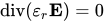
where is the jump of electric displacement flux all over the integration surface, is the component of microscopic electric field normal to the integration surface, is the local relative complex permittivity which takes the value inside the picked metal particle, the value inside the picked dielectric particle and the value outside the picked particle, is the normal component of the macroscopic electric field. Formula (4) comes out of Maxwell's equality . Thus only one picked particle is considered in Bruggeman's approach. The interaction with all the other particles is taken into account only in a mean field approximation described by . Formula (3) gives a reasonable resonant curve for plasmon excitations in metal nanoparticles if their size is 10 nm or smaller. However, it is unable to describe the size dependence for the resonant frequency of plasmon excitations that are observed in experiments [8]

Formulas

[edit]

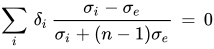
Without any loss of generality, we shall consider the study of the effective conductivity (which can be either dc or ac) for a system made up of spherical multicomponent inclusions with different arbitrary conductivities. Then the Bruggeman formula takes the form:

Circular and spherical inclusions

[edit]

In a system of Euclidean spatial dimension that has an arbitrary number of components,[9] the sum is made over all the constituents. and are respectively the fraction and the conductivity of each component, and is the effective conductivity of the medium. (The sum over the 's is unity.)

Elliptical and ellipsoidal inclusions

[edit]

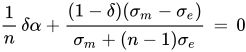
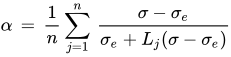
This is a generalization of Eq. (1) to a biphasic system with ellipsoidal inclusions of conductivity into a matrix of conductivity .[10] The fraction of inclusions is and the system is dimensional. For randomly oriented inclusions,

where the 's denote the appropriate doublet/triplet of depolarization factors which is governed by the ratios between the axis of the ellipse/ellipsoid. For example: in the case of a circle (, ) and in the case of a sphere (, , ). (The sum over the 's is unity.)

The most general case to which the Bruggeman approach has been applied involves bianisotropic ellipsoidal inclusions.[11]

Derivation

[edit]

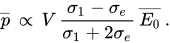
The figure illustrates a two-component medium.[9] Consider the cross-hatched volume of conductivity , take it as a sphere of volume and assume it is embedded in a uniform medium with an effective conductivity . If the electric field far from the inclusion is then elementary considerations lead to a dipole moment associated with the volume

This polarization produces a deviation from . If the average deviation is to vanish, the total polarization summed over the two types of inclusion must vanish. Thus

where and are respectively the volume fraction of material 1 and 2. This can be easily extended to a system of dimension that has an arbitrary number of components. All cases can be combined to yield Eq. (1).

Eq. (1) can also be obtained by requiring the deviation in current to vanish.[12] [13] It has been derived here from the assumption that the inclusions are spherical and it can be modified for shapes with other depolarization factors; leading to Eq. (2).

A more general derivation applicable to bianisotropic materials is also available.[11]

Modeling of percolating systems

[edit]

The main approximation is that all the domains are located in an equivalent mean field. Unfortunately, it is not the case close to the percolation threshold where the system is governed by the largest cluster of conductors, which is a fractal, and long-range correlations that are totally absent from Bruggeman's simple formula. The threshold values are in general not correctly predicted. It is 33% in the EMA, in three dimensions, far from the 16% expected from percolation theory and observed in experiments. However, in two dimensions, the EMA gives a threshold of 50% and has been proven to model percolation relatively well.[14][15][16]

Maxwell Garnett equation

[edit]

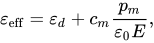
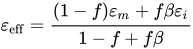
In the Maxwell Garnett approximation,[17] the effective medium consists of a matrix medium with and inclusions with . Maxwell Garnett was the son of physicist William Garnett, and was named after Garnett's friend, James Clerk Maxwell. He proposed his formula to explain colored pictures that are observed in glasses doped with metal nanoparticles. His formula has a form[18]

where is effective relative complex permittivity of the mixture, is relative complex permittivity of the background medium containing small spherical inclusions of relative permittivity with volume fraction of . This formula is based on the equality

where is the absolute permittivity of free space and is electric dipole moment of a single inclusion induced by the external electric field E. However this equality is good only for homogeneous medium and . Moreover, the formula (1) ignores the interaction between single inclusions. Because of these circumstances, formula (1) gives too narrow and too high resonant curve for plasmon excitations in metal nanoparticles of the mixture.[19]

Formula

[edit]

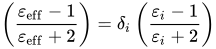
The Maxwell Garnett equation reads:[20]

where is the effective dielectric constant of the medium, of the inclusions, and of the matrix; is the volume fraction of the inclusions.

The Maxwell Garnett equation is solved by:[21][22]

so long as the denominator does not vanish. A simple MATLAB calculator using this formula is as follows.

% This simple MATLAB calculator computes the effective dielectric
% constant of a mixture of an inclusion material in a base medium
% according to the Maxwell-Garnett theory.
% INPUTS:
%     eps_base: dielectric constant of base material;
%     eps_incl: dielectric constant of inclusion material;
%     vol_incl: volume portion of inclusion material;
% OUTPUT:
%     eps_mean: effective dielectric constant of the mixture.

function eps_mean = MaxwellGarnettFormula(eps_base, eps_incl, vol_incl)

    small_number_cutoff = 1e-6;

    if vol_incl < 0 || vol_incl > 1
        disp('WARNING: volume portion of inclusion material is out of range!');
    end
    factor_numer = 2 * (1 - vol_incl) * eps_base + (1 + 2 * vol_incl) * eps_incl;
    factor_denom = (2 + vol_incl) * eps_base + (1 - vol_incl) * eps_incl;
    if abs(factor_denom) < small_number_cutoff
        disp('WARNING: the effective medium is singular!');
        eps_mean = 0;
    else
        eps_mean = eps_base * factor_numer / factor_denom;
    end
end

Derivation

[edit]

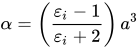
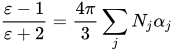
For the derivation of the Maxwell Garnett equation we start with an array of polarizable particles. By using the Lorentz local field concept, we obtain the Clausius-Mossotti relation: Where is the number of particles per unit volume. By using elementary electrostatics, we get for a spherical inclusion with dielectric constant and a radius a polarisability : If we combine with the Clausius Mosotti equation, we get: Where is the effective dielectric constant of the medium, of the inclusions; is the volume fraction of the inclusions.
As the model of Maxwell Garnett is a composition of a matrix medium with inclusions we enhance the equation:
Validity

[edit]

In general terms, the Maxwell Garnett EMA is expected to be valid at low volume fractions , since it is assumed that the domains are spatially separated and electrostatic interaction between the chosen inclusions and all other neighbouring inclusions is neglected.[23] The Maxwell Garnett formula, in contrast to Bruggeman formula, ceases to be correct when the inclusions become resonant. In the case of plasmon resonance, the Maxwell Garnett formula is correct only at volume fraction of the inclusions .[24] The applicability of effective medium approximation for dielectric multilayers [25] and metal-dielectric multilayers [26] have been studied, showing that there are certain cases where the effective medium approximation does not hold and one needs to be cautious in application of the theory.

Generalization of the Maxwell Garnett Equation to describe the nanoparticle size distribution

[edit]

Maxwell Garnett Equation describes optical properties of nanocomposites which consist in a collection of perfectly spherical nanoparticles. All these nanoparticles must have the same size. However, due to confinement effect, the optical properties can be influenced by the nanoparticles size distribution. As shown by Battie et al.,[27] the Maxwell Garnett equation can be generalized to take into account this distribution.

and are the nanoparticle radius and size distribution, respectively. and are the mean radius and the volume fraction of the nanoparticles, respectively. is the first electric Mie coefficient. This equation reveals that the classical Maxwell Garnett equation gives a false estimation of the volume fraction nanoparticles when the size distribution cannot be neglected.

Generalization to include shape distribution of nanoparticles

[edit]

The Maxwell Garnett equation only describes the optical properties of a collection of perfectly spherical nanoparticles. However, the optical properties of nanocomposites are sensitive to the nanoparticles shape distribution. To overcome this limit, Y. Battie et al.[28] have developed the shape distributed effective medium theory (SDEMT). This effective medium theory enables to calculate the effective dielectric function of a nanocomposite which consists in a collection of ellipsoïdal nanoparticles distributed in shape.
with

The depolarization factors () only depend on the shape of nanoparticles. is the distribution of depolarization factors. is the volume fraction of the nanoparticles.

The SDEMT theory was used to extract the shape distribution of nanoparticles from absorption [29] or ellipsometric spectra.[30][31]

Formula describing size effect

[edit]

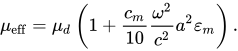
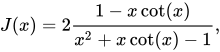
A new formula describing size effect was proposed.[19] This formula has a form

where a is the nanoparticle radius and is wave number. It is supposed here that the time dependence of the electromagnetic field is given by the factor In this paper Bruggeman's approach was used, but electromagnetic field for electric-dipole oscillation mode inside the picked particle was computed without applying quasi-static approximation. Thus the function is due to the field nonuniformity inside the picked particle. In quasi-static region (, i.e. for Ag this function becomes constant and formula (5) becomes identical with Bruggeman's formula.

Effective permeability formula

[edit]

Formula for effective permeability of mixtures has a form [19]

Here is effective relative complex permeability of the mixture, is relative complex permeability of the background medium containing small spherical inclusions of relative permeability with volume fraction of . This formula was derived in dipole approximation. Magnetic octupole mode and all other magnetic oscillation modes of odd orders were neglected here. When and this formula has a simple form [19]

Effective medium theory for resistor networks

[edit]

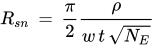
For a network consisting of a high density of random resistors, an exact solution for each individual element may be impractical or impossible. In such case, a random resistor network can be considered as a two-dimensional graph and the effective resistance can be modelled in terms of graph measures and geometrical properties of networks.[32] Assuming, edge length is much less than electrode spacing and edges to be uniformly distributed, the potential can be considered to drop uniformly from one electrode to another. Sheet resistance of such a random network () can be written in terms of edge (wire) density (), resistivity (), width () and thickness () of edges (wires) as:

See also

[edit]

References

[edit]

Further reading

[edit]
Revisions and contributorsEdit on WikipediaRead on Wikipedia
from Grokipedia
Effective medium approximations (EMAs) are theoretical frameworks in physics and that model the macroscopic properties of heterogeneous or composite materials—such as , permeability, conductivity, or elastic moduli—by treating them as equivalent homogeneous media with averaged "effective" properties. These approximations simplify the analysis of complex microstructures where individual components have disparate properties, assuming the heterogeneities (e.g., inclusions or particles) are randomly distributed and much smaller than the relevant length scale, such as the of electromagnetic waves or the observation scale. EMAs originated in the late 19th and early 20th centuries, building on for , and have since been extended to acoustics, , and . The most prominent formulations include the Maxwell-Garnett approximation, developed by J. C. Maxwell in 1873 and refined by J. C. M. Garnett in 1904, which applies to dilute suspensions of spherical inclusions in a host medium and derives the effective ϵeff\epsilon_\mathrm{eff} from the polarizabilities of the components, assuming negligible interactions between inclusions. For spherical inclusions, the basic isotropic formula is ϵeff=ϵhϵi+2ϵh+2f(ϵiϵh)ϵi+2ϵhf(ϵiϵh),\epsilon_{\mathrm{eff}} = \epsilon_h \frac{\epsilon_i + 2\epsilon_h + 2f(\epsilon_i - \epsilon_h)}{\epsilon_i + 2\epsilon_h - f(\epsilon_i - \epsilon_h)}, where ϵh\epsilon_h and ϵi\epsilon_i are the of the host and inclusion, respectively, and ff is the volume fraction of inclusions (with f1f \ll 1). In contrast, the Bruggeman symmetric , introduced by D. A. G. Bruggeman in 1935, provides a self-consistent treatment suitable for higher concentrations and bicontinuous phases, solving kfkσkσeffσk+2σeff=0\sum_k f_k \frac{\sigma_k - \sigma_\mathrm{eff}}{\sigma_k + 2\sigma_\mathrm{eff}} = 0 for conductivity σ\sigma (or analogous forms for other properties), treating all phases equivalently without distinguishing a host. Other variants, such as the coherent potential or differential effective medium schemes, address anisotropic or multiphase systems. EMAs are widely applied in modeling optical responses of nanocomposites, predicting thermal conductivities in porous rocks, designing metamaterials with tailored electromagnetic properties, and simulating light scattering in aerosols or biological tissues. For instance, in , they enable rapid computation of from rough surfaces or particulate media when inclusion sizes yield size parameters x<0.1x < 0.10.50.5, depending on refractive index contrast. However, their validity relies on assumptions like low refractive index contrast, quasi-uniform distribution, and subwavelength inclusions; they break down for high contrasts, large particles (x>0.5x > 0.5), or near percolation thresholds where phase connectivity changes dramatically, often overestimating or underestimating properties by tens of percent in such cases. Advanced extensions incorporate spatial correlations or nonlocal effects to mitigate these limitations in modern applications like plasmonics and phononics.

Introduction

Definition and Purpose

Effective medium approximations (EMAs) are analytical methods that model the macroscopic behavior of heterogeneous materials, such as composites with inclusions dispersed in a host matrix, by replacing them with equivalent homogeneous media characterized by effective tensors like , permeability, or conductivity. These approximations enable the prediction of bulk properties from the constituents' characteristics and their volume fractions, treating the microstructure's complexity as an averaged uniformity. The primary purpose of EMAs is to simplify the analysis of wave propagation and in disordered or composite systems, bridging microscopic heterogeneity to observable macroscopic responses and thereby reducing computational demands in disciplines including electromagnetics, , and . For instance, in electromagnetics, EMAs facilitate the design of photonic materials by estimating effective responses without resolving individual scatterers, while in materials science, they aid in optimizing thermal or electrical conductivity of engineered composites. Central to EMAs are assumptions such as low volume fractions of inclusions to ensure dilute limits where interactions are negligible, quasi-static conditions where the far exceeds inclusion sizes to neglect retardation effects, and the potential for isotropic effective media (e.g., for spherical particles) or anisotropic ones (e.g., for aligned ellipsoids). These assumptions underpin the validity of the homogenization, allowing effective parameters to capture averaged field responses across the material. EMAs are broadly classified into non-self-consistent models, which asymmetrically designate a host medium with embedded inclusions and suit low-fraction scenarios, and self-consistent models, which symmetrically average over all components without privileging a host, extending applicability to higher concentrations. Examples of these types include the Maxwell-Garnett approximation as a non-self-consistent approach and Bruggeman's theory as self-consistent.

Historical Development

The foundations of effective medium approximations trace back to 19th-century efforts to relate the macroscopic properties of materials to their microscopic structure, particularly for dilute inclusions. The Clausius-Mossotti relation, developed in the mid-1800s, provided an early framework by linking the dielectric constant of a material to the of its molecules, assuming a uniform correction for induced dipoles in a continuum medium. This relation, formalized by in 1879 building on Ottaviano-Fabrizio Mossotti's 1848 work on dielectrics, served as a precursor for modeling sparse inclusions in a host medium. Complementing this, the Lorentz-Lorenz equation, first derived by Ludvig Valentin Lorenz in 1869 from optical considerations and independently by Hendrik Antoon Lorentz in 1878 from electromagnetic theory, related the to molecular density, emphasizing the role of local fields in non-dilute systems. These developments laid the groundwork for approximating the effective response of heterogeneous media. A pivotal advancement came in 1873 with James Clerk Maxwell's analysis of dielectric mixtures in his , where he derived expressions for the effective permittivity of a composite consisting of spherical inclusions embedded in a host medium, assuming low volume fractions and treating the mixture as a perturbation of the host. This work, detailed in Volume 1, Chapter IX, introduced the concept of averaging polarizations in heterogeneous s, forming the basis for subsequent models. In 1904, J. C. Maxwell Garnett extended Maxwell's approach to explain the optical colors in metal- composites, such as gold ruby glass, by formulating an explicit approximation for the effective function of dilute spherical inclusions, which became known as the Maxwell-Garnett approximation. The limitations of asymmetric models for higher inclusion concentrations were addressed in 1935 by Diederik A. G. Bruggeman, who proposed a symmetric effective medium theory that treats all components equivalently through a self-consistent averaging procedure, applicable to broader volume fractions and predicting percolation-like thresholds in conductivity. Post-1935 developments focused on relaxing the spherical inclusion assumption; for instance, in 1946, Dirk Polder and Jan H. van Santen generalized the theory to ellipsoidal particles, incorporating depolarization factors to account for shape anisotropy in magnetic and dielectric mixtures. By the 1970s, integrations with percolation theory emerged, notably in Scott Kirkpatrick's 1973 work, which combined effective medium approximations with resistor network models to describe transport properties near percolation thresholds in disordered media. In the modern era, since the 1990s, the rise of nanotechnology has driven computational implementations of effective medium approximations for modeling nanostructured composites, such as nanoparticle assemblies and photonic materials, enabling predictions of optical and electromagnetic responses at nanoscale dimensions.

Fundamental Principles

Homogenization Theory

Homogenization theory provides a mathematical framework for deriving effective macroscopic properties of heterogeneous media by performing asymptotic analysis as the microscopic scale parameter ε approaches zero. In periodic media, where the material properties repeat with a small period εY (with Y the unit cell), the theory separates the microscopic scale ε from the macroscopic scale L, assuming ε ≪ L. This allows the replacement of a rapidly oscillating coefficient a(x/ε) in partial differential equations (PDEs) with an effective constant tensor A^* that captures the average behavior. The seminal development for periodic structures relies on multiple-scale asymptotic expansions to approximate solutions and derive the homogenized equation. For random media, homogenization extends this approach to stationary ergodic fields, where microscopic fluctuations are statistically homogeneous but lack periodicity. The effective coefficients emerge as almost sure constants determined by averages, often via the ergodic theorem. Key results establish that solutions to boundary value problems in random media converge weakly to solutions of a deterministic homogenized PDE, with the effective tensor computed from subadditive variational principles or corrector estimates. Central to the theory are concepts of weak and strong convergence in Sobolev spaces, which ensure the passage to the limit for sequences of functions u^ε in W^{1,p}(Ω). Weak convergence in W^{1,p} implies bounded energy, while strong convergence of gradients requires additional arguments, such as two-scale convergence, to handle oscillations. These tools derive the effective conductivity or tensor A^* = ∫_Y a(y) (I + ∇_y χ(y)) dy, where χ solves auxiliary cell problems, guaranteeing the homogenized PDE div(A^* ∇u) = f inherits ellipticity from the original. The framework addresses boundary value problems for elliptic PDEs like the Laplace equation ∇ · (a(x/ε) ∇u^ε) = f in heterogeneous domains, or the for wave propagation, yielding homogenized coefficients that solve analogous macroscopic problems. In multiple-scale expansions, correctors χ(y,x) ≈ χ^0(y,x) + ε χ^1(y,x) + ... resolve fine-scale variations, with cell problems on the Y given by y(a(y)(ei+yχei(y)))=0,yY,-\nabla_y \cdot \left( a(y) \left( \mathbf{e}_i + \nabla_y \chi^{\mathbf{e}_i}(y) \right) \right) = 0, \quad y \in Y, under periodic boundary conditions, where \mathbf{e}_i are basis vectors. These correctors enable the asymptotic approximation u^ε(x) ≈ u(x) + ε χ(y,x) · ∇u(x), with y = x/ε, and facilitate error estimates in H^1 norms. Despite its rigor, homogenization theory has limitations, particularly near interfaces where boundary layers violate scale separation, leading to non-uniform convergence, or in high-contrast regimes where coefficients a(y) span orders of magnitude, potentially resulting in non-local effective operators or effects that invalidate local approximations.

Averaging Methods and Assumptions

Effective medium approximations rely on volume averaging techniques to derive macroscopic properties from microscopic heterogeneities. In this approach, the effective ϵeff\epsilon_\mathrm{eff} is obtained by integrating the local ϵ\epsilon and E\mathbf{E} over a representative VV, yielding ϵeff=ϵEE\epsilon_\mathrm{eff} = \frac{\langle \epsilon \mathbf{E} \rangle}{\langle \mathbf{E} \rangle}, where \langle \cdot \rangle denotes the spatial 1VV()dV\frac{1}{V} \int_V (\cdot) \, dV. This formulation accounts for the non-uniform field distribution within the composite, distinguishing it from simpler arithmetic means and ensuring consistency with electrostatic principles. Statistical assumptions underpin the validity of these averages in random media. Ergodicity is typically invoked, allowing ensemble averages over many realizations to be replaced by spatial averages within a single large sample, assuming the microstructure is representative. Stationarity ensures that statistical properties remain invariant under spatial translations, facilitating the definition of a representative volume element. Additionally, separation of scales is assumed, where the representative volume is much larger than microscopic features (e.g., inclusion sizes) but smaller than the overall system dimensions, enabling homogenization without loss of local detail. Field fluctuations introduce complexities addressed through approximations on higher-order moments. In dilute limits, correlations between inclusions are neglected, treating the local field as a perturbation around the average, which simplifies calculations by ignoring quadrupolar and higher multipolar interactions. This neglect holds when volume fractions are low, but fluctuations grow with density, potentially requiring inclusion of variance in the field distribution for accuracy. Common assumptions further define the scope of these methods. The Maxwell-Garnett approximation presumes non-interacting inclusions embedded in a host medium, with fields undisturbed by neighboring particles beyond dipolar effects. In contrast, Bruggeman's theory employs self-consistent fields, where inclusions and matrix are treated symmetrically within the effective medium itself. Both operate under quasi-static conditions, requiring the to greatly exceed inclusion sizes (e.g., size parameter x<0.3x < 0.3) to justify electrostatic treatment and ignore retardation effects. Errors arise primarily from violations of these assumptions, particularly at high volume fractions or near thresholds. At high volume fractions, inter-inclusion interactions amplify field fluctuations, leading to significant deviations in predicted compared to exact solutions. Near , where connectivity emerges, the neglect of higher-order correlations fails, causing singularities in effective properties that simple averages cannot capture accurately. These limitations highlight the need for extensions beyond classical averaging in dense or critical regimes.

Classical Models

Maxwell-Garnett Approximation

The Maxwell-Garnett approximation provides an asymmetric formulation for the effective properties of composite materials consisting of dilute spherical inclusions embedded in a host matrix, where the host dominates the overall response. This model is particularly suited for matrix-inclusion systems with low volume fractions of inclusions. For the effective constant of such a composite, the formula is given by ϵeff=ϵh[1+3f(ϵiϵh)ϵi+2ϵhf(ϵiϵh)],\epsilon_\text{eff} = \epsilon_h \left[1 + \frac{3f (\epsilon_i - \epsilon_h)}{\epsilon_i + 2\epsilon_h - f(\epsilon_i - \epsilon_h)}\right], where ϵh\epsilon_h is the of the host medium, ϵi\epsilon_i is the of the inclusions, and ff is the volume fraction of the inclusions. The same formulation extends analogously to other transport properties, such as electrical conductivity or magnetic permeability, by replacing the permittivities with the corresponding conductivities khk_h, kik_i or permeabilities μh\mu_h, μi\mu_i in , due to the mathematical similarity in the underlying electrostatic and magnetostatic boundary value problems. This analogy originates from treatment of heterogeneous media with spherical inclusions. The approximation assumes spherical inclusions, for which the depolarization factor is 1/31/3, reflecting the uniform field inside a in a uniform external field. It relies on the forward scattering approximation, valid for low volume fractions typically below 0.3, where interactions between inclusions are negligible and the response dominates. For anisotropic cases, the model generalizes to a vector or tensor form that accounts for directional dependencies in the effective tensor. In contrast to Bruggeman's effective medium theory, which applies symmetrically to all components and higher filling fractions, the Maxwell-Garnett approach emphasizes the distinction between host and inclusions.

Bruggeman's Effective Medium Theory

Bruggeman's effective medium theory, introduced in , offers a symmetric framework for estimating the effective of heterogeneous materials composed of multiple phases without designating a primary host medium. This approach is particularly advantageous for mixtures at high volume fractions, where components are treated equivalently, making it suitable for disordered or polycrystalline systems. The theory assumes isotropic, spherical inclusions randomly distributed in three dimensions and relies on a self-consistent condition to define the effective medium. The self-consistency arises from embedding small volumes of each component into the effective medium itself, such that the overall polarization induced by an external field averages to zero . For a two-component with ff of inclusions having ϵi\epsilon_i and 1f1-f of the other phase with ϵh\epsilon_h, the symmetric is given by fϵiϵeffϵi+2ϵeff+(1f)ϵhϵeffϵh+2ϵeff=0,f \frac{\epsilon_i - \epsilon_\mathrm{eff}}{\epsilon_i + 2\epsilon_\mathrm{eff}} + (1-f) \frac{\epsilon_h - \epsilon_\mathrm{eff}}{\epsilon_h + 2\epsilon_\mathrm{eff}} = 0, where ϵeff\epsilon_\mathrm{eff} is the effective . This is solved implicitly for ϵeff\epsilon_\mathrm{eff}, ensuring the medium behaves homogeneously under electromagnetic probing. Unlike the Maxwell-Garnett approximation, which assumes dilute inclusions in a distinct host and is accurate only for low ff, Bruggeman's model remains valid across broader composition ranges due to its symmetric treatment. A notable feature of the model for conducting-insulating mixtures is its prediction of a at fc=1/3f_c = 1/3 for spherical particles, marking the point where the effective conductivity transitions from insulating to conducting behavior as the conducting phase fraction increases. This threshold emerges naturally from the self-consistent when one permittivity approaches zero or infinity. For multicomponent systems with NN phases, the extends symmetrically via k=1Nϕkϵkϵeffϵk+2ϵeff=0,\sum_{k=1}^N \phi_k \frac{\epsilon_k - \epsilon_\mathrm{eff}}{\epsilon_k + 2\epsilon_\mathrm{eff}} = 0, where ϕk\phi_k and ϵk\epsilon_k are the volume fraction and permittivity of phase kk, respectively, with ϕk=1\sum \phi_k = 1. This generalization facilitates modeling of complex blends without prioritizing any single component. The theory finds wide application in cermets, such as metal-oxide composites like Co-Al₂O₃, where symmetric intermixing occurs, and in polymer blends or polycrystalline materials requiring equitable phase consideration. Its ability to capture symmetric effective properties has made it a cornerstone for analyzing dielectric and conductive behaviors in such systems.

Model Derivations and Formulations

Derivation of Maxwell-Garnett

The Maxwell-Garnett approximation originates from the work of James Clerk Maxwell on the conductivity of heterogeneous media and was extended by J. C. M. Garnett to properties in optical contexts. The derivation employs a perturbative approach based on the of spherical inclusions, assuming dilute concentrations where interactions between inclusions are negligible. Consider a single spherical inclusion of radius aa and ϵi\epsilon_i embedded in an infinite host medium of ϵh\epsilon_h, subjected to a uniform applied E0\mathbf{E}_0. The inclusion becomes polarized, inducing a dipole moment p\mathbf{p} that perturbs the field in the surrounding medium. Solving for the electrostatic potential inside and outside the sphere, with boundary conditions of continuity in the tangential electric field and normal displacement field at the surface, yields the induced dipole moment: p=4πϵ0a3ϵiϵhϵi+2ϵhE0,\mathbf{p} = 4\pi \epsilon_0 a^3 \frac{\epsilon_i - \epsilon_h}{\epsilon_i + 2\epsilon_h} \mathbf{E}_0, where ϵ0\epsilon_0 is the vacuum permittivity. This expression represents the dipole response, analogous to Maxwell's earlier result for electrical conductivity, where the conductivity κ\kappa replaces ϵ\epsilon. The polarizability α\alpha of the sphere is defined as p=αE0\mathbf{p} = \alpha \mathbf{E}_0, so α=4πϵ0a3ϵiϵhϵi+2ϵh.\alpha = 4\pi \epsilon_0 a^3 \frac{\epsilon_i - \epsilon_h}{\epsilon_i + 2\epsilon_h}. For a dilute array of such non-interacting spheres with number density nn (volume fraction f=n43πa31f = n \cdot \frac{4}{3}\pi a^3 \ll 1), the average polarization P\mathbf{P} of the composite is the sum of the individual dipoles per unit volume: P=np=nαE0=f3α4πa3E0=3ϵ0fϵiϵhϵi+2ϵhE0.\mathbf{P} = n \mathbf{p} = n \alpha \mathbf{E}_0 = f \cdot \frac{3\alpha}{4\pi a^3} \mathbf{E}_0 = 3\epsilon_0 f \frac{\epsilon_i - \epsilon_h}{\epsilon_i + 2\epsilon_h} \mathbf{E}_0. In the dilute limit, neglecting local field corrections beyond the dipole term, the effective relative permittivity ϵeff\epsilon_\mathrm{eff} satisfies P=ϵ0(ϵeffϵh)E0\mathbf{P} = \epsilon_0 (\epsilon_\mathrm{eff} - \epsilon_h) \mathbf{E}_0, leading to ϵeffϵh1+3fϵiϵhϵi+2ϵh.\frac{\epsilon_\mathrm{eff}}{\epsilon_h} \approx 1 + 3f \frac{\epsilon_i - \epsilon_h}{\epsilon_i + 2\epsilon_h}. This perturbative result captures the first-order field perturbation from the inclusions. To extend beyond the strict dilute limit while maintaining the approximation of negligible higher-order interactions, the derivation invokes the Clausius-Mossotti relation as a foundational framework for relating the macroscopic to the microscopic in a cubic lattice or random distribution of spheres. The Clausius-Mossotti factor for the composite is ϵeffϵhϵeff+2ϵh=fϵiϵhϵi+2ϵh,\frac{\epsilon_\mathrm{eff} - \epsilon_h}{\epsilon_\mathrm{eff} + 2\epsilon_h} = f \frac{\epsilon_i - \epsilon_h}{\epsilon_i + 2\epsilon_h}, where the right-hand side represents the average polarizability contribution from the inclusions, treated as if embedded in cavities within the effective medium. Solving for ϵeff\epsilon_\mathrm{eff} gives the full Maxwell-Garnett formula: ϵeff=ϵh1+2fβ1fβ,β=ϵiϵhϵi+2ϵh.\epsilon_\mathrm{eff} = \epsilon_h \frac{1 + 2f \beta}{1 - f \beta}, \quad \beta = \frac{\epsilon_i - \epsilon_h}{\epsilon_i + 2\epsilon_h}. This form recovers the dilute approximation upon to in ff. The Clausius-Mossotti relation assumes a Lorentz correction, where each inclusion experiences the applied field plus the field from a surrounding spherical cavity of host material. The incremental build-up method, central to Maxwell's original approach for conductivity and adopted by Garnett for dielectrics, conceptualizes the composite as formed by successively adding inclusions one-by-one into the host, updating the effective medium after each addition while neglecting mutual interactions. This iterative process aligns with the perturbative summation, where the field perturbation from prior inclusions is approximated by the updated host field, leading to the same polarizability-based accumulation as in the Clausius-Mossotti framework. In optical applications, this derivation draws an analogy to , where the dipole radiation from small spheres in a medium perturbs the propagating wave, effectively modifying the in a manner consistent with the formula above. Garnett applied this to explain coloration in metal-glass composites, such as ruby glass with spheres.

Derivation of Bruggeman's Theory

Bruggeman's effective medium theory is derived using a self-consistent mean-field approach, where the is modeled as consisting of inclusions of each phase embedded within the effective medium itself, rather than a distinct host matrix. This symmetric treatment ensures that the effective (or conductivity) ε_eff satisfies the condition that the average disturbance to the field caused by all inclusions vanishes, leading to a homogeneous response at the . The derivation originates from considerations of heterogeneous mixtures of isotropic substances, initially applied to electrical conductivity but readily extended to properties via analogy. In the effective medium, the of the total polarization P satisfies ∇·P = 0, implying that the behaves as a uniform with no net charge accumulation from heterogeneities. Under the mean-field approximation, the at each inclusion is approximated by averaging over the effective medium, neglecting higher-order correlations between inclusions. This ensures that the scattered fields from inclusions cancel on average, homogenizing the response. The self-consistent assumption posits that every inclusion, regardless of phase, perceives the surrounding medium as having ε_eff. For a two-phase with volume fractions f (inclusion phase i with ε_i) and 1 - f (host-like phase h with ε_h), the average excess polarization induced by the inclusions must be zero to maintain homogeneity. For spherical inclusions, the induced dipole moment in each phase is proportional to (ε - ε_eff) / (ε + 2ε_eff), reflecting the Lorentz correction. Averaging over the phases yields the condition: f \frac{ε_i - ε_eff}{ε_i + 2ε_eff} + (1 - f) \frac{ε_h - ε_eff}{ε_h + 2ε_eff} = 0. This in ε_eff is solved to obtain the effective , providing a symmetric formula that treats both phases equivalently. The derivation draws from in the quasi-static limit, where wavelengths are much larger than inclusion sizes, reducing to for dielectrics (∇·D = 0, ∇×E = 0 with D = εE) or steady-state current flow for conductivity (∇·J = 0, J = σE). For conductivity, Bruggeman analogously starts from Ampère's law in the low-frequency regime, ∇·(σ E) = 0, leading to the same form with σ replacing ε. This underscores the universality of the approach across transport properties. A related variational derivation of Bruggeman's theory emerges from minimizing the energy functional for the composite, aligning it with the Hashin-Shtrikman bounds, which provide the tightest limits on effective properties for isotropic two-phase media. These bounds are obtained by varying trial fields that satisfy the governing equations, and Bruggeman's solution coincides with the bound for the phase with higher when one fraction approaches unity.

Extensions for Complex Systems

Shape and Size Distributions

In effective medium approximations (EMAs), accounting for size distributions in ensembles is essential for realistic modeling, particularly in dilute systems where the Maxwell-Garnett framework serves as a foundation. For polydisperse spheres, the effective ϵeff\epsilon_{\text{eff}} is obtained by integrating the contributions from different particle sizes, often assuming a log-normal or for the radius rr. This involves weighting the α\alpha of each size by its , leading to an effective summed over size bins or via moments of the distribution, such as r3/r6\langle r^3 \rangle / \langle r^6 \rangle factors that arise in scattering-dominated regimes for . For instance, in the quasi-static limit, the generalized Maxwell-Garnett formula for the effective function becomes ϵeff=ϵm(1+fipiαi/Vi1fipiαi/(3Viϵm))\epsilon_{\text{eff}} = \epsilon_m \left(1 + f \frac{\sum_i p_i \alpha_i / V_i}{1 - f \sum_i p_i \alpha_i / (3V_i \epsilon_m)}\right), where ff is the total filling factor, pip_i is the probability density for size bin ii, αi=4πri3(ϵiϵm)/(ϵi+2ϵm)\alpha_i = 4\pi r_i^3 (\epsilon_i - \epsilon_m)/(\epsilon_i + 2\epsilon_m) is the , and ViV_i is the volume of the ii-th bin. This approach captures effects in metal composites where, considering retardation or dynamic effects, size variations can broaden resonances, resulting in wider absorption bands compared to monodisperse cases. Numerical implementations in the , such as those using discrete dipole approximations combined with EMA for arbitrary size distributions, have been pivotal in applications like designing broadband absorbers. Shape distributions introduce further complexity, requiring averaging of the depolarization tensors for non-spherical particles like ellipsoids. In generalized EMAs, the effective tensor Leff\mathbf{L}_{\text{eff}} is computed by integrating the depolarization factors LjL_j (for axes j=1,2,3j = 1,2,3) over an orientation distribution function w(θ,ϕ)w(\theta, \phi), yielding Leff=Lj(θ,ϕ)w(θ,ϕ)dΩ\mathbf{L}_{\text{eff}} = \int L_j(\theta, \phi) w(\theta, \phi) \, d\Omega, which accounts for random or aligned orientations in composites. This is particularly relevant for anisotropic nanoparticles, where shape polydispersity—such as a mix of prolate and spheroids—alters the effective tensor, leading to polarization-dependent optical responses. Seminal extensions in the early 2000s incorporated these averages into Bruggeman-like self-consistent schemes for higher volume fractions, improving predictions for effective refractive indices in polymer-matrix nanocomposites with variations from 1 to 10. These distributional generalizations enhance the predictive power of EMAs for real-world materials, where uniform particles are rare, by incorporating statistical mechanics-inspired averaging without resorting to full-wave simulations, though they assume weak interactions among particles.

Percolation Phenomena

Percolation phenomena in effective medium approximations (EMAs) arise when modeling the connectivity of phases in heterogeneous materials, particularly in systems where one phase begins to form a spanning network that dramatically alters macroscopic properties like conductivity. The symmetric Bruggeman effective medium uniquely predicts a among classical EMAs, occurring at a critical fc=1/3f_c = 1/3 in three dimensions for a two-component composite with contrasting conductivities, such as a conductor-insulator . This threshold marks the point where the high-conductivity phase achieves long-range connectivity, transforming the effective conductivity from zero to finite values. The self-consistent formulation of Bruggeman's underpins this by treating inclusions symmetrically within the effective medium. Near the percolation threshold, the effective conductivity σeff\sigma_\text{eff} scales as σeff(ffc)t\sigma_\text{eff} \sim (f - f_c)^t, where ff is the volume fraction of the conducting phase and t=1t = 1 is the predicted by the Bruggeman model for three-dimensional systems (numerical simulations of actual yield t1.3t \approx 1.3). This scaling captures the divergence of effective properties as the system approaches criticality from above the threshold, reflecting the emergence of an infinite cluster that enables macroscopic transport. In EMA frameworks, this behavior models the infinite cluster formation through mean-field assumptions, where the effective medium embeds inclusions such that perturbations cancel on average, leading to a sharp transition in properties like conductivity or . Extensions of Bruggeman's EMA address asymmetric percolation scenarios, where the two phases have unequal influences due to differing conductivities or volume fractions, requiring generalized formulations like the asymmetric effective medium approximation to adjust the threshold and scaling. Distinctions between lattice and continuum models further refine these predictions; lattice-based EMAs, such as those for networks, yield thresholds dependent on (e.g., fc=1/5f_c = 1/5 for simple cubic lattices with 6), while continuum models like Bruggeman's apply to overlapping geometries without discrete sites, offering broader applicability to real composites. Despite these advances, EMAs exhibit limitations in accurately predicting percolation thresholds, often overestimating fcf_c compared to numerical simulations; for instance, in three-dimensional composites of random spheres, simulations indicate an actual fc0.16f_c \approx 0.16, lower than the Bruggeman value of 1/31/3, due to enhanced connectivity from local fluctuations not fully captured in the mean-field approach. This discrepancy highlights the approximation's tendency to underestimate early cluster formation in disordered systems. Applications of percolation-aware EMAs are prominent in conductor-insulator transitions, such as in filled or composites, where the theory models the abrupt shift from insulating to conductive behavior near fcf_c, aiding design of materials with tunable electrical properties for and sensors.

Specialized Applications

Electromagnetic and Dielectric Properties

Effective medium approximations (EMAs) play a crucial role in predicting the effective constant (ε_eff) of polymer-metal composites, which are vital for enhancing in devices such as capacitors. In these composites, fillers like metal nanoparticles or (e.g., BaTiO3) are incorporated into polymer matrices to boost , with models like the Bruggeman effective medium theory capturing sharp increases in ε_eff near thresholds around 20-50% , enabling dielectric constants up to several hundred while maintaining low loss. For instance, polypropylene-based composites infused with high- TiO2 nanocrystals exhibit modulated ε_eff values around 3.4-4.2 at GHz frequencies, as predicted by Maxwell-Garnett extensions accounting for ellipsoidal grain shapes and validated experimentally. These predictions are particularly accurate for low filler concentrations, where interphase effects at the polymer-filler interface further refine the models to within 10% error. In plasmonics, EMAs facilitate the design of metal-dielectric mixtures that achieve negative effective (ε_eff < 0), essential for metamaterials exhibiting subwavelength manipulation. Plasmonic metamaterials, such as perforated metal films with arrays, are homogenized using EMAs to model them as effective three-layer structures with imaginary refractive indices, enabling resonant tunneling and extraordinary optical transmission up to 100% at specific frequencies below critical thicknesses. This negative ε_eff arises from coupled modes in dilute ensembles, approximated via Maxwell-Garnett for low-volume fractions, allowing loss-free amplification in epsilon-negative active composites with gain media to counteract metallic dissipation. EMAs are applied to compute the optical effective index in graded-index lenses and photonic crystals within the quasi-static regime, where inclusions are much smaller than the , simplifying wave propagation analysis. For graded-index plasmonic nanoparticles, the static effective function homogenizes the structure, yielding accurate dynamic responses validated against Mie for slowly varying index profiles, which supports designs like optical cloaks via cancellation. In two-dimensional photonic crystals, EMAs define effective and permeability using dispersion relations and reflection coefficients in the single-mode approximation, providing bounded and continuous parameters for propagating modes, though validity diminishes near bands. Practical examples of EMAs include modeling thin films of heterogeneous materials, where Maxwell-Garnett and Bruggeman theories derive average dielectric permeability, achieving high fidelity for optical properties in subwavelength regimes. Validation against Mie theory for small particles in mesocrystals, such as ZnO nanoparticle assemblies (160 nm diameter), shows Maxwell-Garnett predictions matching extinction cross-sections within 2% across the visible spectrum, outperforming Bruggeman (5% average deviation) and confirming EMA suitability for filling fractions near 0.74 in electromagnetic simulations. In the , EMAs have underpinned advances in devices and , treating metamaterials as homogeneous media to manipulate electromagnetic paths. For invisibility , EMAs model scattering suppression in transformation optics designs, addressing bandwidth limitations through active or nonlinear variants, as demonstrated in spherical and non-Euclidean geometries since the early 2000s. , enabled by effective indices deviating from in periodic structures like ABA metamaterials, supports superlensing and flat , with exact EMT derivations yielding refractive indices around 1.9 at visible wavelengths, verified via finite element methods.

Conductivity and Permeability in Networks

Effective medium approximations (EMAs) extend naturally to the prediction of electrical conductivity in heterogeneous networks, where the effective conductivity σeff\sigma_\mathrm{eff} is analogous to the effective permittivity εeff\varepsilon_\mathrm{eff} in dielectric composites. In random resistor networks, comprising bonds with conductivities σ1\sigma_1 and σ2\sigma_2 at volume fractions ff and 1f1-f, the Bruggeman symmetric EMA yields σeff\sigma_\mathrm{eff} as the solution to the equation fσ1σeffσ1+2σeff+(1f)σ2σeffσ2+2σeff=0.f \frac{\sigma_1 - \sigma_\mathrm{eff}}{\sigma_1 + 2\sigma_\mathrm{eff}} + (1-f) \frac{\sigma_2 - \sigma_\mathrm{eff}}{\sigma_2 + 2\sigma_\mathrm{eff}} = 0. This formulation treats all components equivalently, embedding them in the effective medium, and is particularly suited for disordered systems like polycrystalline materials or nanowire networks. For magnetic permeability in networks with inclusions, the Maxwell-Garnett approximation provides a dilute-limit estimate for spherical magnetic particles embedded in a host medium. The effective permeability μeff\mu_\mathrm{eff} is given by μeff=μhμi+2μh+2f(μiμh)μi+2μhf(μiμh),\mu_\mathrm{eff} = \mu_h \frac{\mu_i + 2\mu_h + 2f(\mu_i - \mu_h)}{\mu_i + 2\mu_h - f(\mu_i - \mu_h)}, where μh\mu_h and μi\mu_i are the host and inclusion permeabilities, respectively, and ff is the . This expression assumes non-interacting inclusions and quasistatic fields, making it applicable to low-filling-factor magnetic composites. In resistor networks modeling bond , EMAs serve as a mean-field approach to estimate σeff\sigma_\mathrm{eff} across the composition range, particularly away from the fcf_c. Scott Kirkpatrick's 1973 analysis derived the EMA using a method, treating the network as a perturbation around an effective medium where the average scattering vanishes, yielding accurate predictions for bond models except near fcf_c, where finite-size effects and criticality dominate. This framework predicts a smooth crossover in conductivity but underestimates the sharp drop near , with Bruggeman's model giving fc=1/3f_c = 1/3 in three dimensions as a reference point. Kirkpatrick's work established EMA as a benchmark for transport in disordered alloys and lattices, validated against numerical simulations for continuous conductivity distributions. Applications of these EMAs extend to porous media, where effective hydraulic conductivity analogs Darcy's law for fluid flow, with EMA predictions matching simulations for modest permeability contrasts in ordered packings like cubic or body-centered lattices. In ferromagnetic composites, self-consistent EMAs compute μeff\mu_\mathrm{eff} for interacting magnetic inclusions, aiding design of high-permeability materials for inductors and sensors by accounting for Stoner enhancement in metallic ferromagnets.

References

Add your contribution
Related Hubs
User Avatar
No comments yet.