Hubbry Logo
Einstein coefficientsEinstein coefficientsMain
Open search
Einstein coefficients
Community hub
Einstein coefficients
logo
8 pages, 0 posts
0 subscribers
Be the first to start a discussion here.
Einstein coefficients
from Wikipedia
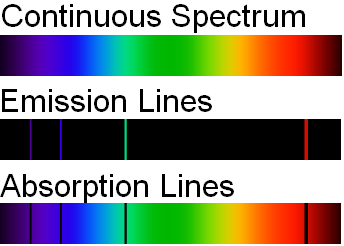
Emission lines and absorption lines compared to a continuous spectrum

In atomic, molecular, and optical physics, the Einstein coefficients are quantities describing the probability of absorption or emission of a photon by an atom or molecule.[1] The Einstein A coefficients are related to the rate of spontaneous emission of light, and the Einstein B coefficients are related to the absorption and stimulated emission of light. Throughout this article, "light" refers to any electromagnetic radiation, not necessarily in the visible spectrum.

These coefficients are named after Albert Einstein, who proposed them in 1916.

Spectral lines

[edit]

In physics, one thinks of a spectral line from two viewpoints.

An emission line is formed when an atom or molecule makes a transition from a particular discrete energy level E2 of an atom, to a lower energy level E1, emitting a photon of a particular energy and wavelength. A spectrum of many such photons will show an emission spike at the wavelength associated with these photons.

An absorption line is formed when an atom or molecule makes a transition from a lower, E1, to a higher discrete energy state, E2, with a photon being absorbed in the process. These absorbed photons generally come from background continuum radiation (the full spectrum of electromagnetic radiation) and a spectrum will show a drop in the continuum radiation at the wavelength associated with the absorbed photons.

The two states must be bound states in which the electron is bound to the atom or molecule, so the transition is sometimes referred to as a "bound–bound" transition, as opposed to a transition in which the electron is ejected out of the atom completely ("bound–free" transition) into a continuum state, leaving an ionized atom, and generating continuum radiation.

A photon with an energy equal to the difference E2E1 between the energy levels is released or absorbed in the process. The frequency ν at which the spectral line occurs is related to the photon energy by Bohr's frequency condition E2E1 = where h denotes the Planck constant.[2][3][4][5][6][7]

Emission and absorption coefficients

[edit]

An atomic spectral line refers to emission and absorption events in a gas in which is the density of atoms in the upper-energy state for the line, and is the density of atoms in the lower-energy state for the line.

The emission of atomic line radiation at frequency ν may be described by an emission coefficient with units of energy/(time × volume × solid angle). ε dt dV dΩ is then the energy emitted by a volume element in time into solid angle . For atomic line radiation, where is the Einstein coefficient for spontaneous emission, which is fixed by the intrinsic properties of the relevant atom for the two relevant energy levels.

The absorption of atomic line radiation may be described by an absorption coefficient with units of 1/length. The expression κ' dx gives the fraction of intensity absorbed for a light beam at frequency ν while traveling distance dx. The absorption coefficient is given by where and are the Einstein coefficients for photon absorption and induced emission respectively. Like the coefficient , these are also fixed by the intrinsic properties of the relevant atom for the two relevant energy levels. For thermodynamics and for the application of Kirchhoff's law, it is necessary that the total absorption be expressed as the algebraic sum of two components, described respectively by and , which may be regarded as positive and negative absorption, which are, respectively, the direct photon absorption, and what is commonly called stimulated or induced emission.[8][9][10]

The above equations have ignored the influence of the spectroscopic line shape. To be accurate, the above equations need to be multiplied by the (normalized) spectral line shape, in which case the units will change to include a 1/Hz term.

Under conditions of thermodynamic equilibrium, the number densities and , the Einstein coefficients, and the spectral energy density provide sufficient information to determine the absorption and emission rates.

Equilibrium conditions

[edit]

The number densities and are set by the physical state of the gas in which the spectral line occurs, including the local spectral radiance (or, in some presentations, the local spectral radiant energy density). When that state is either one of strict thermodynamic equilibrium, or one of so-called "local thermodynamic equilibrium",[11][12][13] then the distribution of atomic states of excitation (which includes and ) determines the rates of atomic emissions and absorptions to be such that Kirchhoff's law of equality of radiative absorptivity and emissivity holds. In strict thermodynamic equilibrium, the radiation field is said to be black-body radiation and is described by Planck's law. For local thermodynamic equilibrium, the radiation field does not have to be a black-body field, but the rate of interatomic collisions must vastly exceed the rates of absorption and emission of quanta of light, so that the interatomic collisions entirely dominate the distribution of states of atomic excitation. Circumstances occur in which local thermodynamic equilibrium does not prevail, because the strong radiative effects overwhelm the tendency to the Maxwell–Boltzmann distribution of molecular velocities. For example, in the atmosphere of the Sun, the great strength of the radiation dominates. In the upper atmosphere of the Earth, at altitudes over 100 km, the rarity of intermolecular collisions is decisive.

In the cases of thermodynamic equilibrium and of local thermodynamic equilibrium, the number densities of the atoms, both excited and unexcited, may be calculated from the Maxwell–Boltzmann distribution, but for other cases, (e.g. lasers) the calculation is more complicated.

Einstein coefficients

[edit]

In 1916, Albert Einstein proposed that there are three processes occurring in the formation of an atomic spectral line. The three processes are referred to as spontaneous emission, stimulated emission, and absorption. With each is associated an Einstein coefficient, which is a measure of the probability of that particular process occurring. Einstein considered the case of isotropic radiation of frequency ν and spectral energy density ρ(ν).[3][14][15][16] Paul Dirac derived the coefficients in a 1927 paper titled "The Quantum Theory of the Emission and Absorption of Radiation".[17][18]

Various formulations

[edit]

Hilborn has compared various formulations for derivations for the Einstein coefficients, by various authors.[19] For example, Herzberg works with irradiance and wavenumber;[20] Yariv works with energy per unit volume per unit frequency interval,[21] as is the case in the more recent (2008) [22] formulation. Mihalas & Weibel-Mihalas work with radiance and frequency,[13] as does Chandrasekhar,[23] and Goody & Yung;[24] Loudon uses angular frequency and radiance.[25]

Spontaneous emission

[edit]
Schematic diagram of atomic spontaneous emission

Spontaneous emission is the process by which an electron "spontaneously" (i.e. without any outside influence) decays from a higher energy level to a lower one. The process is described by the Einstein coefficient A21 (s−1), which gives the probability per unit time that an electron in state 2 with energy will decay spontaneously to state 1 with energy , emitting a photon with an energy E2E1 = . Due to the energy-time uncertainty principle, the transition actually produces photons within a narrow range of frequencies called the spectral linewidth. If is the number density of atoms in state i , then the change in the number density of atoms in state 2 per unit time due to spontaneous emission will be

The same process results in an increase in the population of state 1:

Stimulated emission

[edit]
Schematic diagram of atomic stimulated emission

Stimulated emission (also known as induced emission) is the process by which an electron is induced to jump from a higher energy level to a lower one by the presence of electromagnetic radiation at (or near) the frequency of the transition. From the thermodynamic viewpoint, this process must be regarded as negative absorption. The process is described by the Einstein coefficient (m3 J−1 s−2), which gives the probability per unit time per unit energy density of the radiation field per unit frequency that an electron in state 2 with energy will decay to state 1 with energy , emitting a photon with an energy E2E1 = . The change in the number density of atoms in state 1 per unit time due to induced emission will be where denotes the spectral energy density of the isotropic radiation field at the frequency of the transition (see Planck's law).

Stimulated emission is one of the fundamental processes that led to the development of the laser. Laser radiation is, however, very far from the present case of isotropic radiation.

Photon absorption

[edit]
Schematic diagram of atomic absorption

Absorption is the process by which a photon is absorbed by the atom, causing an electron to jump from a lower energy level to a higher one. The process is described by the Einstein coefficient (m3 J−1 s−2), which gives the probability per unit time per unit energy density of the radiation field per unit frequency that an electron in state 1 with energy will absorb a photon with an energy E2E1 = and jump to state 2 with energy . The change in the number density of atoms in state 1 per unit time due to absorption will be

Detailed balancing

[edit]

The Einstein coefficients are fixed probabilities per time associated with each atom, and do not depend on the state of the gas of which the atoms are a part. Therefore, any relationship that we can derive between the coefficients at, say, thermodynamic equilibrium will be valid universally.

At thermodynamic equilibrium, we will have a simple balancing, in which the net change in the number of any excited atoms is zero, being balanced by loss and gain due to all processes. With respect to bound-bound transitions, we will have detailed balancing as well, which states that the net exchange between any two levels will be balanced. This is because the probabilities of transition cannot be affected by the presence or absence of other excited atoms. Detailed balance (valid only at equilibrium) requires that the change in time of the number of atoms in level 1 due to the above three processes be zero:

Along with detailed balancing, at temperature T we may use our knowledge of the equilibrium energy distribution of the atoms, as stated in the Maxwell–Boltzmann distribution, and the equilibrium distribution of the photons, as stated in Planck's law of black body radiation to derive universal relationships between the Einstein coefficients.

From Boltzmann distribution we have for the number of excited atomic species i: where n is the total number density of the atomic species, excited and unexcited, k is the Boltzmann constant, T is the temperature, is the degeneracy (also called the multiplicity) of state i, and Z is the partition function. From Planck's law of black-body radiation at temperature T we have for the spectral radiance (radiance is energy per unit time per unit solid angle per unit projected area, when integrated over an appropriate spectral interval)[26] at frequency ν where[27] where is the speed of light and is the Planck constant.

Substituting these expressions into the equation of detailed balancing and remembering that E2E1 = yields or

The above equation must hold at any temperature, so from one gets and from

Therefore, the three Einstein coefficients are interrelated by and

When this relation is inserted into the original equation, one can also find a relation between and , involving Planck's law.

Oscillator strengths

[edit]

The oscillator strength is defined by the following relation to the cross section for absorption:[19]

where is the electron charge, is the electron mass, and and are normalized distribution functions in frequency and angular frequency respectively. This allows all three Einstein coefficients to be expressed in terms of the single oscillator strength associated with the particular atomic spectral line:

Dipole approximation

[edit]

The value of A and B coefficients can be calculated using quantum mechanics where dipole approximations in time dependent perturbation theory is used. While the calculation of B coefficient can be done easily, that of A coefficient requires using results of second quantization. This is because the theory developed by dipole approximation and time dependent perturbation theory gives a semiclassical description of electronic transition which goes to zero as perturbing fields go to zero. The A coefficient which governs spontaneous emission should not go to zero as perturbing fields go to zero. The result for transition rates of different electronic levels as a result of spontaneous emission is given as (in SI units):[28][19][29]

For B coefficient, straightforward application of dipole approximation in time dependent perturbation theory yields (in SI units):[30][29]

Note that the rate of transition formula depends on dipole moment operator. For higher order approximations, it involves quadrupole moment and other similar terms.

Here, the B coefficients are chosen to correspond to energy distribution function. Often these different definitions of B coefficients are distinguished by superscript, for example, where term corresponds to frequency distribution and term corresponds to distribution.[19] The formulas for B coefficients varies inversely to that of the energy distribution chosen, so that the transition rate is same regardless of convention.

Hence, AB coefficients are calculated using dipole approximation as: where and B coefficients correspond to energy distribution function.

Hence the following ratios are also derived: and

Derivation of Planck's law

[edit]

It follows from theory that:[29] where and are number of occupied energy levels of and respectively, where . Note that from time dependent perturbation theory application, the fact that only radiation whose is close to value of can produce respective stimulated emission or absorption, is used.

Where Maxwell distribution involving and ensures

Solving for for equilibrium condition using the above equations and ratios while generalizing to , we get: which is the angular frequency energy distribution from Planck's law.[29]

See also

[edit]

References

[edit]

Other reading

[edit]
[edit]
Revisions and contributorsEdit on WikipediaRead on Wikipedia
from Grokipedia
The Einstein coefficients are a set of three fundamental parameters in and that describe the probabilities per unit time for the absorption, , and of photons during transitions between two levels in atoms or molecules. The coefficient B12 governs the rate of absorption from the lower state (level 1) to the upper state (level 2) under the influence of incident radiation, B21 describes the rate of from level 2 back to level 1 induced by the same radiation field, and A21 quantifies the rate of from level 2 to level 1 in the absence of external stimulation. These coefficients were introduced by Albert Einstein in his 1917 paper "Zur Quantentheorie der Strahlung" (On the Quantum Theory of Radiation), where he applied thermodynamic arguments to the equilibrium between matter and radiation to reconcile classical electromagnetic theory with quantum principles, particularly in explaining the Planck blackbody spectrum. Einstein postulated that the stimulated emission process, previously unrecognized, must occur alongside absorption to maintain detailed balance in thermal equilibrium, leading to the prediction of what would later enable the development of lasers and masers. The coefficients are interrelated through fundamental physical relations derived from statistical mechanics and quantum electrodynamics: specifically, B21 = (g1/g2) B12, where g1 and g2 are the statistical degeneracies of the respective energy levels, ensuring symmetry in the absorption and stimulated emission processes adjusted for level populations. Additionally, the spontaneous emission coefficient is linked to the stimulated one by A21 = (8π h ν³ / c³) B21, where ν is the transition frequency, h is Planck's constant, and c is the speed of light; this relation connects atomic transition rates directly to the spectral energy density of blackbody radiation. These relations have been experimentally verified and form the basis for calculating radiative lifetimes, oscillator strengths, and line intensities in spectroscopy across fields like astrophysics, plasma physics, and quantum optics.

Background on Atomic Transitions

Spectral Lines

Spectral lines are discrete wavelengths of light emitted or absorbed by atoms when electrons transition between quantized energy levels. These lines arise from the specific energy differences between atomic orbitals, producing sharp features in otherwise continuous spectra. In the early , observed hundreds of dark absorption lines in the spectrum of sunlight, mapping their positions with high precision using improved prisms. These features, now known as , were initially enigmatic but marked the beginning of systematic spectral analysis. Later, in 1859, provided the key insight by demonstrating that these dark lines correspond to absorption by chemical elements in the Sun's cooler outer atmosphere, matching the bright emission lines produced when the same elements are heated in laboratory flames. This work established the atomic origin of spectral lines and laid the foundation for as a tool for elemental identification. The underlying quantum model explains spectral lines through the relation between energy levels and photon frequencies. The energy difference ΔE\Delta E between two atomic levels determines the frequency ν\nu of the emitted or absorbed radiation via ΔE=hν,\Delta E = h \nu, where hh is Planck's constant. This equation, rooted in the quantization of energy, predicts the precise wavelengths of lines for each transition in an atom. Spectral lines manifest in two primary forms depending on the physical conditions. Emission lines appear as bright features against a dark background in the spectra of hot, low-density gases where excited atoms radiate photons directly. In contrast, absorption lines show as dark gaps in a continuous spectrum when light from a hot source passes through cooler, intervening gas that selectively absorbs photons at matching wavelengths. These distinctions follow from Kirchhoff's laws of , which describe the conditions for continuous, emission, and absorption spectra. In , spectral lines act as unique signatures of atomic structure, enabling the identification of elements in distant , nebulae, and samples without direct contact. The wavelengths and relative strengths of lines reveal details about configurations and spacings, providing insights into atomic composition and environmental conditions. The intensities of these lines are governed by the rates of atomic transitions quantified by Einstein coefficients.

Emission and Absorption Processes

In , the interaction between matter and occurs through three primary processes: absorption, , and . These mechanisms describe how atoms transition between discrete energy levels, exchanging energy with photons of frequency ν\nu, and form the basis for understanding radiative transitions that produce spectral lines. Absorption takes place when an atom in a lower state encounters a with hνh\nu matching the difference between two levels, leading to excitation to the higher state. This process is probabilistic, with the transition rate increasing with the intensity at the resonant , reflecting the atom's inherent susceptibility to the . Spontaneous emission involves an excited atom decaying randomly to a lower state, releasing a of hνh\nu in the process. Unlike absorption, this decay occurs without external prompting, driven solely by the instability of the ; the emitted photon's direction, phase, and polarization are random, resulting in incoherent . The probability of spontaneous emission is characterized by a fixed transition rate for a given atomic system, independent of surrounding . Stimulated emission arises when an incoming of energy hνh\nu interacts with an atom in an , prompting the atom to drop to the lower while emitting a second identical to the first in , phase, and propagation direction. This induced process amplifies the incident radiation coherently, as the two photons emerge in lockstep, contrasting with the randomness of . The likelihood of stimulated emission mirrors that of absorption but applies to de-excitation, scaling with the density. Classically, descriptions of radiation-matter interactions, such as those in the Rayleigh-Jeans law for blackbody spectra, treated as continuously distributed and waves as classical fields, leading to the where predicted diverges to infinity at short wavelengths, contradicting observations. This failure highlighted the need for a quantum framework, where is quantized in discrete units, as pioneered by Planck and extended by Einstein to encompass discrete atomic transitions and -based absorption and emission.

Formal Definition of Einstein Coefficients

Spontaneous Emission Coefficient

The spontaneous emission coefficient, denoted as A21A_{21}, was introduced by in 1917 as part of his foundational work on the quantum theory of , where he analyzed the statistical equilibrium between matter and to derive . In this context, A21A_{21} characterizes the probability of a or transitioning from an upper energy state 2 to a lower state 1 by emitting a photon without external stimulation from the field. Formally, A21A_{21} is defined as the transition probability per unit time for spontaneous emission from the upper level 2 to the lower level 1. Its units are s1^{-1} (inverse seconds), reflecting its role as a rate constant. Physically, A21A_{21} determines the natural lifetime of the , given by τ=1/A21\tau = 1 / A_{21}, which represents the average time an atom remains in the upper state before decaying via , assuming no other decay channels. This lifetime is crucial for understanding the duration of in isolated atoms or dilute gases. In non-equilibrium conditions, such as in astrophysical plasmas or laboratory discharges, A21A_{21} governs the contribution of to the overall intensity of spectral lines, where the emission rate is proportional to A21A_{21} times the population of the upper level. This process complements but dominates in low-radiation-density environments.

Stimulated Emission and Absorption Coefficients

The Einstein coefficients B21B_{21} and B12B_{12} quantify the rates of and absorption, respectively, for a two-level atomic interacting with a field. Introduced by in his 1917 paper on the quantum theory of , these coefficients represent the transition probability per unit time per unit for an atom in the upper state (level 2) to emit a or in the lower state (level 1) to absorb one, driven by the incident . The stimulated emission rate, expressed as the number of transitions per unit time per unit volume, is B21ρ(ν)N2B_{21} \rho(\nu) N_2, where N2N_2 is the of atoms in the upper level, and ρ(ν)\rho(\nu) is the of the per unit interval at ν\nu. Analogously, the absorption rate is B12ρ(ν)N1B_{12} \rho(\nu) N_1, with N1N_1 the in the lower level. These rates vanish in the absence of , distinguishing stimulated processes from , which occurs independently of the external field. In systems without level degeneracy, B12=B21B_{12} = B_{21}, reflecting the between absorption and processes. For degenerate levels, the relation generalizes to g1B12=g2B21g_1 B_{12} = g_2 B_{21}, where g1g_1 and g2g_2 are the degeneracies of the lower and upper levels. The coefficients are typically defined using frequency ν\nu, as in Einstein's original , with SI units of m3J1s2\mathrm{m}^3 \mathrm{J}^{-1} \mathrm{s}^{-2} when ρ(ν)\rho(\nu) has units of Jm3Hz1\mathrm{J} \mathrm{m}^{-3} \mathrm{Hz}^{-1}; in cgs units, they are cm3erg1s2\mathrm{cm}^3 \mathrm{erg}^{-1} \mathrm{s}^{-2}. Equivalent cgs formulations exist for historical contexts. In some modern treatments, particularly in , angular frequency ω=2πν\omega = 2\pi \nu is employed, requiring B(ω)=2πB(ν)B(\omega) = 2\pi B(\nu) to preserve the invariance of the product BρB \rho under the transformation ρ(ω)=ρ(ν)/2π\rho(\omega) = \rho(\nu) / 2\pi.

Thermodynamic Relations

Principle of Detailed Balancing

The principle of detailed balancing states that, in , the net rate of transitions between any two energy levels of an atomic system is zero, implying that the rate of upward transitions (absorption) precisely equals the rate of downward transitions (total emission). This condition ensures no net change in the population of the levels over time, reflecting the of the processes under . For a two-level atomic system, with level 1 as the lower energy state and level 2 as the upper, manifests in the equality of transition rates involving the Einstein coefficients. The absorption rate from level 1 to 2 is given by N1B12ρ(ν)N_1 B_{12} \rho(\nu), where N1N_1 is the of level 1, B12B_{12} is the absorption coefficient, and ρ(ν)\rho(\nu) is the spectral energy density of the radiation field at ν\nu. The total emission rate from level 2 to 1 comprises N2A21N_2 A_{21} and N2B21ρ(ν)N_2 B_{21} \rho(\nu), where N2N_2 and A21A_{21} are the and coefficient for level 2, respectively. Thus, detailed balancing requires: N1B12ρ(ν)=N2[A21+B21ρ(ν)].N_1 B_{12} \rho(\nu) = N_2 \left[ A_{21} + B_{21} \rho(\nu) \right]. In thermal equilibrium, the populations N1N_1 and N2N_2 follow the , accounting for the degeneracies g1g_1 and g2g_2 of the levels: N2N1=g2g1exp(hνkT),\frac{N_2}{N_1} = \frac{g_2}{g_1} \exp\left( -\frac{h\nu}{kT} \right), where hh is Planck's constant, kk is the , and TT is the . Albert introduced this principle in his 1917 analysis to reconcile classical radiation theory with quantum hypotheses, demonstrating that equilibrium demands both spontaneous and stimulated emission processes; this argument provided key evidence for the quantization of by linking atomic transitions to a discrete energy exchange of hνh\nu. While the principle of detailed balancing generalizes to any reversible microscopic process in equilibrium—such as chemical reactions or particle collisions—its application here is confined to radiative transitions in atomic systems, where it constrains the interplay between matter and radiation. This condition establishes foundational relations among the Einstein coefficients without presupposing the form of the equilibrium radiation spectrum.

Equilibrium Conditions

In thermal equilibrium, the principle of detailed balancing ensures that the rates of upward and downward transitions between two energy levels are equal, leading to specific relations among the Einstein coefficients. Consider two levels: the lower level 1 with E1E_1 and degeneracy g1g_1, and the upper level 2 with E2=E1+hνE_2 = E_1 + h\nu and degeneracy g2g_2. The population of the levels follows Maxwell-Boltzmann statistics, so N2/N1=(g2/g1)exp(hν/kT)N_2 / N_1 = (g_2 / g_1) \exp(-h\nu / kT), where kk is Boltzmann's constant and TT is the temperature. Under isotropic radiation, the equilibrium condition balances absorption and emission rates: N1B12ρ(ν)=N2(B21ρ(ν)+A21)N_1 B_{12} \rho(\nu) = N_2 (B_{21} \rho(\nu) + A_{21}), where ρ(ν)\rho(\nu) is the spectral density at ν\nu. In the limit of high or large ρ(ν)\rho(\nu), spontaneous emission becomes negligible compared to stimulated processes, yielding N1B12=N2B21N_1 B_{12} = N_2 B_{21}. Substituting the Boltzmann population ratio gives g1B12=g2B21g_1 B_{12} = g_2 B_{21}, or equivalently, B12=(g2/g1)B21B_{12} = (g_2 / g_1) B_{21}. This adjustment accounts for degeneracy effects, ensuring the coefficients reflect the statistical weights of the levels when g1g2g_1 \neq g_2. For the full equilibrium including , rearranging the balance equation produces ρ(ν)=A21/B21exp(hν/kT)1\rho(\nu) = \frac{A_{21} / B_{21}}{\exp(h\nu / kT) - 1}. To connect this to blackbody radiation, the form of ρ(ν)\rho(\nu) matches Planck's law only if A21/B21=8πhν3/c3A_{21} / B_{21} = 8\pi h \nu^3 / c^3, where cc is the ; this relation is derived by imposing consistency with the known spectral energy density of thermal radiation. The assumptions of isotropic radiation and Maxwell-Boltzmann population statistics underpin these derivations, treating the radiation field as uniform and the atomic ensembles as classical in their thermal distribution. This framework verifies consistency with classical limits at low frequencies, where hνkTh\nu \ll kT. The exponential approximates to 1+hν/kT1 + h\nu / kT, so ρ(ν)(A21/B21)(kT/hν)\rho(\nu) \approx (A_{21} / B_{21}) (kT / h\nu). Substituting the A21/B21A_{21}/B_{21} relation yields ρ(ν)(8πν2kT/c3)\rho(\nu) \approx (8\pi \nu^2 kT / c^3), recovering the Rayleigh-Jeans law for the regime.

Oscillator Strengths

The oscillator strength f12f_{12}, for a transition from a lower energy level 1 to an upper level 2, is a dimensionless parameter that quantifies the intensity or probability of an atomic or molecular transition in the context of electromagnetic radiation absorption or emission. It originates from the classical model of a damped electron oscillator, where the electron is bound harmonically and driven by an oscillating electric field at the transition frequency ν\nu. In this analogy, f12f_{12} represents the effective number of classical electrons contributing to the radiation at that frequency, providing a bridge between classical radiation theory and quantum mechanical transition probabilities. Oscillator strengths typically range from 10310^{-3} to 1 for allowed transitions, with values near unity indicating strong lines comparable to classical dipole radiation. The is directly related to the Einstein coefficient for stimulated absorption B12B_{12} through the equation B12=e24ϵ0mehνg2g1f12,B_{12} = \frac{e^2}{4 \epsilon_0 m_e h \nu} \frac{g_2}{g_1} f_{12}, where mem_e is the , ee the , ϵ0\epsilon_0 the , hh Planck's constant, ν\nu the transition frequency, and g1g_1, g2g_2 the statistical weights (degeneracies) of the lower and upper levels, respectively; this relation holds in SI units. This connection allows oscillator strengths to be computed from known B12B_{12} values or vice versa, facilitating the use of empirical data in quantum calculations. The formula underscores how f12f_{12} scales the quantum transition rate to match the classical absorption cross-section for a single . A key theoretical constraint on oscillator strengths is the Thomas-Reiche-Kuhn (TRK) sum rule, which states that for a given initial state ii (often the ), the sum of absorption oscillator strengths over all possible final states jj equals the number of non-relativistic electrons ZZ available for excitation: jfij=Z\sum_j f_{ij} = Z. This rule, derived from the commutator of the operator with the Hamiltonian, ensures conservation of the total transition strength and serves as a benchmark for the accuracy of computed or measured values across an atom's ; for example, in (Z=1Z=1), the sum is exactly 1. Violations or modifications occur in relativistic or multi-electron systems but remain approximately valid. Experimentally, oscillator strengths are determined from the relative intensities of lines in absorption or emission spectra under controlled conditions, such as in optically thin plasmas or beams, where line strength is proportional to gfgf (with gg the degeneracy factor). Alternatively, they can be inferred from radiative τ\tau of excited states, since A21=1/τA_{21} = 1/\tau and A21A_{21} relates to f21f_{21} via the Einstein relations and the above formula for BB. These methods are essential in for interpreting stellar spectra and abundance determinations, as well as in plasma diagnostics to infer densities and temperatures from observed line ratios. For instance, precise ff-values for iron lines enable modeling of solar photospheric conditions.

Dipole Approximation

The electric dipole approximation provides a quantum mechanical framework for computing the Einstein coefficients from transition matrix elements, applicable when the wavelength of the emitted or absorbed radiation is much longer than the spatial extent of the atomic or molecular system, typically on the order of 0.1 nm for atoms compared to visible light wavelengths of 400–700 nm. In this regime, the interaction between the and the system is dominated by the electric dipole (E1) term in the of the Hamiltonian, as higher-order terms like or electric contributions are suppressed by factors of (atomic size / ). This approximation simplifies the perturbation to H=μEH' = -\boldsymbol{\mu} \cdot \mathbf{E}, where μ=eiri\boldsymbol{\mu} = -e \sum_i \mathbf{r}_i is the electric dipole operator for electrons and E\mathbf{E} is the of the . The coefficients are derived using time-dependent perturbation theory, where the transition probability per unit time follows Fermi's golden rule:
Rif=2πfHi2δ(EfEiω),R_{i \to f} = \frac{2\pi}{\hbar} \left| \langle f | H' | i \rangle \right|^2 \delta(E_f - E_i - \hbar \omega),
with the density of final states accounted for in the continuum of photon modes. For spontaneous emission, summing over photon polarizations and directions yields the Einstein A coefficient for a transition from upper state |2⟩ to lower state |1⟩ (assuming non-degenerate levels for simplicity):
A21=ω3μ2123πϵ0c3,A_{21} = \frac{\omega^3 |\mu_{21}|^2}{3 \pi \epsilon_0 \hbar c^3},
where ω=(E2E1)/\omega = (E_2 - E_1)/\hbar is the transition angular frequency and μ21=2er1\mu_{21} = \langle 2 | -e \mathbf{r} | 1 \rangle is the dipole matrix element (in SI units, with μ212|\mu_{21}|^2 often averaged over orientations). For stimulated emission and absorption, the rate depends on the radiation energy density ρ(ω)\rho(\omega), leading to the B coefficient:
B21=πμ2123ϵ02.B_{21} = \frac{\pi |\mu_{21}|^2}{3 \epsilon_0 \hbar^2}.
Degeneracies are incorporated via g1B12=g2B21g_1 B_{12} = g_2 B_{21}, where gig_i is the degeneracy of level ii, and μ212|\mu_{21}|^2 may include sums over magnetic sublevels.
This approach highlights the E1 transitions as the primary mechanism for allowed lines in spectra, with selection rules Δl=±1\Delta l = \pm 1 and Δm=0,±1\Delta m = 0, \pm 1 arising from the vector nature of the dipole operator. However, the approximation fails for forbidden transitions where μ21=0\mu_{21} = 0 due to parity or angular momentum conservation, requiring inclusion of weaker M1 or E2 terms that are smaller by factors of 102\sim 10^{-2} to 10510^{-5}. The dipole matrix element also connects to the classical oscillator strength fμ212f \propto |\mu_{21}|^2, bridging quantum and semiclassical descriptions.

Applications in Radiation Theory

Derivation of Planck's Law

The derivation of from the Einstein coefficients relies on the equilibrium conditions established by the principle of detailed balancing, where the rates of absorption and stimulated emission balance the in a field. Consider two energy levels with degeneracies g1g_1 and g2g_2, and populations N1N_1 and N2N_2 (with N1>N2N_1 > N_2 in equilibrium for the lower and upper levels, respectively), related by the Boltzmann factor N2/N1=(g2/g1)exp(hν/kT)N_2 / N_1 = (g_2 / g_1) \exp(-h\nu / kT). In equilibrium, the transition rate upward due to absorption equals the total downward rate: N1B12ρ(ν)=N2A21+N2B21ρ(ν)N_1 B_{12} \rho(\nu) = N_2 A_{21} + N_2 B_{21} \rho(\nu), with the relation g1B12=g2B21g_1 B_{12} = g_2 B_{21}. Rearranging yields ρ(ν)=N2A21B21(N1g2g1N2)\rho(\nu) = \frac{N_2 A_{21}}{B_{21} (N_1 \frac{g_2}{g_1} - N_2)} (using B12=g2g1B21B_{12} = \frac{g_2}{g_1} B_{21}). Substituting the population ratio gives N2N1g2g1N2=1exp(hν/kT)1\frac{N_2}{N_1 \frac{g_2}{g_1} - N_2} = \frac{1}{\exp(h\nu / kT) - 1}, so ρ(ν)=A21B211exp(hν/kT)1\rho(\nu) = \frac{A_{21}}{B_{21}} \cdot \frac{1}{\exp(h\nu / kT) - 1}. The degeneracies cancel, yielding an expression independent of gig_i. The relation between coefficients, A21/B21=8πhν3/c3A_{21} / B_{21} = 8\pi h \nu^3 / c^3, follows from thermodynamic arguments equating the high-temperature (low-frequency) limit of the quantum ρ(ν)\rho(\nu) to the classical Rayleigh-Jeans result ρ(ν)=(8πν2/c3)kT\rho(\nu) = (8\pi \nu^2 / c^3) kT, where the mode density of the radiation field times the average thermal energy per mode kTkT matches the form after substituting the occupation number. Substituting this yields the full Planck form: ρ(ν,T)=8πhν3c31exp(hν/kT)1.\rho(\nu, T) = \frac{8\pi h \nu^3}{c^3} \cdot \frac{1}{\exp(h\nu / kT) - 1}. This expression describes the energy density per unit frequency interval in blackbody radiation. Einstein's derivation in 1917 provided a heuristic foundation for quantizing the radiation field, interpreting the result as arising from discrete photons occupying cavity modes, with the average occupation number per mode given by 1/(exp(hν/kT)1)1 / (\exp(h\nu / kT) - 1). This work built on his 1905 light-quantum hypothesis and resolved the ultraviolet catastrophe—the classical prediction of infinite energy density at high frequencies—by confirming Planck's 1900 spectral law through atomic transition probabilities.

Implications for Blackbody Radiation

The introduction of Einstein coefficients provided a quantum mechanical framework that resolved key paradoxes in classical radiation theory, particularly the predicted by the Rayleigh-Jeans law, where classical equipartition of energy implied infinite energy at high frequencies. By balancing (governed by the BB coefficient) with (governed by the AA coefficient), the model ensures that the of follows Planck's distribution, which converges at short wavelengths and matches experimental observations without . This balance demonstrates how quantum transitions prevent the unphysical accumulation of high-frequency modes, marking a foundational shift from classical to quantum descriptions of . A direct consequence of the stimulated emission process encoded in the BB coefficient is the principle underlying laser operation, where population inversion in an atomic medium—achieved by pumping more atoms to an than the —allows to dominate over absorption and . This amplification of coherent light arises because incoming photons trigger identical photons from excited atoms, leading to in intensity within a resonant cavity. Einstein's formulation laid the theoretical groundwork for this phenomenon, enabling the development of devices that produce monochromatic, directional beams essential for applications in , , and . In cosmology, the Einstein coefficients underpin the interpretation of the () as relic from the early universe, with its precisely matching at a of approximately 2.725 . The balance of absorption, , and in ensures the CMB's near-perfect blackbody form, providing evidence for the hot model and allowing constraints on cosmological parameters like the universe's expansion history. Observations confirm deviations from a classical are negligible, validating the quantum statistical nature of the photon gas. Experimental validations of using Einstein coefficients have relied on cavity measurements, where the predicted spectral from the coefficients aligns with observed intensities across wavelengths. Early tests by Lummer and Pringsheim, using electrically heated cavities up to 1600°C, confirmed Planck's law's between Wien's short-wavelength and Rayleigh-Jeans long-wavelength limits, while Rubens and Kurlbaum's measurements further verified the law's accuracy. Modern experiments, such as COBE/FIRAS, have measured the CMB spectrum to a precision of 0.005%, directly supporting the coefficient-derived predictions without deviations exceeding instrumental limits. These tests underscore the universality of the model for enclosed systems. The Einstein coefficient framework also reveals modern extensions in quantum statistics, where the equilibrium distribution derived for photons follows Bose-Einstein statistics, treating them as indistinguishable bosons with zero . This emerges naturally from the between transition rates, explaining phenomena like bunching and the absence of a for radiation. Such insights have influenced treatments of bosonic fields in and condensed matter systems, highlighting the coefficients' role in unifying thermal and quantum descriptions.

References

Add your contribution
Related Hubs
User Avatar
No comments yet.