Hubbry Logo
Palaeoloxodon reckiPalaeoloxodon reckiMain
Open search
Palaeoloxodon recki
Community hub
Palaeoloxodon recki
logo
8 pages, 0 posts
0 subscribers
Be the first to start a discussion here.
Palaeoloxodon recki
Palaeoloxodon recki
from Wikipedia

Palaeoloxodon recki
Temporal range: Late Pliocene–Middle Pleistocene
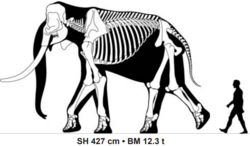
Size comparison of a 40 year old adult male Palaeoloxodon recki atavus from Koobi Fora
Life restoration by Mauricio Antón
Scientific classification Edit this classification
Kingdom: Animalia
Phylum: Chordata
Class: Mammalia
Order: Proboscidea
Family: Elephantidae
Genus: Palaeoloxodon
Species:
P. recki
Binomial name
Palaeoloxodon recki
(Dietrich, 1894)
Synonyms[1]
List
  • Elephas recki Dietrich, 1894
  • Elephas antiquus recki Dietrich, 1916
  • Archidiskodon recki Cooke, 1961

Palaeoloxodon recki, often known by the synonym Elephas recki, is an extinct species of elephant native to Africa and West Asia from the Pliocene or Early Pleistocene to the Middle Pleistocene. During most of its existence, the species (in its broad sense) represented the dominant elephant species in East Africa.[2] The species is divided into five roughly chronologically successive subspecies, collectively termed the "Elephas recki complex". While the type and latest subspecies P. recki recki as well as the preceding P. recki ileretensis are widely accepted to be closely related and ancestral to Eurasian Palaeoloxodon, the relationships of the other, chronologically earlier subspecies to P. recki recki, P. recki ileretensis and Palaeoloxodon are uncertain, with it being suggested they are unrelated and should be elevated to separate species.

Taxonomy

[edit]

The species was initially named from specimens found at Bed IV in Olduvai Gorge, Tanzania by Wilhelm Otto Dietrich in 1915, originally as a subspecies of the European straight-tusked elephant, what is now called Palaeoloxodon antiquus, as Elephas antiquus recki.[3] It was named after Hans Reck, a German paleontologist and geologist who had done the initial surveying of the gorge in 1913, and had collected a considerable number of fossils from the locality.[4] Camille Arambourg in 1942 described additional specimens of the species from Omo Valley in Ethiopia, and suggested that they were distinctive enough that they warranted being placed as the distinct species E. recki. The two deposits are not contemporaneous and the specimens from each locality are morphologically distinctive from each other, which has led to confusion about which locality represents the "typical" morphology of the species.[3] The placement of E. recki in the genus Elephas was contested as early as 1942, when in a publication by Douglas Gordon MacInnes and Henry Fairfield Osborn's posthumous monograph on fossil proboscideans it was suggested that Elephas recki should instead be placed in Palaeoloxodon, though many later authors continued to place the species in the genus Elephas, treating Palaeoloxodon as a subgenus of Elephas.[4] In 1961, H. Basil. S. Cooke once again removed E. recki from Elephas, reassigning it to the genus Archidiskodon.[5] Four years later, Louis Leakey synonymised it once again with Elephas.[1]

Michel Beden's publications during the 1980s on Elephas recki primarily focusing on molar morphology[6][7][8] identified five successive subspecies, ordered here from oldest to youngest, with ages according to a 2023 work by William J. Sanders[4]:

  • E. r. brumpti Beden, 1980 Early Pliocene-~3.2 million years ago (mya)
  • E. r. shungurensis Beden, 1980 ~3.2-2.3 mya
  • E. r. atavus Arambourg, 1947 ~2.3-1.8 mya
  • E. r. ileretensis Beden, 1987 ~1.8-1.4/1.6 mya
  • E. r. recki (Dietrich, 1916) 1.6/1.4 mya-late Middle Pleistocene

For decades after Beden's publications, his view of "Elephas recki" as a succession of subspecies was accepted as orthodoxy. However, Beden's views of Elephas recki evolution were challenged by the work of Nancy Todd published in 2001 and 2005.[3] Todd found that the different subspecies exhibited high variability in molar dimensions within subspecies, but low variability between the subspecies, and that not all of the subspecies clustered together with each other in cladistic analysis, as would be expected if they formed a single species, with E. r. brumpti E. r. shungurensis and E. r. atavus being placed separately from E. r. ileretensis and E. r. recki, and that the supposed subspecies substantially chronologically overlapped, though later work suggested that this chronological overlap was likely overstated.[4]

A 2020 PhD thesis by Hanwen (Steven) Zhang, focusing primarily on skull morphology again challenged the monophyly of Elephas recki as a whole, finding that while E. r. ileretensis and E. recki recki has a close relationship with Eurasian Palaeoloxodon. which genetic data shows is closely related to African elephants (Loxodonta), the other named E. recki subspecies were likely unrelated, and more closely related to true members of the genus Elephas (which contains the living Asian elephant). Zhang suggested that E. r. brumpti was synonymous with "Elephas" planifrons, primarily known from the Late Pliocene-Early Pleistocene of the Indian subcontinent, and that this species should be placed into Phanagoroloxodon, while E. r. atavus should be elevated to full species status as a true member of the genus Elephas. However, while William J. Sanders accepted that E. r. brumpti was unlikely to be closely related to E. recki recki, he rejected the synonymity of E. r. brumpti with "Elephas" planifrons (though he suggested that the two may be sister species), and questioned their placement in Phanagoroloxodon, while he considered the relationship of E. r. atavus to E. recki recki to be uncertain.[4]

The traditional definition of the species sensu lato including the 5 historically recognised subspecies has been termed the "Elephas recki complex".[9]

Outside its core East African distribution. It has also been suggested that material from West Asia, including that from the earliest Middle Pleistocene (c. 780,000 years ago) Paleolithic archaeological site Gesher Bnot Ya'akov (previously attributed to P. antiquus) in northern Israel, the Middle Pleistocene (c. 500,000 years ago) Ti's al Ghadah site in northern Saudi Arabia, and the late Middle Pleistocene Shishan Marsh site in Jordan, belongs to P. recki recki.[9][10][11][4]

Description

[edit]

Members of the species were larger than any living elephant. A large mostly complete male specimen of P. recki atavus[4] from Koobi Fora, Kenya, suggested to have been approximately 40 years old when it died, was estimated in a 2016 study to have measured 4.27 metres (14.0 ft) tall at the shoulder and weighed 12.3 tonnes (27,000 lb),[12] with the tusks of some P. recki individuals reaching 4 metres (13 ft) in length, and masses likely considerably in excess of 100 kilograms (220 lb).[13] In 2024, Biswas, Chang and Tsai estimated its maximum shoulder height at 4.23 metres (13.9 ft), with the estimated body masses of 7 measured specimens ranging from 4.5–15.3 tonnes (9,900–33,700 lb).[14] In comparison to most Eurasian species of Palaeoloxodon, the parieto-occipital crest of P. recki recki at the top of the skull is only weakly developed. The frons (forehead) is tall and biconvex. Like Eurasian Palaeoloxodon species, the premaxillary bones of P. recki recki containing the tusks flare laterally outwards.[9] Over time the molar teeth of P. recki show an increasing number of lamellae, and taller crown height (hypsodonty).[15]

Ecology

[edit]

All named subspecies of P/E. recki, regardless of true evolutionary relationships, are thought to have been dedicated grazers, with the molar teeth of later subspecies showing greater adaption to grazing than earlier subspecies.[2] Carbon isotope analysis of P. recki recki suggests that while it always primarily consumed C4 grasses, it showed a degree of dietary flexibility, and particularly towards the end of its existence it consumed some C3 plants, likely including a degree of browse.[16] Oxygen isotope analysis of P. recki recki also shows a shift from using stable, permanent water sources during the Early Pleistocene to adapting to using transient water sources during the Middle Pleistocene.[16]

Evolutionary history and extinction

[edit]

Following the emergence of P. recki in Africa, at the end of the Early Pleistocene, around 800,000 years ago, a population of P. recki recki migrated out of Africa, giving rise to the Eurasian radiation of Palaeoloxodon.[17] Its descendant taxon or last evolutionary stage, Palaeoloxodon jolensis, is known from remains found across Africa of late Middle Pleistocene to Late Pleistocene age, with a number of authors suggesting that P. jolensis likely became extinct at the Middle-Late Pleistocene boundary around 130,000 years ago. Following the extinction of P. jolensis it was replaced by the modern African bush elephant (Loxodonta africana).[2] The extinction of the P. recki/jolensis lineage in Africa has either been attributed to the increasing aridification of Africa across the Middle Pleistocene, or the growing sophistication of human hunters.[16]

Relationship with humans

[edit]

At several sites across Africa, remains of P. recki have been found associated with stone tools. In some cases like Olduvai FLK, these are likely coincidental, but in others which bears cut marks, these likely represent evidence of butchery by archaic humans. Sites containing P. recki remains with cut marks and/or stone tools include Upper Bed II at the Bell's Korongo site in Olduvai Gorge, dating to around 1.35 million years ago, which has been suggested to be the oldest site in the world with reliable evidence of elephant butchery, associated with Oldowan-type stone tools, and the Olorgesailie Basin Member 1 Site 15 in Kenya, dated to 992–974,000 years ago, and the Nadung'a 4 site near Lake Turkana, Kenya, dating to approximately 700,000 years ago. The Barogali site in Djibouti, dating to 1.6-1.3 million years ago, where a disassociated specimen of P. recki (suggested to be E. recki atavus[4]) was found with numerous stone tools (probably Oldowan) created onsite, has also been suggested to be a butchery site. The P. recki specimen from Gesher Bnot Ya'akov is associated with an Acheulean stone handaxe and other bifaced tools, and displays cut marks and fracture marks indicative of butchery, though the fracturing of the skull, which has been suggested to be the result of an attempt to extract the brain, may alternatively be the result of postmortem trampling.[18]

At the T69 Complex in Olduvai Gorge, dating to around 1.5 million years ago, archaic humans using Acheulean tools knapped P. cf recki bones along with those of the large hippo Hippopotamus cf. gorgops to create bone tools. As of 2025, these are currently the oldest known bone tools.[19]

[edit]

References

[edit]
Revisions and contributorsEdit on WikipediaRead on Wikipedia
from Grokipedia
Palaeoloxodon recki is an extinct species of that lived across from the early to the late Middle Pleistocene, approximately 4.0 to 0.13 million years ago. Reaching shoulder heights of up to 4.3 meters and with an average body mass of around 10.5 tonnes, it ranks among the largest known proboscideans. Characterized by straight tusks, a robust featuring a prominent crest for muscle attachment, and molars adapted for grinding, it was primarily a grazer consuming C₄ grasses in open and environments. As the ancestral form of the genus, P. recki gave rise to the Eurasian straight-tusked elephants around 780,000 years ago through migrations , with its descendants including the massive P. namadicus and the dwarf P. falconeri. analyses indicate that Palaeoloxodon species, including P. recki, are most closely related to modern African elephants (Loxodonta), particularly the forest elephant, rather than Asian elephants. Fossils of P. recki are abundant in key East African sites such as the Omo Valley, , and Turkana Basin, where it coexisted with early hominins and other , serving as an important biochronological marker due to its five recognized representing evolutionary stages with some temporal overlap. The species exhibited dietary flexibility, incorporating some C₃ browse alongside dominant C₄ grasses, and accessed both permanent rivers and seasonal water sources in heterogeneous landscapes of grasslands, woodlands, and wetlands. Its decline toward the end of the Middle Pleistocene is enigmatic but may relate to climatic shifts, habitat changes, and faunal turnover in , marking the transition to more modern elephant lineages.

Taxonomy

Discovery and Nomenclature

The species Palaeoloxodon recki was first scientifically described by German paleontologist Wilhelm Otto Dietrich in 1915, based on fossil remains including molars and limb bones collected from Bed IV of Olduvai Gorge in present-day Tanzania. Dietrich initially classified the material as Elephas antiquus recki, a subspecies of the European straight-tusked elephant Elephas antiquus, highlighting morphological affinities such as hypsodont teeth while noting regional distinctions in the African specimens. The type specimens, housed in collections from the Olduvai expeditions, formed the basis for recognizing this as a distinct East African proboscidean lineage. The specific epithet "recki" was given in honor of Hans Reck, a German paleontologist and geologist who led the early excavations in and documented the geological context of the Olduvai deposits. Key early fossil discoveries beyond the type locality included additional material from and the nearby Koobi Fora Formation in , where upper Bed I and KBS Member remains further illustrated the species' presence in Plio-Pleistocene sediments. Throughout the 20th century, synonymy and taxonomic revisions accumulated as more fossils emerged, leading to the species' reclassification from Elephas to the genus Palaeoloxodon based on shared apomorphies like a high-vaulted skull and straight tusks. French paleontologist Michel Beden's influential works in the 1980s, particularly on dental evolution and stratigraphic correlations, played a pivotal role in these efforts by refining the chronological and morphological distinctions within the lineage, including the establishment of a subspecies framework.

Subspecies Classification

The subspecies of Palaeoloxodon recki were delineated by Michel in a series of publications during the , primarily based on progressive changes in dental morphology observed across East African fossil records, establishing a chronological succession of five forms collectively known as the recki complex. These subspecies reflect an evolutionary trajectory marked by increasing to abrasive diets, with distinctions drawn from molar features such as the number of lamellae (plate-like structures), hypsodonty index (crown height relative to width), and associated body size increases. The earliest subspecies, P. r. brumpti (Beden, 1980), dates to approximately 3.2 million years ago (mya) and is characterized by primitive molars with about 18 lamellae and a relatively low hypsodonty index, indicating less specialized adaptations. Fossils attributed to this form have been recovered from sites like Kanjera in , representing the initial stage of the lineage. Following this, P. r. shungurensis (Beden, 1980) spans roughly 3.2–2.3 mya and displays transitional dental traits, including moderately increased lamellae and hypsodonty compared to brumpti, bridging early and later forms. Key evidence comes from the Shungura Formation in , where stratigraphic layers preserve these intermediate morphologies. The subspecies P. r. atavus (Arambourg, 1947; revised by , 1980) occupied the interval of about 2.3–1.8 mya, notable for further enhancements in body size and molar robustness, with lamellae counts approaching 20 and elevated hypsodonty supporting more intensive wear from gritty vegetation. Advancing to P. r. ileretensis (Beden, 1987), dated to approximately 1.8–1.4/1.6 mya, this form exhibits advanced hypsodonty and lamellae counts around 21–22, reflecting heightened dietary abrasiveness; fossils are prominent in West Turkana deposits, such as those near Ileret in . The terminal subspecies, P. r. recki (Dietrich, 1915; formalized by , 1980), persisted from about 1.6/1.4 mya through the late Middle Pleistocene and represents the largest variant, with molars featuring 24 or more lamellae, a high hypsodonty index exceeding 160, and substantial body mass increases estimated at over 10 tons in mature individuals. Abundant remains occur in West Turkana sequences, underscoring its dominance in later Pleistocene ecosystems. Across these subspecies, Beden's criteria emphasized a directional trend: molar lamellae progressively rose from ~18 in brumpti to 24+ in recki, accompanied by hypsodonty indices climbing from moderate levels (~100–120) to advanced (~160–200), and body sizes scaling up correspondingly, all tied to environmental shifts favoring durable, high-crowned dentition for processing tough, silica-rich forage. Recent biostratigraphic analyses have refined these temporal boundaries, incorporating radiometric dating of volcanic tuffs and faunal correlations to more precisely delimit overlaps and transitions, as detailed in Sanders' comprehensive review.

Phylogenetic Debates

Recent phylogenetic studies have challenged the monophyly of Palaeoloxodon recki (formerly classified as Elephas recki), suggesting that its subspecies may not form a single cohesive lineage within the Elephantidae. In particular, analyses of cranial morphology indicate that earlier subspecies, such as P. r. shungurensis and P. r. brumpti, are more closely aligned with ancestral forms like Elephas howardii or even potential separate genera such as Phanagoroloxodon, while later subspecies including P. r. recki and P. r. ileretensis cluster with Eurasian Palaeoloxodon species. This revision, proposed in Zhang's 2020 doctoral thesis, posits a polyphyletic origin for the P. recki complex, with earlier forms potentially representing stem lineages closer to Loxodonta ancestors based on shared primitive dental and postcranial traits. Similarly, Sanders (2023) argues that the P. recki group encompasses multiple independent evolutionary trajectories, questioning the inclusion of P. r. brumpti in Phanagoroloxodon and advocating for a reevaluation of its taxonomic boundaries to reflect distinct morphological grades. Cladistic analyses further support these challenges, drawing on molar morphology and limb proportions to infer polyphyletic origins within Elephantidae. Todd's (2005) phylogenetic study of dental characters revealed that P. recki subspecies fail to cluster monophyletically, with high intrasubspecific variability in enamel thickness and hypsodonty indices suggesting convergent adaptations rather than linear descent; for instance, the lamellar frequency in molars increases stepwise across chronospecies, but limb robusticity metrics (e.g., humerus-femur ratios) show divergences that align earlier forms more closely with Primelephas than later Palaeoloxodon. Complementary evidence from postcranial elements, including elongated metapodials in later subspecies, indicates potential parallel evolution in browsing versus grazing adaptations, complicating traditional anagenetic models. These morphological signals, when analyzed via successive weighting of cladistic datasets, highlight paraphyly in Elephas relative to Palaeoloxodon, underscoring the need for integrated morphometric approaches. Alternative classifications emerging from 2020s dental studies propose elevating certain to full status or reassigning them to Elephas proper. For example, Saegusa and Gilbert (2008), building on Beden's molar progressions, suggested that P. r. atavus and later forms warrant separation into due to advanced hypsodonty (e.g., crown heights exceeding 300% of earlier Elephas), while transitional subspecies like P. r. kaisoensis might retain Elephas affinity based on intermediate cusp arrangements. Recent mesowear and microwear analyses reinforce this, showing dietary shifts (e.g., from mixed feeding in P. r. shungurensis to in P. r. recki) that correlate with taxonomic splits, potentially justifying species-level distinctions for forms like P. r. ileretensis. However, these proposals remain contentious, as they rely heavily on fragmentary specimens and lack consensus on genus boundaries. A major gap in resolving these debates is the absence of ancient DNA from African P. recki fossils, which hinders direct genetic confirmation of morphological phylogenies. While genomic data from Eurasian Palaeoloxodon (e.g., P. antiquus) indicate close affinity to modern African forest elephants (Loxodonta cyclotis), with shared mitochondrial haplotypes suggesting hybridization events around 500,000 years ago, no such sequences exist for African P. recki due to poor preservation in tropical sediments. This limitation fuels ongoing controversy over whether Eurasian Palaeoloxodon directly derives from late P. r. recki or an earlier, unsampled African branch, as cladistic trees based on morphology alone cannot rule out ghost lineages or introgression. Future paleogenomic efforts targeting well-preserved East African sites may clarify these relations, but current evidence underscores the polyphyletic signals in the fossil record.

Description

Body Size and Morphology

Palaeoloxodon recki exhibited remarkable among proboscideans, with adult males potentially attaining heights exceeding 4.5 meters and body masses of 14-15 tonnes, as estimated from well-preserved specimens using volumetric modeling techniques that account for and skeletal proportions. Recent analyses estimate an average body mass of around 10.5 tonnes for the species. A notable subadult male from the Formation, aged approximately 40 years, already measured 4.27 meters at the and weighed an estimated 12.3 tonnes, indicating substantial size potential even before full maturity. These dimensions surpass those of the modern (Loxodonta africana), whose maximum height reaches about 4 meters and mass up to 10 tonnes in bulls. Females displayed clear , being considerably smaller than males, a pattern consistent with the genus's overall morphology and inferred from comparative skeletal scaling in related species where dimorphism ratios mirror those in extant (males roughly 20-30% taller and up to twice as heavy). The species possessed a robust build adapted to its immense , featuring pillar-like limbs that provided for weight-bearing, as evidenced by the thicker cortical and broader articular surfaces in humeri and femora compared to modern counterparts. Body proportions in P. recki emphasized elongation in the trunk and limbs, contributing to a more gracile yet sturdy frame relative to its mass, similar to the Asian-derived P. namadicus but with adaptations suited to African environments. Growth patterns, reconstructed from juvenile and subadult fossils including trackways of calves and adolescents, reveal rapid ontogenetic development, with individuals achieving near-adult proportions by around 20 years, though skeletal fusion and mass accrual continued into later adulthood.

Skull, Tusks, and Limbs

The skull of Palaeoloxodon recki exhibited a high forehead bounded dorsally by a weakly developed parieto-occipital crest (POC), a structure formed by the forward bending and overhang of the occipital surface that provided expanded attachment sites for neck muscles, such as the splenius, to support the elevated head and substantial tusks. This crest showed ontogenetic variation, appearing incipient during early molar stages (M1) and becoming more pronounced by adulthood, though remaining less robust than in derived Eurasian Palaeoloxodon species. Pronounced temporal lines marked the cranium, particularly strong in males as a sign of sexual dimorphism linked to muscle development, while the facial region was shortened with a medially-laterally wide frons and laterally flared premaxillaries housing the tusks. A large, teardrop-shaped incisive fossa accommodated the trunk's base, facilitating its extension for feeding and manipulation in varied environments. Overall, these cranial adaptations reflected P. recki's role as the basal species in the Palaeoloxodon lineage, with the POC representing an early evolutionary innovation for biomechanical stability under increasing body size. The tusks of P. recki were characteristically straight to slightly curved, diverging laterally from the flared premaxillaries, with enamel caps covering the tips for protection during growth and use. Sexual dimorphism was evident, as males possessed longer, more upward-curving and twisted tusks than females, likely for display and intraspecific competition. Exceptional specimens reached lengths of up to 4 meters and masses exceeding 100 kilograms, underscoring their role in foraging by uprooting vegetation and possibly in combat or defense, as indicated by flaked tips and wear patterns analogous to those observed in modern Loxodonta from similar activities. The limbs of P. recki featured elongated metapodials and robust phalanges, structural enhancements that supported efficient locomotion across open African terrains, enabling long daily distances with a gait. Fossil trackways, including those from probable juveniles, reveal newborn stride patterns with longer paces and no overstepping, suggesting early mobility in settings and adaptations for rapid growth in limb strength. These features, consistent with the genus's overall scaling to large body sizes, minimized energy expenditure during migration and in expansive grasslands.

Dentition and Dental Evolution

The molars of Palaeoloxodon recki are characterized by a structure adapted for grinding abrasive vegetation, consisting of vertically oriented lamellae composed of alternating layers of enamel, dentine, and , with the grooves between lamellae filled by to enhance durability during mastication. The third molars (M3/m3) in late such as P. r. recki typically exhibit 13–19 plates (lamellae), with enamel thickness ranging from 1.8–3.0 mm, facilitating prolonged wear resistance in environments dominated by grasses. Earlier , like P. r. brumpti, show fewer plates (11–14), reflecting a progressive evolutionary increase in lamellar complexity to cope with dietary abrasiveness. Dental succession in P. recki follows the horizontal replacement pattern typical of , involving six sets of cheek teeth per quadrant (deciduous premolars dp2–dp4 followed by permanent molars M1–M3), where anterior teeth are resorbed and posterior ones erupt and migrate forward as the jaw grows, with worn molars extruded and shed anteriorly. This mechanism allows for extended lifespan and continuous adaptation to wear, as evidenced by fossil mandibles preserving multiple tooth stages. The hypsodonty index (crown height relative to width) also evolves markedly, rising from approximately 122 in early forms (P. r. brumpti) to over 200 in late P. r. recki, indicating taller crowns for greater functional longevity. Evolutionary trends in P. recki demonstrate stepwise adaptations to increasingly C4-dominated diets, with lamellar counts increasing from 11–14 in P. r. brumpti through intermediate subspecies (P. r. shungurensis: 12–15; P. r. atavus: 13–17; P. r. ileretensis: 14–16) to 15–18 in P. r. recki, alongside reductions in enamel thickness from ~4 mm early to 2–3 mm late for optimized grinding efficiency. These changes correlate with climatic shifts toward open grasslands, enhancing the species' ecological success across Pliocene-Pleistocene . Fossil specimens from , , such as heavily worn M3s from Bed II (~1.7 Ma), illustrate advanced wear stages with extensive dentine exposure and cupped occlusal surfaces, underscoring the molars' role in sustaining adults into old age.

Ecology

Habitat and Distribution

Palaeoloxodon recki was indigenous to , with its primary geographic range centered in , encompassing regions of modern-day , , and from the early to Middle Pleistocene. Fossil remains have been recovered from over 100 localities across this area, including key sites such as the Shungura Formation (Omo ) in and the Nachukui Formation in , which preserve evidence of fluctuating lake margins and riverine environments. Early forms are documented at Konso-Gardula and Gona in , highlighting the species' long-term presence in rift settings. The species occupied diverse habitats, including open savannas, woodlands, and riparian zones associated with paleo-rivers and lakes, as indicated by stable isotope analyses of enamel from Afar Rift specimens showing exploitation of both C4-dominated grasslands and C3-enriched vegetation near water sources. These environments supported a mixed-feeding lifestyle amid varying climatic conditions during the Pleistocene. Temporally, P. recki ranged from the early Pliocene, approximately 4.0 million years ago, to the Middle Pleistocene around 0.4 million years ago, with greatest abundance and diversity in the Middle Pleistocene. Records indicate peak representation in formations like the Upper Shungura and , reflecting stable populations over much of this interval.

Diet and Feeding Adaptations

Palaeoloxodon recki exhibited a diet dominated by C₄ grasses, comprising 72–94% of its intake based on carbon (δ¹³C) of from East African fossils, indicating a primary habit adapted to open environments. In wetter climatic phases, individuals occasionally incorporated up to 28% C₃ browse, such as shrubs and trees, demonstrating dietary flexibility despite specialized dentition suited for abrasive vegetation. This specialization is evidenced by a shift toward nearly pure C₄ consumption around 2 million years ago, as reconstructed from serial enamel sampling in Pleistocene proboscideans from the , aligning with broader isotopic records of elephantid dietary evolution in . The feeding strategy of P. recki involved bulk , where its straight, elongated tusks facilitated uprooting grasses and clearing patches, allowing efficient consumption of large quantities of low-quality . Dental microwear and mesowear analyses reveal high levels of particle , consistent with grinding tough, silica-rich C₄ grasses in arid to semi-arid settings. Oxygen (δ¹⁸O) data from enamel further indicate adaptations to variable water sources, with Middle Pleistocene specimens showing reduced dependence on permanent water bodies compared to earlier forms, inferred from shifts to transient, seasonal drinking habits that supported survival in fluctuating environments. As a , P. recki functioned as an , promoting expansion through trampling and browsing that suppressed woody vegetation and enhanced soil turnover, thereby maintaining open habitats critical for associated . This role is supported by isotopic from and enamel in East African assemblages, highlighting its influence on Pleistocene landscapes amid increasing aridity.

Evolutionary History

African Origins

Palaeoloxodon recki originated in during the early to mid-Pliocene epoch, approximately 4 to 3.5 million years ago, as part of the family's diversification from earlier proboscidean ancestors. This species is believed to have derived from forms such as Primelephas within the Elephantinae subfamily, marking a transition toward more specialized grazing adaptations. indicates that Palaeoloxodon species, including P. recki, are most closely related to modern African elephants (Loxodonta), particularly the forest elephant. The emergence of P. recki reflects the broader radiation of elephants in following the Miocene-Pliocene boundary, when environmental shifts favored larger, more efficient herbivores. The fossil record documents the initial appearances of P. recki-like forms in East African deposits, with the earliest fossils dating to around 3.5 million years ago. More definitive early fossils occur in the Shungura Formation of the Lower Omo Valley, , where remains first appear around 3.2 million years ago, in stratigraphic units corresponding to the early . These sites provide a continuous sequence illustrating the species' establishment as a dominant proboscidean in the region, with dental and postcranial elements indicating a robust build suited to open landscapes. Transitional forms between P. recki and its ancestors exhibit shared archaic traits, including a reduction in the number of functional premolars—typically to one or none, as seen in later —and the early development of straight, non-spiraled tusks that projected forward rather than curving upward. These features represent evolutionary innovations from more primitive gomphotheres and earlier , enhancing efficiency in abrasive while maintaining structural simplicity in the . The early diversification of P. recki occurred primarily in , where the species underwent morphological variations that allowed it to occupy diverse niches amid expanding C₄ grasslands. This radiation coincided with a major ecological shift around 3.5 to 2.6 million years ago, when savanna grasslands proliferated across the region, driving adaptations for bulk feeding on tough, fibrous plants. By the late , P. recki had become the most abundant elephantid in African fossil assemblages, underscoring its successful colonization of these transforming habitats.

Migration and Diversification

The dispersal of Palaeoloxodon recki from to occurred approximately 800,000 to 600,000 years ago, primarily via the Sinai-Levant corridor during periods when increased humidity and expanded vegetation cover facilitated faunal migrations across the region. This timing aligns with the Early-Middle Pleistocene Transition, a period of intensifying climatic variability that opened periodic migration routes. Key evidence for this event comes from sites like in , dated to around 780,000 years ago, indicating the initial incursion into the and confirming the corridor's role in broader genus expansion. Following this dispersal, P. recki lineages gave rise to several Eurasian derivatives, marking a significant radiation of the genus outside . In Europe, Palaeoloxodon antiquus emerged as the dominant , adapting to forested and open woodland habitats across the continent. In , P. namadicus represented one of the largest proboscideans ever, with shoulder heights exceeding 4 meters, while insular isolation on Mediterranean islands led to extreme in species like P. falconeri on , where adults weighed as little as 100-200 kg due to resource constraints. These offshoots reflect a rapid adaptive diversification, with the genus reaching as far as (P. naumanni) by around 400,000 years ago. Climatic fluctuations during the Pleistocene, particularly warming phases, drove this diversification by enabling intermittent between African source populations and Eurasian colonists, while glacial advances isolated peripheral groups and promoted local adaptations. Non-African forms exhibited morphological divergence from African P. recki, including more pronounced divergence and slight upward curvature in orientation, alongside modifications in architecture such as elevated crests and reduced nasal aperture size, which likely enhanced browsing efficiency in varied Eurasian environments. Genetic implications of these migrations include hypothetical founder effects in the Eurasian lineages, where small colonizing groups experienced genetic bottlenecks leading to reduced diversity and accelerated morphological . These patterns are supported by 2020s cladistic models that integrate cranial and stratigraphic data, reconstructing P. recki as the basal from which Eurasian species branched via peripatric .

Temporal Range

Palaeoloxodon recki first appeared near the Pliocene-Pleistocene boundary around 3.5 million years ago and persisted until approximately 100,000-130,000 years ago in the late Middle Pleistocene, spanning much of the Early and Middle Pleistocene epochs. This long temporal range is established through a combination of and biostratigraphic correlations, with the species exhibiting evolutionary continuity via successive such as P. r. brumpti, P. r. shungurensis, P. r. atavus, P. r. ileretensis, and P. r. recki. Fossils indicate longer persistence in up to ~130,000 years ago. The chronology is divided into key phases aligned with magnetic reversals and faunal zones in East African sedimentary sequences, such as the Olduvai and Shungura Formations. Early appearances coincide with the Gauss-Matuyama magnetic reversal at approximately 2.58 million years ago, marking the Pleistocene onset, while peak abundance occurred during the Middle Pleistocene, particularly in interglacial periods before a decline after Marine Isotope Stage 6 (around 191,000–130,000 years ago). Dating for early sites relies on radiometric methods like potassium-argon (K-Ar) and argon-argon (⁴⁰Ar/³⁹Ar) applied to volcanic tuffs in contexts, providing absolute ages for formations like the Upper Shungura (around 2.3–1.9 million years ago). Later phases incorporate using associated fauna, such as the evolutionary succession of equids ( to Equus), to correlate faunal zones across sites. Regional variations show longer persistence in , where fossils document the species up to ~130,000 years ago in the Afar Rift (e.g., Herto and Gona sites), compared to an earlier fade-out in , with records limited to the Early to mid-Middle Pleistocene.

Extinction

Timeline of Disappearance

The extinction of Palaeoloxodon recki occurred progressively across its range, with the latest records in dating to approximately 130,000–100,000 years ago, represented by the terminal stage of its lineage, Elephas jolensis, at sites such as Natodomeri in . Fossils from the Kibish Formation in southern also preserve remains attributable to this late-phase P. recki lineage around 130,000 years ago, marking one of the youngest verified occurrences in the region. The replacement of P. recki by modern species, Loxodonta africana and early L. cyclotis, took place during the late Middle Pleistocene, coinciding with broader faunal turnovers documented at in , where P. recki remains decline sharply between 500,000 and 320,000 years ago while Loxodonta fossils increase in abundance. This shift reflects a continental-scale transition in proboscidean dominance, with Loxodonta filling the previously occupied by P. recki by the late Middle Pleistocene. The disappearance of P. recki aligns with the end of Marine Isotope Stage (MIS) 5e, the last major period around 130,000–115,000 years ago, after which no further records appear in the sequence. There are no indications of survivals for the species or its direct lineage anywhere in . of these late occurrences relies on uranium-series (U-series) and spin resonance (ESR) analyses of , which provide precise ages for P. recki and E. jolensis s and confirm their rarity after 200,000 years ago across East African sites. These methods, applied to proboscidean teeth from Middle Pleistocene contexts, yield combined ages supporting the post-200,000-year decline and ultimate timeline.

Environmental and Climatic Factors

The extinction of Palaeoloxodon recki was significantly influenced by progressive aridification in East Africa during the Late Middle Pleistocene, beginning around 575,000 years ago and post-dating approximately 200,000 years before present in its later phases. Pollen records from Lake Magadi reveal a decline in moisture-dependent taxa such as Cyperaceae and Podocarpus, alongside an increase in drought-tolerant Poaceae, signaling a shift toward drier conditions. Stable isotope analyses, including elevated Na/Ca ratios in sediments, further confirm the transition to saline, alkaline environments indicative of reduced lake levels and overall aridity, with the most intense phase occurring between 525,000 and 400,000 years ago, followed by persistently dry conditions after 350,000 years ago. These climatic changes, modulated by and transitions between (MIS), led to across East African landscapes, transforming expansive grasslands into discontinuous thornbush savannas dominated by and species. Such vegetation shifts created unfavorable conditions for large grazers like P. recki, whose high energy demands and specialized morphology were ill-suited to sparse, thorny forage with lower nutritional value. Orbital and eccentricity cycles amplified seasonal rainfall variability, exacerbating fragmentation during MIS 12 to 10 (roughly 478,000 to 337,000 years ago), when peaks aligned with reduced habitat connectivity. The rise of more diverse bovid and equid populations during the Middle Pleistocene further intensified resource competition for P. recki, as these smaller herbivores efficiently exploited the emerging C4-dominated grasslands and fragmented savannas. Bovid diversity surged around 800,000 to 400,000 years ago, allowing them to partition niches in arid-adapted vegetation that limited access to high-quality for . Equids similarly proliferated, outcompeting larger through faster reproductive rates and mobility in patchy habitats, though no evidence indicates direct predation as a factor. A 2023 study reconstructing African communities highlights how these environmental pressures drove restructuring, with large-bodied taxa like P. recki—capable of exceeding 10 metric tons—experiencing sharp declines in abundance correlated to a long-term reduction in primary productivity from and grassland expansion since the . Fossil scarcity patterns align with an estimated substantial loss (approaching 50% in suitable ranges) tied to these climatic dynamics, underscoring the non-anthropogenic role in the ' disappearance. This contraction likely compounded dietary challenges, prompting shifts toward mixed feeding strategies as noted in dental analyses.

Role of Human Activity

The overhunting hypothesis posits that early hominins targeted like Palaeoloxodon recki, whose low population densities rendered them particularly susceptible to even modest pressures. These large herbivores, with estimated densities far below those of modern , could not sustain losses from systematic predation, leading to localized declines that compounded over time. A 2024 AI-assisted analysis of global proboscidean fossil records modeled risks, revealing that human-hominin range overlaps increased rates fivefold starting around 1.8 million years ago, with Palaeoloxodon lineages showing elevated vulnerability as hominin populations grew beyond thresholds of ~10,000 individuals. In addition to direct hunting, human activity may have indirectly contributed to P. recki's extinction through habitat modification, particularly via the controlled use of fire by Homo erectus beginning approximately 1 million years ago. Archaeological evidence from sites like Koobi Fora in Kenya indicates that early hominins employed fire to manipulate landscapes, promoting grassland expansion and altering savanna ecosystems across eastern Africa where P. recki foraged. This anthropogenic fire regime likely fragmented habitats and reduced browse availability for straight-tusked elephants, exacerbating resource stress during periods of environmental flux. Temporal overlap between P. recki and later hominins, including Homo heidelbergensis (circa 700,000–300,000 years ago) and early Homo sapiens (from ~300,000 years ago), coincided with the species' decline phase in the late Middle Pleistocene. Fossil records from eastern African sites show P. recki persisting alongside these groups until its regional disappearances around 300,000–200,000 years ago, suggesting potential for intensified human pressures during this interval. Counterarguments emphasize the scarcity of direct evidence for overhunting, with few archaeological sites yielding unambiguous kill remains or cut-marked P. recki bones attributable to hominins. A 2024 global of late extinctions found that 23% of studies identified variability as the primary driver and 23% attributed extinctions primarily to activity (20% to mixed factors).

Human Interactions

Archaeological Associations

Fossils of Palaeoloxodon recki have been documented in association with early human artifacts at several key archaeological sites, providing evidence of spatial and temporal co-occurrence in shared landscapes during the Pleistocene. At in , remains of P. recki from Beds I and II, dated between approximately 1.8 and 1.35 million years ago (mya), occur alongside stone tool assemblages, including choppers and flakes, indicating that early hominins and these elephants inhabited the same riparian environments. Similarly, at in , dated to around 780,000 years ago, a sub-adult P. recki was recovered from Layer II-6 in proximity to handaxes and other lithic artifacts, suggesting overlap in the during Middle Pleistocene dispersals. These associations typically involve P. recki bones found near scatters of stone tools and , without implying direct interaction, but rather reflecting overlapping use of water-rich habitats and open woodlands by proboscideans and early tool-using hominins. Such patterns are evident across valley sites, where P. recki fossils are interspersed with lithic materials in fluvial and lacustrine deposits, highlighting shared ecological niches. No evidence suggests causation between the presence of tools and mortality in these contexts; instead, the co-occurrences underscore the dynamic of Pleistocene savannas. The chronological overlap between P. recki and human evolution spans from the era of Homo habilis around 2.3–1.4 mya, when Oldowan technologies first emerged in Africa, to the Middle Pleistocene transitions involving early Homo species in Eurasia, as P. recki populations persisted until approximately 400,000 years ago. This extended timeframe aligns with P. recki's temporal range in the evolutionary history section, where its African origins and subsequent migrations facilitated broad hominin-elephant sympatry. Recent 2025 research at the T69 Complex in Olduvai Gorge, Tanzania (not Kenya, as initially reported), confirms associations of P. recki remains dated to approximately 1.5 mya with Acheulean stone tools, including over 10,900 artifacts, reinforcing evidence of contemporaneity in Bed II contexts.

Evidence of Exploitation

Evidence of human exploitation of Palaeoloxodon recki primarily comes from archaeological sites in East Africa, where traces of butchery, tool-making, and resource extraction reveal interactions between early hominins and these massive proboscideans. Cut marks on bones, indicative of defleshing and dismemberment, along with percussion damage from hammerstones, demonstrate that hominins accessed meat, marrow, and hides from P. recki carcasses. These modifications are often associated with Acheulean stone tool assemblages, highlighting the species' role as a key resource during the Early to Middle Pleistocene. At Bell's Korongo (BK) in , , dated to approximately 1.35 million years ago, numerous cut marks have been documented on P. recki ribs and long bones, resulting from incisions during butchery processes such as and fillet removal. These marks, analyzed through geometric , show preferential use of fine-grained tools for precise cutting on large remains, including . A 2025 analysis at the nearby T69 Complex further confirms cut marks from lithic tools on proboscidean bones during butchery, alongside hammerstone-induced green fractures for marrow access, though direct proof of active remains absent. Similarly, a 2024 study on remains from a Middle Pleistocene context in reports systematic bone breakage and flaking for marrow extraction without cut marks or hunting indicators, suggesting comparable opportunistic access patterns may apply to African P. recki populations. Bone tools manufactured from P. recki skeletal elements represent some of the earliest evidence of systematic modification beyond simple scavenging. At the T69 Complex in , dated to 1.5 million years ago, de la Torre et al. identified 27 knapped tools, with at least eight derived from P. recki and long (such as femora and humeri). These tools, measuring 22–38 cm in length, exhibit intentional flaking and notching for use in scraping hides or other materials, predating more advanced bone bifaces by a million years. Percussion marks and usewear on associated faunal remains indicate hominins imported stone tools for initial butchery before repurposing elephant for secondary functions. Ivory from P. recki tusks was rarely exploited, with limited evidence of working from sites suggesting possible use in tool handles or ornaments, though such instances are exceptional compared to and utilization. Debate persists over whether exploitation involved opportunistic scavenging of naturally deceased individuals or active , with most evidence favoring the former due to the absence of injuries or kill-site clustering. The immense size of P. recki—up to 4 meters at the shoulder and weighing over 10 tons—provided substantial nutritional yield, with a single carcass potentially supplying thousands of calories in and marrow, sufficient to support a hominin group for weeks. This high-return strategy aligns with taphonomic patterns at Olduvai, where modified remains often occur in low-density scatters without signs of organized drives.

References

Add your contribution
Related Hubs
User Avatar
No comments yet.