


Community hub
Recent from talks
Contribute something
Nothing was collected or created yet.
Modular lambda function
View on Wikipedia
In mathematics, the modular lambda function λ(τ)[note 1] is a highly symmetric holomorphic function on the complex upper half-plane. It is invariant under the fractional linear action of the congruence group Γ(2), and generates the function field of the corresponding quotient, i.e., it is a Hauptmodul for the modular curve X(2). Over any point τ, its value can be described as a cross ratio of the branch points of a ramified double cover of the projective line by the elliptic curve , where the map is defined as the quotient by the [−1] involution.

The q-expansion, where is the nome, is given by:


By symmetrizing the lambda function under the canonical action of the symmetric group S3 on X(2), and then normalizing suitably, one obtains a function on the upper half-plane that is invariant under the full modular group , and it is in fact Klein's modular j-invariant.


Modular properties
[edit]The function is invariant under the group generated by[1]


The generators of the modular group act by[2]
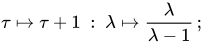
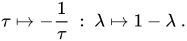
Consequently, the action of the modular group on is that of the anharmonic group, giving the six values of the cross-ratio:[3]

Relations to other functions
[edit]It is the square of the elliptic modulus,[4] that is, . In terms of the Dedekind eta function and theta functions,[4]
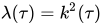


and,

where[5]
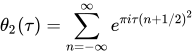
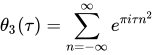
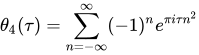
In terms of the half-periods of Weierstrass's elliptic functions, let be a fundamental pair of periods with .
![{\displaystyle [\omega _{1},\omega _{2}]}](https://wikimedia.org/api/rest_v1/media/math/render/svg/1dad129c74171365114e79fdd991264dda783b22)


we have[4]
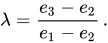
Since the three half-period values are distinct, this shows that does not take the value 0 or 1.[4]

The relation to the j-invariant is[6][7]

which is the j-invariant of the elliptic curve of Legendre form

Given , let

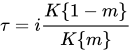
where is the complete elliptic integral of the first kind with parameter . Then


Modular equations
[edit]The modular equation of degree (where is a prime number) is an algebraic equation in and . If and , the modular equations of degrees are, respectively,[8]






The quantity (and hence ) can be thought of as a holomorphic function on the upper half-plane :


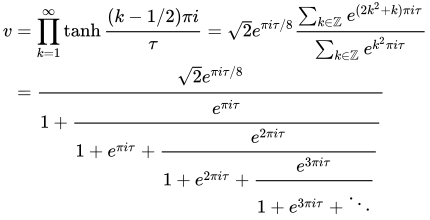
Since , the modular equations can be used to give algebraic values of for any prime .[note 2] The algebraic values of are also given by[9][note 3]


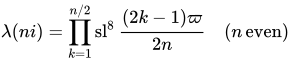

where is the lemniscate sine and is the lemniscate constant.


Lambda-star
[edit]Definition and computation of lambda-star
[edit]The function [10] (where ) gives the value of the elliptic modulus , for which the complete elliptic integral of the first kind and its complementary counterpart are related by following expression:


![{\displaystyle {\frac {K\left[{\sqrt {1-\lambda ^{*}(x)^{2}}}\right]}{K[\lambda ^{*}(x)]}}={\sqrt {x}}}](https://wikimedia.org/api/rest_v1/media/math/render/svg/fdb268d3cffe21cb75f2a37b5f277f3e65609070)
The values of can be computed as follows:
![{\displaystyle \lambda ^{*}(x)=\left[\sum _{a=-\infty }^{\infty }\exp[-(a+1/2)^{2}\pi {\sqrt {x}}]\right]^{2}\left[\sum _{a=-\infty }^{\infty }\exp(-a^{2}\pi {\sqrt {x}})\right]^{-2}}](https://wikimedia.org/api/rest_v1/media/math/render/svg/1b8070bd15a4b2a9b9bd621ffb37eece379cb864)
![{\displaystyle \lambda ^{*}(x)=\left[\sum _{a=-\infty }^{\infty }\operatorname {sech} [(a+1/2)\pi {\sqrt {x}}]\right]\left[\sum _{a=-\infty }^{\infty }\operatorname {sech} (a\pi {\sqrt {x}})\right]^{-1}}](https://wikimedia.org/api/rest_v1/media/math/render/svg/c4d176424e648ac0676545cec2e165cf27d61f78)
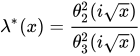
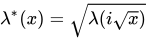
The functions and are related to each other in this way:

Properties of lambda-star
[edit]Every value of a positive rational number is a positive algebraic number:

and (the complete elliptic integral of the second kind) can be expressed in closed form in terms of the gamma function for any , as Selberg and Chowla proved in 1949.[11][12]


The following expression is valid for all :

![{\displaystyle {\sqrt {n}}=\sum _{a=1}^{n}\operatorname {dn} \left[{\frac {2a}{n}}K\left[\lambda ^{*}\left({\frac {1}{n}}\right)\right];\lambda ^{*}\left({\frac {1}{n}}\right)\right]}](https://wikimedia.org/api/rest_v1/media/math/render/svg/fe98aa85642729039559cf8044f68b293548acf6)
where is the Jacobi elliptic function delta amplitudinis with modulus .

By knowing one value, this formula can be used to compute related values:[9]
![{\displaystyle \lambda ^{*}(n^{2}x)=\lambda ^{*}(x)^{n}\prod _{a=1}^{n}\operatorname {sn} \left\{{\frac {2a-1}{n}}K[\lambda ^{*}(x)];\lambda ^{*}(x)\right\}^{2}}](https://wikimedia.org/api/rest_v1/media/math/render/svg/ddcba0773112f9e1a5d79fd395de8e76759416ca)
where and is the Jacobi elliptic function sinus amplitudinis with modulus .

Further relations:

![{\displaystyle [\lambda ^{*}(x)+1][\lambda ^{*}(4/x)+1]=2}](https://wikimedia.org/api/rest_v1/media/math/render/svg/7e015a4b8dbb80bb4bece1c0c5224457cda46f58)
![{\displaystyle \lambda ^{*}(4x)={\frac {1-{\sqrt {1-\lambda ^{*}(x)^{2}}}}{1+{\sqrt {1-\lambda ^{*}(x)^{2}}}}}=\tan \left\{{\frac {1}{2}}\arcsin[\lambda ^{*}(x)]\right\}^{2}}](https://wikimedia.org/api/rest_v1/media/math/render/svg/9c58fcee836e9d6727e9c5a2dd9fe5ccf8ed827b)
![{\displaystyle \lambda ^{*}(x)-\lambda ^{*}(9x)=2[\lambda ^{*}(x)\lambda ^{*}(9x)]^{1/4}-2[\lambda ^{*}(x)\lambda ^{*}(9x)]^{3/4}}](https://wikimedia.org/api/rest_v1/media/math/render/svg/de8a0866508ba81524c948c3c4f6cf7ab4f23c0d)
![{\displaystyle {\begin{aligned}&a^{6}-f^{6}=2af+2a^{5}f^{5}\,&\left(a=\left[{\frac {2\lambda ^{*}(x)}{1-\lambda ^{*}(x)^{2}}}\right]^{1/12}\right)&\left(f=\left[{\frac {2\lambda ^{*}(25x)}{1-\lambda ^{*}(25x)^{2}}}\right]^{1/12}\right)\\&a^{8}+b^{8}-7a^{4}b^{4}=2{\sqrt {2}}ab+2{\sqrt {2}}a^{7}b^{7}\,&\left(a=\left[{\frac {2\lambda ^{*}(x)}{1-\lambda ^{*}(x)^{2}}}\right]^{1/12}\right)&\left(b=\left[{\frac {2\lambda ^{*}(49x)}{1-\lambda ^{*}(49x)^{2}}}\right]^{1/12}\right)\\&a^{12}-c^{12}=2{\sqrt {2}}(ac+a^{3}c^{3})(1+3a^{2}c^{2}+a^{4}c^{4})(2+3a^{2}c^{2}+2a^{4}c^{4})\,&\left(a=\left[{\frac {2\lambda ^{*}(x)}{1-\lambda ^{*}(x)^{2}}}\right]^{1/12}\right)&\left(c=\left[{\frac {2\lambda ^{*}(121x)}{1-\lambda ^{*}(121x)^{2}}}\right]^{1/12}\right)\\&(a^{2}-d^{2})(a^{4}+d^{4}-7a^{2}d^{2})[(a^{2}-d^{2})^{4}-a^{2}d^{2}(a^{2}+d^{2})^{2}]=8ad+8a^{13}d^{13}\,&\left(a=\left[{\frac {2\lambda ^{*}(x)}{1-\lambda ^{*}(x)^{2}}}\right]^{1/12}\right)&\left(d=\left[{\frac {2\lambda ^{*}(169x)}{1-\lambda ^{*}(169x)^{2}}}\right]^{1/12}\right)\end{aligned}}}](https://wikimedia.org/api/rest_v1/media/math/render/svg/c2fca17619134acaa8774d9c38c77bb968fa4f8e)
Special values
|
|---|
|
Lambda-star values of integer numbers of 4n-3-type: Lambda-star values of integer numbers of 4n-2-type: Lambda-star values of integer numbers of 4n-1-type: Lambda-star values of integer numbers of 4n-type: Lambda-star values of rational fractions: |

![{\displaystyle \lambda ^{*}(5)=\sin \left[{\frac {1}{2}}\arcsin \left({\sqrt {5}}-2\right)\right]}](https://wikimedia.org/api/rest_v1/media/math/render/svg/7d109ea5a25fa849e96bddb637123a84e509d5c1)
![{\displaystyle \lambda ^{*}(9)={\frac {1}{2}}({\sqrt {3}}-1)({\sqrt {2}}-{\sqrt[{4}]{3}})}](https://wikimedia.org/api/rest_v1/media/math/render/svg/8ebf346c7efa5f6dae3efb593b460bd8a04a772f)
![{\displaystyle \lambda ^{*}(13)=\sin \left[{\frac {1}{2}}\arcsin(5{\sqrt {13}}-18)\right]}](https://wikimedia.org/api/rest_v1/media/math/render/svg/c1830dc54964c5bebb8598576d9ab94f9851e1b0)
![{\displaystyle \lambda ^{*}(17)=\sin \left\{{\frac {1}{2}}\arcsin \left[{\frac {1}{64}}\left(5+{\sqrt {17}}-{\sqrt {10{\sqrt {17}}+26}}\right)^{3}\right]\right\}}](https://wikimedia.org/api/rest_v1/media/math/render/svg/f14f6bf954b2999ea4dbfdec774ed2697b968b9e)
![{\displaystyle \lambda ^{*}(21)=\sin \left\{{\frac {1}{2}}\arcsin[(8-3{\sqrt {7}})(2{\sqrt {7}}-3{\sqrt {3}})]\right\}}](https://wikimedia.org/api/rest_v1/media/math/render/svg/cd8c3633a286b9981d0cb28a3cc49fc54af80062)
![{\displaystyle \lambda ^{*}(25)={\frac {1}{\sqrt {2}}}({\sqrt {5}}-2)(3-2{\sqrt[{4}]{5}})}](https://wikimedia.org/api/rest_v1/media/math/render/svg/5ed0216f6b6e30fdf1529638ec7558524e79d44e)
![{\displaystyle \lambda ^{*}(33)=\sin \left\{{\frac {1}{2}}\arcsin[(10-3{\sqrt {11}})(2-{\sqrt {3}})^{3}]\right\}}](https://wikimedia.org/api/rest_v1/media/math/render/svg/bfcf5481bf1cb8e486a4935615601091d9b9cdb1)
![{\displaystyle \lambda ^{*}(37)=\sin \left\{{\frac {1}{2}}\arcsin[({\sqrt {37}}-6)^{3}]\right\}}](https://wikimedia.org/api/rest_v1/media/math/render/svg/640df27ea8a870e716f297b76a21d9b795d76cdc)
![{\displaystyle \lambda ^{*}(45)=\sin \left\{{\frac {1}{2}}\arcsin[(4-{\sqrt {15}})^{2}({\sqrt {5}}-2)^{3}]\right\}}](https://wikimedia.org/api/rest_v1/media/math/render/svg/631aa52a3a0aaa5eb5e260324c1084ab5d409804)
![{\displaystyle \lambda ^{*}(49)={\frac {1}{4}}(8+3{\sqrt {7}})(5-{\sqrt {7}}-{\sqrt[{4}]{28}})\left({\sqrt {14}}-{\sqrt {2}}-{\sqrt[{8}]{28}}{\sqrt {5-{\sqrt {7}}}}\right)}](https://wikimedia.org/api/rest_v1/media/math/render/svg/cdd39249b416e79e4160fa39036a66c1f2a30ee2)
![{\displaystyle \lambda ^{*}(57)=\sin \left\{{\frac {1}{2}}\arcsin[(170-39{\sqrt {19}})(2-{\sqrt {3}})^{3}]\right\}}](https://wikimedia.org/api/rest_v1/media/math/render/svg/b5c23349b201df8937ff1c95a09c556bd8bc08a8)
![{\displaystyle \lambda ^{*}(73)=\sin \left\{{\frac {1}{2}}\arcsin \left[{\frac {1}{64}}\left(45+5{\sqrt {73}}-3{\sqrt {50{\sqrt {73}}+426}}\right)^{3}\right]\right\}}](https://wikimedia.org/api/rest_v1/media/math/render/svg/54850d7362503f231ed78b7f7ddc92533baa80cc)
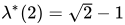


![{\displaystyle \lambda ^{*}(14)=\tan \left\{{\frac {1}{2}}\arctan \left[{\frac {1}{8}}\left(2{\sqrt {2}}+1-{\sqrt {4{\sqrt {2}}+5}}\right)^{3}\right]\right\}}](https://wikimedia.org/api/rest_v1/media/math/render/svg/7b6e0828bc852b827d1391f96efb4b2efe0efc15)


![{\displaystyle \lambda ^{*}(30)=\tan \left\{{\frac {1}{2}}\arctan[({\sqrt {10}}-3)^{2}({\sqrt {5}}-2)^{2}]\right\}}](https://wikimedia.org/api/rest_v1/media/math/render/svg/d7c432d9206866a95a79e11bfc37b08fa93041ef)
![{\displaystyle \lambda ^{*}(34)=\tan \left\{{\frac {1}{4}}\arcsin \left[{\frac {1}{9}}({\sqrt {17}}-4)^{2}\right]\right\}}](https://wikimedia.org/api/rest_v1/media/math/render/svg/b9581fb703634733f9ca070b257be10446ab2d7d)
![{\displaystyle \lambda ^{*}(42)=\tan \left\{{\frac {1}{2}}\arctan[(2{\sqrt {7}}-3{\sqrt {3}})^{2}(2{\sqrt {2}}-{\sqrt {7}})^{2}]\right\}}](https://wikimedia.org/api/rest_v1/media/math/render/svg/0382bbfe1c7590f0100be68cfdc0d686894d4a79)
![{\displaystyle \lambda ^{*}(46)=\tan \left\{{\frac {1}{2}}\arctan \left[{\frac {1}{64}}\left(3+{\sqrt {2}}-{\sqrt {6{\sqrt {2}}+7}}\right)^{6}\right]\right\}}](https://wikimedia.org/api/rest_v1/media/math/render/svg/0c652889c96056f6eef15edf4aa2e737ab1e6b71)

![{\displaystyle \lambda ^{*}(70)=\tan \left\{{\frac {1}{2}}\arctan[({\sqrt {5}}-2)^{4}({\sqrt {2}}-1)^{6}]\right\}}](https://wikimedia.org/api/rest_v1/media/math/render/svg/7b2afd679384b8e6f2ceaa0b2303f223a917612b)
![{\displaystyle \lambda ^{*}(78)=\tan \left\{{\frac {1}{2}}\arctan[(5{\sqrt {13}}-18)^{2}({\sqrt {26}}-5)^{2}]\right\}}](https://wikimedia.org/api/rest_v1/media/math/render/svg/12b6c374bc51b50021db5217e2e0da617668ec63)
![{\displaystyle \lambda ^{*}(82)=\tan \left\{{\frac {1}{4}}\arcsin \left[{\frac {1}{4761}}(8{\sqrt {41}}-51)^{2}\right]\right\}}](https://wikimedia.org/api/rest_v1/media/math/render/svg/4464dafebadfb801b332f1ca263fad1cd99b8d51)
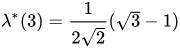
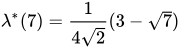
![{\displaystyle \lambda ^{*}(11)={\frac {1}{8{\sqrt {2}}}}({\sqrt {11}}+3)\left({\frac {1}{3}}{\sqrt[{3}]{6{\sqrt {3}}+2{\sqrt {11}}}}-{\frac {1}{3}}{\sqrt[{3}]{6{\sqrt {3}}-2{\sqrt {11}}}}+{\frac {1}{3}}{\sqrt {11}}-1\right)^{4}}](https://wikimedia.org/api/rest_v1/media/math/render/svg/ca80863388682d7501db6f6286e58c07277bdbfc)

![{\displaystyle \lambda ^{*}(19)={\frac {1}{8{\sqrt {2}}}}(3{\sqrt {19}}+13)\left[{\frac {1}{6}}({\sqrt {19}}-2+{\sqrt {3}}){\sqrt[{3}]{3{\sqrt {3}}-{\sqrt {19}}}}-{\frac {1}{6}}({\sqrt {19}}-2-{\sqrt {3}}){\sqrt[{3}]{3{\sqrt {3}}+{\sqrt {19}}}}-{\frac {1}{3}}(5-{\sqrt {19}})\right]^{4}}](https://wikimedia.org/api/rest_v1/media/math/render/svg/7891588ba88cde8cacbff0bf0404b34c15d5ad51)
![{\displaystyle \lambda ^{*}(23)={\frac {1}{16{\sqrt {2}}}}(5+{\sqrt {23}})\left[{\frac {1}{6}}({\sqrt {3}}+1){\sqrt[{3}]{100-12{\sqrt {69}}}}-{\frac {1}{6}}({\sqrt {3}}-1){\sqrt[{3}]{100+12{\sqrt {69}}}}+{\frac {2}{3}}\right]^{4}}](https://wikimedia.org/api/rest_v1/media/math/render/svg/94f944902af860d4aa5a17d27a340a2b6e6b8e20)
![{\displaystyle \lambda ^{*}(27)={\frac {1}{16{\sqrt {2}}}}({\sqrt {3}}-1)^{3}\left[{\frac {1}{3}}{\sqrt {3}}({\sqrt[{3}]{4}}-{\sqrt[{3}]{2}}+1)-{\sqrt[{3}]{2}}+1\right]^{4}}](https://wikimedia.org/api/rest_v1/media/math/render/svg/9fc5894ac5d186fec33494d1fa0572a76481b049)
![{\displaystyle \lambda ^{*}(39)=\sin \left\{{\frac {1}{2}}\arcsin \left[{\frac {1}{16}}\left(6-{\sqrt {13}}-3{\sqrt {6{\sqrt {13}}-21}}\right)\right]\right\}}](https://wikimedia.org/api/rest_v1/media/math/render/svg/3b3be4c863c2ca7895edf17f90d90317bf031620)
![{\displaystyle \lambda ^{*}(55)=\sin \left\{{\frac {1}{2}}\arcsin \left[{\frac {1}{512}}\left(3{\sqrt {5}}-3-{\sqrt {6{\sqrt {5}}-2}}\right)^{3}\right]\right\}}](https://wikimedia.org/api/rest_v1/media/math/render/svg/ce7ec975bb3a14550a0357db9fd9feaff0c60cb8)



![{\displaystyle \lambda ^{*}(16)=({\sqrt {2}}+1)^{2}({\sqrt[{4}]{2}}-1)^{4}}](https://wikimedia.org/api/rest_v1/media/math/render/svg/10044e9406aa1541fe5dd161a1102b9e57bffe47)
![{\displaystyle \lambda ^{*}(20)=\tan \left[{\frac {1}{4}}\arcsin({\sqrt {5}}-2)\right]^{2}}](https://wikimedia.org/api/rest_v1/media/math/render/svg/fdbc3b25b07f3d6569ae38343914fb6d0c572ea8)
![{\displaystyle \lambda ^{*}(24)=\tan \left\{{\frac {1}{2}}\arcsin[(2-{\sqrt {3}})({\sqrt {3}}-{\sqrt {2}})]\right\}^{2}}](https://wikimedia.org/api/rest_v1/media/math/render/svg/cc9fd703b0df93b368adfa44ea533c5bddd77c76)

![{\displaystyle \lambda ^{*}(32)=\tan \left\{{\frac {1}{2}}\arcsin \left[\left({\sqrt {2}}+1-{\sqrt {2{\sqrt {2}}+2}}\right)^{2}\right]\right\}^{2}}](https://wikimedia.org/api/rest_v1/media/math/render/svg/02552edfb14fc2696adcf0b16bab03b3d00003ee)
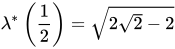
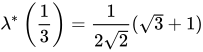

![{\displaystyle \lambda ^{*}\left({\frac {1}{4}}\right)=2{\sqrt[{4}]{2}}({\sqrt {2}}-1)}](https://wikimedia.org/api/rest_v1/media/math/render/svg/f001f57a74a3d1dd03adbc5cc3af66942e1feddb)
![{\displaystyle \lambda ^{*}\left({\frac {3}{4}}\right)={\sqrt[{4}]{8}}({\sqrt {3}}-{\sqrt {2}})({\sqrt {2}}+1){\sqrt {({\sqrt {3}}-1)^{3}}}}](https://wikimedia.org/api/rest_v1/media/math/render/svg/5f503a75e4bef9923cd2e1060e24b5621b40734a)



![{\displaystyle \lambda ^{*}\left({\frac {4}{5}}\right)=\tan \left[{\frac {\pi }{4}}-{\frac {1}{4}}\arcsin({\sqrt {5}}-2)\right]^{2}}](https://wikimedia.org/api/rest_v1/media/math/render/svg/403ad60c05e226ddbaea4dd16302a60f5785d735)
Ramanujan's class invariants
[edit]Ramanujan's class invariants and are defined as[13]




where . For such , the class invariants are algebraic numbers. For example



Identities with the class invariants include[14]

The class invariants are very closely related to the Weber modular functions and . These are the relations between lambda-star and the class invariants:


![{\displaystyle G_{n}=\sin\{2\arcsin[\lambda ^{*}(n)]\}^{-1/12}=1{\Big /}\left[{\sqrt[{12}]{2\lambda ^{*}(n)}}{\sqrt[{24}]{1-\lambda ^{*}(n)^{2}}}\right]}](https://wikimedia.org/api/rest_v1/media/math/render/svg/c8d7ba82805bad5b61422ef8ab1e6d8ff0653f93)
![{\displaystyle g_{n}=\tan\{2\arctan[\lambda ^{*}(n)]\}^{-1/12}={\sqrt[{12}]{[1-\lambda ^{*}(n)^{2}]/[2\lambda ^{*}(n)]}}}](https://wikimedia.org/api/rest_v1/media/math/render/svg/9d2bf73ba7824016a4c00cb2ba22aecdd1e16dbf)
![{\displaystyle \lambda ^{*}(n)=\tan \left\{{\frac {1}{2}}\arctan[g_{n}^{-12}]\right\}={\sqrt {g_{n}^{24}+1}}-g_{n}^{12}}](https://wikimedia.org/api/rest_v1/media/math/render/svg/1ac2a4151df22951f005c839445387ea73698793)
Other appearances
[edit]Little Picard theorem
[edit]The lambda function is used in the original proof of the Little Picard theorem, that an entire non-constant function on the complex plane cannot omit more than one value. This theorem was proved by Picard in 1879.[15] Suppose if possible that f is entire and does not take the values 0 and 1. Since λ is holomorphic, it has a local holomorphic inverse ω defined away from 0,1,∞. Consider the function z → ω(f(z)). By the Monodromy theorem this is holomorphic and maps the complex plane C to the upper half plane. From this it is easy to construct a holomorphic function from C to the unit disc, which by Liouville's theorem must be constant.[16]
Moonshine
[edit]The function is the normalized Hauptmodul for the group , and its q-expansion , (sequence A007248 in the OEIS) where , is the graded character of any element in conjugacy class 4C of the monster group acting on the monster vertex algebra.




Footnotes
[edit]- ^ Chandrasekharan (1985) p.115
- ^ Chandrasekharan (1985) p.109
- ^ Chandrasekharan (1985) p.110
- ^ a b c d Chandrasekharan (1985) p.108
- ^ Chandrasekharan (1985) p.63
- ^ Chandrasekharan (1985) p.117
- ^ Rankin (1977) pp.226–228
- ^ Borwein, Jonathan M.; Borwein, Peter B. (1987). Pi and the AGM: A Study in Analytic Number Theory and Computational Complexity (First ed.). Wiley-Interscience. ISBN 0-471-83138-7. p. 103–109, 134
- ^ a b Jacobi, Carl Gustav Jacob (1829). Fundamenta nova theoriae functionum ellipticarum (in Latin). p. 42
- ^ Borwein, Jonathan M.; Borwein, Peter B. (1987). Pi and the AGM: A Study in Analytic Number Theory and Computational Complexity (First ed.). Wiley-Interscience. ISBN 0-471-83138-7. p. 152
- ^ Chowla, S.; Selberg, A. (1949). "On Epstein's Zeta Function (I)". Proceedings of the National Academy of Sciences. 35 (7): 373. doi:10.1073/PNAS.35.7.371. PMC 1063041. S2CID 45071481.
- ^ Chowla, S.; Selberg, A. "On Epstein's Zeta-Function". EuDML. pp. 86–110.
- ^ Berndt, Bruce C.; Chan, Heng Huat; Zhang, Liang-Cheng (6 June 1997). "Ramanujan's class invariants, Kronecker's limit formula, and modular equations". Transactions of the American Mathematical Society. 349 (6): 2125–2173.
- ^ Eymard, Pierre; Lafon, Jean-Pierre (1999). Autour du nombre Pi (in French). HERMANN. ISBN 2705614435. p. 240
- ^ Chandrasekharan (1985) p.121
- ^ Chandrasekharan (1985) p.118
References
[edit]Notes
[edit]- ^ is not a modular function (per the Wikipedia definition), but every modular function is a rational function in . Some authors use a non-equivalent definition of "modular functions".
- ^ For any prime power, we can iterate the modular equation of degree . This process can be used to give algebraic values of for any
- ^ is algebraic for every


Other
[edit]- Abramowitz, Milton; Stegun, Irene A., eds. (1972), Handbook of Mathematical Functions with Formulas, Graphs, and Mathematical Tables, New York: Dover Publications, ISBN 978-0-486-61272-0, Zbl 0543.33001
- Chandrasekharan, K. (1985), Elliptic Functions, Grundlehren der mathematischen Wissenschaften, vol. 281, Springer-Verlag, pp. 108–121, ISBN 3-540-15295-4, Zbl 0575.33001
- Conway, John Horton; Norton, Simon (1979), "Monstrous moonshine", Bulletin of the London Mathematical Society, 11 (3): 308–339, doi:10.1112/blms/11.3.308, MR 0554399, Zbl 0424.20010
- Rankin, Robert A. (1977), Modular Forms and Functions, Cambridge University Press, ISBN 0-521-21212-X, Zbl 0376.10020
- Reinhardt, W. P.; Walker, P. L. (2010), "Elliptic Modular Function", in Olver, Frank W. J.; Lozier, Daniel M.; Boisvert, Ronald F.; Clark, Charles W. (eds.), NIST Handbook of Mathematical Functions, Cambridge University Press, ISBN 978-0-521-19225-5, MR 2723248.
- Borwein, J. M. and Borwein, P. B. Pi & the AGM: A Study in Analytic Number Theory and Computational Complexity. New York: Wiley, pp. 139 and 298, 1987.
- Conway, J. H. and Norton, S. P. "Monstrous Moonshine." Bull. London Math. Soc. 11, 308-339, 1979.
- Selberg, A. and Chowla, S. "On Epstein's Zeta-Function." J. reine angew. Math. 227, 86-110, 1967.