


Community hub
Recent from talks
Contribute something
Nothing was collected or created yet.
Cross-ratio
View on Wikipedia
In geometry, the cross-ratio, also called the double ratio and anharmonic ratio, is a number associated with a list of four collinear points, particularly points on a projective line. Given four points A, B, C, D on a line, their cross ratio is defined as
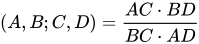
where an orientation of the line determines the sign of each distance and the distance is measured as projected into Euclidean space. (If one of the four points is the line's point at infinity, then the two distances involving that point are dropped from the formula.) The point D is the harmonic conjugate of C with respect to A and B precisely if the cross-ratio of the quadruple is −1, called the harmonic ratio. The cross-ratio can therefore be regarded as measuring the quadruple's deviation from this ratio; hence the name anharmonic ratio.
The cross-ratio is preserved by linear fractional transformations. It is essentially the only projective invariant of a quadruple of collinear points; this underlies its importance for projective geometry.
The cross-ratio had been defined in deep antiquity, possibly already by Euclid, and was considered by Pappus, who noted its key invariance property. It was extensively studied in the 19th century.[1]
Variants of this concept exist for a quadruple of concurrent lines on the projective plane and a quadruple of points on the Riemann sphere. In the Cayley–Klein model of hyperbolic geometry, the distance between points is expressed in terms of a certain cross-ratio.
Terminology and history
[edit]
Pappus of Alexandria made implicit use of concepts equivalent to the cross-ratio in his Collection: Book VII. Early users of Pappus included Isaac Newton, Michel Chasles, and Robert Simson. In 1986 Alexander Jones made a translation of the original by Pappus, then wrote a commentary on how the lemmas of Pappus relate to modern terminology.[2]
Modern use of the cross ratio in projective geometry began with Lazare Carnot in 1803 with his book Géométrie de Position.[3][pages needed] Chasles coined the French term rapport anharmonique [anharmonic ratio] in 1837.[4] German geometers call it das Doppelverhältnis [double ratio].
Carl von Staudt was unsatisfied with past definitions of the cross-ratio relying on algebraic manipulation of Euclidean distances rather than being based purely on synthetic projective geometry concepts. In 1847, von Staudt demonstrated that the algebraic structure is implicit in projective geometry, by creating an algebra based on construction of the projective harmonic conjugate, which he called a throw (German: Wurf): given three points on a line, the harmonic conjugate is a fourth point that makes the cross ratio equal to −1. His algebra of throws provides an approach to numerical propositions, usually taken as axioms, but proven in projective geometry.[5]
The English term "cross-ratio" was introduced in 1878 by William Kingdon Clifford.[6]
Definition
[edit]If A, B, C, and D are four points on an oriented affine line, their cross ratio is:
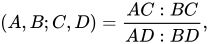
with the notation defined to mean the signed ratio of the displacement from W to X to the displacement from Y to Z. For collinear displacements this is a dimensionless quantity.

If the displacements themselves are taken to be signed real numbers, then the cross ratio between points can be written

If is the projectively extended real line, the cross-ratio of four distinct numbers in is given by
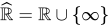



When one of is the point at infinity (), this reduces to e.g.


The same formulas can be applied to four distinct complex numbers or, more generally, to elements of any field, and can also be projectively extended as above to the case when one of them is

The cross ratio can for example be defined for pencils of lines, circles, or conics. For instance, the cross-ratio of coaxial circles can be defined in numerous equivalent ways:

- Let be a point of intersection of the circles on their radical axis, if it exists. Then the cross-ratio of the circles can be defined as the cross-ratio of the tangents to the circles through .
- More generally, given any point in the plane, the polars of this point with respect to those circles are concurrent and there cross-ratio doesn't depend on the chosen point.
- By taking the lines orthogonal to the tangents at and projecting on the lines on which lies the circle centers, we deduce it is equal to the cross-ratio of the circle centers.
- It can be proven thanks to an inversion that the cross-ratio of these circles can be equivalently defined as the cross-ratio of the second points of intersection different than of a circle (and in a degenerate case a line) that passes through .

Properties
[edit]The cross ratio of the four collinear points A, B, C, and D can be written as
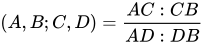
where describes the ratio with which the point C divides the line segment AB, and describes the ratio with which the point D divides that same line segment. The cross ratio then appears as a ratio of ratios, describing how the two points C and D are situated with respect to the line segment AB. As long as the points A, B, C, and D are distinct, the cross ratio (A, B; C, D) will be a non-zero real number. We can easily deduce that


- (A, B; C, D) < 0 if and only if one of the points C or D lies between the points A and B and the other does not
- (A, B; C, D) = 1 / (A, B; D, C)
- (A, B; C, D) = (C, D; A, B)
- (A, B; C, D) ≠ (A, B; C, E) ⇔ D ≠ E
Six cross-ratios
[edit]Four points can be ordered in 4! = 4 × 3 × 2 × 1 = 24 ways, but there are only six ways for partitioning them into two unordered pairs. Thus, four points can have only six different cross-ratios, which are related as:
![{\displaystyle {\begin{aligned}&(A,B;C,D)=(B,A;D,C)=(C,D;A,B)=(D,C;B,A)=\lambda ,{\vphantom {\frac {1}{1}}}\\[4mu]&(A,B;D,C)=(B,A;C,D)=(C,D;B,A)=(D,C;A,B)={\frac {1}{\lambda }},\\[4mu]&(A,C;B,D)=(B,D;A,C)=(C,A;D,B)=(D,B;C,A)=1-\lambda ,{\vphantom {\frac {1}{1}}}\\[4mu]&(A,C;D,B)=(B,D;C,A)=(C,A;B,D)=(D,B;A,C)={\frac {1}{1-\lambda }},\\[4mu]&(A,D;B,C)=(B,C;A,D)=(C,B;D,A)=(D,A;C,B)={\frac {\lambda -1}{\lambda }},\\[4mu]&(A,D;C,B)=(B,C;D,A)=(C,B;A,D)=(D,A;B,C)={\frac {\lambda }{\lambda -1}}.\end{aligned}}}](https://wikimedia.org/api/rest_v1/media/math/render/svg/fbb2b72152ad0c6dfd665c510b6ad36fdf28f3c4)
See Anharmonic group below.
Projective geometry
[edit]
| 1. | The width of the side street, W is computed from the known widths of the adjacent shops. |
| 2. | As a vanishing point, V is visible, the width of only one shop is needed. |
The cross-ratio is a projective invariant in the sense that it is preserved by the projective transformations of a projective line.
In particular, if four points lie on a straight line in then their cross-ratio is a well-defined quantity, because any choice of the origin and even of the scale on the line will yield the same value of the cross-ratio.


Furthermore, let be four distinct lines in the plane passing through the same point . Then any line not passing through intersects these lines in four distinct points (if is parallel to then the corresponding intersection point is "at infinity"). It turns out that the cross-ratio of these points (taken in a fixed order) does not depend on the choice of a line , and hence it is an invariant of the 4-tuple of lines



This can be understood as follows: if and are two lines not passing through then the perspective transformation from to with the center is a projective transformation that takes the quadruple of points on into the quadruple of points on .


Therefore, the invariance of the cross-ratio under projective automorphisms of the line implies (in fact, is equivalent to) the independence of the cross-ratio of the four collinear points on the lines from the choice of the line that contains them.

Definition in homogeneous coordinates
[edit]If four collinear points are represented in homogeneous coordinates by vectors such that and , then their cross-ratio is .[7]


Role in non-Euclidean geometry
[edit]Arthur Cayley and Felix Klein found an application of the cross-ratio to non-Euclidean geometry. Given a nonsingular conic in the real projective plane, its stabilizer in the projective group acts transitively on the points in the interior of . However, there is an invariant for the action of on pairs of points. In fact, every such invariant is expressible as a function of the appropriate cross-ratio.[citation needed]


Hyperbolic geometry
[edit]Explicitly, let the conic be the unit circle. For any two points P and Q, inside the unit circle . If the line connecting them intersects the circle in two points, X and Y and the points are, in order, X, P, Q, Y. Then the hyperbolic distance between P and Q in the Cayley–Klein model of the hyperbolic plane can be expressed as
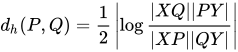
(the factor one half is needed to make the curvature −1). Since the cross-ratio is invariant under projective transformations, it follows that the hyperbolic distance is invariant under the projective transformations that preserve the conic C.
Conversely, the group G acts transitively on the set of pairs of points (p, q) in the unit disk at a fixed hyperbolic distance.
Later, partly through the influence of Henri Poincaré, the cross ratio of four complex numbers on a circle was used for hyperbolic metrics. Being on a circle means the four points are the image of four real points under a Möbius transformation, and hence the cross ratio is a real number. The Poincaré half-plane model and Poincaré disk model are two models of hyperbolic geometry in the complex projective line.
These models are instances of Cayley–Klein metrics.
Anharmonic group and Klein four-group
[edit]The cross-ratio may be defined by any of these four expressions:

These differ by the following permutations of the variables (in cycle notation):

We may consider the permutations of the four variables as an action of the symmetric group S4 on functions of the four variables. Since the above four permutations leave the cross ratio unaltered, they form the stabilizer K of the cross-ratio under this action, and this induces an effective action of the quotient group on the orbit of the cross-ratio. The four permutations in K provide a realization of the Klein four-group in S4, and the quotient is isomorphic to the symmetric group S3.

Thus, the other permutations of the four variables alter the cross-ratio to give the following six values, which are the orbit of the six-element group :

&={\frac {1}{1-\lambda }}&(A,C;B,D)&=1-\lambda ,\\[4mu](A,D;C,B)&={\frac {\lambda }{\lambda -1}}&(A,D;B,C)&={\frac {\lambda -1}{\lambda }}.\end{aligned}}}](https://wikimedia.org/api/rest_v1/media/math/render/svg/f77b572b465e09466c55c49d86ff6cc8898848be)

The stabilizer of {0, 1, ∞} is isomorphic to the rotation group of the trigonal dihedron, the dihedral group D3. It is convenient to visualize this by a Möbius transformation M mapping the real axis to the complex unit circle (the equator of the Riemann sphere), with 0, 1, ∞ equally spaced.
Considering {0, 1, ∞} as the vertices of the dihedron, the other fixed points of the 2-cycles are the points {2, −1, 1/2}, which under M are opposite each vertex on the Riemann sphere, at the midpoint of the opposite edge. Each 2-cycles is a half-turn rotation of the Riemann sphere exchanging the hemispheres (the interior and exterior of the circle in the diagram).
The fixed points of the 3-cycles are exp(±iπ/3), corresponding under M to the poles of the sphere: exp(iπ/3) is the origin and exp(−iπ/3) is the point at infinity. Each 3-cycle is a 1/3 turn rotation about their axis, and they are exchanged by the 2-cycles.
As functions of these are examples of Möbius transformations, which under composition of functions form the Mobius group PGL(2, C). The six transformations form a subgroup known as the anharmonic group, again isomorphic to S3. They are the torsion elements (elliptic transforms) in PGL(2, C). Namely, , , and are of order 2 with respective fixed points and (namely, the orbit of the harmonic cross-ratio). Meanwhile, the elements and are of order 3 in PGL(2, C), and each fixes both values of the "most symmetric" cross-ratio (the solutions to , the primitive sixth roots of unity). The order 2 elements exchange these two elements (as they do any pair other than their fixed points), and thus the action of the anharmonic group on gives the quotient map of symmetric groups .


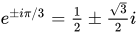


Further, the fixed points of the individual 2-cycles are, respectively, and and this set is also preserved and permuted by the 3-cycles. Geometrically, this can be visualized as the rotation group of the trigonal dihedron, which is isomorphic to the dihedral group of the triangle D3, as illustrated at right. Algebraically, this corresponds to the action of S3 on the 2-cycles (its Sylow 2-subgroups) by conjugation and realizes the isomorphism with the group of inner automorphisms,

The anharmonic group is generated by and Its action on gives an isomorphism with S3. It may also be realised as the six Möbius transformations mentioned,[8] which yields a projective representation of S3 over any field (since it is defined with integer entries), and is always faithful/injective (since no two terms differ only by 1/−1). Over the field with two elements, the projective line only has three points, so this representation is an isomorphism, and is the exceptional isomorphism . In characteristic 3, this stabilizes the point , which corresponds to the orbit of the harmonic cross-ratio being only a single point, since . Over the field with three elements, the projective line has only 4 points and , and thus the representation is exactly the stabilizer of the harmonic cross-ratio, yielding an embedding equals the stabilizer of the point .



![{\displaystyle -1=[-1:1]}](https://wikimedia.org/api/rest_v1/media/math/render/svg/24adc46c179c53ef270f071518cb7d308300fdeb)


Exceptional orbits
[edit]For certain values of there will be greater symmetry and therefore fewer than six possible values for the cross-ratio. These values of correspond to fixed points of the action of S3 on the Riemann sphere (given by the above six functions); or, equivalently, those points with a non-trivial stabilizer in this permutation group.

The first set of fixed points is However, the cross-ratio can never take on these values if the points A, B, C, and D are all distinct. These values are limit values as one pair of coordinates approach each other:

&=(A,B;Z,Z)=1,\\[4mu](Z,B;C,Z)&=(A,Z;Z,D)=\infty .\end{aligned}}}](https://wikimedia.org/api/rest_v1/media/math/render/svg/4172d14271caad37427aa9c305e3c128cfce2630)
The second set of fixed points is This situation is what is classically called the harmonic cross-ratio, and arises in projective harmonic conjugates. In the real case, there are no other exceptional orbits.

In the complex case, the most symmetric cross-ratio occurs when . These are then the only two values of the cross-ratio, and these are acted on according to the sign of the permutation.

Transformational approach
[edit]The cross-ratio is invariant under the projective transformations of the line. In the case of a complex projective line, or the Riemann sphere, these transformations are known as Möbius transformations. A general Möbius transformation has the form

These transformations form a group acting on the Riemann sphere, the Möbius group.
The projective invariance of the cross-ratio means that

The cross-ratio is real if and only if the four points are either collinear or concyclic, reflecting the fact that every Möbius transformation maps generalized circles to generalized circles.
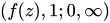
The action of the Möbius group is simply transitive on the set of triples of distinct points of the Riemann sphere: given any ordered triple of distinct points, , there is a unique Möbius transformation that maps it to the triple . This transformation can be conveniently described using the cross-ratio: since must equal , which in turn equals , we obtain



An alternative explanation for the invariance of the cross-ratio is based on the fact that the group of projective transformations of a line is generated by the translations, the homotheties, and the multiplicative inversion. The differences are invariant under the translations


where is a constant in the ground field . Furthermore, the division ratios are invariant under a homothety


for a non-zero constant in . Therefore, the cross-ratio is invariant under the affine transformations.

In order to obtain a well-defined inversion mapping

the affine line needs to be augmented by the point at infinity, denoted , forming the projective line . Each affine mapping can be uniquely extended to a mapping of into itself that fixes the point at infinity. The map swaps and . The projective group is generated by and the affine mappings extended to . In the case , the complex plane, this results in the Möbius group. Since the cross-ratio is also invariant under , it is invariant under any projective mapping of into itself.


Co-ordinate description
[edit]If we write the complex points as vectors and define , and let be the dot product of with , then the real part of the cross ratio is given by:
![{\displaystyle {\vec {x_{n}}}=[\Re (z_{n}),\Im (z_{n})]^{\mathrm {T} }}](https://wikimedia.org/api/rest_v1/media/math/render/svg/fb2bd32abca355ac18f99075851d511f9b34b707)



This is an invariant of the 2-dimensional special conformal transformation such as inversion .

The imaginary part must make use of the 2-dimensional cross product
![{\displaystyle a\times b=[a,b]=a_{2}b_{1}-a_{1}b_{2}}](https://wikimedia.org/api/rest_v1/media/math/render/svg/f245d88996a813e2730e805cf059f1162ec30464)
![{\displaystyle C_{2}={\frac {(x_{12},x_{14})[x_{34},x_{23}]-(x_{43},x_{23})[x_{12},x_{34}]}{|x_{23}|^{2}|x_{14}|^{2}}}}](https://wikimedia.org/api/rest_v1/media/math/render/svg/0702314588cb44e101aa76943658393dca6b1ddc)
Ring homography
[edit]The concept of cross ratio only depends on the ring operations of addition, multiplication, and inversion (though inversion of a given element is not certain in a ring). One approach to cross ratio interprets it as a homography that takes three designated points to 0, 1, and ∞. Under restrictions having to do with inverses, it is possible to generate such a mapping with ring operations in the projective line over a ring. The cross ratio of four points is the evaluation of this homography at the fourth point.
Differential-geometric point of view
[edit]The theory takes on a differential calculus aspect as the four points are brought into proximity. This leads to the theory of the Schwarzian derivative, and more generally of projective connections.
Higher-dimensional generalizations
[edit]The cross-ratio does not generalize in a simple manner to higher dimensions, due to other geometric properties of configurations of points, notably collinearity – configuration spaces are more complicated, and distinct k-tuples of points are not in general position.
While the projective linear group of the projective line is 3-transitive (any three distinct points can be mapped to any other three points), and indeed simply 3-transitive (there is a unique projective map taking any triple to another triple), with the cross ratio thus being the unique projective invariant of a set of four points, there are basic geometric invariants in higher dimension. The projective linear group of n-space has (n + 1)2 − 1 dimensions (because it is projectivization removing one dimension), but in other dimensions the projective linear group is only 2-transitive – because three collinear points must be mapped to three collinear points (which is not a restriction in the projective line) – and thus there is not a "generalized cross ratio" providing the unique invariant of n2 points.
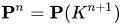

Collinearity is not the only geometric property of configurations of points that must be maintained – for example, five points determine a conic, but six general points do not lie on a conic, so whether any 6-tuple of points lies on a conic is also a projective invariant. One can study orbits of points in general position – in the line "general position" is equivalent to being distinct, while in higher dimensions it requires geometric considerations, as discussed – but, as the above indicates, this is more complicated and less informative.
However, a generalization to Riemann surfaces of positive genus exists, using the Abel–Jacobi map and theta functions.
See also
[edit]Notes
[edit]- ^ A theorem on the anharmonic ratio of lines appeared in the work of Pappus, but Michel Chasles, who devoted considerable efforts to reconstructing lost works of Euclid, asserted that it had earlier appeared in his book Porisms.
- ^ Alexander Jones (1986) Book 7 of the Collection, part 1: introduction, text, translation ISBN 0-387-96257-3, part 2: commentary, index, figures ISBN 3-540-96257-3, Springer-Verlag
- ^ Carnot, Lazare (1803). Géométrie de Position. Crapelet.
- ^ Chasles, Michel (1837). Aperçu historique sur l'origine et le développement des méthodes en géométrie. Hayez. p. 35. (Link is to the reprinted second edition, Gauthier-Villars: 1875.)
- ^ Howard Eves (1972) A Survey of Geometry, Revised Edition, page 73, Allyn and Bacon
- ^ W.K. Clifford (1878) Elements of Dynamic, books I,II,III, page 42, London: MacMillan & Co; on-line presentation by Cornell University Historical Mathematical Monographs.
- ^ Irving Kaplansky (1969). Linear Algebra and Geometry: A Second Course. Courier Corporation. ISBN 0-486-43233-5.
- ^ Chandrasekharan, K. (1985). Elliptic Functions. Grundlehren der mathematischen Wissenschaften. Vol. 281. Springer-Verlag. p. 120. ISBN 3-540-15295-4. Zbl 0575.33001.
References
[edit]- Lars Ahlfors (1953,1966,1979) Complex Analysis, 1st edition, page 25; 2nd & 3rd editions, page 78, McGraw-Hill ISBN 0-07-000657-1 .
- Viktor Blåsjö (2009) "Jakob Steiner's Systematische Entwickelung: The Culmination of Classical Geometry", Mathematical Intelligencer 31(1): 21–9.
- John J. Milne (1911) An Elementary Treatise on Cross-Ratio Geometry with Historical Notes, Cambridge University Press.
- Dirk Struik (1953) Lectures on Analytic and Projective Geometry, page 7, Addison-Wesley.
- I. R. Shafarevich & A. O. Remizov (2012) Linear Algebra and Geometry, Springer ISBN 978-3-642-30993-9.
External links
[edit]- MathPages – Kevin Brown explains the cross-ratio in his article about Pascal's Mystic Hexagram
- Cross-Ratio at cut-the-knot
- Weisstein, Eric W. "Cross-ratio". MathWorld.
- Ardila, Federico (6 July 2018). "The Cross Ratio" (video). youtube. Brady Haran. Archived from the original on 2021-12-12. Retrieved 6 July 2018.
Cross-ratio
View on GrokipediaHistory and Terminology
Historical Development
The concept of the cross-ratio originated in ancient Greek mathematics, where Pappus of Alexandria (c. 290–350 AD) implicitly introduced it in Proposition 129 of Book VII of his Mathematical Collection, demonstrating that the ratio of ratios for four collinear points is preserved under projection from one line to another.[5] This early formulation laid foundational groundwork for understanding projective relations in geometry, though it was not explicitly termed the "cross-ratio" at the time.[6] This invariance under projections was rediscovered in the 17th century by the French mathematician Girard Desargues (1591–1661) in his treatise Brouillon project d'une atteinte aux événements des rencontres du cônne avec un plan (1639), where he explored perspective and collinear points, laying groundwork for modern projective geometry.[7] In the 18th century, Gaspard Monge advanced related ideas through his development of descriptive geometry around 1795, a method for representing three-dimensional objects via planar projections that inherently involves preserving ratios under perspective transformations, setting the stage for explicit cross-ratio applications in spatial configurations.[8] Monge's work, initially kept secret due to military applications, emphasized orthographic projections and became pivotal in bridging practical engineering with theoretical geometry.[9] The cross-ratio received formal algebraic treatment in the 19th century, beginning with August Ferdinand Möbius's 1827 publication Der barycentrische Calcül, where he introduced a formula for it within the framework of barycentric coordinates, enabling computations of projective invariants without metrics.[10] Arthur Cayley introduced the absolute conic in his 1859 "Sixth Memoir on Quantics," which allows embedding metric structures into projective geometry. Felix Klein later employed the cross-ratio to define distances and angles using this absolute conic framework.[11] Felix Klein elevated the cross-ratio's significance in the 1870s through his Erlangen Program, outlined in the 1872 paper "Vergleichende Betrachtungen über neuere geometrische Forschungen," where he positioned it as a key invariant under projective transformations, unifying various geometries under group-theoretic principles.[12] Klein's approach emphasized how the cross-ratio distinguishes projective equivalence classes, influencing modern algebraic geometry and beyond.[13]Key Terms and Notation
The cross-ratio is a fundamental invariant in projective geometry associated with four collinear points on a line, quantifying their relative positions in a manner preserved under projective transformations.[12] It is also known by alternative names such as the double ratio or anharmonic ratio, reflecting its historical and conceptual interpretations in geometric literature. Standard notations for the cross-ratio vary by context but emphasize the ordered quadruple of points. For points on a real line, the common notation is , where the semicolon separates the pairs defining the ratio.[1] In the complex plane, it is often denoted as , treating as a variable point relative to fixed points . These notations assume an ordered quadruple, as permutations of the points yield one of six possible values for the cross-ratio, highlighting the distinction from unordered sets where the absolute value or specific permutations might be considered instead.[12] A special case arises when the cross-ratio equals , termed a harmonic division or harmonic set, where the points form a configuration invariant under certain projective symmetries.[12] The notation for the cross-ratio evolved from August Ferdinand Möbius's introduction of barycentric coordinates in 1827, which used mass-point ratios to define projective invariants, to modern forms emphasizing homogeneous coordinates and projective lines. Möbius's barycentric approach laid the groundwork for these conventions, as detailed in the historical development of projective geometry.Basic Definitions
Definition on the Real Line
The cross-ratio provides a fundamental measure of the relative positions of four distinct points on the real line, presupposing familiarity with directed distances in affine geometry. For points , , , on with coordinates , , , respectively, the cross-ratio is defined by the formula This expression uses signed (directed) distances between the points, ensuring the value accounts for order and orientation along the line.[14][15] The cross-ratio interprets the configuration as the ratio of two affine ratios: the division of the directed segment from to by relative to the division of the directed segment from to by . In other words, quantifies 's position along , while does the same along , and their quotient captures an anharmonic relation invariant to certain affine rescalings.[12][3] If two points coincide, the expression may yield zero, infinity, or be undefined, which arises as limits in the formula; for example, as , the denominator approaches zero, sending the cross-ratio to infinity. Similarly, when one point approaches infinity—such as with —the cross-ratio simplifies to the limit , preserving the relational structure through continuous extension.[12][3] A concrete example illustrates this: for points , , , and , the cross-ratio evaluates to via the limit as , reflecting 's position twice as far from relative to in the affine sense.[14][15]Definition for Points at Infinity
To incorporate points at infinity into the cross-ratio, the real line is extended to the projective real line , which is the one-point compactification . This construction completes the affine line by adding a single point at infinity, ensuring that the space is compact and topologically equivalent to a circle, thereby allowing the cross-ratio to be defined uniformly for all distinct quadruples of points without singularities arising from unbounded coordinates.[12] When one of the points is at infinity, the cross-ratio formula is adjusted by taking the appropriate limit. For distinct points and , the cross-ratio simplifies to , which corresponds to the affine ratio of directed distances from to and . This form arises because terms involving in the denominator vanish in the limit as , reducing the expression to a ratio preserved under translations and scalings. If more than one point is at infinity, the cross-ratio is undefined, as the points must remain distinct and there is only a single point at infinity in ; however, limit cases where multiple points approach infinity yield indeterminate forms that reflect the projective structure.[16][17] A classic example is the harmonic set , where the cross-ratio . Here, the point at infinity pairs with 0 to form the "endpoints" of the line, while 1 and -1 are harmonic conjugates with respect to them, illustrating how infinity enables the detection of harmonic divisions in projective geometry. This configuration underscores the role of the one-point compactification in preserving such invariants across the entire .[12]Properties
Invariance and Basic Properties
The cross-ratio of four points on a projective line is a fundamental invariant in projective geometry, remaining unchanged under the action of linear fractional transformations, also known as Möbius transformations. These transformations, which map the extended complex plane to itself via functions of the form with , preserve the cross-ratio such that if points are mapped to , then . This invariance extends to projective transformations more broadly, making the cross-ratio a complete projective invariant for ordered quadruples of distinct points on a line.[1][12] As a consequence of this invariance, the cross-ratio also remains unchanged under affine transformations, which form a subgroup of the projective group and include mappings of the form with . Such transformations preserve ratios of directed distances, and since the cross-ratio is defined as a double ratio of these distances, it is unaffected. This property underscores its role in distinguishing configurations that cannot be mapped to one another by projective equivalences.[1] Basic algebraic identities further characterize the cross-ratio. One key relation is the reciprocity property: . This follows directly from the definition , as interchanging and while simultaneously interchanging and yields the same expression. Another fundamental identity is , obtained by swapping and , which inverts the ratio. These relations highlight the cross-ratio's symmetry under point permutations.[1][12] The permutation properties of the cross-ratio arise from the 24 possible orderings of four distinct points, which reduce to only six distinct values due to the group action of the symmetric group modulo the projective equivalences. Specifically, the distinct cross-ratios obtained are and , where is the original value; these are interchanged by even permutations within the anharmonic group. This reduction demonstrates the cross-ratio's efficiency in classifying configurations.[1][12] Finally, the cross-ratio uniquely determines a quadruple of points up to projective equivalence on the projective line. Given any four distinct points, there exists a unique linear fractional transformation mapping three of them to fixed positions (e.g., 0, 1, and ), with the image of the fourth determined solely by the cross-ratio value. Thus, two quadruples are projectively equivalent if and only if their cross-ratios coincide (up to the six permutation-related values). This uniqueness property is central to applications in projective geometry, where it serves as a canonical coordinate for point configurations.[1][12]The Six Cross-Ratios
When four distinct points on a projective line are labeled as with cross-ratio , the 24 possible permutations of these labels under the action of the symmetric group yield at most six distinct cross-ratio values, provided .[18] These values form a set closed under the transformations corresponding to even permutations and are given by , , , , , and .[2] Each of these six values arises exactly four times across the permutations, reflecting the stabilizer subgroup of order four in the action on the cross-ratio.[18] The mapping from specific permutations to these values can be enumerated as follows, using the standard definition :| Permutation | Cross-Ratio Value |
|---|---|