


Community hub
Recent from talks
Contribute something
Nothing was collected or created yet.
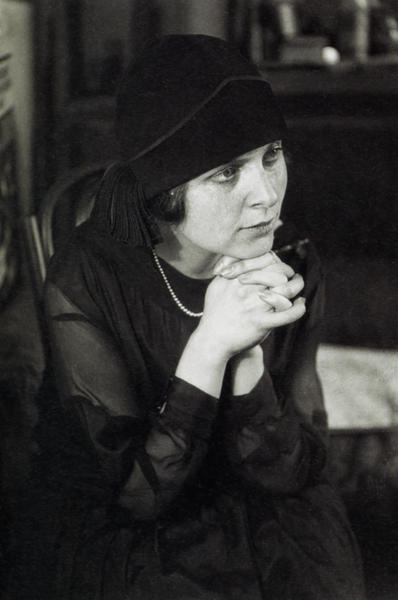
Elsa Triolet
View on Wikipedia | This article needs additional citations for verification. (July 2025) |
Ella Yuryevna Kagan (Russian: Элла Юрьевна Каган; 1896–1970), known as Elsa Triolet, was a Russian-French writer and translator known for being the first woman to be awarded the Prix Goncourt.
Key Information


Biography
[edit]Ella Yuryevna Kagan was born into a Jewish family of Yuri Alexandrovich Kagan, a lawyer, and Yelena Youlevna Berman, a music teacher, in Moscow. She and her older sister Lilya Brik received excellent educations; they were able to speak fluent German and French and play the piano. Ella graduated from the Moscow Institute of Architecture.

Ella soon became associated with the Russian Futurists via Lilya, who was in 1912 married to the art critic Osip Brik; she befriended people of their circle, including Roman Jakobson, then a zaum poet, who became her lifelong friend. Elsa enjoyed poetry, and in 1911 befriended and fell in love with the aspiring futurist poet and graphic artist Vladimir Mayakovsky. When she invited him home, the poet fell madly in love with her sister, marking the start of a series of artistic collaborations involving the two that lasted until the poet's death. Ella was the first to translate Mayakovsky's poetry (as well as volumes of other Russian-language poetry) to French.
In 1918, at the outset of the Russian Civil War, Ella married the French cavalry officer André Triolet, and emigrated to France, where she changed her name to Elsa, but for years admitted in her letters to Lilya to being heartbroken. She later divorced Triolet.
In the early 1920s, Elsa described her visit to Tahiti in her letters to Victor Shklovsky, who subsequently showed them to Maxim Gorky. Gorky suggested that the author should consider a literary career. The 1925 book In Tahiti, written in Russian and published in Leningrad, was based on these letters. She published two further novels in Russian, Wild Strawberry (1926) and Camouflage (1928), both published in Moscow.[1]
In 1928 Elsa met French writer Louis Aragon. They stayed together for 42 years and married in 1939. She influenced Aragon to join the French Communist Party.[citation needed] Triolet and Aragon fought in the French Resistance.
In 1944 Triolet was the first woman to be awarded the Prix Goncourt for her novel Le premier accroc coûte deux cents francs.
She died, aged 73, at the Moulin de Villeneuve, Saint-Arnoult-en-Yvelines, France, of a heart attack.
In 2010, La Poste, the French post office, issued three stamps honoring Triolet.
Documentary
[edit]- 1965 : Elsa La Rose directed by Agnès Varda
- 2022 : In the eyes of Elsa Triolet directed by Gregory Monro
Bibliography
[edit]- На Таити (In Tahiti, in Russian, 1925)
- Земляничка (Wild Strawberry, in Russian, 1926)
- Защитный цвет (Camouflage, in Russian, 1928)
- Bonsoir Thérèse (Good Evening, Theresa - her first book in French, 1938)
- Maïakovski (1939) translation by N. Semoniff (in Russian – published by Т/О "НЕФОРМАТ" Издат-во Accent Graphics Communications, Montreal, 2012)
- Mille regrets (1942)
- Le Cheval blanc (The White Horse, 1943)
- Les Amants d'Avignon. (The Lovers of Avignon, published pseudonymously as Laurent Daniel for Éditions de Minuit, 1943)
- Qui est cet étranger qui n'est pas d'ici ? ou le mythe de la Baronne Mélanie (Who Is This Stranger Who Isn't from Here? or, The Myth of Baroness Melanie) (1944)
- Le Premier accroc coûte deux cents francs (A Fine of 200 Francs, 1945, Prix Goncourt 1944)
- Personne ne m'aime (Nobody Loves Me, 1946; published in French by Le Temps des Cerises éditeurs, 2014)
- Les Fantômes armés (The Armed Phantoms, 1947; Le Temps des Cerises éditeurs, 2014)
- L'Inspecteur des ruines (The Inspector of Ruins, 1948)
- Le Cheval roux ou les intentions humaines (The Roan Horse, or Humane Intentions) (1953)
- L'Histoire d'Anton Tchekov (The Life of Anton Chekov) (1954)
- Le Rendez-vous des étrangers (1956)
- Le Monument (1957)
- Roses à crédit (1959), the 2010 movie Roses à crédit is based on the story
- Luna-Park (1960)
- Les Manigances (1961)
- L'Âme (1962)
- Le Grand jamais (The Big Never) (1965)
- Écoutez-voir (Listen and See) (1968)
- La Mise en mots (1969)
- Le Rossignol se tait à l'aube (1970)
References
[edit]- ^ Elizabeth Klosty Beaujour, Alien Tongues: Bilingual Russian Writers of the "First" Emigration (Cornell University Press, 1989; ISBN 0801422515), p. 199.
External links
[edit]- Elsa Triolet at IMDb
| International | |
|---|---|
| National | |
| Academics | |
| Artists | |
| People | |
| Other | |

Elsa Triolet
View on GrokipediaEarly Life
Family Background and Childhood in Russia
Elsa Triolet was born Ella Yureyevna Kagan on September 12, 1896, in Moscow, into a middle-class, assimilated Jewish family of the Russian intelligentsia.[1] Her father, Yuri Alexandrovich Kagan, worked as a Lithuanian Jewish lawyer and judge, while her mother, Yelena Borman Kagan, a Latvian Jewish woman fluent in German, fostered a household rich in culture and music.[5] The family observed no religious practices but socially participated in Christian festivals.[5] She had an older sister, Lili Kagan—later Lilya Brik—born five years prior, who would marry literary critic Osip Brik.[5] The privileged childhood featured loyal servants, frequent travel with her mother, and multilingual education, including Russian, German, and French learned from a governess; Triolet recalled it as "snug and cozy" with fond memories of her parents' pursuits.[5] Music permeated the home, where her mother, a composer trained under Grechaninov, played and created late into the night amid two grand pianos and walls displaying life-sized portraits of Tchaikovsky and Wagner.[3] Early immersion in literature—such as works by Tolstoy, Chekhov, and Pushkin—complemented the musical environment, shaping her intellectual development.[3] From youth, she engaged with avant-garde circles, befriending figures like Vladimir Mayakovsky, who developed a romantic attachment to her sister, and others including Roman Jakobson and Boris Pasternak.[3][1] Triolet later likened music's role in her formative years to an omnipresent force, as vital as "running water."[3]
Education and Initial Literary Influences
Elsa Triolet, born Ella Yuryevna Kagan on September 24, 1896, in Moscow to a middle-class Jewish family, received a privileged education shaped by her family's cultural emphasis on music, arts, and languages. Her father, Yuri Alexandrovich Kagan, was a Lithuanian Jewish lawyer specializing in contract law, while her mother, Yelena Kagan (née Youlievna), was a Latvian Jewish pianist who had studied under composer Mikhail Glinka pupil Nikolay Rimsky-Korsakov associate Alexander Gretchaninov; music permeated her childhood home. She and her older sister Lili (Lilya) Brik spoke Russian and German natively, with French acquired through private governess instruction, fostering early multilingual proficiency that later aided her literary transitions.[5][9] Triolet completed secondary schooling at Moscow's Lycée Val-itzki, exiting at age 17 in 1913 with a gold medal and diploma amid restrictive quotas limiting Jewish enrollment to 3 percent in higher institutions. She then enrolled at the Moscow Institute of Architecture from 1913 to 1917, concurrently pursuing studies in painting and music, though the Russian Revolution disrupted her formal training. These pursuits reflected a broad artistic formation rather than specialized literary preparation, with no evidence of university-level focus on literature or philology during this period.[5][9] Her initial literary influences stemmed from immersion in Russian symbolist poetry and familial-intellectual circles, including an early 1911 encounter with poet Vladimir Mayakovsky through her sister's connections. As a youth, Triolet engaged with Russian oral epics and medieval knight tales, alongside biblical narratives, which informed her narrative style. Childhood writings captured personal memories, later compiled in her 1926 Russian novella Zemlyanichka (Wild Strawberry), evoking pre-revolutionary domestic life; further encouragement came from correspondence with formalist critic Viktor Shklovsky, whose publication of her Tahiti travel letters prompted novelist Maxim Gorky to urge her toward professional authorship in the early 1920s. These elements—symbolism, personal experience, and mentor feedback—preceded her first published works, such as Na Taiti (1925), marking a shift from amateur verse to prose without dominant ideological imprints at this stage.[5][9]Move to France and Early Career
Emigration and Settlement in Paris
In late 1918, amid the chaos of the Russian Civil War, Elsa Kagan married French cavalry officer André Triolet and departed Russia for France, adopting her husband's surname as Elsa Triolet.[9] The marriage facilitated her emigration, initially positioning her as a correspondent for Russian publications in Paris starting in 1919.[10] The couple soon relocated to Tahiti in 1919, where André held a diplomatic post; during this period, Elsa Triolet documented her experiences in a travelogue published in Russian in 1920, marking her early literary efforts.[1] They separated in 1921, leading her return to Europe; she subsequently spent several years in Berlin, engaging with avant-garde artists and refining her multilingual skills before reestablishing ties to France.[11] By 1928, Triolet had settled permanently in Paris's Montparnasse district, drawn by its vibrant expatriate and artistic communities, which provided a stable base for her evolving career amid ongoing travels and personal transitions.[12] This relocation solidified her integration into French intellectual life, distancing her from Soviet Russia while leveraging her Russian roots for translation and writing.[5]First Publications and Surrealist Connections
Elsa Triolet's earliest literary output consisted of works written in Russian, drawing from her travels and observations. Her debut book, Na Taiti (In Tahiti), published in Leningrad by Ateney in 1925, recounted experiences from her time in Tahiti between 1920 and 1924, originally based on letters home that captured the island's social and cultural dynamics.[9][13] This was followed by Zemlyanichka in 1926, another Russian-language publication issued by the Coopérative des Écrivains "Le Cercle" in Moscow.[9] These initial efforts, encouraged by Maxim Gorky, established her focus on narrative realism and personal insight rather than avant-garde experimentation.[10] Upon settling in Paris in 1928 after periods in Berlin and London, Triolet engaged with the Montparnasse intellectual milieu, associating with artists including Marcel Duchamp, Man Ray, and Francis Picabia while reading Surrealist texts.[1] That November, she met Louis Aragon at a gathering involving Vladimir Mayakovsky, initiating a romantic and intellectual partnership with the prominent Surrealist writer.[12] Through Aragon, Triolet gained proximity to the Surrealist circle, which emphasized automatic writing, dream imagery, and anti-rationalism, though her own prose maintained a more observational style uninfluenced by core Surrealist techniques.[3] Triolet's presence contributed to Aragon's gradual disengagement from Surrealism, as she drew him toward Soviet literature and Marxist politics via her Russian connections, culminating in his break from the group by the early 1930s.[5][1] During this period, she began translating Russian poetry, including Mayakovsky's works, into French, bridging Eastern and Western literary spheres without producing original Surrealist content herself.[14] Her first original French-language publication, the short story collection Bonsoir Thérèse, did not appear until 1938, reflecting a deliberate shift to colloquial, realist prose attuned to everyday life.[9][11]